Tag: IoT

  • NASA/JPL Tech-Incubation CEO Talks Artificial Intelligence

    NASA/JPL Tech-Incubation CEO Talks Artificial Intelligence

    AJ Abdallat is a serial entrepreneur who worked on artificial intelligence (AI) projects and commercializing smart sensors at the NASA Jet Propulsion Laboratory at California Institute of Technology (Caltech) from 1998 until 2011. Later he founded, launched and ran several spinoff companies from Caltech/JPL, doing AI work in support of the space program and various defense agencies. NASA, for one, has used AI in its deep space missions and on the Mars Rover for more than 10 years.

    In 2014, Abdallat cofounded Beyond Limits, which secured licenses to NASA AI technology with the goal of commercializing the technologies. Beyond Limits owns exclusive licenses to 42 blocks of sophisticated intellectual property (IP) developed through NASA R&D investment, a $150 million AI-technology head start under the aegis of Caltech’s Office of Technology Transfer and Corporate Partnerships program.

    Beyond Limits enhances the AI IP developed for NASA/JPL, and drives new IP and innovations through its mission to bring advanced AI technology to commercial applications. The company is an AI leader in cognitive technology that goes beyond conventional AI, binding deep learning and machine learning tools together with symbolic AIs to emulate human intuition.

    We interviewed Abdallat, who is CEO of Beyond Limits, while researching the story, “AI Delivering on the Business Analytics Promise.” He offered a lot of interesting commentary that just didn’t fit that earlier story. With AI poised to potentially revolutionize business, the fact that Abdallat’s career has bridged the gap of advanced AI science and commercializing it makes his insights fascinating on topics including digital transformation, IoT, big data and what AI can and can’t do.

    Note: This is Part 1 of a two-part series.

    devopsy.kinsta.cloud: What three key things about AI should every C-suite member know?

    Abdallat: No. 1 is understanding the transformative power of AI. Most of the AI out there today is not going to replace a human. There is a balance needed between understanding the promise of AI and not being unduly fearful of losing their jobs due to the much-publicized peril. AI is going to advance a lot of progress that’s already in place, not necessarily upend everything. So yes, there are transformative solutions in AI, but I think there are lots of places for it to plug in with what you’re already doing today, in ways that can considerably augment what is done, and free up time for individuals in your organization to turn their minds to the harder problems that AI hasn’t even cracked the shell of yet.

    N0. 2 is business practicality. For every AI algorithm, there are 100 articles telling you that it’s a good thing or a bad thing. It either doesn’t matter or it’s going to change your life. I think one of the things that’s important to realize is that AI needs to start with a problem to solve. So, being cognizant of which of your business problems have the biggest potential payoff in their resolution is how you should think about applying AI, as opposed to what AI would be good at solving. The chances are, if you have a problem, AI can shed some light on it. Prioritizing how you describe that problem will be more important than selecting the right AI hammer to swing at a particular nail. Understanding what your problem really is helps artificial intelligence experts devise solutions for you.

    AJ Abdallat, CEO, Beyond Limits
    AJ Abdallat is co-founder and CEO, Beyond Limits. He’s an AI engineer and entrepreneur.

    The third thing the C-suite should know about AI is timing. The time to start thinking about this is not now, it was yesterday. Companies that started experimenting with AI a few years ago are reaping the rewards today. One large, recent study shows that 75 percent of surveyed executives say that AI will be “actively implemented” in their companies within the next three years. So, it’s happening right now.

    A lot of people reading the news can’t help but wonder maybe today should be the day to act, because every day I read about something new. In fact, the sooner you can modernize your digital infrastructure, the sooner you can bring AI to address your business issues. You need to level the playing field with potential competitors. Today is the day to upgrade your networks to get more digital, get more instrumentation. The benefit is it will optimize a lot of what you’re doing today, even without AI, but it also makes the AI integration possible. AI can’t work if it can’t see the data.

    devopsy.kinsta.cloud: Does AI just pave the cow path or create a whole new business model?

    Abdallat: It depends on your perspective. AI can help to automate a lot of things, and that would be paving the cow path. But in general, AI can help humans see problems in new ways. Let’s say I have a bunch of data and I don’t know what’s important in it. This is the kind of thing where we used to have pre-formed opinions, where we would have a group of statisticians help us answer. Now, with an afternoon and an algorithm I can get you a hypothesis of what’s important in your data. Is that automation? I don’t know, it’s automation of ideation, which is certainly more esoteric, and that’s where we’re headed. But I think there’s probably room for both. AI will achieve new business models, but we’re also trying to get AI to do things we’ve been doing forever. It’s really a function of how. That’s what AI changes: how we do things, not so much why. Why you should change things is ultimately something the C-suite should determine.

    devopsy.kinsta.cloud: CEOs make decisions about the future. Could artificial intelligence help?

    Abdallat: Forty-six percent of executives are fearful that their business may get disrupted by an AI-powered startup, rather than a direct competitor. So, it’s a competitive necessity. Today, big companies are using AI for analytical, predictive, diagnostic and industrial control purposes. Some AI touches ordinary people through services, but they probably aren’t aware. What we’re looking at more and more is: How do I stay aware of a big stream of data and change my hypotheses as that stream comes online? There are companies looking at this, like Beyond Limits. It will become more common, but it’s going to be less about data at rest and more about data in motion. How can I quickly translate the data that I find for my search into some kind of action? That is the next big step for big data, analytics and artificial intelligence.

    devopsy.kinsta.cloud: People say lack of data and missing data are issues. Is that true?

    Abdallat: Yes. One of the things we bump up against is, What happens when I don’t have all the data, or we missed some of it? A lot of machine learning approaches are bumping into this problem as well, and what they need is human intuition or expertise to guide them over those initial stumbling blocks. That’s when the unconventional comes into play.

    IoT is an excellent example of missing data and so on. The internet of things (IoT) brings us new orders of magnitude of data that we need to analyze at higher frequency time scales than we’ve been asked to do before. IoT also forces us to do it out at the edge, away from the super computer that lives in the cloud that can help us answer a bunch of questions efficiently. It’s challenging to make decisions quickly enough at the edge without the ability to go back to the cloud. Because here, the speed of light without exaggeration is a factor. You’re not going to be able to get inside that decision loop if you’re waiting for light to travel back to the server farm and out to the edge again with the information needed to make your decision. You will have to bind some of the intelligence to the edge to be inside the control loop, so to speak.

    IoT also relies a good deal on sensor data that has far less redundancy. That means you’re going to get data drop out. On a single installation, some of the sensors just turn off. Others might be generating data that we know, with some prior knowledge, is out of spec; we know not to believe it. These are the kinds of problems you’re going to have when you interface with industrial machinery and lightweight distributed sensors at scale. The challenge is how to deal not only with the new stream of data, but also the inconsistency in its delivery.

    Watch for Part 2 of this series, which will cover big data/unstructured data, business process issues, human factors, and where AI is headed.
    — Scot Finnie

  • 5 Key 2018 Tech Predictions for the C-Suite

    5 Key 2018 Tech Predictions for the C-Suite

    The most important digital trends for C-level business leaders to consider in 2018 relate to digital transformation, artificial intelligence (AI), internet of things (IoT), General Data Protection Regulation (GDPR) compliance and cybersecurity. Read on for insights and predictions about why these topics will matter so much to C-suites in 2018.

    Prediction 1: Digital Transformation—All Aboard!

    As one of the armaments of business innovation and disruption, digital transformation has become such a buzzword that it turns people off. But in 2018, fates likely will be sealed. A company has either transformed, is on its way to doing so, is actively planning its transformation or has decided not to get on that train. That last group won’t be invited to the AI party and are making themselves targets for disruption. According to Forrester, more than 60 percent of executives believe they are behind in their digital transformation. That’s OK, as long as they keep moving. CEOs need to fund this expensive endeavor from the outset and not try to make it pay for itself. Nickel-and-diming digital transformation could be the last mistake a CEO makes.

    Prediction 2: By 2020, AI Will Be a Game-Changer

    Every so often a technology comes along that has the potential to completely change everything around it. The last such technology was cloud computing. And like cloud, which had several precursors, AI has been around for a long time. AI and machine learning/deep learning are catching up to the initial promise, and that will become more evident as the next few years unfold.

    The best options for near-term success with AI are business intelligence and decision support. Some enterprises are using machine learning/deep learning to plumb big data—especially unstructured data such as text and video—to drive new forms of data analytics.

    Even so, many companies will strike out with AI/machine learning largely because it’s no paint-by-numbers endeavor. Companies need talented people who know how to harness this technology, but those people are scarce and don’t come cheap. Companies need businesspeople actively making sure that the technology serves the business need, potentially in charge of the project. And companies need the right data. An AI-based decision-support system, a common application of the technology, is fueled by quality data. Do you have it? This HBR.org article, “A Survey of 3,000 Executives Reveals How Businesses Succeed with AI,” will help get your organization oriented toward AI success.

    AI is likely to be a largely experimental for the next year to two years as organizations give it a shakedown cruise. But early adopters have had some success, and many see potential for AI to deliver revenue growth.

    Ultimately, AI and machine learning/deep learning will be looked upon as major advances with far-reaching effects, much like cloud computing and the internet. In 2018, it may not seem that way as enterprises experimenting with it feel the pain of separating the hype from the reality, adjusting business processes to make it work, cultural resistance from tech teams and a lack of available talent. Stick with it to reap eventual rewards.

    Prediction 3: IoT—A Thousand Points of Entry?

    Enterprise implementations of IoT functionality are very popular these days. But security vulnerabilities and issues are both inherent and legion with this technology. It simply hasn’t been thought through. In 2018, the disregard for IoT security solutions will come home to roost for several major corporations. Until the security issues are resolved, IoT will begin to be seen by some, at least, as a promising technology that’s not ready for prime time.

    Prediction 4: The GDPR Powder Keg

    By the end of 2018, some companies will be getting out of European markets, while others will look for a means of circumventing the EU’s GDPR. Still others will be scrambling to comply. And a last group will be doing what they’re doing now: taking the risk that the cost of the penalty is less than the cost of compliance. Forrester predicts that 80 percent of firms will not fully comply with GDPR. The unfortunate part is that, while a company may be able to ride out a steep fine on non-compliance, damage to its brand may be irreparable or very slow to heal.

    Companies also can’t just throw money at GDPR—it probably will require new companywide policies and a shift in cultural thinking about personally identifiable data and the individuals behind them. Some companies are going to find it very difficult to make that cultural change.

    Prediction 5: Cybersecurity Needs New Thinking

    Customer experience and security are at odds with each other. Passwords don’t work. Biometrics aren’t completely safe. Security awareness is treated as an afterthought. Security breaches are an everyday headline. What’s it going to take to make society wake up? There is a huge need for a new type of user authentication system, as just one example. There are significant opportunities for those that can deliver new technologies, new products and new solutions. We need to think differently about cybersecurity. We need to teach it in schools. In 2018, we will hit bottom. It will become apparent to all of society that our security measures are antiquated and have no hope of meeting the rising threat from many quarters. As the digital world continues to assimilate more and more of our previous analog way of life at a rapid clip, security has trailed far behind. Cybersecurity desperately needs innovation.

    — Scot Finnie

  • Strap in, CIOs: Analysts Predict Wild Ride for 2018-2020

    Strap in, CIOs: Analysts Predict Wild Ride for 2018-2020

    Digital transformation is the underlying theme of many of the 2018 and beyond IT predictions made recently by analyst firms Forrester, Gartner and IDC. Technologies such as cloud, AI, data analytics, big data, blockchain, IoT, conversational interfaces, DevOps and cybersecurity will also force CIOs to perform a juggling act. The rapid evolution of these technologies combined with the business opportunities they unlock will create a pressure cooker for CIOs, become an everyday topic of discussion for C-suites and possibly even a preoccupation of boards of directors.

    We’ve analyzed the predictions by the three research firms and have gathered the key themes as the seven most pressing issues for the C-suite next year and beyond:

    1. CIOs are at a Crossroads, Representing Both Challenge and Opportunity

    Forrester believes that CEOs will make digital business a top priority in 2018 and CIOs will lead the digital transformation at most companies. In a November report, “CIOs Make the Chief Digital Officer Obsolete,” Forrester summed up: “In 2018, boardroom discussions will focus on digital. Key questions will revolve around platform-based business models, new partnership ecosystems, and new ways to organize for success. CIOs will build new skills and competencies to help drive this change.”

    The challenges for CIOs during this period will demand that they step up, expanding their digital skill sets and employing technologies with both eyes focused on business value. Forrester predicts that CIOs will need to orchestrate the underlying technologies and supplier relationships for companies to manage their platform-based business approach. CIOs would also be smart to leverage cloud computing and open source software, and build on containers, APIs and microservices.

    CIOs also may need to develop new leadership skills to direct their company’s digital transformation. That includes displaying a laser-like customer focus, attracting the necessary talent, restructuring their organizations and developing the culture required to deliver tangible business results. Doing so, Forrester said, “will present CIOs with the opportunity of a lifetime, allowing them to demonstrate the level of trust and performance that their senior peers and boards require, and positioning them as leaders of the digital transformation — even the enterprise.”

    IDC’s November “Worldwide CIO Agenda 2018 Predictions” offers predictions that dovetail with Forrester’s view:

    • By 2020, 60 percent of CIOs will implement an IT business model and culture that shifts focus from IT projects to digitally oriented products.
    • By 2020, 60 percent of the CIOs who have crossed the digital divide will prevail in C-suite turmoil in competition to become digital business leaders for their enterprises.

    Advice to CIOs: Find a leadership coach. Choose one or two lieutenants you trust to delegate important roles to. Find a senior product manager-type person in your company to help you become more knowledgeable about generating business value. Make a point to talk to your CEO about the advantages of digital transformation. Develop a plan for adopting a new digital governance model. What should your digital platform look like?

    2. Digital Transformation Becomes Real for Most Companies in 2019-2020

    We’ve been hearing for a couple of years that companies are digitally transforming their businesses. The truth is that those companies represent the leading edge and they are a small minority. Most CIOs are still stuck doing more with less, the hangover from the last recession. CEOs: Your CIO needs more budget to position your company for digital success over the next few years. IDC predicted that “through 2019, 75 percent of CEOs and their enterprises will fail to meet all their digital objectives, dragged down by conflicting digital transformation imperatives, ineffective technology innovation, cloud infrastructure transition and underfunded end-of-life core systems.”

    That’s a lot of failure. CEOs and CIOs are going to need to work together to make digital transformation a reality. It’s not just about updating your technology, it’s about business innovation.

    Key points on digital transformation from IDC’s CIO 2018 predictions:

    • By 2019, 60 percent of CIOs will complete infrastructure and application replatforming using cloud, mobile and DevOps, clearing the deck for accelerated enterprise digital transformation.
    • By 2019, 60 percent of IT organizations will have deployed digital transformation platforms supporting new customer- and ecosystem-facing business models.
    • By the end of 2019, digital transformation spending is expected to reach $1.7 trillion worldwide.

    3. AI is No Panacea

    Forrester named one of its 2018 prediction reports “The Honeymoon for AI Is Over.” Conventional analytics are undergoing full disruption, largely because AI is perceived to be the solution to both programming analytics and solving the big data riddle. And while it’s likely that AI/machine learning will be able to help with both problems, you can’t just snap your fingers and make it so. Harnessing AI successfully requires specialized engineering talent, quality data, objective planning and some trial and error. According to a Forrester survey, 70 percent of respondents say their firms will have implemented AI in the next 12 months. They chose decision management as their most important use. One of the key points to remember is that the decision-making abilities of it machine learning tool can’t over calm a lack of quality data. Forrester warns: “Don’t be fooled by vendor claims that more intuitive human-to-machine interfaces are [a magic potion] that reduces the need for data and metadata management and curation.”

    Quick AI predictions from IDC:

    • By 2019, 40 percent of digital transformation initiatives will be supported by cognitive/AI capabilities, providing timely critical insights for new operating and monetization models.
    • By 2020, 85 percent of new operation-based technical hires will be screened for analytical and artificial intelligence skills, enabling the development of data-centric digital transformation projects without hiring new data-centric talent.

    4. One-Third of Enterprises will Abandon Big Data Repositories in 2018

    Has your company built a large data lake that hasn’t delivered any significant business value? Well, 2018 may be the year when you rethink that decision, according to Forrester.

    On the other hand, Forrester believes that AI will be able to resolve the longstanding issue of the boundary between structured and unstructured data because of vendors including Digital Reasoning, Expert Systems and Stratifyd.

    As you make your move to digital transformation, having more actionable data based on your pool of big data, especially unstructured text data, could deliver book valuable business insights. This might not be the best time to give up on big data. Especially if you’re actively engaged with AI.

    5. Blockchain: Confusing, Skills Gap, Steeped in Hype—but Full of Potential

    Blockchain will begin to show next year just how difficult it will be to employ but, at the same time, that it’s worth exploring.

    “By the year 2020, the banking industry will derive $1 billion of business value from the use of blockchain-based crypto-currencies,” states Gartner’s October “Top Strategic Predictions for 2018 and Beyond.” “When compared to the estimated $7.6 trillion that is the industry gross output of the world’s banking industry, $1 billion may not seem like much. However, the value is more about the tacit endorsement of crypto-currency as a legitimate option by the banking industry.” Cryptocurrency is just one application of blockchain.

    Advice: Build your blockchain ecosystem early, Forrester recommends in its 2018 prediction report, “Be Ready to Face the Realities Behind the Blockchain Hype.” “The blockchain terminology will remain confusing,” Forrester noted. “The term ‘blockchain-inspired’ is already a common descriptor for software that has some of the characteristics of blockchain or reflects some of the principles of the blockchain network, but isn’t a blockchain in the true sense.” There is a growing skills gap pertaining to software engineers and security professionals who have experience with blockchain. It’s a nascent technology; make sure your team sets realistic goals.

    6. IoT Hits Prime Time, but it Might Not Be Ready

    By 2020, IoT technology will be in 95 percent of new product electronics designs, Gartner said. IoT’s growth is very rapid, even for the computer industry. But that growth comes at a cost. The technology has not overcome what many believe to be rampant security vulnerabilities. “Through 2022, half of all IoT security budgets will be spent on fault remediation, recalls and safety failures rather than protection,” Gartner predicted.

    Forrester is far more positive about the business advantages of IoT in its report, “IoT Moves from Experimentation to Business Scale.” Its predictions are also more detailed in the several areas where IoT might gain traction in 2018. But the security issues are not lost on Forrester, either. The research firm predicted: “IoT will be at the center of broader and more damaging cyberattacks. The Mirai botnet was a harbinger of future IoT security-related attacks and breaches. … Most firms still haven’t shown a consistent commitment to mitigating IoT-specific threat vectors.”

    Advice: IoT is an accident waiting to happen. For B2C companies, the consumer backlash could be fierce if there is a major incident. Make 2018 be the year that you start plugging up those IoT security vulnerabilities and protection gaps.

    7. Most Companies Won’t Comply with GDPR in 2018

    The European Union’s General Data Protection Regulation (GDPR) takes effect May 25, 2018. Forrester predicted in its November report, “A Year of Reckoning,” that 80 percent of companies will fail to comply with the GDPR. Perhaps more to the point, Forrester additionally predicts that 50 percent of those non-compliant firms will do so intentionally, “meaning they have weighed the cost and risk, and are taking the path that presents the best position for their companies.” The other half of the 80 percent will try to comply but will fail.

    Advice: It seems likely that some large company will be made an example of. You don’t want that to be your company.

    Takeaways

    Those are the standout IT-related issues for the C-suite in 2018 and beyond. If you weren’t tuned in to some of them, knowing is half the battle right? Well, probably not. These are tough challenges. Each organization has its own strengths and weaknesses. But generally speaking, if you parse this list by investing time and budget on the first four while minimizing the potential downsides of last three, you’ll be doing very well.

    — Scot Finnie

  • OECD Report Shows U.S. Leads in IoT, Lags in Robotics

    OECD Report Shows U.S. Leads in IoT, Lags in Robotics

    A newly published report by the Organisation for Economic Co-operation and Development (OECD) reveals the state of digital technology adoption, development and related research when it comes to digital transformation, manufacturing automation and providing skill sets for workers that will help carry them in the future.

    The “OECD Science, Technology and Industry Scoreboard 2017” found that when it comes to the internet of things (IoT), the United States leads other G20 countries. It also garners the largest share of the top 10 percent most-cited scientific publications in the world. But that’s where the very good news ends. According to the OECD, that share of the top scientific publications is dwindling as more and higher-quality research is increasingly coming from China. The United States is also below average when it comes to the adoption of robots in manufacturing.

    The top five economies when it comes to developing digital technologies? China, Chinese Taipei, Japan, Korea and the United States. According to the report, India and eastern Europe are becoming more substantially involved in innovation and science.

    Key findings in the 2017 Scoreboard include:

    • China, Chinese Taipei, Japan, Korea and the United States accounted for 70 percent to 100 percent of the 20 fastest growing new information and communications technologies (such as payment protocols or interactive TV) between 2012 and 2015, as measured by inventions patented in the five top intellectual property (IP) offices.
    • Korea and Japan are the leaders in robot intensity, which is measured as the number of robots used in a sector divided by the overall value created by that sector, giving a sense of the pace of automation relative to industry size. Robot intensity is rising in the Czech Republic, Hungary, Slovak Republic and Slovenia and in the BRICS—most notably in China, which is fast catching up to U.S. levels.
    • IoT, or machine-to-machine communication via internet-connected devices such as vehicles, sensors or home appliances, is growing fast. China had the most SIM cards in machines in 2017 at 228 million subscriptions, accounting for 44 percent of global M2M connections and three times the U.S. share. In terms of M2M cards per person, the United States is in the lead among G20 countries, but ranks sixth globally behind Sweden, New Zealand, Norway, the Netherlands and Finland.
    • The number of artificial intelligence technologies patented in the five top IP offices rose by 6 percent a year on average over 2010-2015, led by Japan. Japan, Korea and the United States. Together those countries accounted for over 62 percent of AI-related IP5 patent applications, down from 70 percent in 2000-2005, as filings rose from China and Chinese Taipei. EU countries contributed to 12 percent of the top AI inventions, down from 19 percent in the previous decade.
    • The United States has the biggest share of the world’s top 10 percent most-cited scientific publications, and China has overtaken the UK for second place after tripling its high-impact output in a decade. The U.S. share of top-cited research fell to 26 percent in 2016 from 38 percent in 2005, the UK slipped to 6 percent from 8 percent and China increased its share to 14 percent from 4 percent.

    — George V. Hulme

  • Building a Services and IoT Platform with DevOps, Part 4

    Building a Services and IoT Platform with DevOps, Part 4

    IoT platforms and their solution development have crossed different maturity levels. At first, devices were primitive, isolated and working with limited functions before slowly evolving to communicate and connect with other devices using lightweight communication protocols, and then stepping into advanced level with remote management of devices, harvesting the data from devices and smart decisioning and analytics. Beyond that, IoT has moved to optimized levels of using multiple technology options and adopting cloud and DevOps disciplines to build intelligent IoT solutions.

    This article focuses on giving insights on choice for IoT platforms and factors influencing build or buy options for IoT solutions, different hosting options, factors on IoT development in the cloud and more.

    IoT Platforms: Build, Buy or Both?

    The dilemma of whether to build an IoT system from scratch or buy an off-the-shelf platform still continues. Below are some of the key factors to consider before making the critical decision.

    1. Price: If you plan to build an IoT platform, the infrastructure setup and operation costs can be high. And, as you plan to scale, there will be additional infrastructure cost in setting up additional data centers in that region. If you buy an IoT platform, prebuilt infrastructure is available across global data centers to scale out on a per-usage basis. Plus, you get the the benefit of buying devices from a certified partner ecosystem with discounted device prices. You can buy a few devices from cloud vendors or other device manufacturers, and use mix of devices, mix of cloud/multi-clouds or on-premises, using mix of platform as a service (PaaS)/infrastructure as a service (IaaS) at competitive prices.
    2. Time to Market: A house-built IoT systems will typically take about six to 12 months to complete, including infrastructure setup, device development and software development and testing. Depending on the complexity of the business case, the release cycle may take even more time to get to production, especially with ongoing device technology updates, lack of protocol standards and new business demands.
      Under the buy option, you can buy preconfigured end-to-end solutions available for common IoT use cases such as remote monitoring, predictive maintenance and connected factory, and these solutions can be customized based on need. You can even try to build only few components of IoT solution which may not be available from the vendor, such as the devices/edge, build a field gateway and use preconfigured solutions for data ingestion and data processing, data analytics and data storage components. There are starter kits available to quickly prototype, evaluate and deploy, eliminating spending more cost and effort, before hitting to the ground.
    3. Skillset/Expertise: Building an IoT platform requires a skilled team with expert knowledge of software and hardware and development, which costs more. Currently there is lack of skilled IoT experts with a mix of software and hardware knowledge in traditional industrial-based enterprises.
      When buying a IoT solution from vendors, the solutions are prebuilt and guided by standards and best practices. The platforms are built by experts who are proven with cloud infrastructure, based on their experience working with large customer base and customer support—necessary for IoT platform development.
    4. Scalability: When you plan to scale your business, you need to scale your infrastructure as well. With millions of devices connecting to your infrastructure to send and receive data and firmware updates, monitor the devices, support multiple range of network providers and store large volumes of data being collected and processed, you need a scalable infrastructure on-premises or in the cloud to meet those demands. Setting up a scalable infrastructure on your own requires skilled labor, effort and cost.
      Real-time streaming and data processing capability is available for large volumes of data workload, enabling scaling of individual components of IoT solution, as well scaling as scale units (group of components for data ingestion, data processing and data storage). Choices of different cloud vendors give you options to scale based on demand, horizontally or vertically, adding/removing devices with portability options and providing on-demand simulated test environments with the flexibility to choose multiple clouds or a mix of PaaS/IaaS options from different clouds or hybrid infrastructure.
    5. Security: For in-house IoT development, teams should be aware of various security attacks and develop systems with current security strategies and technologies to both protect data and devices and maintain data privacy. A large infrastructure is needed to support the sandboxed hosting of data in separate geographic regions for secure data storage, device security and user security.
      IoT platform vendors provide security standards. For example, Microsoft provides SDL (Security Development Lifecycle), which enables developers to follow the standards during device development and ensures development happens with security built at all parts of system. These platform providers have prebuilt infrastructure for secure data storage, cloud security, user security, application security and device security, and has separate security teams to protect the data at all levels.
    6. Analysis & Visualization: It’s estimated that 90 percent of the large volumes of data collected from millions of devices remains unused in most enterprises. To tap the data for valuable business metrics, data analysis/algorithms should be updated as industry and device requirements change and extensions are needed to integrate data with data analysis tools to churn the data. There are open-source and proprietary tools available for data mining and data analytics and custom dashboards must be built to monitor the telemetry, setup rules and actions.
      Preconfigured solutions and most IoT platform providers have out-of-box data analysis tools integrated and rules can be defined to analyze data with customizable dashboards, enabling you to focus more on business outcomes and how to churn/mine data, rather than focusing on building algorithms/tools/dashboards from the scratch.

    Factors Driving Cloud-based IoT Development

    Considering the various factors, a hybrid option with mix of buy and build for IoT platform components is better compared to building the platform from scratch, as you get out-of-the-box features from the off-the-shelf platforms that are customizable and extensible to business needs.

    The following are some of the factors driving more and more IoT development in cloud (single/multi-cloud/hybrid), making IoT grow exponentially:

    1. Increasing number of devices – billions/trillions of devices interconnected
    2. Need for remote processing power and high compute
    3. Need for hyperscale systems for processing hot/cold/warm/fast data pipeline with low latency
    4. Need a platform that can quickly evaluate, prototype and deploy IoT applications
    5. Need a platform that provides security by design across devices, gateways, networks, data processing, users and applications
    6. Usage of advanced analytics and monitoring solutions available in cloud
    7. Leverage interdevice communications, interservice communications
    8. Utilize preconfigured IoT solutions for most of the popular use cases such as remote monitoring, predictive maintenance, with proven practices/patterns.
    9. High data storage, highly scalable with minimum cost to deploy
    10. QoS features in cloud—security, performance, usability, backup, etc.
    11. Cloud gateway providers have support for various devices and provides extensibility
    12. Cost of devices, cost to deploy and internet usage has dropped
    13. Out-of-box support and availability of big data and machine learning techniques in the cloud with mobile data visualization
    14. Ease of integration with DevOps tools in cloud, end-to-end testing with simulated devices as containerized environments in cloud

    Expanded internet connectivity, reduced cost of devices, increased spread adoption of remote devices such as smartphones, usage of big data, machine learning techniques and cloud adoption, competitive pricing models and more are the key drivers for IoT’s growth in cloud.

    About the Author / Lavanya Subbarayalu

    Lavanya Subbarayalu is Senior Architect working with Technology Office in HCL Technologies. She has expertise in IOT, Azure, DevOps consulting & Microsoft technologies. She is associated with DevOps COE, working on design and Development of DevOps solutions and consulting tools. Connect with her on LinkedIn.

  • Building a Services and IoT Platform with DevOps, Part 3

    Building a Services and IoT Platform with DevOps, Part 3

    Business needs and IoT demands are taking new dimensions in connecting millions of devices, people, process, tools and systems. With endless possibilities of creating new IoT solutions, DevOps teams are the key players who handle the challenges in successfully rolling out a IoT solution while handling the business, development, operations and infrastructure demands in the background. This article focuses on some of the DevOps best practices to adopt during IoT development, enabling faster time to market.

    DevOps practices to adopt during IoT development

    1. Adopt Security by design – Teams need to be educated and made aware of security threats. Use threat models mitigation techniques such as using authentication; storing secrets separately and protecting those secrets; using tamper-resistant protocols, digital signatures, timestamps, audit trails, encryption, authorization policies, filtering; and running services with least privileges during security design and development.
    2. Shift left security analysis and security testing – Integrate security analysis tools, customize security compliance rules and run security testing as part of continuous integration pipeline, generate security threat reports on vulnerabilities and act on these threat reports to fix issues early in the development phase and minimize the security risks.
    3. Follow security standards during development such as security development life cycle (SDL), which has guidelines and measures for building the software for devices and application components of IoT platform.
    4. Perform code reviews for device software, application software, PaaS rules and configurations, as quality assurance can become a huge risk given the complexity of the infrastructure, millions of devices connecting and dynamic environment configurations. Code review tools need to be integrated to the CI pipeline with pull request code review.
    5. Use the right branching policies in a version control repository, including precommit/preflight builds, pull requests for merging the code changes and access control for maintaining branches and using the right branching strategies, as there will be multiple fragmented development and deployment pipelines for devices and application developments to reduce the overhead. Use distributed repository/central repository with traceability and auditability based on the requirements.
    6. Automate deployments and create deployment pipelines for device development, application development, infra-automation scripts development with build and deployment pipelines targeting for different target endpoints.
    7. Customize the builds and release pipelines to pull the packages from multiple build and deployment pipelines to integrate and deploy as units of deployment.
    8. Plan for frequent release cadences—say, monthly—for application rollouts. Release cadences for firmware update rollouts can be planned for three to six months, as device updates cannot be pushed so often.
    9. Continuously monitor deployments – Use a release management tool for orchestrating the releases and release coordination activities, with gated checks and approvals with a view of what is getting deployed to each environment, as well as traceability and audit.
    10. Enable feedback loops and automated alerts if firmware deployments or application updates fail.
    11. DevOps teams can define key tenets, criteria to be met and standards to be followed for the devices; infrastructure to be provisioned; device protocols usage and standards in connecting to existing/new devices and services. This can reduce the complexity in development and deploying to multiple varied devices by following the same protocols for connectivity and communication.
    12. Train the team of developers, QA and hardware developers on how to do continuous integration for IoT development, follow agile and lean practices and ensure security criteria for all layers of the application and in process.
    13. Adopt user-centric test automation and end-to-end testing approaches and build robust test cases in perspective of testing a complete flow, with devices/services that may not be in your scope but will be part of your overall IoT platform ecosystem.
    14. Create/utilize container based test environments and device simulators coupled with service virtualization for functional testing.
    15. Automated infrastructure provisioning – Use the right configuration management tools to automate the infrastructure along with dependencies to create environments through code instead of provisioning basic VMs.
    16. Use container and cluster management tools such as Docker Swarm or Kubernetes for service discovery, auto-scaling, self-healing and scheduling.
    17. Use RBAC, service accounts and security access controls in the infrastructure templates/scripts that are created instead of individual user credentials to limit the risk of unauthorized users provisioning the environments using scripts. Build security in devices, cloud security, application security and infrastructure automation templates. Use secrets, key vaults, encryption methods and certificates to secure the credentials and access control.
    18. Configure individual build and deployment pipeline jobs for application development and infra-automation development, as there will be a huge development effort involved in automating the infrastructure.
    19. Create infrastructure verification tests with scripting tools such as Python or use testing frameworks such as Pester or any other open-source tools and integrate the infrastructure tests with the CI/CD pipeline. Ensure to run these tests every time the infrastructure is provisioned.
    20. Version-control the infrastructure templates, scripts, user profiles, environment configurations and device configurations apart from source code.
    21. Set up a centralized dashboard of monitoring tools to monitor the clusters, nodes, firewall rules, VMs, applications, devices and services. Feedback should flow back to developers/QA/DevOps teams.
    22. Configure applications to provide logging about exceptions, memory leakages and response times and push the logs to the monitoring tools or the dashboards in monitoring tools.
    23. Use the telemetry from the applications and devices to derive the analytics graphs/trends and set up KPIs/metrics to measure application performance/availability, as well from derive business metrics to set SLAs for DevOps and operations, to improve productivity.
    24. Ensure DevOps teams have close coordination with dev/QA teams of both software and hardware teams, as managing IoT platforms need more skill and expertise in hardware and software in the IoT domain.
    25. Manage legacy and cloud infrastructure with multicloud management platforms, and monitor and optimize the infrastructure usage.
    26. Create a DevOps governance plan/guide, with clearly defined access control policies, access rights for devices, control limits on infrastructure provisioning in different clouds, limits on PaaS/IaaS services to be used, etc., and standardize the process to be followed in DevOps/development/testing/operations, tools, etc.

    Following DevOps practices for application development has become quite streamlined in recent years. However, in IoT, where traditional methodologies and practices are followed in industrial enterprises, adapting to agile methodologies and following DevOps practices coupled with right DevOps-skilled team, tools and expertise can streamline and simplify IoT developments.

    About the Author / Lavanya Subbarayalu

    Lavanya Subbarayalu is Senior Architect working with Technology Office in HCL Technologies. She has expertise in IOT, Azure, DevOps consulting & Microsoft technologies. She is associated with DevOps COE, working on design and Development of DevOps solutions and consulting tools. Connect with her on LinkedIn.

  • Building a Services and IoT Platform with DevOps, Part 2

    Building a Services and IoT Platform with DevOps, Part 2

    BCG’s latest IoT market research finds that predictive maintenance, automated inventory and self-optimizing production are some of the top use cases driving the need to build internet of things (IoT) platforms by 2020.

    As we think of building IoT solutions, it’s important to have a deep understanding of the business-level considerations and architectural design-level considerations before selecting the right IoT platform. This article talks about some of the important factors to consider in selecting an IoT platform.

    Considerations for Selecting the Right IoT Platform

    Following are some of the considerations in selecting a right IoT platform or IoT solution provider.

    Business Need and Requirements: Identify the business needs, estimate the ROI, identify what specific business and architectural use cases needs to be addressed.

    Examine the core differences in different IoT solution providers and analyze their evaluate out-of-the-box features against the defined business/technical limitations for the use cases you have identified before deciding to build custom or off-the shelf solution.

    Global Presence and Business Stability: Identify whether the existing IoT solution providers have a global footprint with datacenters across the geos, which will enable you to scale in that business region as your business grows.

    Device Management: Check if the platform and the hardware is supported by the IoT provider and supports remote monitoring of the devices and maintain over-the-air updates to the devices.

    Data Analytics: Look for options on how data will be stored, the data storage options to store large volumes of data, with segregation and storage of device and telemetry data, in addition to the extraction and reporting tools and dashboards.

    IoT Data Collection: Identify how data can be collected from the devices and how your devices can communicate to the respective platform (cloud or local). Each vendor has different means of collecting the data from the remote devices, For example, Azure IoT uses Azure IoT Hub while AWS uses Rules Engin, to connect and communicate to the devices and collect the data.

    Edge Computing: Identify the network latency, how to filter the data selectively from different devices and relay it to the cloud, the connectivity of devices that are not exposed to internet through a field gateway, the customization of the gateway and protocols and how to achieve quicker response times with different IoT platforms.

    IoT Protocols and Standards: Examine whether the device list supported by the vendor is developed as per the standards defined by IoT consortiums and whether the vendor supports standard protocols or uses any proprietary technologies.

    Compatibility and Extensibility: Examine for the compatibility of the devices to the vendor platforms, support for additional new devices to the platform and support for customization/extensibility of WRT gateway protocols and device rules.

    Storage: Identify platforms/IoT vendors that provide big data storage, data security, compliance and data recovery options.

    Security:  Think security at all levels from ground up—device-level security, device-to-cloud security, cloud security, data security and privacy, user-level security, application security and end-to-end security.

    Pricing and Hosting Models: Finally, compare hosting models and pricing models offered and any hidden costs. Pricing varies from per device to per million message-basis, per message volumes/day, cloud usage and other factors.

    IoT Architectural Considerations

    Hardware and Software Heterogeneity: The platform should support for various hardware and software devices from a wide range of device manufacturers, multiple devices, device operating systems and support multiple protocols including MQTT, web sockets and AMQP. It also should support device management and monitoring of connected/non-connected devices and seamlessly connect with multiple network providers.

    Enhance Security: The system should have security and privacy for device, users, device and user identity, authentication and authorization with policies, data protection (encryption/decryption) for data at rest and in motion, data attestation, SAS-based token per unique publisher, certificates, TLS authentication support and adhering security standards to enable developers to follow security standards during device development and security testing.

    Hot/Cold Data Path Analysis: Determine the network latency, support for high-scale data ingestion, support for high-scale data processing and high data retention options, support for segregating device metadata from telemetry data storage and the ability to perform analytics on the data with customizable dashboards.

    Scale Efficiently: The system should support for hyperscale deployments of individual data processing units such as event hubs, stream analytics and AWS Kinesis and also support millions of device and scale between small to hyperscaled dimensions of devices and telemetry.

    Flexibility: The platform should be extensible to use third-party solutions for individual conceptual components in IoT solutions and should support integration with business applications/workflows and REST APIs/CLIs for communicating to the systems from external systems.

    DevOps Automation: There should be support for the adoption of build, test and deployment automation for device and other solution components in an IoT solution with the right set of tools for DevOps. Testing and monitoring are key in DevOps automation with user-centric end-to-testing and automated releases of firmware updates to the remote devices. The platform you choose or building should be driven with DevOps capability.

    QoS, Cost: Other key factors to consider include maintaining data and devices, monitoring devices, scalability, reliability of systems, backup and disaster recovery of data and devices, performance of the devices, the network and pricing models (based on messages sent/received, per devices, cloud transactions, message size, throttling limitations of cloud based components, cost of ingress/egress/compute/storage/services/business apps/devices/security, etc.).

    Lower Barrier to Entry: The platform should support the ability to evaluate, prototype, deploy and scale quickly; lower the barriers to trying IoT out-of-the-box/preconfigured solutions; and support new development and experimentation with the data to refine and derive useful business metrics from telemetry.

    Building an IoT platform may be challenging, but making critical decisions on business factors and design considerations such as device management, security, storage, analytics and pricing before selecting a platform can help achieve ROI and lead to building a mature IoT platform.

    About the Author / Lavanya Subbarayalu

    Lavanya Subbarayalu is Senior Architect working with Technology Office in HCL Technologies. She has expertise in IOT, Azure, DevOps consulting & Microsoft technologies. She is associated with DevOps COE, working on design and Development of DevOps solutions and consulting tools. Connect with her on LinkedIn.

  • Building a Services and IoT Platform with DevOps, Part 1

    Building a Services and IoT Platform with DevOps, Part 1

    With the growth of the internet of things (IoT), expected to connect more than 50 billion devices (things) in next three years, building intelligent systems in a more connected world is presenting many challenges. Especially in building software for IoT, beyond hardware and network connectivity challenges there are numerous challenges in development, test, release, managing the infrastructure, monitoring the infrastructure and devices (things) and security.

    This article focuses on key components in IoT platform, how to select right set of DevOps tools for building those components, and creating a DevOps pipeline for the IoT platform.

    Building Your Own Services and IoT Platform with DevOps

    The main components in IoT solution comprises of device registration and identity, data ingestion, command and control, rules and actions for hot data analytics and cold data analytics, data storage, alerts and reporting.

    Device Registration and Identity: The devices/edge need to connect to each other and to a cloud gateway to send/receive the data, for which the devices have to be uniquely identified and registered at the gateway so that only authenticated and authorized devices/users can communicate to the cloud. Every IoT platform vendors has its own way of device registration and identity methods for storing device metadata such as AWS Things Shadow and AWS Gateway Rules Engine, Device twin and Azure IOT hub in Azure, GE Predix, etc.

    Data Ingestion: The devices communicate to the cloud/field gateway, which further ingests the data (device info and telemetry info, such as temperature data from sensors) into the cloud. You can use multiple options of PAAS services from Azure/AWS/GE predix, etc. for this component.

    Command and Control: These components cause the device to take an action and send messages to a device from the cloud, which can be built with PaaS services such as AWS Kinesis, Lambda functions, Azure functions, Azure Logic Apps, etc. or open-source technologies.

    Rules and Actions: These components act on specific device-to-cloud data, using the rules defined for processing hot data (where the data needs to be queried and analyzed within specified time interval) and cold data (where the data can be stored for delayed querying and further analysis). These components can also be built with existing PaaS services or using open-source tools such as Apache Storm, Map Reduce, Hive, Data Lake, etc. for data streaming and analytics.

    Data Storage: You need to store multiple types of data ranging from device metadata, telemetry data from specified set of devices, hot data and cold raw data, which needs to be stored and scaled up based on demand.

    Alerts/Notifications: The analyzed data needs to be visualized to derive more useful business metrics and outcomes, which can be integrated to external systems or other business applications to take preventive and predictive actions. Customized dashboards and data monitoring tools needs to be integrated to the solution to enable monitoring, alerts and notifications.

    With increased complexity in IoT development, the large number of devices to be monitored and large volumes of data to be analyzed and to manage complex infrastructure, DevOps becomes essential to the IoT development life cycle.

    Selecting the Right DevOps Tools for an IoT Platform

    Selecting the right DevOps tools for an IoT platform can help overcome challenges in creating/pushing applications and firmware updates to large scale of devices, as well as monitoring and infrastructure provisioning on-demand.

    With PaaS services used for IoT development, there is less code development but more configurations and rules-based development for developing key IoT components.

    Also, the teams developing device software and application development may be distributed, but the releases need to be streamlined with complete traceability and auditability. You need to manage a scalable infrastructure to support an IoT platform.

    Given below are some of the DevOps Tools used in most of IoT developments to help DevOps teams develop, build and release an IoT platform seamlessly.

    • Version Control: Git, for distributed teams and maintaining repositories for device development, application development and infrastructure automation development. Other tools are Clear case, SVN or TFVC.
    • Continuous Integration: Jenkins, VSTS (Visual Studio Team Services) and Bamboo to create jobs to do build, unit test and code quality analysis for the application, device software and infrastructure scripts, with the support of large collection of tools plugins and usage of different build tools such as gradle, maven, msbuild, etc., as well as supporting multiple technology stacks.
    • Infrastructure Provisioning and Automation: Ansible, ARM (Azure Resource Manager) and AWS cloud formation templates to automate the infrastructure in multiple cloud vendors and use tools such as Terraform or Spinnaker to automate the provisioning of infrastructure across hybrid clouds and maintain a common infrastructure blueprint, which enables the porting/migration of infrastructure workloads across clouds.
    • Infrastructure Testing: When PaaS services are used for developing certain components in an IoT platform, testing those PaaS components is a bit different—PaaS services have less code but more configurations and endpoints from dev/test team perspectives. Testing these components will involve endpoint testing, whether rules are created properly, how data flows between the different components and robust infrastructure verification. These infrastructure testing scripts can be written using Python/groovy or Vagrant to simulate the environment and test, or by using testing frameworks such as Pester for PowerShell scripts. You can extend your test solutions to leverage the REST APIs/CLI commands, exposed by different PaaS services, and these test scripts can test the PaaS services too, with simulated test data and generate the test result reports.
    • Continuous Deployment: VSTS Release manager, Jenkins, Capistrano, CA Nolio, etc. can be used to create the deployment workflows for deploying device firmware updates, application updates separately with control to release on multiple environments, gated checks and streamlined deployment process, with feedback enabled.
    • Test Automation: Selenium, Jmeter, security testing tools such as Veracode, EMMA, CA Lisa, Inspec, Robot framework and performance test tools are used for test automation. Testing in IiT is complex, as it needs an end-to-end testing of multiple devices interconnected. Most of the other device development may not be in your control, except your own device development, so to test an end-to-end functionality you need to have robust test cases and simulated test devices and test environments. This is where containers can help in test automation—a simulated device as a Docker container can run in one test environment and testers can use service virtualization tools such as IBM Rational Test Virtualization Server, CA Service Virtualization, Parasoft Virtualize or HP Service Virtualization to test their end-to end functionality when other dependent components/devices are being developed or not available.
    • Security and Code Quality Analysis and Security Testing is key in IoT development. As more and more devices are interconnected, the risk of data breach/data privacy is high; hence, a shift left of security testing during the development phase as part of the CI pipeline is inevitable. Tools such as Veracode, EMMA and Inspec can be used to run security analysis and identify security vulnerabilities and compliance issues. Unit testing tools such as junit, xunit, nunit or mstest can be used based on the technology stack. Code quality analysis tools such as SonarQube, coverity, cobertura and Fxcop are widely used for code quality analysis in IoT application components development.
    • Containerization and Container Orchestration: You can deploy your application as Docker containers, which have less footprint in the physical/hosted infrastructure and runs only with required application framework, libraries and dependencies. These containers/cluster of containers are managed with container orchestration tools such as Kubernetes, Docker Swarm, AWS Container Services, Azure Container Services, etc. As mentioned above, simulated test devices can run in docker containers, which enables shipping/moving the containers across any cloud and making the test environments ready within minutes.
    • Monitoring: Monitoring in IoT involves monitoring the devices; infrastructure VMs/clusters; telemetry data; the build, test and releases; and billing, among others. Metrics such as cluster usage, CPU usage, network availability, response time, number of devices connected and devices updated/not updated can be configured and viewed in monitoring tools including AWS Cloudwatch, Azure Application Insights & LogAnalytics, Stream Analytics, New Relic, Prometheus (open source), Nagios, Coscale, SysDig, Dynatrace and GE Predix Monitoring. The tools can be selected depending on the target platform on different clouds or on-premises, technology stack and other factors.
    • Cloud and Cloud Management: Cloud providers including AWS, GE Predix, Azure and GCP provide out-of-the-box features and support for IoT platforms with starter kits, IoT device SDKs, protocols, gateways customization and more. Cloud management tools such as Right Scale cloud management platform, OneOps, etc., can be used for managing the infrastructure workloads; bringing in central governance, access control and security; monitoring billing and optimization; managing security and standards; and streamlining and orchestration of IoT platform development.

    Depending on the technology stack, the DevOps requirements and business needs, the right tool needs to be selected to streamline IoT platform development with feedback flowing between the different stream of teams involved in IoT development, and to bring in standardization in security, governance and tools, metrics to measure and to better manage IoT platform.

    Release, Rollout Firmware/Application Updates

    Rollout of firmware updates for an IoT platform is more challenging compared to application releases; with device updates, we have to deal with network latency, issues with connectivity of devices, security issues, different sets of devices, different deployment channels, deployments done over the air and different sets of protocols used by different manufacturers.

    There is additional complexity involved when there are new additions to devices or when supporting legacy devices, and this needs incorporating integrated end-to-end testing as part of deployment pipeline, to test the devices and applications from a user-centric approach.

    In IoT development, there are multiple development and deployment pipelines for firmware updates, server-side code, mobile apps and multiple devices delivering to multiple endpoints. Hence, the release cadence of IoT components varies, as application code updates can be released monthly, whereas firmware updates to devices can happen every three to six months—hence, a well-defined process must be followed for regularly integrating the code.

    Continuous testing involves infrastructure testing, performance testing, end user testing and functional testing, all of which must be integrated with the release pipeline, where deployments can happen to simulated test environments, provisioned as environments as code (environment with all runtime dependencies needed to run the application like Docker containers), rather than simply infrastructure as code.

    DevOps teams need to keep track of releases and monitor all these deployments, ensure environments are stable, trace back the releases with the device firmware updates and track the defects. The DevOps teams should pull the release packages of different components from multiple pipelines and prepare main and customized builds to integrate and deploy the components together.

    The following are the main steps in CI/CD pipeline for IoT platform development.

    1. Code checked into version control: Check in the code for application development, device/firmware development, PaaS services configurations, infra automation scripts and templates to the version control, pointing to the defined repositories.
    2. Continuous Integration: Build jobs created in a CI server such as Jenkins/VSTS/Bamboo executes build compilation, unit testing, code quality analysis, automated reviews, environment configuration preparation, running security testing analysis, creating deployment packages or baked-in container images, for deployment.
    3. Triggers Deployment: The build agents generate the packages for firmware updates application updates and notifies release agent to trigger deployment.
    4. The deployment workflow can call a service/worker job, which in turn can connect to the cloud gateway services, to notify firmware updates.
    5. The cloud gateway picks up the firmware updates and notifies devices for devices updates. The devices will the pull the updates and installs the updates and further send telemetry data.
    6. Multiple testing environments in cloud can be integrated to the release pipeline to simulate the firmware updates.
    7. In case of application rollouts, there will be canary releases to gradually roll out to different environments in different regions after functional testing/regression testing.
    8. Testing: Security testing, firmware updates targeting to specific devices, performance of the device during the updates, device identity and memory usage, etc., needs to be addressed during deployments in IoT. Once the application is deployed to the test environment, functional/regression testing occurs and generates the test reports.
    9. Monitoring metrics such as memory usage, performance of the device, network traffic, latency, devices connected, reliability, etc., needs to be monitored, as these are of prime importance to decide on how to implement remote updates and monitoring without affecting the performance of the devices and these metrics has to be notified to the Dev/QA/DevOps teams as part of release pipeline execution.
    10. On-demand environment provisioning scripts/templates must be integrated with deployment pipeline to provision the test environments, add more devices as per the scaling metrics.

    Establishing a CI CD pipeline well ahead at the start of development and following mature DevOps practices such as security testing, infrastructure testing, containerization, monitoring, cloud and DevOps governance and feedback-driven development are the keys to help address the challenges in building your own services and IoT solutions.

    About the Author / Lavanya Subbarayalu

    Lavanya Subbarayalu is Senior Architect working with Technology Office in HCL Technologies. She has expertise in IOT, Azure, DevOps consulting & Microsoft technologies. She is associated with DevOps COE, working on design and Development of DevOps solutions and consulting tools. Connect with her on LinkedIn.

  • Research Firms Agree, Cloud Growth Continues to Soar

    Research Firms Agree, Cloud Growth Continues to Soar

    Investment in all the various types of cloud computing has gone gangbusters in recent years, and for good reason: Cloud computing helps to cut cost, shorting time to market, provides unrivaled scale and reliability.

    This will only continue as enterprises continue to divest from on-premises infrastructure over the long term while seeking to scale the tremendous data generated by AI, IoT, machine learning and digital transformation. It looks as though for the few years ahead, it’s nothing but tailwinds for cloud investment and growth.

    According to research firm Gartner Inc., the software-as-a-service (SaaS) market reached $48.2 billion in 2016, growing more rapidly than the firm previously projected—although Gartner didn’t say in the release what its previous revenue prediction had been.

    Currently, Gartner expects the total worldwide public cloud services market to grow 18.5 percent in 2017 to reach $260.2 billion. That’s up considerably from $219.6 billion in 2016.

    According to Gartner, SaaS revenue is expected to grow 21 percent this year to reach $58.6 billion. “The acceleration in SaaS adoption can be explained by providers delivering nearly all application functional extensions and add-ons as a service. This appeals to users because SaaS solutions are engineered to be more purpose-built and are delivering better business outcomes than traditional software is,” Gartner writes.

    The highest-revenue growth will come from cloud system infrastructure-as-a-service, which Gartner says is projected to grow 36.6 percent in 2017 and hit $34.7 billion.

    Cloud Mojo Keeps on Rising

    Cloud is only going to continue to take a greater share of overall spend in the years ahead. According to Sid Nag, research director at Gartner, last year about 17 percent of the total market for infrastructure, middleware, application and business process services shifted to cloud, and by 2021, that will rise to 28 percent.

    Those looking at trends outside of cloud won’t be surprised to see cloud growing so much greater than that of the overall global economy. According to research firm IDC, worldwide information and communications technology (ICT) is set to rise over the next five years, fueled by IoT, robotics, augmented and virtual reality, cognitive computing and artificial intelligence.

    Total ICT spending on traditional IT, telecom services and new technologies will grow to $5.6 trillion by 2021 from $4.3 trillion in 2016, representing a compound annual growth rate of 6 percent in constant currency terms. Annual growth will accelerate through the forecast period, to 6.5 percent in 2021 from 5.5 percent in 2017, as new technologies account for a growing proportion of the overall market, IDC writes.

    Of course, all of this will increase investment in security and, according to a recent report from Markets and Markets, the cloud security marketing, including identity, data leak prevention, intrusion detection/prevention systems, encryption and security information and event management systems. According to Markets and Markets, the cloud security market will grow to $12.73 billion by 2022, up from only $4.09 billion in 2017.

    — George V. Hulme

  • Government Legislation Aims to Secure IoT

    Government Legislation Aims to Secure IoT

    The U.S. Senate is making moves to protect consumer interests, data, and privacy with regard to the internet of things (IoT). Sens. Mark R. Warner (D-VA) and Cory Gardner (R-CO), co-chairs of the Senate Cybersecurity Caucus, along with Sens. Ron Wyden (D-WA) and Steve Daines (R-MT), recently introduced bipartisan legislation called the Internet of Things Cybersecurity Improvement Act of 2017.


    Addressing IoT Market Failures

    According to a fact sheet released by the senators, “While ‘Internet of Things’ (IoT) devices and the data they transmit present enormous benefits to consumers, the relative insecurity of many devices presents enormous challenges. This legislation is aimed at addressing the market failure by establishing minimum security requirements for federal procurements of connected devices.”

    The proposed legislation drives home a new reality for IoT device manufacturers: While development organizations currently decide to invest in cybersecurity using a cost-benefit assessment, they are ultimately liable for the security of their data and systems.

    The U.S. Senate’s Proposal

    The proposed legislation requires vendor commitments:

    • To ensure devices don’t contain known security vulnerabilities when shipped.
    • To ensure proper disclosure of new security vulnerabilities discovered within their devices.
    • To prepare remediation plans for any IoT device where known vulnerabilities have been discovered.

    The Internet of Things Cybersecurity Improvement Act of 2017 is tied directly to federal government procurement of such devices but Sonatype predicts they likely will extend into private-sector guidelines moving forward. While the legislation is clearly aimed at consumer protections and privacy, it also focuses on quality, safety and regulatory standards applied to every other major manufacturing industry (“Thou shall not ship products with known defects“). It’s commonsensical in other manufacturing industries, and now Congress is directing development organizations to apply similar quality standards for the software it develops and ships.

    Certify IoT Devices are Free from Known Security Vulnerabilities

    The legislation specifically calls for vendors selling IoT devices “to provide written certification that the device does not contain, at the time of submitting the proposal, any hardware, software, or firmware component with any known security vulnerabilities or defects.”

    Notification When New IoT Vulnerabilities are Discovered

    Following the purchase of any IoT devices, the government wants the seller “providing the Internet-connected device software or firmware component to notify the purchasing agency of any known security vulnerabilities or defects subsequently disclosed to the vendor by a security researcher or of which the vendor otherwise becomes aware for the duration of the contract.”

    Ensure Remediation Paths are Available

    Protections go even further in the post-sale period, calling for clear remediation paths. The proposed legislation would require “any future security vulnerability or defect in any part of the software or firmware [of the IoT device] to be patched in order to fix or re-move a vulnerability or defect in the software or firmware component in a properly authenticated and secure manner.”

    20 Vulnerabilities Per Application

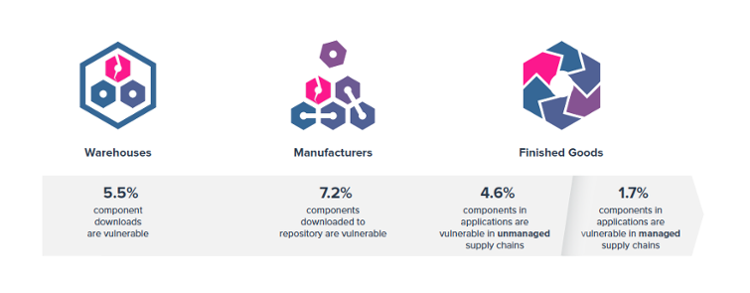
    Recently, Sonatype released its “2017 State of the Software Supply Chain” report that shares empirical evidence of the number of known software vulnerabilities that ship in applications—IoT or otherwise. The report found that development organizations building software with unmanaged software supply chains release applications with an average of 20 known security vulnerabilities, six of which had a Common Vulnerability Scoring System (CVSS) rating between 7 and 10.

    Sonatype’s report also reveals how national governments, federal agencies and industry associations are taking action to help organizations improve open-source hygiene and application security practices. In the past year, new guidelines have been introduced from the White House, Federal Trade Commission, Department of Homeland Security, Department of Health and Human Services and the Department of Commerce to improve the quality, safety and security of software supply chains, related to IoT devices and any other application development efforts.

    The Tide Has Turned

    While the proposed legislation is still open for debate, there is clear evidence that those once ignorant or turning a blind eye to such cybersecurity issues are now paying attention—and they are preparing to make significant changes.

    The full text of the proposed legislation for the Internet of Things Cybersecurity Improvement Act of 2017 can be found here.

    — Derek E. Weeks