Tag: infrastructure management

  • Spacelift Adds On-Premises Edition of Infrastructure Management Platform

    Spacelift Adds On-Premises Edition of Infrastructure Management Platform

    Spacelift has made available an on-premises edition of a platform for automating the provisioning and management of IT infrastructure that previously was only accessible via a software-as-a-service application.

    Company CEO Pawel Hytry said the on-premises edition of the platform satisfies both the requirements of highly regulated industries and the emergence of sovereign cloud requirements that stipulate data must remain within a specific geographic region.

    Regardless of whether this edition of Spacelift is deployed in a local data center or in a cloud service that ensures IT infrastructure is restricted to a single availability zone, the Spacelift observability platform can now be deployed in a way that satisfies any compliance requirement, he added.

    It’s not clear how many organizations that previously relied on a SaaS edition of the platform might be required to shift toward an on-premises edition because of sovereign cloud requirements that have risen in the wake of recent globe trade tensions. Organizations in Europe have now become especially sensitive to dependence on IT infrastructure that might reside in the U.S. out of fear that the U.S. government might impose additional restrictions in the form of, for example, a tariff on digital services.

    It’s also unclear how many providers of SaaS platforms might need to address similar sovereign cloud requirements, but it’s evident IT teams will soon have a lot more deployment options to consider.

    In the meantime, Spacelift is making a case for a platform that makes it easier to enforce best practices across the infrastructure-as-code tools that application developers routinely use to provision IT infrastructure. The challenge organizations are encountering is that much of that infrastructure is misconfigured in ways that enable cybercriminals to exploit vulnerabilities.

    Unfortunately, a recent Spacelift survey found that only 14% of respondents have fully implemented infrastructure automation best practices. The bulk of organizations, in fact, have simply created various islands of automation that they then attempt to manually integrate using multiple scripts, noted Hytry.

    Hopefully, with the rise of platform engineering, more of the management of infrastructure will become automated. A recent survey conducted by Futurum Research finds that adoption of platform engineering as a methodology for building and deploying applications at scale is gaining significant traction, with more than a quarter of respondents (26%) having mastered platform engineering, compared to 41% who are still working toward applying platform engineering across multiple projects. Another 24% are still working toward operationalizing a set of best practices for platform engineering, while 7% are just getting started.

    Roughly half of platform engineering teams provide cloud/multi-cloud management (52%) and dev/test/production environment support (48%). DevOps toolchains (43%), standard platform configurations (42%), and containers/Kubernetes (41%) support are also prevalent.

    Regardless of the approach to IT infrastructure automation, the need to unify the management of platforms has become a more pressing issue. Each platform an organization deploys tends to increase the total cost of IT simply because an additional team of IT professionals is usually required to manage it. Hopefully, as more artificial intelligence (AI) is applied to the management of IT infrastructure, the ability to scale those teams will significantly increase in the months and years ahead.

  • Is SASE the DevSecOps of Infrastructure Management?

    Is SASE the DevSecOps of Infrastructure Management?

    DevOps gained traction when IT and Ops (operations) teams recognized that traditional silos and handoffs were leading to inefficiencies and delays in software delivery. While DevOps enabled seamless collaboration and delivered on its promise of speed and efficiency, security remained an afterthought. To overcome the security loophole, DevSecOps emerged, proposing a shift-left approach to security. It emphasizes conducting tasks like security scanning, vulnerability assessment, and compliance checks all throughout the CI/CD pipeline.

    With DevSecOps, speed no longer comes at the cost of security.

    The DevSecOps approach has helped organizations strike the right balance between security and agility in software development. As the infrastructure landscape continues to evolve with the rise of cloud and edge computing, resource-intensive AI and ML initiatives, and distributed workforces, organizations must establish a similar balance between security and ubiquitous connectivity. This is where secure access service edge (SASE) comes in.

    SASE’s Philosophy is Similar to DevSecOps

    As legacy networks — characterized by rigid hardware-based infrastructure — struggled to keep pace with the demands of modern business, SD-WAN emerged as a solution, providing flexibility, centralized management and dynamic traffic routing. However, when distributed computing and remote work virtually dissolved the corporate perimeter, perimeter-focused security tools were no longer sufficient either. Today, enterprises must extend their security capabilities to almost unlimited network access points.

    SASE addresses this challenge by merging networking and security into a single cloud-native framework. It integrates the entire security stack across all edge locations, ensuring secure connectivity between users, applications and resources no matter where they are. Just as DevSecOps shifts security to the left, making it an inherent part of the entire SDLC (software development lifecycle), SASE shifts security to the network edge, making it an inherent part of network connectivity.

    The strategic resemblance between the philosophy behind SASE and DevSecOps is uncanny.

    1. Breaking Silos

    DevSecOps breaks down the silos between DevOps and security teams, promoting collaboration and shared responsibility. In a similar vein, SASE unifies all network and security functions into a single architecture, effectively dismantling the conventional boundaries between the networking and security teams. It allows both teams to jointly manage, monitor, and secure the infrastructure and network traffic through a unified management dashboard. SASE also effectively breaks the data silos that leave security teams with no insights regarding the networking conditions. SASE’s single pane of glass visibility enables networking and security data correlation, broadening each team’s perspective and eliminating tunnel vision for accurate and robust threat detection and an enhanced security posture.

    2. Embracing the Cloud

    DevSecOps aligns perfectly with cloud-native technologies like infrastructure as code (IaC) and containerization technologies like Docker, making it imperative for cloud-first and cloud-ready organizations. On the other hand, SASE is inherently cloud-native. It delivers network and security services from the cloud, providing organizations with the agility and scalability needed to meet the dynamic demands of a distributed environment.

    Traditional back-haul-based connectivity and perimeter-based security solutions introduce latency and coverage gaps. SASE performs network and security functions at the edge, closest to wherever resources and users are. This eliminates the need for disparate on-premises point solutions and extends corporate security perimeter to match the cloud’s global reach.

    3. Agility Through Automation

    DevSecOps emphasizes automation of security tasks, such as security checks, scans and compliance assessments, within its continuous integration and continuous delivery (CI/CD) pipelines. SASE also leverages automation for networking and security tasks, such as dynamic policy enforcement, AI-driven threat detection and response, and network optimization through dynamic routing and self-healing properties. Automation reduces the need for manual intervention, bolsters security, simplifies operational tasks and enables organizations to respond to evolving demands and circumstances faster, crucial for agile environments.

    SASE as an Enabler for DevSecOps

    Just as DevSecOps enhances security within the context of application development, SASE enhances security and efficiency within the realm of networking and infrastructure management. Both approaches share the common goals of integrating security, promoting automation and ensuring scalability. They may apply these principles to different aspects of IT and cybersecurity, but DevSecOps and SASE can work together seamlessly to support modern IT environments.

    Many organizations adopting DevSecOps realize that they lack the necessary infrastructure to support this approach effectively. DevSecOps demands seamless global collaboration and the integration of security controls across the entire IT environment. This is something SASE can help with. It can simplify infrastructure management and enhance security for DevSecOps in several ways. It offers ubiquitous connectivity for seamless collaboration, provides built-in security measures for faster incident response and ensures reliable infrastructure. As such, these are all crucial aspects for achieving the ultimate DevSecOps goal of delivering secure and high-performance applications at speed. With SASE, organizations can set their DevSecOps up for success.

  • Quali Adds Governance and Cloud Cost Control Tools to Automation Platform

    Quali Adds Governance and Cloud Cost Control Tools to Automation Platform

    Quali today revealed it added governance and cloud cost management tools to its Torque platform for automating IT infrastructure management.

    David Williams, senior vice president for market strategy at Quali, said the added governance tools will make it possible to enforce security, compliance and consumption policies as IT environments are launched using the automation blueprints that Torque enables IT teams to create.

    At the same time, IT teams can now also define consumption policies based on cloud runtime or regions employed within a cloud computing environment. In addition to taking advantage of dashboards to visualize consumption of cloud resources, IT teams can also use Torque to identify cloud waste including detached, inactive and overprovisioned instances. They can pause, right-size or tear down environments to reduce costs and eliminate the possibility of a billing surprise at the end of the month, noted Williams.

    Torque also enables IT teams to detect drift and then update live cloud environments to remediate any that fall out of scope, he added.

    Quali has been making a case for an environment-as-a-service approach to managing IT. That approach is based on a set of triggers for controlling infrastructure via a software-as-a-service (SaaS) platform that can be invoked either via an application programming interface (API) or a graphical user interface (GUI).

    In addition to providing a set of infrastructure provisioning guardrails that prevent mistakes from being made, Torque makes it possible to automatically deploy complete application environments on top of infrastructure provisioned as code using blueprints rather than relying on low-level Terraform scripts. The goal is to increase developer productivity by enabling IT teams to create self-service portals that developers can use to spin up environments.

    That approach is becoming more appealing as many organizations begin to adopt platform engineering as a method to centralize the management of DevOps workflows, noted Williams. In fact, as part of that effort, many organizations are starting to unify the management of cloud and on-premises IT environments, he added.

    While many developers routinely provision IT infrastructure using tools such as Terraform, many of them lack the cybersecurity expertise required to ensure cloud computing environments are configured properly. Developers also tend not to remember to de-provision cloud resources when no longer needed; over time, those factors contribute to unnecessarily increased cloud costs.

    Ultimately, the goal is to find ways to centrally manage IT environments to reduce costs and improve cybersecurity without inhibiting the pace at which developers are building innovative applications, said Williams.

    At the same time, as application environments become more complex, it is becoming even more challenging to provision and manage IT environments at a time when many organizations are reluctant to hire additional IT staff, he noted.

    One way or another, IT environments will become more automated. The issue is determining how best to organize the IT teams managing those environments as tasks that once required a lot of manual effort are increasingly automated.

  • Observe Unveils Observability Platform Built on Snowflake DBaaS

    Observe Unveils Observability Platform Built on Snowflake DBaaS

    After raising $35 million in seed funding, Observe Inc. has emerged from stealth with early access to a namesake observability service that leverages the database-as-a-service (DBaaS) platform created by Snowflake Inc.

    Company CEO Jeremy Burton said rather than build another data lake platform, it makes more sense to make an observability platform available using a software-as-a-service (SaaS) application model based on an existing cloud service.

    Burton said Snowflake, which is based on a relational database running on the Amazon Web Services (AWS) cloud, has already proven it can scale to ingest logs, traces and metrics. The Observe platform leverages that platform to correlate that data to monitor application and infrastructure environments in a way that provides more context than legacy tools that monitor software components and infrastructure in isolation.

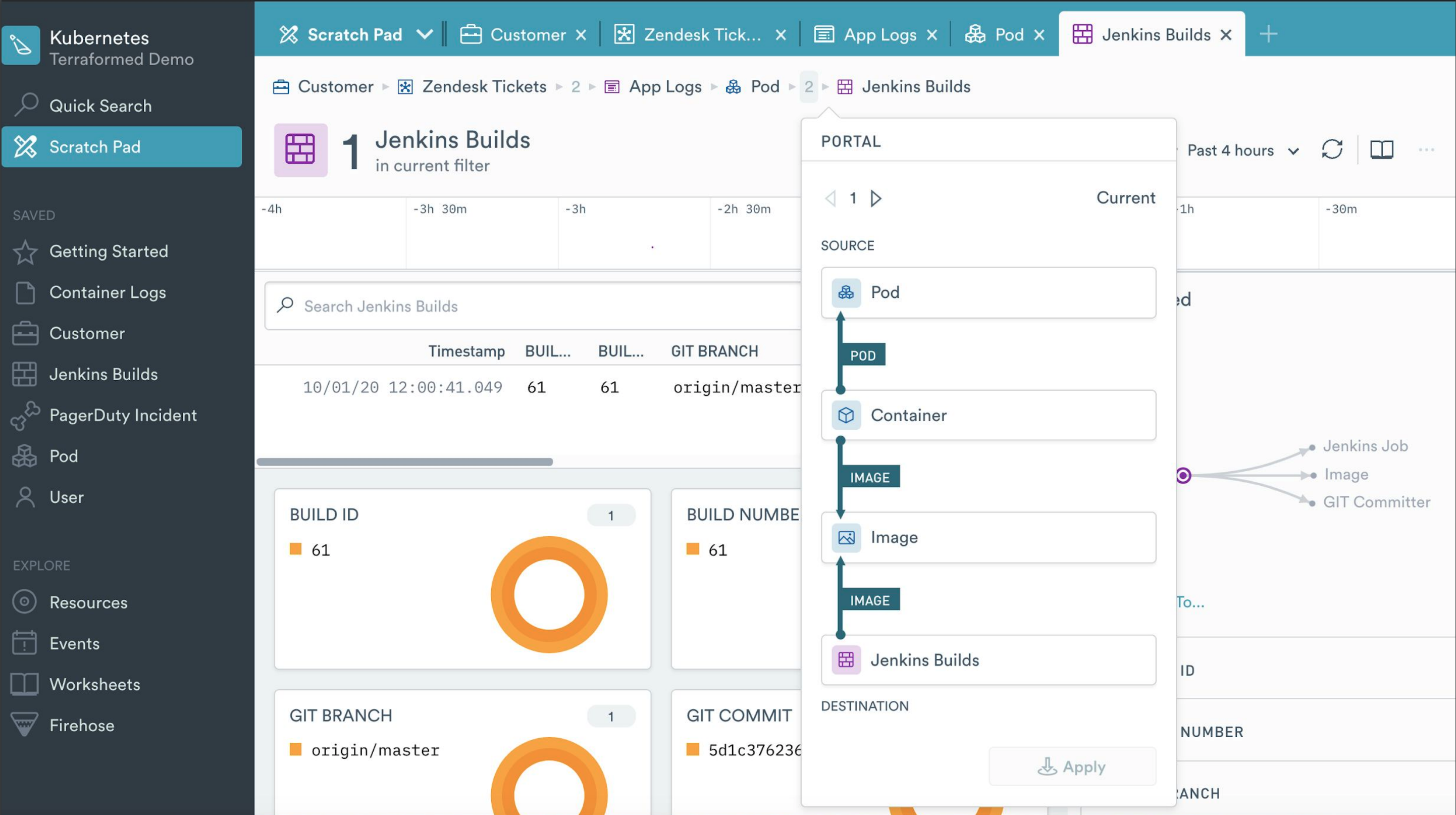
    The context is achieved by creating a “resource” to represent, for example, a user, a session, a shopping cart, a pod, a container, a help-desk ticket or a build. Observe then enables IT teams to also track relationships between resources in a way that the average IT administrator can query without having to tag each resource, said Burton. IT teams can also track how the attributes of a resource change over time, which Burton noted can be employed to reconstitute the state of an entire IT system at any point in time.

    That approach can be applied just as easily to existing monolithic applications and emerging microservices applications because all the data required is ingested into the Snowflake service without requiring IT teams to first instrument and then update each application, added Burton.

    The pricing model for Observe will be based on the amount of data stored in the AWS S3 bucket and the number of queries launched. IT teams will purchase Observe credits that are billed only when the platform is actually used, noted Burton.

    While observability is a core tenant of best DevOps practices, Burton said there is a need to democratize observability in a way that allows any member of an IT team to troubleshoot any issue. There shouldn’t be a requirement to assemble every member of an IT team to diagnose an issue, said Burton, noting over time, that just aggravates developers who don’t really need to deal with, for example, an infrastructure issue.

    IT teams will be provided access to dashboards that enable novice or intermediate users to quickly ascertain the root cause of an issue, while more seasoned engineers with be provided access to worksheets based on a spreadsheet-like interface through which they can manipulate data, said Burton.

    Competition among providers of observability platforms is already fierce. However, as organizations look to rationalize existing legacy monitoring tools in favor of platforms that add more context, the overall size of the observability market will be measured in billions of dollars. Each IT teams will need to decide what type of platform makes the most sense for them based on costs and their preference for one capability a vendor might have that another doesn’t provide.

  • Morpheus Data Simplifies Management of Ansible and Kubernetes

    Morpheus Data Simplifies Management of Ansible and Kubernetes

    Morpheus Data is moving to make it easier to adopt and manage both Ansible and Kubernetes. Its Morpheus 4.0 update, announced today, includes a distribution of Kubernetes as well as tighter integration with the open source Ansible automation framework.

    Brad Parks, vice president of marketing and business development for Morpheus Data, said in the case of Ansible, Morpheus 4.0 will eliminate the need for some organizations to employ Ansible Tower, a web-based console and application programming interface (API) used to manage instances of Ansible. The goal is to make it easier for organizations to take advantage of the declarative Ansible automation framework without having to master all the low-level minutiae currently required to deploy and manage it, he said.

    Morpheus 4.0 also makes it possible to view real-time job status updates and detailed log output and execute phased-based and operational workflows using multiple playbooks and brings governance, auditing and reporting tools to Ansible. Morpheus 4.0 also makes it possible to configure Ansible to run over the Morpheus secure agent communication bus, allowing playbooks to be applied to instances where SSH/WinRM access may not be feasible due to security constraints. Available on both Linux and Windows platforms, Ansible also can employ that bus to query secrets securely from the Morpheus Cypher service for storing application secrets.

    In a similar vein, Morpheus Data is also moving to automate the deployment and management of Kubernetes, an open source container orchestration engine developed under the auspices of the Cloud Native Computing Foundation (CNCF).

    By including a distribution of Kubernetes in Morpheus 4.0 that has been certified by the CNCF, Parks said Morpheus Data now makes it possible to federate the management of Kubernetes clusters across a hybrid cloud computing environment. DevOps teams can employ either the distribution of Kubernetes provided by Morpheus Data or Morpheus to provision instances of Kubernetes services provided by public cloud service providers such as Amazon Web Services (AWS), Microsoft and Google.

    Morpheus 4.0 also makes it possible to securely share and govern resources using role-based access controls, optimize resource allocation using analytic tools and audit, monitor and manage logging. DevOps teams also have the choice of provisioning applications using either Morpheus or the Helm templates made available by the CNCF.

    As Kubernetes moves into the enterprise, Parks said IT organizations will need a management framework that can automate the provisioning of application stacks on any combination of legacy virtual machines, Kubernetes clusters and bare-metal servers. Rather than be required to acquire and master separate tools for each platform, Morpheus 4.0 provides a management platform that allows a single DevOps team to manage multiple platforms more easily, he said. As an enterprisewide orchestration and automation platform, Morpheus is designed from the ground up to eliminate the need for DevOps teams to create complex playbooks by providing out-of-the-box integration with wide a variety of IT platforms, Parks added, noting Morpheus 4.0 also now includes Morpheus Jobs, a tool through which jobs can be scheduled or run ad-hoc using Bash, PowerShell, HTTP, Ansible, Chef, Puppet, Groovy, Python, jRuby or JavaScript.

    The number of organizations attempting to unify the management of multiple platforms is expected to increase significantly in the months and years ahead as the number of cloud platforms being employed increases. The challenge those organizations will face involves not only what tools to employ to achieve that goal, but also defining the DevOps processes capable of spanning a hybrid cloud computing environment.

    — Mike Vizard

  • How a Visual Cloud Management Platform Can Address DevOps Woes

    How a Visual Cloud Management Platform Can Address DevOps Woes

    DevOps and cloud are a match made in heaven. However, the advantages of the cloud are apparent only when continuous deployment, development, operations and other DevOps tasks can be performed and automated seamlessly on the cloud. Moreover, many of today’s cloud management platforms do not offer much cross-functional visibility, something DevOps engineers require.

    A visual cloud management platform can be the answer to ensuring DevOps thrives in a cloud environment. Here are few use cases that highlight how a visual platform can solve a DevOps engineer’s woes:

    Partial Visibility Due to Use of Siloed Infra Management Tools

    There are scores of infrastructure-as-code (IaC) and infrastructure automation tools available, with choices for server provisioning, configuration management, automated builds, code deployments, intraservice orchestration and more, from companies including Ansible, CloudFormation, Terraform, Puppet and Chef. But there’s no single tool that meets all needs. At the end of the day, DevOps engineers need to use and manage dozens of siloed IaC tools that help deploy and manage an end-to-end tech stack.

    Customizing a tech stack to meet the engineer’s needs—choosing from Docker Swarm or Kubernetes, MySQL or Postgres, Jenkins or CircleCI, and so on—can be overwhelming. Figuring out how to run the code in dev; how to build and test; how to deploy changes; where to find metrics, logs, and alerts; and so on across several tools is easier said than done.

    While each orchestration tool provides multiple benefits, engineers also must juggle between multiple dashboards cloud service providers (CSPs) offer. As cloud use increases, complexity and partially visibility are bound to happen, making it difficult to make sense of resource usage and perform root-cause analysis. And if the infrastructure is on a multicloud setup, chances are teams/engineers will lose visibility of resource usage.

    A siloed approach to infrastructure management using multiple dashboards is a big ‘no.’

    Solution: An interactive and immersive visual cloud management platform provides visibility across resources, apps, tools, etc., with a complete context of resource usage from a single pane of glass. The visual console must be visually rich and intelligent enough to provide context-aware real-time prescriptive insights and help with operations on a topology view.

    Visualizing Auto-Scaled Containers and Clusters of Containerized Deployments

    Containers are great for making DevOps workflows easier. Their ability to run almost any type of app has made it popular. Today, there are several container orchestration tools available with autoscaling, including Kubernetes. However, when there are large numbers of clusters of containerized deployments, inspecting or monitoring nodes, pods and containers for optimization, cost reduction and handling system malfunctions can get overwhelming.

    Solution:  A visual cloud management platform can show containers and its subcomponents in a relationship view with other cloud resources on a live topology view. Such a tool will help DevOps engineers investigate anomalies quickly and easily.

    Difficulty in Implementing Resource Dependency Mapping an SDN in a Hybrid Cloud Setup

    Software defined networking (SDN), which enables network automation, is typically difficult to define for DevOps, especially in a hybrid environment. Extending network capabilities or automating the network to update itself when there is a change requirement can be quite challenging in a hybrid setup. The need of the hour is a language, such as JSON or XMPP, that will draw dependency mapping and automate network flow with the cognizance of a human.

    AWS and other public cloud service providers provide basic-level dependency mapping. However, a DevOps engineer loses visibility across resource usage when a business has a chunk of SDN components integrated with dozens of resources on the public cloud or in multicloud or hybrid cloud environments.

    Solution: A visual cloud management platform can map resource dependency on a live topology automatically, analyze and define further network connections and automate operations. With such a tool, a DevOps engineer can easily understand the underlying interconnection, understand the entire infrastructure in a snap and keep the infrastructure hail and healthy.

    Finding Unused DR Environments to Maximize Infrastructure Usage

    Increasingly, DevOps engineers are using backup capacity as development environments to maximize their infrastructure investment. Disaster recovery (DR) environments represent an ideal workspace for developers to test their code with the help of virtualization technologies and advanced networking. However, mapping all the tool integrations and finding that extra capacity in an ever-changing multicloud or hybrid cloud environment can be challenging.

    Solution: A visual cloud management platform can provide visibility into third-party integrations on your cloud and also show any backup capacity available for development use.

    Immersive Visual Consoles Becoming the New Normal

    A visual cloud management platform that helps DevOps engineers get a complete and viewable context across cloud services, network flow and topology view of the entire infrastructure from a single pane is the way forward. Such a platform is the solution to solve several DevOps woes. It enables visualization of public/private cloud services and third-party integrations, giving engineers the ability to understand the resource and network relationship in real time; get a complete perspective of infrastructure; perform contextual monitoring, cloud operations, root-cause analysis in a snap; and ensure security and compliance from one place.

    Let’s look forward to a world in which using these immersive visual consoles will be the new normal.

    — Pradeep Kumar

  • Fleetsmith Pulls Apple into DevOps Orbit

    Fleetsmith Pulls Apple into DevOps Orbit

    For too long now Apple Macintosh systems have been the proverbial red-headed stepchild of DevOps. There are a lot of ways to incorporate Windows systems automatically into a larger DevOps pipeline, but Macintosh systems generally require a lot of manual intervention.

    As part of a larger effort to automate application deployments across Apple systems, Fleetsmith has announced that the platform it created for automating the management of Apple systems now supports both the Puppet and Chef automation frameworks. DevOps teams looking to extend the reach of those frameworks to Apple systems can now invoke Fleetsmith to automate the deployment of Chef and Puppet like any other Macintosh application.

    Of course, once Puppet or Chef are installed, IT organizations can control what gets deployed on those systems going forward. But in general, organizations that deploy Macintoshes prefer to employ tools that provide a native Macintosh experience when it comes to managing those systems, says Fleetsmith CEO Zack Blum. There are plenty of options when it comes to cross-platform management tools, but Blum notes each of the tools compromises the Apple Macintosh experience such that individuals who prefer Apple systems must manage those systems using a construct that was not primarily designed for use in, for example, a Windows environment.

    Over the years, a number of developers have shown a marked preference for Apple Macintosh systems. As a result, it’s difficult to develop a coherent approach to DevOps that does not include some way to automate the management of those platforms, including the ability to deploy DevOps tools such as Puppet and Chef. Blum says that, in time, Fleetsmith plans to increase the number of Macintosh applications that can be distributed via its platform.

    Naturally, Apple is too focused on the end-user experience to trifle with IT management issues. It prefers to leave those issues in the hands of partners such as Fleetsmith, JAMF Software, IBM and SAP. The other alternative is to rely on open-source software that has been created to address this same issue. But Blum says open-source alternatives are more complex than commercial software, while rival commercial approaches to provide the same level of fleet management of Apple system at scale.

    Fleetsmith was developed when its founders worked at Dropbox and Fandom. Both organizations had evaluated several Mac management options before deciding to develop their own code. The company launched last fall with $3.1 million in funding.

    Pricing for the service, which officially is still in beta, is $10 per month per device. The service is free for any organization with fewer than 10 Apple devices. In addition, Fleetsmith integrates with Google G-Suite to make it simple to authenticate users of the service.

    Obviously, there’s more to be done in terms of pulling Apple devices into the greater DevOps ecosystem. But as a first step, making it simpler to deploy Chef and Puppet on these systems signals greater awareness of the overall issue.

    — Mike Vizard