Tag: IDE

  • Flox CLI Tool Makes Managing Custom Developer Environments Simpler

    Flox CLI Tool Makes Managing Custom Developer Environments Simpler

    Flox today made generally available an open source command line interface (CLI) for a namesake tool that enables developers to more easily spin up multiple custom development environments.

    At the same time, the company revealed at the 21st annual Southern California Linux Expo (SCALE 21) that it is now providing access to FloxHub, a free repository for sharing development environments across teams.

    Flox is based on the same declarative framework used to invoke the Nix package management and configuration tool. It allows developers to create environments that contain everything they need to build software, including automatic creation of a software bill of materials (SBOM).

    Ross Turk, head of marketing and developer relations for Flox, said that approach provides developers with a framework for managing multiple development environments that they can spin up using the same methods commonly used to invoke the package managers versus having to master a less familiar approach to manage development environments, he added.

    That capability makes it simpler for developers to both replicate development environments across machines and, when needed, dynamically switch between projects in a way that can be continuously audited by a centralized DevOps team. Instead of requiring a DevOps team to apply the same rigid standard environment across all development projects, each developer is still free to customize their environment based on their personal preferences.

    In addition, developers trying to fix a bug can also now easily reproduce the development environment they were using at the time they were writing the code they needed to review.

    DevOps teams are increasingly finding themselves caught between competing agendas. Many IT leaders are driving the adoption of platform engineering methodologies to centralize the management of DevOps workflows in the hopes of increasing developer productivity and reducing total costs. Conceptually, developers would prefer to have more backend processes managed by those teams, but not to the point where it forces them to use a development environment that has been defined for them. Each developer typically prefers to customize their development environment as the project evolves.

    Arguably, one of the primary reasons developers embrace DevOps is that it gives them more control over their development environments. The challenge is that as each team defines its own DevOps workflow, organizations often later discover they are licensing redundant DevOps tools and platforms.

    In the meantime, it’s not clear to what degree platform engineering might boost developer productivity. It no doubt will reduce the amount of time developers spend managing backend processes, but having that extra time doesn’t directly equate to better code being delivered faster. Writing code is as much an art as science, so it creates levels of inspiration that don’t always occur whenever a developer starts to write code. Instead, platform engineering creates more opportunities for inspiration to strike because they are not spending time on other tasks. At the very least, it should provide more time to run tests on the code that is produced.

    One way or another, as application development continues to evolve, most organizations will find the middle ground that best suits their needs. The challenge now is reducing the amount of time between now and when that goal is eventually achieved.

  • Data Gravity Will Remain an Issue

    Data Gravity Will Remain an Issue

    Things are improving for IT at a rate we haven’t seen since the first wave of container adoption. We have massive automation in the entire SDLC—with AI-based plug-ins for IDEs to help developers write code that is both higher quality and more secure, security deeply integrated into the DevOps toolchain and the unification of testing/security tools across the SDLC. We are once again turning out more code of higher quality faster than we were just a year ago.

    And what is finally starting to catch up is data. I love the current iteration of data virtualization technology, where it can be set to move from region to region or cloud to cloud at leisure in the background. At the same time, data that is accessed in the interim can be instantly transferred. I used to cover storage and data, and frankly, this is the dream world.

    But it doesn’t change the fact that data location matters. While bulk moving data to its final destination will be useful, separating data from applications that access it is simply adding another weak link in the application infrastructure chain.

    This is where the true strength of containers and Kubernetes come in. With Kubernetes, we can put containers with the entirety of our apps into the environment where our data resides. And that means that our application infrastructure is consolidated and that, in a pinch, both application and data can be moved anywhere–because Kubernetes is truly portable (as long as you don’t use customization features of some vendors/platforms anyway).

    The environments we currently choose to use for enterprise applications–from mainframe to public cloud and everything in between–all are capable of running containers, and while there are still deployment differences, customizing a bit to move an entire application is far better than rewriting entire apps to target a new host environment. And the amount of retargeting required is constantly going down.

    So, decide where you would like to host your solution, use data virtualization to move the datasets there, spin up your apps in Kubernetes at that location and enjoy the fruits of your labors. Mergers, acquisitions, moves from one architecture to another, moving from public cloud vendor A to public cloud vendor B … All made far easier by data and Kubernetes portability.

    While people like to call it “cloud,” what we really should be calling it is “portable.” Whichever marketing person decided that cloud included Kubernetes is my sworn enemy, btw. Because the cloud is used without including Kubernetes, so of course, that just confuses the issue. Portable programming is a far better description of data mobility and Kubernetes architecture used in tandem. Doesn’t need a cloud at all.

    And we’re headed there for even more productivity. Just pick where to move it and carry on. We do indeed live in pretty cool times, and you all are the ones making it real. Keep up the good work.

    Image source: https://vecteezy_businessman-holding-social-planet-showing-networking-skills_1268342.jpg


  • AWS re:Invent 2023: Cloud Development Environments

    AWS re:Invent 2023: Cloud Development Environments

    Speaker 1: This is Techstrong tv.

    Shira Rubinoff: My name is Shira Rubinoff. I’m the chief cybersecurity officer with the Techstrong Group. I’m here with Rob Whiteley, CEO of Coder. Rob, it’s a pleasure to be with you here today.

    Rob Whiteley: Yes, thank you so much for hosting me. This is great.

    Shira Rubinoff: Rob, we’ve had some great conversations, and I’d love you to share with the audience who is Coder, what is your story? Please explain who you are, how you came about. Let’s go from there.

    Rob Whiteley: Yeah, I hope you have about two hours. No, I’m just kidding. I’ll give you the short version.

    Shira Rubinoff: Sure.

    Rob Whiteley: Coder is a cloud development environment solution or CDE is sort of the industry terminology. What that basically means is we’re trying to solve the problem of helping enterprises shift their development from local laptops to more of a cloud native where you’re asking developers to access the cloud and develop there.

    The idea is developing locally on laptops is expensive, it’s error-prone, and you often end up with the, “Well, it worked fine on my machine, but then when I ship the code, it doesn’t work.” So we try to solve that. We’ve been around for about seven years, and we actually started life as an open source project called Code Server, which is an IDE. We’ve since grown to have a more complete solution in this CDE space.

    Shira Rubinoff: Well, that’s wonderful and certainly very needed. Let’s dive into the security benefits of this because there are many and much are needed. I’d love to for your audience to understand that.

    Rob Whiteley: Yeah. Yeah. No, I’m super excited to be here because I think it’s an underappreciated element, right? So to me, if I step back, the reason why companies are investing in cloud development is for developer productivity, right? Only about a third of a developer’s time is actually spent coding. The remaining two-thirds is doing operational stuff, administrative. By going to the cloud, you get productivity gains. Great. That’s why I came.

    Why I stay is usually a security benefit. What I mean by that is so many of our customers have told us that, “Well, a developer left his laptop in a cab,” or, “She did not have access when she was on the road.” So by putting things in the cloud, it allows you to connect from any device, and it gets source code off of laptops. That’s now a major source of intellectual property for most companies. The applications run your business, and so to get source code off laptops is a huge benefit.

    That’s just the beginning. That’s usually what triggers. So for example, one of our large banks, it was actually the CISO that brought us in solely to solve that problem of getting source code off laptops.

    Shira Rubinoff: That’s a huge problem.

    Rob Whiteley: It is. I think that alone is worth it, but once you’re in the cloud, I have better access controls, I can do role-based access, I can be more thoughtful about encryption and how I secure it and whether I enforce certain forms of SSH. So there’s a lot of benefits, and I don’t think customers realize that until they’re underway. Part of what we’re hoping to do is front end that conversation a bit more. Security is actually a major driver on shifting to the cloud. It’s not just the productivity gains.

    Shira Rubinoff: Certainly. Let’s talk about the no extra steps that we were discussing earlier. The human factors piece of security is a massive piece that organizations and technology companies and all types of security, and certainly with coding there’s many different steps to do in order to get to what you want to do. Where there’s extra steps and people are in a rush, they don’t want to do that. They want to circumvent it, they want to break it, they want to leave it open so they don’t have to think about it, leave passwords around, all sorts of things. So please tell me what Coder does and why.

    Rob Whiteley: Yeah. No, it’s great. In fact, Coder’s co-founder Ammar, has a phrase that developers are inherently lazy. He doesn’t mean any disrespect by that. It’s just they’re-

    Shira Rubinoff: It’s everybody, right? It’s the multitasking. I wouldn’t just call it coders. Coders are fabulous.

    Rob Whiteley: But I think part of the coding ethos is do things as elegantly and simply as possible. That’s what makes good code. If you shift the security burden to the developer, like we in the industry love this concept of shift left, which basically means shift things earlier in the development lifecycle. What that really means is you’re asking the developer to do more, to take on more steps, to build security into his or her workflow. But that is against that ethos of being lazy and trying to do things efficiently.

    I think one of the things that we’ve noticed is, let’s flip that on its head a little bit. Let’s shift to the developer right. What if we could make the developer more productive and just make security seamless built into it? They’re not having to worry about it. How does that work? Well, if I’m logging into a cloud to do my development, I’m inheriting the entire security infrastructure I’ve already put in place for my cloud, my firewalling, my access controls, my encryption, my backups, everything that keeps that environment that I’ve probably already put in production. I now automatically shift those security controls to my development environment, which again, used to be laptops, and I was very dependent on making sure my antivirus or my mobile device management kept that device secure. My developer had to battle that. They had to toil, they had to update things, they had to make sure.

    We reduce that toil, but more importantly, we take the security off the plate, off the mind. If you access the cloud, it is more secure. Period. Full stop. So that’s what makes I think this work better as opposed to having to send developers through more security training. Yeah, you’ve got to write clean code and have fewer bugs, but that is what the developer should be focused on, not complying with your security policies, which is too much toil.

    Shira Rubinoff: Certainly. My background is heavy in security, and I will tell you the best technologies out there have the security built in and have the no extra steps. You want something that’s better, stronger, faster, without the onus being on the user, which is the developer or somebody who has to be responsible for it. You want to make sure they’re doing their job great and they’re doing their job well without having to burden them with thinking about those extra pieces.

    Just think about our daily lives. Moving a million miles an hour, and certainly the developers, that’s something they have to keep on top of mind, they have to be answering everything, running around and traveling, everything they’re doing. The last thing you want them to think about is, “Wait a second, did I do all these steps?” Because most of the time they haven’t. So that’s an excellent thing that you had certainly built in.

    In terms of the competitors out there that you see or you come face when you’re at the marketplace, what would you say your main differentiators are in the marketplace?

    Rob Whiteley: Yeah, sure. I think for us, there’s two primary ways these solutions get deployed. They’re self-hosted, which means you download the software, that’s Coder. So we start as open source, and you can upgrade to the commercial if you want, but you own the software, you deploy it. Or you can consume it as SaaS. The problem with this space in particular when deployed as SaaS, which is pretty much all of our competitors, is I now have a lot of very sensitive metadata about my developers. What environments are they using? What tools are they using? How often are they in those? What languages? What versions? That all could be used to exploit the application. So that metadata is now flowing out to some third party cloud, which by the way, I had to poke a hole in the firewall just to do, only for them to poke a hole right back into my environment in order to provision the developer workstation.

    For us, keeping it all hosted inside your cloud, whether it’s on-premise or public, we don’t care, is what has been the biggest inherent differentiation. I love SaaS. SaaS is the future, but in an early adopter market like this, there’s a clear leaning towards self-hosted. Most of these organizations can run software as well as a cloud provider anyway, and so they would rather just do it themselves. So that’s difference one.

    The second one I would just say is the majority of solutions in this market, and again I’ll call this the CDE or cloud development environment, is they’re designed with the operator in mind, the backend DevOps team that has to own the infrastructure. We’ve tried to approach it from the developer. What’s going to create the best developer experience? Because one of the things that you hinted at is if you make things difficult, it will not get adopted.

    Shira Rubinoff: Correct.

    Rob Whiteley: We don’t live in a world where we can force developers anymore. They pretty much have to opt in. So if it’s not a good experience, they just won’t adopt that structure.

    Shira Rubinoff: Well, that’s the mindset of developers, and it’s very good that you’re honed in on that. A lot of people are like, “Well, this is what we do for everybody else.” I like the fact that you’re really honed in to what do the developers do? How do they like to work? And work along the path of that. When they talk about security in general or how operating anything really works is think about your user base, work the way they work, and build the security around that.

    Rob Whiteley: Exactly.

    Shira Rubinoff: Don’t try to force them into something. So that’s key.

    Rob Whiteley: Yeah, exactly. So our mindset’s simple. If you make the developer experience clean and you take security friction out of it, they will adopt it. Then you finally benefit from all those advantages we talked about. The worst thing I think you could have is you deploy the solution and they just continue to work on their laptop as if nothing’s changed because they found the new thing too difficult.

    Shira Rubinoff: Right. True. I know you had some really interesting announcement that came out in September. I’d love you to reiterate that and tell our audience a little bit about that and also hint about some new things coming down the pike.

    Rob Whiteley: Yes. Yes. We’re very excited.

    Shira Rubinoff: If you could give us a little bit of a sneak peek here.

    Rob Whiteley: Yeah, back in September we announced something called the Coder Registry. Think of that as a marketplace for Coder plugins. The reason why that’s important is because we believe in developer choice. Developers should choose the tools that make them most productive. What we’ve done is we’ve created this registry so that anybody in the developer tooling ecosystem can write a plugin to Coder. If you want to be able to provision your tool to a developer … Because we sort of own that developer eyeball, if you will … We are the thing they log into to do their work so we can merchandise different tooling. If you want to use a code gen AI tool for assistance, we can make that. By doing these plugins, we’ll create a much more, I think, robust ecosystem where it is not on the developer to do that integration.

    We’re just a tile they can click on now to say, “I want that tool.” But we still give the platform team the chance to curate that. If they don’t want to introduce that tool, then they can just kind of exclude that from the developer’s pick list. That registry is what we announced. We’re building more and more third party support for that. That’s sort of the big thing. So that was big announcement.

    What I can say for next year that I think is going to be most exciting is we’re really trying to focus on how do we make these platform teams that are responsible for making developers productive, for helping secure source code, and really equip them with a much more advanced set of insights. One of the things that Coder does is we collect a lot of that metadata, and like I said, we don’t beacon it to the cloud. It stays local to your environment.

    Shira Rubinoff: That’s important.

    Rob Whiteley: Well, that’s a rich data set. There’s a lot we could do with that data set to help make operators’ lives easier. One of the things we’ll be looking at next year early is how do we expose that in a way where maybe you can figure out, “If I increased the amount of compute, what would that correlate to for an outcome?” By kind of front-ending that we can make it a lot easier for operators. Again, if we can remove friction from the developer experience, they will adopt it. So that’s part of what we’re looking at.

    Shira Rubinoff: Well, that’s very exciting. Everyone stay tuned for that announcement coming up. Anything else you want to add for our audience? Anything that they should take note of or any helpful hints around anything around the AWS Conference or your company itself that you’d like to share with us?

    Rob Whiteley: Yeah, I think the biggest thing would be … So the cloud development environment is new. It’s an emerging market. I think a lot of companies are not necessarily investigating it because they think it’s not right for them, or they don’t want to fit force developers to change behavior. I think what we’ve experienced is every customer that does it has quickly expanded. To me, my biggest call to action is just go look at it. I mean, it’s free. It’s open. You can get started. I’m not even asking you to purchase anything.

    But I think just shifting the behavior from local to cloud, getting those security benefits and demonstrating that win back to the business is the first step in I think what’ll be a sea change in arguably the last mile the cloud has not effectively touched yet, which is developers. Production environments have been in the cloud for a while now. Development environments are next. So I think now’s the time to get started.

    Shira Rubinoff: Well, that’s wonderful. Thank you so much for sharing your insight with our audience.

  • Shared Responsibility? Yeah.

    Shared Responsibility? Yeah.

    One of the things that the last decade or two of enhancements has brought about is an increasing reliance on everyone across the organization to be more secure. While users have long since thrown up their hands and looked for ways to minimize the fallout when a vendor they frequent is compromised, enterprises have to lock down their own things. And given the ever-increasing volume and sophistication of attacks, the demands are growing.

    Cloud brought us the concept of a ‘shared responsibility‘ model. It is necessary in a world where an org does not control the physical servers and supporting infrastructure that applications ultimately run on. The fact is, the shared responsibility model was really cloud vendors reminding us that we still have to protect our apps, no matter where they’re deployed.

    This model and DevOps together have driven us to demand more of developers and DevOps teams with regard to security. It has also driven ops to have to care more, as more is exposed and security demands are up while security staff isn’t.

    And I’ll just remind you of the obvious. If you are responsible for security at the organization, you can get help from everyone, but those people’s job and direct responsibility is not security. They’re lending a hand because everyone cares, and that is the current state of most enterprises – DevOps made everyone involved in the SDLC a bit more responsible for all the things that aren’t their jobs (often a very good thing, often … not), but they’re not specially trained for it. That’s what security teams are for. And high-quality development security/policy management tools offer Dev and Ops and everyone in between a bit of guidance to good security practices along the way. I’ve praised putting security feedback right in the IDE half a dozen times here and elsewhere, and as a security-conscious developer, will continue to do so until it is so pervasive that people start to worry I’m losing it by going on about it. That’s a great example of helping everyone be more secure without requiring a ton of security staff hours in training. Developers don’t purposely write insecure code any more than they set out to make buggy spaghetti code. Giving tools to help them make the code more secure is a huge bonus – to them and to the corporate security team. So, if you’re not using them, start. And look into all of the other options to help non-security staff lock down their bit. The number of available security people on the market is perhaps the largest it has ever been (It’s so bad I actually know a security researcher who took months to find a new gig – that is pretty much unheard of or a unique case before recent days), but budgets to grow the security team aren’t there – any more than they are currently there to grow most teams. So tools to help are still imperative because you’re not going to get double the security staff in 2024 unless there’s only one of you … and you threatened to quit if they don’t get you help, which no one recommends as a negotiation tactic, so even if you’re solo, no doubling for you.

    Just remember who is responsible for overall infosec. Make use of the specialist and their knowledge in their space by finding tools to help them secure in a manner that matches workflow. Then verify because the organization’s security posture is security’s job.

    And keep rocking it. We’ve got so much cool stuff going on at the moment in IT in general that there is plenty of opportunity to improve architectures that are even relatively recent. Check what you have, consider it from a security perspective, improve what you have and keep rolling along.

    But first, relax, take a breather, and enjoy the holiday period.

  • Digma Leverages ML to Bring Observability Insights to IDEs

    Digma Leverages ML to Bring Observability Insights to IDEs

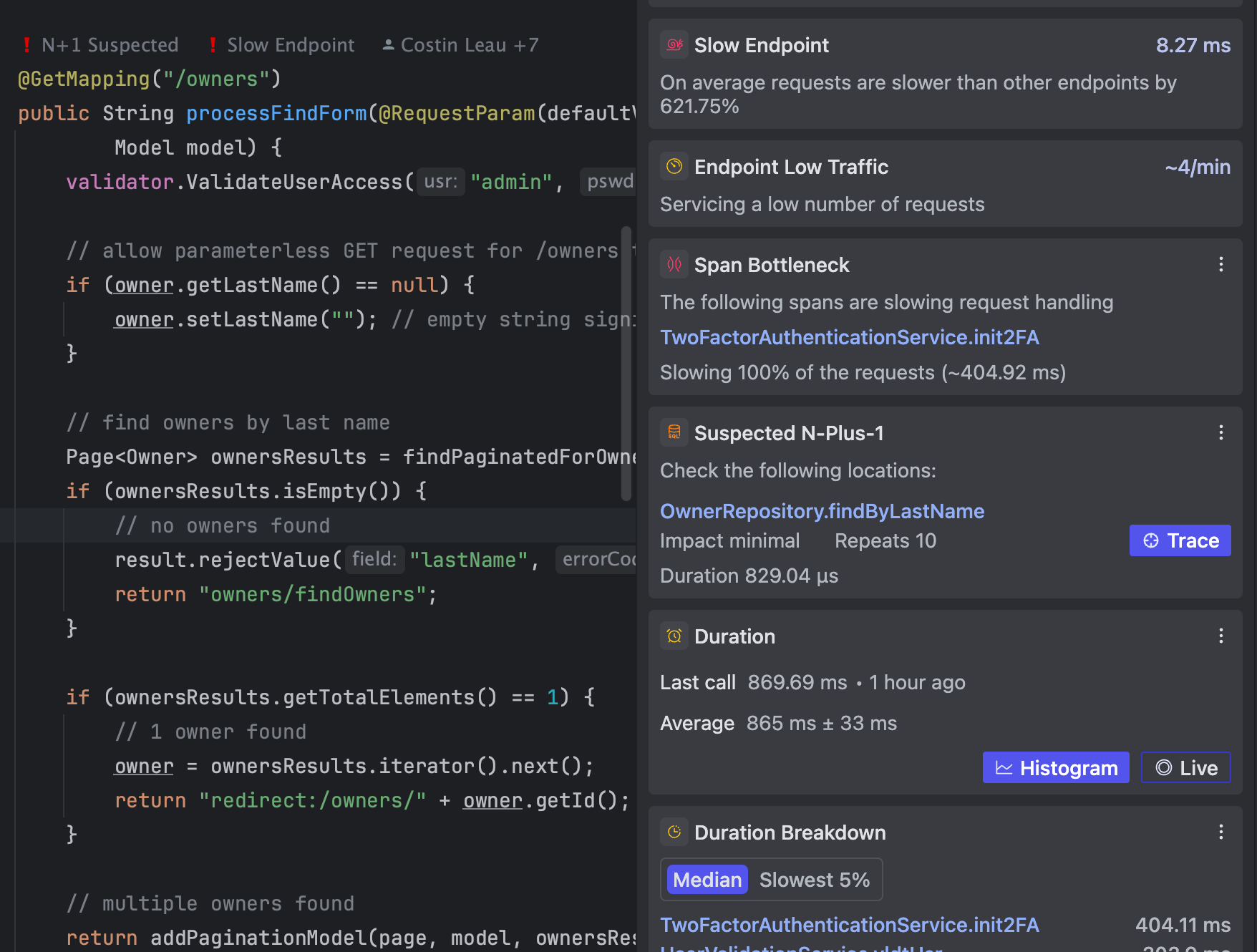
    Digma has launched a namesake platform the provides developers with continuous feedback from observability data that surfaces directly within their integrated development environment (IDE).

    Digma CTO Roni Dover said the Digma Continuous Feedback platform leverages machine learning algorithms to enable developers to easily analyze their code at runtime to identify issues, anomalies and regressions. Digma Continuous Feedback removes the need to consult a separate dashboard that requires developers to log into an observability platform.

    In fact, the reason developers often don’t make use of the data that observability platforms provide to write better code is that it’s not readily accessible at the time they are writing code, noted Dover.

    In general, it’s become much easier to collect logs, metrics and traces by using open source OpenTelemetry agents that can be embedded within software libraries. The Digma Continuous Feedback platform applies machine learning algorithms to that data to provide developers with insights on improving code in real-time, said Dover.

    The ultimate goal is to make it simpler for IT teams to distinguish when, for example, a software component actually needs more memory or is simply inefficient, he added. Those insights can be applied to code written by developers or code generated by an AI platform.

    Whether code is written by a human or generated by a machine, quality is often in question. Developers with varying levels of experience will naturally write code that can differ substantially in quality and efficiency. At the same time, developers may be asked to fix code someone else wrote; the original author no longer works for the organization, noted Dover. In either use case, the Digma Continuous Feedback platform immediately surfaces issues that will enable organizations to set higher baselines for code quality, he added.

    That baseline is especially critical as more code starts to be generated by generative AI platforms based on general-purpose large language models (LLMs) trained using code samples of varying quality collected from across the web. Developers will be able to immediately determine any issues that may arise should they choose to incorporate that code within an application.

    Developers, of course, don’t deliberately set out to write bad code, but the tools that enable them to identify issues are not easily accessible. In fact, too many developers tend to view observability platforms designed for IT operations teams as being overly complex, noted Dover. The Digma Continuous Feedback platform takes that issue off the table by identifying issues without increasing the level of cognitive load developers are expected to carry, he added.

    Eventually, thanks to the rise of machine learning algorithms and generative AI platforms designed specifically to write high-quality code, the overall state of software engineering will improve. The issue is determining the best way to get the benefits these technologies provide directly to the developers who write code—an issue that is at the heart of so many DevOps challenges.

  • Loft Labs Makes Tool for Creating Dev Environments Open Source

    Loft Labs Makes Tool for Creating Dev Environments Open Source

    Loft Labs has made available an open source software project that enables DevOps teams to programmatically create developer environments using a tool that runs entirely on a local client.

    Lukas Gentele, Loft Labs’ CEO, said DevPod provides an alternative to cloud-based approaches such as Codespaces from GitHub that lock organizations into a specific platform for building applications.

    Instead, DevPod can automatically spin up developer environments as code on any public cloud or on-premises IT environment that can run a devcontainer.json file, he added.

    In addition, DevPod will also automatically put developer environments to sleep when not being used to reduce costs, noted Gentele. Other capabilities include support for prebuilds, Git and Docker credential synchronization.

    DevPod was created by Loft Labs to streamline the development of a virtualization platform for Kubernetes clusters. The company is now making DevPod available as open source software that any DevOps team can use to manage developer environments as code more easily than complex server-side alternatives, said Gentele.

    It also makes it easier for developers to switch between cloud-hosted and local environments as needed seamlessly, he noted. That’s critical because it enables organizations to reduce dependencies on cloud computing environments for writing code by allowing developers to use their local machine whenever they prefer, noted Gentele.

    Despite the ubiquitous availability of cloud services, most developers continue to prefer to write code on a local machine. The challenge is that replicating a developer environment elsewhere to foster collaboration has been problematic. DevPod provides a means for developers to collaborate with each other and with software engineers without giving up the inherent flexibility a local development platform provides.

    At a time when organizations are more dependent on software than ever, there is much more focus on developer productivity. DevOps teams have historically tended to focus on DevOps Research and Assessment (DORA) metrics that focus more on deployment frequency and mean-time-to-recovery than they do on developer productivity.

    Of course, measuring developer productivity is an inexact science. An organization might once have tracked lines of code written to gauge productivity, but that is not especially good metric. In more recent times, metrics have been developed that, among other things, keep track of how much time developers spend actually coding versus maintaining their software development environment.

    The issue that most IT leaders will immediately encounter is that every minute developers spend on these tasks, however, is one less minute they spend writing the business logic that drives an application.

    Obviously, there’s no way developers are going to write business logic daily for eight hours straight; there are maintenance windows. However, application development is as much art as it is science. No one knows for sure when inspiration might strike, but if developers are busy maintaining code created to provision infrastructure, it’s less likely they’ll have a flash of brilliant insight that allows them to make an application better. The easier it is to spin up a development environment, the more likely it becomes that inspiration will one day turn into code that runs in an actual production environment.