Tag: ibm

  • IBM Launches Ambitious AIOps Initiative

    IBM Launches Ambitious AIOps Initiative

    IBM today announced it will apply a range of artificial intelligence (AI) technologies to automate the management of IT operations and modernize applications, also known as AIOps.

    Announced at IBM’s Think Digital conference, Watson AIOps leverages algorithms to continuously optimize IT operations while Accelerator for Application Modernization with AI is a suite of tools that leverage continuous learning and interpretable AI models to help organizations stay current as modern of technology and platforms evolve.

    Made available as part of a Cloud Modernization Service engagement, the Application Modernization with AI tools span a range of tasks from applying AI to more accurately identifying software components that should be deployed as containers or converted into microservices to applying symbolic reasoning to dynamically define modernization steps that are surfaced via a natural language processing (NLP) engine.

    Watson AIOps, meanwhile, applies machine and deep learning algorithms to time series data, semi-structured logs, structured data and unstructured data spanning both IT incidents and human conversations to track the timeline of an issue. It then uses that data to correlate root causes, create an explainable diagnosis and generate a recommendation for the best course of action. Built on top of an instance of the OpenShift platform that IBM gained via its acquisition of Red Hat, the Watson AIOps also leverages semantic search techniques that can relate the current incident to past incidents to provide additional context.

    Rob Thomas, senior vice president for IBM Cloud and Data Platform, said Watson AIOps will be made accessible via Slack and comes integrated with Box cloud services. It also is integrated with IT monitoring solutions from vendors including Mattermost and ServiceNow. IBM is applying multiple AI technologies developed by IBM Research for various Watson services provided by IBM, including a Watson OpenScale initiative to make AI explainable to create Watson AIOps, he said.

    That explainability capability is especially critical when it comes to automating IT operations. In general, the main source of resistance to AIOps is a lack of transparency into how algorithms are determining how any given task should be automated. IT teams are concerned not only with whether they can roll back automation for a specific task but also about becoming locked into a specific AIOps platform.

    It is too early to say to what degree IT organizations will embrace AIOps. There is no doubt that in the wake of the COVID-19 pandemic there will be more pressure than ever to automate, especially among organizations that have had to downsize their IT staffs. However, IT automation manifests itself in many forms, not all of which employ machine and deep learning algorithms. At the same time, AI is being infused into every existing IT management tool, so it’s not clear to what degree a dedicated AIOps platform will be required.

    No one expects AI to eliminate the need for IT staff anytime soon. Algorithms, at best, can only augment IT professionals. The challenge now is defining precisely where that human-to-machine interface should optimally be applied.

  • IBM announces Elyra AI Toolkit, a set of AI-centric extensions to Jupyter Notebooks

    Elyra AI Toolkit is a new open source project that extends the JupyterLab user interface to simplify the development of data science and AI models.

    Jupyter Notebooks are now the open standard for data science and artificial intelligence (AI) model development. In keeping with our commitment to open source and the Jupyter community, in particular, IBM is proud to announce Elyra, a set of open source AI-centric extensions to Jupyter Notebooks, and, more specifically, the new JupyterLab user interface.The initial release of Elyra includes:
    • Notebook Pipelines visual editor
    • Ability to run notebooks as batch jobs
    • Hybrid runtime support (based on Jupyter Enterprise Gateway)
    • Python script execution capabilities within the editor
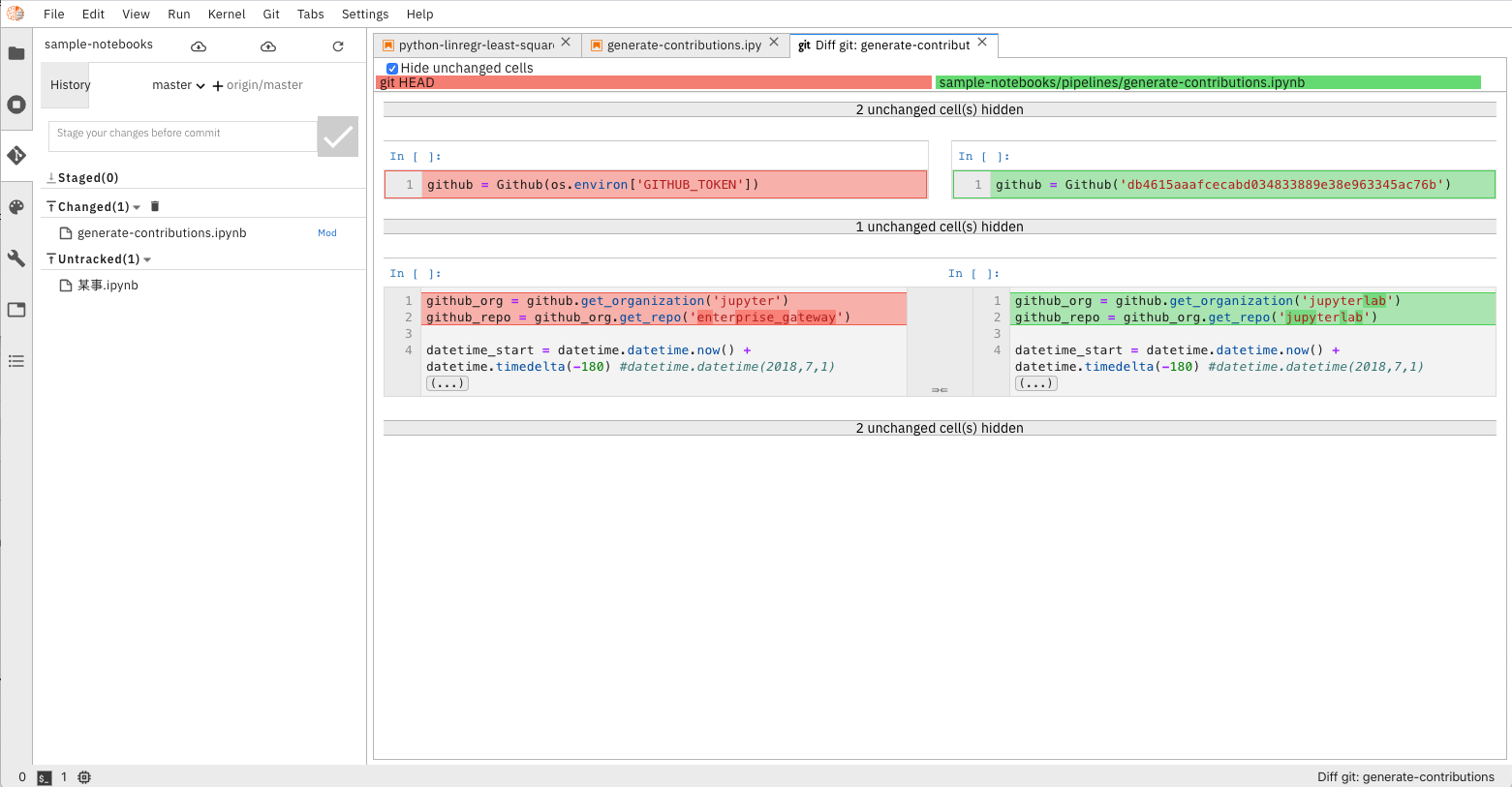
    • Notebook versioning based on Git integration
    • Reusable configuration for runtimes

    We’re excited to announce Elyra and help evolve the Jupyter ecosystem with new tools for AI model development.

    “I’m excited to see IBM engaging with the Jupyter and scientific open source communities with their ongoing contributions in this area. As much as AI tools rely on vast amounts of data and computational resources, the human in the loop remains the critical element for both asking the right questions and making decisions responsibly. That’s where Jupyter plays a role, and I’m delighted to see new tools like Elyra that will help AI workflows within the Jupyter ecosystem.” — Fernando Pérez, Project Jupyter co-Founder and co-Director

    Notebook pipelines

    Building an AI pipeline for a model is hard. Breaking down and modularizing a pipeline is harder. A typical machine and deep learning pipeline begins as a series of preprocessing steps followed by experimentation, optimization, and, finally, deployment. Each of these steps represents its own unique challenge in implementation, execution, scheduling, and operation when bringing deep learning models from development to production.

    Elyra provides a visual editor for building Notebook-based AI pipelines, simplifying the conversion of multiple notebooks into batch jobs or workflows. By leveraging cloud-based resources to run their experiments faster, the data scientists, machine learning engineers, and AI developers are then more productive, allowing them to spend their time using their technical skills.

    The following image shows the Elyra Canvas component that enables the pipeline visual editor. The Canvas user interface was originally developed as part of IBM Watson Studio and is now being open sourced as part of Elyra. So, existing IBM Watson Studio and IBM SPSS Modeler users should feel comforable with Elyra.

    Elyra Canvas

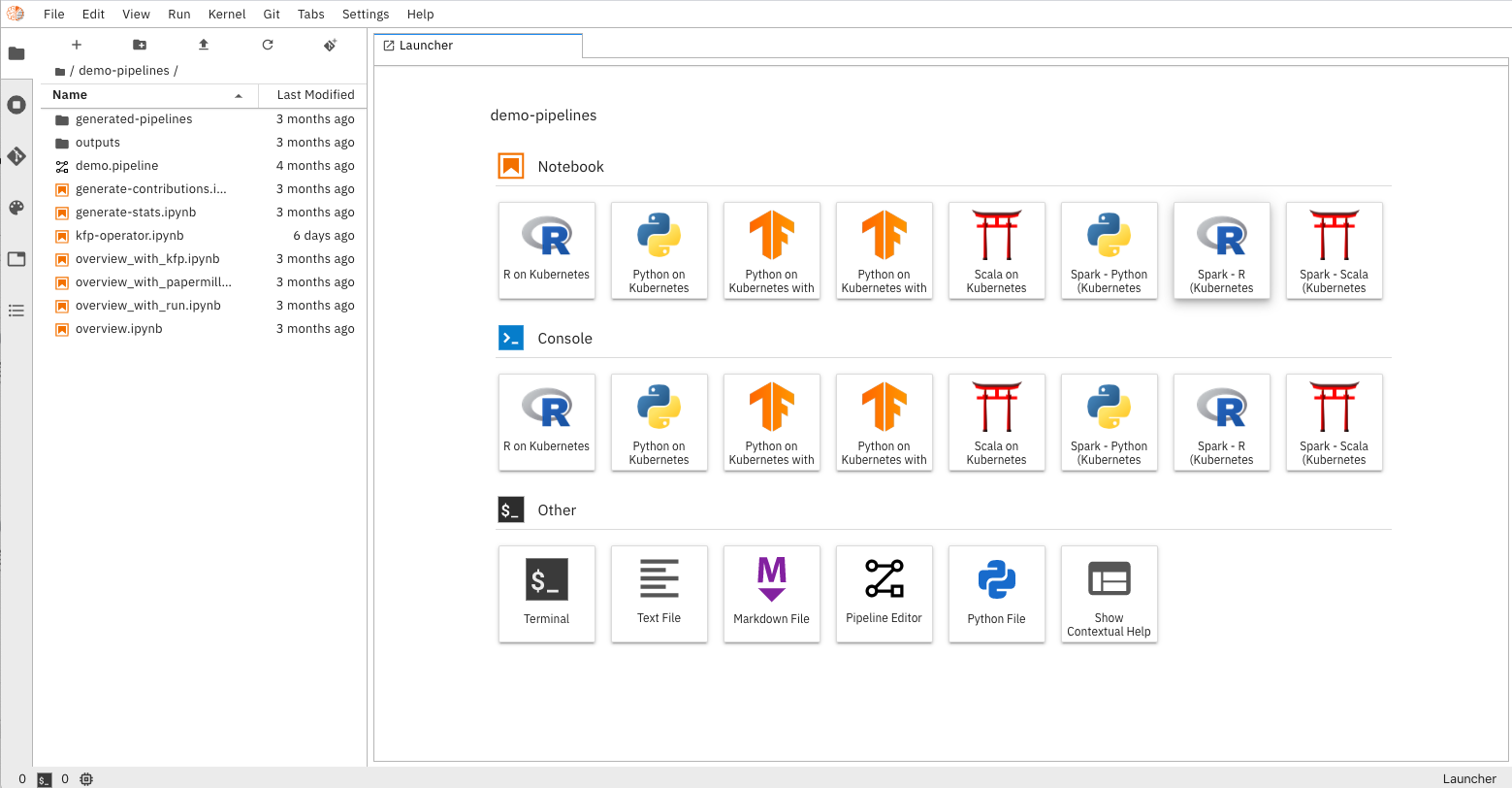
    Elyra also extends the Notebook UI to simplify the submission of a single Notebook as a batch job, as the following image shows.

    Batch job

    Hybrid runtime support

    Elyra takes advantage of the work that we’ve done with Jupyter Enterprise Gateway to enable Jupyter Notebooks to share resources across distributed clusters such as Apache Spark, Kubernetes, and OpenShift.

    It simplifies the task of running the notebooks interactively on cloud machines, so you can use the power of cloud-based resources that enable the use of specialized hardware such as GPUs and TPUs.

    View of main page of AI Workspace

    Python script execution support

    Leveraging the hybrid runtime support, Elyra exposes Python Scripts as first-class citizens, allowing users to locally edit their scripts and execute them against local or cloud-based resources seamlessly.

    Process diagram

    Versioning based on Git integration

    The integrated support for Git repositories makes tracking changes easier, allowing users to roll back to working versions of the code, backups, and, most importantly, sharing among team members. This collaborative working environment fosters productivity.

    Process diagram

    Reusable configuration for runtimes

    Elyra introduces a ‘shared configuration service’ that simplifies workspace configuration management, enabling things like information around accessing external runtimes to be configured once and shared across multiple components.

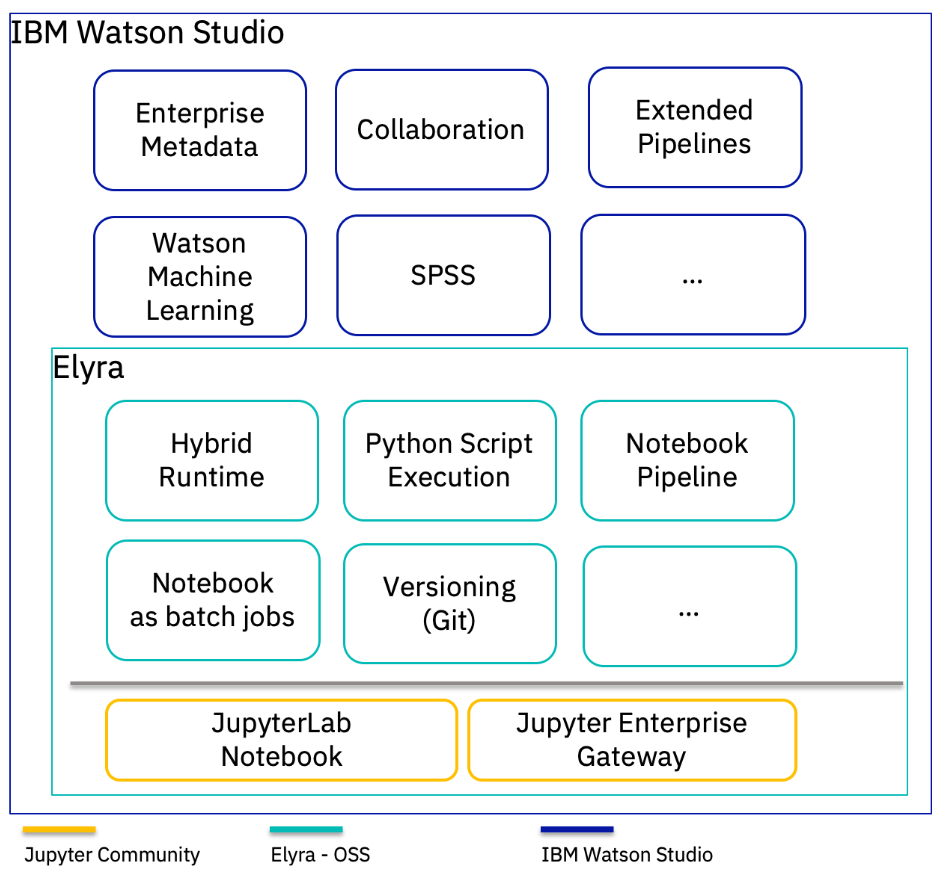
    Elyra and IBM Watson Studio

    IBM recently announced new releases of IBM Cloud Pak for Data and Watson Studio which added JupyterLab as a richer way to work with Notebooks, in addition to classic Jupyter Notebooks. The current version of Watson Studio already provides versioning based on Git integration and is continuing to work with the open source community to incorporate other Elyra extensions.

    Process diagram

    Summary

    Building on a Jupyter Notebooks foundation, the de facto tool for data scientists, machine learning engineers and AI developers, Elyra provides a toolkit designed to help around model development tasks complexity.

    Previously, the work on Jupyter Enterprise Gateway addressed the challenges around scaling enterprise workloads, and now Elyra addresses the challenges of making workload development easier. In addition, IBM is contributing to TensorFlow, PyTorch, Spark, KubeFlow, KubeFlow Pipelines, ONXX, and Egeria to address an even broader set of enterprise data and AI development challenges.

    We would love for you to get involved with the project. Read our contributing guidelines, create new issues if you have questions, suggestions for new features or in case of any problems. We also welcome contributions via GitHub pull requests.

  • IBM Research – Confidentiality and Governance of Cloud Services 

    Our team has spent months developing, tuning and perfecting a complex deep neural network to classify important financial, medical or government data. The application has been containerized, packaged, and is finally ready to deploy as a public service on the cloud, but one thing stands in the way. How do you get assurance that your trade secret code, as well as the highly sensitive data it handles can be kept confidential and private? In addition, how can you provide workload and data governance in highly regulated industries?

    The problems of privacy and confidentiality, and governance is in the center of what IBM Research is tackling. To improve these aspects of container and cloud technology, we have recently contributed two open-source projects: Encrypted Container Images, which ensure that container images remain encrypted and private, and Trusted Service Identity, that ensures that data processed by these images remains secure.

    We will first go through how these technologies enable confidentiality of code and data, and then show how they can provide governance.

    Protecting the confidentiality of workloads and secrets

    To provide high assurance, we want to ensure both data and code are encrypted, which are provided by Encrypted Container Images and Trusted Service Identity respectively.

    Encrypted Container Images protects the confidentiality of the workload/code by extending the OCI (Open Container Initiative) container image specification with +encrypted media types, which allows developers to encrypt container images, so that they can only be decrypted by authorized parties (developers, clusters, machines, etc.). This ensures that the workload stays encrypted from build to run-time. Without the appropriate key, even in the event of the registry compromise, the content of the image remains confidential.

    Ensuring that the workload is encrypted is only one side of the story. Every workload needs some access to data sources or other services. In order to do this, it must authenticate itself, using a password, API key or certificate. Today, this is typically done through Kubernetes secrets. The problem with the Kubernetes secrets is that once they are stored, they would be also available to administrators, cloud operators or anyone with access to this namespace. However, the admins might be third-party employees just managing the resources, might not be certified to access the data or might not have security clearance.

    Trusted Service Identity protects sensitive data access by ensuring only attested services are able to obtain credentials. This is done through the use of workload identity, composed of various run-time measurements like the image and cluster name, data center location, etc, to identify the application. These measurements are securely signed by a service running on every hosting node, using a chain of trust installed during the secure bootstrapping of the environment.

    Extending Governance: Geofencing execution and Location++ based data policy

    When it comes to highly regulated industries, confidentiality of workloads and data is just the tip of the iceberg. Often, more fine-grained controls need to be put into place. And the technologies described above address them.

    • The first type of control is geofencing execution. How do we ensure that this workload is only run in particular clusters or regions? How do we enforce export control or digital rights management? These are natural uses of Encrypted Container Images. By only providing the appropriate decryption keys through attestation, authorization and key management, we can create a trust binding between certain clusters/workers and workloads. This will provide assurance of knowing WHERE workloads are running.Another control is to be able to express, enforce and audit data access via location (or other properties) of the workloads, i.e. GDPR. Trusted Service Identity provides just that. By exposing the properties of workloads in the definition of policies governing secrets, it provides the ability to create policies such as “Only workload X (with this image), running in datacenter DAL05, in kube cluster hipaaCluster can access medical records in this Cloudant database“. This method of governance has very fine-grained controls, that might apply to a wide spectrum of use-cases. In addition, the entire audit trail is retained, tracking every interaction and what process received what secret and when.

      These are just a couple examples of how these technologies can be used to enhance governance in the container cloud ecosystem.

      Find out more

      We have only scratched the surface of exploring these technologies in this article. If you’d like to find out more about these technologies.


  • IBM Boosts Security and Productivity with Red Hat OpenShift 4.3 on IBM Cloud

    As more businesses journey to the cloud, they need ways to easily deploy and manage their critical workloads securely across public clouds, private clouds, and on-premises environments. This is particularly crucial when faced with the ongoing demands to support remote workforces.

    The IBM public cloud has been rebuilt on a foundation of open source innovation, security leadership, and enterprise-grade infrastructure, which makes it easier for clients to rapidly develop new applications and reducesthe complexity in managing teams and technologies. And this is why our public cloud has become the preferred destination for businesses to run their most complex workloads.

    Today we’re taking this a step further by announcing enhancements to Red Hat OpenShift on IBM Cloudwith the availability of OpenShift 4.3 – and we’re the first major cloud provider to offer this. The effort is jointly engineered and supported by IBM and Red Hat.

    Most notably for our clients, we’ve added unique security and productivity features designed to help eliminate substantial time spent on ongoing maintenance like updating, scaling, securing and provisioning. We’re delivering the resiliency needed to handle unexpected surges in use, as well as protection against attacks that lead to breaches or outages and potential productivity losses. Now development teams can focus more on what matters – accelerating cloud native application development so they can drive new, competitive capabilities.

    With this fully cloud managed offering, the master for your clusters is protected by IBM Cloud’s unique architecture, configuration and tools. Below are the technical benefits designed to help save time, reduce outages, and boost security.

    ·        Protect your Master with Automated Recovery
    We’re automating recovery so you don’t lose time with customer support and other tasks that you might have otherwise had to do yourself (like strategy, staffing, storage.)
    By continuously backing up etcd, we’re minimizing the threat of data loss in the unlikely case of a complete master outage. Masters are by default highly available, and you can further protect your master from a single data center failure by adding multizone clusters. So, if one data center goes down there is no impact to availability because IBM Cloud runs an active-active-active master.
    ·        Full Admin Access with Built-in Protection
    Only Red Hat OpenShift on IBM Cloud provides cluster-admin access without the risk of an admin being able to take down the master.  Master nodes for Red Hat OpenShift on IBM Cloud are physically network-isolated from the worker nodes. Therefore the master nodes are not accessible from any of the worker nodes within the cluster (network diagram).

    With this new functionality, you’re no longer faced with recovery as the only viable solution to an outage, and your access is not limited either, as you might experience with other offerings. This means better access to controls and easier cluster management.

    ·        Increase Productivity by Autoscaling the Master
    Red Hat OpenShift on IBM Cloud provides autoscaling masters with an industry-leading  99.99% SLA in multi-zone regions. This means your workloads can expand quickly, while you don’t worry about capacity. You can also autoscale your workersto meet your app’s capacity needs.
    For example, in the heat of delivering a big feature, admins might overlook manually scaling the master, and without this new functionality, you’d have no SLA and your admins would be faced with scaling the master components as your grow – leading to a big loss in productivity.
    ·        Automate Worker Management and Provisioning Based on Workload Needs
    Red Hat OpenShift on IBM Cloud provides total control over worker node provisioning and flexibility with worker pools, so you no longer worry about over- and under-provisioning your apps. IBM automates the worker management and provisioning to help ensure you’re matching workloads with the proper resources.
    Other vendors may limit your ability to provision more node types and flavors, so you can’t easily automate how and when users get resources. Now you can easily mix node types and flavors to realistically match workloads that require a mix of data, compute, and services.
    ·        Managed Security with Red Hat OpenShift on IBM Cloud
    When your CISO, NetOps admin, or DevSecOps admin comes to your door, you know that you’ve got another security and certification mountain to climb.
    The master and its components (compute, networking, and storage) are continuously monitored by IBM Site Reliability Engineers (SREs). They apply the latest security standards in order to detect and remediate malicious activities, and work to help ensure reliability and availability of Red Hat OpenShift on IBM Cloud. Plus they follow relevant cybersecurity practices from the Kubernetes master benchmark that is published by the Center of Internet Security (CIS). Review IBM’s responsibilities for security.
    No other cloud vendor helps you as much as IBM with OpenShift security and compliance, which includes chores for PCI, HIPAA, ISO27K, SOC1, and SOC2 Type 2.
    These benefits were born from common enterprise use cases we’ve solved for our customers: security, resiliency, and productivity. In Red Hat OpenShift on IBM Cloud, we’ve leveraged the experience we’ve gained from running Kubernetes for years — now with 20,000+ clusters in production.

    Additionally, with OpenShift 4.3, users can access the following new capabilitiesas-a-service:
    ·        Operators: Focus on app development with automated updates and health checks of your tools deployed into OpenShift
    ·        Knative: Serverless app development for event-based workloads
    ·        Service Mesh: Microservices management for distributed componentized applications
    ·        Increased security: Built-in authentication, auditing and secrets management

    The IBM Developer Advocacy Program also shared their perspective on the advancements made to Red Hat OpenShift on IBM Cloud. You can view the blog here.

    Additionally, to support today’s announcement and reinforce IBM’s continued commitment to driving open source innovation, IBM Research unveiled two container-based open-source projects that will enable confidentiality of code and data. You can read more about Encrypted Container Images and Trusted Service Identity here.

    Get started today:
    ·        If you have questions or comments, engage our team via Slack. You can register hereand join the discussion in the #openshift channel on https://ibm-cloud-success.slack.com.
    ·        Learn more about Red Hat OpenShift on IBM Cloud
    ·        Check out a free cluster for a quick test driveor do a tutorialon Red Hat OpenShift 4.3 on IBM Cloud

  • IBM and CGI U partner on the 2020 Call for Code Global Challenge University Edition to take on COVID-19 and climate change

    Encouraging students to help tackle the world’s reaction to COVID-19 and climate change.

  • The 2020 Call for Code Global Challenge takes on COVID-19

    By Willie Tejada, Chief Developer Advocate, IBM

    Nearly one month ago, together with Creator David Clark Cause and in partnership with United Nations Human Rights and the Linux Foundation, we announced climate change as the theme for the 2020 Call for Code Global Challenge. In that brief period, much has changed. COVID-19 (Coronavirus) has spread across the world with unprecedented effect and now has the potential to become the greatest crisis of modern times. From its inception Call for Code was created to take on society’s most pressing issues, which is why we are expanding this year’s Challenge to address both climate change and COVID-19, two urgent crises that have the power to compromise our health, our planet, our survival. We’re asking developers, data scientists, and problem solvers to answer the Call.

    On COVID-19:

    In a very short period of time, COVID-19 has revealed the limits of the systems we take for granted. The 2020 Call for Code Global Challenge will arm you with resources (see here) to build open source technology solutions that address three main COVID-19 areas: crisis communication during an emergency, ways to improve remote learning and how to inspire cooperative local communities.

    • Crisis Communication: In times of crisis, communications systems are one of the first systems to become overwhelmed. Chatbots help respond to tens, even hundreds, of thousands of messages a day. Whether via text, websites or communication apps like WhatsApp, being able to converse with chatbots and other resources can play a critical role in helping communities understand everything they need to know rapidly and free up customer service resources to focus on higher level issues. Whether that’s correct hand washing procedure, how to properly detect symptoms, or local updates on quarantine, providing crisis communications digitally has a major role to play.
    • Remote Education: Where possible, people who are self-isolating are being asked to work from home, which presents its own set of challenges: transitioning to a new home office or, as some schools close for the foreseeable future, children find themselves stuck indoors for long periods of time. It is important to keep them engaged, entertained and on top of their education. Technology has a pivotal role to play, whether that’s creating ad-hoc classrooms, or helping parents quickly adapt to home-schooling.
    • Community Cooperation: Your local community must stand united, operate efficiently and be there for its constituents more than ever before. Understanding not only what is happening in your neighborhood, but also how you can help others, or how others can help you, is vital. Consider how you can incorporate everything from weather data to local food and medical supply information to help your local community better deal with a crisis — especially those who need it most.

    On Climate Change:

    As previously planned, today we are revealing our 2020 Call for Code Challenge climate change starter kits (see here). These three quick-start guides explain the individual problems people and communities are facing, and help you start creating applications tied to easy-to-understand use cases in just minutes.

    To help define the specific situations caused by climate change where your innovations could be most helpful, a few weeks ago IBM partnered with the world’s leading humanitarian experts for our kickoff event in Geneva at the historic Palais Wilson, Headquarters of the Office of the United Nations High Commissioner for Human Rights. Together with UN humanitarian experts, and eminent technologists from Red Hat, JP Morgan Chase, Persistent Systems, Unity Technologies, NearForm, and Johnson & Johnson, we collaborated to create our three climate change starter kits.

    Each kit focuses on a key topic — water sustainability, energy sustainability and disaster resiliency — essential to halting and reversing climate change, and grounded in real-world needs defined by the UN Sustainable Development Goals and the Sendai Framework for Disaster Risk Reduction. These are the areas where you can have the greatest impact:

    • Water sustainability: This IoT based solution aims to help farmers, particularly those in shifting climate realities, monitor hyper-localized weather data and adapt their crop strategies to optimize water usage.
    • Energy sustainability: With a goal of building consumer awareness about energy costs across the manufacturing process, this solution creates the framework for a new global product labelling system that would include a comprehensive Climate Impact Rating (CIR), similar to the labels on food products, with incentives for consumers and retailers to drive purchases of more efficient products.
    • Disaster resiliency : To help communities prepare for floods, this app will provide residents education at all stages of an event, from a checklist of essential survival materials to real-time information on the capacity of local shelters.

    The kits include a description of the starter solution, an architectural diagram, and a tutorial with starter code and reference materials. With these starter kits, you can get a head start creating a sustainable solution to halt and reverse climate change. To further increase the impact you can make, IBM is building a wide ecosystem of partners and tech providers to help participants round out their solutions. For example, the HERE location API lets you access geospatial data, routing, geofencing and interactive maps.

    We’ll follow up in a week with more details on our three COVID-19-specific starter kits to help you jump-start your solutions. As with climate change, we are working with some of the world’s leading experts to define the most pressing needs and provide the most helpful resources. That said, you don’t need to wait. You can register and get started now creating applications with our open source-powered software built on Red Hat OpenShift, IBM Cloud, IBM Watson, IBM Blockchain, and data from The Weather Company. As we’ve done the previous two years, IBM will work with the teams who create the most promising solutions to build, fortify, test and deploy them through IBM Code and Response.

    Together, we have the power to use the latest technology in ways that make an immediate and lasting humanitarian impact in local communities and across the globe.

    Thank you for answering the Call in this unprecedented time in our history.

  • IBM Advances Watson’s Ability to Understand the Language of Business

    – Announces first commercial availability of key technologies from Project Debater;

    – Integrated into IBM Watson, the new capabilities help enable businesses to begin mining & analyzing some of the most challenging aspects of human language

    NEW YORK, March 11, 2020 /PRNewswire/ — IBM (NYSE: IBM), the leader in artificial intelligence for business1, is announcing several new IBM Watson technologies designed to help organizations begin identifying, understanding and analyzing some of the most challenging aspects of the English language with greater clarity, for greater insights.

    The new technologies represent the first commercialization of key Natural Language Processing (NLP) capabilities to come from IBM Research’s Project Debater, the only AI system capable of debating humans on complex topics. For example, a new advanced sentiment analysis feature is defined to identify and analyze idioms and colloquialisms for the first time. Phrases, like ‘hardly helpful,’ or ‘hot under the collar,’ have been challenging for AI systems because they are difficult for algorithms to spot. With advanced sentiment analysis, businesses can begin analyzing such language data with Watson APIs for a more holistic understanding of their operations. Further, IBM is bringing technology from IBM Research for understanding business documents, such as PDF’s and contracts, to also add to their AI models.

    “Language is a tool for expressing thought and opinion, as much as it is a tool for information,” said Rob Thomas, General Manager, IBM Data and AI. “This is why we’re harvesting technology from Project Debater and integrating it into Watson – to enable businesses to capture, analyze, and understand more from human language and start to transform how they utilize intellectual capital that’s codified in data.”

    Today IBM is announcing that it plans to integrate Project Debater technologies into Watson throughout the year, with a focus on advancing clients’ ability to exploit natural language:

    A.    Analysis – Advanced Sentiment Analysis. IBM has enhanced sentiment analysis to be able to better identify and understand complicated word schemes like idioms (phrases and expressions) and so called, sentiment shifters, which are combinations of words that, together, take on new meaning, such as, “hardly helpful.” This technology will be integrated into Watson Natural Language Understanding this month. In addition, we are announcing a new classification technology that will enable clients to create AI models that can more easily classify clauses that occur in business documents, like procurement contracts. Based on Project Debater’s deep learning-based classification technology, the new capability can learn from as few as several hundred samples to do new classifications quickly and easily. It is planned to be added to Watson Discovery later this year.

    B.    Briefs – Summarization. This technology pulls textual data from a variety of sources to provide users with a summary of what is being said and written about a particular topic. An early version of Summarization was leveraged at The GRAMMYS this year to analyze over 18 million articles, blogs and bios to produce bite-sized insights on hundreds of GRAMMY artists and celebrities. The data was then infused into the red carpet live stream, on-demand videos and photos across www.grammy.com to give fans deeper context about the leading topics of the night. It is planned to be added to IBM Watson Natural Language Understanding later in the year.

    C.    Clustering – Advanced Topic Clustering. Building on insights gained from Project Debater, new topic clustering techniques will enable users to “cluster” incoming data to create meaningful “topics” of related information, which can then be analyzed. The technique, which is planned to be integrated into Watson Discovery later this year, will also allow subject matter experts to customize and fine-tune the topics to reflect the language of specific businesses or industries, like insurance, healthcare and manufacturing.

    IBM, has long been a leader in NLP, developing technologies that enable computer systems to learn, analyze and understand human language – including sentiment, dialects, intonations, and more – with increasing accuracy and speed. IBM has brought its NLP technology, much of which was born in IBM Research, to market via Watson. Product such as, Watson Discovery for document understanding, IBM Watson Assistant for virtual agents, and Watson Natural Language Understanding for advanced sentiment analysis, are all infused with NLP.

    ESPN Fantasy Football uses Watson Discovery and Watson Knowledge Studio to analyze millions of football data sources each day during the season to offer millions of fantasy football players real-time insights. By processing natural language, Watson identifies the tone and sentiment of news articles, blogs, forums, rankings, projections, podcasts and tweets that cover everything from locker room insights to injury analysis. ESPN Fantasy Football surfaces these insights in player cards that snapshot the “boom” and “bust” potential of each player, as well as a “Player Buzz” section that summarizes the positive or negative commentary about a player.

    KPMG, a multinational professional services network, and one of the Big Four accounting organizations, worked with IBM to create an AI solution based on a variety of Watson services, including Watson Natural Language Understanding. This technology makes it more effective for companies to identify, claim and retain potential R&D income tax credits. Developed by KPMG, the solution can help clients increase the amount of R&D income tax credits they capture because the Watson technology is able to review more documentation quickly while minimizing disruption to the client’s business.

    In the past year, KPMG clients have seen more potential for R&D tax credits, with some projects even seeing more than a 1000% increase in the number of documents reviewed. The solution helps clients uncover more potential activities that qualify for additional income tax credits, while reducing business disruption. As a result, engineers and scientists can stay focused on innovative R&D work by spending less time on income tax compliance activities.

    Watch ‘The Debater’

    Check out the trailer for The Debater, a rare, behind-the-scenes look at the making of Project Debater though the lens of an eclectic team of researchers that dare to take AI into uncharted territory. Official Selection of the Copenhagen International Documentary Film Festival www.ibm.com/research/debater-film.

    About IBM
    For more information please visit IBM Watson.
    For more information please visit IBM Research.
    Developers and data scientists can access Watson APIs at IBM Developer.
    Register here to view a webinar on the news which will be broadcast on March 18 at 1:00PM ET.

    Forward-Looking and Cautionary Statements
    Except for the historical information and discussions contained herein, statements contained in this release may constitute forward-looking statements within the meaning of the Private Securities Litigation Reform Act of 1995. Forward-looking statements are based on the company’s current assumptions regarding future business and financial performance. These statements involve a number of risks, uncertainties and other factors that could cause actual results to differ materially, including the following: a downturn in economic environment and client spending budgets; the company’s failure to meet growth and productivity objectives; a failure of the company’s innovation initiatives; damage to the company’s reputation; risks from investing in growth opportunities; failure of the company’s intellectual property portfolio to prevent competitive offerings and the failure of the company to obtain necessary licenses; cybersecurity and data privacy considerations; fluctuations in financial results, impact of local legal, economic, political and health conditions; adverse effects from environmental matters, tax matters and the company’s pension plans; ineffective internal controls; the company’s use of accounting estimates; the company’s ability to attract and retain key employees and its reliance on critical skills; impacts of relationships with critical suppliers; product quality issues; impacts of business with government clients; currency fluctuations and customer financing risks; impact of changes in market liquidity conditions and customer credit risk on receivables; reliance on third party distribution channels and ecosystems; the company’s ability to successfully manage acquisitions, alliances and dispositions; risks from legal proceedings; risk factors related to IBM securities; and other risks, uncertainties and factors discussed in the company’s Form 10-Qs, Form 10-K and in the company’s other filings with the U.S. Securities and Exchange Commission (SEC) or in materials incorporated therein by reference. Any forward-looking statement in this release speaks only as of the date on which it is made. The company assumes no obligation to update or revise any forward-looking statements.

  • DevOps Deeper Dive: Mainframe Fallout from BMC’s Compuware Buy

    DevOps Deeper Dive: Mainframe Fallout from BMC’s Compuware Buy

    The acquisition of Compuware this week by rival BMC Software signals that the rate at which mainframe environments are being modernized might not be occurring fast enough to support a vibrant third-party tools provider ecosystem.

    Both BMC and Compuware were sold to private equity firms in 2018 and 2014, respectively. Thoma Bravo, which acquired Compuware, is now selling the company to KKR. BMC was acquired by KKR in 2018 from Bain Capital and Golden Gate Capital for $8.5 billion. BMC was originally taken private by investors in 2013.

    Other rivals in the mainframe category include CA Technologies, which was acquired for $18.9 billion by Broadcom last year, and Micro Focus, which includes software assets originally developed by Hewlett Packard Enterprise.

    BMC executives declined to comment on the merger and terms of the deal for Compuware were not disclosed.

    All these machinations by private equity investors doesn’t do much to inspire confidence among end customers, said Judith Hurwitz, president and CEO of Judith Hurwitz & Associates, a market research and IT consulting firm.

    “Private equity firms always have to eventually look for an exit,” she said. “In this case, one investor wanted out.”

    That leaves IT leaders in the unenviable position of not knowing whether the application development platform on which they have standardized might be around for the long haul, said Hurwitz.

    The challenge faced by third-party providers of application development tools in the mainframe space is largely two-fold. While the number of workloads running on mainframes continues to increase thanks mainly to availability of Linux on the platform, the number of organizations that have a mainframe has declined. The low end of the mainframe market has been eroded by high-end distributed systems. In addition, many applications that previously ran on a mainframe have been shifted into a public cloud.

    The second challenge these providers face is IBM, which is now a much more formidable competitor in the mainframe tooling sector. IBM has launched a series of initiatives to provide tools to modernize mainframe platforms using best DevOps practices as part of a larger digital business transformation initiative. However, regardless of the relative strengths of IBM’s DevOps portfolio, there will always be a significant base of mainframe shops that will prefer tools from IBM over those provided by a third-party rival.

    In a prepared statement shared via email, Barry Baker, vice president of IBM Z Software, said:

    Over the last 18 months, we’ve come a long way to expand the ecosystem for mainframe skills by bringing new tools to IBM Z and LinuxONE. Our goal remains unchanged – to make development on Z a common experience for all developers across the tech stack – not just mainframe developers. We’ve made significant progress toward this goal with the adoption of DevOps and industry-standard tools like Git and Jenkins on the platform, along with our own offerings including IBM Z Open Development and IBM Z Unit Testing. We took another step with Red Hat OpenShift on IBM Z, further enabling cloud developers to deploy z/OS applications using OpenShift without any special Z skills required.

    We continue to invest and over the next few months we’ll be unveiling even more tools across three focus areas: developer experience, automation and operations to truly deliver on our promise for a cloud native experience – and encourage our clients to watch this space.”

    Of course, all of IBM’s tooling rivals in the mainframe space have launched similar DevOps initiatives. The challenge they all face is the rate at which mainframe organizations are embracing DevOps may not be fast enough to sustain a vibrant third-party ecosystem. Not surprisingly, BMC has also been extending its reach to encompass distributed computing platforms. Competition among tooling vendors on those platforms is already fierce.

    There can be no doubt mainframes will continue to play a crucial role in IT. Most large enterprises are still dependent on mainframes to run some of their most mission-critical transaction processing applications. Less clear is to what degree those organizations intend to modernize those applications beyond simply making application programming interfaces (APIs) available for legacy applications. IBM, along with every provider of development tools for the mainframe, has been making a case of deploying new applications running on Linux on a mainframe because the total cost is lower than trying to connect those applications running on a distributed system to a legacy mainframe application.

    A recent global survey conducted by Vanson Bourne on behalf of Micro Focus suggests that argument is starting to resonate. Nearly two-thirds (63%) said some form of modernization was favored over the replacing and retiring of older COBOL-based systems in 2020.

    Regardless of how much economic sense that argument makes, however, the rate at which mainframe applications are being modernized will, at best, continue to be an extended process.

    — Mike Vizard

  • 2020 Call for Code Global Challenge Led by IBM Takes On Climate Change on 75thAnniversary of United Nations

    77% of developers and first responders surveyed globally say climate change is the single most pressing issue facing their generation Geneva,February 26, 2020 –Headquarters of the Office of the United Nations High Commissioner for Human Rights–Today, Call for Code Founding Partner IBM and Creator David Clark Cause, in partnership with United Nations Human Rights and the Linux Foundation announced this year’s Call for Code Global Challenge, inviting the world’s software developers and innovators to help fight climate change with open source-powered technology.

    On its 75th anniversary, the United Nations is demanding a ‘global reality check’ and has launched the biggest-ever global conversation on how to address the world’s most pressing issues such as climate change. Heeding the UN’s rallying cry to help build the future we want, IBM is joining forces with key UN agencies and world leaders to help tackle the climate crisis. Following two successful years, the 2020 Call for Code Global Challenge encourages and fosters the creation of practical applications built on open source software including Red Hat OpenShift, IBM Cloud, IBM Watson, IBM Blockchain, and data from The Weather Company. The goal is to employ technology in ways that can make an immediate and lasting humanitarian impacting communities around the world.

    A recent global IBM study conducted by Morning Consult surveyed more than 3,000 developers, first responders and social activists across China, Columbia, Egypt, India, Japan, Spain, United Kingdom, and the United States, and found:77% of first responders and developers surveyed agree with the statement ‘Climate change is the single most pressing issue facing my generation.’ 79%of respondents agree that climate change is something that can be reduced or combatted with technology. 87% of respondents feel it is important that a potential employer has taken action on climate change.Three quarters of respondents agree that the open source community can help scale climate change solutions to communities in need.Eight in ten respondents agree that most people want to do something to help combat climate change, but don’t know where to start.Over 180,000 participants from 165 nations took part in Call for Code in 2019;they created more than 5,000 applications focused on natural disaster preparedness and relief.This year Call for Code is challenging applicants to create innovations based on open source technologies to help halt and reverse the impact of climate change.“There is an urgent need to take action against climate change, and IBM is uniquely positioned to connect leading humanitarian experts with the most talented and passionate developers around the world,” said Bob Lord, IBM Senior Vice President of Cognitive Applications and Developer Ecosystems.

    “IBM is determined to identify, deploy, and scale technology solutions that can help save lives, empower people, and create a better world for future generations.

    Lord noted that IBM has been mobilizing throughout the company, from policy commitments on climate to IBM’s weather forecasting capabilities powered by AI and supercomputers.

    “Over these past two years through Call for Code UNDRR has seen the potential for developers to tackle major societal challenges, and developers will have a crucial role in our response to the climate emergency,” said Mami Mizutori, Special Representative of the United Nations Secretary-General (SRSG) for Disaster Risk Reduction. “Climate change is the most critical issue of our time, with a multitude of localized contributing factors and cascading effects that cannot be solved by a single organization. We need a global network to fight this together.”


    IBM and David Clark Cause are thrilled to launch the third year of Call for Code in Geneva with new sponsor Unity Technologies, returning sponsor Persistent Systems, and new supporters Nearform, Morgan Stanley, and Capgemini. We also welcome returning supporters Bank of China, Cognizant, and Infosys, in addition to the broad ecosystem of companies, universities, and celebrities like Ellen DeGeneres, Jonas Brothers, Sting, and Morgan Freeman supporting the initiative.


    Last year’s Call for Code Global Challenge winning team, Prometeo, created a wearable device that measures carbon monoxide, smoke concentration, humidity, and temperature to monitor firefighter safety in real-time as well as to help improve their health outcomes in the long-term. The solution has been developed further through IBM’s Code and Response program and has just completed its first wildfire field test during a controlled burn with the Grups de Reforç d’Actuacions Forestals (GRAF) and the Grup d’Emergències Mèdiques (GEM) dels Bombers de la Generalitat de Catalunya near Barcelona, Spain. Prometeo was developed by a team comprising a veteran firefighter, an emergency medical nurse, and three developers. As recently piloted, the Prometeo hardware-software solution is based on multiple IBM Cloud services.

    Other applications like 2018 Call for Code winner Project Owl and 2018 Puerto Rico Call for Code hackathon winner DroneAid have also been cultivated through the Code and Response program.


    Visit CallforCode.org to join the community and learn more about the challenge, which will open for submissions on March 22, World Water Day 2020. Additional details, a schedule of in-person and virtual events, and training and enablement for Call for Code will be available at https://developer.ibm.com/callforcode/.


    Download the full IBM study conducted by Morning Consult here.


    About Call for Code
    Developers have revolutionized the way people live and interact with virtually everyone and everything. Where most people see challenges, developers see possibilities. That’s why David Clark Cause created and launched Call for Code in 2018 alongside Founding Partner IBM. This five-year, $30 million global initiative is a rallying cry to developers to use their skills and mastery of the latest technologies, and to create new ones, to drive positive and long-lasting change across the world with their code. Call for Code global winning solutions, among others, are further developed and deployed via IBM’s Code and Response initiative.

    About UN75

    The United Nations launched the UN75 campaign – the largest, most inclusive conversation on the role of global cooperation in building a better future for all. The campaign will see the UN spark dialogues throughout 2020 in diverse settings across the world. In a ‘global reality check’, four innovative data streams will build the first ever repository of crowd-sourced solutions to major global challenges, including climate change. The UN75 dialogues together with a ‘One-minute Survey’ that anyone can take, available here: https://un75.online/


  • IBM Power Systems Certified for SAP HANA® Enterprise Cloud as a provider for large SAP HANA systems

    ARMONK, N.Y., February 19, 2020 — IBM (NYSE: IBM) today announced that IBM Power Systems has been certified for the SAP HANA® Enterprise Cloud as a critical infrastructure platform provider for large SAP HANA systems, aiming to simplify the IT infrastructure for the managed, private cloud environment. The service will run on IBM POWER9-based IBM Power Systems E980 servers, which have the industry’s largest virtualized server scalability of 24TB for the SAP HANA database[i].

    Providing the IT infrastructure for a managed, private cloud environment, the SAP HANA Enterprise Cloud is a scalable and secured service that is designed to accelerate a user’s evolution on the path to cloud readiness. It provides capabilities that span the software and hardware stack, a comprehensive menu of functional and technical services, and the level of control clients should expect on premises, all in one privately managed environment.

    “SAP HANA Enterprise Cloud on IBM Power Systems will help clients unlock the full value of SAP HANA in the cloud, with the possibility of enhancing the scalability and availability of mission critical SAP applications while moving workloads to SAP HANA and lowering TCO,” said Christoph Herman, SVP and Head of SAP HANA Enterprise Cloud Delivery. “Combining SAP HANA Enterprise Cloud capabilities with IBM Power Systems can help establish a faster path to cloud readiness for our clients while addressing risk and providing closer alignment to the intelligent enterprise.”

    SAP HANA Enterprise Cloud users can take advantage of the firmware-based virtualization in the IBM POWER platform that offers the largest SAP HANA scalability in scale-up systems[ii]. This helps enable SAP HANA Enterprise Cloud users to accommodate capacity changes – this is designed for clients to benefit from faster performance of their SAP HANA-based business intelligence applications by running them in a single node while maximizing the availability of SAP applications with the highly resilient infrastructure.

    “In June, IBM announced the availability of POWER9 in the IBM Cloud, taking the first step toward our goal of bringing IBM Cognitive Systems technology to our clients, no matter where they are,” said Stephen Leonard, General Manager, IBM Cognitive Systems, “With the addition of IBM Power Systems in SAP HANA Enterprise Cloud, we’re giving our clients more choices and greater flexibility to run their workloads where they want to across the hybrid cloud and accelerate digital transformation.”

    IBM Power Systems has been delivering scalability and availability for SAP HANA applications since it was certified for SAP HANA in 2015, and the ongoing collaboration between IBM Power Systems and SAP provides virtualization on-demand via hypervisor-defined features in Power Systems. This enables clients to take advantage of multiple SAP HANA Enterprise Cloud service levels and transform their IT operations by shifting the focus from infrastructure maintenance to innovating with SAP HANA in the cloud.

    SAP HANA Enterprise Cloud on IBM Power Systems is another testament to IBM and SAP’s long-standing, client-centric relationship. Since forming the Digital Transformation partnership more than three years ago, IBM Services and SAP have worked together to provide services and capabilities that help accelerate how customers around the world modernize their systems and processes on their path to becoming an intelligent enterprise.

    For more information about IBM Power Systems, visit https://www.ibm.com/it-infrastructure/power