Tag: ibm

  • SoftLayer Bare Metal Servers: Does the Cloud have to be virtual?

    SoftLayer Bare Metal Servers: Does the Cloud have to be virtual?

    SoftLayer announced new service level and features to their Bare Metal Servers today. Continuing their march towards delivering dedicated servers at virtual server pricing and service levels, SoftLayer announced that they will now offer setup in under 30 minutes and hourly billing options. The 30 minute set up is available on a variety of pre-configured hardware platforms with a choice of CentOS, Debian, FreeBSD, or Ubuntu operating systems.

    I had a chance to speak with Marc Jones, CTO of SoftLayer about the new offering. Jones and SoftLayer have long held the belief that a hypervisor is not necessary for a cloud. In fact by giving customers their own dedicated hardware, it is SoftLayer’s view that they are providing a superior platform for their customers cloud requirements. The SoftLayer bare metal servers are integrated into the entire SoftLayer/IBM platform including storage, virtual and other assets.

    Two areas where virtual hypervisor based cloud solutions did offer an advantage perhaps was the time to get up and running and the flexibility of on demand computing billing.  Those are the two areas SoftLayer is hitting head on with this latest offering.

    By having pre-configured hardware specs, it makes it much easier for SoftLayer to spin up the server.  Imagine these different server configurations already mounted in a data center. Now when an order is placed it is just a matter of installing OS and other required software.  This could be done via scripts. In fact Jones mentioned that SoftLayer uses a variety of tools like Chef/Puppet and some home grown tools to accomplish server configuration. This automation is what is allowing SoftLayer to offer 30 minute set ups.

    The configurations available and the hourly rates for them are as follows:

    Processor Cores Core Speed RAM Storage Price/hour
    Intel 1270 4 3.4GHz 8GB 2x1TB SATA $0.46
    Intel 1270 4 3.4GHz 32GB 2x400GB SSD $1.09
    Intel 2620 12 2.0GHz 32GB 4x1TTB SATA $1.24
    Intel 1270 16 2.0GHz 64GB 4x1TB SATA $1.30


    Depending on who you speak to, spinning up a new server on AWS or other public cloud providers can take as little 10 minutes. So that is still significantly faster than having a dedicated server provisioned on SoftLayer. But really is there such a big penalty in waiting less than 30 minutes versus 10 minutes? In exchange you are getting a dedicated piece of hardware. Also from an hourly price perspective, the bare metal server option is still more expensive. But again with this latest release SoftLayer is moving closer to approaching virtual, hypervisor based IaaS levels.

    Jones said that further refinements and improvements will hopefully see SoftLayer continue to narrow the gap between speed of setup and pricing with virtual cloud offerings. But he firmly believes that the advantages to having your own server outweigh the shrinking set up gap and pricing difference.

    Another big plus in the SoftLayer model is its integration with IBM’s offerings. Blue Mix, IBM’s PaaS offering runs on SoftLayer. In fact most of IBM’s cloud offerings are powered by SoftLayer. As part of this SoftLayer is opening up 15 new data centers with the 6th of these in Melbourne, Australia opening today.

    To be sure there are critics who say that without the hypervisor, SoftLayer’s flavor of cloud is not “true” cloud. But as the old saying goes, if it quacks like a duck, walks like a duck, it must be a duck.  With hourly pricing, rapid fulfillment, scalability and more, bare metal servers is more than enough cloud with some distinct advantages.

  • DevOps and PaaS: ‘Give me a platform. Let’s rock, let’s rock, today’

    DevOps and PaaS: ‘Give me a platform. Let’s rock, let’s rock, today’

    Give me a platform. Let’s rock, let’s rock, today.

    – Dewey Finn, School of Rock

    The term Platform as a Service (PaaS) has become overloaded to define any ‘platform’ that provides ‘services’ to its users. The term PaaS is formally defined by NIST as:

    “The capability provided to the consumer is to deploy onto the cloud infrastructure consumer-created or acquired applications created using programming languages, libraries, services, and tools supported by the provider. The consumer does not manage or control the underlying cloud infrastructure including network, servers, operating systems, or storage, but has control over the deployed applications and possibly configuration settings for the application-hosting environment.”

    – The NIST Definition of Cloud Computing, NIST, US Department of Commerce, Sept. 2011

    Like most terms in the IT industry (or to really generalize, the human communication medium known as language), PaaS is overloaded, overused and misunderstood. A quick web search or even a visit to the Wikipedia page on PaaS proves my point.

    I prefer to look at such overloaded terms in context. In this post I am going to look at PaaS thru the lens of DevOps (no surprise to a reader of this website). I will explore what it means to an organization looking to adopt DevOps and leverage the services offered by utilizing a PaaS platform. I will explore and contrast a ‘build your own’ in-house platform as a Service or a subscription based commercial PaaS offered by a vendor. I will use PaaS offerings from IBM to illustrate my points. (Disclosure – IBM pays my mortgage).

    Lets start.

    Defining PaaS:

    The most critical section of NISTs definition of PaaS, that differentiates PaaS from an ‘Infrastructure as a Service’ (IaaS) consumption model for cloud is:

    “… The consumer does not manage or control the underlying cloud infrastructure including network, servers, operating systems, or storage, but has control over the deployed applications and possibly configuration settings for the application-hosting environment.”

    This picture better illustrates the differences.PaaS-IaaS

    As you can see in this picture, what distinguishes the two cloud adoption models – IaaS and PaaS – is how much of the stack is managed by the user (or client) vs how much is managed by the Cloud Platform provider. What is important to highlight is two things:

    1. Every capability in the stack is available as a managed service – this would be a shared, multi-tenant, service available to users, with the underlying implementation abstracted from the user
    2. The Client/user only has to be concerned about managing their own applications, data and user access, leveraging the services available on the platform, which manages the rest

    Platforms as a Service may be either public (IBM BlueMix, CloudFoundry from Pivotal, Google App Engine, etc) or private (hosted CloudFoundry; self built and hosted platform). Organizations may also build their own hosted and managed leveraging multiple technologies, self hosted on a private cloud. For a private instance of course, the organization hosting it in their own data center would be responsible for managing all the services hosted on the platform. Building a PaaS on an IBM PureApplication System, would be a good example.

    DevOps and PaaS:

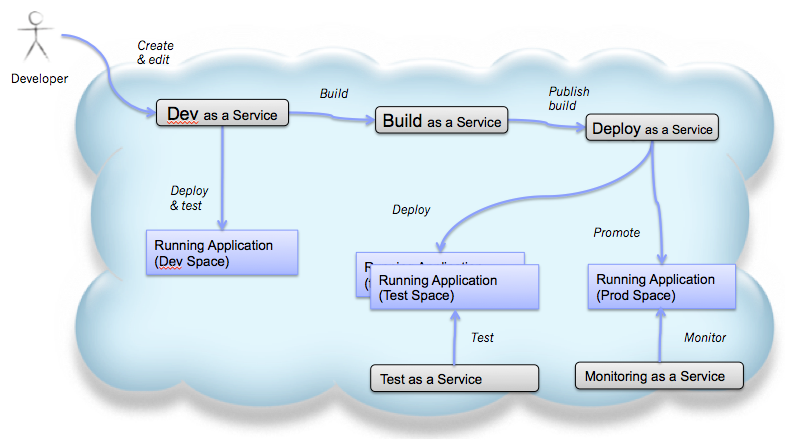
    When one looks at DevOps on PaaS one has to look at the services that need to be hosted on the platform in order to implement a DevOps services platform. If one looks at a DevOps pipeline and the core components that make up a delivery pipeline up, each of the components need to be available as a service, in order to provide a complete ‘DevOps on PaaS’ solution. Namely:

    DevOps Services

    • Development tools as a service (and/or an ability to connect the services on the platform to a desktop IDE)
    • Build as a service
    • Deploy as a service
    • Test as a Service
    • Monitoring as a Service

    These would be what one refers to ‘DevOps Services’.

    In IBM’s new PaaS offering – Codename: BlueMix (in open beta), these DevOps are services are an inherent part of the platform. There services on Bluemix are:

    • Git hosting as a Service
    • Web based IDE
    • Agile planning & tracking, team collaboration as a Service (Jazz.net)
    • Mobile Quality Assurance (MQA) as a Service
    • Continuous Integration as a Service (Jenkins as a Service)
    • Deployment Automation as a Service (powered by UrbanCode Deploy)
    • Performance Monitoring as a Service

    These capabilities working in concert, provide a Continuous Delivery Pipeline on IBM Codename: BlueMix.

    DevOps as a Service (DaaS?)

    So, to conclude. The value proposition for adopting a PaaS platform is self-evident. If you are an organization that delivers software, and is looking to adopt DevOps, a PaaS offering that includes DevOps services allows you to adopt DevOps at a very low cost of entry. You do not need to craft a Delivery Pipeline and implement the whole Continuous Delivery toolchain. Integrations, hosting, servicing – not your problem. Pay-as-you-go, and allow for scale. It is however, not a viable option for all organizations, as it is a drastic shift in corporate culture and potentially policies. Especially if you look at a public PaaS. If you are a born-on-the-web organization, or an enterprise with born-on-the-web applications, you should take a closer look. Check out Codename: BlueMix at www.bluemix.net.


  • Google Starts Cloud World War I, DevOps Wins

    Google Starts Cloud World War I, DevOps Wins

    No matter the outcome, a cloud pricing war will leave DevOps the winner

    By now you probably saw the news and all of the buzz about how Google dropped its drawers eh, pricing on its cloud hosting. This is of course a direct shot at Amazon’s AWS. It’s about time someone with big enough stones (and a big enough data center) took on Bezos and his band of merry cloud makers.  But the real winner in all of this may in fact turn out to be DevOps.

    Of course this is just the first salvo in what promises to go down in history as Cloud War I. Amazon is not going to stand still.  They are perfectly willing to compete on price and in fact part of the AWS mystique is that it is the most cost effective solution (cheapest) out there.

    This will not be just a tit-for-tat move though. In announcing the price cuts Urs Hölzle, VP of TI at Google said, “”We think cloud pricing should track Moore’s Law, so we’re simplifying and reducing prices for our various on-demand, pay-as-you-go services by 30 to 85 percent.”  That means we are going to see cloud prices drop as the speed and power of chips goes up. That is good news! You can see Hölzle’s complete presentation including a cameo by SnapChat’s Bobby Murphy below (be warned this is about 1 hour and 20 minutes long).

    [youtube=http://www.youtube.com/watch?v=qokEYBNWA_0]

    Of course this begs the question, what about the other cloud providers.  How long can Rackspace sit up on its OpenStack perch before diving into this fray? What about Microsoft’s Azure? Redmond wants its piece of the cloud pie, does new CEO Satya Nadella have the stomach for this fight? Can they afford not to? The fact is that Microsoft has the girth and arsenal to compete here. Maybe Google starting this war is the opening they need to climb out of the tech cellar and be relevant again. Cisco just announced a billion dollar initiative to become a cloud powerhouse as well.  As big as a billion is though, that is penny stakes in this game I am afraid.

    Here is another one to watch, IBM’s SoftLayer. Fresh off of a 2b+ acquisition and pledging another billion in cloud dollars, IBM via SoftLayer has the profile to be a winner in this war as well.  They also have IBM’s minions out pushing the solutions. In fact Microsoft and SoftLayer/IBM may have the channels to win this thing in the long run (OK maybe not).

    So where does this leave DevOps? Think Switzerland.  From a DevOps perspective it really doesn’t make a difference which cloud provider emerges dominant. The cheaper and more attractive cloud becomes the more it will drive better DevOps tools, DevOps culture and philosophy.

    Of course there are those that say that if PaaS becomes the dominant cloud platform (and I think it will), that could spell trouble for DevOps.  As if somehow PaaS doesn’t need DevOps.  I say poppycock to that too. Maybe you won’t configure servers in a PaaS environment (and I am not conceding that either), but there will be plenty of places along path that will call for automation, continuous delivery, continuous monitoring and continuous management.  PaaS does not obliviate DevOps.

    That is not to say that applications are not king.  Applications are driving the cloud, DevOps and everything else tech today. A large reason why Google is so goo-goo over Cloud is because it drives more Android apps.  I think we will see more DevOps tools and practice around application development, configuration, management and monitoring. New Relic is already on it.  Anything related to Docker stands to do as well as munition and tank manufacturers did during WW II.

    So buckle in as it may get rough out there as these tech giants battle for cloud supremacy, there an will be winners and there will be losers.  It won’t be just the cloud providers either.  Wars create opportunity and those willing to take the chance will gain the most.

    But for DevOps it is all good. It is like we have a stash of chocolate and gold while we make watches here in Geneva. The war rages on around us but we need at the end of the day no matter what we win.

  • Chuck Norris doesn’t need DevOps, but have we beat “What is DevOps” to death yet?

    Chuck Norris doesn’t need DevOps, but have we beat “What is DevOps” to death yet?

    Chuck-Norris-Card (1)Some interesting and lots of the usual around the DeOps blog beat last week and over the weekend. An interesting piece by Daniel Bryant on his Tai-Dev Blog on why “Chuck Norris doesn’t do DevOps”. It is actually a video of a presentation he gave at the recent London Java Community event and is the subject of a talk that Bryant has been working on for some time.  You can also see the slides from the show on slideshare here.

    Chuck Norris doesn’t do DevOps because he doesn’t have to. Chuck can do everything and he can do it by himself. He has no need to work with Dev or Ops, he does it all. But for the rest of us, to get something done we have to work as part of a team. As such we need DevOps to help us work better, faster deeper. So until we are all as good as Chuck Norris, we need to keep at it.

    To understand why Chuck Norris doesn’t do DevOps, do we have to also define DevOps?  Hasn’t been there enough good descriptions of what DevOps is?  Usually when you keep seeing people trying to solve the same issue over and over again, it generally means it hasn’t been done satisfactorily to date. Is this the case with a definition of DevOps? You would think so by how “What is DevOps” blog posts we see.

    Vishal Biyani on his blog last week writes exactly that. It is actually part of one of a multi-part series of blog posts that will according to Biyani cover:

    • Getting basics right: What is DevOps anyway? (This post)
    • It’s all about delivering: CI & CD
    • Configuration Chaos :  Managing your infrastructure, as code!
    • Monitor, measure and move: From logs to performance and beyond
    • Putting it all together: Collaborate, communicate and continuously improve
    • Further Reading

    Giving Biyani credit he refers back to Magnus Hedemark at Redhat. The first part explains the basic premise behind DevOps, a brief history and the motive behind the DevOps movement.

    I think this is what we should do more often. Refer back to a well written definition that we can point to with consistency rather than having as many definitions of DevOps as there are stars in the sky. An example is OlinData who back in January wrote a well done “what is DevOps” post.  It is no worse than countless others I have seen.  The issue, how many more people will write their own definition instead of just pointing at OlinData’s or Dev2Ops.com definition or any others.

    As long as we spend so many cycles defining what DevOps is, we are wasting cycles that we could be using on doing DevOps and expanding DevOps knowledge. I think we have beaten the what it is fairly well by now, let’s move on.

    An example of moving on is the “BlueMIx” 100 Days announced by IBM and written about on this IBM blog. I will be writing more about IBM and BlueMix, but suffice to say here, IBM is scheduling 100 workshops around the world to help Developers do DevOps with some pretty cool tools from Big Blue.  It promises to be a great event if you can get to one in your area.

    Another good example of blogs moving DevOps forward is the Ranger4 blog. They had a good post up with the 7 Habits of Highly Effective Continuous Delivery Experts.  Good article that take it to the next level.

    Anyway, that is my report today. For those that notice these things, I will be handling the Cup o’ Joe blog here for a while, as reading blogs is something I do.  You can write me at ashimmy@devops.com if you have something on your blog you want us to mention.

  • IBM Invests $1B to Deliver Unique Platform-as-a-Service Capabilities to Connect Enterprise Data and Applications to the Cloud

    Delivers Enterprise Software Capabilities – Integration, Security, Analytics, Commerce to Accelerate New Era of Hybrid Clouds

    ARMONK, N.Y. and LAS VEGAS, Feb. 24, 2014 /PRNewswire/ — IBM (NYSE: IBM) today announced a unique new development environment and capabilities-as-a-service to help clients and developers speed the adoption of “hybrid” clouds, which have the potential to usher in a new era of innovation across the enterprise. As part of its initiative, IBM has invested more than $1 billion for software cloud development and is launching new capabilities running on SoftLayer.

    IBM Invests $1B to Deliver Unique Platform-as-a-service Capabilities

    With today’s news, IBM is addressing three fundamental issues to help speed the adoption of hybrid clouds.

    1)   Enabling enterprise developers for the cloud: According to Evans Data, there are more than 18 million software developers worldwide yet less than 25 percent are developing for the cloud today [1]. As the industry moves to the cloud era, millions of developers are looking to access tools and services that will enable them to leverage this fast-emerging opportunity.

    2)   Integrating across enterprise environments: Enterprises are looking to innovate and drive significant value in a new era of hybrid clouds, which link systems of engagement — built on mobile and social technologies and where consumers are engaging with organizations — with systems of record where data and transactions are processed.

    3)   An open ecosystem and platform for development that accelerates innovation and fosters growth: Developers are looking for a dynamic application development environment to support the cloud era. A new development platform should be open and flexible and make it easier for corporate developers and independent companies alike to create applications and connect them to existing computing systems.

    In response to these market dynamics, today IBM is announcing three new sets of cloud capabilities:

    1)     IBM is opening its extensive enterprise software portfolio to the cloud and launching an open beta codenamed BlueMix™, a new platform-as-service (PaaS) that combines the strength of IBM software, third-party and open technologies. BlueMix provides DevOps in the cloud — an open, integrated development experience that scales. DevOps services help developers, independent firms and enterprise teams get started to build enterprise applications more quickly and effectively. DevOps services enable developers to focus on continuously delivering new functions by learning from their users. Today, IBM also announced a definitive agreement to acquire Boston, MA-based Cloudant, Inc., a privately held database-as-a-service (DBaaS) provider that enables developers to easily and quickly create next generation mobile and web apps.  Cloudant will extend IBM’s Big Data and Analytics, Cloud Computing and Mobile offerings and become an essential component of BlueMix.

    2)     IBM is bringing its middleware portfolio, such as WebSphere, to SoftLayer through pre-defined software “patterns” to easily extend existing applications to the cloud. With more than 200 application and middleware patterns available from IBM and IBM Business Partners, the IBM Software Patterns are differentiated in that they enable application portability across a hybrid cloud environment, providing the flexibility to deploy applications and middleware on-premise or off-premise, simplifying hybrid IT management.

    3)     IBM continues to invest in and expand the services running on SoftLayer, includingDevOps to provide essential capabilities to plan, develop, test, deploy and monitor applications, andsystems management as a service, extending its industry leading solutions to the Cloud. And IBM today announced that it is integrating its Power Systems into its SoftLayer cloud infrastructure to deliver a level and breadth of infrastructure services beyond what has traditionally been available over the cloud.

    “IBM is ushering in a bold new era of innovation by partnering with developers in an open environment to accelerate the emerging world of hybrid cloud computing,” said Robert LeBlanc, IBM Senior Vice President, Software and Cloud Solutions. “We are combining the strength of our developer ecosystem with the depth of subject matter expertise in domains such as mobile, Big Data and DevOps, to build a scalable model that easily spans from a single developer to global teams. Today’s announcement is another significant move in extending true cloud integration — not just to existing data and transaction services but to a new class of emerging applications.”

    IBM Launches Open Beta of Codename: BlueMix, Redefining Cloud Development
    This new application development environment delivers the speed and flexibility of a platform-as-a-service (PaaS) to allow developers to more quickly compose and build enterprise-grade applications for the cloud era by providing access to IBM’s vast software portfolio as composable services.

    This PaaS/services combination, built on open standards and taking advantage of Cloud Foundry, enables developers to avoid vendor lock-in while leveraging their existing application development assets and skills, which is essential for building hybrid clouds. IBM is providing developers an open, flexible cloud environment connecting the enterprise and born-on-the-web developers using their choice of tools, whether IBM, third-party, or open technologies, in a scalable environment.

    Building on more than 20 years of commitment and leadership in driving open standards, IBM also announced it will serve as a founding member of the Cloud Foundry Foundation. The goal of this foundation is to create and develop open source platform-as-a-service ecosystems.

    As part of BlueMix, IBM is building a lineup of developer services focused on mobile, web apps, integration, DevOps and data management. In addition, IBM is continuing to make available to developers its suites of business applications (SaaS) as composable API-based services, such as Watson, commerce, security, analytics, marketing and others. As an example, using BlueMix, developers can leverage middleware services to build a new sales app that can provide retail associates with access to inventory management information from systems of record at the time of customer engagement.

    BlueMix DevOps services provide an integrated experience to help developers accelerate time to market and improve quality. DevOps includes services to store and manage code (using the popular Git repository), a built-in Web integrated development environment (IDE), and Eclipse and Visual Studio integrations to let developers use whichever environment they prefer.  DevOps Services enable agile planning and tracking to share work and collaborate across team members, as well as application deployment automation to streamline the delivery of new function, mobile quality, and performance monitoring to help learn and iterate more quickly. By integrating across the software delivery lifecycle, DevOps services help developers move faster from an idea to an application that meets users’ needs.

    In the automotive industry connected vehicles will rely on a strong IT structure and the cloud has become increasingly important in this area. The international automotive supplier Continental is using the BlueMix platform to offer cloud-based connected solutions that will pave the way for Automated Driving.

    “The investment in IBM BlueMix addresses a much needed gap for Continental that allows us to move more quickly through the cloud in the development of our connected solutions. The automobile industry is following the same trajectory as other devices becoming connected and we see great opportunity for exciting connected features that will transform the future of mobility using the BlueMix platform to create value for motorists and make driving safer, more comfortable and efficient,” said Brian Droessler, Vice President, Software and Connected Solutions, Continental Automotive Systems.

    IBM Brings Its Middleware to SoftLayer with IBM Software Patterns
    IBM is bringing its extensive middleware portfolio to SoftLayer with IBM Software Patterns. Organizations can maximize existing application investments using these pre-defined patterns that are created to capture the many steps for deploying and managing an application.

    IBM Software Patterns are portable between on-premise and off-premise environments, providing the flexibility to deploy applications and middleware to meet dynamic business requirements. Available through the PureApplication Service on SoftLayer beta, IBM Software Patterns open up new possibilities to simplify common IT processes such as DevOps. IT teams can quickly create off-premise environments in the cloud to complete tasks such as application testing and quality assurance, then transfer the applications back to an on-premise production environment. Additionally developers can create their own patterns – writing them once and deploying them on-premise or off-premise – using IBM tools and services, or select from more than 200 Software Patterns provided by IBM and IBM Business Partners ranging from traditional ERP/CRM and Business Intelligence to Web and mobile applications.

    For example, independent software vendor (ISV) Exigen Insurance Solutions has created an application pattern for its insurance industry solution using the IBM Web Application middleware pattern.  With the PureApplication Service on SoftLayer, Exigen can now address new market segments offering clients the option to develop and run Exigen core systems across a hybrid cloud environment making it easier for clients to optimize total costs.

    Additional Services Running on SoftLayer
    IBM is making SoftLayer the foundation of its cloud portfolio.  Building on the company’s recent $1.2 billioninvestment to expand SoftLayer’s global footprint with new data centers worldwide, IBM is announcing additional new cloud services on SoftLayer.

    • IBM Systems Management as a Service – IBM is addressing the critical needs of IT operations by extending its industry leading service management solutions to the Cloud. Built on decades of experience in managing some of the most scalable IT systems in the world, IBM is introducing a comprehensive set of IT management solutions. With just a few clicks, IT practitioners can try and buy systems management as-a-service solutions providing instant insights and value. With these new solutions, IBM provides IT practitioners with the ability to optimize how they manage mixed workloads — both cloud and on-prem — along with connected devices and business applications across any given organization. The new offerings are available both as-a-service hosted on IBM SoftLayer and as on-premise installed software, providing clients with deployment and management choice and flexibility.
    • Power on SoftLayer – Beginning next quarter and continuing over time, SoftLayer’s first service built on Power Systems will be IBM Watson solutions, followed by additional offerings leveraging Power Systems’ advantages of optimization for data and analytics performance. The preliminary set of planned offerings includes:
      • Watson solutions  — includes Watson Discovery Advisor, Watson Engagement Advisor and The Watson Development Cloud, a platform as a service that contains the technology, tools, SDKs and APIs that enable third parties to design, develop and deploy cognitive applications.
      • Software as a Service — includes a wide range of data services optimized on Power Systems includingIBM DB2 BLU and IBM Cognos analytics solutions.
      • Infrastructure as a Service — bare metal Power Systems will be offered to clients as an on-demand infrastructure platform.
    • IBM Platform Computing Cloud Service on SoftLayer – IBM also announced Platform LSF and Platform Symphony software delivered as a service for technical computing and analytics workloads running on SoftLayer.

    About IBM Cloud Computing
    IBM has helped more than 30,000 clients around the world with 40,000 industry experts around cloud engagements. Today, IBM has 100+ cloud SaaS solutions, thousands of experts with deep industry knowledge helping clients transform and a network of 40 data centers worldwide.  Since 2007, IBM has invested more than $7 billion in 16 acquisitions to accelerate its cloud initiatives and build a high value cloud portfolio. IBM holds 1,560 cloud patents focused on driving innovation. In fact, IBM for the 21st consecutive year topped the annual list of US patent leaders. IBM processes more the 5.5M client transactions daily through IBM’s public cloud. For more information about cloud offerings from IBM, visit http://www.ibm.com/cloud. Follow us on Twitter at @IBMcloud and on our blog at http://www.thoughtsoncloud.com.  Join the conversation #ibmcloud. To learn more about today’s news please read Smarter Planet blog.

    [1] Source: Evans Data Developer Population and Demographics Study, 2013.

  • IBM to Acquire Cloudant: Open, Cloud Database Service Helps Organizations Simplify Mobile, Web App and Big Data Development

    ARMONK, N.Y. – 24 Feb 2014: IBM (NYSE:IBM) today announced a definitive agreement to acquire Boston, MA-based Cloudant, Inc., a privately held database-as-a-service (DBaaS) provider that enables developers to easily and quickly create next generation mobile and web apps.  

    Cloudant will extend IBM’s Big Data and Analytics, Cloud Computing and Mobile offerings by further helping clients take advantage of these key growth initiatives. Financial terms were not disclosed.

    Clients across a variety of industries, including gaming, financial services, mobile device manufacturers, online learning, retail and healthcare are already using Cloudant technology.

    “IBM is leading the charge in helping its clients take advantage of big data, cloud and mobile,” said Sean Poulley, vice president, Databases & Data Warehousing, IBM. “Cloudant sits squarely at the nexus of these three key transformational areas and enables clients to rapidly deliver an entirely new level of innovative, engaging and data-rich apps to the marketplace.”

    Organizations are being challenged to quickly create engaging and data-rich mobile and web apps. Mobile device usage is proliferating rapidly worldwide, creating a surging demand for apps and an increased volume of structured and unstructured geographically encoded and globally distributed data.  Five petabytes of data are created every day by mobile phone subscribers around the world. To meet this growing demand, data must be always available and easily accessed by massive volumes and networks of users and devices.

    Cloudant, an active participant and contributor to the open source database community Apache CouchDBTM, delivers high availability, elastic scalability and innovative mobile device synchronization. Cloudant’s JSON cloud-based data service allows mobile and web developers to quickly and easily store and access the explosion of mobile data using an application programming interface (API) that is significantly easier to use than alternatives. Increasingly, developers have embraced NoSQL databases because of their flexibility, and JSON has become the predominant NoSQL database technology for mobile and web app developers.

    “IBM has a rich history in the field of data management, and one that will truly differentiate Cloudant’s technology in the marketplace,” said Cloudant CTO and Co-Founder Adam Kocoloski. “Joining IBM allows Cloudant to innovate faster than ever before, and IBM’s track record in open source software gives us complete confidence in our ongoing collaboration with the Apache CouchDB project. Cloudant could not have found a better home than IBM.”

    Cloudant complements IBM’s Big Data and Analytics portfolio beyond traditional data management by providing a database–as–a–service that enables clients to simplify and accelerate the development of engaging and scalable mobile and web apps. Cloudant also is integral to IBM’s MobileFirstsolutions. It enables developers who use Worklight, IBM’s mobile app development software, to quickly create flexible, reliable and scalable apps that include a variety of structured and unstructured data.

    Delivered as a managed cloud service, Cloudant technology ensures that app developers no longer need to be experts in database management, while database administrators (DBA) can focus on higher value tasks beyond day-to-day administration.

    The acquisition of Cloudant will also strengthen IBM’s cloud solutions by providing developers with the tools and resources to build, test, deploy and scale cloud apps on a variety of hosting layers. Cloudant runs on the IBM SoftLayer platform today and extends IBM’s recent investment in the SoftLayer cloud infrastructure. As a global service sold in 140 countries, SoftLayer provides an easy cloud “on-ramp” to help clients quickly deploy mobile capabilities with the security, privacy and reliability of private clouds and the economy, flexibility and speed of a public cloud.

    “Cloudant’s decision to join IBM highlights that the next wave of enterprise technology innovation has moved beyond infrastructure and is now happening at the data layer,” said Cloudant CEO Derek Schoettle. “Our relationship with IBM and SoftLayer has evolved significantly in recent years, with more connected devices generating data at an unprecedented rate. Cloudant’s NoSQL expertise, combined with IBM’s enterprise reliability and resources, adds data layer services to the IBM portfolio that others can’t match.”

    Cloudant’s DBaaS extensively leverages the availability, elasticity and reach of the cloud to create a global data delivery network enabling applications to scale larger and remain available to users wherever they are located.  In addition, the Cloudant managed cloud service:

    ·         Stores data of any structure as self-describing JSON documents

    ·         Leverages a multi-master replication system and advanced distributed design principles to achieve elastic database clusters that can span multiple racks, data centers, or cloud providers

    ·         Enables global data distribution and geo-load balancing to provide high availability and enhanced performance for applications that require data to be located close to users

    ·         Provides full-text search, advanced geo-spatial and temporal querying, and flexible, real-time indexing

    ·         Integrates via a RESTful application programming interface (API)

    ·         Enables easy data replication and sync for mobile applications, with open source, device-native software libraries

    ·         Offers 24×7 monitoring and management by its Big Data experts

    The acquisition of Cloudant is expected to close in 1Q14. Following the close, Cloudant will join IBM’s newly formed Information and Analytics Group led by Senior Vice President Bob Picciano, a business unit within the IBM Software & Systems Group.

    About Cloudant

    Cloudant provides the world’s first globally distributed database-as-a-service (DBaaS) for loading, storing, analyzing, and distributing operational application data for developers of large and/or fast-growing web and mobile applications. Delivered as a managed cloud service, Cloudant technology accelerates time-to-market and time-to-innovation because it frees developers from the mechanics of data management so they can focus exclusively on creating great applications. It also offers high availability, elastic scalability, and innovative mobile device synchronization. For more information, visit https://cloudant.com/

    For more information about IBM Big Data and Analytics, visit http://ibm.co/bigdataanalytics

    For more information on IBM Cloud, visit http://www.ibm.com/cloud-computing/us/en/

    For more information on IBM MobileFirst, visit http://www.ibm.com/mobilefirst/us/en/

    “Apache,” “Apache CouchDB,” and “CouchDB” are registered trademarks or trademarks of theApache Software Foundation in the United States and/or other countries. All other brands and trademarks are the property of their respective owners.