Tag: ibm

  • IBM Adds Lower-Cost Linux Mainframe to Portfolio

    IBM Adds Lower-Cost Linux Mainframe to Portfolio

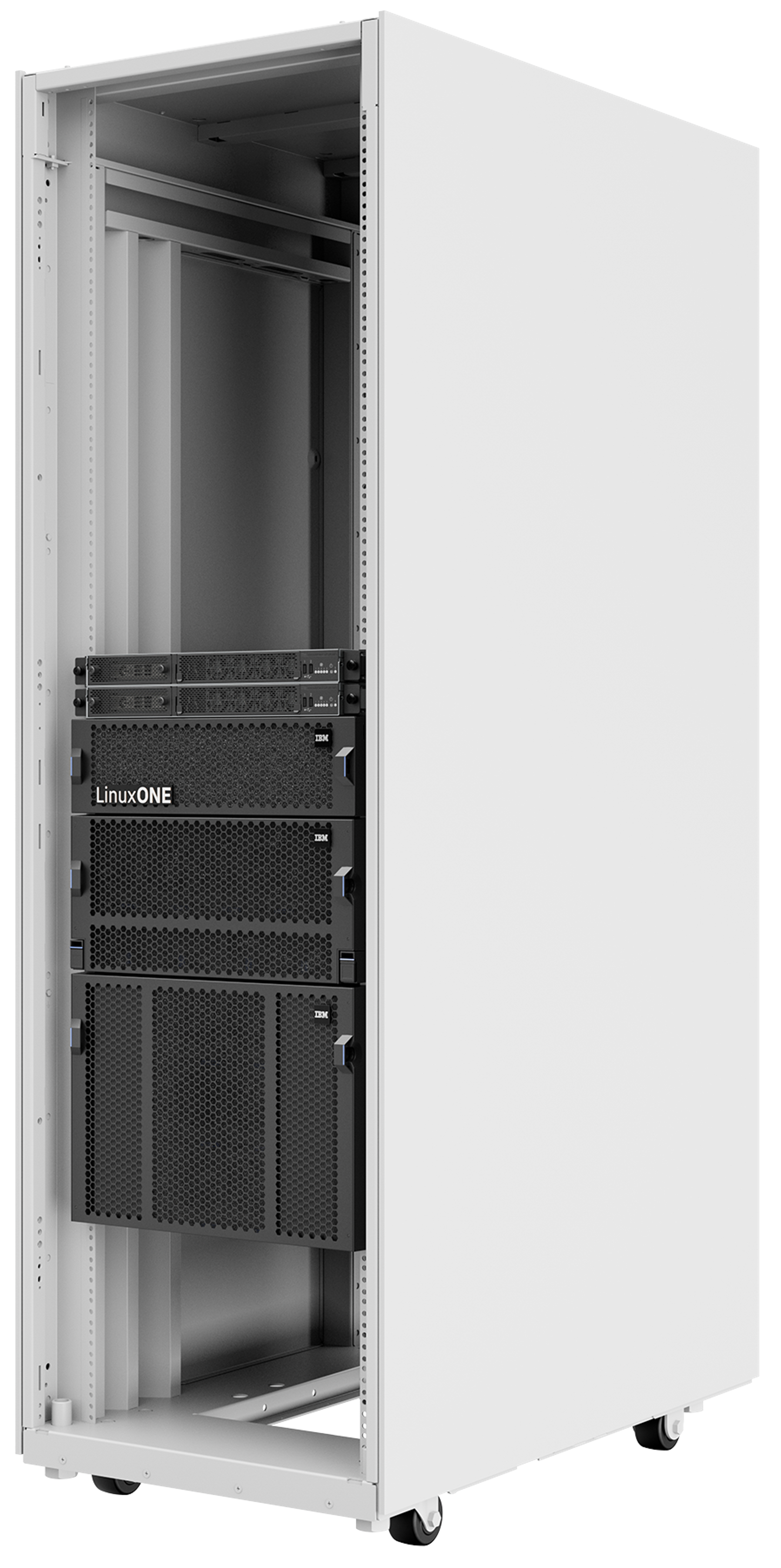
    IBM today made its most aggressive move yet in its quest to make mainframes running Linux more affordable, launching an entry-level platform starting at $135,000.

    The IBM LinuxONE 4 Express is a pre-configured rack system that is based on the same 5.2Ghz IBM Telum processor that IBM uses in its Z16 series of mainframes.

    In addition, the platform supports IBM Secure Execution, which is designed to thwart any attempt to decrypt data in the future using quantum computers.

    IBM claims organizations that move Linux workloads from x86 servers to an IBM LinuxONE 4 Express can save over 52% on their total cost of ownership over five years.

    The overall goal is to make it simpler for organizations to consolidate workloads that otherwise would need to be deployed across a distributed computing environment, she added. That approach ensures higher levels of availability for workloads that are increasingly processing massive amounts of data using two levels of physical and two levels of virtual cache in a way that consumes less energy, noted Tina Tarquinio, vice president of product Management for IBM Z and LinuxONE.

    The IBM LinuxONE 4 Express also includes an integrated accelerator for running artificial intelligence (AI) inference engines using more than 6 TFLOPs compute capacity per chip.

    IBM expects that as more organizations process sensitive data to drive AI applications, there will be increased interest in deploying applications in more secure on-premises IT environments, said Tarquinio. Mainframes provide a more cost-effective way to achieve that goal at a time when DevOps teams are embracing methodologies such as platform engineering to centralize the management of workloads, she added.

    At the same time, increased reliance on automation is making it simpler for IT teams to rely on multiple types of platforms to optimally process workloads. That capability enables IT teams to make platform decisions that are based on fit-for-purpose best principles more easily, noted Tarquinio.

    It’s not clear how many organizations will now be able to afford a mainframe when the initial cost of an x86 server is still much lower. But in the face of ongoing economic uncertainty, it seems more organizations are willing to consider all their options. The issue is that adding additional X86 servers is often viewed as the path of least resistance to increasing compute capacity.

    Naturally, each IT team will need to decide what path forward makes the most sense for them, but as workloads continue to become more data-intensive, it’s clear that infrastructure requirements are changing. The more data that needs to be processed, the more challenging it becomes to maintain service level agreements that are based on maintaining specific levels of application performance, noted Tarquinio.

    The challenge now is determining where best to run those workloads across an increasingly hybrid cloud computing environment that continues to offer more options as IT platforms evolve and expand.

  • Five Great DevOps Job Opportunities

    Five Great DevOps Job Opportunities

    devopsy.kinsta.cloud is now providing a weekly DevOps jobs report through which opportunities for DevOps professionals will be highlighted to better serve our audience.

    Our goal in these challenging economic times is to make it easier for DevOps professionals to advance their careers.

    Of course, the pool of available DevOps talent is still relatively constrained, so when one DevOps professional takes on a new role it tends to create an opportunity for others.

    The five job postings shared this week are selected based on the company looking to hire, the vertical industry segment and, naturally, the pay scale being offered.

    We’re also committed to providing additional insights into the state of the DevOps job market. In the meantime, for your consideration:

    Dice.com

    Travelers
    Hartford, Connecticut
    DevOps Tech Lead
    $133,500 to $220,300

    Indeed.com

    Lawrence Berkeley National Laboratory
    San Francisco, California
    Identity and Access Management DevOps Engineer
    $126,900 to $214,140

    SimplyHired.com

    Workday
    Pleasanton, California
    Software Development Engineer
    $112,500 to $204,000

    LinkedIn

    IBM
    Denver, Colorado
    DevOps Engineer
    $110,100 to $161,100

    CareerBuilder.com

    Cognizant Technology Solutions
    Oakdale, New Jersey
    DevOps Manager – Technology Modernization
    $95,500 to $212,600

  • VS Code for Mainframe: The Enterprise Developer Tipping Point

    VS Code for Mainframe: The Enterprise Developer Tipping Point

    Optics matter. At a recent industry conference, a university lecturer reconfirmed what many in attendance already knew, “3270 [green screens] scare off the young generation of developers.” No matter how state-of-the-art the platform or mission-critical the applications, perceptions are formed largely based on optics, and green screens are not a good look.

    Beyond optics, though, a new option offers the promise of a more normalized developer experience (DevX) and DevOps productivity across platforms, along with the staffing flexibility it brings. In short, Visual Studio Code (VS Code) is a big step toward breaking down the mainframe silo.

    VS Code’s extensible, ‘any language, any platform’ design makes it the perfect tool for mainframe developers and with the free and open Code4z extension pack, VS Code is mainframe-ready. Developers are now using VS Code for mainframe AppDev just like their peers, taking advantage of the extraordinary ecosystem and the other many benefits that have made it a runaway success.

    Per my previous article, Git for Mainframe: Back to the Future, combining VS Code with Git (i.e., editor and source interfaces) makes the experience complete.

    So how does Code4z make VS Code mainframe-ready?  Let’s explore the answers from a functional perspective.

    Editing & Debugging

    Mainframe is closely associated with core languages like COBOL, Assembler and JCL, which are often ignored in the world of modern tooling. With VS Code’s extensible framework, however, incorporating these languages is simple and seamless.

    The Language Server Protocol (LSP), which was developed for VS Code, is now an open standard also used by the next generation of browser-based editors, providing a degree of future-proofing. LSP extensions provide a rich editing experience with a wide range of popular features including IntelliSense, which offers capabilities like syntax checking, verb formatting suggestions and variable name completion.

    Code4z offers LSP extensions for COBOL and High Level Assembler (HLASM) while additional extensions are available for languages like JCL, REXX, Db2, and Easytrieve. The extensibility of this technology has already been used to extend syntax awareness to specific language dialects.

    Similar to LSP, the Debug Adapter Protocol (DAP) provides a native interface and layer of abstraction for debug services. Code4z’s debugger extension facilitates the debugging of CICS and batch COBOL programs, an integral part of the end-to-end experience.

    Access & Security

    Mainframe applications, the lifeblood of many businesses, require rock-solid security throughout the entire SDLC. Code4z leverages Zowe, the award-winning open source framework that extends mainframe security and access controls to tools like VS Code. The Zowe Explorer extension, built on the Zowe CLI, provides access to data sets, jobs and USS files and developers also use it to issue TSO and MVS commands and to submit JCL. Zowe Explorer is packaged with Code4z as is a data editor for mainframe data sets including VSAM. This extension is built on Zowe Explorer, again leveraging the extraordinary extensibility.  A Zowe Explorer for CICS is also available.

    Similarly, developers can access a rich and growing set of conformant Zowe CLI extensions via the terminal and scripting.

    Access to SCMs tools is also supported. In addition to VS Code’s native Git integration, there are extensions for Endevor, ChangeMan ZMF, and related tools.

    DevOps Automation

    Since my introductory article a few years ago, Z is for Zowe – the Open Path to Mainframe DevOps, Zowe has enjoyed wide adoption with 69% of surveyed sites either currently using or planning to use it within the year.

    With mainframe teams now using Zowe to adopt modern shift-left practices, scripts for scanning, building, deploying and testing can be run manually by developers from VS Code, in addition to automatic triggers from code commits. This flexibility further empowers developers to own their code throughout the SDLC and beyond.

    With VS Code, mainframe developers can be equipped with more self-service capabilities like Db2 schema provisioning to accelerate the testing process. With capabilities like these, developers can remain in the VS Code experience focused on editing rather than being distracted by low-value infrastructure activities, like requesting and waiting for DBA action.

    Playing the Long Game

    While VS Code is the dominant tool today—almost 3 times as popular as its closest competitor according to Stack Overflow with the lead growing—what is the long-term opportunity?

    Demand for a modern, enterprise-aligned experience spans many domains, from increasing productivity to backfilling retiring staff. Elevating team morale and future-proofing vital mainframe assets ensure this adoption trend will only increase.

    But tools change. Browser-based editors and in-the-cloud collaboration are gaining greater acceptance and the AI-assist excitement is palpable. Bringing mainframe developers onto an enterprise platform ensures mainframe teams will be able to benefit from the same advances as distributed peers. Enabling VS Code and its cloud equivalents demonstrates a commitment to the long-term success of these applications and by reducing the idea-to-production cycle, product owners become champions.

    While not all mainframe developers will embrace VS Code, especially those close to retirement, the vast majority will, as we have experienced within our Broadcom engineering organization. The bottom line is that VS Code makes them even more productive, as illustrated in Confessions of a Career ISPF Programmer.

    Many of today’s developers are proficient with multiple languages (i.e., polyglot) so picking up an additional language like COBOL becomes less daunting if everything else—editor, repo, DevOps processes, etc.—is familiar.

    Getting Started

    For a closer look at the many free and open Code4z extensions, check out the Developer Cockpit, which simulates a COBOL/Db2/CICS developer configuration. And read From VS Code to Mainframe Developer Cockpit for more detailed use cases.

    Most importantly, try it! Code4z is available on the VS Code Marketplace.

    And stay tuned for additional Code4z extensions in the pipeline. There’s never been a more exciting time to be a mainframe developer!

  • Convert COBOL Easily? Yes, Please!

    Convert COBOL Easily? Yes, Please!

    I was reading Mike Vizard’s article about IBM previewing an AI tool to convert COBOL to Java and mentally cheered this move. No, seriously—massively cheered this move.

    There are a lot of uses of large language models (LLM) right now, and many of them are not all that exciting, in my opinion. This one, though? This is huge. In the course of my career, I have been involved in three projects to convert COBOL and one to convert FORTRAN, with some projects that required interfacing with RPG III systems. In all of these cases, the costs were prohibitive. Two of the three COBOL projects never made it past estimates because the cost of resources who know both COBOL and Java were prohibitive, as is the complexity of most mainframe applications as they were modified over the years. The Fortran project never got past resourcing, and the RPG III interfaces were just that. We had to pull the data as it was presented by RPG III systems and only act on our copy, with a separate process used to update the core systems. Why? Because modifying the RPG was impractical, but we could be agile. It was … painful, to put it mildly.

    What all of these projects shared was the lack of a skilled workforce. And what IBM is offering is an LLM that acts as that workforce. If you get the application into Java, there is a large pool of developers that can then troubleshoot it. While the environment issues will still exist and people skilled in tools like JCL are increasingly hard to find, that part can be rebuilt in the new environment. (One question I have about IBM’s project is, “Can it convert to Java for a Linux LPAR/VM?” I suspect that this iteration converts within z/OS, but it would be cool to see increased options in the future.)

    Honestly, this trend will only increase. While IBM’s use of LLM is aimed at moving COBOL to Java, there are an incredible number of lines of Java out there to train on, so soon enough, there will be other conversions in and out of Java. And that’s all good news. We recreate the wheel a lot. The longer-term implication of AI-assisted conversion is that we won’t have to. Think about it: We could feed in a mathematical routine in Fortran and get the language of our choice out the other side.

    Way back in the day, a collection of compilers named TopSpeed let you develop in any of several languages, even mixing and matching to create applications that used each language (and developer) for their strengths. This is the TopSpeed dream writ large. (Disclaimer: I was a huge TopSpeed fan. Bought their intro kit and wrote systems mixing C/Pascal/ASM without having to mess with things like parameter sequences. Yeah, I was cool.)

    We have had too few developers for a very long time. Now, we are about to have a world where developers can focus on truly unique functionality, and the rest is generated based on the mass of implementations we already have. Think in terms of sorting algorithms—99% of the sorting problems out there were mastered decades ago, and yet we frequently see people re-implementing, even today. Now we can tell a system, “Generate a tree sort,” and just make calls. Every time we implement a new language, this type of thing has to be re-implemented, and often it is re-implemented because we don’t know about the available solutions. In the future, we will have solutions at our fingertips.

    And as with the other benefits of automation, we’ll do less busy work and add more business value. While there will be some pain, I think in the long term that is a huge benefit. And you’ll still be there, making things go zoom.

  • IBM Previews Generative AI Tool for Converting COBOL to Java

    IBM Previews Generative AI Tool for Converting COBOL to Java

    IBM this week announced it will preview a generative artificial intelligence (AI) tool for converting COBOL code running on mainframes into Java. The preview will be available next month during IBM’s TechXchange learning event, IBM said.

    Kyle Charlet, CTO for Z software at IBM, said watsonx Code Assistant for Z makes use of large language models (LLMs) that IBM has trained to both convert and optimize Java code for z/OS running on IBM mainframes.

    Rather than converting COBOL into Java code line for line, the watsonx Code Assistant for Z improves the syntax of Java code generated using object-oriented techniques, he noted.

    IBM’s watsonx.ai code model, which will have knowledge of 115 coding languages, is based on 20 billion parameters that will eventually be applied to other programming languages such as PL/1, added Charlet.

    That model is the same core LLM that IBM used to create Red Hat Ansible Lightspeed, a tool to generate code for an IT automation framework that is scheduled for release later this year. In the future, IBM will also most likely employ generative AI to convert REXX code into Ansible code, said Charlet.

    IBM expects the final offering will combine generative AI tools with its existing Application Discovery and Delivery Intelligence (ADDI) inventory and analysis tool to streamline the modernization of legacy mainframe applications.

    The goal, however, is not to move COBOL applications off the mainframe. Java applications created using watsonx Code Assistant for Z will still call the same data sources, such as an IMS database or CICS transaction processing system, as the original COBOL application.

    That approach will make mainframes more accessible to a wider pool of developers that know Java, which should increase the overall pace of innovation for application development, noted Charlet.

    There are billions of lines of COBOL code currently running on mainframes that, in one way or another, need to be modernized as the pool of developers that know COBOL continues to shrink. Generative AI will make it easier to quickly assess, update, validate and test code, which should accelerate code conversion efforts that otherwise would take years to complete, said Charlet.

    It’s not clear how quickly organizations might move to modernize COBOL applications, but as the time and effort to do so decreases, so should the cost of modernizing legacy code. Most organizations still running z/OS on mainframes are committed to the platform, but if they can transition to Java, the overall cost of building and maintaining mainframe applications should decline.

    In the meantime, it’s not likely that AI will replace developers. IBM recommends that developers further optimize the Java code generated by watsonx Code Assistant for Z.

    Most developers are already using some form of AI to accelerate application development. The next wave of AI will see more widespread use of LLMs that are optimized for specific tasks and that generate more reliable results. After all, the quality of any output from an AI model is always directly related to the quality of the data used to train it. The narrower the set of vetted data, the more trustworthy the AI becomes—the opportunity for erroneous data to create AI hallucinations is a whole lot less than any general-purpose AI model could achieve with customization.