Tag: ibm

  • Embracing DevOps in the IoT Era

    Embracing DevOps in the IoT Era

    To those of us struggling to cope with the challenges of delivering software over the Internet of Things (IoT), DevOps can be the savior.

    Delivering software over the Internet is no easy task, and delivering it over the Internet of Things is even more formidable. How do you deliver software to so many “things,” many of which are “loners” unconnected to the rest of the world?

    What’s encouraging is that the software management processes and tools that we know and have learned to love still work in the IoT era. In fact, not only do they work, they are essential.

    We need teams to work together more smoothly and communicate more quickly to mitigate the higher technological risks. DevOps processes and tools, therefore, are critical in the IoT era because they facilitate smooth, well-oiled collaboration between teams.

    A Typical IoT Scenario

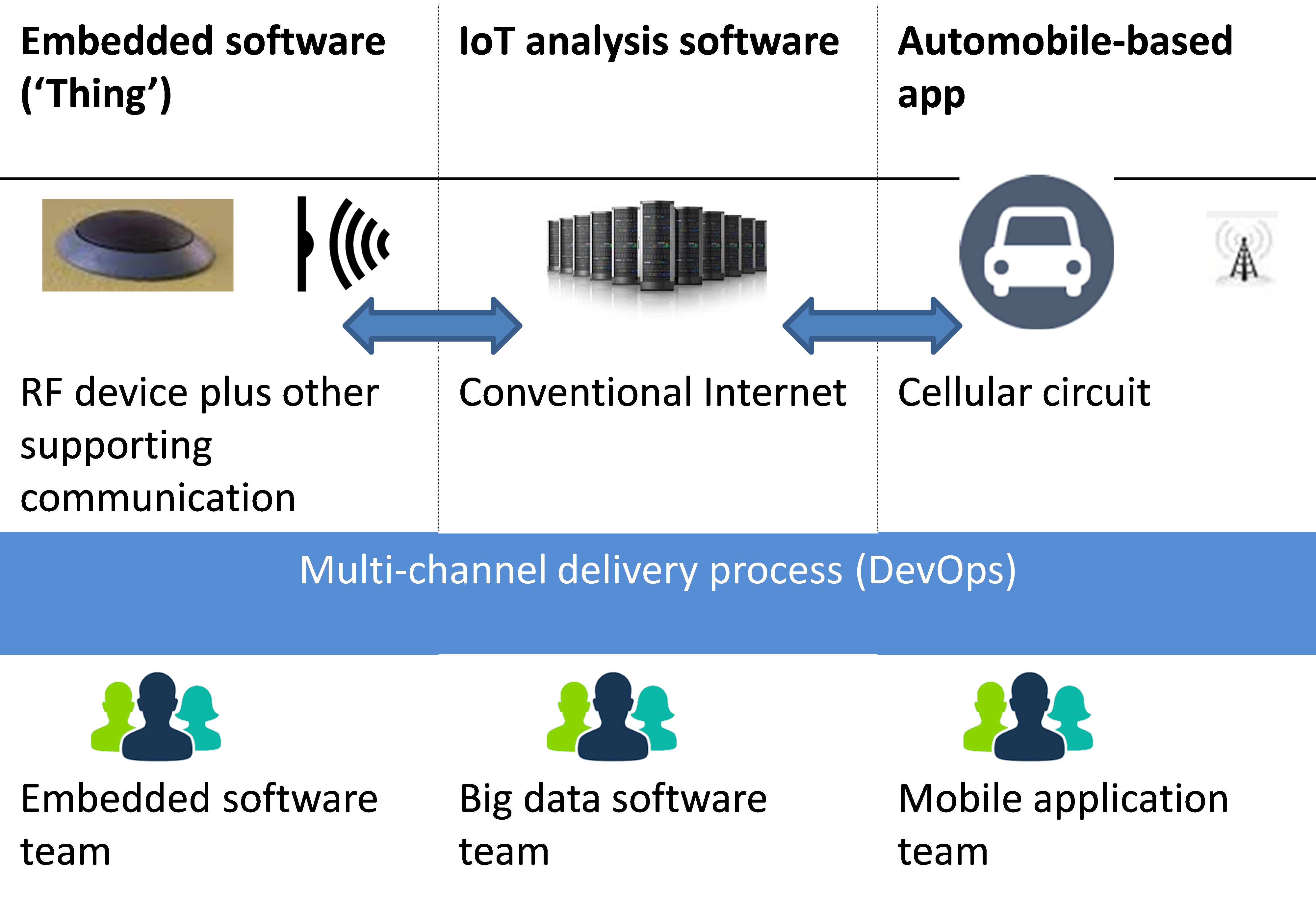
    Consider a scenario in which you need to develop a “smart” parking system for a “smart” city. The system will involve multiple sensors in the parking lots, a display device in each parking area along with communication equipment, a central server for control and analysis and a smart device in each car.

    Drivers can check how many slots are available in nearby parking lots on their automobile devices and navigate to the appropriate parking lot. They also can book slots in advance and start paying from the time they book the slot. When they leave a slot, the parking slot sensor automatically detects that the slot is free and updates a central server. The central server transmits slot availability to the car-based devices, where they become visible to drivers. The central server also generates various kinds of reports and performs various kinds of high-end analysis.

    As with any conventional Internet system, there are multiple software components. All of them have their respective delivery (development, testing and deployment) streams. These streams need to work interdependently and collaboratively, and they need centralized configuration management and dashboards.

    DevOps & IoT

    The Scale and Diversity of IoT

    The differences and challenge, however, lie in the sheer scale of deployment, the diversity of deployment environments and the multiple deployment channels. As you can imagine, any large city will have millions of cars, thousands of parking lots and, hence, hundreds of thousands of individual slots. The number of deployment devices easily can run into the millions.

    In the interest of preventing monopolies, not all the parking sensors will be from one manufacturer. The same holds for the car-based devices. While certain standards can be enforced, not all manufacturers will adhere to one universal protocol. It will be necessary to allow multiple communication and security protocols on these devices. This multiplicity of protocols can complicate software deployment on the devices.

    Other Considerations

    What makes the entire deployment process even more complex is the fact that most of the deployment will be done over the air (OTA). Given that OTA deployment is susceptible to radio-frequency interference and other transmission issues, the deployment process must allow for more robustness than conventional wired deployments.

    There are even more factors to consider: A city-based system can be extremely dynamic. New cars get registered every day, adding to the traffic. New parking lots may be built every now and then and get integrated into the smart city system. New kinds of chips from new sensor manufacturers could be added, as mentioned earlier, to increase competition. New, more sophisticated car-based devices coming into the market might offer to host the smart parking software. Of course, as in conventional systems, new functionality and patch fixes would be released frequently. Finally, as the system becomes part of city life, its utility as an analytical tool could increase beyond analyzing parking trends to other spheres of activity.

    These business and technological factors can exert tremendous evolutionary pressures on the system. A smart system in a smart evolving city must evolve, too. Yet, no change anywhere in the system must be allowed to break the system anywhere else. The chances of this happening are higher in an IoT system because interconnection protocols have not matured enough to become universal and because physical device conditions can never be predicted perfectly. For instance, a single extra field required by the central big data server could place an unsustainable additional burden on the fragile radio-frequency system in the parking lot and bring down the entire data transmission.

    How DevOps Can Help

    To offset the increase in technological and business risk in the IoT, we need robust processes and tools that mitigate the additional risk by improving communication and collaboration between teams. Tools that have the following features become indispensable:

    • A centralized dashboard providing a cross-stream view of the software development;
    • The ability to trace linkages between all related software artifacts across streams and lifecycle stages, given the stressful nature of interdependencies between streams; and
    • A tool that can detect broken linkages.

    The tools also need a well-oiled DevOps management culture that encourages close collaboration and rapid communication between development and operations.

    IoT heightens the need for close collaboration between multiple software streams and within streams between development and operations. Adopting a DevOps culture and DevOps enabling tools is the way to offset the risks of software delivery in the Internet of Things.

    About the Author / Vidhya V. Kumar

    Vidhya V Kumar

    Vidhya is an advisory software engineer at IBM. An evangelist and practitioner of agile methodologies, continuous delivery and documentation, she has about 10 years of experience in the IT industry. She is a subject matter expert in DevOps, application lifecycle management and search methodologies.

  • IBM BlueMix OpenWhisk Takes Infrastructure Out of the Equation

    IBM BlueMix OpenWhisk Takes Infrastructure Out of the Equation

    Thousands of people descended upon Las Vegas last week for the annual IBM InterConnect conference, where IBM shares its vision with customers and developers and makes big announcements. One of the biggest things Big Blue unveiled was BlueMix OpenWhisk, an event-driven programming service designed for a serverless computing environment.

    OpenWhisk uses an event-driven model, automatically executing code in response to external events such as incoming sensor data or designated triggers. (Event-driven programming is also called serverless programming, because the events themselves more or less become the foundation on which the programming is built.)

    Al Hilwa, program director of Software Development Research for IDC, declared the BlueMix OpenWhisk announcement to be one of the most interesting revelations at the IBM InterConnect conference. “This is IBM’s play in the hot area of serverless back-end computing supporting an event-driven application model like AWS Lambda, Google Cloud Functions and technologies from players like iron.io,” he noted. “This is the new face of PaaS, where developers do not have to worry about infrastructure.”

    I recently wrote that advances in DevOps increasingly seem to marginalize the “Ops” part of the equation, essentially making it obsolete: I noted that what you’re left with essentially is developers with the processes and tools to automate the infrastructure back end. Technologies such as containers and services such as AWS Lambda simplify greatly the process of programmatically generating, modifying and maintaining the underlying infrastructure.

    As I summed up in that article, though, Ops won’t really go away. Advances in DevOps and technologies such as serverless computing simply free operations teams. They can spend less time putting out fires or maintaining mundane configurations and focus more on big-picture issues that improve performance and help the company innovate.

    OpenWhisk is evidence of that future. It has the potential to transform IT and accelerate DevOps even more. Developers can develop and deploy applications faster and more seamlessly without the need to worry about the servers or middleware traditionally required. OpenWhisk will handle the necessary code.

    IBM suggested developers can use OpenWhisk to create microservices-based applications, where each individual task or component is developed and maintained separately. Different teams can operate in parallel on their individual elements.

    OpenWhisk joins other serverless computing platforms including Amazon’s AWS Lambda and Google’s Google Cloud Functions. As Hilwa pointed out, there are also emerging players such as iron.io. The unique value that OpenWhisk brings to the table is that it is integrated with the BlueMix platform, which means developers have immediate access to all of the apps, analysis and services BlueMix has to offer.

    IBM will open source the codebase of OpenWhisk itself. That isn’t a surprise, since BlueMix itself is based on open source code and IBM is a major proponent and benefactor of open source projects. The true potential of a tool such as OpenWhisk can be realized more quickly with the community at large helping to evolve it, but IBM can continue to act as consultants and provide deeper services for customers to help them maximize the value of OpenWhisk.

  • Live Blogging InterConnect 2016

    Live Blogging InterConnect 2016

    We are live in Las Vegas for InterConnect 2016.

  • Can’t Miss Events at InterConnect Next Week

    Can’t Miss Events at InterConnect Next Week

    devopsy.kinsta.cloud will be live from IBM’s InterConnect conference in Las Vegas all next week. You can expect a pretty steady stream of updates in all forms of media. We will be posting articles, live blogging, tweeting, podcasting and even broadcasting video throughout the week. So if you can’t make it out to Vegas, you can follow along here on devopsy.kinsta.cloud

    Whether you are going to Vegas or following along from home, I wanted to give you my picks for the top DevOps related content at InterConnect next week. Here are my top picks:

    1. Well I would be remiss if I didn’t start-off with my own panel which I am moderating. I am joined by Michael Azoff from Ovum, Dan Berg of IBM, Raghunath Ragman of Kaiser Permanente and Gene Kim. The topic is what will DevOps look like in 3-5 years. It should be a great discussion.
    2. Right before my panel is another great panel on DevOps and multi-speed IT. That panel features my friend Carme DeArdo of Nationwide, Hayden Lindsey and Sanjeev Sharma of IBM, Brad Schick of Skytap and Tapabrata Pal of Capital One. That is an all star cast and it should be a great discussion.
    3. Both of the above panels are on Wednesday, the keynote on Wednesday morning looks like another great one. It features IBM VPs Angel Diaz and David Linquist, Gene Kim, Tapabrata Pal of Capital One, Sam Ramji of the Cloud Foundry Foundation and John LeFreniere of Hertz. The topic is Innovate Like a Startup and Scale for the Enterprise.
    4. Talking about innovation like a startup and scaling like an enterprise, a different kind of session is the workshop that Sanjeev Sharma and Mustafa Kapadia, two of my friends at IBM are putting on. I have seen these two conduct this workshop before and it really is a great experience to help in your DevOps journey.
    5. Bluemix Garage Method on the Expo floor. There is a large DevOps Zone on the expo floor and there is also a full set up with the Bluemix Garage Method. We have featured the Bluemix Garage method in a few articles before. If you are not familiar with it you should check it out as it really represents lessons learned on IBM’s own DevOps journey.

    Well those are my top 5 but it is hard to pick from over 200 DevOps related sessions. There are 3 and half days chocked full of learning here, so this barely scratches the surface.  Not to mention an Elton John and/or Pitbull concert Wednesday night thrown in.

    If you want to see more can’t miss DevOps activities at InterConnect below is a YouTube that has all of the above and more. If you are going to InterConnect look for us and say hi. If not you can read, hear and see all about it right here.

  • Application Analytics for DevOps will be Presented by Nastel Technologies at IBM InterConnect 2016 in Las Vegas

    Join us and learn about analyzing shared metrics and tracking transactions in order to reduce support costs and deliver continuously. Visit Nastel in booth #660

    Melville, NY (PRWEB) February 18, 2016

    Nastel Technologies, a global provider of software for Application Performance Monitoring (APM), delivering real-time application analytics, transaction tracking and forensics will present “Application Analytics for DevOps” at IBM InterConnect 2016 in Las Vegas. The presentation will be delivered on February 22nd at 7 pm in the Expo Theater in the Mandalay Bay Solution Expo.

    Many organizations struggle with adopting DevOps. These businesses have invested in a large assortment of tools to make this work and yet there is still finger-pointing instead of collaboration. Nastel AutoPilot provides forensics for IT. Analyze the data from multiple sources, compare behavior across different times and locations, create metrics and search for the patterns that emerge.

    Join Nastel Technologies and learn how AutoPilot can help by providing: continuous monitoring, tracking and analytics. Nastel AutoPilot creates and analyzes shared metrics across HDFS, Logstash, Flume, Syslog, Kafka, MQ, Spark, Log4j, JMS, Java and other data sources; tracks transactions across applications; and provides an easy-to-use natural language to inquire or subscribe to live metrics.

    Nastel is also exhibiting at IBM InterConnect 2016 in booth 660. Nastel will be demonstrating its new AutoPilot Insight solution and end-user monitoring capabilities. AutoPilot Insight helps businesses gain instant insight into application performance by providing: a unified application analytics platform, automated transaction tracking, a wide array of data collectors and an English-like query language. All of this is built on an elastic architecture using clustered computing and NoSQL.

    jKool will also be presented in the Nastel booth and show a solution that provides real-time analytics for the Internet of Things (IoT).

    “2015 was an outstanding year for Nastel, with large wins, happy customers and new product innovation. Our laser focus on ensuring the highest levels of customer satisfaction combined with our relentless technical innovation has been the key to our revenue growth. With the addition of our new cutting edge analytics and forensics capabilities we are excited to provide continued competitive advantage to our global customer base” said Charley Rich, VP Product Management at Nastel Technologies.

    Recently, Nastel was honored by Gartner’s recognition of its accomplishments in the 2015 Magic Quadrant for Application Performance Monitoring Suites

    The chosen APM solution for over 200 Fortune 500 and Global 2000 corporations, Nastel AutoPilot has earned a reputation for helping companies significantly reduce the frequency and duration of costly application outages. By providing real-time analytics and transaction tracking across multiple event sources, Nastel AutoPilot is able to evaluate situations in IT Operations as a whole as opposed to just individual events. This powerful approach can infer a root-cause from multiple events and deliver meaningful, actionable alerts at the same time it prevents false alarms.

    About Nastel Technologies

    Nastel Technologies is a global provider of application performance monitoring solution with real-time analytics, comprehensive transaction tracking and forensics. Nastel is a privately held company headquartered in New York, with offices in the U.S., the U.K., France, Germany and Mexico, and a network of partners throughout Europe, the Middle East, Latin America and Asia. For more information, visit us at http://www.nastel.com.

  • Preview of IBM InterConnect Speakers

    Preview of IBM InterConnect Speakers

    Next week devopsy.kinsta.cloud will be in Las Vegas to cover IBM’s InterConnect Conference. With over 200 DevOps related sessions, there is something for just about everyone on the schedule.

    We thought it would be useful to give you a peek at some of these presenters. Below are interviews of some InterConnect speakers from their recent appearances at the DevOps Enterprise Summit this past October.  While most will be presenting on different topics, there will still be a DevOps angle.

    So here is Alan Shimel, Editor-in-Chief at devopsy.kinsta.cloud, with several InterConnect scheduled presenters:

    First is an interview with DevOps leader, author and researcher, Gene Kim. Gene is the host of the DevOps Enterprise Summit and will be at InterConnect in several sessions.

    Next up is Mustafa Kapadia, IBM practice leader and devopsy.kinsta.cloud contributor.

    CJ Paul and David Myers join Jayne Grohl, founder of the DevOps Institute who was scheduled to speak at InterConnect but had to withdraw to an injury.

    Of course how can you talk IBM DevOps without Rosalind Radcliffe, distinguished engineer and multi-speed IT expert.

    In this clip, CJ Paul and Rosalind Radcliffe are joined by Gary Gruver, author of Leading the Transformation and well known DevOps expert.

    Finally, Rachel Reinitz CTO Bluemix Garage and IBM VP Angel Diaz and Kristal York talk about innovating like a startup, scaling like an enterprise.

    We are bringing the video gear to InterConnect and hope to have lots of new video interviews for you in the coming weeks!

  • Google Hangout:  DevOps for Multi-Speed IT

    Google Hangout: DevOps for Multi-Speed IT

    Whether you call it two-speed IT, bi-modal IT or variable-speed IT, it is a reality as teams, projects and divisions within organizations deliver business capabilities. These business capabilities are composed of services and applications that, when orchestrated, deliver business value to users. Lines of business that need these capabilities do not care how these individual services and applications are delivered—they want them to be high-quality, to attain maximum customer and business value, and to be delivered quickly. This panel will consist of experts from IBM and several of our clients. The panelists will discuss how they have adopted DevOps in a two-speed IT model: the challenges faced, successes achieved and lessons learned.

    Date: Wednesday, February 3rd, 2016

    Time: 4pm eastern standard time

    HANGOUT LINK:(NO REGISTRATION REQUIRED*) 

    *Google Hangouts are FREE.  To participate in a Google Hangouts LIVE,
    a Gmail or Google  Profile is required.
     

    Your Hostalan_new_head_shot

    Alan Shimel | Editor-in-Chief  | devopsy.kinsta.cloud,, An often-cited personality in the security and technology community and a sought-after speaker at industry and government events, Alan has helped build several successful technology companies by combining a strong business background with a deep knowledge of technology.

    Our Guests

    Carmen-DeArdo-sqCarmen DeArdo, Technology Director | Nationwide Insurance

    An ardent advocate of DevOps and a leading speaker in the DevOps and technology related events, Carmen is responsible for driving continuous delivery utilizing DevOps, Lean and Agile techniques across Mobile, Distributed and Mainframe and other technologies.


    Brad_Schick-_Outdoor_4x6-1Brad Schick, CTO/VP of Engineering | Skytap
    As Chief Technology Officer, Brad Schick leads Skytap’s overall architecture, technical direction, and IP strategy. Brad also ensures Skytap’s technology aligns with the company’s vision and key partnerships. As Vice President of Engineering, Brad runs Skytap’s engineering, quality assurance, and operations teams. Brad is a software industry veteran with proven team and corporate leadership skills. Most recently, Brad was founder at Wegos, Inc., an innovative gaming start-up. Prior to Wegos, he was the Vice President of Engineering at Vizrea, which was acquired by Microsoft in 2007. Earlier in his career, Brad worked at Microsoft Corporation, where he led development teams on Windows and Internet Explorer. Brad has also been an instructor at the University of Washington and has a passion for hands-on problem solving and programming at all levels. Brad holds a B.S.E. in Mechanical Engineering from Tufts University and was recently the winner of the Startup Technology Star award presented by Puget Sound Business Journal.

    sanjeev-sharmaSanjeev Sharma, IBM Distinguished Engineer| IBM
    Sanjeev is an IBM Distinguished Engineer, and the CTO for DevOps Technical Sales and Adoption at IBM, leading the DevOps practice across IBM. Over the past three years Sanjeev has become the client facing Technical Sales SME and Solution Architect for DevOps and is recognized as a Thought Leader for DevOps within IBM, with IBM’s customers and across the broader DevOps solution space. Sanjeev is responsible for leading the worldwide technical sales community for DevOps offerings across IBM’sa portfolio of tools and services. Sanjeev speaks regularly at conferences around the world, including IBM InterConnectr, IBM Innovate, IBM Pulse. IBM Impact and IBM Connect.
  • IBM AND CATALOGIC SOFTWARE TO ANNOUNCE JOINT SOLUTIONS FOR HYBRID CLOUD AND DEVOPS IN LIVE ONLINE EVENT FEBRUARY 2ND

    Live Online Event Will Present Details of New Set of Solutions That Combine Catalogic Software’s ECX Data Management Platform With Various IBM Storage Offerings and IBM SoftLayer Cloud

    /EINPresswire.com/ — WOODCLIFF LAKE, NJ — (Marketwired) — 01/27/16 — IBM® and Catalogic Software today announced that they will hold a live online event next week to introduce a new series of tested and validated joint solutions for both Hybrid Cloud operations and for DevOps, in addition to other important IT use cases. The event will be carried via live online stream on Tuesday, February 2nd at 11 AM Eastern. The event is open to the public, and available by registering at the following link: http://data.catalogicsoftware.com/en/ibm/catalogic-launch-event-lp-feb-2-2016

    The event will be co-hosted by IBM VP of Storage, Bina Hallman, and Catalogic Software CEO, Ed Walsh. The session will demonstrate how Catalogic’s data management software platform leverages IBM storage to deliver key functionality like self-service provisioning and automation — fundamental attributes of a modern, dynamic infrastructure. This powerful combination allows IT to easily deploy resources and move data in support of operations in the Cloud or in support of DevOps processes.

    The companies are not releasing significant details ahead of the formal announcement, but have revealed that each of the solutions being introduced combines Catalogic’s ECX software based copy data management platform with one of IBM’s primary storage offerings including the Storwize® family of storage arrays, SAN Volume Controller with IBM Spectrum Virtualize™ software, the IBM FlashSystem™ V9000 storage array, and storage software offering IBM Spectrum Protect™.

    Next week’s event will include live demonstrations that showcase how IBM storage can be leveraged as the infrastructure in key use cases. To exemplify the Hybrid Cloud capabilities, one demonstration will show how IBM storage clients can easily extend operations to the public cloud, using ECX’s automation and data management capabilities to orchestrate the process of creating live application environments in IBM’s Public Cloud division, SoftLayer, as well as in Amazon Web Services. A second live demonstration will show how leveraging ECX’s data management allows the IT organization to use IBM storage as the primary infrastructure in a DevOps environment.

    “Together with IBM, we are bringing powerful solutions to market that directly address some of the most pressing challenges that enterprise IT teams have today,” said Walsh. “We knew that a live presentation with detailed demonstrations was the best way to convey the value that these solutions can bring to our clients, and we are thrilled to be joined by Bina Hallman in our live broadcast next week.”

    About Catalogic Software
    Catalogic Software is the market’s leading software provider of intelligent Copy Data solutions. Founded in 1996 and with thousands of customers worldwide, Catalogic’s mission is to enable IT organizations to leverage their copy data, delivering significant reductions to CAPEX and OPEX while providing superior services to the business. With its software products, Catalogic helps clients Manage, Orchestrate and Analyze their Copy Data across their enterprise and cloud in support of mission critical IT functions including disaster recovery, test/dev, DevOps, next generation data protection, and business analytics. Catalogic has a state-of-the-art Partner Program, and its products are sold exclusively through its global network of distributors and value-added resellers. Visit the Catalogic Partner page at www.catalogicsoftware.com/en/partners, and download a free trial version to see the impact of ECX firsthand at: www.catalogicsoftware.com/en/products/trial

    Press Inquiries:

    Joanne Hogue
    Smart Connections PR
    410.658.8246
    Email Contact

  • DevOps Chat: Rosalind Radcliffe and Bimodal IT

    DevOps Chat: Rosalind Radcliffe and Bimodal IT

    I had the pleasure of sitting down with IBM distinguished engineer Rosalind Radcliffe the other day to talk about bimodal IT, systems of engagement, variable speed DevOps and IBM’s upcoming InterConnect 2016 event.  I have interviewed Rosalind many times over the last few years and it is always informative and interesting. I hope you find it to be so as well.

    Below is the SoundCloud streaming audio interview, followed by the transcript of our talk.  Enjoy!

    Alan Shimel:                Hi, Alan Shimel here with another DevOps Chats, and my guest is – for this session is a friend of mine, Rosalind Radcliffe of IBM. Rosalind, welcome.

    Rosalind Radcliffe:      Thank you. 

    Alan Shimel:                Rosalind, I think you’ve appeared on DevOps Chats before, and of course we have done webinars and videos together, and so many other things. But for members of our audience who may not be familiar with who you are; do you want to give a brief background?

    Rosalind Radcliffe:      Sure. So I’m Rosalind Radcliffe, I’m a Distinguished Engineer at IBM, and I’m responsible for our DevOps strategy for Enterprise Systems. So I am not only responsible for driving our product direction, but I really spend a lot of time with clients helping them with their DevOps transformations for their Enterprise Systems – mostly mainframe, and their systems of record.

    Alan Shimel:                Excellent. Rosalind, of course, we’re going to talk a little bit about today about this term that’s been creeping up, Bimodal IT, and then I want to spend some time talking to you about the upcoming InterConnect Conference as well. Maybe we can combine Bimodal IT and InterConnect; I don’t what we would call that, but Trimodal. Anyway, so Rosalind in talking offline before we jumped on here I think we both agreed that we weren’t big fans of the term Bimodal IT, and all that seems to have entailed now. Do you want to share with our audience why you may not be a fan?

    Rosalind Radcliffe:      Yeah. I think the term and the way it’s used isn’t implying that there is a defined slowness for the systems of record. I think it’s important instead of saying Bimodal to say more variable speed IT or something that implies that the systems may move at different speeds. I’m not going to disagree with that, but it’s not that one is inherently faster and one is inherently slower. It’s that hopefully for your system of record you’ve built that as a set of API’s or services, and so you don’t have to change the services as often as you need to change that system of engagement to entice the users to stay connected.

    So it really should be about how the systems of record and the systems of engagement can work together through loose coupling, and through proper services. I do think that is going to happen; there are going to be different speeds at different times. Sometimes, honestly, the systems of record might be moving faster than the systems of engagement, because there are changes needed – regulation changes, etc. But it’s – we need to pay attention to it from that standpoint and that’s the reason why I don’t like Bimodal IT. It’s really variable speed.

    Alan Shimel:                Yep. The other point that gets me with it is this whole idea of Bimodal IT, it almost takes that we have two tracks if you will, that move at different – or two trains on a track that move at very different speeds. But they never interact; it’s almost – it almost reminds me of civil rights, separate but equal. We have the water fountain for the mainframe guys, and a water fountain for the cloud dudes, and they both serve water so that’s okay. But the mainframe guys can’t drink from the cloud dude’s water fountain.

    It didn’t work for civil rights, and – I don’t think it works for IT either. I think a better model when we talk about systems of record, systems of engagement, and this whole world, is more – I call it the Swiss watch model. Where you have gears that turn at different speeds, but they all mesh together in a fine tuned timepiece. To me, that’s a much better model than this idea of separate tracks, if you will. What do you think about that Rosalind?

    Rosalind Radcliffe:      I actually think that’s a wonderful way of putting it. Because I think that – it would be a much better interpretation with the gears and the Swiss watch, and Swiss watch timing is always excellent with their gearing system; so that’s exactly what it is. The teams need to work together, and they need to be using the same tools, the same practices, the same processes, and each system needs to go at the speed that is required for the changes that they need to make. But they’re obviously interacting. Your systems of engagement is nothing without your systems of record. So they need to interface properly, they need to work together to provide this end-to-end solution for their end users.

    So they have to be collaborating, and I – honestly I think the organizations that have brought the teams together, that do the systems of engagement and the systems of record into one team, actually do the best. They’re the most efficient; so they may have variable ability in the speed they’re delivering on different parts. But they’re all working together, they’re all collaborating, they’re all one team; not this separation idea. I think your example is very good, it’s not separate, but equal, it’s one team.

    Alan Shimel:                I agree wholeheartedly. I’m not here blaming Gartner for pushing this whole Bimodal IT name and paradigm. But, Rosalind at last year’s InterConnect I remember having a bunch of conversations with you and Sanjeev Sharma and Carmen Diardo, and we were using the term variable speed IT. Right?

    Rosalind Radcliffe:      Yes, absolutely.

    Alan Shimel:                To talk about it – the similar thing, and, of course, I – we’ve heard other people use the term two speed IT. But I think in larger organizations, there’s actually more than two speeds; there’s a lot of different pieces that move at different speeds.

    Rosalind Radcliffe:      That’s really the right answer. I really think it’s important have that ability to move at the speed required by businesses – the business demands, and that’s why it’s necessary. I think there’s a lot of thought process about Bimodal IT, because there are still or there seem to be people out there that still think the mainframe can’t move as fast, that it can’t use DevOps practices. I think that’s actually the core of the issue. We have to break down this thought process that the systems of record – the mainframe can’t move as fast, can’t be DevOps. It really can be, and it’s a reality – I guess it’s a hot button in a sense right now. I’ve just spent the last two weeks with two different clients, and this week with one of them – the first principle they put up was that there’s nothing about the mainframe that means it shouldn’t be DevOps. That the first principle is it needs to be DevOps, it needs to take advantage of the same pipeline, the same functions, the same capability to be able to move as fast as required in a reliable, consistent way with all the advantages of automated testing and automation.

    Alan Shimel:                Absolutely. Rosalind, let’s turn a little bit to this year’s InterConnect where we will have – whether you want to call Bimodal IT, variable IT. There are out of the 200 or 300, I forget how many DevOps related tracks there, there will be some great ones, and I want to talk to you a little bit about that.

    Rosalind Radcliffe:      Yeah, I’m looking forward to the event as well, though I’m not ready for it yet. There will be a lot of discussion and a number of sessions, both customers as well as IBMers talking about the variable speed IT or the different ways that different parts of the application development need to interact, and need to work together. One of the clients I was speaking with this week will be there talking about their DevOps development, particularly about how they’re literally building brand new applications on the in COBOL CICS applications using DevOps principles. So I look forward to all the different client discussions that are held there, bringing their teams together, and I think your Swiss gear interpretation is a good way of putting it. Because that’s what they’ll be talking about, how they’ve geared the teams together to be able to work together to provide the value the company needs.

    Alan Shimel:                Absolutely. Rosalind, are you allowed – can we mention to our audience what company is that presenting? Are you allowed to say at this point or no?

    Rosalind Radcliffe: So in that case, it’s Rabobank, because they’re published as a session speaker; so they’ll be speaking. There are actually quite a few. Rabobank’s one, UBS is another; there are numerous speakers scheduled – client speakers scheduled who are going to be speaking about their efforts and their transformations.

    Alan Shimel:                Rosalind, what about you? I’m sure you’re speaking.

    Rosalind Radcliffe:      Yeah, I have quite a few sessions that I’ll be discussing DevOps overall, working with clients and their transformations, the capabilities available, as well as having more discussions on the ops side of DevOps. I think one of the things that has been an interesting challenge is the how do we really bring ops into DevOps since we really do have ops organizations. That’s going to sound really strange, but when we think about DevOps a lot of the discussion has really focused on automation and delivery, not really focused necessarily on running the systems. So I’m trying to help some of the discussions bring more of the ops side in. How do we really get the ops collaboration coming in? How do we tie the teams together from a complete end-to-end standpoint?

    Alan Shimel:                Excellent. Rosalind, it’s hard to pick among many, but what do you – besides the ones you just mentioned, give our audience – if they’re wondering should I go, should I not go, not sure; what are the two or three biggest either sessions or points of learning that you think people should know about to jump in here?

    Rosalind Radcliffe:      Honestly, I think there are too many sessions to name, but the way to think about it is there are too many sessions to name. There are lots of client sessions, we’re going to be discussing their experiences. So the value out of a conference like this, one of the key values is the ability to hear from your peers, and to network with your peers to understand how they’ve done this, how they’re getting value. That’s the best way to learn from other people who are already experienced or who are experiencing. You’re going to learn from people who are headed for you, and you’re going to be helping people who are behind you. So it’s the networking, it’s the opportunity – hear those sessions, and the opportunity to meet all of the different people who are working in this space.

    I think that’s the value of conferences like this; the chance to network and take advantage of that. Many people I’ve met in prior InterConnect’s have said it’s the collaboration, it’s the conversations, it’s the meeting of people that have given them the most value. Attending the sessions is also very important, but it’s the sessions that give them those contacts. So they learn in the session, and then they have this contact that allows them to continue to discuss. You always get fun – learn something new, you get some fun stories, you get something you’re really going to be able to take back and provide value to your organization.

    Alan Shimel:                Absolutely. Rosalind, believe it or not we’re just about out of time; we probably have gone over. As usual it’s always — when this happens whenever we talk I apologize. But, I am looking forward to seeing several of your sessions at InterConnect, as well as I should mention – this is a quick plug, I am moderating a session myself on what DevOps will look like in the next three to five years, and I have none other than Gene Kim on the panel with me, which should be a lot of fun. So if anyone listening is attending Interconnect, please come on down for that one.

    But, Rosalind, it should be quite a show, and I’m looking forward to how this whole Bimodal IT, variable speed IT, how it plays out. We’ve said it before, mainframes aren’t going anywhere, and the new way of doing things like DevOps and Agile and stuff it’s going to influence how we use our systems of engagement, but it’s not going to negate them. It’s always a pleasure to speak with you, and look forward to seeing you in Las Vegas February 21 to the 25th correct?

    Rosalind Radcliffe:      Correct. I’m looking forward to it as well, and as you mentioned the panel discussions, those are always wonderful. I’m hoping that I can make it to your session with Gene Kim if I’m not in another session myself. So I’m looking forward to it, and it’ll be a great week.

    Alan Shimel:    Absolutely. Rosalind Radcliffe, Distinguished Engineer IBM, thanks for joining us today on this edition of DevOps Chats

  • Google Hangout:  What will DevOps look like in three to five years?

    Google Hangout: What will DevOps look like in three to five years?

    DevOps seems to be everywhere today. But what does the future hold for today’s tech darling? Will the principles and patterns of DevOps still be recognizable in three to five years? Or will the next new wave come along wipe out what seems to be a major change to the way software is developed and operated? This panel will try to peer into the crystal ball and foretell what the future of DevOps holds, and what it may look like in the near and farther future.

    Date: Wednesday, January 27th, 2016

    Time: 1pm eastern standard time

    HANGOUT LINK:(NO REGISTRATION REQUIRED*) 

    *Google Hangouts are FREE.  To participate in a Google Hangouts LIVE,
    a Gmail or Google  Profile is required.
     

    Your Hostalan_new_head_shot

    Alan Shimel | Editor-in-Chief  | devopsy.kinsta.cloud,, An often-cited personality in the security and technology community and a sought-after speaker at industry and government events, Alan has helped build several successful technology companies by combining a strong business background with a deep knowledge of technology.

    Our Guests

    Raghunath-RamanRaghunath Raman | Director – Digital APIs and Integration Delivery | Kaiser Permanente

    22+ years of experience in developing and executing enterprise product strategy and global initiatives. -Strong technical background, verifiable record of product development, service deployments, operations and program management of multi-million dollar portfolios. – Demonstrated prowess to formulate & deliver highly complex programs throughout an organization. – Seasoned in managing and building complex, interdependent systems and enterprise frameworks. Speaker @ IBM interconnect 2015, Speechtek 2009 , Speechtek 2010, etc.


    chrisChris Lazzaro | STSM, IBM Cloud Development, Collaborative DevOps |IBM
    Chris is a lead architect, building tools that enable developer productivity and operational excellence in IBM Cloud. He strives to enable customers to make the digital transformation to the cloud with DevOps tools, standards, practices, and the ecosystem needed to innovate faster than their competition. Chris began his career with IBM Tivoli in 1998, building systems management tools, and he has helped transition those capabilities into SaaS and cloud-native operations tools. With a focus on innovative, leading-edge solutions, he has obtained recognition as an IBM master inventor.


    KlenkPeter Klenk | Offering Manager, Bluemix Garage Method & Cloud DevOps Solution | IBM
    Peter is the product manager for IBM’s cloud DevOps solutions. He has more than 20 years of business and technical leadership experience in the software development lifecycle and tools area. Peter led the product management team and was CTO for IBM Rational’s automated software quality portfolio, which included service virtualization, functional test automation, and performance testing. Previously he held several development management, architecture, and developer roles for Rational’s change and configuration management solutions. He has a degree in Computer Science and Engineering from the Massachusetts Institute of Technology.