Tag: hybrid cloud

  • Morpheus Data Advances DevOps Across Hybrid Clouds

    Morpheus Data Advances DevOps Across Hybrid Clouds

    Thanks to the rise of multi-cloud computing, the challenges associated with managing DevOps are becoming exponentially greater. Most IT organizations are not likely to be 100 percent sure at any given time which application workload is running where.

    To address that issue, Morpheus Data has added a Cross-Platform Discovery module to its Unified Ops Orchestration platform that employs machine learning algorithms to determine not only what applications, virtual machines and containers have been deployed on-premises or in a public cloud, but also how much capacity, memory usage and power consumption each is using and their and overall performance.

    At the same time, Morpheus Data is adding integration with Github and Jenkins continuous integration/continuous delivery (CI/CD) environments as well as support for both Docker Swarm and Kubernetes clusters.

    Finally, Morpheus Data has added connectors to IBM Cloud, Upcloud and HPE OneView services and been certified as a ServiceNow partner. The Unified Ops Orchestration platform already supports Amazon Web Services (AWS), Microsoft Azure and Google Cloud Platform.

    Brad Parks, vice president of marketing and business development for Morpheus Data, notes that as IT environments become more distributed in the age of the cloud, new approaches to change management will be required. The Unified Ops Platform provides an opportunity to consolidate change management processes within the context of a single control plane.

    While more IT organizations are making use of multiple cloud services, most are managing each IT environment in isolation. Over time, the lack of unification of the control planes for each of those environments conspires to increase the total cost of ownership for IT. Morpheus Data is making a case of for unifying the management of multiple platforms running on-premises or in public cloud instead of requiring IT staff to master multiple management tools.

    That single management plane, Parks says, also makes it much easier for IT organizations to take dynamically employ multiple cloud environments. Price points for cloud services are liable to change at any moment, but it doesn’t necessarily follow that the same type of workload will continue to be deployed on the same cloud. At the same time, the characteristics of a workload may have evolved to the point where it doesn’t make financial sense to deploy it on a public cloud. A common management platform makes it possible to move that workload with the least amount of disruption possible.

    Most IT organizations today are concerned about getting locked into a cloud service provider. Being able to demonstrate an ability to switch between cloud service providers gives IT organizations an opportunity to negotiate cloud service contracts from a position of strength. Most cloud service providers are counting on the fact that the cost of switching from one provider to another is simply too high. Integrated DevOps processes wrapped around a common management plane, however, will make it clear to all concerned that the platform provider serves at the pleasure of the internal IT department, not the other way around.

    — Mike Vizard

  • Cloud Capabilities Turn Developers into Operational Experts

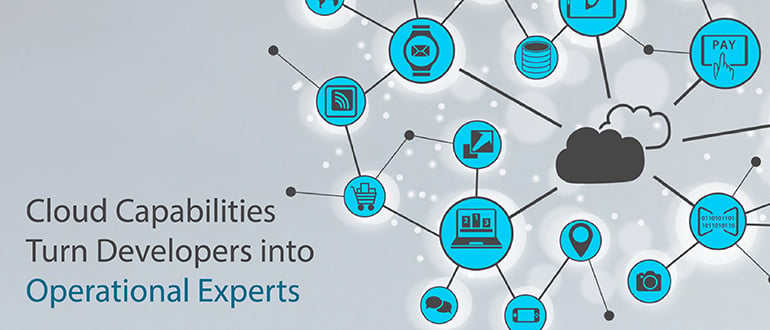
    Cloud Capabilities Turn Developers into Operational Experts

    The upside-down world of digital transformation can leave you feeling like you’ve fallen down an internet rabbit hole. If you’re a DevOps denizen, the swirling pace and scale of virtualization might give you that “lost in the Technicolor forest” feeling when it’s time to release an app into the wild. “Curiouser and curiouser!” you say as you try to sort through hybrid combinations of private and public clouds, CDNs, and data centers.

    As a developer, you worked hard on the design, build and test—now you want to make sure it takes the best, fastest path to microservices and users. It’s folly to trust the answer from any one source—synthetic measurements may purr like a Cheshire Cat over hardware health, meanwhile the White Rabbit of RUM (real user measurements) is spazzing out over latency and traffic jams. The lesson Alice finally learns in Lewis’ timeless tale? She must learn to control the journey herself.

    Developing for the Complex Cloud

    Fortunately, there’s a way for developers to mix that “just right” solution that will reveal the right path through the internet forest. This used to be the purview of operations—setting up servers and delivery conduits. In the pre-cloud era, developers just wrote code. Somebody in Ops pushed it live, and that part of the process was opaque to the developer. With the proliferation and maturation of the cloud, the Ops team is increasingly focused on dynamic infrastructure and services. Developers routinely spin up their own servers. As DevOps teams focus more on microservices and containers and less on “stacking and racking” servers, performance, control and delivery become the focus areas that matter.

    As the division between Dev and Ops experts continues to dissolve, each becomes increasingly aware of the other’s roles, responsibilities and skill sets. The goals of agile development, non-stop testing and optimized delivery become the shared destination; paths merge until everyone is creating momentum around the prized feedback loop. As infrastructure and services become more abstracted, the focus is less on writing original code and building stacks and more on selecting resources. The selection and use of these resources has to be strategically guided by real-time intelligence to meet multiple performance and business objectives. The more abstract and hybridized the infrastructure becomes—and it is moving rapidly in that direction for every business—the harder it is to navigate. If you can’t keep all your resources straight, you can’t optimize them. Centralizing and automating tracking and traffic management is mission-critical.

    The Delivery is in the Code

    Which brings us back to the developer’s mandate to control and optimize delivery from the application. Cloud-based delivery tools combine real-time user measurement with scriptable application traffic shaping and built-in cost controls. Gone are the days of blaming poor performance on the network. End users expect seamless, instantaneous experiences, no matter what. This is a tall order for modern apps that combine video, microservices and dynamic content. To ensure high quality of experience (QoE), you have to automate and optimize with software-defined delivery. Developers can now contribute to optimization by coding in delivery intelligence.

    This isn’t merely another task for the developer; it’s an opportunity. Developers are now empowered to deliver the functionality of their product or service exactly as designed. Developers are now actively part of the process that brings together global and local traffic management data (RUM and infrastructure health), application performance management and cost considerations to ensure the cheapest, fastest path to that microservice. The balance and mix of these factors can be customized and fine-tuned by the developer (a.k.a., the newly minted operations expert).

    The Bleeding Edge Becomes the Bedrock

    You know the cloud is no fairy tale when 74 percent of tech CFOs claim that this year the most measurable impact on their business will come directly from cloud computing. Spending on cloud computing is set to grow at 19 percent CAGR through 2020, six times the rate of overall IT spending. Developers who can harness the magic of hybrid cloud/CDN for video, web content and application delivery will be rock stars. Picture it: fully automated delivery based on business rules, actionable data from real user and synthetic testing, and self-healing network optimizations. Developers can push their capabilities and control right to the bleeding edge, making them an even more agile contributor to the continuous improvement cycle.

    Soon enough, as technology progresses and infrastructure is increasingly software-defined, these skills will become a requirement. Over the next few years, this data-driven approach to app and content delivery will be considered a standard capability for digital businesses and a core responsibility for developers. The forward momentum of organizations that have committed to both cloud-first and DevOps-first strategies is powerful and will quickly boost early adopting competitors out of reach. The number of developer-operators capable of managing application delivery in capacity-aware, consumer-responsive, application-tuned ways will soon build to critical mass. Don’t get left behind, wandering lost in the woods.

    About the Author / Andrew Marshall

    Andrew Marshall is the Director of Product Marketing for Cedexis, and has driven product marketing efforts at New Relic, Amazon Web Services, and Microsoft. Connect with him on LinkedIn.

  • DevOps Chat: Madhura Maskasky, Platform9

    DevOps Chat: Madhura Maskasky, Platform9

    This DevOps Chat is with Madhura Maskasky, co-founder and VP of product at Platform9. If you are not familiar, Platform9 offers an “open source as a service.” While that sounds pretty cool, think managed hybrid cloud and now managed Kubernetes in an infrastructure-agnostic service.

    Madhura does a great job of explaining this, so have a listen for yourself. As usual, below the streaming audio player is a written transcript of our session.

    Alan Shimel: Hey, everyone, this is Alan Shimel of devopsy.kinsta.cloud here for another DevOps Chat. Our guest on today’s DevOps Chat is Madhura Maskasky. Madhura, welcome and thanks for joining us.

    Maskasky: Thanks for having me. I’m excited to be here.

    Alan Shimel: Madhura, I didn’t mention in introducing you; you are with Platform9, an open source-as-a-service company. Correct?

    Maskasky: Yeah. I’m VP of Product and co-founder at Platform 9 Systems. What Platform9 does is we pioneered a unique model, a SaaS-based model for deployment of complex open-source cloud-native frameworks such as OpenStack and Kubernetes.

    Alan Shimel: Beyond sort of that tagline, Madhura, I believe—was it your co-founder or CEO that I might have interviewed at—I want to say it might have been the DevOps Enterprise Summit.

    Maskasky: Yeah. It must be Sirish Raghuram.  

    Alan Shimel: Yeah. It was kind of my first introduction of Platform9 and I was kind of taken with the business model. I thought it was interesting and unlike anything I had seen to that point. As I mentioned, Madhura, beyond the tagline, can you give our audience really a sense of what it is that Platform9 is doing?

    Maskasky: Absolutely. As we started, our roots come from VMware. That’s where myself and my co-founder spent about seven-plus years. A common theme that we saw working with mid to large-sized enterprise customers at that time was the amount of struggle they were going through trying to realize this vision of a private cloud, which was a concept that had started becoming popular for a about a year at that point.

    The reason for it starting to become popular was because public cloud had set such an exceptionally high bar for how easy it can be to consume infrastructure. But yet, enterprises, customers of VMware or otherwise, were really failing to live up to that high bar and create an equal offering that utilized their internal resources that might be based on their data centers or in a hybrid way, but create a similar and seamless interface for their internal consumers to consume those resources.

    So Platform9 started with the vision that it should be easy, fundamentally as easy as consuming a public cloud, for anyone to consume resources from any infrastructure endpoints, whether they’re private of pubic or hybrid. We wanted to do this using possibly an open source software that’s available, because we also felt strongly that open source is going to be the new norm of how cloud infrastructure is consumed.

    So specifically what Platform9 does, our very first product offering was managed OpenStack, our OpenStack-as-a-service. What that model means is that we deploy the OpenStack control plane in a SaaS-hosted manner. The control plane is deployed outside of our customer’s data center, and then it integrates with their data center or their public cloud endpoint via a mechanism of an agent.

    An agent, if you have a private infrastructure, the agents become the bridge between the private infrastructure and our cloud-hosted control plane. And if you have a public cloud, then we have drivers that interact directly with that pubic cloud endpoint. So, that’s really how the model works, and it lets you get up and running with OpenStack in a matter of minutes.

    Now we’ve repeated the same model with Kubernetes, which is the most powerful container orchestration framework for building your applications using the microservices paradigm, where Kubernetes is also deployed as a SaaS-hosted service on the infrastructure endpoints of the device, so private or public endpoints.

    Alan Shimel: Got it. Of course when I look at it, Madhura, I see, okay, so you had the OpenStack offering, OpenStack-as-a-service, and now you dig into the Kubernetes and containers. I have to assume that—and maybe I shouldn’t assume. Let me ask you: How quickly is that OpenStack market growing?

    Maskasky: We’ve seen a pretty significant growth in our OpenStack customer base just year over year. In 2016 we were at about 50 customers strong. There have been multiple statistics that forecast a pretty strong overall growth in OpenStack revenue for 2017-plus as well. Just yesterday I think I was reading an article that was mentioning a multibmillion-dollar projected revenue growth in the overall OpenStack market, and the fact that Fortune 500s are going to be consuming increasingly OpenStack.

    So even with containers, virtualized infrastructures are not going away any time soon, and the big challenge that enterprise customers face that we see is, on one hand, they are looking to save some money by converting part of their currently virtualized infrastructure into open-source Linux KVM and use OpenStack versus, say, going entirely the VMware route. Or, on the other hand, some customers start by being 100 percent public cloud consumers, but then realize that that’s a very expensive model at scale, and hence want to go to more of a hybrid deployment, where part of their infrastructure is hosted privately or in a service provider data center.

    For both of those cases Platform9 is an extremely good fit because we support both VMware as well as KVM and because of our as-a-service model.

    Alan Shimel: Got it. What about Kubernetes? Maybe it’s because I live in a DevOps bubble, but that seems to be kind of taking off, huh?

    Maskasky: Kubernetes is taking off in a pretty significant way. We felt that Kubernetes was going to start building this level of momentum about a year or so ago, as we were looking at the different container orchestration frameworks and evaluating them for their pros and cons, and the other two optimal ones are Mesos and Docker Swarm.

    Mesos and Docker was in its very early stages with its offering at that time, but the primary reason for Kubernetes being so popular is I would say three important factors associated with it. One is from project maturity. They were kind of the most mature projects—it was built inside Google and vetted inside Google before it became the open source project that it is today. It had a pretty significant community outside of simply Google developers, who are actively contributing to it.

    A new version comes out every three to four months and the pace of iteration is just astounding. In 3 it has a number of enterprise customers publicly vouching for it by showcasing the use cases and examples of how they are leveraging it.

    Alan Shimel: Got it. Madhura, now that we’ve got that straight, let’s talk a little bit about recent news from Platform9. Do you want to share with our audience?

    Maskasky: Absolutely. We shared two pieces of news recently, actually just a week ago. The first one was that the managed Kubernetes offering, which has been in beta for about six months, is now generally available. They’ve had the opportunity to have the offering beta tested with a couple dozen customers since we announced it around June of 2016. So now we are excited to share with the world that it is generally available.

    What it is again, pure Kubernetes deployed as a SaaS-managed service. We think it’s the industry’s first infrastructure agnostic Kubernetes-as-a-service offering, because it lets you consume both your private and public infrastructure, and it comes built-in with a number of enterprise readiness features like multi-tenancies, single sign-on, quota management, as well as being able to deploy highly available Kubernetes clusters.

    Alan Shimel: That’s great. Definitely, again, I just think there’s something—I think the market desperately needs this kind of offering. I remember when OpenStack first came out. Actually, if you remember Cloud.com, Martin Nickens I think was involved in that one and several other companies. It was really at that point in the evolution of migration to the cloud; it was important that people were able to get all the pieces in one box, if you will—cloud-in-a-box, for lack of a better word.

    But in today’s world even that paradigm doesn’t work. People want as-a-service. So if they can get a Kubernetes kind of infrastructure-as-a-service like this and agnostic, it’s fantastic. Also, something called Fission was introduced as well, yes?

    Maskasky: That’s right. That was the second part of our announcement, which is we announced a new open-source framework called Fission. What it is, is it’s designed to be the de facto open-source alternative to AWS Lambda.

    Alan Shimel: I’m sorry. I didn’t mean to cut you off. Go ahead.

    Maskasky: No worries, Alan. So just some context behind it. When it comes to serverless, AWS has really made Lambda extremely popular and introduced this new paradigm of function as a service. But a problem with it that we see is the fact that it locks you into the AWS ecosystem, because Lambda is firmly designed to integrate with all the other Amazon services that are offered in their ecosystem, but it doesn’t necessarily provide built-in integrations for the most popular open-source tools and frameworks that your developers might want to use.

    It kind of goes back to an important piece that we’ve always held, which is the development community loves to embrace the right sort of tools that let them do their job well. They like choice and they do not like being told or being scripted to go to a set of one tools only. So those are some of the motivations behind Fission.

    Now Fission is also built off of Kubernetes, and by having that focus on Kubernetes it has an added advantage that it simplifies consumption of Kubernetes as well.

    Alan Shimel: Got it. In my mind, the company has positioned these Kubernetes offerings to really take a leadership position as we see Kubernetes and containers really kind of explode onto the scene. What’s next for Platform9?

    Maskasky: Kubernetes and containerization is a big part of our road map and our strategy for 2017-plus. We’re just getting started with managed Kubernetes going generally available. We have a ton of work ahead of us as part of our road map, and we’re looking for customer feedback as well, truly making the offering cloud-agnostic, enabling as many current points as our customers would like us to offer with built-in integrations, providing the ability to create federated clusters across these current point. So, in a nutshell, really realizing that true hybrid container-as-a-service vision through the managed Kubernetes offering.

    That’s one. The second big part is, again, Fission. Fission has just gotten started as an open-source project. We’re looking to make it the de facto way of running function as a service within Kubernetes. So we’re looking to work with the CNCF, the Cloud Native Computing Foundation, and we are looking for the Kubernetes community to really start investing in it.

    We’re seeing some grassroots early traction adoption. Someone in the community recently built a dot-net client for Fission and out-of-box support for Node.js and have been building support for Go. We’ve been hearing folks who started using Fission on top of their internal community’s deployment and they’re telling us about their use cases. So these are all some points of feedback, so we want to grow and build on that.

    Alan Shimel: Got it. Madhura, as I promised you before we came on, the time goes so quickly. We’re already past 15 minutes, but it’s okay. I think we got a great—at least a taste of what Platform9 is all about, and perhaps we could find out more on another DevOps Chat or maybe an article here on devopsy.kinsta.cloud or Container Journal, as the Kubernetes stuff certainly lends itself to that.

    Madhura, where can people find out more information?

    Maskasky: The best way to find out more about everything happening on Platform9 is by going to our website, Platform9.com. You can also follow us on Twitter. The handle is @Platform9Sys. Fission has its own website, Fission.io, and you can also follow Fission on Twitter as well. The handle is @Fissionio. So that’s the best way to stay on top of all our news.

    Alan Shimel: Fantastic. Madhura—and I’m still mispronouncing your name probably, I apologize—Maskasky, thank you for being this episode’s guest on DevOps Chat. Continued success of Platform9 and please keep us posted. I love the open-source angle. I love the Kubernetes sort of as a service, the serverless stuff with Fission, very, very exciting stuff you guys are doing over there. So please keep us posted and best of luck.

    Maskasky: Thanks, Alan. Thank you for having me. This was a lot of fun chatting with you and absolutely I will keep you posted.

    Alan Shimel: Absolutely. This is Alan Shimel for devopsy.kinsta.cloud on another DevOps Chat, and we hope to see you on another one, another chat hopefully soon. Have a great day, everyone.

    — Alan Shimel

  • Protecting Data in Public Cloud and Hybrid Cloud

    Protecting Data in Public Cloud and Hybrid Cloud

    Backup, business continuity (BC) and disaster recovery (DR) have all been a critical part of IT for more than 30 years—ever since we began relying on technology to run our businesses. Traditional solutions were designed for the world of on-premises infrastructure and structured applications and relational databases. But the world is changing. In the last blog, I talked about the era of digital transformation and the impetus it has on rethinking and reinventing the fundamental backup and recovery architecture for workloads moving to the cloud and applications being born in the cloud.

    The Motivations Leading to Reinvent Backup and Recovery

    Application and data platforms are undergoing the biggest transformation since the dawn of computing. There are several forces at work:

    • New applications. The third-generation applications are geo-distributed, scale across multiple systems, are always on and typically deployed in a cloud-first model.
    • Existing applications are moving to the cloud. They aren’t going away, but companies are moving some or all of them to the cloud. They still need backup and recovery.
    • RPO and RTO windows are shrinking: Enterprises want “always-on” and gone are the days when you could do nightly backups.
    • Smaller companies will go all-in on public cloud. SMBs don’t want to be in the business of IT. They’ve been driving the rapid growth of cloud applications and platforms.
    • Enterprises will build hybrid clouds. Enterprises will deploy applications and data across on-premises and public cloud environments. Scale, compliance and other factors mean they’ll need to keep some systems on-premises.
    • Everyone will use multiple clouds. No one will bet their business on one cloud or one provider. Even now, enterprises are splitting workloads across clouds or cloud and on-premises. Development and test may use one cloud, while the same application might be deployed in a private cloud or a different public cloud.

    Cloud’s Impact on Backup, Recovery and Continuity

    Cloud gives organizations much more agility, operational savings and a pay-as-you go model. Public cloud providers can also build much more resilient infrastructure. Amazon guarantees 99.95 percent availability for EC2 and 99.99 percent for S3; S3 is designed for 11 nines of data durability, with multiple availability zones. Because the cloud is so reliable—and cheap—it’s quickly becoming a backup target for on-premises data. But that shouldn’t trick us into believing backup and recovery are “built-in” when we run applications in the cloud. Even Amazon itself recommends backup services for all AWS-native applications and cloud databases.

    While service availability and data resiliency addresses infrastructure business continuity and disaster recovery, it doesn’t provide point-in-time recovery or application-level intelligence for backup and recovery. As good as the cloud platforms are, they don’t protect against logical errors. And research shows 8 out of 10 errors are logical errors—data corruption, user errors.

    But Won’t Existing Backup Products Work in the Cloud?

    As we noted above, traditional backup and recovery products don’t meet the needs of cloud applications—even for existing applications that have moved to the cloud, and not just because they were built in a different era. Cloud and distributed architectures present several other challenges:

    • Cloud breaks the media server based architecture of traditional solutions. Cloud applications and data don’t reside on a specific array or disk, so you can’t easily backup what you can’t see. Backups also don’t capture configuration data in the cloud, such as AWS Cloud Formation templates.
    • Cloud doesn’t speak the same language. Legacy solutions talk to tape, disk or virtual disks. Backup and recovery in the cloud means integrating with the right protocols, such as the S3 API or Google Cloud Storage.
    • Backup appliances can’t be moved to the cloud. Existing backup appliances that work extremely well on-premises can’t be picked up and moved to the cloud.
    • Traditional backup agents won’t scale. If you could get a backup agent running in the cloud, it wouldn’t scale well across dozens or possibly hundreds of nodes.
    • VM is not the right layer of abstraction: Look for technologies that provide a scalable application-centric view of data management and data protection, introspect application data and use global semantic de-duplication to achieve storage efficiencies, instead of relying on traditional de-duplication techniques. The benefit of this approach is fine-grained and highly space-efficient data protection that can span clouds over network links.
    • Cloud Gateway or Migration Services: Unidirectional only.

    The problem of backup and recovery of cloud applications is novel there are three critical things a cloud backup and recovery architecture should have:

    • Elastic compute only. The architecture should scale efficiently on elastic compute instances. There shouldn’t be any CapEx costs for servers or appliances.
    • No media servers. Backing up large scale out databases requires direct a parallel streaming architecture for data movement between the database and secondary storage. Legacy backup architectures rely on media servers that would quickly become choke points. Direct parallel streaming also allows the data to remain available in native formats.
    • Semantic deduplication. Scale-out application databases typically have a 3x replication factor. If you backup individual nodes or even manage to snapshot the whole database, two-thirds of the backup data is redundant. Over time, backups will be 75 percent to 80 percent inefficient without semantic deduplication that works across a distributed architecture.

    — Brian Yin

  • Top Reasons to Use Node.js

    Top Reasons to Use Node.js

    When considering the architecture of a new web app, it might be a good idea to include Node.js in the discussion as a key part of that architecture. Node.js could provide you with additional speed, can be used on numerous platforms and has an active community from which to get modules and other assistance.

    What is Node.js?

    Node.js is a server-side platform developed by Ryan Dahl in 2009. It was built on Chrome’s V8 JavaScript engine and designed with a non-blocking, event-driven I/O. It is also cross-platform, able to be run on Windows, Linux and OS X. Its non-blocking I/O is due to its use of asynchronous functionality, which keeps the server from waiting on data to be returned before being able to move on to other tasks.

    Why Use It?

    Given the architecture of Node.js, a number of advantages are provided both to developers and the resulting apps they develop. A few of these advantages include speed, programming language consistency, real-time apps developed easily and a large number of modules/packages for developers to use while creating new apps.

    Speed

    Node.js offers speed advantages in many cases. First, it uses the Google V8 engine, which is optimized for JavaScript speed. Also, its use of non-blocking asynchronous behavior can ease the time it takes for users to see actions as complete, since things can be going on in the background while the user moves on to other tasks.

    One Language

    JavaScript is listed as the most popular programming language. Source: Thenewstack

    Using Node.js, front-end and back-end code can both be in JavaScript, so your developers don’t have to transition between languages as they move through the stack. Some architectures, such as the MEAN stack (MongoDB, Express.js, Angular.js, Node.js), are designed around this principle. In this case, the stack uses JavaScript for Express, Angular and Node. MongoDB uses BSON for database queries, which uses the same syntax as JSON (JavaScript Object Notation).

    Seeing full-stack developer as the largest occupation and JavaScript as the top language among both back-end and front-end aligns with what we’ve been seeing in overall JavaScript adoption.

    Source: Mikeal Rogers, Node,js Foundation Community Manager 

    For developers, this can help both with moving across the stack during development as well as help communication among developers, as they will be referencing the same language (JavaScript) while discussing programming decisions.

    Real-Time Apps

    Node.js is a great platform for creating real-time apps. With a module such as Sockiet.io, you can create real-time chats, games and more. Along with its non-blocking asynchronous architecture, real-time apps can be developed with plenty of speed and responsiveness.

    Modules

    The Node Package Manager (NPM) makes it easy to install packages that others have developed to perform any number of tasks. This helps to encourage code-sharing among developers and to reduce the amount of custom development that has to be done when one or more packages can take care of that coding for you.

    Notable Examples

    Some notable examples of Node.js use are Paypal and Uber, showing that it can, indeed, be useful for large projects.

    Paypal

    Node.js and an all Javascript development stack helped PayPal bring efficiencies in engineering and helped rethink and reboot product, design and operational thinking.

    Source: Sameera Rao, Paypal Sr. Business Products Engineering Manager 

    Back in 2012, Paypal had a single app running all things, including UI, API and more. This included a lot of duplicated code that was copied and pasted from one app to another to make apps for different locations.

    Using Node.js, the company was able to modularize and clean up its code and processes, which in turn sped the development of apps it needed at any given time.

    According to Paypal’s engineering team, they were able to build the Node.js app with 33 percent fewer lines of code and 40 percent fewer files, and were able to build it twice as fast and with fewer people than before. Certainly, Node.js proved to be advantageous to their development.

    Uber

    Uber used Node.js from the beginning, and its distributed system was a perfect fit, since a lot of network requests are made. The non-blocking asynchronous I/O used by Node.js helped to ensure those requests could be made and handled quickly to provide the best service possible.

    Conclusion

    The benefits of Node.js have been proven. It helps speed development, can be used on numerous platforms and has an active community from which to get modules and other assistance. Include Node.js in your future conversations about website architecture.

    — Brian Wheeler

  • 12 Tips for Managing Your Multi-Cloud Environment

    12 Tips for Managing Your Multi-Cloud Environment

    No single cloud vendor has the perfect solution for your unique business situation. The only way to maximize the benefits of cloud services to your business is by dealing with several cloud providers and monitoring all of them simultaneously. That’s the IT equivalent of singing an aria while standing on your head and scrambling eggs. (Not really, but it can seem that way.)

    Here are 12 things to keep in mind when planning your company’s multi-cloud strategy:

    • Map your entire network, and then identify where the cloud fits in it. Get a clear picture of the cloud’s role in your overall system-management strategy to avoid having to backfill gaps in the data needs of business managers and other customers. Different lines of business will be best served by different cloud providers.
    • Work with vendors that respond quickly and positively to the unexpected. There will always be unforeseen situations when you’re stitching together multiple cloud services. Your partners should report regularly on the state of their services, enhancements, and new features.
    • Automate low-level monitoring and maintenance tasks. Two primary reasons for adopting cloud services are cost savings and more efficient operations. One way to achieve both is by reducing the amount of human oversight required to keep your systems humming.

    The potential complexity of multi-cloud management is shown in this flowchart encompassing the many elements that need to be stitched together precisely. Many of these low-level operations must be automated to optimize your strategy. Source: Carl P. Lehrmann, 451 Research

    • Follow your users. Pay close attention to how the “consumers” of your apps and systems are actually putting the tools to use. They are the best indicators of which processes are the biggest productivity boosters. You can also learn about any new services the users discover that help them get their work done faster, more efficiently and/or less expensively. This lets you get a jump on the kinds of tools the users are most likely to need in the future.
    • Double down on cost controls. You can’t control what you can’t see. Dealing with multiple vendors complicates the process for requisitioning new services. To avoid unnecessary impediments to quick implementation of useful new services, devise a purchasing process that is as flexible as the services themselves. However, not long after the service honeymoon period, evaluate whether each new service is proving to be worth the cost and whether there are better and/or less-expensive alternatives.
    • Application life cycle continues to dictate cloud migration. Data centers may be shrinking, but they are definitely not disappearing. For reasons related to security, compliance, insurance, and any number of other factors, some systems are staying in house for the foreseeable future. You certainly want to avoid attempting to lift and shift an in-house app to a cloud service, particularly one that is only a couple years old and thus hasn’t yet paid for itself. Once an older system is ready for a reinvention, it’s easier to make a business case for going cloud-native.
    • Take advantage of the power of pre-emptable virtual machines. Because they persist for no longer than 24 hours, pre-emptable VMs are a good choice for batch processing and fault-tolerant deployments, according to ComputerWeekly’s Matthew Cooter in a November 2016 article. Pre-emptable VMs are as much as 80 percent less expensive than Google’s regular instances, and their fixed price help companies plan and manage their costs.
    • Adopt an integrated data center management system designed for virtual environments. This is the only way to ensure your server, storage, network, security, operations and applications teams are working as a single unit toward common goals, according to Jay Litkey, president and founder of cloud service provider Embotics, in a November 21, 2016, article in Virtual Strategy magazine. Any organization structured around traditional physical infrastructure boundaries is destined to struggle with the shift to hybrid and multi-cloud environments.
    • Identify the apps in your organization that are best suited to cloud-native implementation. Traditional apps are monolithic, run as VMs, use a scale-up architecture and are generally more difficult to develop, deploy and maintain. By contrast, cloud-native apps are more modular and service-oriented, comprised of collections of containers and services, based on a scale-out architecture, and easy to automate, move, and scale.

    Focus on the apps in your organization that will benefit most from a cloud-native approach, and wait on those that are better served by deployment on a traditional data-center platform. Source: TechTarget

    • Match your apps to the services that play to their strengths. Big-name services such as VMware and AWS have bifurcated to meet the diverse needs of their customers. For example, VMware’s vSphere-based Enterprise Hybrid Cloud is intended for traditional apps, and the company’s Native Hybrid Cloud is designed for modular, microservice-based systems. Similarly, AWS’s Elastic Compute Cloud, Elastic Block Store, EFS file system and VPC private networks mimic in-house data centers, while the company also supports higher-level services such as NoSQL databases, BI processing, Hadoop-like clusters, message queues, push notification services, media transcoders and search engines.
    • Automate policy across cloud environments. The only efficient approach to use of multiple cloud services is to have a single standard for policies that are applied automatically to each environment. The policies cover such areas as virtual servers, workloads, data storage, traffic flows, compliance/regulation, reporting and security. It’s also easier to apply updates and changes when you have a single configuration across different infrastructures because the changes propagate seamlessly from environment to environment.
    • Vendor lock-in becomes a thing of the past. When you rely solely on one public cloud service, it can be difficult to migrate virtual machines and other resources to another service. Among the factors to consider are comparable read/write loads, data transfer needs and network latency. By relying instead on your custom combination of cloud services, all of which share policies and configurations, you find yourself managing the change instead of the change managing you.

    — Brian Wheeler

  • Azure vs. AWS for the Enterprise

    Azure vs. AWS for the Enterprise

    In a previous post we discussed Azure & OpenStack, the less-explored hybrid cloud, and we thought we’d segue on the hybrid cloud theme, and follow up with an additional post focusing on a question we’re often asked …

    Azure or AWS?

    It’s one of the most common questions enterprise customers today face as they look to go to the cloud. According to this year’s Gartner’s Magic Quadrant report, the two cloud powerhouses are the clear market leaders, and as they each add new services to their arsenal and expand their service offerings, customers must decide which one is best-suited for their business needs. This, of course, is in the context of public cloud, whereas the question of OpenStack vs. VMware usually arises in the context of private cloud. And with reports popping up all the time that demonstrate growing numbers around every hybrid cloud mix-and-match scenario, many enterprises are debating on what to bet their cloud strategy.

    To begin this comparison, it’s important to understand how each has evolved. Azure was built as a holistic platform and has been geared toward the enterprise from the beginning. It began as a platform as a service (PaaS), making it easier for developers to build applications without worrying about the servers on which they’re running. In addition, part of the Azure approach always has been to think about how to integrate each service to the platform as a whole and support enterprises’ IT flexibility with keeping specific workloads on-premises while complementing their IT requirements with services running on the cloud.

    AWS, on the other hand, started scaling from the infrastructure from the beginning. Its approach has been to continually be ahead of the innovation curve and offer services that IT operations can easily comprehend and use to support their compute and storage requirements on demand.

    Market Share Comparison: The Path to Growth

    It’s not hard to see why both AWS and Azure have grown into their roles as the market leaders. Today more than 70 Amazon services can be utilized, including the basic compute, storage and network building blocks, as well as “up the stack” services such as database as a service and even frameworks to easily scale mobile applications, databases and more. AWS has a massive public cloud with the largest data centers in the world, and excels at allowing their customers to choose the building blocks they need to create a variety of service offerings.

    That said, Azure is growing as well, and quickly gaining ground on AWS. Microsoft has moved aggressively to match AWS by enhancing and building up its array of offerings. The company has been selling to the enterprise market for decades and, as a result, has garnered strong relationships with many large global organizations. These efforts and relationships seem to be paying off, as a recent survey of 100 CIOs by Morgan Stanley predicted that Azure would be the largest infrastructure-as-a-service (IaaS) vendor by 2019.

    Enterprise-Grade Product Capabilities

    AWS and Azure both provide comprehensive enterprise cloud services, and they both do it well. The core features of AWS include a large suite of infrastructure and application services that enable running nearly everything in the cloud, from traditional enterprise applications to large web-scale workloads. AWS is the clear winner these days in terms of the number of services it offers; the services are well-connected and provide full cloud capabilities for most enterprise needs.

    Azure is also fast closing the gaps with the enterprise cloud market, including with large-size virtual machines, StorSimple Virtual Array, itsNAS offering and the SQL Data Warehouse. In addition, with its recent announcement of Azure Stack, and via solutions such as Cloudify, Microsoft strengthens hybrid architecture and workload mobility between on-premises and public cloud workloads.

    Other factors that are driving enterprises to adopt Azure include the Azure Security Center (ASC), which provides a centralized view of security policies and configurations from multiple Azure subscriptions; the ability for customers to save time and effort through unified operations tools such as SQL Manager, Visual Studio and other such services; and seamless VM migration to migrate servers between disparate environments.

    Growth Strategies

    Microsoft also plans to invest heavily in cloud growth going forward, with a big push and investment in new features and infrastructure. Microsoft’s Intelligent Cloud unit continues to be the focal point of the company’s growth strategy, as the company claims that nearly 60 percent of Fortune 500 companies use at least three of Microsoft’s cloud offerings.

    Both AWS and Azure, in fact, are investing heavy capital expenditures on worldwide data centers and servers. AWS, for example, has just announced a new Asia Pacific region in Mumbai, India, with two availability zones. And with the introduction of new regions in the U.K., Microsoft has announced 34 Azure regions around the world, with 28 generally available today—more than any other major cloud provider. With certifications such as MCSE and many more, Microsoft has more certifications than any other cloud provider in the industry.

    Both AWS and Azure are poised to continue growing, and both companies have big futures in the cloud market. It’s clear, however, that in the cloud game today, Azure is narrowing the functional gap. Azure gives enterprises the ability to use existing Microsoft software licenses under the Enterprise Agreement (EA), giving enterprises better terms and packages. Microsoft enterprise users are potentially ‘power users,’ and prefer a DIY approach versus pre-packaged and opinionated options. This leaves the market open to more collaboration, such as through the use of Docker Swarm. With this type of approach, users have control over the way they run their apps on various platforms, with open-source orchestration to allow consistent management and control of their applications and services.

    — Sharone Zitzman

  • DevOps Chat: Mark Nunnikhoven, Trend Micro on Hybrid Cloud

    DevOps Chat: Mark Nunnikhoven, Trend Micro on Hybrid Cloud

    devopsy.kinsta.cloud sits down with Mark Nunnikhoven, VP Cloud Research at Trend Micro. We discuss hybrid cloud, hybrid cloud security, DevSecOps and more. Mark is very involved in research on the latest threats and trends in cloud security. This is a great interview that I think you will find very interesting.

    As usual, the transcript of our conversation follows:

    Alan Shimel: Hi, this is Alan Shimel, devopsy.kinsta.cloud, here for another DevOps chat, and I’m joined today by Mark Nunnikhoven of Trend Micro. Mark, welcome to DevOps Chat.

    Nunnikhoven: Thanks for having me, Alan.

    Shimel:  I hope I didn’t mangle your name too bad, did I?

    Nunnikhoven: No, it was perfect. It’s a tricky one. It looks really menacing, but ends up being relatively simple after you’ve heard it a few hundred times, so –

    Shimel: Absolutely, very good. So, Mark, I asked you to join us today—I think we had done a webinar and talked a bit offline about, you know, some of the challenges around securing hybrid cloud and, you know, versus obviously people moving stuff to the cloud, people still have stuff in their data center, and what’s good for one may not necessarily be good for the other, but what’s good for both might be an entirely different thing. And I wanted to just spend a little bit of time with you talking about the challenges of securing the hybrid cloud.

    Nunnikhoven: Yeah, it’s definitely an interesting topic that I don’t think gets enough attention, so I’m glad we can have this chat.

    Shimel: Yep. Before we jump into it, though, Mark, I’d be remiss if I didn’t give you a chance to just let people know, I did mention you’re with Trend Micro, but what is your role there?

    Nunnikhoven: Yeah, I’m the vice president in charge of cloud research. So I look at how organizations are tackling security in the cloud, in hybrid environments for, you know, traditional servers and workloads, containers, serverless, sort of anything that’s breaking new ground. It’s a lot of fun and there’s a lot of really interesting stuff happening.

    Shimel: Great. So, Mark, you know, I think I started us off by saying there’s people who are making solutions for the cloud, there’s people making solutions for the data center, the ARM RAM. And what’s good for one is not necessarily good for the other, and then, of course, most of the world is living in some sort of hybrid environment.

    Nunnikhoven: Yeah.

    Shimel: What do we do?

    Nunnikhoven: [Laughs] That’s a great question, ’cause, you know, I’ve seen—working with organizations around the world, I’ve seen sort of all of the possible scenarios, I think at least the major ones that people kind of come to thinking might work, and they sort of range from we’re going to force data center processes and controls into the cloud, which is a recipe for disaster. You know, they’re very different environments, to the opposite, of we’re gonna take everything that’s working in the cloud and we’re gonna force it on the data center, to, you know, we’re gonna run two completely different environments in completely different ways, and essentially double the workload. None of those is really satisfactory. Sort of the best route forward tends to be looking at what’s working in the cloud and trying to push a lot of those concepts into the data center. But you still need to make adjustments for the reality that the data center is very, you know, sort of slow and very high level of rigor and very formulaic, and, you know, very well-established. So you do need to make adjustments, but, you know, the goal is to get one way of doing things with allowances for the difference in both environments.

    Shimel: Yep. And Mark, as you said, that may be the goal, but, you know, from day one, you obviously—you need a plan to get there. And can you maybe share with our audience a little bit, where do you see the logical steps, if you will, to getting there?

    Nunnikhoven: Yeah, and I think that’s a really good way to phrase it, you know, because we can all—we all love the architecture Powerpoints and you go the events and you get real excited about what the eventual design and implementation will look like. But getting there can be really ugly and really messy. I think the biggest thing, and it’s unfortunately the thing that people tend to forget about, is looking at not just the security, but the operations processes and controls that you’re using today, and why you’re using them. And I think that’s the big piece that people miss, is, you know, why am I using something like an intrusion prevention system, or why am I using anti-malware or why do I have this change review board for any sort of operational change I want to make. And once you start to dig into the why you do these things, you realize that the implementation can change, as long as you’re still meeting that why.

    So, you know, we put intrusion prevention in place so that we make sure that any time we open up traffic to this server, that we verified it is actually secure web traffic like we’re expecting. Once you know that’s the reason, then you can look and say in my data center, that makes sense to have a big perimeter appliance doing that job, whereas in the cloud, it makes more sense to have something running on the host, doing that same job. So you’re still getting the same answer to why. It’s just the how is different in each environment. So it’s—you’ve got to dig into those, and it starts to clarify what you’re doing.

    Shimel: Got it. Mark, what are we seeing—I mean, what—obviously at Trend, you’re probably talking with a lot of customers. Are they coming from the cloud down with their solution? In other words, buying a cloud solution and building—or from the data center up, if you will?

    Nunnikhoven: A lot of the time we’re seeing the data center up, simply because it’ll be one team within a larger organization. So we’re talking mainly, you know, traditional enterprise and large governments. And it’ll be one team that’s gone and said we’re gonna push everything and build it new in the cloud, and when they start to kick off that process, they start to get a lot of existing policy and existing culture enforced on them. So they’ll get, you know, specifically the security. They’ll get people saying, well, you need this, you need to make sure that, you know, you go across these boundaries in your design, you’re networking a certain way. So they start to try to take those same designs, which are great in the data center, but horrible in the cloud, and they try to push those into the cloud, and they usually end up failing. And then about six months afterwards realize that they need to take a new approach, because it is a completely different environment.

    Shimel: Got it. And, you know what, Mark, I’m a firm believer that at least for the foreseeable future, five, 10 years, hybrid cloud is the—is the dominant, right, the dominant usage pattern that we’ll see from people. Is this yours as well?

    Nunnikhoven: Yeah, 100 percent. And for me, it’s simple economics. As much as you want to be in the cloud, if that’s the case, if bought in even, you know, you’ll see it at the major events from the big cloud providers. They’ll pull up big enterprises who are—their CEO or the CIO is, you know, yelling from the top of their lungs that they’re gonna be all in on the cloud. Even in those scenarios, they’re still going to take 12 to 18 months to move out of their data centers.

    But the reality is most enterprises have already made a multimillion dollar investment in technology that’s working. It might not be working as fast as they want, but you can’t walk away from that. The cost savings in the cloud, if they’re there, are not that significant that you’re gonna leave millions on the table. So the reality is, you know, for a standard data center life cycle, so like you said, a five to seven year term, you’re gonna be dealing with two environments. And it’s not just that it’s two environments, it’s two environments that are completely different. It’s very much apples and oranges. So you do need a different approach.

    Shimel: Got it. And, Mark, I don’t want to put you on the spot, but what Trend Micro specifically, what kind of solutions are you guys, you know, working with customers on?

    Nunnikhoven: Yeah, so one of our big push, and we’ll just hit it real brief, because we don’t want it to be a sales pitch at all, it’s just we have a platform called Deep Security, and we built it with the principle of trying to put security as close to the data and application as possible. And because of that, we’ve been able to adapt it for multiple cloud use, for data center use, for the hybrid scenario quite well, because we’ve taken a lot of the principles that work in the cloud and made it so that you can leverage them where it makes sense in the data center. So a lot of automation, a lot of programmability, and a lot of intelligence in the products so you don’t have to worry about the nitty-gritty of dealing with security day to day, unless it’s really urgent and requires you to intervene.

    Shimel: Excellent. And, I mean, Trend is obviously not the only one doing this, Mark. When we talk about cloud too, I wanted to ask you this, public versus private clouds, where are you seeing this kind of—you know, are we—you know, to me, a private cloud is—goes hand in hand with hybrid, right? But there are people who are doing public cloud and data center, and that’s hybrid as well.

    Nunnikhoven: Yeah, and I find for me, you know, private was a real big push back from a lot of the incumbent data center vendors, and, you know, we’ve kind of gotten out of that hype phase and into the reality of it. And I tend to see what a private cloud is, is somebody who’s taken the data center and adapted a lot of the cloud processes and the ideas behind a public cloud and implemented them within their data center, which can be a really good thing. So you can get on-demand resources, so you just query in API instead of sending out a ticket and getting a bunch of people to do work. You know, getting that accountability, getting that accessibility and that visibility that we’re used to in the public cloud, getting that in the data center.

    So I think the ideal hybrid scenario is leveraging private cloud/public cloud. A lot of people aren’t there with their data center, because implementing change takes a long time. There’s a lot of cultural change, a lot of tooling change. So you’ll see them with sort of more the traditional data center approach. But if they want to be successful over the next few years, they need to start pushing more of those private cloud ideas internally, because that will help them have one set of processes and tools across both the public and the private cloud.

    Shimel: Makes sense, makes sense. And Mark, what about people, though, who just say, you know what, I’m—I’m biting the bullet, I’m just gonna do cloud, you know, or I’m just gonna do data center. You know, first of all, nothing is forever, obviously, right? You could say that today, but things change. Is the Trend Micro solution, specifically, let’s say, is it one that will work with one, but that scales to the other? Or, in other words, how do we stay out of dead ends?

    Nunnikhoven: Yeah, and specifically from us, this is something we’ve been dealing with with our customers over the last few years, because we’ve got customers who are 99 percent in the cloud and 1 percent in a data center somewhere, and the exact opposite. And it really—you know, every culture and enterprise is unique in what their blend and their mix of those environments is. So having the tool be agnostic to that is really important. So, you know, we’ll scale from protecting one system, to protecting 100,000 systems, with the same platform, very, very easily.

    And I think there are a lot of projects out there, you know, not just commercial offerings from Trend Micro, but we’re seeing this a lot in the operational monitoring space. So, you know, things like Ryman or Logstaff, which are two great open source projects to help you correlate data, they work equally well in the cloud as they do in the data center, and I think that’s really a big win for people, is that you need to put the assets in the environment that makes the most sense, but you should be able to use modern tools in both. And that’s a real big, important point for people to take away, is that you want to be—even if you’re in a traditional sort of slowing evolving data center environment, you want to be making sure that you’re leveraging some of the great advances we’ve made in security and in operational tools.

    Shimel: Excellent, excellent. Mark, we’re coming near the end of our time, as this always seems to go quick. But let’s talk a little bit about the research that you’ve been doing, and just give our audience maybe a little insight. What are you kind of researching now? What do you find really interesting?

    Nunnikhoven: Yeah, the biggest area I’m focusing on right now is the rise of what’s been deemed the serverless architecture. So obviously sort of a poor choice of names. There are servers somewhere. But it’s the idea of leveraging a function as a service as something like Microsoft du jour functions or AWS Lambda, where you’ve just got code that you input that runs in a sandbox on someone else’s system and you don’t have to worry about any of that. So scaling and operational tasks are kind of out the door, but these are heavily leveraging SaaS services and you’re sort of picking the best aspects of multiple providers, and stitching it together into one big application. And there’s a lot of really interesting advantages for the business there, because you’re focusing purely on delivering value to your users.

    But from a security perspective, now you’ve got multiple parties and systems that you have to trust, that have to work together, that have to share security controls, and then that is normally only one application in a suite of others. So you’ve got serverless applications, you’ve got applications that are running on containers, and then traditional applications. So I’ve been looking at not just the serverless, but how you do you address all of these in a consistent manner, so that you can apply security to the data where it’s being processed.

    Shimel: Excellent. Mark, we are butting up against time here, but one last question, and it’s one I frequently ask our guests here on DevOps Chat. If you had to recommend one book to our audience to read, not necessarily the last book you read or anything like that, but one book they should read, what’s your recommendation?

    Nunnikhoven: Yeah, that’s always a tough question. I love reading, so I’m always reading three or four books at a time. And, you know, it’s a safe assumption that this audience has already read “The Phoenix Project.” If they haven’t, they should. My latest favorite in this space is called “The Art of Monitoring.” It’s by James Turnbull, and it’s a look at how to implement metrics and measurements around running applications, regardless of where they are. So it talks about logging, it talks about real-time alerting, and it’s a really great approach, in that, you know, it’s always looking at results. So not just collecting data for data’s sake, but it sort of walks you through how all of this stuff should roll up to give your teams some actionable insight on how your application is doing. It’s a really great book.

    Shimel: Got it, interesting. Well, Mark, thank you so much for being this episode’s guest, of DevOps Chat. We’d like to maybe have you back on sometime and talk to us about more of the research you’re doing. Continued success to you and Trend Micro, and just thanks again. This is Alan Shimel, for DevOps Chat, and thanks for joining us. Until next time.

  • Simplify and Streamline Hybrid Cloud with DevOps

    Simplify and Streamline Hybrid Cloud with DevOps

    The cloud is not new. The virtues of the cloud have been proclaimed incessantly for years, and most businesses have embraced cloud servers and services on some level. The realities of data security and the need to leverage existing investments in IT infrastructure, however, generally result in some sort of hybrid cloud setup, with servers and applications that span both local data centers and cloud providers. Hybrid cloud deployments can be complex and volatile, which is where DevOps comes in.

    I wrote a report recently for devopsy.kinsta.cloud that takes a closer look at the pros and cons of hybrid cloud, and the symbiotic relationship with DevOps. “DevOps Enabling the Hybrid Cloud” examines how DevOps tools and practices streamline management of such an environment. It also looks at some of the security implications and how DevOps can address those concerns.

    The report explains, “Speed and flexibility are imperative for organizations that want to remain competitive. Organizations that strive to lead understand that IT must be viewed as a strategic advantage—a powerful tool for driving innovation and creativity. The hybrid cloud provides a bridge from legacy hardware and assets to cutting-edge concepts such as containers and serverless computing for organizations that do it right.”

    One truism addressed in the paper is that customers—whether they’re external customers of your company or the users within the company that rely on IT services and applications—don’t know or care where your applications or data are delivered from. They know that they want stuff to just work when they need it to work. It’s up to IT to determine the most efficient and effective way to achieve that goal, and to provide a seamless, frustration-free experience. Sometimes that means relying on cloud servers and services, and sometimes it means using local infrastructure.

    I spoke with Justin Foster from Trend Micro about the overlap of hybrid cloud and DevOps, and specifically about unique security issues with hybrid cloud environments. He stressed that legacy tools and traditional approaches to security are not sufficient for the more dynamic hybrid cloud environment. As explained in the report, “Security has to be baked in from the beginning and throughout the development life cycle.”

    A pure cloud infrastructure is unlikely for any established company. It may be achieved eventually through attrition, but there’s no getting around the fact that there already are servers and applications in place. The hybrid cloud approach is the right solution in most cases, and DevOps tools and practices are essential to help manage and secure the hybrid cloud effectively.

    Click here to download the report: “DevOps Enabling the Hybrid Cloud.”

  • DevOps Q&A: SUMO Heavy’s Brodie on the Hybrid Cloud

    DevOps Q&A: SUMO Heavy’s Brodie on the Hybrid Cloud

    Not every expert says DevOps will enable the hybrid cloud. One says it never will. Find out why in this Q&A with Bob Brodie, partner and CTO of SUMO Heavy, a digital commerce design and development firm.

    David Geer: How will DevOps enable the hybrid cloud?

    Brodie: I do not feel that DevOps enables the hybrid cloud. Hybrid clouds are very complex, and DevOps would need to be supported by a team of network and system engineers. The beauty of being on the cloud is that it’s API-driven. You can provision servers and configure and deploy with tools that are easy to set up.

    Bringing dedicated servers into that environment which do not have tooling to match the cloud counterpart means that it can’t be solely maintained by a DevOps team, but rather needs much more support. We have worked in hybrid cloud environments, and have experienced firsthand the amount of effort and resources required to create and maintain a hybrid cloud environment.

    Geer: What makes hybrid clouds more complex than being either fully in the cloud or fully dedicated?

    Brodie: When mixing dedicated servers with cloud servers on the same network, you will likely need parallel VPNs set up so you are not sending your data unencrypted over the internet and so that if there is a networking issue there is a fallback. Setting up full-duplex, parallel VPNs can require both expensive hardware and specialized resources to configure and maintain that hardware.

    Geer: Why have tools such as some of the ones AWS is building (OpsWorks On-Premises) not hit the inflection point where these are making it easier to enable the hybrid cloud? What other tools are examples of this?

    Brodie: OpsWorks On-Premises is just one tool that AWS has. They also have VPNs to connect your dedicated hardware to your virtual private cloud. These tools aren’t necessarily to make it easier to run a hybrid cloud, but they allow you to utilize existing AWS provisioning and deployment tools to set up and deploy to your existing infrastructure.

    Geer: Why do you think these tools never will make it easier to enable the hybrid cloud?

    Brodie: Hybrid cloud infrastructure is inherently more complex than being fully dedicated or fully cloud-based. They are two different types of ecosystems, and are managed differently. They require different skill sets and levels of experience within those ecosystems.

    Geer: Please expand on your following statement: “The problem is that the methodologies behind the two schools of thought (Separate sysops and dev versus DevOps) are vastly different in thought and practice, and to really bring dedicated hardware into a cloud-based architecture is very cumbersome, especially if the dedicated environment is not utilizing complex virtualization.” What does the difference in schools of thought have to do with it? What does bringing dedicated hardware in have to do with it?

    Brodie: My point here is that “DevOps” is often misused. It isn’t a tool, it is a mindset. It’s a combination of development and sysops. A “hybrid cloud” is a mix of dedicated hardware and cloud infrastructure. My main point here is that DevOps practices do not make managing enterprise developments easier across hybrid cloud environments. Hybrid cloud environments are inherently more complex than the alternatives (dedicated hardware or fully cloud-based).

    The reason for this is that development is becoming more and more intertwined with sysops. For example, five years ago you could download MAMP onto your Mac and be fully set up with a PHP & MySQL development environment. Modern PHP development requires a developer to understand specific versions of PHP and MySQL, how to manage them, how various applications communicate with each other and, often times, many other applications (Redis, MongoDB, Queueing systems, etc.). These can be complex to maintain, and even if they are distributed to developers from the ops team, it will often be in the form of Vagrant boxes or Docker files, which the developer will be required to understand.

    This is the nature of the “DevOps” school of thought, versus the traditional “SysOps separate from development” school of thought. The target environment needs to be considered when developing an application. For example, if the application will reside on AWS then the developer will need to have a solid understanding of the tools available on AWS (RDS, EC2, ElastiCache, etc.). The maintenance of these becomes part of the developer’s job, which was not present in previous times. Adding the extra complexity of a hybrid cloud means that the developer needs to understand the underlying network architecture of that system.

    Geer: In what way is the hybrid cloud a settling point, mostly built on marketing?

    Brodie: Hybrid cloud environments are not ideal. They are costly to maintain and provide more points of failure because of the networking between them. What it can do is provide a halfway point for CIOs that are reluctant to move to the cloud, so they can see some of the benefits on the cloud side and hopefully move their organization to the cloud.

    Geer: What are organizations afraid to let go of?

    Brodie: Many organizations are scared to move to the cloud. They may have a CIO/CTO that is afraid of “losing control.” I have seen many environments such as this.