Tag: Harness

  • Harness Launches Open Source Gitness Platform

    Harness Launches Open Source Gitness Platform

    At its unscripted conference today, Harness unveiled a streamlined open source git platform, dubbed Gitness, that is significantly lighter weight than the platforms DevOps teams traditionally rely on to build increasingly complex applications.

    At the same time, the company is adding four additional modules to its continuous integration/continuous delivery (CI/CD) platform to improve developer productivity and make it simple to build and deploy secure applications.

    Finally, Harness is launching an Engineering Excellence Collective, a consortium of 300 senior engineering leaders. The collective is developing a maturity model based on 11 pillars for achieving software engineering excellence; a FinOps Excellence community initiative was also announced to advance best practices for controlling cloud computing costs.

    Harness CEO Jyoti Bansal said the need for a modern open source Git platform—as an alternative to legacy platforms developed a decade ago—has never been more apparent. Gitness provides all the collaborations, performance, analytics and security capabilities DevOps teams require in a streamlined platform that reduces overall bloat by seamlessly integrating, for example, code hosting and automated pipelines, he added.

    Other core capabilities include automated status checks and mandatory reviews, branch protection rules, user access management tools and a semantic search engine that has been infused with generative artificial intelligence (AI) capabilities that invoke multiple large language models (LLMs).

    Collectively, the approach reduces the amount of time spent when attempting to integrate and manage disparate tools on legacy platforms that inevitably lead to the creation of additional bottlenecks, said Bansal. Rather than bolting on additional tools, the time has come to simplify software engineering by migrating to a platform specifically designed to address modern software engineering requirements, he added.

    Designed to be installed using Docker contains in a matter of minutes, DevOps teams can also take advantage of tools to automatically migrate their existing repositories and pipelines from platforms such as GitHub and GitLab.

    Gitness is also at the core of one of the four additional modules that Harness is adding to its portfolio. The Harness Repository is a premium tool, available in beta, that provides governance and compliance-as-code capabilities embedded within the repository.

    The three other modules being added are a Harness Internal Developer Portal based on open source Backstage software, Harness Infrastructure as Code Management that makes it simpler to implement GitOps workflows at scale and Harness Software Supply Chain Assurance to provide visibility into open source software components and manage the creation of software bills of materials (SBOMs).

    It’s not clear whether DevOps teams are ready to rip and replace existing platforms, but the pressure to improve developer productivity has never been higher. Organizations increasingly realize that developers are spending the bulk of their time managing development environments tied to legacy platforms that create bottlenecks and are becoming more costly to manage and sustain.

    Harness, in effect, is now calling for the establishment of an alternative approach based on open source software that promises to streamline software engineering workflows. As applications incorporate microservices, security controls and AI models, they are only going to become more challenging to build and deploy at scale.

  • Harness Brings Generative AI Capabilities to DevOps Workflows

    Harness Brings Generative AI Capabilities to DevOps Workflows

    Harness today added a raft of generative artificial intelligence (AI) capabilities to its continuous integration/continuous delivery (CI/CD) platform as part of a larger effort to reduce the level of manual toil that today conspires to create DevOps bottlenecks.

    The added generative AI capabilities include an AI Development Assistant (AIDA), which analyzes log files and correlates error messages with known issues. It also includes the ability to use natural language to define policies for governing cloud assets and costs and an ability to automatically identify security vulnerabilities and generate code fixes.

    Other generative AI capabilities that will be added to AIDA over the next three to six months include automated code reviews along with tools for creating pipelines and launching chaos engineering experiments.

    Harness CEO Jyoti Bansal said these are the first of a series of generative AI capabilities that will be applied across the entire software development life cycle (SDLC) using large language models (LLMs) that the company has trained using publicly available sources. AIDA, at its core, provides a tool for creating custom prompts for launching queries against LLMs and a vector database that Harness has incorporated into its platform.

    That approach means no customer data was used to create the model and none of the data used will find its way into a generative AI platform that is available to anyone, said Bansal. As a result, organizations don’t need to be concerned they light run afoul of licensing issues because proprietary code was inadvertently included in an LLM, he added.

    Most of the existing generative AI capabilities that have been brought to market thus far are designed primarily to improve developer productivity, noted Bansal. Harness is now bringing the benefit of generative AI to DevOps teams that today rely on too many manual processes to manage the automations they build on behalf of application development teams, he added.

    Harness is making AIDA available at no extra charge at a time when many DevOps teams will soon be evaluating the AI capabilities provided to them. Most DevOps teams are not going to want to manage workflows without being able to rely on AI to reduce toil and eliminate bottlenecks. Overall, Harness is forecasting generative AI will drive a 30% to 50% increase in DevOps productivity. In addition, Harness is forecasting there will be a 50% to 75% reduction in the time spent remediating vulnerabilities.

    Bansal said that as that process occurs, Harness is betting more organizations will move to replace legacy CI/CD platform with more modern alternatives.

    Previously, Harness has invested in machine learning algorithms to automate a range of DevOps tasks. Generative AI, in combination with machine learning, will transform DevOps workflows in ways that will ultimately improve both the rate at which applications can be built and their overall quality.

    It’s not clear whether organizations might be willing to replace CI/CD platforms that they have been customizing for decades, but at the very least, that option is now more widely considered than ever.

  • Harness Acquires Propelo to Surface Software Engineering Bottlenecks

    Harness Acquires Propelo to Surface Software Engineering Bottlenecks

    Harness this week announced it has acquired Propelo, a provider of an analytics tool that identifies bottlenecks in software engineering processes. Terms of the acquisition were not disclosed.

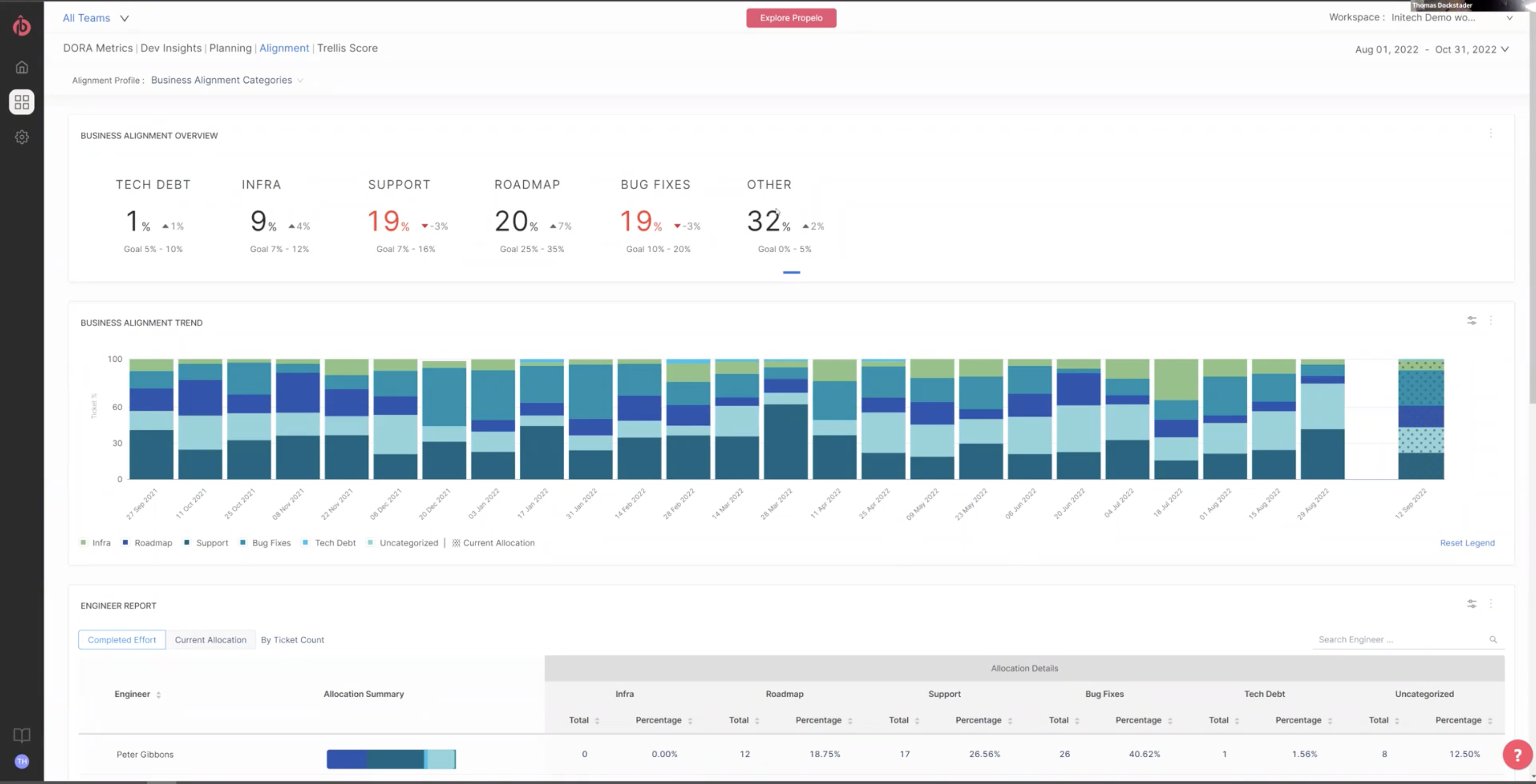
    The Propelo offering will be made available as a module, dubbed Harness Software Engineering Insights, that organizations can choose within the company’s overall continuous integration/continuous delivery (CI/CD) platform.

    Scott Sanchez, chief marketing officer for Harness, said Propelo is unique in that all the integration required to collect data from a wide range of DevOps platforms is already baked into the tool. As a result, DevOps teams can instantly collect telemetry data from not just the Harness platform but also CI/CD platforms such as Jenkins, GitLab and Azure. In addition, there are integrations with more than 40 third-party tools, such as the Jira project management software from Atlassian.

    Those integrations enable the Harness Software Engineering Insights module to surface insights aligned with the DevOps Readiness Assessment (DORA) metrics from Google and the satisfaction, performance, activity, communication and efficiency (SPACE) frameworks.

    In an uncertain global economy, there is more focus than ever on increasing the productivity of DevOps teams, noted Sanchez. More organizations are going to be reluctant to hire as many full-time employees as they once did, so more attention is being paid to getting the most out of existing investments, he added.

    That focus on productivity will naturally lead to a re-examination of workflows to identify bottlenecks in DevOps workflows that, if eliminated, would help increase the pace at which software is being developed, said Sanchez. In some instances, the software development life cycle (SDLC) processes companies are using are as much as 20 years old, he noted.

    The acquisition of Propelo is the latest addition to a portfolio of DevOps tools designed to be deployed alongside existing platforms, noted Sanchez. Organizations that have been using platforms such as Jenkins are not going to rip and replace overnight, he added. The Harness portfolio is designed to be deployed alongside existing platforms to enable organizations to modernize their DevOps workflows in a much less disruptive way than rival DevOps platforms, said Sanchez.

    Harness initially developed a CD platform before acquiring Drone to add a complementary CI capability. It then acquired ChaosNative to add a chaos engineering tool, based on the LitmusChaos open source tool, that is now being advanced under the auspices of the Cloud Native Computing Foundation (CNCF).

    It’s not clear how quickly organizations will modernize legacy DevOps platforms. Still, in many cases, workflows and pipelines that were designed for a different era of application development are not able to support the pace at which modern cloud-native applications are being developed. It will, of course, be up to each DevOps team to determine whether adding additional DevOps tools and platforms makes economic sense; application developers tend to naturally gravitate toward organizations that reduce as much development friction as possible.

    In an era where organizations are counting on developers to drive digital transformation initiatives, the underlying DevOps tools and platforms employed to build applications can easily make the difference between success and failure.

  • Harness Acquires ChaosNative to Meld Chaos Engineering, DevOps

    Harness Acquires ChaosNative to Meld Chaos Engineering, DevOps

    Harness this week announced it acquired ChaosNative as part of a plan to more deeply integrate chaos engineering with DevOps workflows.

    At the same time, the company added a Harness Service Reliability Management (SRM) and Harness Security Testing Orchestration capability to its continuous integration/continuous delivery (CI/CD) platform.

    Chaos engineering, as a discipline, refers to experiments on a software system that test its resiliency in the face of an unplanned outage. The goal is to deliberately make resources unavailable to see how the application environment either adjusts or whether it fails.

    ChaosNative’s LitmusChaos platform, which manages these chaos engineering tasks, was donated to the Cloud Native Computing Foundation earlier this year.

    Scott Sanchez, chief marketing officer for Harness. said the company plans to shift chaos engineering further left as part of an effort to enable developers to test the resiliency of their applications before they are deployed in a production environment.

    It’s still early days where adoption of chaos engineering within DevOps workflows is concerned. Many IT leaders’ performance is measured based on the stability of application environments. The idea that they should deliberately break something as part of an effort to make an application more resilient requires a shift in mindset, noted Sanchez.

    However, once IT leaders start to appreciate how chaos engineering actually improves the availability of applications it’s only a matter of time before the practice becomes more widely implemented, he added.

    In the meantime, Harness is looking to automate more of the lower-level tasks that today’s DevOps teams often manually manage. Harness SRM enables DevOps teams to automatically track service level objectives (SLOs) that are attached to specific pipelines within the Harness CI/CD platform.

    The Harness STO module, meanwhile, makes it simpler to orchestrate security testing across multiple pipelines.

    In general, there is now more focus on the productivity of DevOps teams as the number of applications that are being built simultaneously increases. The challenge, however, is not just the number of applications but also the dependencies that exist between them.

    Harness is making a case for a CI/CD platform that automates DevOps tasks by employing, for example, machine learning algorithms to identify which applications are most likely to fail before a build is completed. The goal is to reduce the amount of time DevOps teams waste waiting for builds to complete only to discover that the application almost immediately failed.

    The time, effort and cost of maintaining a DevOps platform will naturally vary as the overall environment becomes more complex. However, as DevOps processes become more automated, the platforms themselves become more accessible to a wider range of organizations. Today, the effort required by a DevOps to set up and then support a CI/CD environment is often considerable.

    Nevertheless, as more organizations rely on custom applications to drive digital business processes, it’s only a question of when and to what degree DevOps best practices will be more widely adopted. After all, the total cost of application downtime is only going to rise in the age of digital transformation.

  • Harness Expands Software Delivery Platform With Acquisition of ChaosNative and Launches Two New Modules to Help Developers Rapidly Deliver Resilient, Reliable, Secure Software

    Acquisition of ChaosNative– Original Creator of CNCF Project LitmusChaos–  
     Expands Harness Software Delivery Platform With Chaos Engineering Capabilities to Help Enterprises Achieve Resiliency Goals

    New Module, Harness Service Reliability Management (SRM), Embeds Service Level Objectives (SLOs) in the CI/CD Pipeline so Developer Teams Move Faster While Assuring Unreliable Code Doesn’t Get to Production
    New Module, Harness Security Testing Orchestration (STO), Automates Security Scanning and Governance to Fix Vulnerabilities Before Deployment
    San Francisco, CA, March 22, 2022—Harness Inc., the software delivery platform company, today announced major platform expansions with the acquisition of ChaosNative Inc., the original creator of the popular Cloud Native Computing Foundation (CNCF) open source project LitmusChaosTM, and provider of ChaosNative LitmusTM, the highly scalable and secure enterprise platform for chaos engineering. Harness also launched two new modules to enable developers to more rapidly deliver reliable and secure software.
    Harness Service Reliability Management (SRM) module enables teams to adopt modern software reliability practices, using SLOs to actively govern the software delivery lifecycle (SDLC). As the first solution to actively manage SLOs in CI/CD pipelines, Harness SRM helps reliability teams eliminate the friction that comes from reliability issues like SLO violations or low error budgets. These problems force engineering teams to focus on stabilizing services, or even stopping deployments altogether, rather than on their core charter—adding new features at velocity to drive business value.

    Harness Security Testing Orchestration (STO) module helps enterprises deliver business value more quickly by increasing security in deployments and reducing vulnerabilities and conflicting aims between developer and security teams in the software deployment process. Harness STO not only eliminates the pain and risk of manually tracking security issues, but minimizes the rework that delays deployment.

    ChaosNative’s chaos engineering capabilities will be available in the Harness platform this quarter. Harness SRM and Harness STO are both tightly integrated with the Harness Software Delivery Platform. Customers can deploy each module independently with their existing tooling or use all of the Harness modules together to build a powerful, unified modern software delivery pipeline that spans CI, CD, Feature Flags, Cloud Cost Management, SRM, STO and Chaos Engineering.

    “Developers are under intense pressure to deliver highly resilient, secure and reliable software with velocity to increase business value, grow revenue, and delight end users. However, reliability, resiliency and velocity have been seen as conflicting goals– and the toil and stress of attempting to optimize for all degrades the developer experience,” said Jyoti Bansal, CEO, Harness. “With the acquisition of ChaosNative and the addition of Harness SRM and Harness STO, the Harness platform bridges the chasm of velocity, resiliency, reliability and security, empowering developers to rapidly and reliably deliver on business objectives while providing an unmatched developer experience.”

    Harness Chaos Engineering Brings the Power of Chaos Engineering to the Harness Software Delivery Platform
    Harness is integrating ChaosNative Litmus into the Harness Software Delivery platform, providing customers with a proven chaos engineering solution. Harness Chaos Engineering improves application reliability across distributed environments, tracks reliability improvements, avoids costly unplanned downtime, reduces mean time to resolution (MTTR), and provides a better end-user experience for customers. Combining ChaosNative’s advanced testing capabilities with Harness’s software delivery platform enables developer teams to take control of their service reliability. The acquisition of ChaosNative is complete and the integration will be generally available this quarter.

    Harness SRM Solves the Problem of Balancing Velocity With Reliability 
    Engineers and reliability teams ultimately share the same goal: protecting their organization from downtime and reputation damage resulting from unreliable deployments, while delivering value and new features to end users as rapidly as possible. The two teams must balance the needs of software engineers striving to deliver software faster to achieve business value with reliability teams prioritizing cautious deployments to avoid rollbacks and maximize uptime. Both velocity and reliability are required to achieve customer satisfaction, so Harness SRM offers a solution to:
    1. Reduce the workload of manually tracking service level indicators (SLIs), SLOs, and error budgets by automating the process.
    2. Enable deployment of highly-reliable software by providing quality and reliability feedback at every stage of software development, with reliability checks such as error tracking and latency analysis.
    3. Give developer teams the freedom to move faster, while ensuring that unreliable code doesn’t get into production, by establishing reliability guardrails.
    For more information on Harness SRM please visit:
    Harness STO Automates Security Scanning and Governance Throughout the Software Delivery Lifecycle 
    Harness STO enables developers to produce deployments with fewer and less severe security vulnerabilities. This can accelerate time to market because potential problems are discovered and fixed before they reach deployment, where the security team would normally discover them. Moreover, detecting vulnerabilities in development, prior to deployment, can significantly reduce rework required when security teams discover vulnerabilities in deployment, which risks slowing time to market for new apps and features.

    Harness STO:
    1. Enables the delivery of highly secure software by automating proactive security scanning and governance throughout the CI/CD pipeline.
    2. Empowers DevSecOps teams to customize governance configuration and establish consistent policies and procedures using policy as code and the Open Policy Agent.
    3. Eliminates time-consuming manual analysis by normalizing, deduplicating and correlating mountains of data from all scanners, delivering a prioritized list of vulnerabilities.
    For more information on Harness STO please visit:
    About Harness
    Harness is the only end-to-end platform for complete software delivery. It provides a simple, safe and secure way for engineering and DevOps teams to release applications into production. Harness uses machine learning to detect the quality of deployments and automatically roll back failed ones, saving time and reducing the need for custom scripting and manual oversight, giving engineers their weekends back. Harness Inc. is based in San Francisco. More on Twitter @harnessio and at harness.io.
  • Harness CD Platform Now Available via Source-Available License

    Harness CD Platform Now Available via Source-Available License

    Harness today announced a free community edition of its continuous delivery (CD) platform is now available under a source-available license rather than a more traditional open source license.

    Scott Sanchez, chief marketing officer for Harness, said the goal is to make CD as accessible to developers and DevOps teams as their current CI platform. Harness already makes an open source edition of its continuous integration (CI) platform available.

    The Harness CD platform is available under a Polyform Shield license that provides free access to the platform, including the right to use, modify and distribute it but not launch a competitive offering. A source-available license is an alternative to an open source license that allows an organization to potentially create a fork of the Harness CD that could, for example, be delivered as a cloud service. That specific issue has led to scenarios where vendors that create an open source project find themselves competing for revenue against a cloud service provider that is not necessarily as committed to contributing and maintaining the primary open source project. At this juncture, it’s not clear how many other vendors that make software available under an open source license might take a similar tack.

    While most organizations that embraced DevOps have been able to successfully implement a set of CI best practices, the number of organizations that have implemented CD is not nearly as high. One reason for that is automating deployments across platforms has never been especially easy. Each platform tends to be customized to the point where it is difficult to automate application deployments. In effect, each platform is its own unique type of “snowflake.”

    However, as the number of digital business transformation initiatives continues to steadily increase, the need to regularly update application experiences is going to require more organizations to implement a set of CD best practices. A source-available license should help increase the number of DevOps teams that can access and experiment with a CD platform, noted Sanchez. The challenge, of course, is that many of those applications are now based on microservices with components widely distributed across an IT environment.

    Historically, CI and CD have been synonymous when viewed within the context of a CI/CD platform. It’s not clear to what degree DevOps teams will look to better leverage the CI/CD platforms they already have in place rather than deploying a dedicated CD platform for IT operations teams and letting developers choose whatever CI platform they prefer. In general, a recent survey conducted by the Continuous Delivery Foundation found that 80% of respondents that work for companies with two or more employees are involved in DevOps to some degree.

    Regardless of approach, the coming year is shaping up to be one where many more organizations take DevOps initiatives to the next level. Arguably, as more organizations realize how dependent they are on software to differentiate themselves from rivals, the ability to deliver new application experiences has become critical. At the core of those efforts is a set of DevOps best practices that will ultimately determine just how competitive those organizations will be.

  • Harness Opens Continuous Delivery Service with Free, Source-Available License to Enable Seamless Adoption of World-Class CI/CD Platform

    DevOps Teams Can Now Use Harness CD with a Free, Source-Available Community Edition, While Enterprise Users Benefit From 100% of Harness CI/CD Code Available in Open Public Repos

    San Francisco, CA, Jan. 19, 2021—DevOps teams seeking a world-class Continuous Integration/Continuous Delivery (CI/CD) platform now have an open source and source-available option in the Harness CI/CD platform. The company today announced that it is opening the CD component of its DevOps platform, which is now free and accessible under a source-available license, complementing its CI platform, which is already available under an open source license.

    100% of the Harness CI/CD source code is now available in public repositories, available at no cost. Users can now quickly and easily get started with Harness CI/CD to build an agile software delivery solution, without license or usage fees. Scaling to additional enterprise-grade features and SaaS plans is a straightforward upgrade path.

    “We opened our source code and product roadmaps to the community to simplify adoption for teams that want a globally adopted and category-leading CD platform, one with AI-powered intelligence that automates deployments and rollbacks so they can get back their nights and weekends,” said Jyoti Bansal, founder and CEO of Harness.

    With today’s announcement, Harness is opening its CD service in a Community Edition under the free and source-accessible Polyform Shield license. This user-centered choice of license empowers Harness users with free and open accessibility to the code, including the right to use, modify and distribute, but not use it to launch a competitive offering.

    The Harness CD Community Edition joins Harness CI Community Edition (formerly known as Drone Open Source), the massively popular open source, cloud-native CI solution available under the Apache 2.0 license.

    The move comes at a period of rapid growth at Harness. The company now has more than 500 employees and continues to add enterprise users of its CI/CD platform, as well as individual services in its product portfolio.

    “At present, the market tends to regard software licensing in a binary fashion, as either open source or proprietary, attaching something of a stigma to source-available licenses,” said Steve O’Grady, principal analyst at Redmonk. “This is unfortunate and shortsighted, because source-available licenses are a legitimate alternative to both. The problem with these licenses is not that they are not open source, but rather that they are periodically represented as such by parties with little regard for industry-standard definitions. While materially distinct from open source and not granting the same breadth of permissions, source-available licenses can nevertheless offer tangible benefits to users and enterprises alike. Harness’ decision to be clear about the differing licenses applied to its CD and CI components, therefore, is welcome.”

    About Harness

    Harness is the only end-to-end platform for complete software delivery. It provides a simple, safe and secure way for engineering and DevOps teams to release applications into production. Harness uses machine learning to detect the quality of deployments and automatically roll back failed ones, saving time and reducing the need for custom scripting and manual oversight, giving engineers their weekends back. Harness is based in San Francisco.

  • Harness Updates Cloud Cost Control Tool for DevOps Teams

    Harness Updates Cloud Cost Control Tool for DevOps Teams

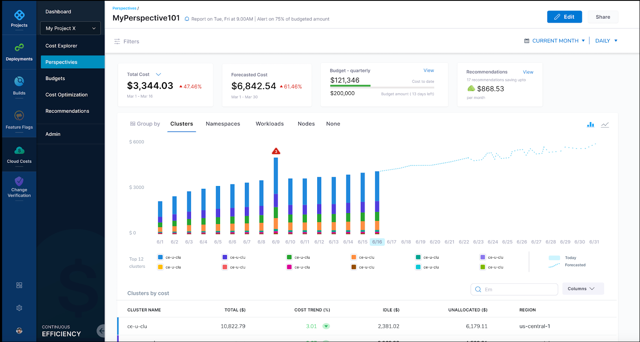
    Harness today announced that it has updated its cloud cost management (CCM) module for its namesake continuous integration/continuous delivery (CI/CD) platform to add support for Kubernetes at the node level in addition to providing business intelligence tools to analyze overall cloud costs.

    Harish Doddala, senior director of product management for Harness, said the update surfaces more granular insights into cloud costs that DevOps teams are incurring because cloud resources are being wasted. The latest version of CCM enables DevOps teams to create their own customized views of those resources.

    As the overall economy continues to recover from the COVID-19 pandemic, more organizations are looking to exercise greater control over IT costs. In the immediate aftermath of the pandemic, many DevOps teams consumed cloud resources without much regard to cost to enable organizations to advance various digital business transformation initiatives. Now, finance teams are requiring DevOps teams to account for those cloud costs.

    The goal is not only to reduce costs whenever possible—by, for example, quickly identifying a sudden spike in cloud resources consumption—but to accurately forecast budget costs on a monthly basis so that both IT and finance teams can collaboratively track spending. The typical finance team is just as concerned about accurately predicting costs as they are the total amount spent.

    Harness Cloud Cost

    Ultimately, Doddala says Harness’ CCM enables organizations to better assess which software development projects to prioritize based on the cloud resources allocated. It’s not uncommon for organizations to suddenly have to shift software development priorities as business conditions change and evolve. A project that may be a top priority today can easily be downgraded because, for example, a rival has been able to launch some new capability that an organization now needs to quickly match.

    DevOps teams, unfortunately, don’t always pay as much attention to infrastructure costs. Harness’ CCM helps reduce those costs by automatically stopping idle resources running on Amazon Web Services (AWS), Microsoft Azure, Google Cloud Platform (GCP) or any Kubernetes cluster, said Doddala.

    There are, of course, any number of existing tools that cloud service providers make available to enable IT teams to reduce costs. CCM, however, provides that capability within the context of a DevOps platform that can span multiple cloud computing environments, noted Doddala. DevOps teams, for example, can create and enforce cost policies for cloud infrastructure into a CI/CD pipeline and prevent an organization from being surprised by a bill from their cloud service provider at the end of the month.

    It’s not clear the degree to which cost control modules will influence the selection of one CI/CD platform over another. However, it’s apparent the days when organizations consumed cloud resources with little regard to cost are ending. In fact, there may soon be more cost controls imposed on software development projects than there were prior to the pandemic. The challenge, of course, is finding a way to automate the implementation of those controls and minimize the impact on software development velocity.

  • Harness Employs ML to Streamline DevOps Workflows

    Harness Employs ML to Streamline DevOps Workflows

    At the online {Unscripted} 2021 conference, Harness today announced an update to its namesake DevOps platform that includes support for feature flags that expose new capabilities to a select number of users for testing purposes along with the ability to prioritize the running of those tests based on the likelihood an application is likely to fail them.

    In addition, Harness is adding a unified pipeline capability that enables DevOps teams to streamline the management of multiple tools that make up a workflow and has updated its cloud cost management module to enable DevOps teams to automatically stop idle workloads. That capability is based on technology the company gained with its recent acquisition of Lightwing.

    Steve Burton, chief marketing officer for Harness, said Harness is now employing machine learning algorithms to identify which tests an application is most likely to fail. That test intelligence module enables DevOps teams to run those tests first versus testing an application only to discover close to the end of that effort that an application will need to be updated and then retested. The amount of time spent on testing is then sharply reduced, noted Burton.

    Overall, Harness is reducing the amount of time and effort spent maintaining DevOps pipeline and workflows, said Burton.

    The cost of maintaining a DevOps platform will naturally vary as the overall environment becomes more complex. It may not be clear how much time a DevOps team is spending on testing, but the faster that process becomes the more likely an application will be thoroughly tested before it is deployed in a production environment. Fixing applications after they are deployed in a production environment is, of course, considerably more expensive.

    At the same time, as the number of applications being built simultaneously increases, the amount of cloud resources being consumed also increases. Developers, however, don’t typically pay close attention to what workloads are consuming which cloud resources, which can result in an unpleasant surprise when the monthly bill from the cloud service provider comes due.

    In general, Burton says machine learning algorithms and other forms of artificial intelligence (AI) will soon become table stakes for any provider of a DevOps platform. The expectation is the platform will routinely employ AI to streamline processes and reduce total costs, noted Burton.

    Many of the manual tasks that DevOps teams regularly perform to maintain a DevOps platform will increasingly become automated as usage of machine learning algorithms becomes more pervasive. It’s not clear to what degree organizations may abandon a legacy DevOps platform to take advantage of those capabilities. However, over time it will become apparent that some organizations are spending a lot more time building and deploying applications than others as the next generation of DevOps platforms, infused with machine learning algorithms, are installed.

    In the meantime, DevOps teams might want to make a list of the manual tasks they perform today as part of an effort to determine how much time they are wasting that might otherwise be spent on tasks that are more valuable to the organization.

  • Modernizing Continuous Integration

    Modernizing Continuous Integration

    In the duality of continuous integration/continuous delivery (CI/CD), CI focuses on build automation. Leveraging CI practices for software delivery is normal for most organizations and can be seen as a solved problem. However, the demand for increasingly distributed applications has risen with the expansion of microservices, and development teams have the expectation that every commit should be a build.

    Continuous integration has, surprisingly, become an unexpected bottleneck with these expectations. To begin modernizing CI, it’s important to first understand some of the challenges. Let’s dig in.

    Challenges of Continuous Integration

    Given that build and release candidates follow advancements in development technology closely — such as new languages, packaging and paradigms in testing the artifact — expanding the capabilities in continuous integration implementations can be challenging. With the introduction of containerized technology, the firepower and velocity required to build greatly increased.

    Scaling Continuous Integration Platforms

    The infrastructure required to run a distributed CI platform can be as complex as the applications they are building because of the heavy compute requirements. Consider how much a local machine’s resources are tied up during a local build and test cycle. Now, multiply that by the number of folks on a team or in an organization and you start to understand just how much compute power is being used. Distributed build runners are just one area that can be complex, and managing when new build nodes are spun up and spun down can depend on the platform/end user.

    Keeping Up With the Technology Velocity

    The adage of “the only constant in technology is change” is true. New languages, platforms and paradigms are to be expected as technology pushes forward. The ease of including new technologies in a heterogeneous build or accepting new testing paradigms, however, can be difficult for more rigid CI platforms. These legacy platforms were designed for only a small subset of technologies. With legacy or rigid approaches, the dependency management required to maintain technical velocity becomes a significant burden.

    What it Takes to Modernize Continuous Integration

    The simplest way to change continuous integration practices and platforms is to take what I call the four-pillar approach: platform infrastructure modernization, engineering efficiency strategy, test optimization and rapid pipeline development. Making strides in any of these pillars will put you on the path toward modernizing your continuous integration platforms and practices. Making strides in all of the pillars will set up your DevOps teams for significant success.

    Platform Infrastructure Modernization

    The location where the actual builds and packaging take place (e.g. build nodes/runners) do most of the heavy lifting and have a fairly elastic workload nature. Builds (e.g. a JAVA JAR build) and packaging (e.g. a Docker Image Compose) are compute-heavy tasks. Once the build and packaging are complete, the runners can sit idle. This shows the importance of having an ephemeral build node. The build node spins up during the task, then spins down or is destroyed after the build task is done, so as to not drain resources.

    Engineering Efficiency Strategy

    A core tenet of engineering efficiency is meeting your internal customers where they are. For software engineers, this means being as close to their tools and projects as possible. Like many modern pieces of application infrastructure, shifting left to the developer means being included in the project structure in source code management (SCM).

    A common disconnect in CI platforms is dependency management. Over the past decade, for software engineers, this problem has been solved with package or build tools such as Maven, Gradle and NPM. Engineers need to simply define implicitly or explicitly what they need, and the dependencies will be resolved. Continuous integration tools can suffer from a disconnect, since we are leveraging several tools that potentially don’t have a common syntax. So, again, it’s important developers have close oversight on all the tools they need to complete their projects to reduce this friction.

    Test Optimization

    While initial confidence in getting tests into the CI pipeline expands, more tests — and sometimes inappropriate test coverage — is introduced by the ease of integration with the pipeline. An even harder problem to identify and rectify is flaky tests. A flaky test is one that both passes and fails periodically without any code changes. This becomes a twofold problem: increasing execution time and lack of confidence with flakiness. The most logical solution to avoid these issues is adding test optimization. A modern continuous integration solution should be able to visualize pipeline order, timings and overall execution to help identity (and eventually rectify) excessive coverage and flakiness.

    Rapid Pipeline Development

    Software is an exercise in iteration. The lower the barriers to entry for iteration to occur, the more gains in engineering efficiency and agility are achieved. Local builds happen dozens of times before reaching a committable stage, moving them forward to a dev-integration environment. It’s here where having a local environment is key. Oddly, most continuous integration pipelines are designed to run externally from a local machine. So, the ability to move to a local CI pipeline helps build confidence that the externally run pipeline will be successful.

    Continue on Your Continuous Integration Journey

    Continuous integration might seem like a solved problem for many organizations, but as with any technology, there is always room for improvement and modernization. Like any engineering efficiency paradigm, CI is a journey and the destination ever-evolving.