Harness today revealed that it will make available a set of open source tools for testing the resiliency of applications that are based on a chaos engineering platform the company gained with the acquisition of LitmusChaos.
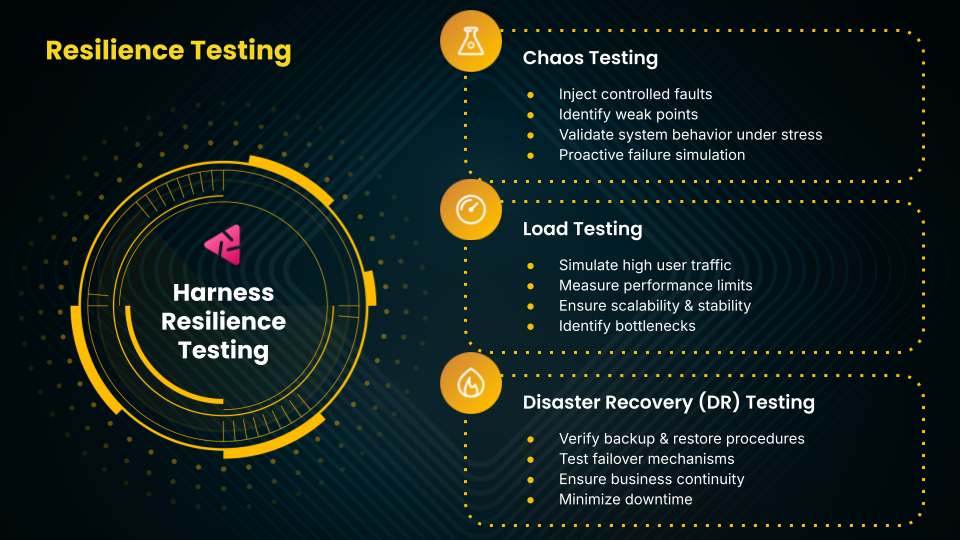
The Harness Resilience Testing platform extends the scope of the tests provided to include application load and disaster recovery (DR) testing tools that will enable DevOps teams to further streamline workflows.
Uma Mukkara, head of chaos engineering for Harness, said those additional capabilities will provide DevOps teams with a more comprehensive set of tools that, in addition to identifying single points of failure, can address application scalability and business continuity requirements.
The load testing capability, for example, will enable DevOps teams to better identify the root cause of bottlenecks adversely impacting application performance, while the DR tools make it possible to verify backup and restore procedures.
The overall goal is to make it simpler to streamline resiliency testing across an entire portfolio of applications, said Mukkara.
At the core of the Harness Resilience Testing Platform is LitmusChaos, an open source chaos engineering framework that Harness gained when it acquired ChaosNative in 2022 and then subsequently donated to the Cloud Native Computing Foundation (CNCF). The Harness Resilience Testing Platform is the means through which Harness is now providing additional value on top of the open source project, noted Mukkara.
Harness earlier this year also added generative artificial intelligence (AI) capabilities to the platform to make it simpler to create tests via a natural language interface, a set of capabilities that will also be extended to the Harness Resilience Testing Platform, added Mukkara.
That AI capability also surfaces additional insights for running the next test in a series to ensure resilient applications are deployed in a production environment. Additionally, Harness has included a set of AI safeguards to ensure that chaos engineering experiments remain narrowly focused.
It’s not clear how many DevOps teams have embraced chaos engineering but it is becoming simpler to create and manage these types of tests using generative AI capabilities that are embedded in testing platforms. DevOps teams should soon expect to be able to invoke a set of AI agents to autonomously run these tests.
Hopefully, as it becomes easier to run those tests the quality of the applications being deployed in production environments will significantly improve. Historically, many DevOps teams have been somewhat hesitant to employ chaos engineering tools because they already know how fragile their applications are. Running a set of tests that deliberately break those applications may seem counterintuitive to a DevOps team that is racing to meet an application delivery deadline.
However, as every DevOps team knows, technical debt as defined by the number of known issues that need to be addressed in the next application update only increases over time. The sooner those issues are discovered while developers are still writing code the easier it becomes to reduce that technical debt by eliminating issues long before an application ever gets deployed in a production environment.