Tag: events

  • Top 5 Reasons to Attend Jenkins World

    Top 5 Reasons to Attend Jenkins World

    The countdown is on! Jenkins World 2017 is coming to downtown San Francisco, Aug. 28-31, for the annual opportunity to learn about all things Jenkins, DevOps and continuous delivery. This year’s event will be held at the Marriott Marquis and will bring together approximately 2,000 Jenkins users, comprised of Jenkins experts, IT executives, DevOps practitioners and partners from all over the world. The event is led and sponsored by CloudBees, the hub of enterprise Jenkins and DevOps, and will offer attendees opportunities to learn, explore and network, while shaping the future of Jenkins.

    As a special offer to devopsy.kinsta.cloud readers, we are offering a discounted registration. Use the promotional code JWDEVOPSCUST during your Jenkins World registration and get 20 percent off!

    Need more convincing? Below are five reasons to attend this year’s Jenkins World:

    • Hear keynotes from industry leaders: Kohsuke Kawaguchi, founder of the Jenkins project, kicks off the conference with the opening keynote this year. Other keynotes you won’t want to miss include Sacha Labourey, CEO of CloudBees and Jez Humble, CTO at DevOps Research and Assessment LLC and co-author of “The DevOps Handbook,” “Lean Enterprise” and “Continuous Delivery.” Kohsuke will provide perspective on the dramatic milestones reached in the community this year, while Sacha will provide perspective on how CloudBees and DevOps are transforming industries. Jez will discuss DevOps principles and practices, how to overcome typical obstacles and the results companies are realizing from DevOps initiatives.
    • Attend optional training and workshop sessions: Leave Jenkins World a Jenkins master by getting certified and/or learning the fundamentals of Jenkins by attending trainings for the Certified Jenkins Engineer (CJE) exam, and the Certified CloudBees Jenkins Platform Engineer (CJPE) exam. There are several other training opportunities and a wide range of workshops addressing topics such as pipeline automation, Docker, Blue Ocean and more. Maximize the learning opportunities through the options offered early in the week, then stay for the conference and get exposure to another 60+ conference sessions.
    • Brush shoulders with the Jenkins stars: Get access to some of the biggest Jenkins experts in the world, attend their sessions and network with them. A sampling of sessions from the Jenkins World agenda includes:
      • DevOps Leadership Panel from Dirk Luedtke, SAP; Kolby Allen, WatchGuard; Moied Wahid, PayPal; Stas Zvinyatskovsky, Accenture
      • The Ten Commandments of Continuous Delivery from Viktor Farcic, senior consultant at CloudBees
      • How We Do DevOps at Rosetta Stone from Kevin Burnett, DevOps lead at Rosetta Stone
      • Azure DevOps Open Source Integrations from Arun Chandrasekhar, senior program manager at Microsoft
      • You also won’t want to miss the ever-popular Ask the Experts booth, where Jenkins experts from around the globe address your specific issues and questions on the spot. You’ll return from the conference armed with a solution to that vexing issue you have been trying to solve!
    • Visit a variety of vendors: At the expanded Sponsor Expo you can check out a range of technologies that integrate with Jenkins as well as DevOps services provided by experts. Check out the booth swag and make sure to check out the news coming from the vendors.
    • Meet the Butler and snap a selfie: You may have seen the Butler on his wild social media adventures recently, but at Jenkins World you’ll have the chance to meet him in person. Don’t forget to snap a pic with him at the social media booth and share with your friends. There will also be Flat Jenkins floating around beforehand—stay tuned to social media (specifically #JenkinsWorld on Twitter) to see where he lands before Jenkins World!

    All of this and so much more awaits you at Jenkins World. Go register now! Use this code JWDEVOPSCUST and get 20 percent off your conference registration.

    See you soon!

    About the Author / André Pino

    André brings more than 20 years of experience in high technology marketing and communications to his role as vice president of marketing at CloudBees. He has experience in several enterprise software markets including application development tools, middleware, manufacturing and supply chain, enterprise search and software quality and testing tools. André has particular expertise in working with the executive teams of enterprise software companies to create unique competitive positioning, build pipeline and establish sustainable market leadership. Prior to joining CloudBees, he served as principal analyst serving technology marketers at Forrester Research. He has also held a number of senior management positions in marketing and communications with companies such as Segue Software, Hewlett-Packard, Unisys Corp. and Bluestone Software. André holds a BS from Eastern University.

  • DevOps Viewpoints from Pink17

    DevOps Viewpoints from Pink17

    I recently had the opportunity to cover Pink17, Pink Elephant’s 21st Annual International IT Service Management Conference & Exhibition in Las Vegas, Nevada. In this case, what happened in Vegas did not stay in Vegas; instead, most came home with actionable takeaways surrounding Pink17’s theme, “Communicate, Connect. Change,” to help grow their businesses.

    The content-rich and comprehensive program, with inspirational keynote speakers, 12 tracks and more than 120 sessions, was a veritable smorgasbord of subjects spanning the IT service management (ITSM) spectrum. This included many thoughtful and informative DevOps-focused tracks. The event as a whole was a well-organized and executed conference. The attendees whom I spoke with thought the sessions were relevant and the peer networking invaluable. Whether you were there for a strategic vision, a tactical plan or operational know-how, Pink17 delivered.

    In this article, I’ll present some key takeaways from the conference along with some interesting conversations I had along the way with three of Pink Elephant’s thought leaders including their visions for DevOps in the ITSM space.

    IT Success is About Delivering Business Value

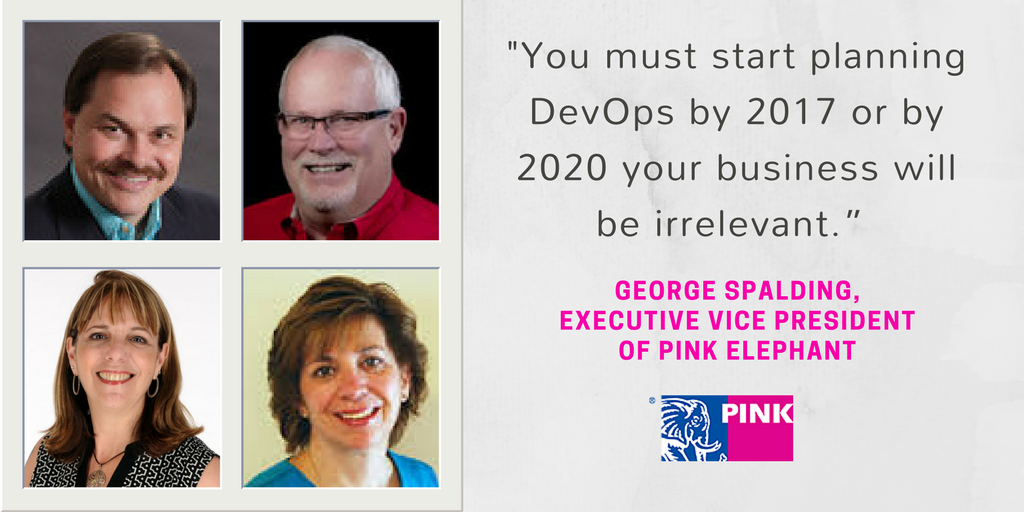
    In his opening remarks, George Spalding, executive vice president of Pink Elephant, had a message for IT professionals: “You must start planning DevOps by 2017 or by 2020 your business will be irrelevant.”

    This message was supported throughout many of the DevOps sessions, such as in “Agile, Lean, and DevOps – Working Together To Increase ITSM Efficiency,” presented by Troy DuMoulin, VP Research & Development for Pink Elephant. In this session, DuMoulin revealed how Agile, Lean and DevOps practices can work together to help organizations achieve the elusive challenge to be better, faster and cheaper.

    According to DuMoulin, much has changed in the IT world in last three years, and although many of the practices are the same, IT professionals now need to do their jobs faster, while at the same time delivering additional business value. “The language has changed. No longer do we talk about maturity, robustness, compliance, risk and availability,” said DuMoulin. “Now Agile, Lean, and DevOps are all about the concept of speed, and efficiency is key.”

    We Didn’t Invent DevOps—It’s Always Been There. The IT Community is Just Refining It

    According to several DevOps speakers, DevOps isn’t just one entity but rather a system of dynamic parts that work collectively together. When everything is about a quest for fast flow, DevOps can be considered a system of value generation. According to DuMoulin and others at Pink17, the key for ITSM professionals to realize is that a DevOps culture is about creating a fast flow for their existing work—not replacing it.

    DevOps Teams Deliver Real Value to Successful DevOps

    In her session, “DevOps Teams: A Continuous Engagement Approach,” Jayne Groll, co-founder and board member of the DevOps Institute (DOI) and also a member of the Pink Think Tank, provided insight into emerging DevOps roles, skills and competencies that are delivering real value to successful DevOps. In particular, she explored various models for DevOps teams to support continuous engagement, shared accountabilities, faster deployments and increasing trust between DevOps, Ops, Security, QA and Support.

    Besides defining the emerging roles and skills in DevOps, including those focused on people, practices and automation, Groll also discussed models and approaches for the creation of DevOps teams including how their value creation differs from today’s hierarchal IT organization.

    “The DevOps Teams are continuous and cross-functional,” said Groll. “These teams demonstrate ‘CALMS’ values—Culture, Automation, Lean, Measurement and Sharing.”

    Make Sure the Right People are at the Table at the Right Time

    Jack Probst, principal consultant at Pink Elephant and a member of the Pink Think Tank, thinks when most people talk about DevOps they see it as an automation play, when really it’s an organizational change and culture effort because people are really rethinking the way in which work will be conducted. According to Probst, the biggest challenge for IT professionals is finding the time to make sure all the right people are at the table at the right time. Regardless of DevOps tools that are used, if people aren’t talking to each other—DevOps won’t work.

    “For me, DevOps is defining the way you put the LEGO pieces together in an organization to make it work,” said Probst.  “DevOps has a lot of buzz, but at its core, it’s a people issue. Adopt and adapt and figure out what’s important and make it work inside your organization.”

    Furthermore, to avoid short-sighted thinking and get the optimal results in a DevOps initiative, organizations need to think of DevOps in terms of people and culture and not only tools.

    Start with Why?

    In her session, “The Yellow Brick Road & The Effective Organizational Change Manager,” Robin Hysick, management consultant with Pink Elephant, discussed the Change Management Body of Knowledge (CMBok)’s 13 critical knowledge areas, the related professional certification levels and how the methods are techniques covered by the CMBok can help organizations manage successful projects and transformative initiatives.

    Robin’s perspective on integrating DevOps into an existing ITSM system is all about the why.

    “The first thing an organization needs to do is to first understand why? I like to refer people to Simon Sinek and his ‘Golden Circle’ explanation,” said Hysick. “We’ve never done this in IT. … Organizations won’t succeed with DevOps and change management until they know why they’re doing what they’re doing.”

    In addition, Hysick teaches the DevOps Institute’s DevOps Foundation and Certified Agile Service Management courses. She says when people come to these classes they usually have no idea what DevOps is—when they leave they understand the concept behind DevOps and where it came from. Most importantly, IT professionals return from the classes knowing exactly what to ask their decision makers so they can best determine how to achieve a DevOps solution.

    Conclusion

    So what were my takeaways from my Pink17 Vegas experience? Mainly that DevOps isn’t only about tools, automation or continuous delivery—it’s about people. The right people at the same table who have the intelligence and the passion for getting to the heart of their business’s why factor?

    Too often IT managers are so busy in the day-to-day needs of quickly producing their products they forget the reason they are doing it in the first place. And the most important question gets lost in our frenetic world of disruptive technology: Why?

    At Pink17 IT professionals learned that to have a successful DevOps initiative, they need to take a beat before they run off to their next sprint or say “we’re doing DevOps now,” and figure out why their business wants to “do DevOps?” What is the business problem they are trying to solve? What change do they want to make it? Why will it benefit their business? What are the opportunities or urgencies of their business and then define what they need to do to make the outcome happen? Whether it’s bringing more tools to bear, implementing automation or more, it all should start with, Why?

    Did you attend Pink17? What were some of your favorite sessions? Looking to attend Pink18, read more here.

    — Ingrid Sides

  • Debating the Future of DevOps

    Debating the Future of DevOps

    Change happens at an astronomical pace in the DevOps world, and I constantly see organizations shifting in their needs as the weeks and months go by. One week, the most essential need will be a specific configuration management tool and the next, it will be an urgent requirement to work on containerization.

    Many companies forget that simplicity often is the key and the focus should be on transferring to engineers the requirements of the business and product owners. It’s not always about implementing every new tool just because another awesome engineering team is using it—they might have different business needs and end goals than yours.

    Whether you are consulting for another client or working on your own internal applications, is your focus on how exciting the new container management system is or how to build the best possible end product that the business requires? Your DevOps organization should be focused on understanding these needs as well as the needs of every team across the technology function and more. So how, then, do we find the line between leading, following or resisting trends to create the most competitive advantage for our organizations?

    The DevOps movement will continue to break down silos and increase collaboration. I see DevOps and big data coming closer together; for example, our DataOps teams will have the usual deep understanding of infrastructure, the ability to automate processes, write scripts, build CI pipelines and continuously deploy new code. However, there also will be increasing demand to work with the likes of Splunk and Hadoop to process large sets of data as well as monitoring and logging.

    The cultural idea of bringing our teams closer together, to understand each other and to increase productivity will drive such shifts in skill sets. Other technology touchpoints such as containerization and serverless architecture will continue to spread deeper into organizations, while security and privacy may creep further up our list of priorities as we continue adopting more technologies into our organizations. However, it may take some tough learning curves before we really understand the implications caused by not taking SecOps seriously.

    Every organization has different needs based on the stakeholders, the tech stack, the infrastructure architecture and more. DevOps will continue to shift, take on other aliases and functions, but the truth is that the future of DevOps is simply the future of your organization.

    Understanding what that future holds, however, is up for debate. That’s why we’re hosting an event designed to push DevOps thinking beyond current boundaries among practitioners of varying backgrounds. The Future of DevOps Debate, an invitation-only event, is happening Nov. 10. Salt, host of the event, plans to share footage of the event as well as posting further blogs and articles, providing everyone a glimpse into the day’s conversations and, well, debates.

    The day includes a dedicated session discusses the pain points, experiences and successes leaders have had in their past and current positions. The day’s conversations will be in debate-style format so that everyone gets their opportunity to share thoughts and contribute. The core focus is to work toward the future of DevOps.

    This is the first Future of DevOps Debate, and Salt plans to run a series of events on a quarterly basis. It also contributes to the local New York DevOps community, sponsoring events such as DockerNYC and hosting ServerlessNYC, to name a few.

    It’s clear we are at an inflection point in DevOps, as new technologies and processes strive for attention. Together, we can help shape the future of DevOps and push the industry well beyond its current boundaries.

    About the Author / Conor Delanbanque

    conordelanbanqueConor Delanbanque is managing consultant and head of DevOps USA at Salt. Previously, he was supporting and consulting clients across Europe with their DevOps transformation efforts. Connect with him on Twitter at @ConorDevOps.

  • What to Expect from DevOps Enterprise Summit San Francisco 2016

    What to Expect from DevOps Enterprise Summit San Francisco 2016

    Many have asked me what I’m looking forward to at DevOps Enterprise Summit 2016 in San Francisco—it is the third year of our conference, and I think it will be our best conference yet! Here are three of the things I’m looking forward to most:

    Where Are They Now?

    First off, we will have seven speakers back to present for the third time at the conference. Having this pattern of repeat speakers is a bit unusual for a conference, but I love that we’re following these leaders on their continuing journey. For me, it’s almost as if we have front row seats of an unfolding documentary of the ongoing transformations that they are helping drive in their large, complex organization.

    Why do I think this is important? My belief is that in the DevOps Enterprise community, many of us are on a common journey, increasingly being asked to help elevate the state of the practice for the entire technology organization, often involving thousands of engineers. To see the journey unfolding for other pioneering leaders is often a glimpse into our own future.

    The third-time speakers include:

    Heather Mickman from Target,

    Scott Prugh and Erica Morrison from CSG,

    Tapabrata Pal from Capital One,

    Carmen DeArdo and his colleagues Jim Grafmeyer and Cindy Payne from Nationwide Insurance,

    Terri Potts from Raytheon,

    Courtney Kissler in her new role at Starbucks, and

    Jason Cox, who is giving the closing keynote about the DevOps journey at Disney. (So stick around!)

    Each of these leaders will recap on their DevOps journey so far, whether and how their roles have changed, the new challenges that have emerged since last year, and what they’ve done to overcome those challenges.

    We’ll also be hearing from four people who have had a tremendous influence on the entire DevOps community: John Allspaw, CTO at Etsy; Mark Imbriaco, who led the Ops organizations at 37signals, Heroku, GitHub, LivingSocial and DigitalOcean; Adrian Cockcroft, who led the migration of Netflix into the public clouds; and Michael Nygard, author of the seminal book “Release It!”

    Transformations from Different Industry Verticals

    We always want to hear about DevOps transformations at all stages of the journey—I’m particularly looking forward to three of them that that are outstanding on their own merits, but are also interesting because of the industry they operate in: airline, hospitality and insurance. These are three industry verticals that we don’t typically associate with DevOps.

    Susanna Brown and Ben Chan will talk about how DevOps is changing how American Airlines works (and doing it in the middle of its merger and integration with US Airways), Matt O’Keefe will talk about speed becoming the prime directive at Hyatt Hotels and Resorts, and Opal Perry will talk about her efforts to transform culture at Allstate Insurance (which, like Nationwide Insurance, operates in an industry famous for its centuries-old, risk-averse traditions and decision-making styles).

    I’m also excited about another conference first for us, which is the joint presentation from Suzette Johnson and Robin Yemen, from Northrop Grumman and Lockheed Martin, respectively. I met Johnson at an Agile conference for the Federal Government community, and I was so inspired by the work that they’ve done within their firms and the broader community at large to improve outcomes for federal programs—both civilian and military.

    New Session Format: DevOps Workshops

    As adult learners—and this is especially true for leaders—we tend to learn more effectively from observation, experimentation and group exercises and group learning, as opposed to didactic lectures and descriptions of theory.

    I’ve observed that the DevOps Enterprise community is truly a group of people who are helping each other. To help further enable the spontaneous and serendipitous interactions that make great communities great, we are adding a set of sessions called DevOps Workshops.

    These are 60-minute sessions that run alongside the conference talks, and each workshop will focus on one of the community’s top problem areas:

    • How can we better lead change in our organizations?
    • What are the modern architectural and technical practices that every leader in our organization needs to know?
    • How do we design our organization to best enable DevOps outcomes?
    • What are ways that we can more effectively bridge the information security and compliance gap?

    Each of these workshops will have a 10-minute introduction, which will be followed by 45 minutes of small-group discussions. And to help ensure that each small group achieves its learning objective, as well as to ensure open and healthy dialogue, we have decided to have trained facilitators use the Lean Coffee format.

    Lean Coffee helps achieve this through a democratic selection of topics and rigorously enforced time-boxing of each topic. I’ve always been amazed at how effective this technique is at creating good outcomes.

    (Why Lean Coffee? In my personal experience, all it takes is a bad facilitator or one person who loves hearing themselves talk to ruin the small-group session for everyone. I can’t think of a better mechanism than Lean Coffee to neutralize these risks.)

    In addition to the amazing lineup of repeat speakers, expert talks, and new stories, my hope is that these DevOps Workshops will be of tremendous value and create fantastic learning and networking opportunities for all attendees. The collaboration and relationships that result from each of the DevOps Enterprise Summits never ceases to amaze me, so we’d like to give attendees a variety of opportunities to engage with our speakers and with each other throughout all three days.

    I’m looking forward to the best DevOps Enterprise Summit ever! I hope to see you there!

    — Gene Kim

  • DevOpsDays and Diogenes: Thoughts from a First-Timer

    DevOpsDays and Diogenes: Thoughts from a First-Timer

    I went seeking honesty at a DevOps conference and met Diogenes.

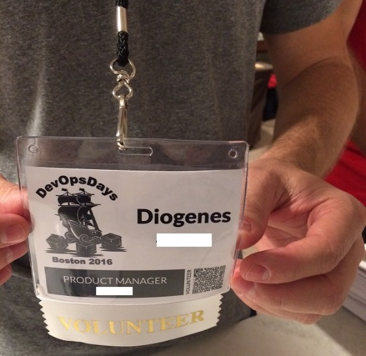
    Diogenes of Sinope was a controversial figure in ancient Athens who was known for walking around the famed ancient city—some say in the nude— during daytime with a lamp in his hand. He parried inquisitors who questioned his strange habit of using a lamp by day by insisting that he was looking for an honest man. At the recent DevOpsDays Boston, I actually met Diogenes. True story. See picture below. (Thankfully, he was wearing clothes.) But, as you probably guessed, this was not the man with the lamp, but rather one of the many conference organizers looking to help less-acquainted individuals find their way around the many meetings and speakers that filled the two-day conclave. Indeed, my Diogenes was instrumental in organizing the conversations and lectures that proved both honest and helpful.  Rather than a self-congratulatory summit, the two-day meeting was an honest conversation highlighting the advantages as well as many of the stresses befalling organizations that have adopted DevOps.

    DiogenesI found the most honest discussions were a floor up and a bit removed from the topics discussed in the main ballroom. These discussions were given the informal title of “Open Spaces” and were run in a typical un-conference format. These conversations were the real opportunities to learn about the stresses of implementing the modern portmanteau of DevOps.

    Tensions Between Dev and Ops: Why Can’t We All Get Along?

    One of the most interesting discussions in the Open Spaces looked at the dynamics between Devs and Ops. Like with any two groups that need to work together to accomplish larger organizational goals (think Sales and Marketing or Design and Engineering), there are inherent tensions that need to be overcome. The tensions between Dev and Ops are based on the different mission each pursues. Dev is striving to get software out the door as quickly as possible and push software updates forward. Ops is guided by the need to keep the ship as steady as possible, which often means limiting updates, as every update opens the door to potential bugs and deployment challenges. Starting with this premise of conflicting motivations, issues of trust and respect further complicate the relationship as each sees the other as trying to control the process.

    Yet, participants in this Open Spaces discussion were hopeful that tensions could be dissolved if management played an active role in creating cross-functional teams and managing workloads better. It was suggested that by essentially seeding Ops with Devs and vice versa, a greater community of understanding could be created. By promoting this cross-pollination, there would be greater understanding on both sides the implications (from the Dev side) of pushing software over the wall to Ops too quickly. From the Ops side, there would be greater understanding that 100 percent uptime is incompatible with dynamic product cycles that encourage innovation. A common and acceptable level of uptime needs to be agreed upon by both sides.

    For example, creating demos and code walk-throughs so both Dev and Ops can comment on potential problems and issues allows both Dev and Ops to see issues at the beginning rather than at the time of deployment.

    Blameless Post-Mortems in DevOps: Can They Exist?

    Another fascinating discussion in the Open Spaces focused on blameless post-mortems. Postmortems first and foremost suffer from an image problem. I believe it starts with the root word “mort” and it doesn’t get much better. To be clear, there was a lot of back and forth during this Open Space about the difference between a “postmortem” and a “retrospective.” Retrospectives are usually a weekly or bi-weekly event that bring to light the multiple root causes that are leading to defects or causing success through a review of RCA. In typical DevOps, one-week sprints are followed by a retrospective. Usually, the more data you can bring to a retrospective, the better. Post-mortems, on the other hand, result from an incendiary incident that was unexpected and undesired.

    Since post-mortems inevitably occur due to human oversight or lack of planning, there is no amount of thinking or planning that can prevent a crisis and thus prevent a post-mortem. As such, effective management will make post-mortems as painless as possible. The goal is to have blameless post-mortems balanced with accountability. According to one participant,

    “No one wants central casting to send in a screaming manager in a time of crisis who is only interested in assigning blame. That doesn’t help anything.”

    Importantly, you cannot fire yourself out of a post-mortem. Post-mortems are a necessary instrument to get at the root causes of issues. And while several different events can cause one issue, the post-mortem will at least begin to look at the process which caused the chaos. By not making the goal of post-mortems to find a scapegoat, the participants in one of these sessions can actually work on effective problem-solving.

    The goal of post-mortems needs to be effective problem-solving with the intent of committing the lessons learned to an actual document. It is not enough to let the lessons learned remain as an informal corpus that lives only in the heads of the engineers involved. Instead, documentation is required and it has to be in accessible place. Furthermore, it needs to be summarized and presented to management in either a lunch-and-learn or seminar so that the lessons learned then become actionable.

    Furthermore—and this was perhaps the most interesting part of the discussion on post-mortems—effective post-mortems are about getting Dev and Ops out of silos. There is no automation tool that will make Dev and Ops work together. Dev and Ops cannot just be about finding another automation tool. Instead, management needs to step in to help the process. Management needs to take engineers out of their silos and get them to work together if post-mortems are going to be really effective.

    Are You Feeling the Burnout Yet?

    After so many hours of interesting discussion in the DevOpsDays Open Spaces, I too was beginning to tire a bit. So perhaps it was well-planned to move on to a discussion on avoiding burnout.

    The artifacts of burnout are seen throughout the DevOps world as engineers constantly change jobs. This might be the phenomena of the “shiny orb,” where engineers always feel that there is a better, higher-paying job on the other side of the fence. However, as much as that might be true, it is equally the case that engineers are trying to escape burnout.

    According to the kanban methodology, which is woven into DevOps, you only pick up work as you can process it. Yet, DevOps practitioners often pick up work because they want to feel like they are team players or invincible or because they underestimate the work’s demands. They also fear the “imposter syndrome,” whereby colleagues seem less genuine if they don’t accept a piece of work offered to them. Inevitably, because the work is more than the engineer can handle, he or she becomes overwhelmed and is too proud to reach out for help.

    In a well-managed workplace, admitting overwork would not be an admission of failure. Instead, there would be a supportive culture to help the engineer or better mentoring on how to get through a challenging issue. “One-on-ones,” where the manager and individual contributor sit down together, would effectively solve the issue.

    But given the idiosyncrasies of workplaces, good management is not a given and engineers are often left to find their own coping techniques to help avoid burnout. The participants in this particular Open Space came up with the following gems:

    • Brain dumping. Empty your brain by putting all the thoughts and tasks that remain on your list and in your brain at the end of the day onto post-it notes. This helps avoid burnout because you are able to clear your brain prior to leaving work.
    • Create a Slack-based or bullet journal as a way to write yourself notes and create a list of priorities.
    • Follow the Pomodoro technique. Take a five-minute break every 25 minutes and a 15-minute break every two hours to better monitor how much time you are devoting to an issue and also to ensure you don’t forget to get a bit of movement into your day.
    • Learn how to say ‘no’ to requests. It’s a very simple word, but uttering ‘no’ once in a while will ensure that you mark boundaries and don’t take on more responsibility than you can handle.
    • Enlist management to make them aware of time you are spending beyond the normal working day and try to figure out ways to better manage the schedule and avoid burnout.

    The participants of this Open Space left with some new techniques to consider in avoiding engineer burnout. Hopefully, they will be implemented to practical advantage.

    Conclusion

    My first DevOpsDays conference was a true eye-opener.  I was lucky to get my education among such thoughtful and well-spoken individuals. I look forward to future opportunities to learn at the foot of Diogenes.

    About the Author / Orlee Berlove

    orlee_berloveOrlee Berlove is the Marketing director at OnPage Corporation located in Waltham, Massachusetts. OnPage is a cloud base incident alert and management system that elevates notifications so they continue to “ALERT-UNTIL-READ” so it’s not confused with email, SMS or phone calls. Incidents can be programmed to arrive to the person On-Call and can be escalated if they are not attended to promptly. Follow OnPage on Twitter and LinkedIn.
  • 8 Reasons to Go ‘All In’ and Attend Jenkins World

    8 Reasons to Go ‘All In’ and Attend Jenkins World

    Jenkins World 2016, the world’s largest gathering of Jenkins users, is coming to the Santa Clara (California) Convention Center, Sept. 13-15. The lead organizing sponsor is CloudBees, along with a number of premier Jenkins ecosystem vendors including BlazeMeter, Undo and Black Duck. Jenkins World will offer attendees opportunities to learn, explore and network. This year’s theme is “All IN” as Jenkins users, experts and thought leaders prepare to go all in on DevOps.

    Need more convincing? Below are eight reasons to go all in at Jenkins World 2016:

    Hear keynotes from industry leaders — Kohsuke Kawaguchi, founder of the Jenkins project, kicks off the conference with the opening keynote this year. Other keynotes include Sacha Labourey, CEO of CloudBees, and Gary Gruver, former DevOps exec at Macys.com and HP and industry author. Rumor has it that Gene Kim may make a guest appearance, too!

    Attend training/workshop add-on options — Come to Jenkins World as an attendee, leave as a Jenkins master. Join us a day early to attend Jenkins certification training and/or learn the fundamentals of Docker and Jenkins. Additional workshops, covering topics such as plugin development, Jenkins certification and automating pipelines with the Pipeline plugin, are available.

    FREE certification! Your Jenkins World registration also provides you with the option to take a certification exam completely free! Did we mention it was FREE? All you have to do is sign up and study up!

    Brush shoulders with the Jenkins stars — Get access to some of the best Jenkins experts in the world; attend their sessions and network with them. The sessions cover a range of topics including infrastructure as code, security, containers, pipeline automation, best practices, scaling Jenkins and community development projects.

    Visit a variety of vendors — At the expanded Sponsor Expo you can check out a range of technologies and services that help you optimize software delivery with Jenkins.

    Pick up your next read — CloudBees Senior Consultant Viktor Farcic has recently published his book, “The DevOps 2.0 Toolkit: Automating the Continuous Deployment Pipeline with Containerized Microservices.” Be one of 200 lucky attendees to get a free copy and be sure to catch his session Sept. 13. We will even be hosting a book-signing with Viktor.

    Do you follow CommitStrip? They will be onsite and you can help them paint a custom Jenkins-themed mural!

    Meet the Butler and snap a selfie – You may have seen the Butler on @CloudBees engaged in some Xtreme social media adventures to get himself to Jenkins World, but at Jenkins World you’ll have the chance to meet him in person. Don’t forget to snap a pic with him at the social media station and share with your friends.

    All of this and so much more awaits you at Jenkins World. Go “All In” and register now! Use this code JWDEVOPSCUST and get 20 percent off your conference registration.

    See you in Santa Clara!

  • Jenkins World Speaker Gruver on the State of DevOps

    Jenkins World Speaker Gruver on the State of DevOps

    Santa Clara, California, will be home to the biggest gathering of Jenkins users in the world Sept. 13-15. This year’s Jenkins World conference will feature Gary Gruver, DevOps expert and author of “Leading the Transformation.” We had a chance to connect with Gary and hear his thoughts on the state of DevOps, continuous delivery and what he thinks the biggest trends are.

    devopsy.kinsta.cloud: As continuous delivery (CD) and DevOps continue to be adopted and advance, what specifically should we be on the lookout for?

    Gruver: I believe the biggest opportunity for breakthroughs in CD and DevOps is in large, complex, tightly coupled systems. Most DevOps implementations have been with smaller teams—whether in small businesses or large businesses—that allow these small teams to work fairly independently. Currently, these are the fastest moving, most innovative DevOps implementations. That said, I feel the biggest opportunities for positive business impact are in the larger, more complex systems just because they are currently much less efficient. This is why I think we will see the biggest improvements in those environments, and innovations and updates will track towards these advancements.

     devopsy.kinsta.cloud: How are technologies like containers becoming a bigger part of an automated pipeline?

    garygruverGruver: Containers make it easier and less complex to move to infrastructure-as-code, which is one of the big breakthroughs of DevOps. This space is moving quickly because of how important environment consistency is to companies. It will be interesting to see how this space evolves over the next few years.


     devopsy.kinsta.cloud: What advice do you have for enterprises just starting their DevOps journey?

    Gruver: Segment the applications down into different deployment pipelines to make the problem as small and less complex as possible. A deployment pipeline should include all the applications that have to be qualified and deployed together because of their architectural coupling. Then, optimize each deployment separately based on DevOps principles instead of forcing everyone to implement all the same DevOps rituals like was common with previous agile transformations. This is a topic I can spend quite a bit of time discussing and thinking about, as you can read more about in my book!

    devopsy.kinsta.cloud: What roadblocks still exist for companies trying to adopt DevOps?

    Gruver: Finding executives that are willing to engage with their organizations and lead the DevOps transformation is a solid roadblock. It is still new concept in larger enterprises that require the multiple acceptance from members of the C-suite.

    devopsy.kinsta.cloud: What do you find most exciting about the current state of CD?

    Gruver: It is finally scaling to large organizations where the majority of the code that is being worked with exists and therein are the biggest opportunities I see for improvement. This means that DevOps is being introduced right up the chain, extending it from just the realm of IT.

    devopsy.kinsta.cloud: What do you want Jenkins World attendees to know about your keynote?

    Gruver: I am planning to provide a framework you can use to help align your large organization on your DevOps journey. My objective is for DevOps practitioners in organizations of all sizes to walk away with tips for implementation and a better understanding of best practices to apply to individual DevOps journeys.

    devopsy.kinsta.cloud: What does being “all-in” on DevOps mean to you?

    Gruver: To me, being “all-in” on DevOps means that everyone one is committed to the DevOps principles and is working together to continually improve the development and delivery processes. In other words, they have the same approach to achieving the same goal.

    devopsy.kinsta.cloud: Where do you think DevOps adoption is today?

    Gruver: Mature in unicorns and just getting started in large enterprises; hence, there are so many opportunities!

    To learn more about Gary Gruver and his approach to DevOps, please visit his homepage. While you’re at it, download a sample of his latest book, “Leading the Transformation.” Interested in learning more about Jenkins World or attending this year’s Jenkins World? Click here and register with the code JWDEVOPSCUST to receive a 20 percent discount.

  • Call for Papers Now Open: CD Summit and Jenkins Days Fall Tour

    Call for Papers Now Open: CD Summit and Jenkins Days Fall Tour

    After a successful spring run, devopsy.kinsta.cloud, where the world meets DevOps, along with premier sponsors, CloudBees, the enterprise Jenkins Company and IBM, today announced that their DevOps Connect: CD Summit/Jenkins Days roadshow will continue this fall with seven dates in the United States and Europe. The call for speakers to appear at these events is now open. Today we are announcing the shows will be coming to Atlanta, Denver, Austin, Seattle, Los Angeles, Berlin, and Amsterdam.

    I began my employment at devopsy.kinsta.cloud as a web admin and social media manager. Shortly thereafter, I became marketing and media manager. I had decent education surrounding web scripting (HTML/PHP/CSS/Photoshop), but none about DevOps and software engineering. I attended the spring events and had a front-row seat to the summits and what they had to offer. The keynotes offered a plethora of information surrounding Jenkins, BlueMix and how to undertake a DevOps transformation at the corporate level. We were honored to have Kohsuke Kawaguchi, CTO of CloudBees and founder of Jenkins, offer his unique perspective on the growth of Jenkins, joining CloudBees, and the development of recently released Jenkins 2.0.

    Our other two keynotes featured individuals we were lucky to have. Gary Gruver, who led the transformation at HP and Macy’s, outlined what he walked into, how he changed the company, and what happened when we walked away. He gave a clear-cut story about the transformation he embarked on when joining those companies. The third keynote came from Mustafa Kapidia of IBM. Mustafa was such a captivating speaker who really knew how to gauge his audience’s knowledge surrounding DevOps and continuous delivery.

    The breakout sessions in the afternoon following lunch offered a bit of something for everyone. There were three separate tracks: technical, management and Jenkins. The technical track was just that: a track devoted to the more technical-oriented crowd such as engineers and developers. The management track was devoted more to those looking to undergo transformations, incorporate DevOps at their workplace, and manage DevOps teams. The Jenkins track focused solely on information that was connected to utilizing Jenkins in the workplace.

    In addition to the summit itself, CD Summit and Jenkins Days feature a day dedicated to workshops on DevOps, IBM BlueMix and Jenkins. These were a hit from the get-go, pulling in people of all levels, from developers to executives wishing to broaden their knowledge. The fall will feature the workshop day as well.

    I met a lot of people during my time at these events, cementing the fact it is a great place to network and learn about different companies and how they are doing devops. Prior to attending these events I only knew a small chunk about DevOps/CD/CI based on the articles we publish on devopsy.kinsta.cloud and from my interaction with professionals in the industry. By attending the events I expanded my knowledge, greatly improving my capacity to understand what occurs from the junior level to the executive level at a company utilizing DevOps practices and principles.

    According to the press release, “These events are designed for Enterprise Managers and Buyers along with Developers, Engineers, Sys Admins, and Architects. With three main tracks focused on IT managers, technical engineers, and Jenkins practitioners, attendees will get access to the best minds in CD and DevOps. The presenters are experienced developers, build managers, QA, DevOps practitioners, IT managers/executives, architects and IT operations who are luminaries within the DevOps community.”  I would recommend attending this event for anyone who fits this description, and for anyone outside the realm of this description who wishes to learn more about DevOps or continuous delivery.

    Today we are opening up the Call for Papers for the fall events. Anyone who would like to submit their entry can follow the respective links below for each city:

    For more information please visit http://www.devopsconnect.com

    Link to the press release: https://devopsy.kinsta.cloud/2016/06/27/devops-connect-cd-summit-and-jenkins-days-fall-schedule-announced/

  • DevOpsDays Silicon Valley is Coming!

    DevOpsDays Silicon Valley is Coming!

    DevOpsDays Silicon Valley is coming, so mark your calendar! DevOpsDays events are a global phenomenon, bringing together practitioners across roles for two days of scheduled presentations and networking in a community-organized event. You won’t want to miss this year’s conference!

    The 7th annual DevOpsDays Silicon Valley is scheduled for June 24-25 at the world-famous Computer History Museum. Silicon Valley is the oldest of the U.S. events and was originally the third DevOps Days ever. The conference, which started in 2010 as a low-key event hosted on the campus of LinkedIn, has grown into a major event.

    This year’s lineup includes talks from a variety of perspectives including security! Jennifer Davis, co-author of “Effective DevOps,” will open the conference up with “Devops is for Everyone.”

    DevOpsDays Lineup

    Here is the 2016 speaker lineup:

    Keynotes:

    • Troubleshooting Troubleshooters: Debug Your Colleagues for Fun and Profit, by Bethanye McKinney Blount, CEO/Co-Founder
    • From Divided to United – Aligning Technology & Business Teams, by Dominica DeGrandis, Director, Learning & Development
    • Cost versus Performance: Analytics for Walking the Tightrope, by Elizabeth (Betsy) Nichols, Chief Data Scientist
    • The Future of Automation, by Adam Jacob, CTO and Founder of Chef

    Presentations:

    • Behind Closed Doors: Managing Passwords in a Dangerous World, by Noah Kantrowitz
    • At the Intersection of Happy and Healthy: DevOps Meets IoT, by Gail Ferreira
    • Heresy in the Church of Docker, by Corey Quinn
    • DevOps Army of N – Recovering From Being a Human SPOF, by Jonathan Disher
    • (Parental) Leave Actually, by Dave Dash, Nicole Grinstead, Melissa Sandgren
    • How to Onboard Entry-Level Talent to a DevOps Culture, by Angel Tian and Sophia Castellarin
    • Autoscaling Containers … with Math, by Allan Espinosa
    • How I Learned to Change My Mind and Became a Better Engineer, by Ramin Khatibi
    • Removing the Stigma of P0w3rship, by Ed Anderson

    Ignites Include:

    • How Do You Measure Availability? Performance and Availability and SLMs, oh my! by Warren Turkal
    • Feature Feature, by Linda Goldstein
    • The Elements of Developer Experience (DX) Design, by Stephen Boak
    • Reflections of an Operations Burnout, by Jamie Dahl
    • Breaking Brooks’ Law with DevOps, by Jason Yee
    • A DevOps Team is a Daft Idea and You Should Feel Bad! by Caedman Oakley
    • How Can You Scale It If You Don’t Trust It? by David Blank-Edelman
    • From WWW to GGG, by Anne Ahola Ward
    • How I Learned to Stop Worrying and Love the Protocol, by Pete Sclafani

    Following the inspiring talks, each afternoon is dedicated to Open Space, where the agenda is dedicated to small-group, participant-led discussions chosen on the fly. This is the chance to dive into specific topics, ask for help, discuss what you’ve done, find like-minds or just be a fly on the wall and take it all in.

    If you are in the San Francisco Bay/Silicon Valley area, get your tickets for the June 24th and 25th DevOpsDays Silicon Valley ($199) before they sell out. We also have a limited number of education tickets for faculty, staff and students ($100). If you live elsewhere, be sure to keep an eye on the main DevOpsDays site for upcoming events. Also, check out DevOpsDays Silicon Valley recorded talks from 2015.

    About the Author / Damon Edwards

    41368124db43a27257c31df174a61357_400x400Damon Edwards is the co-founder and managing partner of the DTO Solutions, a DevOps and automation engineering consultancy whose clients include leading SaaS, e-commerce, gaming, and financial services companies. Damon Edwards is also the co-founder and vice president of SimplifyOps, a provider of support and services for the users of the Rundeck open source project. Damon has spent over 14 years working on both the technology and business ends of IT operations. Damon is also a frequent conference speaker and writer who focuses on DevOps and operations improvement topics. Damon is active in the international DevOps community, including co-organizing the DevOps Days conference series, co-hosting the DevOps Cafe podcast, and a co-author of the DevOps Cookbook from IT Revolution Press.

  • DevOps Connect at RSA: In Security, Choose Increments

    DevOps Connect at RSA: In Security, Choose Increments

    Earlier this week the worlds of DevOps and information security collided at the DevOps Connect Rugged DevOps event, held in conjunction with RSA Conference 2016. The security-centric audience got to hear from a number of thought leaders across the DevOps and infosec worlds about ways security pros and DevOps teams can work together and establish incremental improvements in application security, as IT picks up the pace of software delivery.

    Among the talks, Forrester Analyst Amy DeMartine discussed her team’s findings after studying the “best of the best” in implementing Rugged DevOps patterns. There are seven habits universal across organizations that are succeeding with this new way of developing and deploying secure applications, she notes.

    “Think of it as a fitness program, and the muscles that you are building up are those that strengthen application security,” she says.

    These habits included a number of obvious practices, along with a few surprises, including:

    • Increase trust and transparency between Dev, Sec and Ops.
    • Understand the probability and impact of specific risks.
    • Use the continuous delivery pipeline to incrementally improve security practices.
    • Standardize third-party software and then keep current.
    • Govern with automated audit trails.
    • Test preparedness with security games.

    All are good tips for getting security, dev and ops to work better at delivering code both faster and more securely. But the seventh habit probably raised the most CISO eyebrows and could have the most potential to effect meaningful change and collaboration:

    • Discard detailed security road maps in favor of incremental improvements.

    According to her, the “best of the best” organizations in Rugged DevOps have security leaders that make it a habit to ditch detailed security road maps in favor of a establishing broad vision and achieving incremental security improvements over time.

    As she related in her talk, she’s seen too many organizations develop extensive and extremely detailed multiyear road maps only to see them grow obsolete not only because of rapid changes in the IT environment, but also the constant pivots attackers make in their attack techniques.

    Instead, she said, security leaders have to take the same continuous improvement approach that their peers in development and operations have made in their shift to DevOps.

    “This is a mind shift change that has to happen,” she warns.

    To achieve good results, security leaders should be focused on “real-time, actionable measurements” to focus on improvements that matter, such as decreasing remediation time for vulnerabilities.

    “In DevOps, we call this Plan, Do, Check, Act, where you’re taking very small changes. Say you want to insert static analysis right after a developer checks in new code. So you’re going to go off and plan. The plan is to insert static analysis,” she says. “Then you’ll do—we’re going to look at tools, we’re going to create our rules. We’re going to check to make sure it works, if it improves things. And then we’re going to move on to the next thing—maybe it’s tightening our rules or maybe it’s adding another tool.”