Tag: events

  • DevOps India Summit Sets the Stage for DevOps’ Future in India

    DevOps India Summit Sets the Stage for DevOps’ Future in India

    DevOps India Summit 2018, India’s biggest DevOps conference, concluded with notable audiences and best in industry experts setting the tone for the future of DevOps in India. The summit was held Sept. 1 at the Marriott Hotel, Whitefield, Bengaluru with a pre-event workshop Aug. 31. Around 500 professionals, including corporate leaders and mid-level managers from across the country, who witnessed the best minds in DevOps sharing their valuable insights on all phases of DevOps transformation. The event was designed to create a platform where practitioners of DevOps in India can hear the stalwarts share their experience and share their own journey and experience through calls for papers.

    The world-class summit, organized by Xellentro in partnership with DevOps Institute, Crevise Technology, Confinity Consulting, GitLab, Datamato, Sumologic, Zoomcar, MongoDB, TechGig, The Entrepreneur and PEOPLECERT, focused on the future of DevOps in India. The attendees got an opportunity to connect with the industry pioneers and learned about some of the emerging DevOps practices they can apply in their own organization. Experts from the United States, France, Brazil and India gave a sneak preview of DevOps adoption and how those initiatives and technical practices can help organizations attain the highest levels of performance.

    The topics were well-chosen and balanced, starting from the keynote by John Willis on DevSecOps to Marc Hornbeek speaking about the Continuous Delivery Architecture, Aymen El Amri speaking about Cloud Native and Amanda Mattos sharing her DevOps journey in the organizations she has worked. We also had sessions on Container-based CI Solutions by Archana Joshi, director of Cognizant Technology Solutions; DevOps Assessment Framework by Dr. Shome from TCS; High-Speed DevOps from Zoomcar, the Importance and Use of Database by MongoDB; Gaming in DevOps by Wipro; Scaling DevOps by Padma; DevOps in Automotive Engineering by KPIT; and many more. There were 30 sessions and six lightning talks, all of which were received with great enthusiasm.

    There was a panel discussion with 10 speakers and various topics were discussed from various areas of DevOps including DevSecOps and the need to include DevOps in university curriculum.

    The participants expressed their happiness to be able to hear such varied topics on DevOps and the great learning they had in the event and expressed their desire to attend in future years.

    During the event, Xellentro also awarded the highest Tweeter with Amazon vouchers.

    The pre-event had workshops by Marc Hornbeek on Architecting Continuous Delivery and was attended by a large audience who found this session extremely useful.

    Niladri conducted the G2G3 DevOps Simulation and the participants were intensely involved in this great immersive experience, which taught them the basic principles of DevOps—a great way to start the DevOps transformation and helps in making the participants feel the difference practicing the principles.

    GitLab products were also shown by their representatives.

    “It was a great feeling to attend this summit, as we get to meet new people who have been in this industry for a while,” said John Willis, president, DevOps and Digital Practices at SJ Technologies. I have come across people who are smart, aggressive learners and are eager to know more that they put up questions that was never asked before, it took me a time to navigate to an answer.”

    Marc Hornbeek commented that the event had the feel of DOES Summit but at a more manageable scale, where speakers could mingle with the delegates and take part in more knowledge-sharing among each other.

    At the end of the event, prizes were awarded on behalf of Xellentro. PEOPLECERT announced awards for five participants who were given free examination vouchers for training through Xellentro. DevOps Institute also announced prize to the highest scorer in DevOps Practitioner certifications conducted through Xellentro.

    Thanking all the partners and participants at the event, Niladri Choudhuri, who conceptualized the event said: “It is very encouraging to see people coming together and working as team to promote the real essence of DevOps. I thank all the participants who brought their enthusiasm along and asked so many relevant questions. This is the first ever DevOps event in India in such large scale with prime focus on the core content and quality of speakers who bring value to organisation. This is a start to more such future initiatives and I thank everyone for their support.”

    DevOps India Summit is starting a community of DevOps practitioners to create a platform to share, learn and enjoy the DevOps journey and help each other in the journey. People interested, other than the delegates who are already members of this community, can join this community here.

    — Niladri Choudhuri

  • DevOps Enterprise Summit: Las Vegas 2018: A Sneak Peek

    DevOps Enterprise Summit: Las Vegas 2018: A Sneak Peek

    Wow! It’s hard to believe that just a few months ago, we were wrapping up two days of immersive learning at the DevOps Enterprise Summit London event, and now we are getting ready for our biggest DevOps Enterprise event ever — Las Vegas 2018!

    In this post, I describe the programming objectives for the 2018 DevOps Enterprise Las Vegas event—what our most important focus areas are, how it differs from previous years, and why certain elements remain the same. I shared this with our programming committee early in our planning process, so that we could scrutinize and critique it. As someone once famously noted, “To be able to think clearly, one usually needs to first write it clearly.”

    Our first objective is to have the 2018 Las Vegas event be even better than our 2018 London event, which in turn, I believe, was even better than our 2017 San Francisco event, which was the better than all of our previous events. Aiming to have the next conference to be better than the last is challenging, especially when you think that your last event was the best yet—but without a doubt, stating this as an explicit objectives makes it impossible just to coast.

    But, the good news is, there are plenty of challenges this community faces, and I have confidence that by helping the community overcome those challenges, the result is a better conference.  And I think you’re going to love what we have in store for you!

    (And with that in mind, I hope that when you see this year’s conference speaker lineup, you’ll agree that this will be the best DevOps Enterprise Summit yet — if you haven’t registered yet, please use the special code below to save $300 off your registration price!)

    Here are the other programming objectives for 2018, created with the fantastic Programming Committee:

    Our Programming Objectives:

    • Get great experience reports, and repeat experience reports
    • Elevate focus on Spanning Business/Technology Divide
    • Elevate focus on Next Generation Ops and Infrastructure
    • Ensure conference structure helps attendees achieve their goals
    • Get best subject matter experts from the domains we need

    Great Experience Reports (And Repeat Experience Reports)

    For the past four years, one of the hallmarks of DevOps Enterprise Summit is that we have many repeat speakers presenting their ongoing DevOps transformation experience reports. This has been an awesome way to document their journeys and progress over time—it is especially gratifying to see how their areas of responsibility keep growing. Repeat experience reports make up 15 percent of our programming.

    • Chad Avery, Program Manager, DevOps; Aimee Cardwell, VP, Consumer Product Development – American Express
    • Ross Clanton, Executive Director, Technology Modernization – Verizon
    • Pauly Comtois, VP DevOps – Hearst Business Media
    • Jim Grafmeyer, Director, IT Infrastructure; Jared Speno, Senior Technical Consultant – Nationwide
    • Chris Hill, Head of Systems Engineering – Jaguar Land Rover
    • Olivier Jacques, Principal, DevOps transformation; Joan Watson, Dir. DevSecOps – DXC Technology
    • Bryan Finster, Staff Software Engineer; Dana Finster, Sr. Software Engineer – Walmart

    One potential danger of having repeat speakers is the self-reinforcing loop and creating a self-contained echo chamber, merely repeating what we like hearing.  That’s why we continue to seek out new experience reports—new experience reports are 25 percent of our programming.

    In these new experience reports, we actively seek the largest and most recognized firms across every industry vertical, to give DevOps Enterprise champions more case studies and empirical evidence to make their case internally, and overcome objections.

    I’m delighted that over the years, we’ve had some of the world’s largest banks present, as well as large not-for-profits, government agencies, and military branches—organizations that are often views as risk-averse and conservative.  For these stories, we are interested in organizations at all stages of the journey.  And these stories are a source of fantastic and serendipitous discoveries, as well.

    I’m delighted that this year, we have new speakers:

    • Dan Barker, Chief Architect – National Association of Insurance Commissioners
    • Ann Corrao, Distinguished Engineer and Master Inventor – IBM
    • Scott Havens, Director of Software Engineering – Jet.com and Walmart Labs
    • Simmons Lough, IT Specialist – US Patent & Trademark
    • Keanen Wold, Manager, DevOps Transformation  – Delta Airlines

    Spanning the Business and Technology Divide

    Another goal is to help the community get business leadership onboard—and by that, I don’t mean business leadership silently tolerating DevOps.  Instead, what we are looking for are enthusiastic and grateful business partners, who want to tell the world how all their goals, dreams and aspirations were finally achieved by working together with their technology counterpart.  In London 2018, we had some fantastic talks along these lines (from Nike, Capital One, and Verizon Enterprise).

    In Las Vegas, we’ll be featuring even more talks like this, showing how technology leaders are partnering with not just business leaders, but also other areas of the business, such as product leadership, security/privacy, legal, project management and so forth.

    These unique types of experience reports will represent about 15% of our overall talks, and I’m super-excited about their stories—these are the most difficult talks to find, because they require a technology leader with a great working relationship their business counterpart, and that they’ve created visible successes.

    • Courtney Kissler, Vice President, Nike Digital Platform Engineering – Nike; Ann Bradley, Chief Privacy Officer and Global Counsel – Nike Direct
    • Aimee Bechtle, Senior Manager Advanced Engineering; Abbie Gray, Product Manager in Credit Card Channels Product & Platform – Capital One
    • Levi Geinert, Director of Engineering; Lucas Rettig, Principal Product Owner; Dan Cundiff, Principal Engineer – Target
    • Topo Pal, Senior Director & Sr. Engineering Fellow;  Jamie Specter, Counsel, IP & Technology Legal Group – Capital One
    • Jason Cox, Director, Systems Engineering; Deepti Mutnuru, Senior Project Manager – The Walt Disney Company
    • Alice Raia, Vice President, Digital Presence Technologies; Le Quach, Director, Strategic Design & Implementation – Kaiser Permanente

    Next Generation Ops and Infrastructure

    I’ve written before about how this programming objective came from Jason Cox at Disney (one of our programming committee members), who said to me every year, “Great conference for Dev, but it wasn’t as great for Ops.”

    In 2018, we finally did something about it: Starting in London 2018, we reserved 25 percent of talks for next generation Ops and Infrastructure concerns, and created a separate subcommittee to focus on this area.

    And wow, we were all very, very happy with the results—in fact, I think the elevation of this topic has fundamentally changed the feel of the conference (you can watch a full discussion about this track here). In this track, we really make an effort to help define and clarify what exactly the role of Ops leader is, all the technology and organizational changes there have been in how infrastructure is designed, delivered and operated.

    This year, we are dedicating about 25 percent of the programming to this topic, and we are preserving that proportion for the main stage presentations, as well. I love that these presentations are also a bit more technical, but there’s no doubt that it is extremely relevant for the technology leadership community. (After all, as Mark Schwartz famously observed, “Last I heard, this is still a technical field.”  Haha!)

    Examples of talks in this track include:

    • Jeffrey Snover, Technical Fellow and Chief Architect for Azure Storage & Cloud Edge – Microsoft
    • John Rzeszotarski, SVP, Director of Continuous Delivery and Feedback – KeyBank
    • Cornelia Davis, Senior Director of Technology – Pivotal
    • Damon Edwards, Co-founder and Chief Product Officer- Rundeck
    • Tom Limoncelli, Renowned Author and Speaker, Former Sys Admin for Google, currently SRE Manager – Stack Overflow
    • Shaun Norris, Global Head, Cloud Infrastructure Services – Standard Chartered Bank
    • Charity Majors, former Production Engineering Manager for Facebook, currently CEO, Engineer and Co-founder – Honeycomb.io.

    BONUS – if you haven’t seen the Next Gen Ops panel discussion from the June conference in London, it’s worth a watch here.

    Subject Experts from Areas We Draw Upon

    In our San Francisco 2017 conference, one of the most notable (and for me, memorable) moments was the Safety Culture and Lean Panel we had, featuring three luminaries in the field.  Dr. Sidney Dekker and Dr. Richard Cook (Safety Culture) and Dr. Steven Spear (Lean) and I discussed the areas of mutual reinforcing principles from those two fields, and discussed how lessons learned from those domains could be applied to the DevOps Enterprise community.

    This year, we are honored to have Dr. Christina Maslach speak on her lifetime of research on burnout. She is professor emerita of psychology at the University of California, Berkeley, and her area of research focus includes: burnout and job stress; and individuation and social influence, as well as the positive antithesis of burnout, work engagement, as a better framework for developing interventions.

    My mentor, Dr. Steven Spear, will be presenting as well.  He presented at DevOps Enterprise Summit in 2015, and was part of the panel I mentioned above.  He is currently Senior Lecturer at the MIT Sloan School of Management. Dr. Spear is a Senior Fellow for the Institute of Healthcare Improvement, and was a four-time recipient of the Shingo Prize for Research Excellence. He is the author of “The High Velocity Edge,” and has extended his research beyond manufacturing to R&D, workplace safety, health care, etc.

    (Stay tuned for some exciting news that we’ll be able to share about something else special we have planned!)

    Twenty percent of our programming is dedicated to these types of talks—Dr. Nicole Forsgren (founder and CEO of DevOps Research and Assessment) will be presenting the “2018 Accelerate State of DevOps Findings,” which was done with the help of Google Cloud. Rosalind Radcliffe (Distinguished Engineer, Chief Architect for DevOps for z Systems IBM) will be presenting on her work elevating the state of the practice for the mainframe ecosystem.  And many more!

    Networking and Community Activities

    When I look at the DevOps Enterprise community, it is a community of networkers. I see lasting collaborations and friendships that have lasted for years and the mark of a phenomenal community is one that is actively helping one another. With that desired outcome in mind, we have made some changes to our programming.

    • New – DevOps Confessions! This came about some advice from Dr. Richard Cook who made the observation that the stories presented on stage are the heroic triumph stories, but stories that come out over evening drinks are those about the struggles and failures and near-misses. To bridge that gap, we’re going to set aside 15 minutes every morning where I will read two anonymized stories of confessions from leaders in the DevOps community. Hear more about this project here.

    Furthermore, there will be an hour per day in the programming where there are no talks — instead, this is a time for networking and collaboration and information sharing, with various levels of structure. (Our observation was that formats such as Lean Coffee were extremely popular, but because they were scheduled at the same time as talks, people went to the talks instead because of the “Fear of Missing Out”.  So, now there are no talks to compete with!)

    • Ask the Speakers! If you have questions for our speakers, we’re creating dedicated times for you to meet with them and ask the questions that will dig deeper into what your interests are. We’ll also open up a Slack channel for every attendee to use and submit questions directly to speakers and to other attendees.
    • Lean Coffee Sessions! We want to help attendees connect with and learn from their peers at the conference in another semi-structured format as well. We’re going to produce Lean Coffee sessions, led by Dominica DeGrandis, both days of the conference. This will be comprised of 10 tables big enough for 10 people to talk about similar interests that are relevant to the theme at the table. Hopefully, this provides another opportunity to learn a lot and make some valuable new connections.
    • Birds of a Feather Sessions!  These are more like the DevOpsDays unconference sessions, with less structure than a Lean Coffee format, driven by specific topics that attendees want to discuss and learn about.

    We also will have…

    • Slack Workspace! We will have our very own Slack workspace for the DevOps Enterprise Summit! You’ll be able to join the channel to take part in the conversation, as well as a “Who’s Hiring?” channel to learn about potential opportunities in the space. These channels will stay open after the conference ends to keep the dialogue rolling!
    • Lunch time! There will be a few different lunch options that attendees can take advantage of as well:
      •  Eat lunch with a speaker will be a first come, first serve basis. During these sessions, you will have opportunities to sit down face-to-face with a speaker and again, dive deeper into the subject matter of their presentation and experiences in a more personal setting.
      • Have lunch with fellow attendees at high top tables around the buffet stations where there are pre-written note cards to serve as seed questions for discussion.
    • Industry party! Every good conference comes with a good party, and DOES18 Las Vegas will be no different! Thanks to our friends at Delphix, the industry party is happening on Monday evening following Day 1. We’ll have sponsor giveaways, food, drinks, and another great opportunity to continue conversations with fellow attendees and speakers. I’ve found this time proves to nurture some of the best networking and listening to some amazing stories from in the trenches!

    This year at DOES18 Las Vegas, we’ll also be having Lightning Talks and the IT Revolution Author Book Signing! These will be on Day 2, following closing remarks. There will be refreshments and happy hour snacks as well!

      • Lightning Talks! Presented by our friends at Sonatype, these talks happen from 6:30-7:30 p.m. in Chelsea. These are rapid fire, must-see presentations – just watch the Lightning Talks from 2017 to see what I mean. More information forthcoming about these talks soon and if you’re attending, be on the lookout for the call for presentations as well!
      • IT Revolution Author Book Signing! From 7:15-8 p.m. in the Chelsea Balcony. We are excited to debut the latest title from IT Revolution Press and author Dr. Mik Kersten, “Project to Product,” at the IT Revolution book signing on Tuesday night! I believe this will be a very important book for our generation of technology leaders—the majority of economic value will be created when the largest brands across every industry vertical adopts the better ways of working pioneered by the FANGs (Facebook, Amazon, Netflix, Google), of which the DevOps Enterprise community is leading the charge. Mik’s book describes how project management and other orthodoxies need to be replaced with product-oriented cultures and management paradigms.

    As you can see, there’s a lot that is getting me excited for the conference this year! We hope we will see you at what is sure to be the best DevOps Enterprise Summit yet! Register now (and book your room at the Cosmopolitan) to ensure your spot at DOES 18 Las Vegas!

    — Gene Kim

  • How to Convince Your Manager to Send You to DevOps World | Jenkins World 2018

    How to Convince Your Manager to Send You to DevOps World | Jenkins World 2018

    The largest gathering of Jenkins users and DevOps practitioners is less than a month away. DevOps World | Jenkins World 2018 will be held in two locations this year, Sept. 16-19 in San Francisco and Oct. 22-25 in Nice, France. With exciting keynotes from industry influencers including Dr. Nicole Forsgren, CEO and chief data scientist at DORA, and James Governor, analyst and co-founder of RedMonk, there will be tons of learning and networking opportunities. There will even be a “Westworld” themed party, making it an event you do not want to miss.

    So now that we’ve convinced you to attend, you need to convince your manager why they should send you to DevOps World | Jenkins World 2018. Don’t worry: There are lots of good reasons why attending would be beneficial to you and your company. Once you have successfully convinced your manager to attend DevOps World | Jenkins World, don’t forget to register! To sweeten the deal, you can enter the promotional code just for devopsy.kinsta.cloud readers: JWDEVOPSCUST. That code gets you 20 percent off your registration.

    Keep Learning

    With more than 70 sessions offered in San Francisco and 50 sessions in Nice, all presented by DevOps and Jenkins experts, DevOps World | Jenkins World provides a chance to learn from DevOps leaders. Be sure to emphasize to your manager the importance of learning from the very best in the DevOps community, in training and workshops and, of course, in the breakout sessions. From Jenkins founder Kohsuke Kawaguchi to CloudBees CEO Sacha Labourey and the aforementioned industry influencers, your manager will greatly appreciate the knowledge you bring back to the office from experienced industry experts.

    You should definitely take advantage of some outstanding training opportunities to enhance your continuous delivery, Jenkins and DevOps knowledge. Available training sessions include Jenkins Certification Training, Jenkins Fundamentals, DevOps Leader Certification Training, CloudBees Core Fundamentals, CloudBees Core on Kubernetes and Value Stream Mapping for DevOps. Additionally, you will receive a free Jenkins exam with the purchase of a full conference registration. That is a huge value-add for both your resume and your organization!

    Build Your Network

    DevOps World | Jenkins World brings together thousands of software development experts, thus providing numerous networking opportunities. The conference gives you the opportunity to learn of challenges other organizations in the industry have faced and how they’ve overcome them. If they have already solved a challenge you are just starting to tackle, you could walk away with knowledge that more than pays for the cost of the conference. Conference attendees can also share success stories that may inspire your organization’s next big win. Make it known to your manager that you will be exposed to people like you, who have similar business needs and challenges, whom you will be able to connect with and learn from.

    Invest in Your (and Your Company’s) Future

    As we previously mentioned, with the industry continuing to innovate and evolve, having the skill set to keep up with these changes help make you a valuable asset to your team. When convincing your manager to let you attend, make sure you also present how this knowledge will help push you and your team forward, ultimately propelling your entire organization forward. Highlighting the potential ROI of this opportunity will help your manager better justify the cost to send you to DevOps World | Jenkins World. Detail exactly how much airfare and lodging will cost, but also note what kind of impact it will have on the organization’s bottom line. The ROI will be evident—make that clear!

    We would like to think we have provided some pretty solid justifications for you, but if you still need an extra boost, we have also created an email template to use when sending all this over to your manager for review. Once your boss gives you the green light, go register!

    — Alan Shimel

  • A Certifiable Reason to Attend Training at DevOps World | Jenkins World 2018

    A Certifiable Reason to Attend Training at DevOps World | Jenkins World 2018

    There are many factors that make DevOps World | Jenkins World the essential DevOps event to attend each year. Whether it is the keynotes and speaker sessions from industry-leading DevOps experts, the expo where you can check out the latest and greatest from our friends in the software industry or the themed after-party, there are many reasons why year over year the conference grows. An added benefit that contributes to DevOps World | Jenkins World being the DevOps event of the year is the wealth of informative preconference training and certification. Think of them as the workout before the big game, providing you the tools and knowledge to make the most of the conference and beyond.

    The growth of attendance and variety of attendees of  the DevOps World | Jenkins World conference is one of the indicators that the industry is constantly innovating and evolving. Last year, Forrester declared 2018 as the “Year of DevOps,” with 50 percent of survey respondents reporting they had already implemented DevOps with plans to expand. For DevOps practitioners to keep up with the continuous pace of modern software development, there also has to be continuous learning. Training and certification at DevOps World | Jenkins World will cover relevant topics in software development, such as authorization and security, build management, instance administration and interfacing with cloud services, in addition to Jenkins and CloudBees Core fundamentals.

    Not only are all training sessions available to add on to your full conference sessions pass, but you also can receive a free Jenkins certification exam voucher—a $150 value—for the Certified Jenkins Engineer (CJE) and Certified CloudBees Jenkins Platform Engineer (CCJPE) exams. You can choose to sign up for an onsite exam at DevOps World | Jenkins World (first-come, first-serve) or use it at a later date. There are also several half-, one- and two-day courses that can be added during the event registration process.

    In addition to our recommendations below, check out the Training and Certification page to see what courses can help strengthen your software delivery pipeline skills.

    DevOps Leader Certification Training

    Successful implementation of DevOps requires leadership. Whether you are in a  tactical or strategic role, if you help design, influence, implement or motivate the cultural transformation in DevOps adoption, this course will take your DevOps leadership to the next level.

    Value Stream Mapping for DevOps

    If you’re looking to better understand DevOps, you are in the right place! Join Mike Orzen, a recognized and prominent Lean thought leader and author, to learn the ins and outs of DevOps value stream mapping, helping you identify inefficiencies in your current process, and optimize it to deliver more value to your customers.

    Jenkins Fundamentals

    It wouldn’t be Jenkins World without Jenkins! To prepare yourself for both the Certified Jenkins Engineer (CJE) or Certified CloudBees Jenkins Platform Engineer (CCJPE) certifications, Jenkins Fundamentals introduces you to the best practices for leveraging Jenkins to drive your continuous development life cycle with Jenkins.

    CloudBees Core Fundamentals

    As the foundation of CloudBees, once you’ve mastered Jenkins Fundamentals, CloudBees Core Fundamentals is the obvious next step. In this training, attendees will gain the skills needed to leverage the CloudBees Core product suite to successfully scale CD and DevOps in their organizations. The training includes an overview of the key proprietary features provided with CloudBees Core to enhance the capabilities of Jenkins.

    CloudBees Core on Kubernetes

    Kubernetes is seeing widespread adoption as the operating system for cloud native applications and the industry’s go-to container orchestration system. This course will provide attendees with the tools needs to run CloudBees Core on Kubernetes, and leverage public and private clouds to establish an elastic, scalable CD and DevOps platform. The course includes hands-on installation of CloudBees Core on Kubernetes. 

    Go to https://www.cloudbees.com/devops-world to learn more and to register. Additionally, use this special code just for devopsy.kinsta.cloud readers—JWDEVOPSCUST—at registration, and you’ll get a 20 percent discount.

    — Brian Dawson

  • DevOps TV: DOES18 London Video Panel Roundup

    DevOps TV: DOES18 London Video Panel Roundup

    The DevOps Enterprise Summit is one of my favorite places to connect with the world’s best technologists and DevOps practitioners. It’s the perfect forum for insightful conversations, valuable networking and immersive learning—and the comraderie is unmatched. For me, it’s always a pleasure to catch up with my great friends in DevOps and get an insider’s perspective from the leaders who are driving the industry and practices forward.

    This past June, DevOps Enterprise Summit London (DOES18) did not disappoint. We experienced firsthand some of the most iconic business transformation stories in DevOps. We also heard from the best technologists in the business. The programming committee introduced new themes and brought in fresh perspectives that reach beyond Dev and Ops. We got to see how the technology value stream influences the entire business from the standpoint of those impacted the most.

    Once again, devopsy.kinsta.cloud partnered with IT Revolution and DOES18 organizers for in-depth video panel conversations with the speakers and thought leaders. Next-generation ops and infrastructure, spanning the divide between tech and business, DevSecOps and experience reports were all topics of conversation at this year’s show. We talked about challenges, opportunities and what the future is going to look like for DevOps. Here are the highlights from the videos we shared on DevOps TV.

    Where are They Now?

    One of the things I look forward to most at DevOps Enterprise Summit (DOES) is reconnecting with leaders who have shared their DevOps journeys and experiences from the early days. These companies can act as the compass for those that are just starting IT transformation journeys. At DOES, we learn where these industry pioneers are headed, the ups, the downs and what they are working on/need help with next. For example, we continued the conversation with Jonathan Fletcher at Hiscox, whose DevOps journey has been incredible to follow. The Verizon team, who presented on Day, 2 sat down with me and talked about the long lasting effects their DevOps transformation has had on such an extremely large and already successful company. Last, but not least, representatives Capital One chronicled their DevOps transformation journey and their march toward high performing teams across the organization.

    DevOps Right Now

    If you want the scoop on where DevOps stands today, DOES is the place to be. I enjoyed the conversation I had with DevOps thought leader and author, Mirco Hering, who shared invaluable knowledge on the current state of DevOps. We also sat down with Ilkka Turunen, Zane Lackey and Margo Cronin to take a deep dive into one of today’s hottest topics: DevSecOps. Examining value streams of high performing companies was also top of mind and it was interesting to hear how adjusting that value depended on the changing needs of the customer. Nicole Bryan, Carmen DeArdo, Dominica DeGrandis, Mik Kersten and I had an insightful discussion about this topic.

    ITSM and DevOps Can Be Friends

    Whether you were a skeptic of ITSM or DevOps in the early years, it’s likely you didn’t predict that they would be compatible. We had a great conversation with the fantastic Jayne Groll, Rob England and Dr. Cherry Vu around ITSM, ITIL and DevOps—and how DevOps and ITSM can actually complement each other.

    Next Gen Operations and Infrastructure

    Gene Kim and the programming committee worked hard to make next-generation ops and infrastructure a big theme at this year’s conference by seeking some of the sharpest talents in this arena. We had the amazing opportunity to interview John Willis, Damon Edwards and Cornelia Davis to talk about where ops is headed.

    Spanning the Tech and Business Divide

    As I mentioned earlier, DOES18 examines how the technology value stream goes far beyond just Dev and Ops. We looked at its impact on HR, project management and more—and how DevOps applies to leadership these other areas of the organization. I had the pleasure of sitting down with Fin Goulding, Jelena Laketic and Mark Schwartz to discuss the role that IT leaders should play in a successful DevOps transformation and what things are of value when injecting high performance into a company. I also reflected on the different business organization strategies used to turn normal companies into high performers and common problems that can be overcome on that journey with Jon Smart, Morag McCall and Tom Clark.

    Competitiveness and DevOps

    If your organization isn’t constantly adapting to out compete the competition, regardless of whether you are practicing DevOps, you may have already lost. Jennifer Wood and Chris Hill stopped by to discuss the need for companies struggling to compete in their industries to adopt DevOps practices. We also got to get a glimpse into their own company’s transformation efforts as well. One industry in particular that is facing disruption is financial services. I was lucky enough to sit down with two high-profile finance based IT leaders, Shaun Norris and Nick Funnel, to engage in a discussion on the evolution of DevOps in their industry and the direction of DevOps in the future as technology continues to evolve for finance.

    Las Vegas is Around the Corner

    There are plenty more videos to check out on DevOps TV from DOES18 London and recordings of the onstage presentations at the conference as well. You can also view the PowerPoint slides here.

    I look forward to connecting with all my DevOps friends again at DOES18 USA in Las Vegas this October!

    — Alan Shimel

  • DOES London 2018: The Excitement is Building

    DOES London 2018: The Excitement is Building

    DOES London 2018 is on the horizon. Are you ready?

    Holy Cow! We’re only a few weeks away from DevOps Enterprise Summit London 2018 and I can’t begin to describe just how excited I am for our third event in Europe. I never learn as much in short period of time as I do during my days spent at DevOps Enterprise. It’s the place where some of the most courageous and exciting transformation stories I have ever seen take place, and this year’s conference is going to be no different!

    So many of the presenters and organizations involved are pioneering the practices that will be commonplace in business in 10 years. In addition to the two days of showcasing amazing experience reports from the leaders of large and complex organizations—sharing what they did, what they learned and their outcomes—we continue to document transformation journeys from several enterprises and leaders year over year. I hope you’ll join us in London for the next chapter! And, if you haven’t registered yet, use the “Friends of Gene” code below!

    20% OFF DOES18 LONDON REGISTRATION WITH CODE “FOG20”

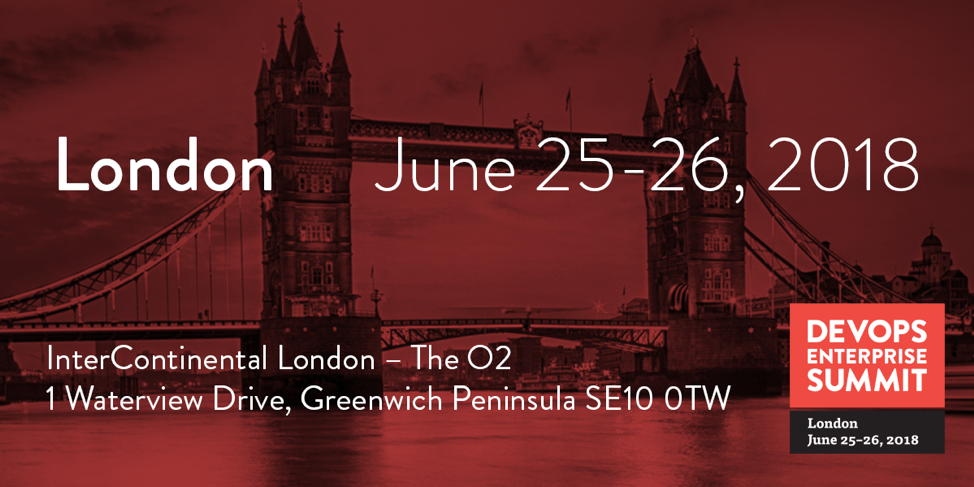
     London: June 25-26, 2018

    To nurture high-learning, exciting networking opportunities, and to create a forum for exchanging insights with some of the best practitioners and subject matter experts on the planet, we developed a list of objectives that I think promise to make this year’s DevOps Enterprise Summit London the best conference yet.

    Programming Objectives:

    • Get great experience reports, and repeat experience reports.
    • Elevate focus on Next Generation Ops and Infrastructure.
    • Help conference attendees achieve their goals.
    • Elevate focus on Spanning Business/Technology Divide.
    • Get best subject matter experts from the domains we need.

    Next Generation Operations and Infrastructure

    Jason Cox, Director of Systems Engineering at The Walt Disney Company, is a member of the DevOps Enterprise Summit Programming Committee, and someone whose advice I’ve relied on ever since I met him in 2013. I’ve also quoted him extensively in “The DevOps Handbook.”

    In the four years since the first DevOps Enterprise Summit, Jason has consistently told me, “That was a great conference, but it was a better conference for Dev than it was for Ops.”  I had promised him each year that we’d do a better job choosing better Ops talks, and I finally asked him to join the conference Programming Committee.

    This year, we’ve dedicated nearly a quarter of the agenda to speak to “Next Generation Ops and Infrastructure Practices,” targeted specifically at Ops leadership, and created a separate subcommittee to focus on a multiyear road map to properly define the problem space, and seek out the talks to help define the direction of the solution.

    As we were reviewing the amazing talks that we have ahead for DevOps Enterprise Summit London this year, both Jason and I were amazed and very satisfied at the Ops perspectives being presented—it is genuinely different than previous years. The reason for this focus is best verbalized from Jason, as he says:

    “This year’s conference programming will help Ops leaders work towards the same goal that our Development partners are also working towards. These talks should resonate strongly with nearly everyone in Ops leadership, and help them not just participate in the DevOps journey, but be active leaders in it, as well.”

    In a lot of cases these problems are the hindrances for a DevOps transformation going the “entire way” and ultimately can be the difference between the high performers and the so-so performers or low performing organizations. These sessions include experience reports and expert talks from:

    Jason Cox, Director, Systems Engineering, The Walt Disney Company

    Jeffrey Snover, Technical Fellow, Microsoft

    Cornelia Davis, Senior Director of Technology, Pivotal

    Damon Edwards, Co-Founder, Rundeck

    Rob England and Cherry Vu, Teal Unicorn

    Jayne Groll, CEO, DevOps Institute

    Nick Funnel, GTIS CTO Development Practice Lead, Barclays

    Tom Clark, Head of Common Platform, iTV

    John Rzeszotarski, SVP, Director of Continuous Delivery and Feedback, KeyBank

    Shaun Norris, Global Head, Cloud Infrastructure Services, Standard Chartered Bank

    Spanning the Divide Between Tech and the Business

    Increasingly, the obstacles that technology leaders face in large, complex organizations are outside the technology value stream. This year, I am super excited about how we are going to be able to point out how these barriers. It’s not just Dev versus Ops. It’s also about exploring how the technology value stream pertains to project management, the funding model, information security, product owners and product managers, etc. In short, we have some amazing talks and experts presenting in London in regards to “spanning the business and technology divide.”

    We’re doing this by having a technology leader co-present with their business co-collaborators. And, we’re going to get the full-hearted endorsement dialogue to unfold on stage for everyone to see.

    My friend and fellow programming committee member Damon Edwards points out that nothing lives in isolation. When you look at the bigger picture as a business, things such as automation help, but moving the bits around have very little to do with the organization being successful. What matters more is how the organization is structured, how people are incentivized, how they view their work and how they interact with the systems around them that really dictate the successes and failures. You’ll notice these are all business functions, not technology functions.

    So, we have multiple talks to showcase these patterns and involve the business-side stakeholders to tell how the business side is fundamentally understanding and driving the transformation journey. These are three presentations that I am really excited about and you can hear more about them over here >>>.

    Verizon Enterprise
    John Scott, IT Manager; Oliver Cantor, Associate Director of Product Strategy; Sanjeev Jain, CIO of EMEA

    Nike EMEA
    Randy Lyons, Sr. Director, Nike Digital Engineering EMEA; Michele Power, CFO Nike Direct EMEA

    Capital One
    Aimee Bechtle, Senior Manager, Advanced Engineering; John Schmidt, Director, Product Management

    Creating a Community of Connections

    It is so important for the organizers of the DevOps Enterprise Summit to help attendees achieve better outcomes, and we’re trying to meet this objective by addressing three common phenomena to conference-goers:

    1. The “velvet rope” problem where there is a person or a group of people that you really want to talk to, but you can’t get to them for one reason or another. Or worse, you have to decide between waiting in a line of people to talk to someone or miss out entirely and head to the next session on your agenda.
    2. Other situations where you’re surrounded by people, but don’t know who you actually should be talking to. If you’re like me, in the past I decided the best use of my time was to go do something else, such as check my email instead of interacting with my peers. In retrospect, this might’ve been the dumbest thing I could’ve done.
    3. Everyone is going to lunch, and they’re organizing by restaurant names, but what you really want to know what the subject matter of the discussion will be.

    Together with Jeff Gallimore, we are working on establishing different ways to create opportunities for people to ask and answer as many questions as possible. After all, the quality of the audience is one aspect that we think separates the DevOps Enterprise Summit from other events! Therefore, the more spontaneous conversations and interactions we can nurture onsite, the better for everyone. So, how are we striving to do this? Read below and you can also listen to Jeff talk about it here>>>.

    • Slack Workspace! We will have our very own Slack workspace for the DevOps Enterprise Summit! For the first time ever, every attendee has an opportunity to join the shared workspace to interact with speakers, attendees and sponsors. There will even be a “Who’s Hiring” channel for new job opportunities. What’s more, this channel will be open even after the conference ends, so that we can continue the dialogue and interactions with people after June 26.
    • Ask the Speakers! We’re creating opportunities for attendees to have a dedicated time and location to ask the plenary speakers questions that go deeper on the information they presented earlier that morning. We’re going to open up a Slack channel for every attendee to use and submit questions directly to speakers and to other attendees. During the “Ask the Speaker” sessions, we’ll use this repository to highlight the most popular questions, and give attendees different ways to engage with speakers directly.
    • Lean Coffee Sessions! We want to help attendees connect with and learn from their peers at the conference in another semi-structured format as well. We’re going to produce Lean Coffee sessions, led by Dominica DeGrandis, both days of the conference. This will be comprised of 10 tables big enough for 10 people to talk about similar interests that are relevant to the theme at the table. Hopefully, this provides another opportunity to learn a lot and make some valuable new connections.
    • Lunch time! There will be a few different lunch options that attendees can take advantage of as well:
      • Eat lunch with a speaker will be a first-come, first-served basis. This will give you an opportunity to sit down face to face with a speaker and, again, dive deeper into the subject matter of their presentation and experiences in a more personal setting.
      • Have lunch with fellow attendees at high-top tables around the buffet stations, where there are note cards with seed questions to start discussions.
    • Industry party! Book signings, sponsor giveaways, food and drinks and a great opportunity to continue conversations with fellow attendees and speakers. This is where some of the most interesting conversations take place and I heard some amazing stories there last year.

    Leaders Talking About the Continuation of their Journeys

    Another thing that I am always so delighted by is the constant scouting and searching that the programming does to look for the amazing case studies we get to hear at the DevOps Enterprise Summit. Chris Hill of Jaguar Land Rover is a testament to this fact, and we’re really looking forward to having him as part of the program this year. We caught up with Chris during a recent YouTube Live hangout, and he previewed some of his presentation for us here >>>.

    “The DevOps Enterprise Summit for me is something I hold close to my heart, considering I attended my first event in 2016 in San Francisco where I walked away from that conference with the books and motivation I needed to transform my organization. In terms of how we’ve started with our DevOps transformation, this actually came organically from the conference.” — Chris Hill, Jaguar Land Rover

    We have some excellent repeat speakers this year talking about the continuation of their journeys, including Topo Pal, technical fellow at Capital One; Jonathan Fletcher, CTO at Hiscox; Scott Prugh, CTO at CSG; alongside Erica Morrison, executive director at CSG; and Jonathan Smart, head of Ways of Working at Barclays.

    We also have multiple PhDs to present subject matter expert talks on the domain expertise that we need to help us achieve our goals. Here is a glimpse into the expertise we are drawing in at the DevOps Enterprise Summit this year:

    • Richard Cook, research scientist at The Ohio State University, is presenting this year and he’s the person who has probably influenced John Allspaw’s thinking the most over the last decade. I can’t wait for his talk highlighting a new way to think of operations.
    • Nicole Forsgren, CEO at DevOps Research and Assessment, is someone whom I’ve had the pleasure of working with for years on the “State of DevOps” report with Puppet, now in collaboration with Google Cloud. She’ll be sharing the latest knowledge and learnings from that research.
    • Mik Kersten, CEO of Tasktop, will be talking about his work from project funding models to product funding models.

    As you can see, there’s a lot that is getting me excited for the conference this year! To watch the full preview discussion of DevOps Enterprise Summit London 2018 and learn more about the conference, please watch our YouTube Live event with Alan Shimel, editor in chief of devopsy.kinsta.cloud; Damon Edwards, co-founder of Rundeck; Jeff Gallimore, partner at Excella; and Chris Hill, head of Systems Engineering, Infotainment at Jaguar Land Rover.

    Thanks for reading and look forward to seeing you all in London!

    Attend the DevOps Enterprise Summit

     London: June 25-26, 2018

    — Gene Kim

  • Tricentis Accelerate Conference’s Big Reveal Came from its Audience

    Tricentis Accelerate Conference’s Big Reveal Came from its Audience

    At the recent Accelerate San Francisco 2018 conference, Tricentis was joined on stage by big-name customers, global partners and well-known quality and DevOps evangelists. This was the first time a U.S. date for Accelerate was added alongside its annual stop in Vienna, Austria. And, while the number of attendees was impressive—especially when Google IO and Microsoft Build were held the same week—it was the undeniable sense of urgency running through the audience that stood out, to me, as the week’s biggest takeaway.

    Having covered countless software and technology conferences over the years, it’s always somewhat eye-rolling when the hosting vendor or conference organizer uses their time on stage poorly. I often see this done in one of two ways. They either, a) relentlessly try to sell you on a current transformation or shift that no one really buys into, or, b) only explain that there is a shift—one that everyone agrees on—but then offer no actionable information for those who will be impacted by it.

    Agile, DevOps, digital transformation, continuous integration/delivery—all of which came up throughout Accelerate—have been the focal points of software conferences for years. These shows have given development and operations teams a wealth of information, case studies, lessons learned, best practices and inspiring keynotes, and they should be commended for it. But, today’s CIOs are frantically looking for the culprit behind how they’ve invested so much to make these processes and methodologies possible—yet, are still struggling to get high-quality, software out the door faster. Many of these CIOs are realizing the glaring oversight that they, and these conferences, have made.

    Accelerate San Francisco’s manual testers, automation engineers, exploratory testers, test managers, QA directors and more didn’t have to be sold on the idea that testing has an enormous opportunity to solve the challenges their CIOs are facing today. Those who truly respect the power of “good” testing (an the artistry behind it) have always known what testers were capable of providing to the business. However, testing has been hamstrung by legacy technologies that prevented moving at the same pace of their development and operations colleagues.

    But, today, those constraints have been removed, thanks to innovative test automation technologies and testers and QA professionals may not even have to sell their “new” worth to management. More and more often, the C-suite is recognizing software testing as an untapped resource for innovation, and many of Accelerate’s attendees could clearly sense the attention and expectations from their leadership on the horizon.

    Day 1 of Accelerate was largely product-focused and featured a number of “discovery” and “deep dive” sessions led by the product owners of some of Tricentis Tosca’s most popular functionality. Continuous Testing, Load Testing, API Testing & Service Virtualization, SAP Testing were all showcased and demoed to existing customers and those evaluating whether Tricentis could assist them on their own unique journeys. Day 1 wrapped up with a product road map discussion given to a standing room-only crowd, and led by Tricentis chief product officer, Dr. Gerd Weishaar.

    Day 2 kicked off with a bang with what was dubbed, “The Great Debate in Software Development.” Electric Cloud’s Anders Wallgren, Accenture’s Jeff Wilkinson and Tricentis founder Wolfgang Platz sat down to discuss who owns quality today, why that responsibility might change, and how testers and SDETs can be prepared for the future. There were some really outstanding—and oftentimes, conflicting—points made by each panelist, including:

    “Development is a skillset; quality engineering is a mindset.”

    “Testing is always reactive; quality engineering is proactive.”

    “Quality is a frequency and depth of measurement game.”

    Once we get the debate’s recording online, I’ll share the link in a future blog, and would love to keep the conversation going with anyone who is interested. There was so much that was presented that’s worth discussing and debating further.

    Dr. Nicole Forsgren took the stage immediately after the debate and introduced her new book, “Accelerate,” (how could we not have invited her to a conference with the same name?) that she co-authored with fellow DevOps household names Gene Kim and Jez Humble. I’m constantly looking for ways to get testing more on the minds of DevOps community (because it makes zero sense for it to be so absent), so I was thrilled to learn that continuous testing has made it into DORA’s next “State of DevOps” report. Their annual survey that this report is focused on should be released soon, so look out for that.

    Tricentis CEO Sandeep Johri then took the stage to give his thoughts on Tricentis’ role within the current state of software testing. Johri pointed out that while software becomes the key to success in many digital transformation initiatives, it also becomes a serious problem when software cannot be released at the speed that business demands. “Who cares if you can develop faster if you can’t also ship faster?” said, Johri. “You cannot ‘ship and pray’ in the enterprise.”

    Being able to ship faster—with a sound, risk-based assessment of each release candidate—requires continuous testing, said Johri. And, to CIOs who historically have viewed testing as a bottleneck to innovation, I can see where this could be a hard sell. “You know that thing that you hate? The thing that costs a fortune, and takes forever, and doesn’t provide you with an easily discernible ROI? Do that way more, or, better yet, do it all the time.”

    But, as Johri remarked—and I’d never actually heard someone word it this way—”Testing isn’t a bottleneck. Scripting is.” This is 100 percent accurate, and, as CIOs in greater number begin to realize this, continuous testing will become not just better understood, but a must-have in every organization. It’s the manual effort around testing that slows you down, stalls innovation and adds increased costs around the requirement for testers or developers to have coding expertise. These costs and bottlenecks are what CIOs want to eliminate. As awareness of modern test automation technologies that remove these constraints increases, Johri predicts that the solutions that can’t offer the same level of agility at scale will continue to fade from the market.

    The next keynote of the day was given by Tricentis founder Wolfgang Platz. While Platz gave due-credit to what I’m calling the “A.I.-lephant in the room,” it was the advice to the Accelerate attendees of how to navigate the current transformation going on in world around them that I found most inspiring. Platz shared the current strategic priorities for CIOs in 2018, and it was remarkable how clear it was to everyone in the crowd where they could assist with meeting each one of them.

    We hear all the time about lofty aspirations such as, “Quality is everyone’s responsibility,” and, “DevOps establishes that every team is working toward the same goal.” But, when Platz ran through CIO priorities such as digital transformation, customer experience, data analytics, moving faster, improving culture, scaling agile development and freeing up budget, eyes didn’t roll. People didn’t groan or walk out. It was clear that the entire room understood exactly what they were capable of by trading the limitations of yesterday for the capabilities of tomorrow.

    Today’s CIOs have never been under more pressure to avoid disruption, and my biggest takeaway from Accelerate was that the testing community understands that accomplishing this monumental task—in every software release—is only possible with their involvement.

    Let’s see how many testers continue to navigate through change introduced by others, and how many take the opportunity to drive new change themselves.

    — Noel Wurst

  • Appian World Recap: Low Code, BPI, Hackathon & The Woz

    Appian World Recap: Low Code, BPI, Hackathon & The Woz

    I had a chance to attend my first Appian World a few weeks ago. It was right in my backyard, at the iconic Fountainbleau in Miami Beach. I brought a video crew with me and had a chance to do some deep dive interviews with customers, partners and Appian execs. I will highlight those further down. The real story of Appian World, though, was about low code, business process management, hackathons and the Woz. I wrote a recap of the CEO’s keynote from the show, but wanted to follow up with more details.

    shimmy and wozAppian had announced a hackathon with the winners to be announced at Appian World after the judges—John Rymer, Steve Wozniak and myself—selected the winner from five or six finalists. The winner received a $5,000 cash prize. Contestants came from all over the world; some were teams from Appian partners and customers, while others were individuals.

    (Before I tell you more about the winner, let me say that judging this hackathon alongside Steve Wozniak was a personal bucket list moment for me. I did get a little giddy standing next to the Woz and talking with him about the hackathon contestants. But enough about me.)

    Back to the hackathon. After evaluating the finalists, we (the judges) decided that the winner best exemplified the spirit of a hackathon. Brad Cauzza created FRED, a facilities record database. Basically, using Appian low code app building and integrations, Brad built a system that allowed visitors to sign in when visiting a facility. It also tracked incoming packages and more. It was a really nice use of the Appian platform.

    There were some finalists who had grander applications, but we thought FRED was a great example of what you do at a hackathon. Below is my interview of Brad and Malcom Ross of Appian.

    While we are looking at interviews, I also had a chance to sit down for a deep dive with Appian founder and CEO Matt Calkins. Matt has guided Appian from a small group of he and his three co-founders all the way through to public entity. Appian is not an overnight wonder; it has been a 19-year trip for Matt and his team. He shared a lot of his views on this journey, as well as where he sees Appian going in the future.

    As I mentioned, there were actually four founders of Appian and they are all still with the company 19 years later. That is quite unusual, to say the least. I also had a chance to sit and chat at length with another Appian founder, Michael Beckley, who is CTO-founder of Appian, like Matt from day 1 all of those years ago. Here is my discussion with Michael:

    Over the course of the event I spoke with several Appian folks, as well as partners and customers. You can see the whole YouTube playlist of Appian World 2018 interviews on our DevOps TV YouTube channel.

    — Alan Shimel

  • Devops Chat: Interop China Features DevOps and DevSecOps Tracks

    Devops Chat: Interop China Features DevOps and DevSecOps Tracks

    Interop China has been growing steadily since its inception in 2013. It is part of the Cloud Connect conference in Shanghai. This year the conference will feature both DevOps and DevSecOps tracks and talks. Jayne Groll of the DevOps Institute is the DevOps track chair and Alan Shimel of devopsy.kinsta.cloud and Security Boulevard is speaking at DevSecOps.com. We sat down with Molly Huang and Kelly Yao of UBM China to discuss this year’s event.

    Molly and Kelly give us a little of the history of Interop & Cloud Connect China, as well as a behind-the-scenes look at what goes into selecting tracks and putting on a major event such as this. It is also a great look into the tech scene in China.

    As usual, the streaming audio of our conversation is below followed by the transcript of our conversation.

    Audio

    Transcript

    Alan Shimel: Hey, everyone. This is Alan Shimel.

    Jayne Groll: And this is Jayne Groll.

    Shimel: And you’re listening to a combined podcast tonight of DevOps Chat, along with Continuous Chit Chat, which is, of course, the podcast from The DevOps Institute and the Community of Continuous Learning.

    Jayne, welcome!

    Groll: Hi, Alan, how are you? I don’t think we’ve done a podcast together in a little bit, huh?

    Shimel: Well, we—[Laughter] that’s what happens when you travel around the world.

    Groll: [Laughter]

    Shimel: And I’m traveling as well, but we have certainly been on opposite ends of the world, and that’s actually a great lead-in to tonight’s show, Jayne, where we talk about traveling around the world, because we’re happy and lucky to have two of our colleagues coming to us from China today. We have Kelly Yao, who’s a Project Manager at UBM in China, and Molly Wong, who works with UBM for Interop China, and it was a Cloud event, wasn’t it?

    Kelly, Molly—welcome to our podcast.

    Molly Wong: Hi! Hello, Jayne. Hello, Alan.

    Kelly Yao: Hi, Jayne and Alan.

    Shimel: Thank you.

    Wong: It’s really nice to help out.

    Shimel: Ladies, thank you. Molly, besides Interop China, what was the Cloud event you mentioned?

    Wong: Okay. So, the whole name of our event is Interop and Cloud Connect China.

    Shimel: Ah, I got it.

    Groll: So, it’s one event?

    Shimel: Yes, so—

    Groll: It’s one single event.

    Shimel: Got it.

    Wong: Yeah, it’s one single event.

    Shimel: Interop and Cloud Event China. Very good. Now, Molly, if you don’t mind me asking you, many people in our audience, I’m sure, are familiar with the Interop name. It’s been one of the top IT shows here in the United States for 20 plus years. But they may not be familiar that China has an Interop event. How long has Interop China been held? How many years?

    Wong: So, as we all know, Interop is an international event focused on information technologies and the ecosystems of the cloud community. But when it was first introduced to China in 2013, however, only the deliberation of cloud computing was capped, because at that time, Chinese companies were just at the same point switching from hardware to cloud services for cost reduction.

    So, that’s why, initially, the Interop China event is not called Interop, it was called Cloud Connect China.

    Shimel: Ah, interesting!

    Groll: And I was gonna ask, and it kind of makes some sense, if you think of Interop as an international event, which is really about operations, and Cloud Connect certainly is about operations. So, it sounds like, Molly, that the approach here was really to produce an event that spoke to not only cloud from an operational perspective, but also just IT operations in general. Is that correct?

    Wong: Yes, because, you know, UBM, by its nature, is an event organizer. So, we have to keep up with the global trends and add different burning topics into the conference every year so as to make the event more compelling.

    Shimel: Absolutely.

    Wong: So, this year—and Alan, if you don’t mind, let me ask a little bit about DevOps. Because, as you know, I’m gonna be the track chair for the DevOps track. So, tell us why you decided to add a DevOps track to Interop, and even including DevSecOps, which is a security—obviously, DevOps and Security.

    So, what are you hoping to come out of the DevOps track?

    Wong: You are asking me, or Kelly?

    Groll: Either one. We haven’t heard from Kelly, so maybe Kelly wants to answer.

    Wong: Okay, I will answer that for Kelly, because I’m mainly responsible for the content.

    Groll: Okay.

    Wong: So, I think nowadays, the technological benefits of DevOps is very obvious, and organizations that successfully implement DevOps, implement DevOps tools and practices in general, they tend to be ahead of their competitors across key metrics like profitability and growth. So, that’s why the Chinese DevOps communities are growing so fast, as a lot of professionals are flocking into the DevOps ________ and to learn and adapt.

    So, from our part, we think we would love to contribute to build up a platform for these lovers and learners to communicate, to collaborate, and to excel.

    Shimel: Excellent. Jayne—so, Molly, if you don’t mind, I’d like to hear from Kelly a little bit. Kelly, in your role of Program Manager, how are you sourcing content? Where is the content for the DevOps and the DevSecOps and so forth? Is it internal to the Chinese community? Are you bringing in also people from around the international DevOps community? You know, I imagine it must be quite a job putting this all together.

    Kelly Yao: Yes, yes. Exactly. Like, for us, it’s just a platform. We are an event organizer. So, we are not professionals who are familiar with this content. So, what we do is, we will have a—what is it? Like—

    Wong: An advisory board.

    Kelly Yao: – yeah, advisory board. So, we will have the board meeting like twice a year to put up all the content. So, this year, we decided to put this DevOps tracks, and so, it will benefit our event, it will benefit the whole content for this event. So, that’s when, but you recommended it to us—you and Jayne recommended it to us by Interop ITX, because it’s like—yeah. We’re like partners, so both Interop ITX and Interop China, we’re working together to deliver the content.

    And so, when we decided to make the DevOps tracks and then that we reached out to you at devopsy.kinsta.cloud and also for Jayne—

    Wong: Yes, for Jayne at the DevOps Institute.

    Kelly Yao: – yeah, DevOps Institute. And, of course, you are the expertise that—you are the experts, that you will know how to make the content right and how to recruit speakers for, the most suitable speakers for this content, for this topic.

    Shimel: Understood. Fantastic. And ladies, how has—you know, from what we understand, and of course, we’re on the other side of the world, but it’s a small world in today’s Internet, right? We’re all connected.

    Wong: Uh huh, yeah.

    Shimel: We know that the DevOps community in China is, as you said, Molly, is growing very fast. It’s already very large, and I’m wondering, what kind of have you gotten from the community about adding the DevOps tracks? Has it been a positive reaction?

    Wong: I think everybody here are fully aware of the benefits of DevOps. But, you know, the challenges of actual adoption remain huge. Because, you know, for the DevOps design for the architecture, it’s all about the tradeoffs. The development of DevOps in China now stands between the early and middle age, because, for the DevOps professionals, they need to consider what they deem as the most important thing and what are they willing to sacrifice or give up for and, really, how to lower the costs when running in a public cloud.

    So, I think there are a lot of concerns. There is a need to figure out the full implementation.

    Shimel: Understood. And, you know, Molly, just—Interop ITX in Las Vegas is a large show, thousands and thousands of people. How big is Interop China? How many attendees do you expect?

    Wong: I think the estimated number would be around 3,000.

    Shimel: That’s a big, that’s a—

    Wong: Yeah. Each year, like—

    Groll: It’s a nice sized continent, you know?

    Wong: – around 3,000 people are coming to—yes, 3,000.

    Shimel: Very interesting. And, you know, DevOps is great, but give our listeners a sense—what are some of the other tracks about, besides DevOps?

    Wong: Besides DevOps, this year, we also have AI—

    Kelly Yao: Artificial intelligence—

    Wong: – big data—

    Kelly Yao: – big data, and data mining.

    Wong: Yeah.

    Kelly Yao: Yeah, as well as information security.

    Wong: Information security, yes.

    Shimel: Mm-hmm. So, I have to tell you ladies that listening to both of you talk about the challenges of DevOps and what other areas are of interest to the crowd, you know, to the community in China, it really is a very small world. Because these are the same issues, the same topics that we see here in the United States, it’s the same thing that we see in London and in the rest of Europe. Jayne, you can talk, you were just at a few conferences in Europe.

    There are some things that just seem to be universal in today’s technology scene, and everyone is excited about artificial intelligence and machine learning. Cyber security information or InfoSec is top of mind; every day, we seem to hear of more breaches and hacking. And, of course, DevOps is very exciting.

    Jayne, as Molly said, you are the DevOps chair for Interop China. I mean, that’s very exciting. Give us a little idea of what you’ve done in your role there.

    Groll: So, I’m also the DevOps Track Chair for Interop ITX U.S. So, it’s been very fascinating working with both teams, because, you know, Alan, as you said, the challenges, the successes, the emerging practices in DevOps in particular are very, very universal. And some are starting to emerge differently. Some are, for example, to start, reliability engineering in the U.S. is starting to gain some momentum. I’m not sure, specifically, around the world, but I do know in Asia-PAC ________, there’s conferences like that as well. So, that’s an emerging practice.

    Looking at continuous delivery and how it relates to operations is a theme that’s carrying through from both conferences. So, I’m particularly excited about really visiting with the Chinese community, as you know, DevOps Institute is a very, very global organization, and really having some face to face time, bringing content, bringing learning to Interop China and the Cloud Connect.

    The other thing we’re gonna do at this event is, we’re gonna do some DevOps training. So, working with one of our Chinese partners, we’re going to do a half-day Essential DevOps workshop. So, for those that are not even so much, “What is DevOps?” but really, a visit to, “What are these practices?” like continuous integration, continuous delivery. I mentioned site reliability engineering. So, in addition to a traditional conference program, we’re going to also bring a half-day workshop to Interop China and Cloud Connect. So, I’m really very, very excited about that in particular. And we will have one of our Chinese colleagues, one of our Chinese partners deliver it so that it can be localized, and he’ll bring not only being able to deliver it in a native Chinese language, but also bring some very, very good local examples and case studies to the training as well.

    Shimel: Excellent, excellent. You know what? We didn’t really get the details that, Kelly and Molly, if you can share with us, what are the dates for Interop China?

    Wong: Yeah, it will kick off on May the 9th to 11th this year.

    Shimel: Okay, and it’s in Shanghai.

    Groll: In Shanghai—in Shanghai.

    Shimel: Yes, it is, it’s in Shanghai.

    Wong: Yeah, in Shanghai.

    Shimel: And for people who may be listening to our podcast who are in the area or maybe would like to attend, where can they go on the web to get information about that?

    Wong: Yeah, sure. They can register online through our official web portal, cloudconnectevent.com.

    Shimel: Cloudconnectevent.com—excellent.

    Wong: Yes.

    Shimel: And that is for Interop China. So, this—if I’m understanding, this is the fifth year for the event.

    Wong: Actually, it’s the sixth year, yeah.

    Shimel: Sixth year—yes. So, Molly and Kelly, how many years have you been involved with the event?

    Wong: Yeah, actually, we two are—we’re jumping into this platform, this event from last year, 2017.

    Shimel: And so, from ’17 to ’18, do you see a big change?

    Wong: Yes. I think the market is changing itself. Like, most of our exhibitors, sponsors, most of the cloud enterprises, they’re changing themselves and also their knowledge, their application on the technology. So, it’s changing themselves, and also ________, it’s like, we’re also changing our content to adapt to the market.

    Shimel: Like any good event organizer should, correct? You’ve got to adapt to what the market is there.

    Wong: Yes.

    Shimel: Well, I have to tell you that I am personally very excited to be coming to Shanghai and delivering a presentation on DevSecOps and why security, it’s vital that security become part of the DevOps equation, we’ll talk more about it. And to be there with Jayne and Jayne will be delivering as well, as well as some DevOps Institute training. It promises to be a great event for the Chinese DevOps community as well.

    Molly and Kelly, I want to thank you for joining us. We’re just about out of time, unfortunately. But—

    Wong: Okay.

    Shimel: – this was great. We’re looking forward to coming out to Shanghai in May, and we’re hoping that this will be a tremendous event, and we hope to see you there soon. Thanks very much for joining us tonight.

    Groll: Really enjoyed it.

    Wong: Thank you, Alan and Jayne.

    Shimel: Thank you.

    Groll: And maybe we could do a podcast from the event.

    Shimel: That would be great!

    Groll: So, let’s—you know, [Cross talk] maybe we can do a live podcast from the event.

    Wong: Yeah, yeah. We’re really excited to see those in the event.

    Shimel: Fantastic.

    Wong: And I’m also looking forward to—yeah, looking forward to the podcast if we can have, on site, the Interop China.

    Shimel: That would be fantastic. Jayne, I’m gonna give you the last word tonight.

    Groll: [Laughter] Well, thank you. Molly, Kelly—it’s a pleasure to work with you. For those that are listening, if you do have the ability to attend, it really does promise to be not only a fantastic event, but an event where there’s lots of opportunities to learn and really track some of the emerging trends not only in DevOps, but particularly on the operational space. So, if you’re going to be in Shanghai, we all look forward to meeting with you. Molly, Kelly—see you in a few weeks. Alan, see you in a few weeks. And for everyone, thanks for listening.

    Shimel: You’ve just listened to a Continuous Chit Chat and DevOps Chat. Have a great day, everyone! Bye bye.

    — Alan Shimel

  • Fast Pass: Your Ultimate Guide to the Best of Jenkins World

    Fast Pass: Your Ultimate Guide to the Best of Jenkins World

    At the end of the month, Jenkins users and DevOps professionals from around the world will head to San Francisco for the annual Jenkins World conference, taking place Aug. 28-31. The conference lasts four days, but time flies when you’re attending trainings, keynotes, sessions and networking events. To make sure you get the best of everything at Jenkins World, we’ve put together a guide that will ensure you have the most productive and enjoyable experience.

    NOTE: devopsy.kinsta.cloud readers can get 20 percent off registration with the code JWDEVOPSCUST.

    Take the Time to Develop Your Skills

    The first two days of the conference will be full of workshops and training sessions. Regardless of skill level, there are trainings for everyone. Those just getting familiar with Jenkins can attend an “Introduction to Jenkins” training for free and learn how to easily create pipelines while putting in place best practices for continuous integration (CI) and continuous delivery (CD).

    Those a bit farther along their Jenkins journey can attend workshops such as “The Final Mile: Jenkins Pipeline and Patterns for Operations,” where attendees will review patterns of common problems and solutions specific to operations teams in a CD environment , as well as how to create Jenkins pipelines that address the needs of operations.

    Don’t Miss These Essential Sessions

    All attendees should make sure they make it to each of the keynotes, of course! Keynote speakers include Sacha Labourey, CEO of CloudBees; Kohsuke Kawaguchi, founder of the Jenkins project; and Jez Humble, CTO at DevOps Research and Assessment LLC.

    In addition to top-notch keynote speakers, there are a number of DevOps professionals you’ll want to hear from while at the show. Try to attend at least one of these sessions:

    Keep an Eye Out For …

    Make sure you listen in to find out who the winners are of the first annual Jenkins World Awards Program. There are two awards tracks: Jenkins Community Awards and CloudBees Innovation Awards. Each track has several categories including Jenkins Contributor Award, DevOps Automation Excellence Award and more. Winners will be announced Thursday, Aug. 31, at the show.

    You’ll also want to stop by the sponsor expo hall to check out dozens of great vendors. As with any good conference, there will be plenty of swag passed out. Exhibitors will include GitHub, BlazeMeter, Docker, JFrog, Fugue, Sonatype and others. Don’t miss out on taking a photo with the famous Jenkins butler at the CloudBees booth!

    Can’t Forget to Network

    With so many great sessions to attend, don’t forget to make time for networking events. It would be a waste to not take advantage of dedicated networking time to speak with experts and peers who have likely dealt with some of the challenges your organization may be facing. There will be several networking opportunities, including a reception Aug. 30 sponsored by CA BlazeMeter. Or if you’re looking for ways to stay active, attend a scheduled walk or yoga class.

    If you can check off all of the above activities, you’re bound to leave Jenkins World a better professional! Make a checklist at the start of the conference to ensure you hit all the events and sessions you’re most excited for.

    If you haven’t registered yet, there’s still time! Use the promotional code JWDEVOPSCUST for 20 percent off.

    About the Author / André Pino

    André brings more than 20 years of experience in high technology marketing and communications to his role as vice president of marketing at CloudBees. He has experience in several enterprise software markets including application development tools, middleware, manufacturing and supply chain, enterprise search and software quality and testing tools. André has particular expertise in working with the executive teams of enterprise software companies to create unique competitive positioning, build pipeline and establish sustainable market leadership. Prior to joining CloudBees, he served as principal analyst serving technology marketers at Forrester Research. He has also held a number of senior management positions in marketing and communications with companies such as Segue Software, Hewlett-Packard, Unisys Corp. and Bluestone Software. André holds a BS from Eastern University.