Tag: documentation

  • Swimm Adds Generative AI Chat Tool for Documentation

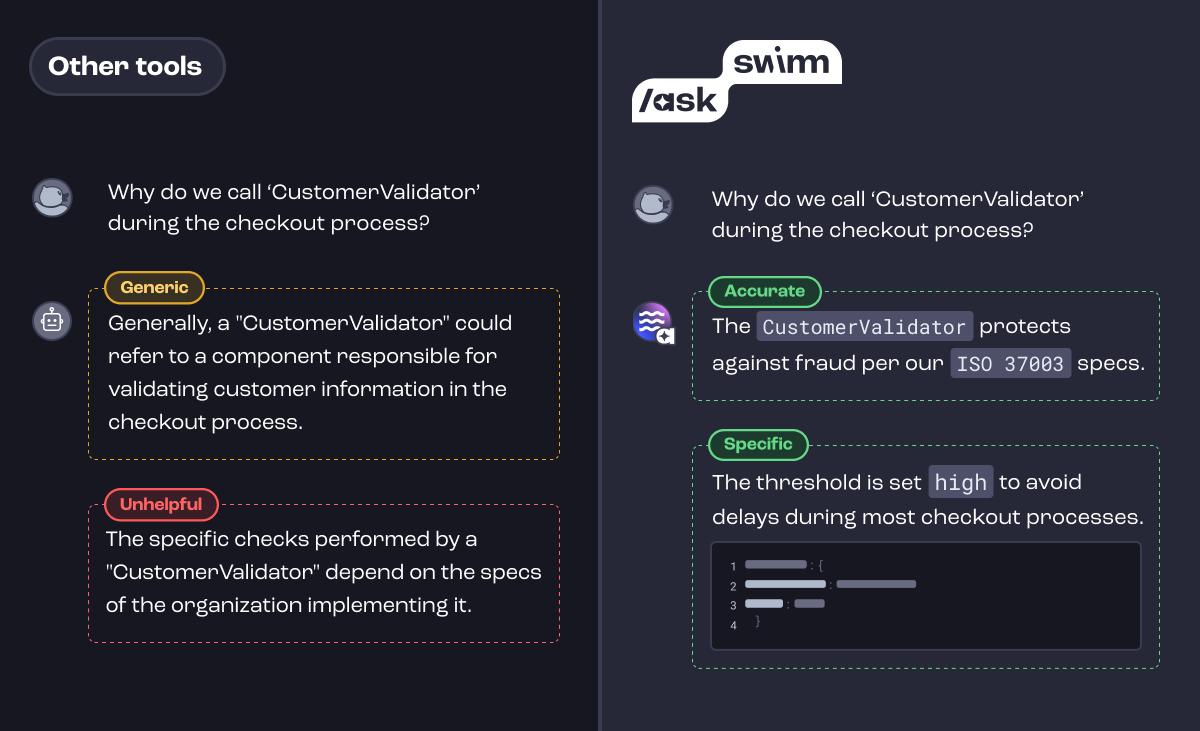
    Swimm today announced it has added a chat tool that enables developers to use natural language to surface insights into code.

    Company CEO Oren Toledano said the /ask Swimm tool makes it simpler to launch queries that enable developers to better understand how code was constructed.

    The /ask Swimm tool aggregates documentation along with other related data to surface factors that are not evident in the code itself, such as documentation of business decisions, product design considerations and decisions concerning why specific architectural choices were made. It automatically captures and updates code-related knowledge to provide a continuous feedback loop as code, documentation, files and repositories are created and updated to provide deeper insights into code that goes beyond what might have been actually documented.

    The overall goal is to provide a mechanism that enables developers to understand how and why code was constructed within the context of an integrated development environment (IDE), said Toledano.

    Swimm has previously made available a platform that uses generative AI platform to create a static analysis of documentation. That capability should make it simpler for organizations to track documentation at a time when generative AI platforms such as ChatGPT are exponentially increasing the amount of code being written. In theory, those platforms should be able to also create documentation for that code, but there will still be a need for tools to track and analyze it.

    In the longer term, Swimm plans to continue to extend its usage of generative AI to provide deeper levels of insights across entire applications and software ecosystems to address that challenge, noted Toledano.

    In the short term, however, it’s clear that AI is making developers more productive than ever. In fact, the volume of code being generated might soon overwhelm existing DevOps pipelines and workflows. Most DevOps teams will need to revamp those workflows as the pace at which more applications than ever are being developed and deployed faster than ever.

    It’s still early days as far as generative AI adoption is concerned, but it’s clear many developers are already using it to write code. How much of that code makes it into a production environment is difficult to determine, but a lot of that code is going to be of varying quality. A general-purpose AI platform such as ChatGPT was trained using code collected from all across the web. The code generated by these platforms is only as good as the examples used to train it, all of which were created by human developers who may have made mistakes, such as including code that has known vulnerabilities.

    Regardless of whether code was generated by a machine or a human, the probability that documentation will need to be analyzed as part of a code review process is always high. The challenge and the opportunity is to determine the best way to apply AI to a longstanding challenge that is now being exacerbated by the existence of AI tools that, with each passing day, are only becoming more accessible to developers.

  • Copado Expands Beta of Generative AI Tools for Salesforce DevOps Platform

    Copado Expands Beta of Generative AI Tools for Salesforce DevOps Platform

    Copado today announced it has expanded a beta program through which it provides application development teams building applications for the Salesforce software-as-a-service (SaaS) platform access to generative artificial intelligence (AI) capabilities enabled by ChatGPT.

    David Brooks, SVP of Evangelism for Copado, said the company, via the usage of vector databases, has exposed instances of ChatGPT to everything in its knowledge base that has been collected over the last 10 years. That approach enables Copado to extend the large language model (LLM) used to train ChatGPT without exposing any data that might be used to one day train the next version of the generative AI platform.

    The goal is to enable DevOps teams to generate code and tests faster while simultaneously reducing the time required to handle support calls, said Brooks.

    In addition, Copado is using ChatGPT to enable impact analysis and conflict detection to reduce the level of friction encountered when deploying applications in a production environment. That latter capability is critical because, in many instances today, DevOps teams don’t have a firm understanding of how code needs to be deployed, resulting in unnecessary rollbacks of application deployments, noted Brooks.

    Generative AI will also automate the creation of documentation, such as release notes for every application deployed, to reduce the overall level of toil DevOps teams experience, noted Brooks.

    Copado also plans to provide governance tools that will enable DevOps teams to ensure the code written by an LLM is not based on a hallucination that results when trying to reconcile conflicting data, added Brooks. There will, of course, always be a need for a human to review code before it is deployed in a production environment, he added.

    In the longer term, Copado will make it possible for organizations to invoke multiple LLMs to address various functions as they best see fit, said Brooks. In fact, DevOps teams should expect to soon be employing multiple copilots trained to address specific tasks such as writing code, deploying applications, assessing cybersecurity and addressing compliance mandates, he added.
    Ultimately, application development and deployment efforts that today require weeks to complete will soon be accomplished within the same day, said Brooks.

    At the same time, organizations will also be able to better manage application environments that today operate at levels of scale few IT teams can manually track. Generative AI capabilities, in effect, will make it simpler for DevOps teams to effectively manage application environments at much higher levels of scale, said Brooks.

    Each organization will naturally need to determine to what degree they are prepared to absorb that level of innovation, but it’s clear the pace at which applications are built and deployed is about to exponentially increase. The issue organizations will increasingly encounter is that business processes will not be able to absorb the rate at which software can be built and updated.

    It’s not clear just yet to what extent generative AI will transform DevOps, but as advances continue to be made, many of the manual tasks and bottlenecks that today conspire to slow down application development and deployment are about to be eliminated in ways that few would have thought possible a little more than a year ago.

  • The API Life Cycle Mixer’s Manual: What Goes Into a Single Source of Truth?

    The API Life Cycle Mixer’s Manual: What Goes Into a Single Source of Truth?

    In bartending, the mixer’s manual is a trusted source of information. These books can contain hundreds of recipes for classic cocktails, some of which might be 100 years old, while others might be for drinks that only recently arrived on the scene. Mixer’s manuals also can be great sources of inspiration for new, yet-to-be-tested recipes for exciting additions to a bar’s or restaurant’s offerings. This balancing act of preserving the old while encouraging exploration into the new can provide a valuable lesson for API development in the software world. An API’s “single source of truth” is, in many ways, the software organization’s own mixer’s manual. This is especially true when the right approach is taken to ensure that software remains functional and performant and serves up experiences that delight customers and keep them coming back for more.

    The Rise of APIs and Mixology

    While we might think of mixology and the mixologists who practice this craft as relatively new terms, the first recorded use of the word “mixologist” dates back to 1852 and “mixology” followed shortly after.

    Just how similar are the work, mindsets and passions of mixologists and API developers and designers? Check out this definition of a mixologist and count the similarities for yourself:

    “The term ‘mixologist’ refers to someone who studies the history of mixed drinks, has a rich appreciation of the ingredients and techniques used and regularly creates new and innovative mixed drinks … their job title implies that they do a significant portion of their job behind the scenes, creating new craft cocktails and putting their signature twist on existing favorites.”

    The best API developers, designers and architects of the world should recognize a lot of the above in their own work. They have deep respect for their craft and are always honing it further. They seek to understand the tastes and palates of their consumers. They factor in other stakeholders’ inputs, they test, iterate and test their creations again before “serving” those APIs to production.

    Like mixologists and bartenders (if you see them as two different roles), every professional along the API life cycle should understand the needs of consumers, customers and the business–and then design and develop their APIs accordingly. An essential part of this process is continuous validation and adaptation to market requirements.

    Maintaining Confidence in Ever-Changing Recipes

    Changes to APIs, even minor ones, can have significant downstream effects. And the same can be said for tweaks made to an age-old cocktail recipe, where adding or removing a single dash of this or that can completely change the flavor of a drink … as well as people’s interest in it.

    While there’s no “standard” rate of change to APIs to plan for, you can expect changes to be needed with each new software release. This could mean changes are being made (and need to be tested against and validated) every few weeks, every month or even every day, depending on your release cadence. There also can be as-needed, ad-hoc changes.

    What’s crucial for teams to ensure is that these changes do not disrupt an API’s functionality or performance. To make this possible, teams are increasingly leveraging API contract testing to provide a safety net of sorts. This comes in the form of testing that validates changes against a “contract” that details an API’s original, agreed upon and, therefore, required functionality.

    The ability to foresee the impacts of changes to APIs can depend on the maturity of an engineering team and its ability to collaborate across departments, time zones and varying levels of technical expertise. Tools and guidelines that promote standardization and collaboration can prevent mishaps from overlooking or being blind to negative downstream effects.

    Documentation is Key

    Whether we’re talking about being able to trust a single source of truth for the most up-to-date version of a published API or the latest edition of a mixer’s manual for tried-and-true drink recipes, clear and concise documentation is key. But it’s also not enough for this documentation to simply exist.

    It seems like common sense—although you’ve probably worked somewhere where it wasn’t—that your API documentation also needs to be easily accessible, understandable and usable. Ensuring all of these things leads to smoother onboarding and a positive developer experience and, ultimately, to wider adoption of a functional, performant API that meets or even exceeds expectations.

    API documentation is often the first point of contact a developer has with an API. It serves as a guide, walking developers through the API’s features, endpoints, request/response models and error messages. It also provides insight into the underlying business logic and unique characteristics of an API.

    Good API documentation follows the principle of a single source of truth, meaning that it should be comprehensive, up-to-date, and consistent. It should always mirror the actual behavior of the API, reducing the guesswork for developers and minimizing the potential for misunderstandings and errors.

    Just as a mixologist relies on a detailed and accurate cocktail recipe to deliver a pleasing experience to a patron, API developers depend on good documentation to create and deliver useful, value-add APIs and powerful applications.

    Continuous Improvement = Continuous Education

    Like a mixologist who meticulously adjusts the ingredients of a cocktail or who creates new cocktails to meet the evolving tastes of customers, developers must constantly adapt their APIs to meet changing market demands, business needs and industry standards.

    This is achieved through a potent blend of market research, collaboration, adherence to standards and governance and meticulous testing. However, as software development, testing and deployment technologies and processes continue to evolve, the tech industry must continue educating itself and refining its practices.

    With a mindset focused on constant learning and continuous improvement and a dependable single source of truth as their guide, development teams can confidently serve up exceptional API experiences in every release. In the end, the aim is to create APIs that are reliable and easy to consume and that meet the unique needs of the moment–much like a mixologist’s perfect beverage.

  • Is AI the Answer to Devs’ Documentation Problem?

    Is AI the Answer to Devs’ Documentation Problem?

    I have written this blog half a dozen times over the years, but every once in a while something comes up that makes me realize I should revisit it once more for those in the back. This time, it was a social call with a group of friends, some of whom are in high-tech, all of whom are smart and often insightful. One member of the group, a tech lead for a company that you do business with, was talking (in vague terms, of course; this person is a professional) about work he is doing, and the group started to make fun of documentation.

    Let’s face it—since the very first line of code was written, we have sucked at documentation. It is a rare project that (a) gets just enough documentation and (b) keeps that documentation up-to-date. What we most often get is no documentation or documentation that records the initial design but, by the end, bears little resemblance to the code’s actual workings. The worst of all types of documentation is the “It’s self-documenting!” kind, which has gotten another boost based on the idea that OpenAPI/Swagger will be a tell-all about what is actually happening with the API. Like far too much API testing, it does a good job of telling you about inputs and outputs and, in most cases, absolutely nothing about what is done with the inputs or what magic happens to get you the outputs.

    After our call, I got to thinking. What can we do to adequately document the code? I mean, with AI becoming all the rage and the set of lines of source code available for training being so massive, you would think we could do better. Maybe we can—but right now, the language processors that we currently pass off as AI are too busy being conversational or generating the code itself. Both of those spaces are going to take a while to get “good enough” to rely upon without review (not as long as many think, but certainly not tomorrow). Maybe that point will be when some enterprising engineer will turn it on source. Though I think that it will take a documentation specialist and not a coder—after all, we coders created this problem and haven’t fixed it in decades.

    Many of us truly believe the “self-documenting” part when that is and absolute lie. It may be self-documenting to someone who wrote it or, in the best cases, someone with deep domain knowledge, but certainly not to the person who has to pick it up. We all have horror stories of working on that application—or porting/rewriting an application—that claimed to be documented or self-documented and was not even close. The saving grace in all of the cases that I worked on was that the code actually worked and performed the job required. Given some extra time to step through it, it could be rewritten even without good comments and docs. (Hat tip to the dev that had to pick up one massive porting project from me because I left to go write about storage—the project was huge and was a blast, but having to hop in halfway through probably made him crazy.)

    If you are planning for the future, I recommend a ton of things, but for documentation, only two. First, write design docs, discuss decisions and put them in Git with the source code. Require that they be reviewed and updated after each sprint. Then, make sure that there are comments in the code. Using naming conventions to document code is helpful, to be sure. But more is needed—particularly as code morphs into whatever it is going to be in long-term final form. We have all seen that method or function that has a name … and then doesn’t do what the name implies. Or worse, that does what the name implies but also applies half a dozen side effects because devs needed somewhere to put new functionality. And we haven’t even talked about complexity like feature flags.

    So do both, and require that devs spend a bit of time on each during each sprint—not to be a jerk, but to pave the way for dev #327 that inherits this code and has to make sense of it. Help them get productive quickly.

    And keep rocking it. We have documentation problems because we solved business problems rapidly. That’s a good thing, we just have to think about the next gen of devs that will be on this project, and give them that little boost into productivity that documentation offers. And maybe you’ll help the compliance team while you’re at it, but that’s a different blog.