Tag: docker

  • Microsoft partners with Docker to bring containers to Windows Server

    Microsoft partners with Docker to bring containers to Windows Server

    Docker has taken the DevOps world by storm, and that has caught the attention of Microsoft. Now, Microsoft and Docker are teaming up to bring native support for the container technology to the next generation(s) of Windows Server.

    Docker is an open platform that enables organizations to run any application as a Docker container. The Docker containers can be implemented across virtually any infrastructure—delivering tremendous agility and flexibility for managing virtual applications. The container concept accelerates software development timeframes, and allows organizations to reduce costs and improve efficiency at the same time. It’s easy to understand why Docker is so popular.

    There have been more than 21 million downloads of the Docker platform, and there are over 45,000 “Dockerized” applications available on the Docker Hub Registry, and 13,000-plus Docker-related projects on GitHub. Just last month Docker took in $40 million in another round of investment.

    Major names in tech, like Rackspace, Google, and IBM have already pledged their support for Docker. Now Microsoft wants to bring the hot technology to Windows.

    Docker Engine for Windows Server will allow customers to create Docker container applications that can run locally on Windows Server, or on virtual Windows Server instances in the cloud on Azure. In a blog post announcing the Docker partnership, Ross Gardler of Microsoft Open Technologies explains, “As part of this announcement, MS Open Tech is contributing code to the Docker client that supports the provisioning of multi-container Docker applications on Azure. This code removes the need for our cross-platform CLI to bootstrap the Docker host. In other words, we have taken a simple process and made it even simpler.

    “This development is interesting because Docker has been a really fast moving technology having come out of almost nowhere a year ago to where now it is an incredibly widely supported technology,” stated Al Hilwa, an IDC analyst. “It is a bit of engineering but Microsoft wisely decided that they did not want to leave Windows developers out of the Docker party. This is good for Microsoft because those 45K ‘Dockerized’ applications will be able to run on Windows.”

    To be fair, Microsoft isn’t completely new to Docker. Earlier this year it added support for Docker in Azure, but only on Linux. This new partnership launches an open source project to develop a Docker Engine runtime for building, running, and managing Docker containers natively within Windows Server. Docker Engine for Windows Server will be managed as a Docker open source project, but Microsoft will be a major contributor to the community.

    The Microsoft blog post describes why Docker’s container technology is so important for the fast-paved development of a DevOps environment. “Containers do not include a full operating system, consequently rapid development and scaling of container-based applications is possible through very quick boot and restart operations. Furthermore, highly efficient creation of modified container images, by virtue of only capturing the differences between the original and new containers, enables improved management and distribution of containerized applications; the resulting images are both small and highly portable across almost any platform.”

    Hilwa summed up with some thoughts about the new strategic vision of Microsoft. “What is even more interesting is that the work on the Docker engine in Windows is being done in open source—really showcasing the new Microsoft attitude towards open source (e.g. the open sourcing of Roslyn a few months ago). I really think we are seeing a faster and more open Microsoft, one that is more willing to integrate and collaborate with competing technologies without a lot of hesitation.”
  • Why We Build in Docker Containers

    Why We Build in Docker Containers

    We are using Docker as a virtualization technology for our continuous delivery/deployment pipelines, in Rultor.com. We experimented with other technologies and Docker’s approach proved to be the best fit for our needs. Docker is a command line tool that can run a shell command in a virtual Linux, inside an isolated file system. Every time we build, we want to run build scripts in their own Docker containers, perfectly isolated from other builds in other projects.

    There are three main reasons…


    –THIS STORY HAS BEEN MOVED TO CONTAINER JOURNAL–


  • A Simple Service Discovery Solution for Docker

    A Simple Service Discovery Solution for Docker

    The ambassador pattern is an approach for multi-host Docker application deployment. It helps containers on different hosts to discover each other and communicate. Despite of the variants, the idea can be illustrated as the following:

    (web) –link–> (web proxy) —network—> (db proxy) –link–> (db)

    Instead of the web connecting with the db directly,

    1. A local web proxy is linked with web and web is configured to send all traffic to localhost, which is received by the web proxy
    2. Alongside this, the db proxy announces the db container with a predefined key in a key/value registry (etcd, consul, etc). The key is also used by the web proxy to discover the db container in the registry

    3. Once discovered, the web proxy will route the traffic to the db proxy, which is linked with the db container.

    As a result, the connection is setup.


    Pros & Cons

    This pattern has a number of advantages:

    1. Non-intrusive: The Docker image can be used without any modification, as it is configured statically
    2. Dynamic: Containers can discover each other in a dynamic way, particularly valuable to the autoscaling/load balancing case
    3. Resilient: Failover is made transparent to the container

    However, there is also some amount of tradeoff for the above benefits:

    1. Complex: There are more components to learn and manage
    2. More moving parts: A wrong key or value could lead to some bizarre results, which may be particularly difficult to debug
    3. Inflexible: The proxy is good for 1-to-1 or a load-balanced connection, but it couldn’t handle other topology, such like Dynamo ring


    Solution

    Compared with the ambassador pattern, another solution of service discovery is to leverage the file mount feature to mount the application configuration file from the host instance into the container:

    $ sudo docker run —rm -it -v ~/.bash_history:/.bash_history ubuntu /bin/bash

    The approach is:

    • Simple: No proxy, no registry, easy configuration files
    • Non-intrusive: No code changes or image modification
    • Flexible: Works with any application configuration
    • No moving parts: Easy to reason about

    One may argue that this is a static configuration of the containers, which does not cope with scenarios like autoscaling and failover. The answer to this is an orchestration engine. The engine need to keeps a watchful eye over the cluster and re-generate the configuration file to make sure the containers always get the correct connection whenever something happens.

    Technically, the solution can be illustrated as:

    Docker Service Discovery Solution

    Instead of letting instances announce and discover each other via a central database, this explicit route specifies the logical relationship between services. Then the engine renders the file upon provisioning:

    mysql://root@@{db.PrivateIpAddress}:3306 — -> mysql://root@10.0.0.4:3306

    Using this approach to deploy a multi-instance Docker application, all you need to do is to specify three things:

    • which docker image to run, i.e. my/node
    • the container setup, i.e. port, cpu, mem
    • the app configuration file content and link with other containers

    This solution does not look particularly sexy, but what it is, is dead simple and robust; and works an absolute charm for any type of application.

  • Docker closes C round for $40m

    Docker closes C round for $40m

    An old adage of business is if someone offers you money, take it. Another is strike when the iron is hot. Few things in tech are hotter than Docker and they have taken in another round of investment. This one is their biggest to date, $40m led by Sequoia.

    The release is below. Some additional quotes:

    “At Gilt, we are moving all of our software to run on Docker’s platform. Gilt runs on a very modern micro services architecture,” said Michael Bryzek, Gilt Groupe, CTO and founder. “Docker helps us keep services isolated and simplifies our continuous delivery pipeline that in turn encourages innovation and experimentation across all of our teams.”

    “Docker’s platform has become an important part of how we build and deploy new services at New Relic,” said Nic Benders, director of site engineering, New Relic. “For example, when we launched the New Relic Insights product, Docker gave our development team more independence and let them focus on bringing a great piece of software live on an aggressive schedule. Docker has helped us deliver new services faster than ever before.”

    Customer successes like Gilt and New Relic that were showcased at DockerCon in June­­ – coupled with the release of Docker 1.0 and the Docker Hub collection of management tools – have triggered exponential usage growth. There have now been 21 million downloads of the Docker platform, up from 3 million at DockerCon. Over 35,000 “Dockerized” applications are now available on the Docker Hub Registry, and more than 13,000 Docker-related projects have launched on GitHub. Docker has also seen rapid growth in the technology partner ecosystem with over 100 companies – including industry heavyweights Amazon, Google, IBM,Microsoft, Red Hat and VMware – having announced Docker–supporting platform initiatives.

    Industry veteran Bill Coughran, who joined Sequoia after eight years as a senior vice president of engineering at Google, will represent Sequoia on the Docker board.  In addition to his vast industry experience, Coughran brings a deep understanding of the technical underpinnings of Docker and containers, which are emerging as critical components of web-scale infrastructure systems.

    “Big businesses are being built by making accessible to all the transformative technologies championed by web-scale companies, and Docker is one of the most promising leaders of this movement,” said Coughran. “The velocity at which the Docker team has innovated on product and grown its community is staggering – in 18 months they’ve accomplished what many leading companies take years to build.”

    Docker Secures $40M in Series C Funding to Drive the Future of Distributed Applications

    Sequoia Capital-led round to support rapid expansion into the enterprise and continued growth of the Docker platform

    San Francisco, Calif. – September 16, 2014 – Docker, Inc., the company behind the Docker open source platform, today announced that it has partnered with Sequoia and raised $40 million in series C funding. Coming on the heels of a successful series B in January, this round represents a nearly 3X increase in round size and an even greater increase in valuation; reflecting the explosive growth of the Docker platform and ecosystem, and the broad interest in Docker as a solution for delivering distributed applications. Existing investors Benchmark, Greylock Partners, Insight Ventures, Trinity Ventures, and Jerry Yang also participated. Docker will use the funds to drive adoption of its platform in the enterprise and to broaden its rapidly growing ecosystem of application developers, system administrators, platform providers, and technology partners.


    Launched in March 2013, Docker is an open platform for building, shipping and running distributed applications. Docker provides a platform that enables any application to be created and run as a collection of consistent, low-overhead Docker containers that work across virtually any infrastructure. This new model liberates developers from application and infrastructure dependencies, significantly accelerates the software development lifecycle, and enables substantial improvements in infrastructure cost and efficiency.


    Dockerized applications empower continuous business innovation shaped by software and that potential has fueled rapid adoption by web-scale companies such as Baidu, Cambridge Healthcare, eBay, Gilt, Groupon, Spotify and Yandex. These companies are reporting acceleration in development/build/test cycles from weeks to minutes, and increases in data center efficiency by 10X or more. This has spurred interest from more traditional enterprises such as financial institutions and government agencies, which are looking for similar tangible benefits delivered with enterprise-grade solutions and support from Docker.

  • Is Docker leaving Immutable Infrastructure?

    Is Docker leaving Immutable Infrastructure?

    According to Chad Fowler’s definition, Immutable Infrastructure can be defined as:

    “[S]ervers (or whatever) are deployed once and not changed. If they are changed for some reason, they are marked for garbage collection. Software is never upgraded on an existing server. Instead, the server is replaced with a new functionally equivalent server.”

    Though the idea is powerful implementing it is actually very difficult, especially with hypervisors. Thus, the DevOps community has advocated Docker from its launch to market because of its capability of building the Immutable Infrastructure, due to its layered image approach and super fast “booting” performance.

    However, last week Docker introduced us all to a new feature to allow “Writable /etc/hosts, /etc/hostname and /etc/resolv.conf”:

    “You can now edit /etc/hosts, /etc/hostname and /etc/resolve.conf in a running container. This is useful if you need to install bind or other services that might override one of those files. Note, however, that changes to these files are not saved during a docker build and so will not be preserved in the resulting image. The changes will only “stick” in a running container.”

    It‘s an interesting move as the Writable feature opens another door. Things are no longer static, at least not 100%. For example you could change the state of a running container. The question now being asked is: Where is Docker heading to next? Are they moving away from ‘Immutable Infrastructure’ and if so, is ‘Immutable Infrastructure’ wrong?

    The answer is Yes and No.

    Immutability itself is a hugely valuable way to build, deploy and operate applications. But like all patterns, there is some trade-off.

    One of the most discussed benefits of Docker is the consistency across different deployments: dev, qa, staging, prod, etc. However, there is always some context-specific configuration, e.g. IP, dns name. As the result, those parameters have to be set at the runtime, instead of being hard-coded in the “read-only” images. There are various ideas on how to solve this service discovery problem [1][2][3]. Yet the issue remains that all of these solutions are more or less intrusive to the code and application, which means quite some effort in testing the theories. Then, the whole thing becomes a decision based on personal preference. Even though we of course all want better ways to manage the infrastructure, the engineering cost with the 100% immutability is a concrete no go for a lot of people.

    —

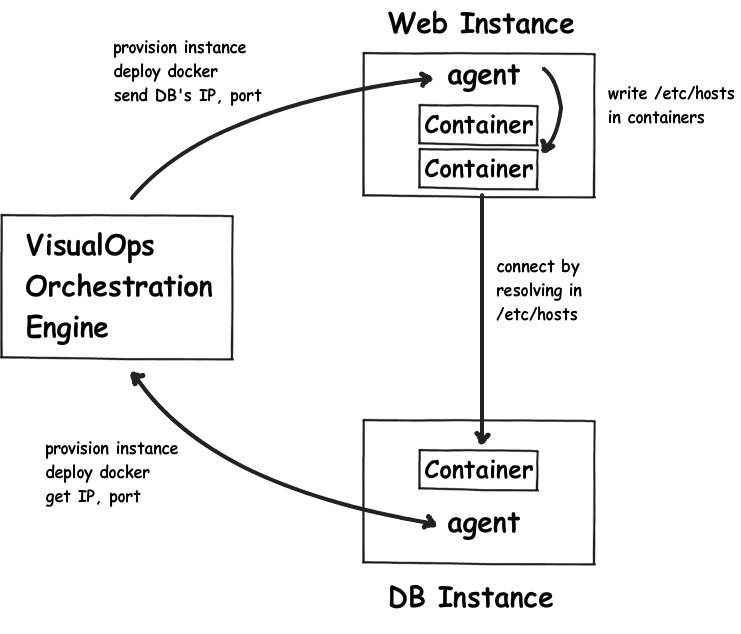
    The new Writable feature gives us the option to non-intrusively determine the configuration at the runtime, so that it will not cost you too much effort, while at the same time retaining the immutability. Assuming you are deploying a WordPress application, which involves web-tier containers and DB containers. You certainly don’t want to hard code the DB instance’s IP, nor bring in an etcd cluster, which adds more moving parts to manage and increases the odds of faliure . Instead, an orchestration tool could do the job by leveraging the Writable feature of Docker:

    Immutable Infrastructure

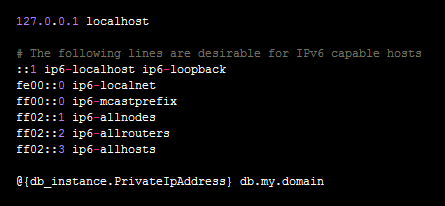
    As in the above diagram, the orchestration tool will take care all heavy lifting, from instance provisioning, container deployment, to a properly setup /etc/hosts file in the web containers. More importantly, if your DB instance’s IP changed, the orchestration engine will automatically rewrite /etc/hosts to fix the DB connection. And all you need to do is just to specify the following in /etc/hosts:

    Immputable infrastructure - hosts

    Pretty easy, right?

    In conclusion

    While Docker lays a great foundation of code deployment and it is especially useful in keeping the unit as immutable as possible, the deployment context plays an important part in the service discovery. By leveraging the new Writable feature and the Orchestration tool, one could really benefit from immutability, whilst avoiding having to change too much.

    [1] smartstack [2] etcd [3] consul

  • Panamax, Docker management for humans

    Panamax, Docker management for humans

    Panamax, a new open source tool from CenturyLink brings the promise of building complex Docker based environments like a child using Legos. The tool is a management interface for managing and building multiple Docker environments. You can search the official Docker repository as well as a number of others to find best of breed, Docker pre-built containers. Panamax is available on GitHub and is released under an Apache 2.0 license.

    I spoke to Lucas Carlson, chief innovation officer at CenturyLink yesterday about Panamax. Lucas also heads up the CenturyLink Labs and this is one of the first projects that they have developed and released. Lucas gave me a demo of Panamax. In just a few moments we had searched for and found several WordPress containers. We chose one from the official Docker repository and quickly installed it. After that it was simple to choose other services such as Ruby and add them to our instance as well. In no time we had added several different Docker containers and had build a pretty sophisticated environment. Below are some screen shots of Panamax in action.

    panamax 1

    panamax 2

    Lucas explained to me that he thinks of Panamax as “Docker management for humans.”  It makes building multi-docker environments really easy. From the Panamax press release:

    Prior to Panamax, running multi-container, multi-server apps with Docker was difficult. Developers needed to learn as many as five new technologies – libswarm, systemd, etcd, ambassador and fleet – as well as Docker-specific best practices just to get started. Panamax packages these technologies and best practices into an intuitive user experience that automates the heavy lifting of deploying complex applications. Developers simply drag-and-drop containers and can easily access the open-source cloud application marketplace. Panamax can run on laptops, virtual machines, bare metal or any public cloud that supports CoreOS like CenturyLink Cloud. 

    Right now as the previous paragraph points out, Panamax only supports CoreOS. Of course this gives it the availability to run on Amazon and a number of other cloud providers in addition to CenturyLink’s own cloud service. However, it is only a matter of time I would think until Panamax is ported to other cloud Linux OS distributions.

    Docker is already one of the fastest growing open source projects of all time.  Third party applications such as Panamax validate that there is an entire ecosystem that is beginning to emerge and thrive around Docker containers. I was pitched by several PR agencies this past week about new companies launching or coming out with products around Docker.

    Many of these companies believe that Docker is going to closely follow the path of VMware as it becomes the virtualization solution of choice.  What Docker will offer versus what others will offer is still being thrashed out. It was similar with VMware as well. What security would VMware provide and what 3rd party security was available? This was a burning question for a while. Similar questions will be asked around Docker and everyone jockeys for position around table here.

    CenturyLink of course feels that Panamax will give them a leg with Docker developers choosing the CenturyLink cloud over Amazon and others.

    So Docker continues its red hot ascent through the tech world. Panamax coudl become a star in the Docker world allowing everyone to make complex Docker environments as easy as building Legos. As Lucas said, it is Docker management for humans.

  • Bringing Collaboration, Orchestration and Lifecycle Management to Docker Containers

    Bringing Collaboration, Orchestration and Lifecycle Management to Docker Containers

    As you most likely know, Docker is a Linux container technology that stands to revolutionize or standardize the delivery mechanism of applications and services in the cloud.

    Docker, which just turned 1.0, has created an enormous amount of buzz, a vibrant community, and an extremely interesting ecosystem upon which developers and operations teams can draw to ultimately build better applications and better utilize cloud resources.

    We, at ElasticBox, wanted to see what we could do by combining these two great technologies. With developer and IT operations in mind, we’ve created the ability for you to consume Docker as a service with  collaboration, orchestration, and lifecycle management capabilities. You can now create Boxes and use Docker as a service, giving you and your team the ability to distribute Docker files as Boxes across your organization, collaborate on the continued development and maintenance of these assets, provide an orchestration tool for the deployment of application or infrastructure components, and finally, manage their lifecycle across different environments – development, test or production.

    Tutorial – Deploy the Ghost blogging platform in a Docker Container on any cloud using ElasticBox

    To demonstrate this integration, let’s launch an instance of Ghost, a simple but powerful publishing platform, in a Docker Container on the Cloud Provider of your choice. By the end, you will have built a Ghost / Docker Box in ElasticBox that can be deployed, versioned and shared. For step by step instructions, click through the Slideshare below.

    For more information on how to use Docker in ElasticBox, please visit our documentation.


  • Docker acquires Orchard to extend platform leadership

    Experienced team brings talent and technology to strategic developer initiatives

    San Francisco, CA – July 23, 2014 – Docker, Inc., the commercial sponsor of the Docker open source project, today announced that it has acquired Orchard Laboratories, Ltd., for an undisclosed amount.  Orchard is an early Docker community member and creator of solutions on the Docker platform, including a hosted Docker service and Fig, an application composition and orchestration tool.  With the Orchard team and technologies extending Docker’s capabilities for developers, this acquisition accelerates Docker’s mission of delivering an open platform to build, ship, and run distributed applications.

    “Our goal is to provide the best tools and experiences for developers creating web-scale applications that move frictionlessly between bare metal, virtualized, and cloud environments,” said Ben Golub, CEO, Docker.  “Orchard really stood out to us with their vision of what developers need and their delivery of well-designed services and products.”

    Fig, Orchard’s orchestration tool, is noteworthy in the ease with which a developer can compose and manage a multi-container Docker application.  After defining the application’s containers and their dependencies in a simple configuration file, the developer can – with a single command – automatically start all the components of the application, including containers, network connections, and storage dependencies.  This eliminates the overhead and inevitable mistakes inherent in re-typing multiple complex terminal commands or creating rigid, unmaintainable custom scripts.

    “Docker and the potential of its community and platform interested us from the start,” said Ben Firshman, CEO and co-founder, Orchard.  “We’re excited to bring our products and experiences from Orchard, and join with the Docker team to build great tools that developers love to use.”

    Firshman and co-founder Aanand Prasad will lead developer environment initiatives at Docker while continuing to maintain Fig.  Orchard, the hosted Docker service, will not be a focus, and Orchard customers have already been informed and will be provided with a smooth transition program.  Firshman and Prasad will continue to reside in London where, in addition to their product leadership work, they will help expand Docker’s European footprint.

    Additional Information


    About Docker, Inc.

    Docker, Inc. is the commercial entity behind the open source Docker project, and is the chief sponsor of the Docker ecosystem. Docker is an open platform for developers and sysadmins to build, ship, and run distributed applications.  With Docker, IT organizations shrink application delivery from months to minutes, frictionlessly move workloads between data centers and the cloud, and slash infrastructure costs by 50 percent or more.  Inspired by an active community and by transparent, open source innovation, Docker has been downloaded 4+ million times and is used by thousands of the world’s most innovative organizations, including eBay, Baidu, Yelp, Spotify, Yandex, and Cambridge HealthCare.  Docker’s rapid adoption has catalyzed an active ecosystem, resulting in more than 20,000 “Dockerized” applications and integration partnerships with AWS, Red Hat,  Google, Canonical, IBM, OpenStack, Rackspace, and Cloud Foundry.


    Docker, Inc. is venture backed by Greylock Partners (Jerry Chen), Benchmark (Peter Fenton), Trinity Ventures (Dan Scholnick), AME Cloud Ventures (Yahoo! Founder Jerry Yang), Insight Venture Partners, Y Combinator, and SV Angel (Ron Conway).

  • Docker acquires Orchard, makers of Fig

    Docker acquires Orchard, makers of Fig

    First acquisition by Docker bring tools, talent and geography to hot container start up.

    Docker today announced that they are making their first acquisition. Docker is acquiring Orchard. In terms of scope of the acquired company they didn’t have to look to far. Orchard was an early member of the Docker community. They operated a hosted Docker service and developed an orchestration tool called Fig. In terms of geography though Docker reached across the pond for this one, as Orchard is London-based and will remain so. The acquisition brings both IP and talent, as well as reach to San Francisco based Docker.

    I spoke to Scott Johnston, SVP of products at Docker about the acquisition.  Scott told me that the hosted service from Orchard is not really strategic to Docker’s future plans. In fact they have already told Orchard’s hosting clients that the service will be phased out and other options will be made available to them.  There are several hosted Docker solutions available, so no customers should be left in the lurch with this move.

    More strategic to Docker is Fig, with which, according to the release, “a developer can compose and manage a multi-container Docker application.  After defining the application’s containers and their dependencies in a simple configuration file, the developer can – with a single command – automatically start all the components of the application, including containers, network connections, and storage dependencies.  This eliminates the overhead and inevitable mistakes inherent in re-typing multiple complex terminal commands or creating rigid, unmaintainable custom scripts.”

    More than the IP itself though Johnston emphasized that the Orchard team shared Docker’s values, views and goals. This made the company an easy choice to be Docker’s first acquisition. As important as Fig, Johnston and the Docker team are excited to be adding the two co-founders of Orchard to the company. Ben Firshman and Aanand Prasad, will be joining Docker and will head up Docker’s developer environment initiatives while continuing developing and maintaining Fig.

    Since both Firshman and Prasad are based in London, Johnston told me that this will serve as a anchor for Docker’s UK based activities, as well as the start for Docker to expand its presence throughout Europe. Docker is as popular in Europe as here in the US, so having a presence there was important.

    Like so many acquisitions by start up companies, this one is as important for the talent Docker is bringing in house as it is for the IP and technology it acquired.  My friend and DevOps advisory board member, Brad Feld always told me that he liked to see the start up companies he invests in acquire other companies as the fresh blood and ideas they bring are good to keep the energy flowing. It appears that Orchard fits the bill here for Docker. I am sure there several VC investors are very happy with the acquisition.

    As expected Scott declined to discuss any specifics around the size of the deal. Usually these type of early stage acquisitions are heavily leveraged with equity. In the case of Docker, owning some shares pre-later round financing may wind up being quite valuable to the Orchard team indeed.

    I don’t think this will be the last acquisition we see from the Docker team. As they continue to build out there business model they will make build versus buy decisions pretty often. When they do if the decision is to buy, they have the means to do so.

    Congratulations to both the Docker team and the Orchard team. Building a company that someone is willing to fork over good money for is an accomplishment to be proud of.  Good luck to all of the Docker team, both old and new.

    While on the subject of Docker, James Turnbull has authored a new book, called appropriately enough “The Docker Book“. It is “designed for SysAdmins, Operations staff, Developers and DevOps who are interested in deploying the open source container service Docker™.”

  • Sold out Dockercon highlights Dockers coming of age

    Sold out Dockercon highlights Dockers coming of age

    Docker grows up with release of version 1.0

    There is little doubt that Docker is one of the hottest names in tech.  Anything written about them seems to be a magnet for readers. When Solomon Hykes, CTO and co-founder keynoted the recent Gluecon 2014 conference it was standing room only. It’s pretty much the same story at this week’s initial Dockercon conference in San Francisco.

    I spoke with Scott Johnston, SVP of product at Docker last week in anticipation of this week’s conference. Due to a prior commitment I couldn’t make it out for the conference. It seems I am the only one not there. Scott told me the only thing holding them back from letting more people in is the fire marshal. They have a waiting list of something like 300, while others are scalping passes to the show!

    The big news from the show is the official release of version 1.0 of Docker. Of course the previous release .11 was a preview release of 1.0. It is not that version 1.0 has any new important features that no one has seen before. It is more a case that Docker is now official. In an era where Google kept products in beta forever it seemed, Docker is out there.

    Speaking of Google, one of the presentations at Dockercon today is about how Google is now supporting and using Docker in Google Cloud. Red Hat is also a big proponent/partner of Docker and the fact that IBM is a platinum sponsor should give you a hint as to what Big Blue thinks of Docker.

    In fact in both my conversations with Johnston and with Scott Rich, IBM Distinguished Engineer, DevOps at IBM Innovate last week, they mentioned some interesting IBM/Docker work. I think we may have to wait a bit longer to get more facts on that.

    Besides the 1.0 release, Docker has a few other important announcements this week dealing with some of the new services and products that Docker is rolling out around the open source version. The best way to explain these to you is to frame it the way Scott Johnston did for me.

    The open source Docker project is now called Docker engine. That is the platform. On top of this Docker and others will roll out services and products. They can be rolled out via the Docker Hub. Think of Docker Hub as the beginning of a Docker app store or marketplace. I think that you will see both Docker and 3rd parties with offerings in the Docker Hub very soon.

    From the Docker Hub announcement major features include:

    • An integrated Console  for managing users, teams, containers, repositories, and workflows;
    • The Docker Hub Registry, offering more than 14,000 “Dockerized” applications, available to all users as building blocks for their own applications;
    • Collaboration tools, enabling  users to manage and share their applications through both public and private repositories, and to invite collaborators to participate in any stage of the application development lifecycle;
    • The Automated Build Service, which keeps applications up-to-date by automatically rebuilding and updating an application’s public or private repository whenever the source code is updated on GitHub or Atlassian Bitbucket. Over 25% of the more than 14,000 Dockerized applications in the Docker Hub Registry are now created using Automated Builds, providing both automation and end-user assurance of container origin;
    • The Webhooks service, which enables users to automate repetitive workflows for build pipelines or continuous deployment, Interoperable with any RESTful API,  webhooks enables organizations to take advantage of the web APIs published by any service or software package, like GitHub, AWS, or Jenkins; and
    • The Docker Hub API, which includes a user authentication service, so that third party applications and services can gain authenticated access to applications in a user’s public and private repositories. Third-party services that have already integrated with the Docker Hub API include AWS Elastic BeanStalk, Deis, Drone.io, Google Compute Engine, Orchard, Rackspace, Red Hat, Tutum, and many others.

    In addition to Docker Hub, Docker also announced enterprise support services in conjunction with the release of the 1.0 version. This will allow large enterprises to rest easy knowing they can get expert help and support with SLAs wrapped around using Docker.

    Not that lack of support is slowing down the hype around Docker. Another subject Scott and I spoke about is how Docker can possibly live up to the hype surrounding it?  All too often we have seen companies and technologies crushed under the over-hyped expectations which make it impossible to live up to. Scott and the whole Docker team are keenly aware of this. They are really trying to under promise and over deliver. They are intentionally not fanning the fire with much speculation.

    Every technology goes through the Gartner hype cycle I guess. Overblown expectations lead to the trough of disillusionment. But for leadership at Docker including Scott this is not their first rodeo. They are doing everything they can to balance the hype and promise with the reality of a project/product that is still taking baby steps.

    The Docker team is also hard at work on the next round of Docker Hub offerings, as well as improvements to the Docker engine itself.  Scott assures me the team is committed to open source and the Docker engine will remain open source. The project itself is getting more support and code contribution than ever, so it remains vibrant.

    If you are lucky enough to be a ticket holder to Dockercon, hold on to your stub. It may be worth something someday. You could say you were there at the very first one. In the meantime the Docker team is hard at work making sure that they fulfill the promise that this 1.0 release holds. Congrats and good luck to Ben, Scott, James Turnbull, Julien Barber and the rest of team over at Docker.