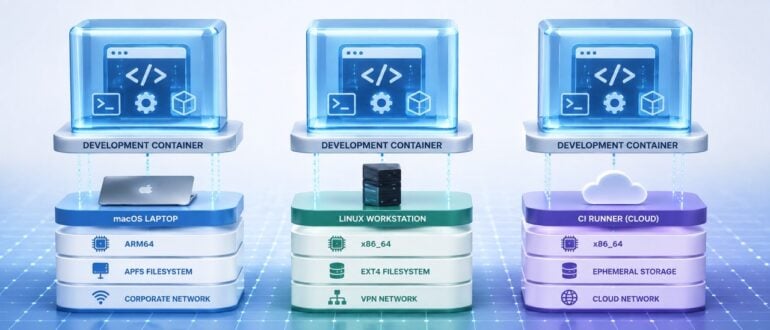
Standardized developer environments promise to eliminate one of software engineering’s oldest explanations: “It works on my machine.” By packaging approved runtimes, dependencies and tools into containers, virtual machines or cloud workspaces, organizations expect every developer to start from the same foundation.
The approach delivers clear benefits. It reduces onboarding time, minimizes dependency conflicts and makes development environments easier to reproduce. Yet developers using the same environment definition can still experience different build times, test results, network behavior or access failures. Local results may also differ from CI and production, despite sharing the same container image.
A container defines only part of the development environment. The systems supporting it continue to influence how software is built, tested and executed, making reproducibility a broader engineering problem than environment standardization alone can solve.
The Environment Extends Beyond the Container
A development container defines the operating-system image, language runtime, command-line tools, editor extensions and setup commands. The Development Container Specification provides a common way to describe these components and improve portability across supporting tools.
The container, however, still depends on the system running it. Its behavior is influenced by the host’s processor architecture, memory, filesystem, virtualization layer, network configuration, security controls and available peripherals. GitHub Codespaces, for example, runs development containers inside virtual machines and offers different machine types with varying CPU, memory and storage allocations. The container definition may stay the same while the underlying resources change, as outlined in the GitHub Codespaces overview.
Local containerized environments introduce another layer of dependency. Docker Desktop runs its engine inside a Linux virtual machine on macOS and Windows, requiring network and file operations to cross boundaries between the host, virtual machine and container. Docker’s networking documentation explains how these backend components interact.
Standardizing what runs inside the container improves consistency, but it doesn’t eliminate the influence of the system underneath it.
Host Differences Still Leak Into Development
Bind mounts, port forwarding, credential helpers, browsers, VPN clients and local certificates connect the standardized environment to the developer’s machine. Those integrations are necessary for day-to-day work, but they also allow host-specific behavior to influence the development workflow.
Filesystem behavior is one example. Linux filesystems are generally case-sensitive, while the default macOS filesystem is case-preserving but not case-sensitive. A repository containing both Config.js and config.js may work without issue in Linux but create conflicts when shared from a Mac. Docker documents this behavior in its Desktop settings documentation.
File synchronization introduces similar challenges. Docker’s synchronized file-sharing feature has documented limitations around file counts, symbolic links and case conflicts. Large repositories can therefore behave differently across host configurations even when the development container itself is unchanged.
Host-level issues can also interrupt development in ways that environment definitions cannot prevent. Memory pressure, storage problems or virtualization failures can interrupt builds even though the shared environment configuration remains unchanged.
Recognizing these dependencies is just as important as standardizing the environment itself. Containers improve consistency, but they don’t replace the operating system and hardware that keep the development workflow running.
Standardization Can Freeze Drift Instead of Removing It
A shared environment definition only remains valuable when it is maintained. An image tagged latest, an unpinned feature or an installation script that downloads the newest package can produce a different environment every time it is rebuilt.
The opposite problem is just as common. Teams delay rebuilding shared images because updates might interrupt development. Over time, those images continue running with outdated packages, expired certificates or obsolete tooling. Standardization then distributes the same outdated environment across the entire team.
Persistent state makes the problem harder to detect. Package caches, persistent volumes, editor extensions and files created by setup scripts often survive longer than expected. Two workspaces built from the same configuration can gradually diverge because one contains weeks of accumulated state while the other was created from scratch.
This is why reproducibility requires more than a shared image. The Reproducible Builds project identifies tools, versions, operating-system assumptions and configuration as essential parts of the build environment. Its documentation also highlights how paths, locales, time zones and other environmental differences can affect build outputs.
Reducing drift requires deliberate maintenance. Important dependencies should be pinned to immutable versions or digests, environments rebuilt on a defined schedule, and clean rebuilds tested regularly to verify they still produce the expected results.
Local Development and CI Are Often Standardized Separately
Many organizations maintain one configuration for developer workspaces and another for CI. The two environments may appear similar, but they are built from different definitions, maintained by different teams and updated on separate schedules.
A developer may run tests inside a long-lived container with cached dependencies and unrestricted network access. The CI job, meanwhile, executes on a freshly provisioned runner with different preinstalled tools, limited credentials and a clean filesystem. GitHub confirms that every job on a GitHub-hosted runner starts in a new virtual machine, while its -latest runner labels refer to GitHub’s current stable images rather than the newest operating-system release. These details are documented in the GitHub-hosted runners reference.
Those differences affect more than execution speed. A local build may succeed because an undeclared dependency already exists, while the same build fails in CI because the environment starts from a clean state. The reverse can also happen when a CI runner contains tools or configurations that developers don’t have locally.
Reducing this gap requires more than keeping tool versions aligned. The same scripts should install dependencies, run tests, perform static analysis and build artifacts in both local environments and CI. Where differences are unavoidable, they should be intentional, documented and easy for developers to reproduce.
External Services Remain Moving Targets
Modern development workflows depend on more than local tooling. Package registries, cloud APIs, identity providers, feature-flag services and internal platforms all form part of the development environment. Standardizing the client doesn’t standardize the services it connects to.
Access can also vary between environments. A cloud workspace may reach resources that a corporate laptop cannot, while VPNs, DNS configuration, proxy rules or identity policies introduce another layer of inconsistency. GitHub notes that Codespaces requires additional configuration to access private networks, registries and on-premises services.
These differences become visible when software behaves correctly in one environment but fails in another because an external dependency responds differently or cannot be reached at all. The development environment may be identical, yet the workflow still breaks.
Treating external services as part of the developer platform helps reduce those inconsistencies. That includes documenting access requirements, providing service emulators where practical, maintaining reliable test data and distinguishing application failures from environment-related failures during troubleshooting.
Build a Contract, Not a Golden Image
Expanding a developer image to include every possible tool isn’t the answer. Larger images become harder to maintain, increase the attack surface and make it more difficult to understand what the environment actually guarantees. Instead, teams need an explicit developer-environment contract.
The contract should define:
- Supported host operating systems and processor architectures
- Minimum CPU, memory, storage and virtualization requirements
- Pinned toolchains and verified dependency sources
- Expected filesystem and networking behavior
- Required external services and authentication paths
- Commands shared between local development and CI
- Rebuild frequency, ownership and support procedures
Automation should continuously test that contract. A clean environment should be created from scratch, the application built and the main test suite executed. Teams should test supported architectures and run the same verification after changing the environment definition.
Measuring the environment is equally important. Tracking setup success rates, rebuild times, CI failures that cannot be reproduced locally and environment-related support requests provides a clearer picture of whether standardization is improving software delivery or simply making inconsistencies harder to identify.
Standardize the Right Boundary
Standardized developer environments remain one of the most effective ways to reduce unnecessary variation across engineering teams. They simplify onboarding, improve consistency and make modern development workflows easier to manage. But they cannot eliminate every source of inconsistency on their own.
The environment where software is built extends beyond the container or workspace definition. Host systems, external services, architecture differences, CI runners and accumulated local state all influence how code moves from development to production. Ignoring those dependencies makes environment-related failures harder to diagnose, even when every developer appears to be using the same configuration.
Standardization is most effective when it is treated as an ongoing engineering practice rather than a one-time provisioning task. Teams that continuously verify, maintain and observe their developer environments are far better positioned to deliver software that behaves consistently throughout the entire delivery pipeline.