As more organizations focus on digital transformation as the centerpiece of their growth strategy, software developers and IT teams are under heightened pressure to perform—quickly and efficiently.
That begs two questions: Can we do better? And if so, how can we do better?
The answers can be elusive, especially for DevOps teams that have over-relied on processes and models that, while previously successful, may not be as relevant for today’s projects. Of course, the point about relevance has been further magnified during the pandemic, when sudden shifts to remote working left many teams scrambling to ensure they had the capacity and infrastructure to support massive work-from-home cohorts.
Software development and IT operations support teams that are winning by doing better in this new era are truly embracing Agile. And that means taking to heart the definition of “Agile,” which is a mindset of values and principlesto continually evolve your way of working (WoW) to ensure your productivity and value are tailored to fit the tasks at hand.
Conversely, teams that have relied on their go-to framework or approach for every assignment are often missing the boat with respect to efficiencies, effectiveness and even ROI. This is because they aren’t assessing whether their proven WoW is useful for their current projects.
That can lead to underwhelming results. A report from Digital.ai revealed that while over 90% of software development teams take an Agile approach to their work, a whopping 96% of their digital transformation projects have failed or been delayed. Clearly, that suggests Agile has worked for them in the past,but the nature of digital transformation projects is calling for teams to adapt to new or hybrid approaches that may differ from their go-to WoW.
Challenging? Yes. Doable? Also Yes
While there is no quick fix to attain true flexibility amid complexity, the journey begins with the recognition that, yes, you can do better. And to do better—to become an adaptive, lean, responsive and learning organization under any circumstances—there are a number of steps to take to ensure your journey to Agile freedom is successful.
Here are five that I believe must be considered for DevOps teamsto become better and more effective:
Consider all options. Agile has been practiced for more than two decades, and literally hundreds of frameworks and approacheshave been developed and implemented. If you examineyour WoW in a context-driven, pragmatic manner you are more likely to select the best-fitting technique given the situation.
Do your homework.Your team leaders may not be familiar with the breadth of the Agile, traditional and hybrid frameworks at their disposal. But there’s help available. Seek out online courses and certifications designed to help organizations and individuals explore and navigate the multitude of Agile frameworks that they may currently be overlooking.
Focus on value. It’s great if your gut tells you that your Agile framework is reaping real results, but can you prove it? If your senior leadership has invested in Agile training, coaching and certifications, they’ll demand to see some tangible returns. With well-chosen Agile approaches that match the work required, you will be able to deliver the proof that Agile is driving measurable value that matters. Even further, learning which metrics to use in different situations can help measure this value.
Sidestep bottlenecks. By choosing the best WoW for the project at hand, you are more likely to eliminate the wasteful or inefficient processes that can add hours or days to any assignment. Understanding how to unclog these pipes is critical in improving the flow of value to your customers.
Motivate with morale. If your team is frustrated and morale is low, productivity, the quality of the work and your retention rate will be, too. But, if you’re able to do Agile well, this can help your teams be happier, more productive and more successful in accomplishing project goals. Ultimately, that means a more joyful customer base, too.
Conclusion
In the long run, the framework or approach you choose isn’t as important as your willingness to be open-minded in applying Agile frameworks to projects on a case-by-case basis. As you become more comfortable with new or different approaches, you will promote continuous improvement through carefully considered experimentation.
That means you’ll become a learning organization, one that is open to change and evolution. With that mindset, your development and IT ops team will do better—guaranteed. Because true agility comes from freedom, not frameworks.
Many people sometimes have a tough time figuring out what exactly digital transformation is and why it’s so important. I want to tell you a real-life story of how a once-respected brand, lululemon, has failed the digital transformation journey and, as a result, may fail in a new retail landscape.
The story starts innocently enough with my desire to get my wife a lululemon gift card for her birthday. She has gotten her vaccines and is returning to the gym, so I figured it was a great time to get new workout clothes. I purchased a gift card on March 15 to be delivered via email a few weeks later on her birthday. It was a simple digital transaction that for any company that has its digital transformation act together would be a no-brainer. Well, this is where lulu turns off the tracks and turns into a digital lemon.
On the day of my wife’s birthday, I had planned that she would wake up and see how thoughtful I was in getting her the gift card. She didn’t say anything about the card, though, so I finally asked if she received the gift card. She didn’t know what I was talking about. I had her check her spam folder, nothing. Nope, no gift card.
Thus began a day that would see me reach out and communicate with the lulu team no fewer than six times. It seems that lulu uses a third party for digital gift cards. Each time I reached out to a lululemon “educator” (that is what they call them, and did I get an education), I was told a different story:
A simple apology and card being emailed, give it an hour.
Sorry, it must be that email address, do you have another email address? Give it an hour.
Hmm, seems our third-party gift card provider is having problems today.
We located your card, it was sent to: tlaynguyen@gmail.com could I check that email? (I would love to, but that isn’t an email address I have.)
Well, we have no control over when the third party sends emails.
Digital gift cards are non-refundable, even if you didn’t receive it. Sorry, can’t help you.
You have blocked our emails from your computer.
At this point I realized that lululemon, while maybe making great workout gear, is analog to the core. A simple digital transaction like this had them tied in knots, wasted hours of my time and so turned off my wife that she is looking elsewhere for her new workout gear.
This past year has taught us that retailers that can’t hop on the digital transformation train are heading for the precipice. It seems as though lululemon may have already gone over the deep end. The company better hope the malls fill up quickly because in a digital world, lulu is truly a lemon.
Few corporate functions have seen their role disrupted as much as IT these last few years. The help desk days are long gone. As digital transformation accelerates, IT is becoming less about outright technology and more about creating capabilities that enable the overarching business strategy. As such, IT is the engine behind any company’s digital transformation.
Here are three ways IT can advance today’s digital journey by empowering the business from a consultative, strategic position.
Going Digital While Digitizing
First, let’s agree on digital transformation’s foundational terms, which understandably elicit some ongoing confusion: “digitization” and “digital,” which the MIT Center for Information Systems Research has described as two discrete yet complementary things. In short, digitization is about leveraging technology to improve or enhance business processes, operations and offer development. By contrast, going digital is about giving customer value to digitization—with the goal of revolutionizing the customer experience and creating new digital business models. What’s the point of digitizing a process or product if the user experience is poor?
Balancing these complementary efforts is essential. It is the role of IT to ensure that digitization and digital can happen at the same time.
Rethinking the Economic Model
To keep up, IT must move away from traditional demand-based models, enabling capabilities with a product mindset instead of a time-bound project mindset. The concept of capability (that is, a business area enabled by a consistent set of IT products) is quite critical to avoid creating one-off or point solutions that are just the means to answer to a specific demand. Instead, looking to IT as the enabler of corporate practices that are always evolving and improving (e.g., cybersecurity) is imperative. Embracing Agile methodologies will bring this approach to fruition.
Pivoting to this kind of a capability-based model requires a modern API-based architecture, which fundamentally is the way out of building and/or replacing monolithic systems. As today’s world requires a fine balance of speed and frugality, a mastery of resource allocation, and a prioritization rigor, we must unburden resources aimed at replacing systems that are working just fine.
To that effect, Amazon Web Services has a great architecture principle referred to as “two is better than zero.”In other words, it is better to have two similar IT components emerge from fast-paced, parallel development than nothing due to project bottlenecks and unmastered interdependencies. Even if we want to drive re-use every time we can (and have mechanisms for that), we should not bog down overall transformation due to one weighty project. So thinking in terms of not just tolerating diversity, but enabling it, is a good way to built an architecture that can empower both agility and resiliency.
Addressing Technical Debt Continuously
Technical debt is perhaps every incumbent company’s biggest challenge when going digital. The cost of maintaining legacy and outdated systems is high, and heavy technical debt is another obstacle to achieving full digital transformation. Accenture consultants see this every day, describing this burden as a price that “hinders [companies’] ability to innovate and adapt in the digital age.”
This is where IT can come to the rescue by having a structured approach and engagement model designed to streamline systems and processes in order to free up resources for reallocation. First focus on eliminating legacy custom-built applications and localized tools based on criteria that are well known and shared (think of a scoring system). Here, again, resource allocation can play its part by ensuring the full cost of those legacies is being recognized by the organization.
A huge added advantage of a continuous effort to remove technical debt (beyond cost, the reduction of obsolete systems and a simplified IT landscape) obviously relates to security. Especially at a time when the average cost of a single data breach globally is $3.9 million. In fact, potential cybersecurity and IoT-related physical safety concerns “will pressure CIOs at G2000 companies to increase IoT security spending by up to 25%, temporarily neutralizing business productivity gains”by 2020 (IDC). Redirecting technical debt can offset part of this essential spending on security.
Accenture notes that 79% of CEOs report that their organization is adopting new and emerging technologies faster than they can address related security issues. IT teams therefore must carry the security torch, determining and implementing ways to make security easier for employees while also protecting the end-to-end digital ecosystem. A continuous effort to reduce the technical debt is one way—among many others—to improve posture.
A Place at the Digital Transformation Table
Indeed, these are exciting times for every business. Digital is all about creating customer value, guided by a better understanding of customer needs deeper in the enterprise. Since providing a great experience is not only about the user interface but also about the ability to mobilize the internal systems in order to deliver at scale, IT experts now have a major seat at the table for revolutionizing the customer experience at scale.
The essential ingredients to full digital transformation are clear: digitizing and going digital, being able to embrace emerging technologies with an architecture that makes diversity efficient when required and creating cyber citizens that continuously reduce the corporation’s technical debt. Behind the scenes and now front and center, IT is pushing forward the transformation strategy for companies staking a competitive claim in today’s digital economy.
BMC AMI places machine learning, predictive analytics, domain expertise, and intelligent automation at the core to help enterprises achieve self-managing mainframes
HOUSTON – October 18, 2018–BMC, a global leader in IT solutions for the digital enterprise, today announced BMC AMI, automated mainframe intelligence solutions that will deliver higher performing, self-managing mainframe environments to meet the growing demands created by digital business growth. Extending BMC’s leadership in mainframe innovation, BMC AMI solutions combine built-in domain expertise, machine learning, intelligent automation, and predictive analytics to help enterprises automatically manage, diagnose, heal, secure, and optimize mainframe processes.
“Enterprise IT teams are experiencing complexity at an accelerating rate, and data and transaction volumes are exploding – all while trying to manage a changing workforce, close the skills gap, and optimize costs,” said Bill Miller, President of ZSolutions at BMC. “With AMI, we are freeing up IT staff to work on high-value initiatives by removing manual processes through intelligent automation. BMC AMI will automatically analyze dozens of KPIs and millions of metrics a day, and proactively identify, predict, and fix problems before they become an issue.”
According to Gartner, by 2020, thirty percent of data centers that fail to apply artificial intelligence and machine learning effectively in support of enterprise business will cease to be operationally and economically viable.1 The BMC AMI solutions enhance mainframe systems through intelligent automation by predicting outages before they occur, solving performance degradations, and mitigating cost increases.
With BMC AMI, customers benefit from BMC’s expertise in collecting deep and broad z/OS® operational metrics from a variety of industry data sources, built-in world-class domain expertise, and multivariate analysis. The new offerings include:
BMC AMI Autonomous Solutions
enable IT operations to automatically anticipate and repair performance degradations and disruptive outages before they occur, without manual intervention. This
set of intelligent, integrated solutions extends to BMC AMI for Security Management, BMC AMI for DevOps, BMC AMI for Performance and Availability Management, and BMC AMI Cost and Capacity Management.
BMC AMI Enterprise Connectors
connect business-critical data from the mainframe to the entire enterprise and simplify the enterprise-wide management of business applications. These offer a truly
holistic view of enterprise data by streaming
mainframe metrics and related information in real-time to a variety of data receivers, including leading Security Information and Event Management (SIEM) solutions
such as Splunk, IBM® QRadar®, ArcSight, LogRhythm, McAfee Enterprise Security Manager, and others. The BMC AMI Data Extractor
for IMS solution is available now, and additional solutions will
be available early in 2019.
“BMC has been instrumental in helping us grow our business, deliver innovative solutions, and increase customer satisfaction, all while ensuring costs are kept at optimal levels,” said Gregg Kimbrough, Senior Manager Hosting Services, Thrivent Financial. “We look forward to seeing how AMI will help us move closer to achieving a self-managing mainframe so that we can continue to keep up with the demands of today’s digital business.”
Earlier this month, BMC announced the signing of a definitive agreement to acquire assets of CorreLog, Inc., which provides real-time security management to mainframe customers. The announcement furthers BMC’s commitment to the security space, expanding the data connectors that are available to clients and accelerating BMC AMI for security offerings.
To learn more about BMC AMI solutions, visit www.bmc.com/ami
The story you’re about to read and its recommendations are real; they contrast with what you have heard so far about digital transformation and DevOps implementation. Its objective is to convince you about that the time to go digital is now; it’s about transforming your business, not only IT; and to do it you’ll have to implement DevOps entirely.
In September, Toys R Us, one of the world’s largest toys store chains, filed for bankruptcy protection. A better understanding of how disruption in the retail industry impacted the company would have helped to prevent its downfall and to reinvent its business model. For example, providing Toys 2.0 (a generic term referring to a new generation of toys built on cloud, mobility, IoT and AI technologies) gaming services could have helped the company survive.
Shifting to Toys 2.0 demands a revolution in thinking, vision, practice and value that business leaders, CIOs and IT vendors haven’t done yet. They must forget the obsolete notion that technology and speed determine business success. Adopting paradigms that stress innovation and solve competitive constraints is the safest path toward fast and durable revenue.
The biggest problem Toys R Us faced was the fact that consulting firms and IT vendors either didn’t understand the challenge as an industry disruption issue—or if they did, they improperly addressed it.
Let’s clarify: To tackle your industry’s disruption, you must adapt your business model including the set of interactions, staff and skills, processes and practices, beliefs and values and infrastructure and tools used across your company to generate revenue. Industry disruption is the challenge, and DevOps through its many assets is the unique business capability companies need to quickly transform and win their digital battles.
The problem, as Alan Shimel, founder, CEO and editor in chief of devopsy.kinsta.cloud, puts it:
“While so many companies have already started to use DevOps or planning to use DevOps and related methodologies soon, there is only a small percentage of companies that are end-to-end DevOps. This means there is still tremendous opportunity in bringing DevOps to market.”
How should have Toys R Us leveraged DevOps to tackle its industry’s disruption? Why did investing in that global digital e-commerce platform prove insufficient? How well did they transform their business model? How would have implementing DevOps 100 percent helped to overcome Amazon and Walmart competition?
The principles, ideas, practices and solutions in this article are part of a case study we developed at ITaaSNow to see how to help companies facing similar challenges.
What is DevOps?
Alan, who is a major contributor to DevOps, is right: Only a small percentage of companies have fully adopted it. DevOps is much more than the automation toolchains consultants and vendors talk about. If they want to help lines of business survive and keep their job, CIOs must get a grasp of DevOps’ business facets.
So, what is DevOps? Why do I think, it would have saved Toys R Us from digital downfall?
DevOps Beyond the Operations Automation
From my experience implementing it, DevOps is a business capability that seeks to optimize business operations (versus the sole IT operations). It provides companies with four competitive advantages needed to meet the digital business competitive challenges:
Enterprise collaboration
Business agility
Short time-to-value
Innovation culture
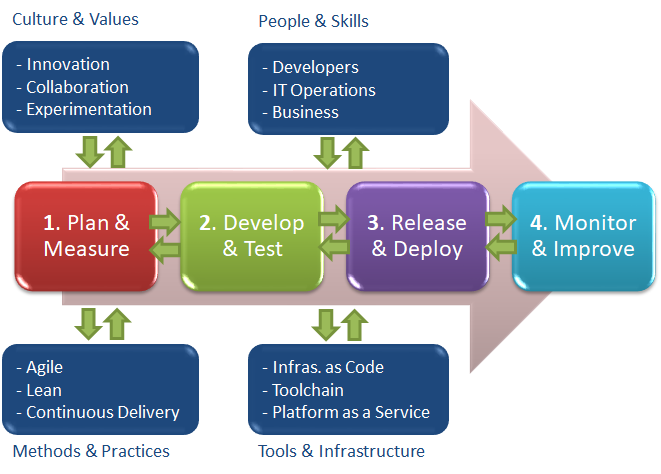
Figure 1 – DevOps Overview
As the picture shows, DevOps is a set of concepts aggregated around the notion of value stream to form a digital business management capability. It’s structured around four stages that format the company’s interactions and workflows into a powerful digital business management capability. These stages include:
Plan & Measure – addresses strategic watch, service prioritization and revenue generation through innovation portfolio management practices and infrastructure.
Develop & Test – takes advantage of agile and lean practices and infrastructure to ensure innovations design, development and testing.
Release & Deploy – leverages continuous delivery practices and infrastructure to timely deliver the right innovations to the right markets.
Monitor & Improve – stresses continuous improvement to guarantee not only premium customer experience but also customer value.
Four business value catalysts are used to act as revenue generators:
Culture & Values
People & Skills
Methods & Practices
Tools & Infrastructure
As you can see, DevOps transcends application development issues; it covers the entire business life cycle.
DevOps Framework as a Facilitator of DevOps Implementation
So, what is a DevOps Implementation framework?
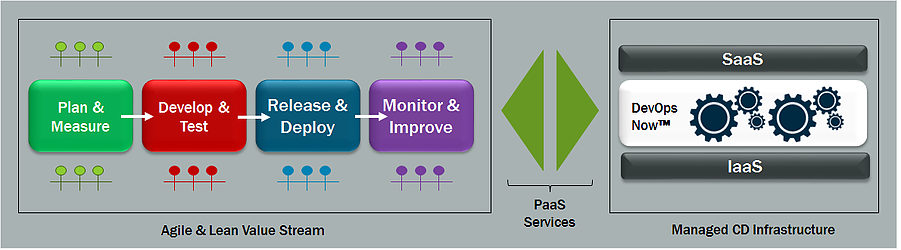
Concretely speaking, it’s a bundled DevOps platform combining managed PaaS infrastructures and optimized value streams to help companies boost their digital business:
Figure 2 – DevOps Implementation Framework
The platform seeks to help businesses implement DevOps end to end and builds on three principles to guarantee digital profits:
Innovation as the revenue driver – It’s the belief that business can resist the competition imposed by technology companies such as Apple, Google, Amazon and Facebook when they use innovation to keep customers loyal, attract new ones and generate revenue.
Value stream agility as the foundation of market responsiveness – It’s the demonstrated notion that companies are market-responsive when they rely on agile and lean value streams.
Managed cloud as the catalyst of business performance – It’s the proven idea that when companies are focused on their core business, they innovate and offer superior customer experience.
The 5-Step Digital Transformation Blueprint
The 5-Step Digital Transformation Blueprint makes DevOps implementation fast and easy. As illustrated, it’s a comprehensive business transformation framework I developed to help clients with their digital transformation initiative:
Figure 3 – The 5-Step Digital Transformation Blueprint
It’s an integrated and inclusive approach to business transformation that involves the company’s relevant contributors. It structures the transformation effort into a five-stage transformation journey:
Digital strategy: In this step, the transformation team uses tools like the SWOT analysis matrix to help business and IT executives understand the changes in the disrupting industry along with the impacts on the company’s business model.
Value stream: In this step, the transformation team uses tools such as the value stream mapping to identify the required changes and get business and IT executives agree on the company’s future value stream. Interactions, staff, skills, processes, practices and tools are at the heart of the discussions.
Digital platform: In this step, enterprise and solution architects work together to identify and implement the technology and tools selected to support activities in the value stream.
Digital organization: In this step, a panel of business and IT users at the operational and executive levels experiment the new digital business model under actual business conditions. The tested digital business model is then deployed as the new digital organization.
Digital business management: In this operation phase, the value stream and the digital infrastructure are extensively used to run the business.
How Chief Digital Officers Set Up Top Digital Businesses
It would be remiss on my part not to recommend the online digital transformation course that gives DevOps practitioners—executive and operational from both the business and IT—the insights about implementing DevOps as the foundation of digital business.
Analyzing Amazon and Walmart Disruptive Impacts to Spot Guidelines for Reinventing the Company
Many bankruptcies happen because business leaders don’t take the time to understand their industry’s disruption and the impacts on their overall business.
The reality on the ground is, industry analyses and competitive strategies are either overlooked or totally ignored. Understanding the toy industry’s disruptive effects would have helped to identify Toys R Us’s transformation as the safest solutions to avoid bankruptcy.
DevOps implementation framework makes the difference, it sees DevOps as the foundation of digital business success. It considers industry and competitive analyses essential steps of the DevOps transformation initiative. Figure 4 outlines the outcomes that resulted from our industry analysis:
Figure 4 – Toy Sector’s SWOT Analysis
As illustrated, it was shown that Toys R Us should have exploited Amazon’s vulnerabilities and take advantage of the technological opportunities to reinvent itself as a Toys 2.0 gaming service provider. These vulnerabilities include little product differentiation while technological opportunities refer to the new toy generation built on cloud, mobile, IoT and AI technologies.
The company’s strengths—reputation, longtime industry presence, brand equity—combined with the cost savings resulting from managed cloud adoption would have not only simplified its transformation but also challenged Amazon on costs.
Changing the Value Stream to Establish Innovation and Invent the Company’s Digital Business Model
Business leaders don’t take the right transformation decisions because they lack insights into the changing competitive environments. Aggressive marketing and sales campaigns supporting short-term financial gains. Toys R Us failed because it bet on its debt reimbursement at the expense of its business model reinvention.
A DevOps implementation offers a value stream mapping framework that not only facilitates innovation culture implementation but also speeds up digital business models development.
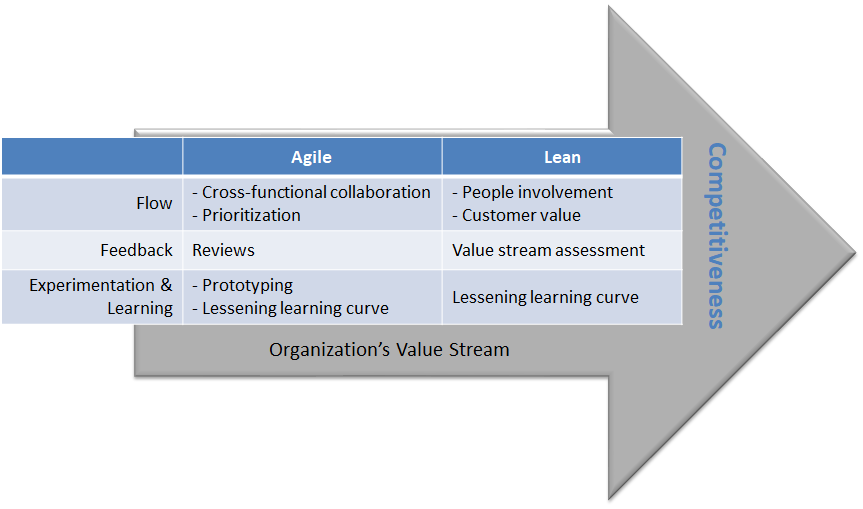
Figure 5 – Value Stream Mapping, Agile, and Lean
The objective of the value stream mapping I performed was to outline the features of work environments that take advantage of DevOps Three Ways to equip the company with the competitive advantages needed to resist Amazon and Walmart. The following lines summarize the outcomes.
Implementing DevOps Flow Principle to Defeat Amazon and Walmart on Innovation: The value stream mapping recommended to leverage Agile and Lean principles to properly implement the flow principle and defeat Amazon on its little product differentiation. The Agile’s features to stress included collaboration and prioritization while focus on people engagement and customer value were the Lean’s benefits to emphasize. Their combination were likely to not only foster innovation culture but also accelerate time-to-market and time-to-value.
Implementing DevOps Feedback Principle to Guarantee Superior Customer Experience: As to the feedback principles, the value stream mapping recommended to use Lean’s value stream assessment and Agile’s review mechanisms. The objective was to institutionalize continuous improvement practices as a means to ensure superior customer experience.
Implementing DevOps Experimentation and Learning as the Foundation of the Innovation Capability: As to the experimentation and learning principle, the recommendation was to take advantage Agile’s prototyping and learning curve-lessening features to institutionalize innovation and risk-taking cultures. They were likely to not only help the company challenge its competitors on innovation but also ensure durable revenue and customer loyalty.
Enabling the Value Streams with Managed PaaS Services
Using technology ingeniously to boost business activities is clearly one of the keys to succeed in the digital business. Today’s DevOps-timid approach focused on speeding up IT operations alone not only is ineffective, but it also doesn’t make sense. It’s the entire value stream that needs optimization, not just IT.
The findings of the digital platform assessment I performed, showed as illustrated, that the global e-commerce platform wasn’t enough to compete against Amazon and Walmart. The company was at the embryonic stage of digital transformation maturity practices:
Figure 6 – Toys R Us Possibly at the Embryonic Stage of Digital Transformation Maturity
The findings suggested that using technology to innovate or creating the operational conditions to cut cost, accelerate time-to-market and be responsive to market opportunities were either overlooked or improperly addressed.
Using a digital platform engineering framework allowed me to design in a record time the following architecture:
Figure 7 – Possible PaaS Platform for Toys R Us
The digital platform would have built on two cloud services supporting the value stream: managed software as a service (SaaS) and platform as a service (PaaS). Let’s discuss them.
How Managed SaaS Services Would Have Helped to Fix the Cost Leadership and Business Agility Issues
SaaS services would have supported the Plan & Measure stage. In addition to supporting varied management activities, it would have provided two fundamental tools that possibly could have enabled the Toys 2.0 strategy: customer relationship management (CRM) and innovation management portfolio. CRM tracks, measures and improves customers’ experience, keeps them loyal and guarantees revenue. Innovation portfolio management identifies innovation ideas, supports their implementation into digital services and monitors generated value. It gives the company opportunities to disrupt and control its industry.
The on-demand and metered billing features of SaaS services would have allowed Toys R Us to get the needed software in record time while enabling time-to-market, time-to-value and responsiveness competitive advantages.
How a Managed PaaS Platform Could Have Helped to Address the Express Delivery Issue
PaaS services would have supported activities covering the Develop & Test, Release & Deploy and Monitor & Improve stages. In addition to providing the technologies needed to implement Toys 2.0 gaming services, it would have built on microservices to set up the automation tool chain and accelerate innovations development and delivery.
Wrapping Up
The recent IT innovations are disrupting several industries and expanding the digital economy. To avoid troubles, businesses must urgently start their digital transformation. Toys R Us, Sears and many others learned it the hard way.
It’s urgent to understand that the digital transformation of your business isn’t only about migrating your IT to the cloud, implementing automation tool chains or deploying artificial intelligence tools across the company. It’s primarily about transforming with a strategic mindset your company’s business model from the ground up.
Digital transformation is a complex process that engages the entire company, and requires specific methodologies, practices and tools. I renew my recommendation to take the online course, “How Chief Digital Officers Course Set Top Digital Businesses“—you’ll get from it the practical vision, approach, processes, practices and tools that’ll help you create the conditions for successful digital business with DevOps.