Tag: digital business

  • AppDynamics Survey Sees Rush to Digital Transformation

    AppDynamics Survey Sees Rush to Digital Transformation

    A survey of 1,000 IT professionals in organizations with annual revenue of at least $500 million conducted by AppDynamics, a unit of Cisco Systems, finds nearly three-quarters (74%) report digital transformation projects which typically would take more than a year to be approved are now being signed off on in a matter of weeks.

    The research also finds 95% of respondents changed their technology priorities during the pandemic, with 88% identifying digital customer experience as being a priority now.

    In addition, some 71% said some digital transformation projects have been implemented within weeks versus the months or years it would have taken to implement a similar initiative before the pandemic. At the same time, 66% of respondents noted the pandemic has exposed weaknesses in their digital strategies, creating an urgent need to accelerate initiatives.

    Not surprisingly, the survey also finds 81% of respondents said the pandemic has created the biggest technology pressure their organization has ever experienced, with 61% under more pressure at work than ever before. Almost two-thirds (64%) said they are now being asked to perform tasks and activities they have never done before.

    Despite the enormous pressure technologists are facing, 87% said this period of time is an opportunity for technology professionals to show their value to the business. In fact, 80% of survey respondents report that the response of their IT teams to the pandemic has positively changed the perception of IT within their organizations.

    The survey specifically identifies managing spikes in website traffic (81%), lack of unified visibility and insight into the performance of the technology stack and its impact on customers (80%) and managing mean time to resolution (MTTR) with a remote IT department (70%) as major challenges.

    IT teams during this time need clear goals and objectives (90%), real-time data at the point of need (89%), autonomy and accountability (88%) and the freedom to experiment and take risks (87%), the survey finds.

    Angie Mistretta, chief marketing officer at AppDynamics, said the survey mirrored an earlier AppDynamics report that tracked a rise in the use of search terms such as “digital experience monitoring” and “application performance management (APM).”

    In general, Mistretta said it’s also apparent the rate at which application workloads are moving into the cloud is accelerating as organizations look to deploy more resilient applications based on cloud-native technologies such as Kubernetes that are designed from the ground up to access remotely.

    It may take time for IT organizations to master cloud-native platforms to deploy microservices-based applications. As such, the number of monolithic applications being lifted and shifted into the cloud remains considerable. Once those applications are shifted, many IT teams will only then start to modernize those applications.

    Naturally, AppDynamics is betting many more organizations will require access to an APM platform to navigate this brave new world of legacy and emerging digital business applications in the cloud. The challenge for IT teams, however, is there have never been so many APM options available.

  • The Real-Time Innovation Dividend

    The Real-Time Innovation Dividend

    Time is compressing. The attention span of individuals and organizations is becoming ever shorter. There are only brief windows that can be devoted to any given transaction.

    Expectations around situational knowledge, updated in real-time, are compounding. Customers expect the applications they interact with know where they are, what they are looking for and what their preferences are in terms of price, value, design and timeliness of delivery. If the proper options aren’t provided immediately, the customer will move on to another provider.

    While the time available to an algorithm or application is contracting, the complexity of the tasks for successful interactions is increasing. Digital businesses must do more in ever shorter time windows. Differentiation in the digital world has a lot to do with a deep understanding of the customer based on multiple data streams and driving decisions that provide a deeply personalized experience.

    In business, we need to have a current picture of our situation. We build models and analytic dashboards, but these fall short in allowing us a real-time view. The latency of these models may be measured in seconds, minutes, hours, even days and weeks. As latency expands, the picture is not of the moment and that difference defines operating risk. The phrase “time is money” has never been more accurate.

    Brokerages require as close to a real-time view of positions allowing them to manage risk more closely, in terms of their aggregate position, based on a transactionally correct view of precisely what they have on their books to respond in real-time to global market changes.

    For retailers, it means knowing the content a customer has seen and the environment where they encountered it. Did they just come from a brick and mortar store? What digital journeys have they been on? What online content have they been perusing? Continually adaptive models use the answers to these questions to select active customers and recommend options that address what they are searching for.

    The digital shopping experience is composed of multiple linked processes, working in concert to continually understand the customer experience. Different system elements–user profiles, decisioning, recommendation engines and machine learning and AI–require data across different time windows. Some of these systems deal with terabytes of data and some petabytes. Some require absolute consistency and for some eventual consistency is good enough. In many of these systems, there is a demand for hyperscale within tight time windows.

    The ability to take in more data within a given time window feeds the currency of the context. It is not enough to have a lot of data, but you also need the most current view of that data. Operating at hyperscale enables an organization to deliver exponentially more data than traditional databases. This makes models more accurate and, by extension, more valuable.

    Scale Plus Speed Equals More Time

    In some sense the combination of scale with speed creates time, giving you the ability to do more within a given time window. Consider this a dividend, allowing the use of more data or allowing the process to be completed in less time.

    The systems that interact directly with either customers, employees or clients are edge computing systems, pulling in and processing data within relatively tight time windows. Edge systems may have expiry windows where data is deleted after a given time window where it is deemed to be stale.

    The data collected and processed at the edge may be moved to a system of record or core transactional store and kept for longer periods providing historical context. These data sets may grow to petabytes in size while still needing to support response times measured in milliseconds. Meeting these requirements requires hyperscale capability, where the performance of data access does not degrade as the repository of information grows.

    Here’s a real-life example. We must match the information collected regarding devices, identity and patterns that establish context against our database of user profiles. We want to run more sophisticated recommendation engines based on these patterns to ensure we are putting the closest thing to what the customer wants in front of them. We also want to make pricing decisions in real-time, to gain the largest basket at the best margins. We may have established a model that tells us customers with this profile are likely to make additional purchases after this transaction, so our analysis and optimization boundaries go beyond just this transaction. We will want to log this so we can track this behavior to validate the model. We have these processes going on, some in parallel, others in sequence:

    • Establish an identity profile of the customer.
    • Match that profile against a database of profiles that models likely desires and behaviors.
    • Based on that match, determine the products and/or services to recommend.
    • Select the content and media types based on the user profile.
    • Determine pricing based on the user profile and the transaction profile.

    The last element, real-time pricing, is something we want to modify to take into account the margin and profitability of the customer over time. We also know that if this impacts the overall window of the transaction the customer has a higher likelihood of abandoning the transaction and we can lose out on not just this transaction, but a whole set subsequent to this one.

    Doing Better for Both the Customer and the Business

    By building models based on hyperscale capability, 10 milliseconds are saved here, another 20 milliseconds there. This creates the time bandwidth in the overall process to add the notion of optimizing pricing around not just this transaction, but the value of this transaction profile and the relative margins of the various components in this sale and other subsequent sales that are likely to happen. We have created time to do this additional processing and do better–better for our customers and better for our business. And we know that as we add more data points to our profiles and scale up to include more data overall, we won’t experience performance degradation. These time benefits will remain. This is the real-time innovation dividend.

    — Lenley Hensarling

  • Three Insights from the World’s Leading IT Organizations

    Three Insights from the World’s Leading IT Organizations

    IT is in a state of change on a consistent basis, but never more so than now. With the increasing importance of the digital customer experience across all industries, technology is at a new inflection point in how it can fundamentally impact executive priorities. And while nobody can speak for the direction of IT as a whole, there are a few resources so comprehensive that they’re worth reviewing when they’re released.

    Take, for example, the 2019 Harvey Nash/KPMG CIO Survey. It’s the largest global survey of CIOs with data from 3,645 respondents across 108 countries. IT leaders who participated in the survey controlled a whopping $250+ billion in annual IT budgets. The CIO survey examines how board priorities, technology adoption, skills gaps and IT leadership is changing in the age of digital business.

    Here are three insights that explain the tectonic shifts occurring in enterprise IT teams today.

    Digital Leadership: Three Steps to Becoming a Digital Native

    The 2019 Harvey Nash/KPMG CIO Survey shows only 30% of IT organizations are digital leaders. These organizations are unusually adept at “using digital technologies to advance their business strategy,” and can launch innovative solutions that generate new revenue streams, enable faster time to market and cut down operational costs. Here are three defining characteristics of what it takes to be a digital leader in 2019:

    • It’s All About Data. Data management and analytics is a core competency of leading IT organizations. Digital leaders are in a strong position to maximize the value of their organizational data by extracting, aggregating and curating the right information. This data is then used to train machine learning models, create high-value assets and deliver customer value on an ongoing basis.
    • Speed of Execution. Digital leaders are willing to either quickly double down on successful experiments or pull the plug on products that don’t deliver expected value. They are also more likely to leverage agile and DevOps practices to increase software release velocity and iterate rapidly on solutions using fast feedback loops.
    • Expansive Mindset. Digital leaders have transitioned from project thinking to product-centric innovation for creating enduring value from their software investments. They also build cross-functional teams across their business and IT silos for better collaboration and faster decision making for digital transformation initiatives.  

    What Does This Mean? CIOs will need to embrace big data analytics, agile delivery models and product-centric teams to create the right foundations for digital business. Without proper foundational investments, IT leaders will struggle to meet business demands, gain customer trust and withstand competitive pressures in the face of escalating customer expectations.

    Business-Managed IT: How Shadow IT Finally Became Respectable

    In the last decade, the adoption of cloud services led to the phenomenon of shadow IT where business units would directly buy cloud solutions without consulting IT teams. CIOs resented their growing irrelevance and tried their best to bring shadow IT under their control.

    The 2019 CIO survey confirms 64% of enterprises have made peace with business-managed IT investments. In fact, 10% of IT leaders actively endorse this approach. What factors have led IT teams to change their mind on shadow IT?

    The survey shows organizations with business-led IT scored better on key metrics than organizations without any mandate for business-managed technology spend. Business-led IT organizations delivered “better customer experiences and faster time to market for new products (52% more likely) as well as positive employee experiences (38% more likely).”

    For business-managed IT spending to be truly successful, CIOs will require the right guardrails in the form of central IT oversight. The 2019 CIO survey makes the case that organizations without IT team involvement are twice as likely to have multiple security issues and are also less likely to build customer trust with their technology investments.

    What Does This Mean? Instead of actively opposing shadow IT investments, CIOs should partner with their business counterparts to create effective governance and operating models for business-managed IT spending. Central IT oversight will ensure the right support for digital business initiatives, reduce the risk of unauthorized breaches and minimize wasted spend.

    Influencing Without Authority: What It Takes to Be an Effective Technology Leader

    Board membership for CIOs dropped this year, with only 58% of IT leaders being part of the executive team in 2019 as compared to 71% in 2017. Does this mean CIOs no longer have executive backing for orchestrating and executing digital business strategies in their enterprise?

    The 2019 CIO Survey indicates board membership, headcount or annual budgets are not the right indicators of the power and influence of technology leaders. Instead, CIOs should focus on building trust across organizational boundaries, creating partnerships with the right executive stakeholders and ensuring the success of critical initiatives. CIOs working for digital leaders are comfortable exerting influence without authority and are driving organizational growth, by being “three times more likely to collaborate strongly with business leaders.”

    What Does This Mean? Formal board membership or the size of the IT team is not the best way to assess CIO influence. The best technology leaders ensure successful enterprise transformation by garnering strong commitment from the board, building digital capabilities with cross-functional teams and creating a sense of urgency for rapid innovation.

    — Deepak Jannu

  • The Value of Commercial Open Source

    The Value of Commercial Open Source

    Adhering to the open source definition enables a large, passionate community to collaborate and share their work, insights and innovations on a given OSS project. Companies working in commercial open source add to that value by turning what may look to enterprises like “raw material” into whole product.

    These combined efforts serve to improve products, while continuing to protect customers from the stranglehold of proprietary vendors. Beyond just open source, adherence to open specifications (such as CMIS in the content services space) and implementing open RESTful APIs provides a treasure trove to developers that they can quickly and efficiently build upon to add new innovative functionality into the solutions they craft to meet specific business needs.

    When vendors employ open thinking at all these levels (open source, open standards, open APIs), there are commercial benefits across the board. The enterprise customer has a hedge against lock-in, can benefit from the innovation across the community, and, perhaps most importantly, can quickly and nimbly respond to changing market conditions while relying on the robust software quality commercial open source provides.

    James Dixon, Pentaho Founder and CTO, has described the approach of commercial open source as being akin to a Bee Farm.  Bees can, of course, create honey on their own in the wild, but most of us buy honey that comes from a farm. The beekeeper’s job is to create conditions that attract the bees in the first place, and then (bravely!) collect the resulting honey before refining, packaging and distributing in a way that appeals to consumers.  This system of open collaboration adds value throughout the supply chain, from the bee to the beekeeper to the customer at the breakfast table.

    Likewise, in commercial open source, the vendor takes on the role of beekeeper, creating conditions in a community that attract and retain contributors to help create a better product for all in a win-win-win scenario:

    • The community gains open source software they can use for their own purposes. This software has more functionality and more resources than a ‘pure’ open source project could provide. In this way the community profits directly from the company and its customers.
    • The customers gain higher quality software at a better price. The customers profit from the open source community’s ability to produce high-quality software.
    • The company gains by growing and increasing its valuation as a result of keeping both sets of consumers content.

    I can’t think of a more perfect metaphor for the role of commercial open source. In fact, as a nod to James’s insight, years ago the Alfresco user community named their organization the “Order of the Bee.” What a complimentary match for our company, which, after all, is named after an open air, outdoors experience!

    The open source mindset provides areas of opportunities along the entire supply chain, from creation of software to products and services on which the software runs. Just as bees are integral to honey, open source is integral to today’s digital business environment.

    About the Author / Chris Wiborg

    Chris Wiborg is Vice President of Product Marketing at Alfresco Software. In his role, Chris is responsible for setting and executing the go-to-market strategy for Alfresco’s Digital Business Platform. Connect with him on Twitter and Linkedin.


  • Gartner: Digital Business Driving Spending

    Gartner: Digital Business Driving Spending

    With half the year gone, Gartner just revised its 2017 worldwide IT spending projection up 1 percent to 2.4 percent. That may not sound like a lot, but last year’s IT spending growth was effectively flat at 0.3 percent. It isn’t just the uptick in the overall spending level that’s interesting, it’s how Gartner predicts the money is being spent. It sees the move to digital business and the related adoption of new technologies such as internet of things (IoT), blockchain and smart machines as a growth engine that’s creating new potential reasons for spending.

    “Digital business is having a profound effect on the way business is done,” said John-David Lovelock, vice president and analyst at Gartner. “The impact of digital business is giving rise to new categories; for example, the convergence of ‘software plus services plus intellectual property.’ These next-generation offerings are fueled by business and technology platforms that will be the driver for new categories of spending. Industry-specific disruptive technologies include the internet of things in manufacturing, blockchain in financial services (and other industries), and smart machines in retail. The focus is on how technology is disrupting and enabling business.”

    Worldwide, Gartner is forecasting that the enterprise software market will be the highest growth segment of IT spending—7.6 percent growth in 2017 from 5.3 percent in 2016. (Device spending is also up markedly in the report.) Enterprise software will be one of the keys to driving and controlling revenues derived from digital business advances.

    Takeaways for senior IT leaders: Digital disruption is the probable stick slowly driving the adoption of digital business. The carrot is innovation. This is putting it too simply, but it’s true: Disrupt or be disrupted. And just because many of the high-profile digital disruptions have been business-to-consumer, don’t think you’re safe in the business-to-business sector, either. As this plays out, probably over the next five to 10 years, a lot more companies are going to be burned and a lot more companies are going to be made. You can no longer laugh this off as a buzzword.

    It starts with analytics, preferably sifting through meaningful big data. Digital business is rewriting business process and the way data is collected, interpreted, moved and consumed in profound ways. That could make your analytics easier to implement and analyze. But if you don’t have a major business analytics upgrade just rolling out, you’re flying blind.

    Ride the wave, but as you adopt new cloud-based services and enterprises apps, there’s a potential for management complexity to trip you up.

    “With the increased adoption of SaaS-based enterprise applications, there also comes an increase in acceptance of IT operations management tools that are also delivered from the cloud,” said Lovelock. “These cloud-based tools allow infrastructure and operations organizations to more rapidly add functionality and adopt newer technologies to help them manage faster application release cycles. If the I&O (infrastructure and operations) team does not monitor and track the rapidly changing environment, it risks infrastructure and application service degradation, which ultimately impacts the end-user experience and can have financial as well as brand repercussions.”

    — Scot Finnie

  • Digital Business: Paving the Way for DevOps’ Second Act

    Digital Business: Paving the Way for DevOps’ Second Act

    DevOps is the buzzword of the moment. It’s at the heart of every strategy—not just CIOs’ IT transformation strategies but also IT vendors’ sales and marketing strategies. The question business unit leaders always ask is, “Is DevOps to improve IT or to boost the business?”

    The disconnect is so big between the concerns of today’s DevOps practitioners and business unit expectations on one side and digital competitive challenges on the other that the question is worth asking. Indeed, the proliferation of tech startups and digital services is making competition tougher and forcing business unit leaders to adopt innovation, velocity and timely revenue as their top competitive advantages, helping them to survive their industry disruption and then boost their digital growth.

    Let’s say it straight: The many DevOps and even cloud migration projects out there aren’t likely to help business units effectively address the digital economy’s challenges. Automating your application deployment processes with infrastructure as code and continuous delivery infrastructure on their own will never make your company an innovation champion or equip it with the fastest time-to-value in the world. That erroneous belief is nurtured within the IT community; it’s the tangible proof that IT still doesn’t understand the business. Period.

    Joe McKendrick, in his fantastic, “The Elusive Mystique of the Digital Enterprise,” and, “Cloud Computing’s Second Act is All Business,” offers insights likely to help business unit leaders remind their CIOs the business reality, “What matters is revenue.” IT innovation for the sake of innovation doesn’t make sense. And Adam Jacob, co-founder and CTO of IT automation company Chef, in a fantastic article, “The Secret of DevOps: It’s Always Been About People, Not Technology,” gives a DevOps vision that’s totally in line with business unit expectations more importantly to more effectively address digital competitive challenges.

    Adam Jacob’s System of Thought: The Foundations of DevOps’ Second Act

    Adam Jacob defines DevOps as:

    Fundamentally being about taking the behaviors and beliefs that draw us together as people, combining them with a deep understanding of our customers’ needs, and using that knowledge to ship better products to our customers.

    He adds:

    Notice that I don’t mention technology, which may be surprising coming from the CTO of a DevOps-focused company.

    He concludes:

    Tools matter. But tools exist in service of the prime directive: building highly functioning, highly effective cross-functional teams, that attack your thorniest business problems as a unit, rather than as lone individuals or silos with competing incentives.

    This perspective of DevOps unveils an authentic business thinking for IT that I turned into a digital business approach:

    adam-jacob-thought-v2

    It’s represented through the above virtuous circle of principles structured around customer:

    Customer is the source of digital wealth: This expresses the proven belief that being customer-focused increases service quality, keeps customers loyal and, in turn, increases his value of the money they spend to buy services. It prevents customer churn caused by changing consumption habits, whereby digital services are increasingly preferred to traditional services.

    People make, create and innovate: This principle translates the proven idea that giving staff skills, resources, authority, opportunity, motivation, and holding them responsible and accountable for outcomes of their actions, will contribute to their qualification and satisfaction and ultimately make them committed to the organization’s wealth. It creates work environments and work styles conducive to innovation.

    Behaviors and beliefs strengthen involvement and commitment: This principle highlights the demonstrated notion that sharing common beliefs, principles and values creates team spirit, which increases cross-functional collaboration and, in turn, accelerates problem-solving and decision-making. It contributes to the business agility.

    Product is the digital wealth driver:  It’s the now-acknowledged idea that to succeed in the rising digital economy, businesses must align their application delivery approach to the new product development (NPD) principles. Applications take value to customers. It helps to keep up with the fast-paced digital business environment.

    Velocity makes the business responsive to market opportunities: It’s the widely adopted notion that time-to-value is the essential revenue driver that will make businesses digitally wealthy. That principle is enabled by the continuous delivery infrastructure which automates—therefore accelerates—the application delivery processes chain.

    This unprecedented vision, dominant on the business side, contrasts with the technocentric approach promoted by the vast majority of IT vendors to increase their sales.

    Being honest to customers is telling them this: Implementing continuous delivery infrastructure is not implementing DevOps. It will never, on its own, make the business digitally competitive.

    I have no doubt that you’re convinced Adam Jacob, Joe McKendrick and even Ernest Mueller, author of “DevOps: It’s Not Chef and Puppet” are definitely right. The question you might be asking now, which may be provocative is, “Okay, that’s good! How do you implement all that?”

    Implementing DevOps’ Second Act Foundations into a Digital Business Capability

    The first step toward implementing DevOps is to admit that a new IT paradigm is needed, Adam articulates it that way:

    Leaders need to realize that implementing DevOps means changing the technology system as well as the cultural system. They must acknowledge that both are intertwined and, to be successful, both systems must evolve to drive velocity.

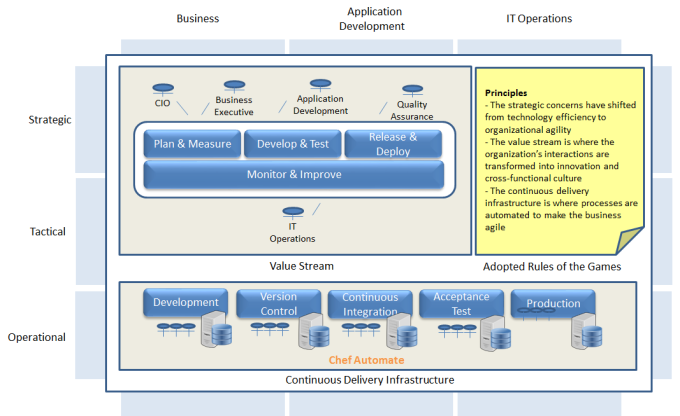
    It’s not different from the two-dimension IT advocated in my recent book, “Rethink Your IT with DevOps: The Complete Guide to Aligning Your IT to DevOps” and  in my online contents, “Become Digitally Savvy in Just Hours. Boost Your Digital Revenue Now“:
    two-dimension-it

    DevOps implementation is based on four principles that determines successful business transformation:

    Concerns have shifted from technology efficiency to business agility: Forget the outdated idea that IT tools on their own can help your business units succeed. What will make them digitally successful is the combination of technology efficiency and organizational flexibility and agility.

    See IT as a two-dimension asset: To win legitimacy among business units, offer a two-dimension vision of IT including the value stream and the continuous delivery infrastructure. Value stream is where value is created and the continuous delivery infrastructure is what enables business agility.

    The value stream is where the innovation and agility cultures are built: Transform your business organizational structure into an agile value stream through deploying agile practices and methodologies such as Scrum, Kanban and Exteme programming.

    The CD infrastructure is where fast time-to-value is enabled: Automate your applications delivery processes into an accelerated applications delivery chain using automation and continuous delivery tools such as Chef Automation, AWS CodePipeline and Apprenda.

    Summing It Up

    Experienced DevOps Strategists know that DevOps is the means to an end, and not the end itself. DevOps is an enabler to one or a combination of these business competitive advantages: short time-to-value, market responsiveness, innovation culture and many more.

    All the noise surrounding the so-called DevOps tools has to do with technology business—making money through selling IT tools—and absolutely not DevOps.

    DevOps isn’t a tool, it’s an IT approach stressing business competitiveness: shorter time-to-value, market responsiveness and innovation.

    — Philippe Abdoulaye