Tag: devsecops

  • Oxeye Platform Helps Fix Code Vulnerabilities

    Oxeye Platform Helps Fix Code Vulnerabilities

    Fresh from raising $5.3 million in seed funding, Oxeye emerged this week from stealth to launch a namesake application security testing platform that, in addition to pinpointing issues in code, also provides advice to best remediate the issues it found.

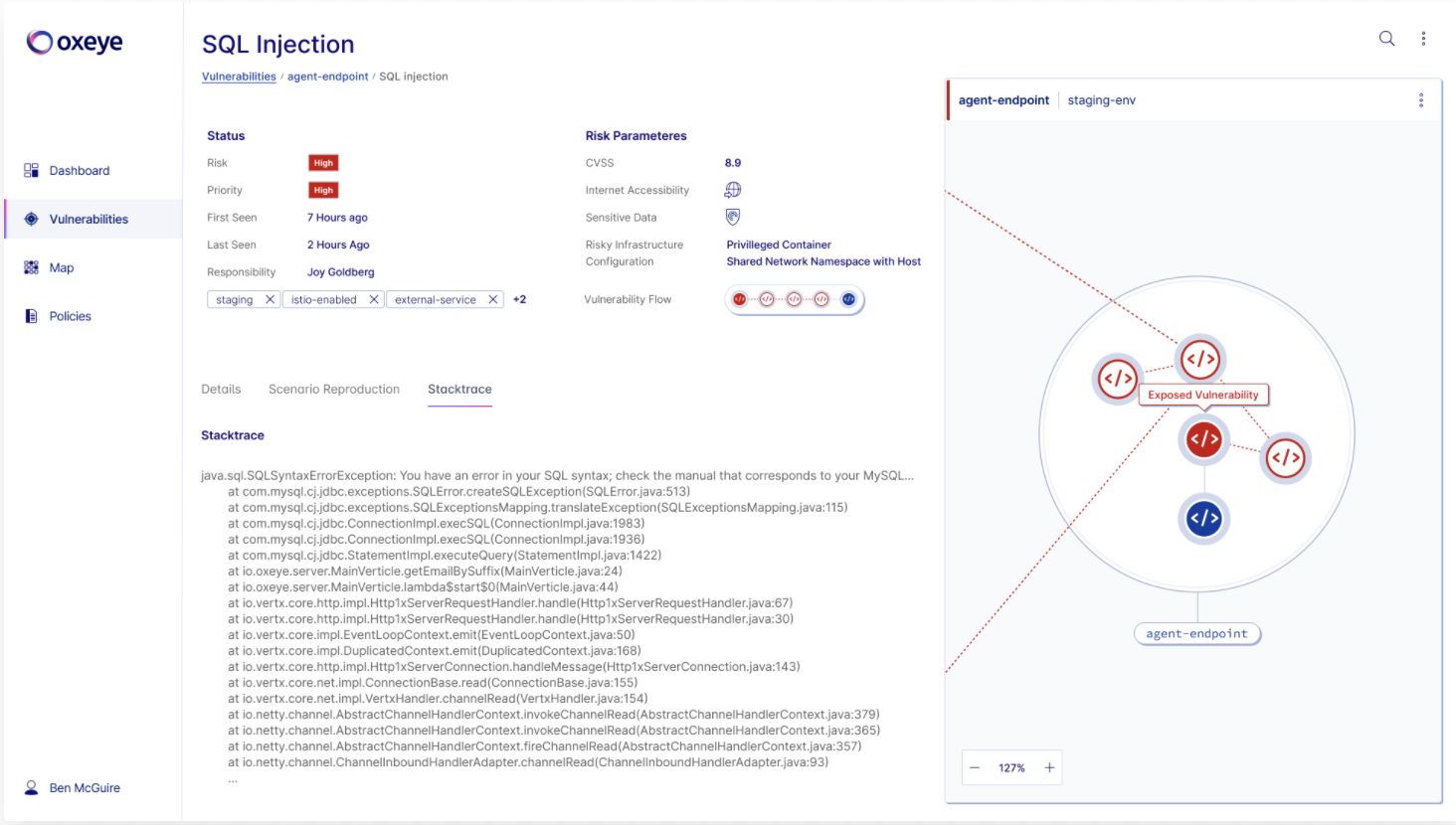
    The Oxeye platform requires developers to download an observer tool that scans code for vulnerabilities. Once pinpointed, the Oxeye platform guides developers through the remediation process without requiring them to inject agent software into every application.

    Oxeye CEO Dean Agron noted developers don’t typically have a lot of cybersecurity expertise. As application environments become more complex—thanks to the rise of microservices-based applications—it only becomes more likely that mistakes will be made. The only way to resolve security issues before applications are deployed in a production environment is to augment developers using a platform that finds vulnerabilities all the way down to specific lines of code, he said.

    In theory, responsibility for application security is being pushed further left toward developers as organizations embrace DevSecOps best practices. However, making developers more accountable for security without providing them the tools required to achieve that goal is not going to improve the overall state of application security.

    The challenge organizations face today is finding a way to empower developers to address security issues without slowing down the rate at which applications are built and deployed. The best way to achieve that goal is to give developers access to a security tool designed to both analyze code for vulnerabilities and explain how to avoid encountering that issue again, said Agron.

    Left unaddressed, the current software supply chain crises will only deepen, added Agron. According to International Data Corp. (IDC), more than 500 million digital applications and services will be developed and deployed using cloud-native platforms by 2023. That’s roughly equal to the total number of applications and services deployed over the last 40 years, according to IDC.

    It’s not clear to what degree the rise of digital applications might force the DevSecOps issue within more organizations. It’s is clear that a new generation of more complex applications based on microservices is being rolled out to drive a wide range of mission-critical applications. The more business value an application has the more attention it inevitably attracts from cybercriminals.

    Regardless of the type of application, it’s apparent that there is a pressing need for a way to better secure applications. The further left that process starts the less costly it becomes to achieve and maintain security. Cybersecurity teams have a vested interest in helping developers do the right security thing as early as possible if no other reason than to reduce the number of vulnerabilities they will inevitably discover later.

    Making developers more aware of security issues is, of course, only the first step. However, in the absence of any tools that can be easily incorporated within an application development workflow, the concerns being raised will amount to little more than yet another sermon that will be ignored as developers once again rush to meet yet another application delivery deadline.

  • DevSecOps Progress: Slow and Steady

    DevSecOps Progress: Slow and Steady

    [pdf-embedder url=”https://devopsy.kinsta.cloud/wp-content/uploads/2022/02/devsecops-progress-slow-and-steady.pdf”]

  • DevSecOps Tech Radar Highlights Diverse Tooling Adoption

    DevSecOps Tech Radar Highlights Diverse Tooling Adoption

    The DevSecOps Technology Radar showcases the opinions cloud-native groups have about DevSecOps tools. To review, The Technology Radar is a periodic report from the Cloud Native Computing Foundation (CNCF), a burgeoning host for new open source projects that are becoming pivotal underpinnings to cloud-native architecture at large.

    Just like previous radars, the DevSecOps Technology Radar was assembled using feedback from the CNCF end-user community, which is a group of over 155 organizations that use cloud-native technologies to build and distribute their services, spanning startups and enterprises. The Radar report organizes popular tools into adopt, trial and/or assess status, based on a technology’s active use and its maturity.

    ‘Adopt’ means these tools are stable and come highly recommended for use in production systems.

    ‘Trial’ means users have had some success with these tools, and it is recommended that others consider them.

    ‘Assess’ means these are promising tools that are good for solving specific needs.

    So, why was DevSecOps selected as this Radar’s theme? According to the Radar team, DevSecOps was chosen because it is highly relevant to current development focuses. “We realized that more than half of the tools we were using in CI/CD were actually security-oriented,” said Sergiu Petean, head of DevOps at Allianz Direct. This goes beyond DevOps—”this is definitely an uppercase ‘Sec’,” he said.

    “More than half of our time is spent discussing designs around security,” said Keith Nielsen, director, cloud architecture at Discover Financial Services. Financial services especially must find innovative methods to balance speed-to-market with security. Nielsen also cited the rapid rate of change in this space, which requires companies to continually reevaluate their security posture.

    DevSecOps Radar Results

    So, where did the CNCF end-user community place popular DevSecOps tools? The Radar ended up rating 16 tools across the three different levels:

    • Adopt: Istio, Sonarqube, Artifactory, Hashicorp Vault, Calico/Tigera, Terraform, ArgoCD and OPA.
    • Trial: XRay.
    • Assess: Cilium, Harness, SonaType Nexus, Hashicorp Sentinel, GitHub Actions, Linkerd and Trivy.

    The above results were based on 252 votes from end users across 35 tools, with most respondents coming from large companies across multiple sectors.

    Out of these tools, Terraform collected the highest number of ‘Adopt’ votes. This technology aids the move toward infrastructure-as-code (IaC) with declarative configuration files, which is important for DevSecOps automation. Tied for second place were Hashicorp Vault and Artifactory, indicating that secrets management, access control and continuous updates for security are pressing requirements.

    Other open source tools on the Radar are providing impressive ways to unify security controls. For example, OPA is a universal layer for applying policies that could help unite fragmented authorization across applications. Or, service mesh options like Linkerd and Istio place a sidecar proxy around applications to centrally manage access control, observability and networking across a large microservices ecosystem. Such projects are programmable to fit into the DevSecOps pipeline.

    Analysis

    In general, the radar team was somewhat surprised to see such a high number of security tools in use today. Some tools compete in the same arena, making hunting for the right tool challenging. “The sheer number of products is a bit staggering … what we’re seeing is a highly fractured strategy from different companies,” explained Nielsen, who said he expected more consolidation on capabilities.

    After evaluating the DevSecOps tooling landscape, The Radar team organized their core findings into three main takeaways:

    Usability is compromised at the expense of security. Security features are necessary, but they often come at the cost of usability. The DevSecOps Radar team found that the developer experience for most tools is poor. Many disparate tools must be stitched together to have a truly automated pipeline which is cumbersome to implement. “The tools are getting better, but still there’s not a cohesive, prescriptive way to develop for the cloud,” said Nielsen.

    The pace of change in the security space is rapid. Major cloud providers continue to rapidly release new services, which has led to an explosion in new tools. Simultaneously, the speed of innovation is accelerating within companies, opening up unique security needs. Combined, this means the security landscape is constantly shifting. “Security tools are trying to keep up with the services and how you host them and run them,” Nielsen said. “We definitely weren’t expecting to see so many newcomers in the security space,” Petean agreed. Though DevSecOps is spoiled for choice these days, “it’s always better to have options,” he added.

    Microsegmentation is important but presents a significant challenge. Many great tools enable companies to improve how they segment traffic, such as service mesh tools like Linkerd and Istio. However, implementing cloud-native microsegmentation is bumping against legacy implementations for established companies. Between API gateways, service mesh, edge firewalls and Kubernetes federated firewall functions, DevSecOps has much complexity to deal with, Nielsen said.

    The DevSecOps Technology Radar: In Review

    In recent years, cloud-native technology has placed increasing emphasis on solving the security puzzle. Companies continue to reevaluate their security approach in light of cloud-native strategies, novel vulnerabilities and new compliance requirements. DevSecOps is proving to be a useful, if not necessary, practice to maintain both security and rapid software delivery.

    With new security tools and unique approaches coming out so frequently, it’s easy to have “analysis paralysis.” However, DevSecOps must start somewhere. And, for those who trust the opinions of the CNCF Technology Radar, you now have some helpful insights on where to begin.

  • How AI is Changing DevOps for the Better

    How AI is Changing DevOps for the Better

    Managing a DevOps environment involves a high degree of complexity. The rapid proliferation of data has made it difficult for DevOps teams to effectively onboard, ingest and unlock data and implement information to make good business decisions and deliver delightful experiences. Imagine a team poring over troves of information to identify critical factors that triggered an event—they would end up investing long hours to interpret and analyze the information.

    The future of DevOps will be AI-driven. It’s fair to say that it’s challenging for human intelligence to harness large volumes of highly complex data. Consequently, AI-powered solutions will become the number one choice for integrating and analyzing data and transforming how teams develop, deliver, deploy and manage applications.

    By 2023, 40% of DevOps teams will leverage application and infrastructure monitoring solutions with built-in AI capabilities, Gartner noted. Currently, in times of disruption, Gartner predicts the AIOps market will grow at breakneck speed, between $300 million and $500 million per year.

    Let us explore how AI and DevOps are intertwined before we explore how AI is transforming DevOps.

    DevOps and AI are Intertwined

    AI and DevOps are intertwined. Integrating AI in a DevOps environment boosts the overall performance and efficiency of an organization.

    AI and ML-powered solutions enable DevOps teams to onboard, map and integrate large volumes of customer or partner data with accuracy and speed. That is to say, business users find it easier to drive processes like data onboarding, data mapping and data integration, thus improving ease of doing business and delivering improved customer experience (CX).

    Organizations that rely on AI-powered solutions no longer need to devote long hours to custom coding and EDI mapping to analyze large volumes of data. The time saved can be used to focus on more important, innovation-driven tasks.

    AI also boosts automation, allows users to address and resolve issues in both data and applications and facilitates better cooperation among teams.

    4 Ways AI is Transforming DevOps

    The efficacy of DevOps correlates with an upward shift in AI. It can empower even non-technical business users to create connections and drive transactions at the speed of business. As a result, it brings non-technical business users to the forefront of business, thus freeing IT and developer teams to focus on more important tasks. Business users can leverage machine learning algorithms to collect data from different parts of DevOps systems and then map and integrate it in minutes through predictions.

    Here are four ways AI is transforming DevOps:

    1. Improved data access: The lack of free access to complex data streams is a challenge for DevOps teams. AI enables business users to access all the siloed data and harness its true potential for better insights delivery and decision-making. AI-powered tools can gather data from various sources for consistent and repeatable analysis.
    1. Faster data integration: AI and ML-enabled technologies enable non-technical business users to execute data mapping and data integration in minutes instead of months. As non-technical users drive operations, IT becomes free to take up governance and instead focus on more high-value tasks. Thus, not only can AI help business users integrate data faster to deliver experiences and value but also enables IT teams to drive innovation and growth.
    1. Higher implementation efficiency: With the support of AI, businesses can perform more tasks with less human intervention and minimal coding. This reduces the burden laid on IT or developer teams, enabling them to concentrate more on innovation and creativity.
    1. Better security: As security is essential to facilitate a successful software implementation, DevSecOps is a fundamental aspect of software development. Organizations must bolster their security systems to guard against an increase in threats. AI can play a vital role here. It can enhance DevSecOps and boost security by recording threats and executing ML-based anomaly detection through a central logging architecture. By combining AI and DevOps, business users can maximize performance and prevent breaches and thefts.

    Accelerating development cycles while making sure data is interpreted and analyzed properly is a challenge faced by DevOps teams today. Artificial intelligence-powered solutions are helping organizations transform every stage of DevOps building cycles without burdening IT teams or adding costs. Ergo, AI can enable users to transform the DevOps environment, deliver delightful experiences and grow revenue.

  • Securing Your Software Development Pipelines

    Securing Your Software Development Pipelines

    Earlier this year, it was announced that the attack on IT management software provider SolarWinds had been used to compromise other organizations, including parts of the United States government. There were several reasons for alarm because of this news, but one of the biggest was the revelation that attackers breached SolarWinds’ software development process and pipeline. The level of concern was such that it led to a first-of-its-kind executive order on cybersecurity.

    The security of the software development process has been a concern for development teams for decades, beginning with Ken Thompson’s thought experiment around hacking compilers to inject vulnerable code (PDF). As the software development process becomes increasingly automated, this means there is more to secure. Indeed, the biggest difference between Thompson’s “Reflections on Trusting Trust” and today is that much of our concern stems from just how much we, as development teams, must trust code that was not written by us.

    The issue of code ‘not written here’ is bigger than just open source libraries – though those are a big part of the issue since a typical Java application is 97% third-party code by weight, according to the Veracode State of Software Security, 2020. Moreover, modern cloud-native applications are also comprised of additional types of code written by others, including container images, serverless code and other cloud-native artifacts.

    As a result, an attacker could compromise a development pipeline by one of a variety of means:

    • Poisoning an upstream open source repository by taking over an open source project, or by typosquatting
    • Compromising a container image repository
    • Gaining access to the continuous integration server and making changes in the pipeline to incorporate malicious code
    • Gaining access to the source repository, identifying an existing vulnerability (zero-day) in an application, and exploiting it in production

    So, what must be done to mitigate these threats? A lot of the answer comes down to testing, managing the chain of custody and monitoring access to internal resources.

    • Managing access—Systems that touch your software development process provide a door that, if not properly secured, may allow an attacker to walk in and compromise the software you ship to your customers. Things to be aware of here include the source control system, the continuous integration server and other tools (including quality and security tools) that have access to the source repository. Similarly, any activity that touches the source code, especially commits to the source code repository, must be properly authenticated with a developer GPG key. This prevents spoofing a user’s identity by setting git configuration parameters (this blog post from Alessandro Segala describes the problem nicely) or by stealing credentials.
    • Manage the chain of custody for software dependencies—Most modern software dependency managers allow connections to multiple software registries, including public registries that can be easily attacked or compromised. Configuring dependency managers to only allow connections to an authorized list of registries can help keep compromised packages from entering the build pipeline. This can also help to ensure that only dependencies that are free of critical and high vulnerabilities can be used in the application. This topic also relates to the next one on testing for vulnerabilities. Part of managing code coming from other parts of the software supply chain is looking for security vulnerabilities in the code. Consider a security scanning tool that can look for vulnerable open source libraries or container images with vulnerabilities and security misconfigurations.
    • Testing for vulnerabilities —Code introduced by an attacker may introduce new vulnerabilities. Using static application security testing (SAST) can help to identify serious security issues, including poor cryptographic practices, hard-coded credentials, and injection vulnerabilities. Performing SAST in the pipeline allows for the identification of critical and high severity defects early, enabling you to fail a pipeline upon their discovery and preventing insecure code from being deployed into production. Likewise, as noted above, testing for vulnerable containers and open source libraries can prevent vulnerabilities from being introduced via the software supply chain. Finally, using dynamic application security testing (DAST) to perform an end-to-end runtime test for a web application in a pre-production environment can help identify other exploitable issues in the end-to-end application. It can also find problems with application configuration that are only observable in the deployed environment. Both SAST and SCA might identify weaknesses in software that, while indicative of poor coding processes, may not be vulnerabilities. So, selecting tools that allow you to set a baseline of acceptable findings can help to ensure this control is adopted successfully.

    Solving all these problems requires thinking about different parts of the application development process as a complete system. To that end, Veracode collaborated with Venafi, Sophos and CloudBees earlier this year to put together a proposed blueprint for secure software development pipelines. The proposal is maintained on GitHub and is available for users to raise issues or propose pull requests on the blueprint—all input is welcome.

    The importance of getting this right cannot be underestimated. Hacks and breaches continue to hit the headlines, and putting in place the right tools, technologies and processes to minimize security risk in the software development pipeline is more critical than ever. 

  • Salt Security Adds Support for GraphQL APIs

    Salt Security Adds Support for GraphQL APIs

    Salt Security has extended its platform for securing application programming interfaces (APIs) to include support for APIs built using GraphQL.

    GraphQL is an open source data query and manipulation language for APIs that was originally developed by Facebook. It provides a more efficient approach to querying data than the REST APIs that are widely used today.

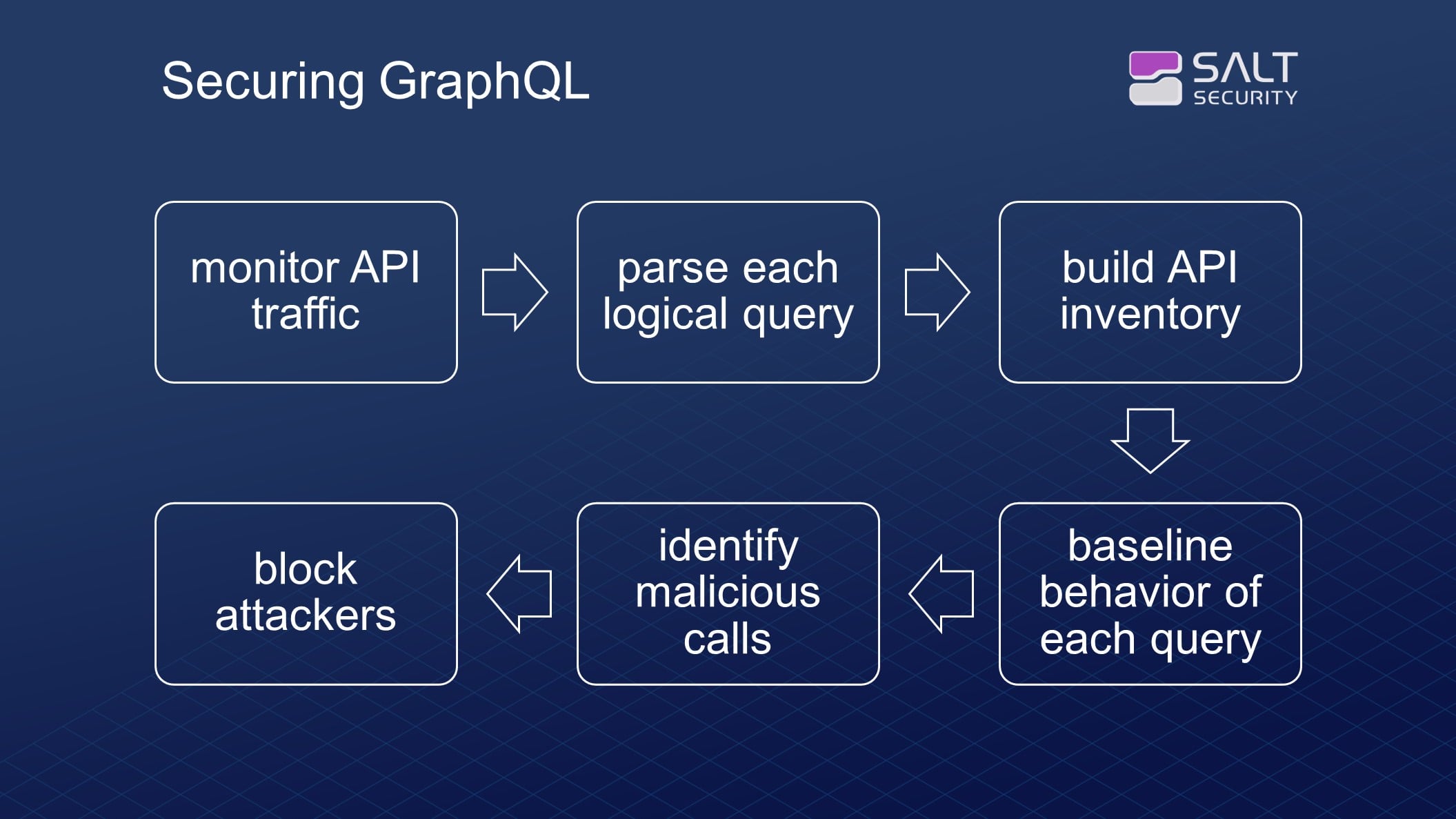
    Elad Koren, chief product officer for Salt Security, said adding support for GraphQL alongside existing support for REST APIs to the Salt Security API Protection platform will make it possible for security teams to discover those APIs, mitigate data exposure, stop attacks and eliminate vulnerabilities. The Salt platform parses the complex structure of each GraphQL query to identify unique object entities that are then used to create a complete inventory of the GraphQL APIs being employed.

    APIs built using GraphQL are more challenging to secure because of the unique call and response formats, noted Koren. Cybercriminals can also, for example, leverage GraphQL capabilities such as nested queries and query batching, to launch distributed denial of service (DDoS) attacks, he said.

    Many developers will tend to assume that, because GraphQL is relatively new, most cybercriminals are primarily focused on exploiting REST APIs. However, as more developers employ GraphQL, it’s only a matter of time before cybercriminals begin to find ways to exploit APIs that may not be as secure as the REST APIs that many organizations already know how to secure.

    The Salt Security platform itself is based on a big data engine that employs machine learning algorithms and other forms of artificial intelligence (AI) to identify attacks in real-time. It creates a baseline to identify legitimate system behavior while preventing cybercriminals from using penetration testing tools to perform reconnaissance.

    From a DevOps perspective, the Salt Security API Protection Platform integrates with tools such as Jira and Slack to ensure that remediation details are routed to the right development team in addition to helping track tickets to ensure remediation fixes are implemented. It also can be integrated with security information event management (SIEM) platforms from vendors such as Splunk and Sumo Logic to enable incident response for both DevSecOps and security operations teams.

    Most IT teams will not be replacing REST APIs with GraphQL-based APIs overnight. However, there will soon be enough APIs based on GraphQL to warrant additional security measures. Less clear is to what degree those security measures will be put in place by DevSecOps teams versus a security operations team.

    One way or another, however, the number of APIs that need to be secured is accelerating rapidly as organizations roll out a new generation of microservices-based applications that drive mission-critical digital business transformation initiatives. Each microservice has its own API that needs to be built and then secured. Unfortunately, most APIs are built by developers that don’t always have the greatest appreciation for security. As such, while more responsibility for API security is shifting left toward developers, many security teams would be well advised to make certain every API being deployed is fully secure.

  • Sysdig Adds Cloud Access Controls to DevSecOps Platform

    Sysdig Adds Cloud Access Controls to DevSecOps Platform

    Sysdig announced today that it is adding a Cloud Infrastructure Entitlements Management (CIEM) capability to its Secure DevOps platform as part of an effort to better enforce least-privilege access within the context of a larger zero-trust approach to cybersecurity.

    Nick Fisher, vice president of product marketing for Sysdig, said this addition to the company’s core DevSecOps platform for securing cloud services will prevent organizations from inadvertently providing individuals with excessive permissions that result in cybercriminals gaining widespread access to applications and systems when the credentials those individuals have are compromised.

    A recent report from the Sysdig Threat Team found that nearly 80% of users have excessive entitlements due to overly permissive policies. Similarly, Gartner forecasted that 75% of security failures will result from inadequate management of identities, access and privileges by 2023, up from 50% last year.

    The CIEM offering from Sysdig enables cybersecurity and IT operations teams to resolve that issue across multiple clouds in under two minutes once installed, said Fisher. The Sysdig platform achieves that goal by making it possible to leverage templates as a set of infrastructure-as-code (IaC) tools that enable DevOps teams to integrate security within their existing workflows.

    CIEM also simplifies access control auditing by making it easier to discover who in the organization has permission to access cloud infrastructure services. As part of that capability, Sysdig also provides out-of-the-box compliance policies and access to reports that can be generated on-demand to surface a detailed audit trail of all cloud permission changes.

    Finally, CIEM will generate an alert any time someone is denied permission to access a cloud resource, noted Fisher. That capability provides cybersecurity teams with an opportunity to then review what permissions might need to be granted or whether a bad actor is attempting to compromise a cloud environment.

    Most of the cloud security issues that organizations encounter can be traced back to developers that have misconfigured one cloud resource in a way that allows cybercriminals to access, for example, a port that has been left open. CIEM extends the Sysdig platform so that, in addition to scanning for vulnerabilities and misconfigurations, it can detect and respond to attacks across containers and virtual machines deployed in a cloud environment.

    Thanks, in part, to recent high-profile breaches of software supply chains, there’s a lot more focus on cloud security as the rate at which applications are being deployed on these platforms steadily increases. While the cloud platforms themselves are fundamentally secure, the challenge most organizations are encountering is they have immature processes in place for securing the workloads running in the cloud.

    Of course, being able to limit access to those cloud resources is only the first step toward implementing a set of DevSecOps best practices to ensure the integrity of the cloud platforms being employed. Unfortunately, too many developers still tend to assume the cloud service provider is taking steps to secure workloads on their behalf. In reality, cloud service providers have adopted a shared responsibility model that, from their perspective, limits their cybersecurity responsibility to the core infrastructure they provide. It’s up to the DevOps team responsible for the workloads running on those platforms to figure out how to secure the rest of that IT environment.

  • Codenotary Uses Immutable Database to Verify Software Artifacts

    Codenotary Uses Immutable Database to Verify Software Artifacts

    Codenotary today unfurled a free notarization and verification service for open source artifacts and containers to enable IT organizations to track the provenance of the components that make up their applications.

    Dennis Zimmer, Codenotary CTO, said the Community Attestation Service is based on an immutable open source immudb database that cryptographically attaches an identity to each software artifact. Additionally, the Community Attestation Service can be integrated with the continuous integration/continuous delivery (CI/CD) platform that DevOps teams employ to build and deploy applications using those artifacts, added Zimmer.

    The identities created by the Community Attestation Service can then be used to verify a software bill of materials (SBOM) that will soon be required by not only every U.S. federal agency but also organizations that are trying to better secure their software supply chains in the wake of a series of high-profile breaches, said Zimmer. The Community Attestation Service will also encourage developers to reuse source code, builds, repositories and Docker container images that they know they can reliably employ within a zero-trust IT environment, noted Zimmer.

    Some developers have, of course, been signing their code for years, while others simply didn’t see the need. With its free service, Codenotary is trying to expand the pool of developers that will not only sign their code but do so in a way that can’t be tampered with later, noted Zimmer.

    Unlike blockchain databases that are employed to provide immutable records of transactions, Zimmer said the immudb platform was created to provide an immutable database capable of processing millions of transactions per second. That database is also being used to build a wide range of applications that go beyond the scope of the Community Attestation Service so DevOps teams can have confidence in the viability of the underlying platform, noted Zimmer.

    In the wake of some troubling security breaches, it’s now only a matter of time before security teams start to ask more difficult questions about how applications are built. Developers could wait for those cybersecurity teams to eventually create policies that DevOps teams would be required to enforce, or they can more proactively embrace a service that tracks the provenance of code that hopefully, has been scanned for all known vulnerabilities. In fact, it may not be too long before organizations decide not to employ code that has not been verified. There may even be a backlash against using code that is unsigned that could result in many existing applications either being updated or outright replaced.

    On the plus side, Zimmer noted there’s a lot more awareness of the need to sign code. The challenge is most organizations don’t have the processes in place. Fortunately, there’s a lot more interest in DevSecOps best practices to ensure the integrity of code. However, awareness of the need for something doesn’t always result in concrete actions being taken unless DevOps teams can simply make it easy for developers to do the right thing. After all, it’s not as though developers want to employ insecure code, it’s just that they are often simply too busy to make sure every last artifact employed is verified as secure.

  • Authentication in Serverless Apps—What Are the Options?

    Authentication in Serverless Apps—What Are the Options?

    Serverless applications are growing in popularity among DevOps engineers. They provide a convenient, predictable way to run simple processes like CI/CD builds or automation scripts with no need to stand up infrastructure. They are also commonly used to deploy microservices. However, serverless applications present unique security challenges, one of them being authentication. 

    How can you ensure services communicate with other services or with the outside world only if authorized to do so? How can you ensure users can conveniently and securely access multiple instances of a serverless function?

    In serverless applications, there are many components interacting—not only end users and applications but also cloud vendors and applications. This is why common authentication methods, such as single factor, two-factor and multifactor authentication offer only a bare minimum foundation. Serverless authentication requires a zero-trust mentality—no connection should be trusted, even communication between internal components of an application should be authenticated and validated.

    To properly secure serverless authentication, you also need to use authentication and authorization protocols, configure secure intraservice permissions and monitor and control incoming and outgoing access. In this article, I’ll cover all these briefly and demonstrate a practical example—setting up authentication in the AWS serverless ecosystem.

    What Are the Most Common Authentication Methods?

    Here is an outline of the standard authentication methods used by most applications.

    Single-Factor Authentication

    Also called primary authentication, this is the most prevalent and straightforward type of authentication. Single-factor authentication asks for only one authentication method; for example, a security PIN, password or PIV card, to gain access to a service or system.

    These methods are solid in relation to familiarity and usability; however, they are generally linked to poor security and credentials can readily be stolen or guessed through phishing, data breaches or by using keyloggers.

    Two-Factor Authentication

    Two-factor authentication (2FA) adds another layer of intricacy, as it needs an additional factor to authenticate a user’s identity. Common verification methods include one-time passwords, tokens created by a registered device or PIN numbers. The presence of two verification methods significantly improves your level of security. 

    Multifactor Authentication

    This is the most complex process of authentication. It makes use of two or more independent factors to verify a user’s identity and authorize access to the system. In common scenarios, multifactor authentication (MFA) makes use of at least two of the following factors:

    • A PIN or password (something known)
    • Security token or mobile phone (something owned)
    • FaceID or fingerprint (something you are)
    • Location information, typing speed or the like (something you can do) 

    Authentication and Authorization Protocols

    An authentication protocol is a communication protocol that protects authentication data as it transfers between two entities. It enables a receiving entity to authenticate a connecting entity as well as authenticate itself to a connecting entity. This is achieved by declaring the type of information required for authentication and syntax.

    There are several types of authentication and authorization protocols, including:

    • Lightweight Directory Access Protocol (LDAP)—a software protocol that enables anyone to find data about individuals, organizations, and resources like files and devices within a network. LDAP allows this whether a user uses the public internet or a corporate intranet.
    • The Security Assertion Markup Language (SAML)—an open standard that allows sharing security information about authentication, authorization and identity across several different systems. 
    • Open Authorization (OAuth)—an open standard authorization framework designed for token-based authorization established over the internet. OAuth enables third-party services to use end-user account information without exposing user account credentials to the third party. This blog post can help you understand the differences between SAML and OAuth.
    • OpenID—enables authentication services and websites to exchange security information in a standardized manner. OpenID Connect—the newest version of the protocol—provides improved identity management, support for mobile application development, and interoperability. Learn more in the official OIDC FAQ.

    Secure Authentication on Serverless

    In serverless systems, there are four forms of access—four forms of communication that should be secured. An individual service won’t have to include all four, but the categories that it does feature should be well-protected. 

    Intraservice Access

    Creating a system by uniting serverless services has many advantages. However, you should consider the security of every additional service. 

    A service with excess permissions is a liability. Unnecessary permissions provide excessive access to data, actions or services, and a bug might let malicious users exploit that service and use its permissions to endanger your system. Hence, you should give careful consideration to the permissions required by each service.

    Effectively overseeing intraservice access permissions is often an overwhelming job. Luckily, all of the top-tier cloud providers have native access management services to make this task simpler. AWS has AWS IAM, Azure has Azure Active Directory and Google Cloud Platform (GCP) provides Cloud IAM. 

    Incoming Access

    A network is made accessible through a SaaS offering to external users. Access will be restricted, and every user will require the official credentials to achieve that access. 

    However, this brings up the same problems raised above—the secrets must be stored somewhere. You cannot manage how your users access and store the credentials that you provide them with; therefore, you should assume that their credentials are not being kept securely and that they may be compromised at any point.

    This would appear to be an unmanageable issue, but there is a solution—to provide temporary credentials. This means that even if the secrets were revealed, they would expire shortly afterwards. 

    The cloud providers have services for this. Google Cloud IAM offers short-lived credentials, AWS IAM lets you create temporary credentials and Azure Active Directory lets you configure expiration dates for its signatures that have shared access.

    Outgoing Access

    When your organization’s serverless function has access to an external third-party service, it typically needs some sort of access credentials. These credentials need to be kept somewhere, but this storage is sometimes not as secure as it should be. Today, certain web applications continue to store secrets in databases, text files or hardcoded within the function code. 

    Cloud providers have services for securely retaining credentials and secrets. AWS has AWS Secrets Manager, Azure offers Azure Key Vault and GCP offers Google Cloud Secret Manager.

    End User and Customer Access

    The issues with this access type are akin to those for incoming access, though the solution is different. Whether in B2B or (particularly) B2C environments, not many users would put up with a requirement to continuously regenerate or refresh their credentials. Thus, another approach is needed. 

    The top-tier cloud providers all have a user authentication service—Azure Active Directory B2C, AWS Cognito and Google Identity Platform. You should also consider using third-party end-user verification, as this will help you avoid vendor lock-in. Third-party offerings also tend to offer a better developer experience. The most common third-party authentication providers are Okta and Auth0.

    AWS Lambda Authentication Solution Example

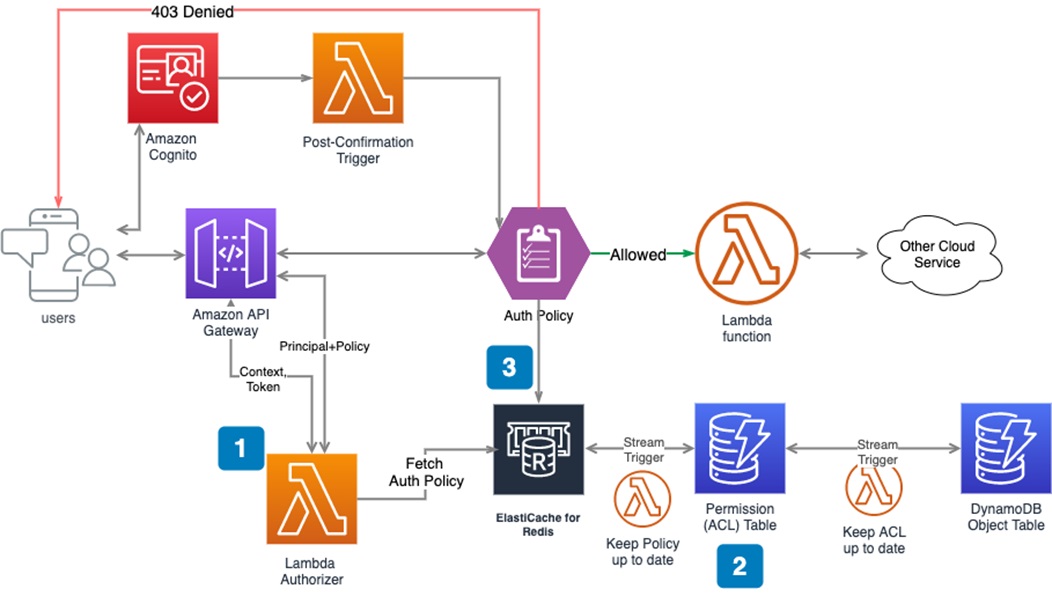
    Amazon Cognito offers managed authentication and authorization that can help you build secure web services in a serverless architecture. It is typically used in combination with Amazon API Gateway when building complex serverless applications that require permission control.

    For example, a payroll system may have a manager and two additional employees. The three employees can use their unique usernames and passwords to log into the payroll system—this process is called authentication.

    To retrieve paystubs, the three employees undergo role-based authentication:

    REST API GET /api/employee/{employee_id}/paystubs

    However, the permissions they get through this process should be unique to their needs. This may involve setting up the following conditions:

    • The manager can access the paystubs of all employees.
    • Employees cannot access the paystubs of other employees, only their own. 

    You can use AWS managed services to fulfill the above requirements and also meet future scaling needs.

    Image Source: AWS

    Step One: Setting Up AWS Lambda Authorizer

    The Lambda authorizer is the brain that centrally determines whether the requester has the relevant permissions for the requested API resources.

    Here’s how you can set it up:

    • Navigate to the Amazon API Gateway and create an authorizer.
    • Select the API resources you want to secure and assign the AWS Lambda function to them.
    • Configure your new AWS Lambda authorizer.

    Step Two: Building User Access Control List (ACL)

    It is crucial to establish user permissions and keep them up-to-date. The approach might differ according to your identity provider. Here is an example of the process if you use Amazon Cognito as your IDP. 

    1. Initialize the ACL

    Every user has a unique ID, so you can describe each user’s permissions by inserting items in the permission table in Amazon DynamoDB when you register with Cognito. The DynamoDB permission table stores the access control list for all users, although the implementation may differ based on the use case. 

    For this example, let’s use a single integer ID for each employee (the UUID strings in real applications tend to be much longer). 

    Manager:

    uuid: xxxx-xxx-xxx-xxxx-xxxxxxxx

    employee: {“allow”: [“/5”,”/5/*”]}

    paystubs: {“allow”:[1,2]}

    Employee 1: 

    uuid: xxxx-xxx-xxx-xxxx-xxxxxxxx

    employee: {“allow”: [“/6”,”/6/*”]}

    paystubs: {“allow”:[3,4]}

    Employee 2: 

    uuid: xxxx-xxx-xxx-xxxx-xxxxxxxx

    employee: {“allow”: [“*”],”deny”:[“/7”,”/7/*”]} // employee_id=7 is the manager of employee 2

    paystubs: {“allow”:[1,2,3,4]}

    2. Manage the Access Control List (ACL)

    The user permissions in a complex project are constantly changing. Employees can be promoted, demoted or terminated, with different access requirements depending on their changing roles. A new manager, for example, needs access to all pay stubs, which means you have to create a new pay stub object for every employee. 

    You can manage user permissions using the Amazon DynamoDB stream:

    Lambda functions can easily be integrated when you insert or modify items in the permissions table. A Lambda function might include code that modifies permissions according to changes to the role of a user.

    3. Build an ACL policy

    Once you’ve established an ACL with user permissions for every object, you should create an authorization policy document. The Lambda function authorizer uses this policy to evaluate whether user API requests should be allowed or denied.

    Amazon API Gateway offers a mechanism for evaluating policies internally. internal policy evaluation mechanism. The Gateway will automatically evaluate any policy JSON returned by the authorizer. For details about Lambda authorizer’s output standard, see this document.

    In this article, I covered the basics of authentication in serverless applications:

    • Single-factor authentication
    • Two-factor authentication
    • Multifactor authentication
    • Intraservice access
    • Outgoing access
    • Incoming access
    • A real-life example with Amazon Cognito

    I hope this will be of help as you gain a better understanding of authentication and authorization techniques that help secure serverless applications.

  • Learn a Bit About AI

    Learn a Bit About AI

    Every once in a while, a trend becomes broad enough that I feel the need to offer career advice. This year it will be simple: Know enough about AI/ML to be dangerous. We are past the point where not having at least a basic understanding is a good idea. Looking around the data center, AI is in use from the earliest stages of development through production network performance evaluation. Somewhere in your environment, you are using AI and ML. More to the point, somewhere in the places you may interview going forward, they are using AI and ML.

    I’m not suggesting you become an AI/ML expert—though you certainly could; I have a relative that is a data scientist and that’s all he does—design and tweak algorithms. He’s learning new things pretty much daily, so if you like that (as I do), it’s an option. But for those of us doing DevOps or SRE or even regular old operations, we’re only going to have to understand a bit.

    Understand what tools like Jupyter are, and what the most commonly used ML algorithms in your space are. Then, learn about how AI and ML help with what you are doing. Just as knowing more about the compiler/interpreter of your chosen language helps you solve more odd problems, AI is going to have that same issue. Think about how those folks who understand the guts of routing are the ones we want solving our routing problems. Again, same scenario.

    Moving forward, AIOps, NetOps, DevSecOps … All intend to increase the amount of work offloaded onto the AI in question. In a lot of cases that is great. We have enough to do; if you can paw through those logs and give me relevant summary info, go for it. But it doesn’t end there—some AI engines are making the calls and implementing changes. In both network and application security, a fair number of vendors will tell you there is no time to wait for humans to stop an attack, and they encourage their customers to turn on automated responses. That’s the first of many applications for AI/ML. We will see an increasing number of AI/MLOps tools being used for full-on automation. We all do difficult jobs with a complex—sometimes bewildering—number of inputs. But we use pattern recognition and experience to make determinations and do what’s best for our organization. Our software has reached the point where sometimes, it can do that for us on the easier tasks so we can focus on the more complex ones. When the AI/ML fails—and it will, because pattern recognition and historical trends are not always indicative of normal usage—knowing what is going on under the covers can help you determine if it did the right thing in the wrong way, or simply did the wrong thing. And it can help you to quickly recover. I can’t speak for every organization, but I’ve never seen one that lamented, “Sure wish that outage had lasted another couple of hours!”

    And keep rocking it. Somewhere in the distant future, an  AI may be able to do your job as well as you. But that isn’t today. Even if it can handle one bit, it certainly isn’t rocking the entire breadth of your responsibilities like you are. Thank you, from all the users that don’t realize you’re keeping them live.