Tag: devops

  • The devopsy.kinsta.cloud Containerization and Microservices Survival Guide

    The devopsy.kinsta.cloud Containerization and Microservices Survival Guide

    Containerization and microservices seemed to have leaped out of nowhere and smack into the center of the enterprise IT scene. But neither leaped from nowhere. Both containerization and microservices have been part of the fabric of enterprise tech for some time—within Linux for containers and service-oriented architecture for microservices.

    Largely, thanks to containerization, both now are moving quickly to become central components of enterprise tech. Containers in recent years—and especially in recent months—have moved from tools used in development environments to production. And the ability to manage containers as discrete services is enabling enterprises to be able to respond quickly and be agile to technology demands.

    According to a recent survey from app performance vendor NGINX, of roughly 1,800 IT professionals, while container and microservices software adoption is limited it’s use is accelerating. The survey found that only 20 percent of respondents said they are using containers in production, while about one-third are doing the same for microservices.

    That survey, not surprisingly, indicated that microservices and container use will continue to accelerate, as roughly two-thirds of respondents said that they are currently evaluating containers and 70 percent microservices.

    Microservices are workloads that perform a single task and they are not dependent on the infrastructure or other applications for their ability to complete their designated task or “service.” Microservices are very effective at providing enterprises the ability to rapidly build software that solves business problems. They also make it possible for development teams to scale their efforts and build a more resilient architecture.

    With all of that in mind, and considering the nature of the inflection point most enterprises find themselves in now, we’ve assembled this microservices and containerization survival guide. The guide consists of some of the most important storage on microservices and container management that we’ve ran in the past year.

    DevOps Teams: Containers Will Help You Become Future Ready

    According to The State of Containers 2015 Docker Adoption Survey, more than 70 percent of respondents are either using Docker or evaluating for future use. Given the overwhelming popularity of containers, this post provides three trends that DevOps teams must be prepared for.

    7 Web Interfaces for Container Management and Orchestration

    Managing containers used to be a command-line affair. But a rich and growing ecosystem of web-based interfaces for containers has now emerged. This post provides an overview of the different web UIs available for container management and orchestration.

    ‘Containers-as-a-Service’ Is a Hot Trend

    Containers are still sort of the new kid on the IT block, but already containers-as-a-service is emerging as a thing. Here’s what you need to know.

    A Closer Look at Container Monitoring

    Enterprises have to ensure that all of their microservices perform well and provide their services as designed. Beyond that, how much do they really need to know about what’s going on inside their containers? The answer to this question varies. In this post Gerald Haydtner provides an overview for container-monitoring options.

    Containers: Not One to Rule Them All

    When it comes to the container platform ecosystem, not all container platforms are created equal. This post will help you sort through the options.

    Building Microservices: A Few Considerations

    An experienced practitioner details the top five design considerations when building microservices.

    5 Docker Best Practices You Should Follow

    Support for Docker has been integrated into many products and platforms and a lot of organizations are either already using Docker containers or trying to understand how to do so themselves. Our Tony Bradley provides the Docker best practices one needs to know to succeed.

    How to Choose a Cloud Platform for Containers

    Containerization has broadened from one or two vendors to a broader, more container-agnostic world and a drive to better scalability, redundancy, interoperability and security. Amazon, Google and Microsoft each have their own unique approach to addressing these cloud container concerns as they battle each other for supremacy. Here’s a look at how to evaluate each.

    Container Security: Why Bother?

    Are containers secure? Probably not. But knowing each approach’s strengths and risks—and available options—could help ease adoption.

    Container Security Challenges: Are Container Scanners Enough?

    How secure are containers? Not very, according to open source company Red Hat, which has published a blog post blasting the container ecosystem for lacking good security processes. Here’s a synopsis of what Red Hat has to say about container security, and some additional perspective.

    For Container Security, Automation Is Key

    Regardless of the IT infrastructure element in question, if it connects to a network—even through proxies or human intermediaries—eventually someone will find a security flaw and exploit it. Compatibility issues with new applications or infrastructure elements will emerge. Because of these reasons, all IT infrastructure elements need to be managed, without exception.

    Containers and Security Q&A: Putting a Lid on Risk

    How do containers affect security? And how can IT teams do everything they need to do in order to ensure the containers in use are as secure as they reasonably can be?


    — George V. Hulme

  • Industry Alignment: Supporting Real-World DevOps Workflows

    Industry Alignment: Supporting Real-World DevOps Workflows

    In our ongoing work to advance the interests of customers around adoption of Agile, DevOps and continuous delivery, the theme of evolving workflows to better suit human-scale work cycles often comes to the fore.

    While  it’s easy to say that build, test, release and monitoring capacities should feed into each other to promote continuous collaboration, realizing this vision in the form of integrated tooling is still no trivial feat. And it is further exacerbated by the reality that DevOps teams typically utilize a wide range of products built by a diverse set of providers, from larger players such as CA Technologies to open-source projects.

    If the goal is to drive  application lifecycle processes and supporting technology to better support human work cycles—along with accelerating organizational velocity and improving quality—somewhere in this domain of tooling integration there’s a need for relevant vendors to participate.

    That work officially begins today.

    At the Jenkins World 2016 conference this week, CA, along with a dozen other leading DevOps solutions providers and the DevOps Institute, announced the DevOps Express consortium. Joining us, along with CloudBees and Sonatype, which spearheaded this effort, are Atlassian, BlazeMeter, Chef, GitHub, Infostretch, JFrog, Puppet, Sauce Labs, SOASTA and SonarSource.

    So what’s the big deal? The direction of this initiative—which will focus first on supplying reference architectures that describe field-tested integrations of best-in-breed solutions—strikes directly at the heart of the central DevOps tenet: collaboration.

    The immediate result is that these providers are moving to boost interoperability across a typical production DevOps toolchain. It is truly noteworthy that these solutions providers, some of whom maintain palpable competitive interests, are putting aside those considerations to advance the interests of end users; that is a very DevOps phenomenon.

    In many other areas of IT, this type of cross-pollination either never commences or doesn’t emerge until the sector is so well-established that industry collaboration seems more of an effort to fend off perceptions of commoditization. To anyone familiar with the incredible pace of innovation ongoing in the automation sector, and the potential for competition between many of the companies involved in DevOps Express, it should be immediately obvious that this is a partnership that truly puts customers first.

    Yet, if we’re serious about empowering the kind of wholesale software factory reinvention that we espouse around DevOps, this is something that had to take place. How can an industry talk endlessly about eliminating stovepipes and marrying long disparate processes, and then defer to a walled garden worldview as it relates to the enabling products? That certainly wouldn’t really add up.

    It’s amazing to see what’s going on in the world of technology these days, and ever more exciting to be a part of it. We’re proud to be a member of DevOps Express.

    It’s a great time to be involved in this space.

    — Jeff Scheaffer

  • Chef Boards the DevOps Express with CloudBees, Others

    Chef Boards the DevOps Express with CloudBees, Others

    You often may have more questions than answers as you progress along your DevOps journey. Which tools should I choose? Do these tools work well together? What have other people done in my situation? You’re often left Googling to find the right integrations and piece together an architectural solution.

    Today, I’m excited to announce that Chef is joining DevOps Express, a new industry initiative comprised of 14 leading DevOps vendors and service providers. Led by CloudBees and Sonatype, and including everyone from Atlassian to GitHub, this initiative is focused on creating solutions that will help you adopt DevOps practices. Specifically, by defining reference architectures and highlighting best practices, supported integrations and solutions, we believe that DevOps Express will simplify and accelerate DevOps adoption for organizations of all kinds.

    DevOps Express uses popular technologies spanning multiple solution components to provide a framework for building reference architectures that are better integrated and supported. Creating reliable and actionable reference architectures for organizations will ease DevOps adoption and minimize risk for organizations.

    DevOps is collaborative by its very nature—it’s all about bringing teams together. This includes cultural transformation, breaking down silos between disparate teams and working together around the common goal of adding value for customers. These principles are just as true for us, the vendors providing tools to help you on your DevOps journey. We, too, must break down silos and work together to provide more value for you, our common customer. I’m looking forward to what we’ll build.

    About the Author / James Casey

    james_caseyJames Casey is vice president of Partner Integration at Chef. His career spans more than 15 years in companies ranging from mobile and finance startups to CERN, the birthplace of the World Wide Web. He specializes in building tools for operating large computing infrastructures. He previously created monitoring tools at CERN for the Large Hadron Collider.

  • Introducing DevOps Express!

    Introducing DevOps Express!

    The DevOps Institute (DOI) is proud to join industry leaders as a founding member of the DevOps Express. The DevOps Express is a bold initiative between tool providers and others to create a solutions-oriented approach that will make enterprise DevOps adoption easier using popular technologies spanning multiple solution components. Working together, DevOps Express members have committed to improving interoperability within the DevOps stack, and creating a framework for industry partners to develop reference architectures that will be better integrated with better support.

    The 14 founding members of DevOps Express include vendors spanning multiple solution categories in the software delivery process, as well as service organizations providing consulting, training and professional services:

    • CloudBees
    • Sonatype
    • Atlassian
    • BlazeMeter
    • CA Technologies
    • Chef
    • DevOps Institute (DOI)
    • GitHub
    • Infostretch
    • JFrog
    • Puppet
    • Sauce Labs
    • SOASTA
    • SonarSource

    DOI is honored to be a part of this important and innovative program. We believe this initiative represents the industry’s commitment to “walking the DevOps walk” by agreeing to collaborate, align and integrate for the betterment of the market. We are excited that major industry partners are unifying to give enterprises potential starting points for creating a DevOps stack, while also increasing quality and lowering risk. As knowledge, best practices, architectures and models emerge from the work of DevOps Express, DOI will ensure that these are available to the DevOps learning community and embedded into DOI courses, articles and future member benefits.

    The DevOps Express is leaving the station, and DOI is on board! Read the press release for more information about this historic initiative.

  • Communication Skills Matter in DevOps

    Communication Skills Matter in DevOps

    While the precise definition of DevOps is an evolving matter, a simple way to describe it is this: DevOps is a change of mindset toward an agile and inclusive approach to IT. DevOps enables IT professionals to think and work beyond technology silos, thereby deriving meaningful results at a faster rate than with more traditional methodologies.

    This involves going outside of our comfort zones and collaborating outside the confines of our own cliques. By working across operational boundaries, DevOps will require an understanding of technical, operational and service aspects of the business. This means the heart of DevOps lies not in technology, methodology nor administration: The heart of DevOps lies in communication, which brings all these together.

    DevOps professionals seem to agree. In Incapsula’s DevOps Salary Survey conducted in 2015, the California-based cybersecurity firm identified communication skills as one of the highest priorities for DevOps professionals, almost as much as operational skills.

    In other words, effective communication across the organization is considered as important as actually building the product, and it is integral to building the product itself. This means when you’re in the field of DevOps, a smart investment in communication skills will pay off for both individuals and the team.

    Communication Fosters Teamwork

    There usually exists a disjoint between technical and non-technical departments, particularly in technology companies. Engineers, for example, might be fascinated by an elegant piece of code, an algorithm that automatically governs a process or an infrastructure that does exactly what it’s supposed to do. But to the rest of the organization, those things take place purely in the background and work best when they aren’t noticed at all.

    Tech people take pride in the technology, while operations people take pride in business results. The two often find themselves at odds due to a lack of communication about what is really needed, and how to get there. Successful communication in DevOps focuses on finding common ground and working toward achieving this.

    For communication to be effective, the emphasis should be on the user of your message. You’ll need to have a deeper understanding of where they’re coming from. No amount of expertise matters if you can’t convey it properly. You can’t gain any growth or value for your career or organization if there is always a unidirectional disconnect.

    Bottom line is, you need to correctly identify your intended recipients and find a common ground to better engage.

    You Can Increase Your Value as a DevOps Pro

    Trust is an essential component of teamwork, which is also important in the development life cycle and in decision-making processes. Being a communicator enables you to better establish trust among your colleagues—something that, unfortunately, is lacking in many IT project life cycles.

    This is why pure technologists don’t necessarily make good DevOps professionals—an observation highlighted by the Incapsula survey, which shows that a mix of general and technical skills are essential for a successful DevOps career. In fact, general skills are usually more important in securing higher-paying jobs in this field. These include understanding business operations, developing communication skills and remaining flexible and open to change. In addition, the rising trend in outsourcing DevOps pros across a global talent pool means your communication skills have to transcend languages and contexts.

    A good DevOps professional knows that value is not just about the technology, but rather about the product. Even the best technologies in the world are just abstract concepts until you translate them into a product people can actually use and enjoy. Thus, going beyond technical capabilities, you will need to know how to collaborate to transform technologies into useful and marketable products.

    You Can Advance Your Career Faster

    Chatting up the project managers, glad-handing the operational staff and picking the brains of departmental leaders may not come naturally to pure technologists. However, for DevOps professionals increasingly engaged in conversations across the enterprise, knowing the language unique to the organizational culture—verbal and nonverbal—can make all the difference in terms of career advancement.

    Such organizational language can be considered as its own kind of coding. This facilitates everything from a working knowledge of financial reporting, to the listening skills needed to understand the technology goals meaningful to each business unit. It’s also how unwritten rules about business priorities or hierarchies are communicated.

    After all, the career survey cites at least 26 job descriptions among DevOps professionals, including project manager and operations manager, among others. This means you don’t necessarily have to get stuck in one position or job description. In an organization that fosters the DevOps culture, your value goes well beyond your technical capabilities, but rather the focus is more on organizational skills.

    The Takeaway

    Since DevOps involves cross-functional teams instead of compartmentalized departments, everyone will need to be more involved in business operations, product development and support. Being an effective communicator is at the heart of all this, and it can spell the difference between success and failure in a DevOps environment.

    It’s easy to think that there is little more to learn in terms of communication, especially if your DevOps integration is already mature and your team is functioning optimally. However, your investment in becoming a better DevOps communicator begins with learning the language and culture of the organization. This also includes a continuous reassessment of skills and the ability to build connections from each and every encounter with colleagues, partners and other stakeholders.

    About the Author / Laureen Fagan

    LaureenFaganA senior PR counsel and thought leader, Laureen Fagan has 15 years experience as a media and PR professional, which includes her stint at CBS and Fox broadcast affiliates in the United States, and in print and wire-service newsrooms in Chicago, Washington D.C., and Jerusalem. Laureen received her MSJ from Northwestern University’s Medill School of Journalism, and completed additional graduate study at University of Notre Dame in Theology / Hebrew Bible that includes French, Arabic and Hebrew study. In addition to tech and business, Laureen creates informed content and deep analysis on international affairs, health care, culture and religion.


  • Q&A: BDO’s Coffman on Change Management, Security and DevOps, Part 1

    Q&A: BDO’s Coffman on Change Management, Security and DevOps, Part 1

    DevOps’s best asset is swift and valuable change, which also may be its biggest risk factor. DevOps certainly challenges change management and security. We recently discussed these challenges and the solutions with Deena Coffman, managing director at BDO Consulting’s Technology Advisory Services practice. Here is part one of that exchange.

    David Geer: What kinds of challenges does DevOps create for change management? Can you illustrate with an example?

    Coffman: By combining the sysadmin and developer functions, DevOps can lend to “shortcutting” the change management process in the interest of expediency. It may also undercut the value of having a critical eye from both a distinct system administrator and a distinct development reviewer. DevOps is designed to move quickly, and while the pace of change is accelerating, speed is often an ingredient for a security incident. Much like having the same individual who approves invoices also issue a check, DevOps makes for a faster, but not always secure, process.

    When the system of checks and balances can be purposefully circumvented, that privilege tends to be invoked more often than necessary. As a result, developers may bypass change management altogether far too frequently. The collaborative benefits from DevOps integrating typically siloed functions such as QA, software development, security and information technology operations are important, so long as they aren’t offset by compromises in quality and security that result from the reduction in the review and approval process.

    The expedient nature of DevOps can also lead to error, given the absence of human experience involved in the evaluation process. Before DevOps, if a developer needed to change a setting on the web server, they would submit a change request and wait for approval. Under a DevOps structure, though, the developer simply scripts the change and commits it to the repository—automatically kicking off the build process. The process runs unit testing, integration testing, functional testing and regression testing against the new code, and then pushes the new code to the staging environment and finally, to production.

    Geer: What kinds of challenges does DevOps create for security? Can you illustrate with an anecdote?

    Coffman: The biggest security challenge in a DevOps environment is that speed becomes paramount, which reduces critical evaluation on security risks. Developers incentivized to quickly deploy new capabilities are naturally pushed toward productivity and efficiency, which often run counter to security. DevOps can skew that balance so that security is only lightly or sometimes insufficiently considered. Automated testing will test for known exposures, but a trained, experienced human may be able to anticipate a risk before it materializes.

    Geer: How can flaws in change management in DevOps approaches lead to security issues?

    Coffman: Flaws or inefficiencies in the change management process reinforce the views of those who are prone to bypassing what they perceive as tedious process requirements. If a change management process is too burdensome or seen as lacking value, people will avoid it at any opportunity—not just when an exception permits a bypass. Since technology professionals tend to have a bias against waste and inefficiency, introducing a process requirement that consumes time and effort without returning value has a high probability of triggering a wholesale negative reaction.

    Geer: What kinds of things do DevOps shops and teams need to be doing to address change management so that they continue to meet the expectations of the business?

    Coffman: When it comes to ensuring that change management meets business expectations, it really comes down to several key ingredients: flexibility, speed, efficiency and risk management.

    DevOps teams should design and manage the change management system to be efficient, responsive, and flexible enough to accommodate cursory reviews for low risk scenarios and careful, in-depth reviews for other changes. Leadership needs to also set a tone of support for the change control process so it is not dismissed or marginalized. Additionally, engaging outside expertise and/or including additional quality and security measures for higher risk projects are recommended.

    A risk review that identifies projects with security and privacy risk and distinguishing types of changes supports the automation decisions and builds a DevOps program that balances its benefits with risk management.

    Stay tuned for part two.

  • Top 5 DevOps Practices to Improve Security in Engineering

    Top 5 DevOps Practices to Improve Security in Engineering

    We’ve all been there … A new application or feature needs to be deployed yesterday and the last thing anyone wants to do is address security requirements. On the flip side, the very last thing anyone wants to address later is a security breach or a cost associated with non-compliance. Not only is it a massive headache but also it’s extremely expensive. According to the IBM X-Force Threat Intelligence Report 2016, the average cost of a data breach in 2015 was $154.20 per record ($363 per healthcare record) with the average total cost of a breach estimated at $3.79 million.

    Not only is a breach expensive in terms of cost that can be easily quantified, but there are also costs that are harder to quantify such as the impact to branch image and customer loyalty. According to a new FireEye research report, 76 percent of respondents would likely take their business elsewhere due to negligent data-handling practices. In an incredibly competitive technology space, none of us can risk turning a blind eye to security if we want to attract customers with cool new features and then keep those customers with trust and reliability.

    Security seems to be one of those topics that you either love or hate. I’m personally interested in it; however, I realize it’s not an interest shared by all. In the land of unicorns, we want all developers (infrastructure and application) to have more ownership in security, but tight schedules combined with the lack of expertise and reliable controls often can make that strategy unreliable. To make matters worse, a secure system and application isn’t something that is always glaringly visible to an end user or product owner. As a result, security may easily get deprioritized as something that “can be fixed later.” The “fix it later” strategy can be a dangerous decision, as many cybercriminals now are actively taking advantage of those that deploy quickly without adequate controls. How do you balance the customer’s desire to have new features delivered quickly with the fact that they need secure systems protecting their data against malicious threats?

    Several common DevOps practices inherently lend themselves to providing a development and delivery pipeline that can improve your overall security posture. DevOps combined with SecOps includes practices that shift operational and management aspects of a system to the left to ensure we are able to reliably delivery and manage secure systems.

    5 Security Practices Worth Considering

    Below is a list of the top five DevOps practices and tooling that can help improve overall security when incorporated directly into your end-to-end continuous integration/continuous delivery (CI/CD) pipeline:

    1. Collaboration
    2. Security test automation
    3. Configuration and patch management
    4. Continuous monitoring
    5. Identity management

    If you iteratively build in security practices as you move infrastructure and application code through the deployment pipeline, it greatly increases your security posture as well as decreases the cost of future rework.

    Collaboration and Understanding your Security Requirements

    Many of us are required to follow a security policy. It may be in the form of a corporate security policy, a customer security policy and/or a set of compliance standards (ex. SOX, HIPAA, etc). Even if you are not mandated to use a specific policy or regulating standard, we all still want to ensure we follow best practices in securing our systems and applications. The key is to identify your sources of information for security expertise, collaborate early and understand your security requirements early so they can be incorporated into the overall solution.

    Security Test Automation

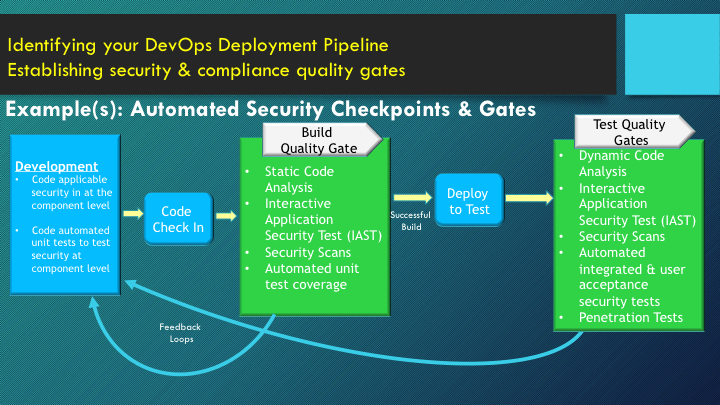
    Whether you’re building a brand new solution or upgrading an existing solution, there likely are several security considerations to incorporate. Due to the nature of quick and iterative agile development, tackling all security at once in a “big bang” approach likely will result in project delays. To ensure the project keeps moving, a layered approach often can be helpful to ensure you are continuously building additional security layers into your pipeline as you progress from development to a live product. An example of building gates in as you progress through your pipeline is shown below. Security test automation can ensure you have quality gates throughout your deployment pipeline giving immediate feedback to stakeholders on security posture and allowing for quick remediation early in the pipeline.

    sec

    Configuration Management

    In traditional development, servers/instances are provisioned and developers are able to work on the systems. Sometimes there is a “golden image” developers use to provision that can ensure that the provisioned servers/instances have a hardened operating system. However, as soon as any additional development and configuration activities happen on those servers, that server is no longer golden. To ensure servers are provisioned and managed using consistent, repeatable and reliable patterns, it’s critical to ensure you have a strategy for configuration management. Your strategy may include Chef for one situation, Salt for another situation, immutable infrastructure, or a combination of practices. The key is ensuring you can reliably ensure and manage consistent settings across your environments.

    Patch Management

    Similar to the concerns with configuration management, you need to ensure you have a method to quickly and reliably patch your systems. Missing patches is a common cause of exploited vulnerabilities including malware attacks. Being able to quickly delivery a patch across a large number of systems can drastically reduce your overall security exposures.

    Continuous Monitoring

    Ensuring you have monitoring in place across all environments with transparent feedback can alert you quickly of potential breaches or security issues. It’s important to identify your monitoring needs across the infrastructure and application, and then take advantage of some of the tooling that exists to quickly identify, isolate, shut down and remediate potential issues before they happen or before they become exploited. Part of your monitoring strategy also should include the ability to automatically collect and analyze logs. The analysis of running logs can help identify exposures quickly. The collection and analysis of security logs can identify issues that require remediation as well as provide automatic collection of compliance evidence. Compliance activities can become extremely expensive if they are not automated early.

    Identity Management

    DevOps practices help allow us to collaborate early with security experts, increase the level of security tests and automation to enforce quality gates for security and provide better mechanisms for ongoing security management and compliance activities. While painful to some, it has to be important to all if we don’t want to make the headlines.

    We are all busy keeping up on everything that is emerging in technology and it’s difficult to keep up on all of the latest issues, so relying on reputable tools and reliable sources of information can be extremely beneficial. Some of my favorite resources in this area are The OWASP and SC Magazine. IBM X-Force is another great reliable resource to check out for the latest threat research and services. There are also a slew of tools out there to help with different areas of security in each of the practices covered in this blog. I’d love to hear about some of your favorites at @Shelbee_SE.

    About the Author / Shelbee Smith-Eigenbrode

    Shelbee

    Shelbee Smith-Eigenbrode is a senior software engineer/IT architect at IBM and has been in IT for 19 years.  She has worked across varying roles spanning the software development life cycle. Her experience across functional roles as well as performing that work deeply inside traditional silos has contributed to her passion for embracing the DevOps culture and transforming the way teams are delivering technologies by adopting DevOps practices. She is a member of the IBM Academy of Technology committed to driving innovation and technical advancement.

  • Software Assurance Takes Center Stage at Developer Day

    Software Assurance Takes Center Stage at Developer Day

    Cloud Security Alliance and SAFECode Develop Training for Improved Software Security Using Cloud and DevOps Practices

    Software assurance is one of the most important and possibly one of the least understood areas of software development today. Software assurance is a comprehensive process that encompasses a set of design, coding and testing methods for ensuring that software functions as intended without introducing vulnerabilities, malicious code or defects that can bring harm to the end user. This approach is especially important in the cloud because increasingly the tools for developing applications are coming from cloud providers. The architecture for applications is changing rapidly and requires developers to understand the risks and vulnerabilities when developing applications in the cloud environment.

    As we continue to see vulnerabilities within applications that lead to exploitation and theft of data, there exists a lack of acknowledgement in how to properly define and address these issues. With increased expectations on reducing time to market, development teams are pressured to work in sprint cycles using agile methodology thinking. New feature development is put first and developing secure code can become an afterthought.

    While individual companies do implement effective methods for developing and delivering more secure and reliable software, except for a small number of organizations such as Software Assurance Forum for Excellence in Code (SAFECode) and the Cloud Security Alliance (CSA), there have been limited coordinated, industry-led efforts to build upon this positive work and promote best practices to advance software assurance more broadly, especially in cloud technology.

    Inaugural Developer Day Planned for Sept. 12

    The inaugural Developer Day event launched by the Cloud Security Alliance and SAFECode is a workshop developed to address these issues by educating software professionals on the challenges of improving software security using cloud and DevOps practices. A unique curriculum was developed by CSA and SAFECode to address the challenge of improved security using cloud and DevOps practices. The event is free but pre-registration is encouraged:

    WHAT:  SAFECode/CSA Developer Day

    WHEN:  Monday, Sept. 12; 1-6 p.m. PDT             

    WHERE:  Adobe Systems Incorporated Corporate Headquarters
    345 Park Avenue, San Jose, California
    Park Room, East Tower

    Event Fee:  Free          

    Registration:  https://www.eventbank.com/event/777/register/

    Developers play a critical role in secure software assurance, and in today’s IT landscape, this role has never been more important. The application of effective software assurance methods is a proven way of enhancing and preserving trust and reliability of software.

    A Practical Primer on Software Assurance

    The half-day Developer Day event provides software developers with an important general primer on the core principles and applications of software assurance, and how to build in security utilizing cloud and DevOps practices. Attendees also will be provided with insight on state-of-the-art software assurance trends and learn how they can deepen their knowledge of software assurance. The event agenda includes three sessions:

    • SAFECode: Driving Software Assurance among Software Professionals
      • Fundamental Practices for Software Assurance
    • CSA: Cloud + Dev = Security Awesome
    • Putting Theory into Practice: Software Assurance Case Studies

    SAFECode and CSA created the Developer Day with two goals in mind. The first was to share recent developments and trends in the practice of software assurance across a number of different domains. The second was to demonstrate the top ways to combine development practices such as DevOps with cloud deployments to increase security without slowing things down.

    Online Software Assurance Training Available

    If you can’t make Developer Day, SAFECode and CSA also recently launched a jointly developed free, online, on-demand cloud security training program called, “Basic Practices for Service Development of Cloud Applications.”  The two-part training program teaches students about different cloud models as well as basic practices and aspects of secure development of cloud applications. It is part of a broader security engineering curriculum made available for free by SAFECode.

    About the Author / John Yeoh

    john_yeohJohn Yeoh is the Senior Research Analyst for the Cloud Security Alliance (CSA) working within industry working groups, SDOs and strategic relationships in the development of cloud security standards, tools and solutions and strategy development. With over 15 years in research, John has authored reports on IT, cybersecurity, cloud and new technologies. His thought leadership has been presented in SC Magazine, USA today, Information Week and others, and he currently sits on numerous technology committees in government and industry. John’s graduate studies include Massachusetts Institute of Technology and University of Southern California with undergraduate work at Eastern Washington University and University of Washington. Connect with him on Twitter and LinkedIn.
  • GRC: A Key Ingredient in DevOps’ Secret Sauce

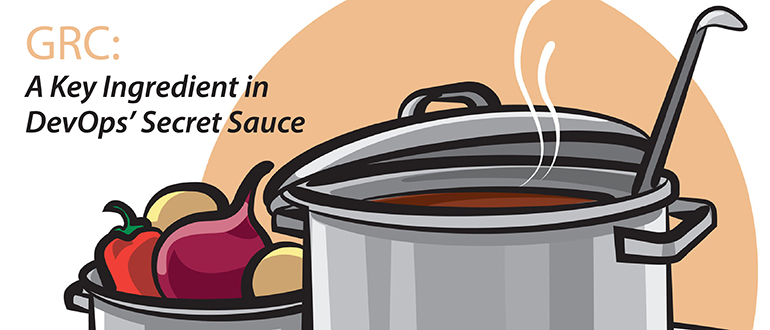
    GRC: A Key Ingredient in DevOps’ Secret Sauce

    By now, surely everyone has seen cooking competition shows such as “Hell’s Kitchen” and “Top Chef,” in which people compete to create and serve the best dishes as quickly as possible. These hit TV programs are like the DevOps world, which also consists of people creating and releasing the best software as fast as they can with whatever they are given. In both instances, the best use of random ingredients brings rewards and failure brings disappointment.

    DevOps is becoming evermore common as companies in all industries work to unify their developers and other IT staff while automating as much of the process as possible, creating nimble, fast-moving teams. Think of it in the same way professional kitchens have cooks dedicated to specific stations, such as vegetables or fish, and are able to react swiftly to whatever orders are placed. By redesigning their in-house teams in this fashion, organizations can add speed, agility and resilience to critical functions.

    But, often what’s forgotten in the high-pressure, rush-rush-rush world is the critical importance of security and regulations. Governance, risk management and compliance (GRC) always must form the base decisions; otherwise; the final products will either not be able to be used or, worse, be dangerous to the company, its customers and its shareholders. It’s really no different than cooks having to abide by health code regulations or risk sickening and possibly even killing their diners. Don’t think GRC is that serious? It wasn’t long ago that Dwolla was fined $100,000 by the Consumer Fraud Protection Bureau (CFPB) for lying to customers about data risks. That was the CFPB’s first fine and you can bet more are sure to follow.

    Of course, a key difference is that in the business world, regulations and compliance standards constantly are being created or changed. That makes DevOps even more challenging, but that challenge cannot mean ignoring GRC. In fact, GRC should be seen as a key DevOps enabler, not an obstacle. An organization’s legal and compliance team can take advantage of highly agile, forward-moving DevOps teams to design and implement changes that satisfy risk and control points (resulting in successful audits and avoiding fines) while, at the same time, staying abreast or even beating the competition.

    The key here is to ground DevOps in GRC requirements so they become second nature and security measures are incorporated effectively into all DevOps processes, even automated ones. It’s crucial these measures are seen as integral to the processes and not simply layered on top as an afterthought, just as you wouldn’t try to get raw chicken juice off of lettuce after you’ve made a salad.

    Tactically speaking, how is this accomplished? DevOps teams need awareness and training. They need to learn the rules and laws specifically governing their particular industry, and how to implement them. And, companies need to have internal audits and other review policies in place to ensure GRC is enforced.

    For all of this to happen, however, a very important role must orchestrate it: management. Just as every kitchen depends upon a head chef to ensure not only that each station is obeying health codes (i.e. the law) but also that overall the meal is being prepared and delivered properly, company management must assume its authoritative role in setting up and defining the organization’s internal communication. This means breaking down silos and coordinating a regular flow of information from Compliance to DevOps team and back again.

    If this is done properly, DevOps can enable an innovational Nirvana, with companies boosting speed while maintaining security, creating the perfect consumer experience.

    About the Author / Robert Hawk

    Robert HawkRobert Hawk serves as Information Security Expert at xMatters, Inc. He has extensive experience in information systems security, computer security, cyber security, information assurance and governance, risk, and compliance (GRC) management. He specializes in frameworks and standards from: ISO/IEC, NIST, IEEE, IETF, ITU-T, Common Criteria, AMI-SEC, NERC, CIS, DoD, ANSI, PCI and ISECOM. Robert is a lifelong researcher, innovator and instructor. Connect with him on LinkedIn.

  • DevOpsDays and Diogenes: Thoughts from a First-Timer

    DevOpsDays and Diogenes: Thoughts from a First-Timer

    I went seeking honesty at a DevOps conference and met Diogenes.

    Diogenes of Sinope was a controversial figure in ancient Athens who was known for walking around the famed ancient city—some say in the nude— during daytime with a lamp in his hand. He parried inquisitors who questioned his strange habit of using a lamp by day by insisting that he was looking for an honest man. At the recent DevOpsDays Boston, I actually met Diogenes. True story. See picture below. (Thankfully, he was wearing clothes.) But, as you probably guessed, this was not the man with the lamp, but rather one of the many conference organizers looking to help less-acquainted individuals find their way around the many meetings and speakers that filled the two-day conclave. Indeed, my Diogenes was instrumental in organizing the conversations and lectures that proved both honest and helpful.  Rather than a self-congratulatory summit, the two-day meeting was an honest conversation highlighting the advantages as well as many of the stresses befalling organizations that have adopted DevOps.

    DiogenesI found the most honest discussions were a floor up and a bit removed from the topics discussed in the main ballroom. These discussions were given the informal title of “Open Spaces” and were run in a typical un-conference format. These conversations were the real opportunities to learn about the stresses of implementing the modern portmanteau of DevOps.

    Tensions Between Dev and Ops: Why Can’t We All Get Along?

    One of the most interesting discussions in the Open Spaces looked at the dynamics between Devs and Ops. Like with any two groups that need to work together to accomplish larger organizational goals (think Sales and Marketing or Design and Engineering), there are inherent tensions that need to be overcome. The tensions between Dev and Ops are based on the different mission each pursues. Dev is striving to get software out the door as quickly as possible and push software updates forward. Ops is guided by the need to keep the ship as steady as possible, which often means limiting updates, as every update opens the door to potential bugs and deployment challenges. Starting with this premise of conflicting motivations, issues of trust and respect further complicate the relationship as each sees the other as trying to control the process.

    Yet, participants in this Open Spaces discussion were hopeful that tensions could be dissolved if management played an active role in creating cross-functional teams and managing workloads better. It was suggested that by essentially seeding Ops with Devs and vice versa, a greater community of understanding could be created. By promoting this cross-pollination, there would be greater understanding on both sides the implications (from the Dev side) of pushing software over the wall to Ops too quickly. From the Ops side, there would be greater understanding that 100 percent uptime is incompatible with dynamic product cycles that encourage innovation. A common and acceptable level of uptime needs to be agreed upon by both sides.

    For example, creating demos and code walk-throughs so both Dev and Ops can comment on potential problems and issues allows both Dev and Ops to see issues at the beginning rather than at the time of deployment.

    Blameless Post-Mortems in DevOps: Can They Exist?

    Another fascinating discussion in the Open Spaces focused on blameless post-mortems. Postmortems first and foremost suffer from an image problem. I believe it starts with the root word “mort” and it doesn’t get much better. To be clear, there was a lot of back and forth during this Open Space about the difference between a “postmortem” and a “retrospective.” Retrospectives are usually a weekly or bi-weekly event that bring to light the multiple root causes that are leading to defects or causing success through a review of RCA. In typical DevOps, one-week sprints are followed by a retrospective. Usually, the more data you can bring to a retrospective, the better. Post-mortems, on the other hand, result from an incendiary incident that was unexpected and undesired.

    Since post-mortems inevitably occur due to human oversight or lack of planning, there is no amount of thinking or planning that can prevent a crisis and thus prevent a post-mortem. As such, effective management will make post-mortems as painless as possible. The goal is to have blameless post-mortems balanced with accountability. According to one participant,

    “No one wants central casting to send in a screaming manager in a time of crisis who is only interested in assigning blame. That doesn’t help anything.”

    Importantly, you cannot fire yourself out of a post-mortem. Post-mortems are a necessary instrument to get at the root causes of issues. And while several different events can cause one issue, the post-mortem will at least begin to look at the process which caused the chaos. By not making the goal of post-mortems to find a scapegoat, the participants in one of these sessions can actually work on effective problem-solving.

    The goal of post-mortems needs to be effective problem-solving with the intent of committing the lessons learned to an actual document. It is not enough to let the lessons learned remain as an informal corpus that lives only in the heads of the engineers involved. Instead, documentation is required and it has to be in accessible place. Furthermore, it needs to be summarized and presented to management in either a lunch-and-learn or seminar so that the lessons learned then become actionable.

    Furthermore—and this was perhaps the most interesting part of the discussion on post-mortems—effective post-mortems are about getting Dev and Ops out of silos. There is no automation tool that will make Dev and Ops work together. Dev and Ops cannot just be about finding another automation tool. Instead, management needs to step in to help the process. Management needs to take engineers out of their silos and get them to work together if post-mortems are going to be really effective.

    Are You Feeling the Burnout Yet?

    After so many hours of interesting discussion in the DevOpsDays Open Spaces, I too was beginning to tire a bit. So perhaps it was well-planned to move on to a discussion on avoiding burnout.

    The artifacts of burnout are seen throughout the DevOps world as engineers constantly change jobs. This might be the phenomena of the “shiny orb,” where engineers always feel that there is a better, higher-paying job on the other side of the fence. However, as much as that might be true, it is equally the case that engineers are trying to escape burnout.

    According to the kanban methodology, which is woven into DevOps, you only pick up work as you can process it. Yet, DevOps practitioners often pick up work because they want to feel like they are team players or invincible or because they underestimate the work’s demands. They also fear the “imposter syndrome,” whereby colleagues seem less genuine if they don’t accept a piece of work offered to them. Inevitably, because the work is more than the engineer can handle, he or she becomes overwhelmed and is too proud to reach out for help.

    In a well-managed workplace, admitting overwork would not be an admission of failure. Instead, there would be a supportive culture to help the engineer or better mentoring on how to get through a challenging issue. “One-on-ones,” where the manager and individual contributor sit down together, would effectively solve the issue.

    But given the idiosyncrasies of workplaces, good management is not a given and engineers are often left to find their own coping techniques to help avoid burnout. The participants in this particular Open Space came up with the following gems:

    • Brain dumping. Empty your brain by putting all the thoughts and tasks that remain on your list and in your brain at the end of the day onto post-it notes. This helps avoid burnout because you are able to clear your brain prior to leaving work.
    • Create a Slack-based or bullet journal as a way to write yourself notes and create a list of priorities.
    • Follow the Pomodoro technique. Take a five-minute break every 25 minutes and a 15-minute break every two hours to better monitor how much time you are devoting to an issue and also to ensure you don’t forget to get a bit of movement into your day.
    • Learn how to say ‘no’ to requests. It’s a very simple word, but uttering ‘no’ once in a while will ensure that you mark boundaries and don’t take on more responsibility than you can handle.
    • Enlist management to make them aware of time you are spending beyond the normal working day and try to figure out ways to better manage the schedule and avoid burnout.

    The participants of this Open Space left with some new techniques to consider in avoiding engineer burnout. Hopefully, they will be implemented to practical advantage.

    Conclusion

    My first DevOpsDays conference was a true eye-opener.  I was lucky to get my education among such thoughtful and well-spoken individuals. I look forward to future opportunities to learn at the foot of Diogenes.

    About the Author / Orlee Berlove

    orlee_berloveOrlee Berlove is the Marketing director at OnPage Corporation located in Waltham, Massachusetts. OnPage is a cloud base incident alert and management system that elevates notifications so they continue to “ALERT-UNTIL-READ” so it’s not confused with email, SMS or phone calls. Incidents can be programmed to arrive to the person On-Call and can be escalated if they are not attended to promptly. Follow OnPage on Twitter and LinkedIn.