Tag: devops tools

  • SolarWinds Acquires Loggly to Add Analytics to DevOps Portfolio

    SolarWinds Acquires Loggly to Add Analytics to DevOps Portfolio

    An ongoing SolarWinds effort to drive down the cost of implementing DevOps has been extended by acquiring Loggly, a provider of log analytics software provided as a cloud service.

    Christoph Pfister, executive vice president of products at SolarWinds, says the Loggly service rounds out a portfolio of DevOps offerings spanning application and infrastructure monitoring, website monitoring and log management software.

    In keeping with the company’s overall DevOps strategy, SolarWinds will provide access to Loggly at substantially less cost than rival log analytics platforms such as Splunk, Pfister says. Pricing for the Loggly service starts at $99 per month. In contrast, other log analytics platforms charge IT organizations based on the amount of data being analyzed, which results in many of them limiting the amount of log data they analyze because of cost concerns.

    IT organizations have been making major investments in log analytics to more proactively discover anomalies indicative of either potential application performance issues or security breaches. The more log data being analyzed, the more accurate the analytics being applied to those logs becomes. The goal should be to make data science capabilities as broadly available as possible, says Pfister.

    Next up, Pfister says SolarWinds will be working on unifying the user interface experience between Loggly and the rest of its DevOps portfolio. In addition, SolarWinds is examining whatever opportunity there may be to bundle various cloud services together in a single suite of offerings, says Pfister.

    Log analytics has emerged as a foundational component of both DevOps and, by extension, digital business transformation. Developers are keenly interested in being alerted to events that might have a potential impact on their applications before they occur. IT operations teams, of course, are relying on analytics to enable them to be more proactive when it comes to making sure IT infrastructure resources are continuously available. At the same time, business users are discovering that log analytics can provide them insights into events that are indicative of how, for example, end users are employing new capabilities that have been added to a website.

    While most IT administrators have a lot of experience hunting through logs looking for specific events, the sheer volume of data in those logs prevents most of them from gleaning anything that approaches actionable intelligence. Advanced analytics applications provide the means through which all the log data being collected becomes more valuable to the business.

    As it becomes more affordable for more IT organizations to apply monitoring and log analytics, the number of IT organizations embracing DevOps practices should increase. Having access to tools, of course, is only one part of the equation. But most organizations wind up backing their way into DevOps, starting with tools that provide them additional capabilities and insights. Once they master those tools they begin to apply the knowledge and insights they gain to implement more sophisticated DevOps processes. For many IT organizations, however, the cost of acquiring those tools to get started down the path to DevOps has simply been too high.

    — Mike Vizard

  • CA Technologies Extends DevOps Push

    CA Technologies Extends DevOps Push

    At its CA World 2017 conference this week, CA Technologies moved to tighten the integration between the various elements of its DevOps portfolio acquired over the last year and unveiled CA Digital Experience Insights, an analytics-infused monitoring tool delivered via a software-as-a-service (SaaS) model.

    The company also announced an instance of the CA Microservices Gateway that allows the API management platform to be deployed as a Docker container. Earlier this week, CA Technologies launched a beta release of Fastrack.io, a service for monitoring Kubernetes clusters based on machine learning algorithms and embedded in an instance of the open-source Prometheus container monitoring service.

    The company is also adding CA Virtual Test Data Manager, a tool that makes it simpler to create copies of large data sets for testing purposes, and CA Service Virtualization Community Edition and CodeSV, a plug-in that enables DevOps teams to invoke service virtualization from within their integrated development environment to mimic external services without having to connect to an actual instance of those services running in a production environment.

    Additionally, CA Technologies announced it has integrated CA Veracode security testing software with CA Automic IT automation platform, and announced general availability of BlazeMeter API Test, a SaaS-based API testing tool, and CA Continuous Delivery Director SaaS, a service that integrates the DevOps toolchain.

    Aruna Ravichandran, vice president of DevOps product and solutions marketing for CA Technologies, says each of these offerings are part of a larger company effort designed to enable organizations to set up their own software factories. Now that more organizations have come to realize their ability to differentiate themselves depends on custom software, many of them want to be able to acquire all the integrated DevOps tools required to achieve that goal from a single vendor, Ravichandran says.

    CA Technologies is making a concerted effort to link the need to create a software factory as a prerequisite for driving digital business transformation at scale. To achieve that goal, she says, control over IT operations is continuing to shift to the left as developers become more accountable for the entire application experience. Offerings such as CA Digital Experience Insights make it simpler for developers to holistically manage those end user experiences by infusing predictive analytics and machine learning algorithms coupled with improved data acquisition techniques in a single service, Ravichandran says.

    CA Technologies clearly wants to become a DevOps force to be reckoned with. In the last two years it has acquired Blazemeter, Automic, Veracode and Runscope. Prior to that, the company acquired Rally Software, Nolio, Grid Tools and Layer 7 Technologies. From here it’s likely CA Technologies will continue to expand its portfolio by acquiring companies while tightening the integration between the various code bases that make up its DevOps portfolio.

    The company’s stated goal is to provide a suite of DevOps tools and services that are too compelling to ignore without forcing IT organizations to consume a product or service they don’t want by maintaining open interfaces across the portfolio. The degree to which CA Technologies can succeed in that effort remains to be seen. But there’s no getting away from the fact that the company has now assembled a formidable DevOps arsenal of products and services.

    — Mike Vizard

  • With Distelli Technology, Puppet Expands DevOps Portfolio

    With Distelli Technology, Puppet Expands DevOps Portfolio

    At its PuppetConf 2017 conference, Puppet made it clear its ambitions now extend well beyond its namesake IT automation framework for IT infrastructure. On the heels of acquiring Distelli in September, the company announced it is adding several products to its portfolio based on technologies developed by Distelli.

    The new offerings include Puppet Pipelines for Apps, to automate commits; Puppet Pipelines for Containers, to automate the building of Build Docker Images from a source repository and then deploying them on a Kubernetes cluster; and Puppet Container Registry, to host Docker images and unify views of them regardless of whether the repositories are local or remote.

    At the same time, the Blueshift platform developed to automate deployments of container platforms such as Kubernetes, Docker Swam and Mesos is also being enhanced. The Kubernetes module now installs the container cluster in a more secure way that is also highly available. The Docker module adds support for Puppet Code Manager, Docker Swarm mode and Docker Secrets. A Kream tool makes it easier to deploy Kubernetes and Helm, a package manager for Kubernetes, at the same time. Helm also now can manage applications deployed on Kubernetes.

    In addition, the company announced Puppet Discovery, a tool that makes it simpler to identify infrastructure distributed across a hybrid computing environment, and Puppet Tasks, which employs new open-source agentless software dubbed Puppet Bolt to automate entry-level IT tasks. Bolt is capable of running existing scripts written in any framework and executing them on any platform that Puppet supports.

    The company is also adding a Task Manager to Puppet Enterprise that makes it easier to manage ad hoc tasks and executing them across hundreds of Puppet nodes. The latest release of Puppet Enterprise includes tools for inspecting packages deployed on and a tool to simplify configurations of those nodes.

    Puppet has also expanded its alliance with Splunk to tighten integration between the two IT operations’ platforms, and formed new alliances with Baracuda Networks, CloudPassage, Conjur/CyberArk, Cumulus Networks, Electric Cloud, F5, Intelliment Security, Onyx Point, Praecipio Consulting and Sensu. In addition, the Puppet module for the Microsoft Azure cloud has been updated to provide access to more disk storage, expanded networking support and support for Azure tags.

    Tim Zonca, vice president of marketing and business development, says with these products Puppet should no longer be considered a one-product company. It is now committed to developing a full range of DevOps management capabilities. That’s significant, notes Zonca, because today there is too much tension between IT operations teams and developers caused by silos of automation across various DevOps processes. As part of that effort, the company is also committing to start to synchronize the release cycles of the various elements of its portfolio.

    As DevOps continues to mature, the line between how infrastructure, applications and security are managed continues to blur. Many IT organizations prefer to acquire a set of DevOps tools from one vendor because it simplifies purchasing and support. Over time, those vendors combine those tools into an integrated suite that aims to unify the management of infrastructures, applications and security. Most vendors today are a long way from unifying those functions, but a wave of consolidation across the DevOps sector suggests the race is on to provide a unified DevOp stack capable of being employed across multiple platforms.

    The percentage of IT organizations that make extensive use of IT automation frameworks such as Puppet is relatively small. Much of the resistance to IT automation frameworks can be attributed now to simple inertia. But as the size and scope of IT environments exceed the capabilities of an internal IT team to manage manually, it’s now only a matter of time before reliance on IT automation increases.

    Puppet and other vendors also have infused their platforms with machine learning algorithms to expand the scope of what can be automated within an IT environment. In general, Zonca says reliance on those capabilities tends to increase in time once the DevOps teams gains confidence in the algorithms’ abilities to make the right decision. Until such time, Zonca says most IT professionals employ those algorithms to either present them with a series of suggested options based on the most recent events that have occurred. Given the nearly infinite number of possibilities that can be inferred from those events, most DevOps teams already are going to need all the machine learning algorithm help they can get.

    — Mike Vizard

  • Total DevOps is Needed, Plugins are Not Enough

    Total DevOps is Needed, Plugins are Not Enough

    Trace3 was proud to be a Gold Sponsor, exhibitor, trainer of the DevOps Institute leadership certification course and newest partner of CloudBees at the CloudBees Jenkins World 2017 event in San Francisco last month. Jenkins World 2017 attracted 54 sponsors/exhibitors, an 80 percent increase over 2016.

    The growth of interest and sponsors for this event demonstrates that the number of available tool choices for creating the continuous tool chains to realize continuous delivery and DevOps is growing. One of our top takeaways from Jenkins World 2017 is: Plugins are not enough!

    Indeed XebiaLabs’ “Periodic Table of Tools” is a valiant attempt to illustrate categories of DevOps tools and attributes of specific tools. Version 2 of the Periodic Table is now released, and I heard that version 3 is already on the way. While the table shows an impressive 15 categories of tools, I estimate there are actually 29 categories, if you consider tools for cloud management, test management, test creation, code analysis, code collaboration, ALM systems, dashboards, security and others.

    XebiaLabs’ table shows five attributes for each tool: open source, free, freemium, paid and enterprise. In my opinion, there are at least two additional categories: ecosystem and cloud readiness. While the table indicates 120 tools, my own estimate counts 300+ DevOps tools, including CloudBees, Electric Cloud, Perforce, Scalyr, Service Now, Tricentis. SmartBear, SonarQube, Parasoft, Coverity, Fugue, QA Symphony and many others.

    While the exact number of tool categories, tools and attributes is arguable, there are many tools to choose for a continuous delivery toolchain. The state of practice for integrating tools into a seamless toolchain is the plugin or do-it-yourself scripting. Anyone who has implemented a toolchain knows that the existence of tool plugins, while useful, is not enough. The quality and completeness of each plugin varies significantly. Some off-the-shelf plugins are so basic they are little more than marketecture. Even the best plugins are limited to a pairwise matchup between tools of specific version pairs, and not a universal tool or version. For example, a tool with a plugin for Jenkins version X may not function with Jenkins version Y or CloudBees Enterprise of other tools at any version.

    The DevOps Express collaborative initiative announced by 14 participating vendors at Jenkins World 2016 was an attempt to resolve the plugin problem. One year later, the DevOps Express website has shown a growth to 123 tools across 18 categories. However, just like the XebiaLabs Periodic Table of Tools, it is remarkable that the number of tool categories and tools that are not comprehensive (and lacking plugin compatibility) are not guaranteed for any combination of tools that may be needed for a toolchain for a specific enterprise.

    Each enterprise has unique toolchain requirements and preferences. Selecting and an integrating DevOps tools is not like buying a box of “standard” Lego bricks that are guaranteed by the manufacturer to fit together. Each tool and plugin is different.

    The choice of tools, the combination of tools and the integration of the chosen tools all must be carefully chosen to fit the specific customer requirement. More importantly, the integration must be architected to ensure the chosen combination works well together in a seamless toolchain.

    Until there is an absolute standard plugin architecture that all tool plugins are guaranteed to be compliant with, expert consulting services will be essential to make tools choices and make sure the tool chain works.

    With such a rapidly growing list of tools and vendors, only the most capable consulting teams with deep insight and partnerships with the widest array of tool vendors will be able to address enterprise DevOps solutions properly.

    — Marc Hornbeek

  • Automic Chart Maps Out Its DevOps Ecosystem

    Automic Chart Maps Out Its DevOps Ecosystem

    Everyone who follows me knows that I’m a fan of XebiaLabs’ Periodic Table of DevOps Tools. It was the first attempt I am aware of to arrange things in a way that helped DevOps teams navigate the increasingly bewildering world of DevOps toolsets. In fact, my friend Colin Walker over at ExtraHop and I have been planning to pick some up for our offices for a year or so.

    (Add on note: It sounds like I’ll be getting a copy of the XebiaLabs poster. Woo hoo!)

    Visit the interactive version.

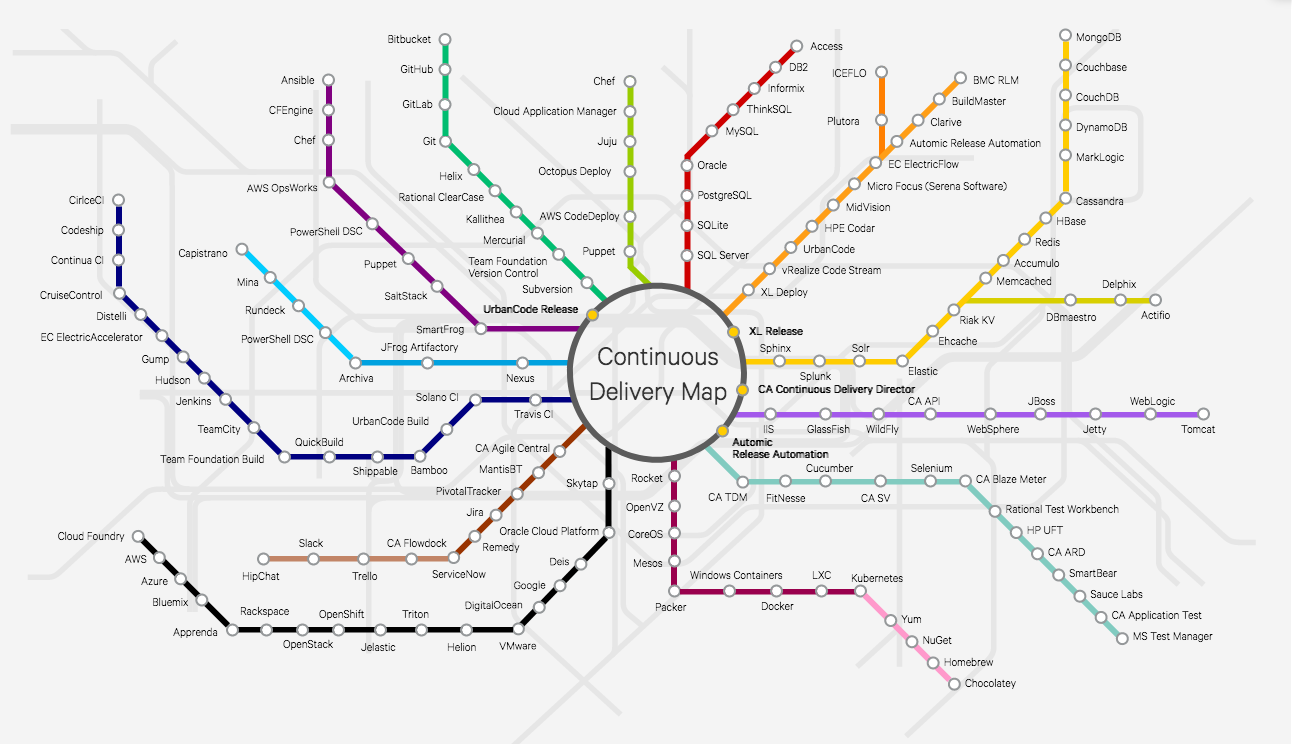
    So this week when I found out about Automic’s chart—let’s call it “The Spider” because of the way it branches out—I thought I’d let you all know that it is also out there. The cool part about The Spider, in my opinion, is the interactivity (which means I still want the XebiaLabs poster for my office). You can click on a node, get information about the tool and be presented with a link to the tools’ website—and, if they’re integrated with Automic, a link to the integration in their marketplace.

    For quick research, this is a nice chart. I wouldn’t want to have to maintain it, at the rate the market is changing, but it’s a useful starting point for “I need a tool that does X” and exploring short one or two paragraph descriptions of each of the options. It’s not complete, but it would be a full-time job to make such a chart complete and keep it up to date, and it’s pretty far along. You won’t miss any major vendors in a space by starting with The Spider.

    I clicked around and looked at the writeups for several products, and they read well. Considering that Automic is a vendor (they’re owned by CA, so kind of an über-vendor) in the space, it would not have surprised me to find they were limited or slanted in their writeups, but they weren’t. So I asked Scott Wilson, product marketing director for release automation, about that, and he told me they actually wanted to couch the details in the framing that each vendor used. Considering that Automic has a plug-in architecture that interfaces to many of these products, I suppose that makes sense. And making sense or not, it’s good for us, because we don’t have to pry apart two layers of vendor-speak to figure out how a product can help.

    If you’re trying to figure out the CD market, or a subset of that market, this is another good tool to have access to, so thought you all would be interested. The plan is to keep it up to date, so hopefully it is useful for a while moving forward.

    — Don Macvittie

  • The Right DevOps Tools for Value Stream Velocity

    The Right DevOps Tools for Value Stream Velocity

    Think of DevOps tools as stepping stones to releasing new functionality into the hands of your customers faster and more frequently. Working together, tools automate processes and help companies become modern software factories. But isolated tools, like a lone rock in the middle of a river, are much less useful.

    Disparate tools may help an individual or a team do their job, but they impede the progress of the larger organization. To achieve desired efficiency across the application life cycle, companies may waste time and amass technical debt by integrating tools with scripts.

    The other answer is that organizations get restrictive. They may establish a “center of excellence” for DevOps that prescribes a toolchain that works together, but are those tools going to be the best fit for all individuals and teams, supporting an agile mindset?

    The ideal scenario is for a DevOps toolchain to become an integrated, dynamic continuous delivery powerhouse where “best fit” tools work in concert to enable better performing teams and better customer experiences.

    Start with the Right Tools for the Job

    DevOps teams are focusing on automating and streamlining all aspects of the application life cycle. It makes sense to choose the tool that’s best for the job. And teams should feel free to experiment and take advantage of new tools emerging every day that solve new problems or do a better job solving existing problems.

    Typical areas of DevOps tool investment include:

    • Planning and managing development work
    • Managing, tracking and documenting all code changes
    • Building, managing and deploying containers
    • Automating iterative builds/continuous integration
    • Developing and deploying to cloud platforms
    • Automating the deployment of applications into environments at all stages
    • Provisioning, configuring and monitoring environments
    • Managing all types of testing with the right requirements and data
    • Validating security before vulnerabilities become a problem
    • Promoting better agile team collaboration
    • Monitoring and managing an application in production

    These tool categories each serve a vital role in the application life cycle. However, there remains a significant lack of coordination and shared knowledge across the DevOps toolchain to generate the value stream velocity that can keep businesses competitive and customers engaged. For example, if a testing function is isolated, it becomes a black hole of activity and often a bottleneck to delivery.

    Build the Smarter DevOps Toolchain

    When teams can visualize, orchestrate and track the continuous delivery value stream from development through production, the pipeline becomes an intelligent entity of its own. How is the pipeline performing? How is it adding value to the organization? How do you improve the pipeline?

    For example, by integrating the planning and management solutions as part of the value stream, you can keep track of the user stories—including where they are deployed, what tests have been done and the results. Bi-directional integration enables automatic updates in the planning/management tool. Layer in collaboration tool integrations, and dev teams can get instant feedback and respond more quickly, shifting quality left.

    The result: real-time information and the ability to plan and prioritize more effectively. Release and development teams now have a shared view and understanding of release status and business implications.

    The testing function is another area where tools can work better together. Instead of sequential and separate functional, integrated, performance, API or security testing, you can build a testing workflow that runs in parallel, automatically promotes tasks, monitors progress and sends feedback of testing status. This can include orchestrating the generation of the right test cases, test data and virtual services for the app under test. With all the testing knowledge gathered in one place, it’s easy to see testing gaps and determine the risk of a release.

    Launch DevOps Mission Control

    A control center that manages the continuous delivery value stream can help teams not only manage the health and schedule of an active release more effectively, but it can also provide the visibility and analytics to help teams iteratively improve.

    There are a number of tools on the market that look beyond the silos of the application life cycle to connect and extract value from an end-to-end toolchain. As you assess tools that can enable a dynamic value stream, ensure they have capability in these five areas:

    1. Plug and play integrations: Does the tool support common DevOps plug-ins? How easy is it to integrate tools, whether they are open source, commercial or home grown?
    2. Full pipeline visibility: Does it enable orchestration and tracking of all releases at all stages—planning, development, test and production—including feedback loops and planning for the next release?
    3. Continuous quality: Does it support a shift-left testing model to ensure testing happens continuously and rigorously? Does it help you prioritize your testing and automate risk assessment for your releases?
    4. Business value alignment: Does it provide intelligence about the app content in the pipeline? Can you see what code is deployed where in the pipeline and its status? Can you map how the content of a release aligns to business priorities?
    5. Actionable analytics: Does it extract meaningful data points from pipeline operation to provide analytics that support real-time decisions, as well as inform improvements over time? Can you get insights into release and pipeline performance, testing coverage and speed, release readiness, team productivity, and so on?

    With intelligent integration of your DevOps toolchain you can increase your value stream velocity and deliver the best quality apps—every single time.

    — Patricia Johnson

  • DevOps, Continuous Delivery – It’s All About Automation

    DevOps, Continuous Delivery – It’s All About Automation

    I spent a large portion of my career in the networking industry, marketing routers, switches and other gear that makes the internet work. Networking—like many industries—is currently undergoing a revolution that is in large part driven by software. Functions that used to be delivered as a standalone device can now run in software (not unlike the apps on your smartphone); and software is also being relied on more to make decisions about how traffic is routed through the network.

    I still read up on the networking industry occasionally, and if you’re looking for an expert opinion or just good journalism in this space, you’d be hard-pressed to find a better source than Craig Matsumoto. Craig wrote an interesting opinion piece called “NFV, SDN, Big Data – It’s All About Automation.” You don’t have to know what those acronyms mean to understand the premise.

    What’s interesting is that the same premise can be applied to many of the things that promise to make software development easier, faster and cheaper. DevOps, continuous delivery, continuous testing—all rely on automation to be successful.

    DevOps, of course, requires more than just automation—as it’s also a cultural shift—but automation plays a huge role. The three main components of successful DevOps are commonly cited as tools (or technology), process and people (or culture). Automation is the primary goal of the first two: tools that enable you to automate previously manual tasks, and then establishing the processes that allow you to take advantage of this automation.

    The same can be said of continuous delivery or continuous testing. Continuous testing relies on being able to automatically generate test cases, automatically create virtualized testing environments and create automated calls for testing.

    The premise of a modern software factory also relies on automation. Any modern factory, whether it’s producing cars or toothbrushes, strives to improve efficiencies by eliminating as many manual tasks as possible.

    The fact that software development and operations are lagging behind other industries in terms of automating the production of its goods (i.e., software) is maybe a bit ironic, given that software development is typically seen as more technologically advanced.

    However, it’s also a result of the maturity of the industry and that fact that coding, by its nature, cannot be automated. But the tasks that surround the actual writing of code certainly can be automated, and that’s what the modern software factory promises. The more you can automate, the more successful you will be in delivering quality software faster, with reduced risk and costs.

    Automation seems to bring with it concerns about employment—that is, there is a not-unfounded fear that it’s possible to automate oneself out of a job. However, there was an interesting study that came out, focusing on the automobile industry—one of the most well-known examples of factory automation. The study concluded that:

    In the last six years, (2010–2015), according to the IFR (International Federation of Robotics), US industry has installed around 135,000 new industrial robots. The principal driver is automation in the car industry. During this same period, (2010–2015), the number of employees in the automotive sector increased by 230,000.

    Essentially, automation not only improved production velocity and quality, it also resulted in a net increase in employment.

    The message is clear: Automate what you can and only rely on manual tasks for what you must. If you focus on automating your software development life cycle, not only will you be able to deliver software faster, cheaper and with better quality, but you also will be well on your way to achieving continuous delivery and DevOps.

    — Brendan Hayes

  • Atlassian Builds a DevOps Stack for the Enterprise

    Atlassian Builds a DevOps Stack for the Enterprise

    One of the major challenges associated with DevOps is that it’s not something an enterprise IT organization can buy. Because of that issue, it’s often challenging for IT organizations to forecast what types of DevOps tools they are going to need. To make it a lot easier to cope with that issue, Atlassian has announced Atlassian Stack, a suite of software that makes Atlassian DevOps tools available in a single package.

    Sean Regan, head of product marketing for Atlassian, says this approach will make it easier for enterprise IT organizations to embark on a DevOps journey without having to worry about what type of tool they may need now versus in the future. For example, an IT organization may opt to get started using the Atlassian Jira software to track software development projects and then work its way up to deploying Atlassian Bamboo continuous integration/continuous deployment (CI/CD) software. From there, Regan says, a DevOps team may opt to embrace collaboration software to streamline communications across their various teams.

    The move to launch Atlassian Stack comes after the company updated a slew of its DevOps offerings, including the release of Bitbucket Server and Data Center 5.0 and Bamboo 6.0. In addition to tightening the integration between both DevOps tools, the company added capabilities for verifying commits, smart mirroring and the ability to define a Bamboo configuration as code.

    Rather than making DevOps teams acquire each tool individually, he says, many senior IT leaders now request a means through which the entire Atlassian portfolio can be made more readily available. That shift in purchasing behavior suggests that the level of DevOps maturity inside many organizations is advancing considerably, he notes.

    Of course, there are many who would contend that level of DevOps maturity has been a long time in coming. Web-scale companies have been employing DevOps tools for years to accelerate the rate at which new applications are released and updated. In contrast, traditional enterprise IT organizations have been slow to implement DevOps processes. In fact, it’s taken the pressure arising from digital business transformation initiatives that have accelerated application deployment timetables to get enterprise IT organizations to fundamentally rethink IT operations. Business leaders are making it painfully obvious that their patience with extended rollouts for new applications is at an end.

    Naturally, the rate at which those transformations are occurring within organizations will still vary considerably. However, the silos that exist within enterprise IT organizations need to be consolidated. The next issue is determining to what degree altering those processes needs to come in the form of a DevOps edict from above versus letting teams come together of their own accord to meet a specific application deadline. Whatever the approach, the way enterprise IT has been managed historically is no longer up to the digital business transformation tasks at hand.

    — Mike Vizard

  • 3 Key Uses of a DevOps Toolchain

    3 Key Uses of a DevOps Toolchain

    DevOps toolchain infographicThe ultimate goal of DevOps is to streamline development. DevOps doesn’t necessarily require tools and is not defined by its tools, but for most organizations, they play an integral role in automating tasks and ensuring processes run as efficiently as possible. When used together, a combination of DevOps tools form a DevOps toolchain, which enables teams to flow smoothly through the DevOps life cycle.

    While the integration of DevOps is by no means ubiquitous, we’re witnessing its growing presence in the mainstream IT world. A plethora of tools and systems has emerged to facilitate continuous build, test, release and deploy, but constructing an effective DevOps toolchain to run efficiently can be a tricky undertaking. It often requires a good deal of experimentation and continuous refinement to ensure that critical processes and hand-offs are effectively automated.

    While the specific tools and systems you utilize will depend on your organization’s unique needs, it’s helpful to keep three key uses of a DevOps toolchain in mind to guide your planning and organization. Let’s take a closer look at the primary ways that an organization can benefit from a DevOps toolchain.

    1. Resolve Product Defects. The first use for a DevOps toolchain is to help resolve individual product defects more efficiently. Automation enables you to generate dependable, targeted alerts to your team about major IT incidents. This can not only improve the speed with which you resolve issues, but also help to proactively sidestep potential problems from escalating and damaging your customer experience.

    2. Refine Incident Management. The second way to use your toolchain is to further refine your management of major incidents and to facilitate the rapid and automatic progression from pinpointing critical events to escalating targeted communications to the right team members and following through until the issues have been resolved. It’s especially important that communications are delivered only to the appropriate team members—mass notifications, particularly to teams of hundreds or thousands of personnel, are ineffective and don’t do anything to combat alert fatigue.

    3. Innovate Faster. Finally, remember that your toolchain is meant to help you innovate faster by driving continuous build, test, release and deploy. Combining monitoring, diagnostics and continuous testing can help your organization ensure rapid delivery and follow best practices for agile development. Decentralized version control, for instance, is used by 85 percent of software organizations because it can help streamline the development process tremendously.

    Which tools are best for you, and which combination of tools will work best for your DevOps toolchain, is a subjective exercise. Regardless of the tools you use, though, it’s clear that there are benefits for organizations that put together an effective DevOps toolchain that can help streamline and optimize the life cycle from beginning to end.

    — Tony Bradley

  • Digital Business: Paving the Way for DevOps’ Second Act

    Digital Business: Paving the Way for DevOps’ Second Act

    DevOps is the buzzword of the moment. It’s at the heart of every strategy—not just CIOs’ IT transformation strategies but also IT vendors’ sales and marketing strategies. The question business unit leaders always ask is, “Is DevOps to improve IT or to boost the business?”

    The disconnect is so big between the concerns of today’s DevOps practitioners and business unit expectations on one side and digital competitive challenges on the other that the question is worth asking. Indeed, the proliferation of tech startups and digital services is making competition tougher and forcing business unit leaders to adopt innovation, velocity and timely revenue as their top competitive advantages, helping them to survive their industry disruption and then boost their digital growth.

    Let’s say it straight: The many DevOps and even cloud migration projects out there aren’t likely to help business units effectively address the digital economy’s challenges. Automating your application deployment processes with infrastructure as code and continuous delivery infrastructure on their own will never make your company an innovation champion or equip it with the fastest time-to-value in the world. That erroneous belief is nurtured within the IT community; it’s the tangible proof that IT still doesn’t understand the business. Period.

    Joe McKendrick, in his fantastic, “The Elusive Mystique of the Digital Enterprise,” and, “Cloud Computing’s Second Act is All Business,” offers insights likely to help business unit leaders remind their CIOs the business reality, “What matters is revenue.” IT innovation for the sake of innovation doesn’t make sense. And Adam Jacob, co-founder and CTO of IT automation company Chef, in a fantastic article, “The Secret of DevOps: It’s Always Been About People, Not Technology,” gives a DevOps vision that’s totally in line with business unit expectations more importantly to more effectively address digital competitive challenges.

    Adam Jacob’s System of Thought: The Foundations of DevOps’ Second Act

    Adam Jacob defines DevOps as:

    Fundamentally being about taking the behaviors and beliefs that draw us together as people, combining them with a deep understanding of our customers’ needs, and using that knowledge to ship better products to our customers.

    He adds:

    Notice that I don’t mention technology, which may be surprising coming from the CTO of a DevOps-focused company.

    He concludes:

    Tools matter. But tools exist in service of the prime directive: building highly functioning, highly effective cross-functional teams, that attack your thorniest business problems as a unit, rather than as lone individuals or silos with competing incentives.

    This perspective of DevOps unveils an authentic business thinking for IT that I turned into a digital business approach:

    adam-jacob-thought-v2

    It’s represented through the above virtuous circle of principles structured around customer:

    Customer is the source of digital wealth: This expresses the proven belief that being customer-focused increases service quality, keeps customers loyal and, in turn, increases his value of the money they spend to buy services. It prevents customer churn caused by changing consumption habits, whereby digital services are increasingly preferred to traditional services.

    People make, create and innovate: This principle translates the proven idea that giving staff skills, resources, authority, opportunity, motivation, and holding them responsible and accountable for outcomes of their actions, will contribute to their qualification and satisfaction and ultimately make them committed to the organization’s wealth. It creates work environments and work styles conducive to innovation.

    Behaviors and beliefs strengthen involvement and commitment: This principle highlights the demonstrated notion that sharing common beliefs, principles and values creates team spirit, which increases cross-functional collaboration and, in turn, accelerates problem-solving and decision-making. It contributes to the business agility.

    Product is the digital wealth driver:  It’s the now-acknowledged idea that to succeed in the rising digital economy, businesses must align their application delivery approach to the new product development (NPD) principles. Applications take value to customers. It helps to keep up with the fast-paced digital business environment.

    Velocity makes the business responsive to market opportunities: It’s the widely adopted notion that time-to-value is the essential revenue driver that will make businesses digitally wealthy. That principle is enabled by the continuous delivery infrastructure which automates—therefore accelerates—the application delivery processes chain.

    This unprecedented vision, dominant on the business side, contrasts with the technocentric approach promoted by the vast majority of IT vendors to increase their sales.

    Being honest to customers is telling them this: Implementing continuous delivery infrastructure is not implementing DevOps. It will never, on its own, make the business digitally competitive.

    I have no doubt that you’re convinced Adam Jacob, Joe McKendrick and even Ernest Mueller, author of “DevOps: It’s Not Chef and Puppet” are definitely right. The question you might be asking now, which may be provocative is, “Okay, that’s good! How do you implement all that?”

    Implementing DevOps’ Second Act Foundations into a Digital Business Capability

    The first step toward implementing DevOps is to admit that a new IT paradigm is needed, Adam articulates it that way:

    Leaders need to realize that implementing DevOps means changing the technology system as well as the cultural system. They must acknowledge that both are intertwined and, to be successful, both systems must evolve to drive velocity.

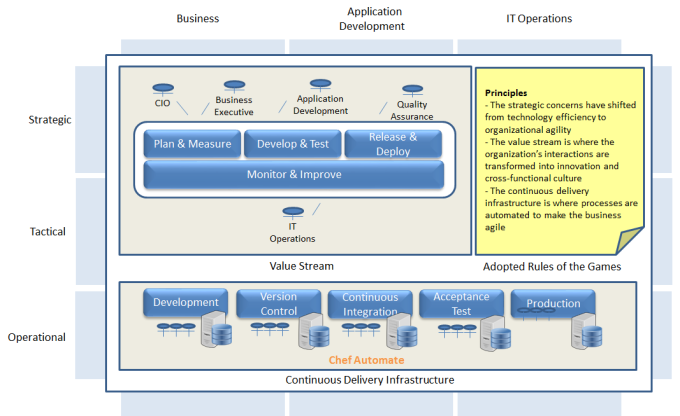
    It’s not different from the two-dimension IT advocated in my recent book, “Rethink Your IT with DevOps: The Complete Guide to Aligning Your IT to DevOps” and  in my online contents, “Become Digitally Savvy in Just Hours. Boost Your Digital Revenue Now“:
    two-dimension-it

    DevOps implementation is based on four principles that determines successful business transformation:

    Concerns have shifted from technology efficiency to business agility: Forget the outdated idea that IT tools on their own can help your business units succeed. What will make them digitally successful is the combination of technology efficiency and organizational flexibility and agility.

    See IT as a two-dimension asset: To win legitimacy among business units, offer a two-dimension vision of IT including the value stream and the continuous delivery infrastructure. Value stream is where value is created and the continuous delivery infrastructure is what enables business agility.

    The value stream is where the innovation and agility cultures are built: Transform your business organizational structure into an agile value stream through deploying agile practices and methodologies such as Scrum, Kanban and Exteme programming.

    The CD infrastructure is where fast time-to-value is enabled: Automate your applications delivery processes into an accelerated applications delivery chain using automation and continuous delivery tools such as Chef Automation, AWS CodePipeline and Apprenda.

    Summing It Up

    Experienced DevOps Strategists know that DevOps is the means to an end, and not the end itself. DevOps is an enabler to one or a combination of these business competitive advantages: short time-to-value, market responsiveness, innovation culture and many more.

    All the noise surrounding the so-called DevOps tools has to do with technology business—making money through selling IT tools—and absolutely not DevOps.

    DevOps isn’t a tool, it’s an IT approach stressing business competitiveness: shorter time-to-value, market responsiveness and innovation.

    — Philippe Abdoulaye