Tag: DevOps networking

  • NetOps vs. DevOps: New Data is Enlightening

    NetOps vs. DevOps: New Data is Enlightening

    Traditionally, we have seen development—and, by extension, DevOps—as having a less-than-cordial relationship with network operations (NetOps). Since the goals of the two groups are sometimes at cross purposes—DevOps wants access to make everything run automated, and NetOps wants to control a production environment so that it is stable—we’ve naturally talked in those terms.

    I’m a developer who learned other skills, including operations, along the way. I can manage to get things done on F5 Networks or Cisco Systems gear, but I’ve sat with true experts while they worked their magic and have a lot of respect for the NetOps crowd. So this topic has always been of interest to me.

    Now, according to a recent survey conducted by F5 Networks, we can see that the animosity we have all been lead to believe is there really isn’t. There is also a press release here, and surprisingly, it offers more information from the survey than the blog does.

    There is a ton of interesting data about rate of automation, views of other teams and deployments in the survey results, making it well worth a read-through.

    While DevOps and NetOps remain at odds regarding how much pipeline access should be available via self-service and automation, for the most part both groups view the other as on the right track. Eighty-two percent of DevOps and 76 percent of NetOps agree that each other prioritizes “the right things.” Clearly, there is common ground across the digital divide in at least goals and focus, if not always in the organizational chart.

    This, to me, says that DevOps is having the proper impact on the organization. That what’s important is getting prioritized on both sides of the pipeline. Or it says that this was always the case, and DevOps has had little impact. Historical surveys, however, seem to indicate that there was not always this level of belief between the two groups.

    Interestingly enough, there has been a lot written about whether your DevOps methodology should be operations- or development-driven, but networking has always been a bit off to the side. Not the type of operations that historically is discussed in DevOps; it sat with teams such as Security and QA working with DevOps but not generally a part of the DevOps teams.

    The results here would indicate that network automation is occurring at a healthy clip (makes a guy want to look at vendor APIs again, and see what’s changed to enable this fact), and if the majority of DevOps people are saying the NetOps team is focused on what’s important, likely the integration into DevOps is further along than pundits have portrayed.

    Though the results indicate that many DevOps teams want more access and control of network operations than they have, this is likely the natural outgrowth of the different views these teams have always had. Network operations’ goal is rock-solid infrastructure. DevOps’ goal is speedy delivery. These two things can be at odds relatively easily.

    I’m hoping that F5 offers us more access to data than a blog and a press release, but honestly what is in those two is enough to get you pondering about the state of NetDevOps (or whatever we’re calling it this week) versus the perception.

    Disclaimer: I am a former F5 employee, and have a positive view of the company and its products. My wife is also F5’s Principal Technical Evangelist, and had a hand in this survey. While this doesn’t impact writing about survey results, you’ve been informed.

    — Don Macvittie

  • appOrbit: End-to-End Hypercloud

    appOrbit: End-to-End Hypercloud

    As cloud and DevOps have heated up, enterprise need for cloud portability and deeper DevOps integration have become pretty clear. The need for portability to avoid cloud lock-in has been a desire of enterprise cloud users from day one. A variety of people are attempting to address this need, but the market is still very much evolving.

    In the area of DevOps integration, the two topics currently causing struggles are security and networking. Continuous deployment inevitably requires both to be part of the DevOps package, and those are the newest additions to the field, so it is still maturing.

    Enter appOrbit

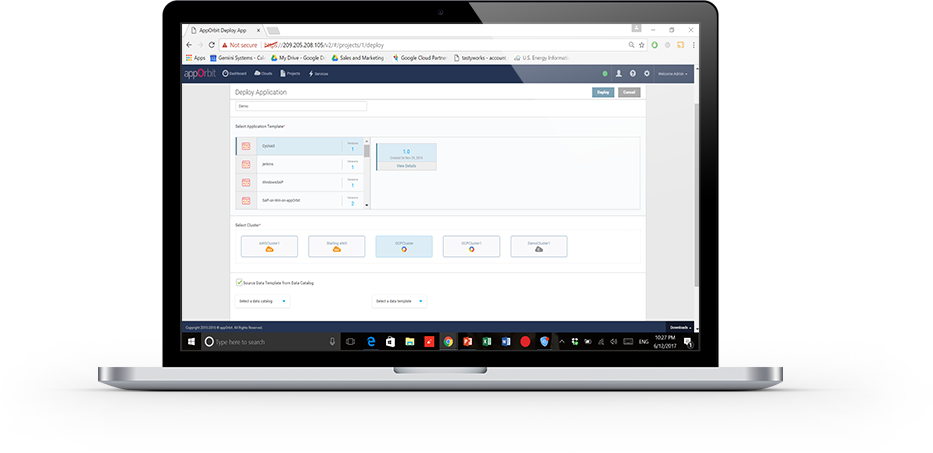
    appOrbit recently came out of stealth mode with an overarching architecture to enable hypercloud and extend the DevOps process across the entirety of the dev/test/deploy ecosystem. The idea is to offer a platform that doesn’t care what languages or deployment tools you use, or even what databases you’ve tossed data into, and covers the process from first line of code to management and monitoring post-deployment.

    That’s a big claim, so I got on the phone with appOrbit to poke around a bit. Better would be to take the time and use the toolset, but I’ll settle for our questions about the traditional weak spaces in the process, and about how they achieve some of the company’s claims. For now.

    My first impression was that this was application release automation/application release management (ARA/ARM), and Rahul Ravulur, CEO of appOrbit told me I wasn’t far off; I just wasn’t thinking big enough. A large part of the process is ARA, but additionally, appOrbit worries about networking, security policy and long-term monitoring and management, all while offering deployment portability.

    Finally, the End Game is in Sight

    From the beginnings of the Ops side of the DevOps movement (what I like to call devOPS), the end goal was pretty obvious: to improve the entirety of the process. It was clearly going to take time—good network engineers are wizards that can make a network do astounding things—and we had to figure out how to make that more repeatable. On the DEVops side, repeatable was relatively painless: We already did a predefined sequence of steps over and over; the point was to break them into smaller iterations and automate what was ripe for automation. Much of Ops was the same, but networking and security had many more variables to take into account, and less history of “here’s a prescribed sequence, do it.”

    If appOrbit can do as it claims—and its customer list includes some customers I’ve worked with that probably wouldn’t be there if the product was vaporware—then we’re seeing the culmination start. The culmination will include limitless portability, sort of a “we don’t care where you deploy, just tell us and we’ll do it”; it will include development tool agnosticism—“We don’t care what tools you used, we’ll deploy it”; and it will include complete solutions—“We’ll move your data, we’ll move your app, we’ll configure the target network, we’ll run the security checks relevant to the target platform.” It sounds like appOrbit has traveled quite far down that path already.

    What, Exactly, Did You Intend?

    One interesting bit appOrbit talked to me about and I’d like to take out for a spin is the idea of adding “intents” to security and networking. Tell it what you’re after, and through a combination of built-in functionality and plug-ins it will deploy your application as you intended. For things like opening a port, this seems pretty straightforward, but security and networking are complex topics. What is/isn’t covered by security policies/intents? What if my intent is for the system to create a VPN, lock down all the ports, then open just a few and connect the VPN back into the data center over an encrypted port? Who manages certs? Where does it get the credentials to get back into the data center? What happens if I take this whole VPN-based deployment and decide to put it inside the data center after all? Do I have to rework the networking intents to remove the VPN? The questions are endless.

    But assume this is the beginning of a road that truly can end up with “deploy anywhere, and deploy as you intended.” That’s what we’ve been waiting for, and it’s inevitable, so I for one am glad to see us set off meaningfully down the path.

    Improvement Makes Movement

    The mere act of someone talking about having pulled all this together will be good for customers. Ravulur’s stress that “a lot of what we do is ARA” will no doubt make ARA vendors step up their attempts to be as inclusive as appOrbit is, and the market will move forward. appOrbit’s use case of “legacy app migration” without changing the app alone offers an avenue for enterprises to begin to move to new platforms. That in and of itself will be a help to the huge number of enterprises that want to move to a more modern environment but aren’t ready or able to rewrite entire systems. And again, it will spur on competitors—in this case in the application provisioning space, most likely—to try and implement similar functionality in a relatively short time frame.

    Beyond Hope

    In a nutshell, I hope that appOrbit can do all that it claims, but even if it falls short in some areas (I honestly have only touched on a few of the areas it has pulled together; there’s a lot here), it is a step forward, and I think the company will drive the market more toward the end goal of application portability from both the Dev and deployment sides, while automating a more complete solution.

    To me, that’s all good. Not everyone is pure cloud, and a far fewer number want to be pure public cloud brand X. The automation tools I’ve been knee-deep in all have been massively complex under the covers, and no doubt this one is, too; simplifying automation so it is easy to adapt to a given environment is a huge part of the task these tools perform. Figuring out the weaknesses is what we customers have to do, but in the end, we’re moving forward.

    I, for one, will look for a chance to play with appOrbit’s toys, validate some of its claims, and see how well it suits enterprise needs. But I don’t have a timeline, so if you’re interested, you should check them out yourself.

    — Don Macvittie