Tag: devops institute

  • NTUC LearningHub And DevOps Institute Collaborate to Meet the Growing Need for DevOps Professionals Through Certified DevOps Training

    NTUC LearningHub and the DevOps Institute collaborate to offer four globally recognised DevOps training and certification programmes

    SINGAPORE – Media OutReach – 14 March 2019 – NTUC LearningHub and the DevOps Institute have announced their collaboration to accelerate digital transformation within companies through the skills training and adoption of DevOps — an innovative approach and set of processes that brings development and operations teams together to complete software development. The partnership was announced today at the DevOps Institute APAC Roadshow in Singapore themed “Moving ahead in the Digital Era with DevOps”, which was organised in partnership with the Employment and Employability Institute (e2i) as a supporting and outreach partner.

    Industries today are being disrupted. New software-driven products and experiences are creating an immense wave of change across sectors — from transport (Grab, Gojek) to retail (Amazon) to cable TV and movies (Netflix) to music (Apple, Spotify) and hospitality (Airbnb). Companies need to create new business models — and this depends on their ability to build and deliver software rapidly, reliably, and repeatedly.

    In utilising the DevOps approach, which is rapidly gaining popularity worldwide and in Singapore, organisations can create and improve products at a faster pace than they can with traditional software approaches. The increasing demand for DevOps professionals is most notable amongst employers such as ST Electronics, Singapore Airlines, GovTech Singapore, KPMG, DBS, and Infosys.

    Recognising the growing worldwide interest and adoption of DevOps, NTUC LearningHub is excited to partner the DevOps Institute to offer globally recognised DevOps training and certification to our learners. A total of four courses will be launched, with the first — DevOps Foundation — already mapped to the Infocomm Technology (ICT) Skills Framework and scheduled to launch in April this year. The course will be funded by SkillsFuture Singapore, and NTUC LearningHub is the first training provider in Singapore to offer DevOps courses that are eligible for SkillsFuture funding. The other three courses — Certified Agile Service Manager (CASM), DevOps Leader (DOL), and DevSecOps Engineering (DSOE) — will be launched later in May this year. e2i will partner NTUC LearningHub and DevOps Institute to introduce the programme and reach out to more Singaporeans and companies to acquire DevOps capabilities. Together, the target is to train and certify 120 professionals in the DevOps Foundation programme and 60 professionals in each of the other three programmes annually.

    “At NTUC LearningHub, we are always on the lookout for the latest industry solutions to improve the skillsets and employability of our Singaporean workforce,” said Mr. Kwek Kok Kwong, Chief Executive Officer of NTUC LearningHub. “With the rising popularity of the DevOps approach and the growing demand for DevOps expertise by industries, we are excited to partner with the DevOps Institute and leverage their DevOps Certification Model to equip our local workforce with expertise in this field. Our partnership with the DevOps Institute will expand our growing repertoire of best-in-class partners and make this emerging skill more accessible and affordable to our local workforce.”

    “DevOps Institute is proud to partner with NTUC LearningHub, which has been instrumental in Continuing Education of Professionals across Singapore over many years,” said Mr. Dheeraj Nayal, Region Head — APJ & Global Community Ambassador of DevOps Institute. “Considering that DevOps Institute’s core objective has been to propagate and deliver Continuous Learning for Professionals in the DevOps & Agile domain, this partnership complements and enhances the value of NTUC LearningHub, and creates a great opportunity for learners to advance their skills for the future. We are really delighted to announce our partnership and welcome NTUC LearningHub as our Strategic Registered Education Partner in Singapore.”

    Ms. Jayne Groll, Chief Executive Officer of DevOps Institute said, “DevOps Institute is committed to advancing the careers of the people who will make DevOps a reality for their organizations through our unique skills-based certification model.  We are excited to partner with NTUC LearningHub and support their efforts in equipping the Singapore workforce with the skills, knowledge, ideas, and learning (SKIL) that is necessary for the digital age. We welcome them as a Strategic Registered Education Partner in Singapore and look forward to working closely with them.”

    “As Singapore steers toward Services 4.0, e2i continues to work with partners, bringing better ways of working to our workforce. In a typical IT environment, Developers and Operations often work in silos causing delays. DevOps is a more holistic approach for an end-to-end software delivery lifecycle, where operations and development engineers work together to improve collaboration among all stakeholders. With DevOps capabilities, our workers and businesses can work faster and more effectively, which will help maintain their competitive edge,” said Mr. Gilbert Tan, CEO of e2i.

    About NTUC Learning Hub (LHUB™)

    NTUC LearningHub was corporatised in 2004 with the vision of transforming the lifelong employability of working people. We work with both corporate and individual clients and provide learning solutions in areas such as Infocomm Technology, Soft Skills & Literacy, Workplace Safety & Health, Security, Human Resources, and Leadership and Service Excellence.

    To date, LHUB™ has helped over 16,700 organisations and achieved over 2 million training places across 600 courses with a pool of 1,300 certified trainers. As a Total Learning Solutions provider to organisations, we also forge partnerships and provide a wide range of relevant end-to-end training solutions and work constantly to improve our training quality and delivery.

    Visit www.ntuclearninghub.com for more information.

    About DevOps Institute, USA

    The DevOps Institute (DOI) is a global, open continuous learning community dedicated to advancing the human elements of DevOps success.

    DevOps Institute helps advance the careers and emerging practices of the DevOps community based on a new human-centered framework consisting of skills, knowledge, ideas, and learning (SKIL).  All our work, including accreditation, research, events, and continuous learning programs — is focused on providing the “know-how” to make DevOps succeed.

    Visit https://devopsinstitute.com/ for more information.

    About Employment and Employability Institute (e2i)

    e2i (Employment and Employability Institute) is the empowering network for individuals and companies seeking skills and solutions for growth. Since 2008, e2i has assisted more than 600,000 individuals through our career guidance, professional development, and job matching services. With an extensive network of partners, e2i offers hiring, training and productivity solutions to businesses. We are an initiative of the National Trades Union Congress (NTUC) to support nation-wide manpower and skills upgrading initiatives.

    See more at: https://e2i.com.sg/about-e2i/corporate-information/ | Employment and Employability Institute, e2i

  • Got DevOps Skills? A Look at the Upskilling: Enterprise DevOps Skills Report

    Got DevOps Skills? A Look at the Upskilling: Enterprise DevOps Skills Report

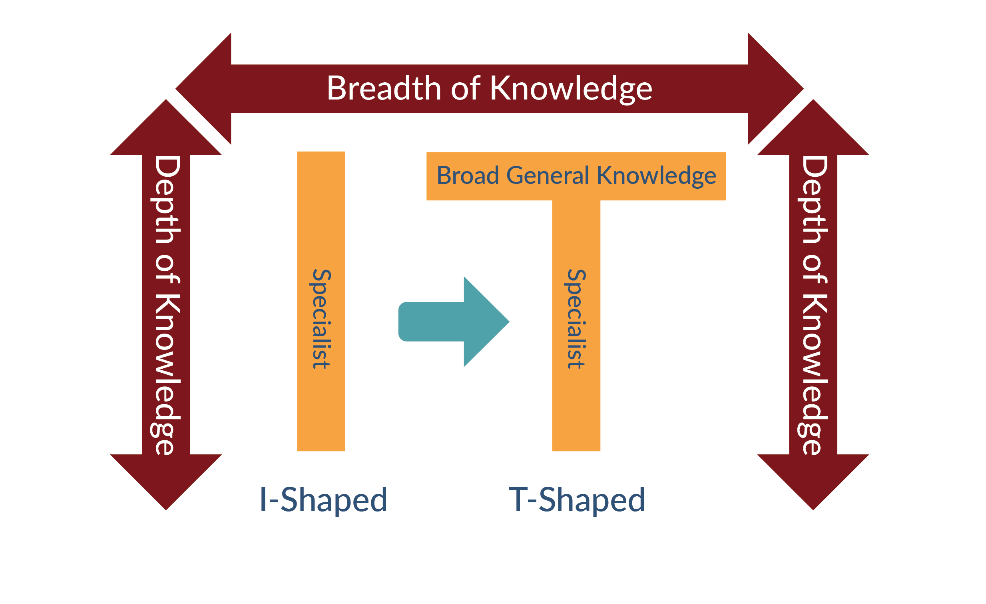
    IT recruiting is at an all-time high and organizations want T-shaped professionals with cross-functional skill sets to join their teams. While “T” represents an individual’s core competency, and the top of the T represents a broad range of related knowledge, there has been little clarity on which skills are the most important across a wide spectrum of possibilities—until now.

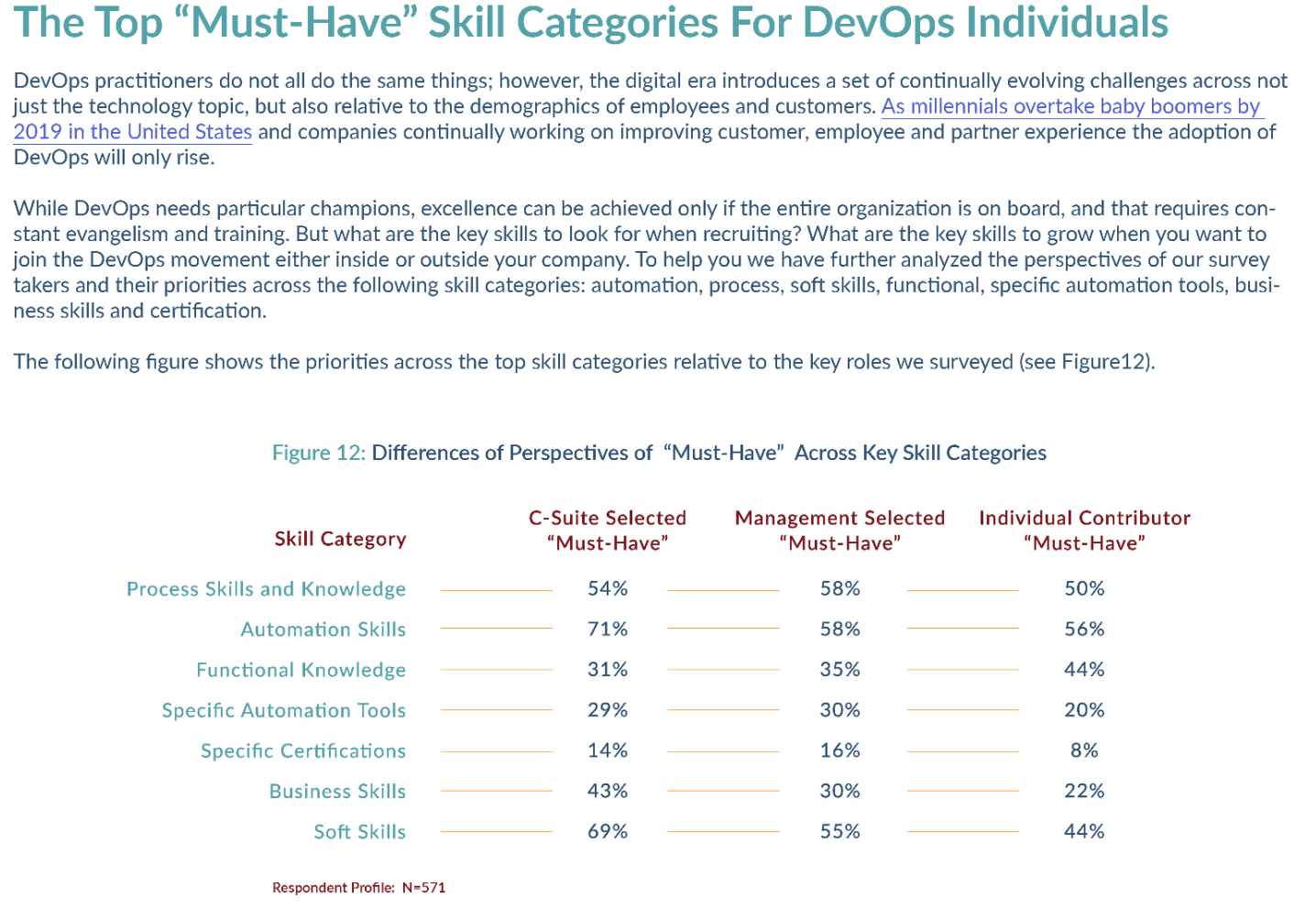
    DevOps Institute launched the Upskilling: Enterprise DevOps Skills survey in 2018 to focus on the human element of skilling. The feedback from more than 1,600 individual responses echoed the notion that regardless of vertical, organizational size, geography or role, DevOps practitioners need data-backed skilling statistics. As the focus within the enterprise, DevOps community shifts from “What is DevOps?” to “How do we do DevOps,” this demand is more crucial than ever. After all, “how to” requires “know-how” and “know how” requires a new set of skills. But which skills?

    According to DevOps Institute’s Upskilling: Enterprise DevOps Skills Report:

    • Soft skills and technical skills are equally important
    • IT operations knowledge received the most “must-have” votes as a functional skill in DevOps
    • Cloud and analytical knowledge are the top technical skills
    • DevOps Engineer emerged as the most popular job title (see below for figure N=812)
    N=812

    The report was developed in partnership with veteran research analyst Eveline Oehrlich, formerly of Forrester Research. This comprehensive data provides indications of which functional, process, technical and automation skills are “must-have,” “nice to have” and “not important.”

    This is particularly significant for IT professionals who are confused about where to focus their personal skills transformations in their journey toward the “T.”

    Should developers work on upskilling their testing, automation, process and/or security skills? Should operations professionals learn to code, test or explore more about machine learning and AI? What about project management and systems administration? The Upskilling: Enterprise DevOps Skills Report can be used as a snapshot of critical enterprise skills that are important to successful digital transformation.

    The Upskilling: Enterprise DevOps Skills Report was released March 4 and is now available for download. On behalf of Platinum Sponsor Electric Cloud, Gold Sponsor CloudBees and Silver Sponsor Lenovo, industry influencers and international DevOps community, we hope this data will help shrink the skills gap and support the transformational goals of both individuals and organizations. We’re already looking forward to the launch of DevOps Institute’s Upskilling: Enterprise DevOps Skills Survey 2020 to continue meeting the demand for ever-evolving skilling trends in the DevOps community—stay tuned!

    — Jayne Groll

  • Upskilling: The Enterprise DevOps Skills Survey and Report

    Upskilling: The Enterprise DevOps Skills Survey and Report

    There has been a lot of recent reference to “T-shaped” IT professionals—individuals whose core competence (the stem) is supplemented by a broad range of other knowledge including soft skills (top of the T). T-shaped talent is in such high demand with a limited supply that recruitment efforts have become very competitive for those with upskilled and cross-skilled transformational know-how.

    Unfortunately, the migration from a deeply skilled specialist to a T-shaped practitioner is leaving many confused about what skills they should be acquiring and hiring and when. That’s why DevOps Institute (DOI) recently launched the 2019 “Upskilling: Enterprise DevOps Skills Report” community survey to help individuals and enterprises better understand the current and future state of DevOps skilling across the global IT community. Using data science coupled with hiring manager interviews, DOI’s goal in fielding the report is to provide tangible insight into why and where IT practitioners, managers, leaders and business stakeholders should focus their efforts in growing personal and organizational skills portfolios.

    Eveline Oehrlich, a former vice president and research analyst at Forrester, is bringing her data science expertise as the lead analyst for the report. Founding Platinum sponsor Electric Cloud and founding Gold sponsor Cloudbees are also sponsoring this important project. The “Upskilling: Enterprise DevOps Skills Report” will be a year over year project, and the results will be published in Q1 2019.

    The global survey will remain open until Dec. 7 and can be accessed through the following link: https://www.research.net/r/K9WD2XC

    We encourage everyone in the DevOps community to complete the survey so that the data samples truly reflect the global state of DevOps skills.  Any organization that has at least 20 people complete the survey will get a personal snapshot of the data results. All respondents who complete the survey will be entered into a drawing for four $100 Amazon gift cards.

    — Jayne Groll

  • The DevOps Institute Fields The ‘2019 Upskilling: Enterprise DevOps Skills Report’ Survey

    First of its kind survey to baseline and track DevOps skillsets across the global enterprise IT community met with broad industry support

    BOCA RATON, FLA. October 22, 2018 – The DevOps Institute (DOI), the Association for DevOps Professionals, today announced the launch of the “2019 Upskilling: Enterprise DevOps Skills Report” community survey in collaboration with founding Platinum sponsor Electric Cloud and founding Gold sponsor CloudBees. The survey and resulting report are designed to help companies better understand both the current and future state of DevOps skilling and cross-skilling across the global IT community. Using data science coupled with qualitative analysis, DOI’s goal in fielding the report is to provide tangible insight into why and where IT practitioners, managers, leaders and business stakeholders should focus their efforts in growing personal and organizational skills portfolios. Eveline Oehrlich, former Vice President and Research Director at Forrester, will bring her data science expertise as the lead research analyst for the report.

    To participate in the “2019 Upskilling: Enterprise DevOps Skills Report” survey, please visit: (https://www.research.net/r/K9WD2XC).   

    The “2019 Upskilling: Enterprise DevOps Skills Report” survey is active through December 7, 2018, and the corresponding report will be published in early 2019. In addition to contributing to the global DevOps community, any organization that has at least 20 survey respondents will receive a snapshot of their skills profile when the report is published. DOI is excited to validate DevOps skilling and cross-skilling needs across the global IT community, but also support individual organizations and understand where they are today and where they need to go tomorrow.

    “’T’ is the shape of transformation and digital transformation requires cross-functional skills at all levels of the IT organization,” said Jayne Groll, CEO of DevOps Institute. “However, the migration from a deeply skilled specialist to a cross-functional T-shaped practitioner is leaving many in IT confused about what skills they should be acquiring and hiring and when. Hopefully, this research will provide some data backed clarity.”

    “The DevOps movement is at the heart of one of the biggest business transformations in history, enabling organizations to deliver innovation at an unprecedented rate,” explained Carmine Napolitano, CEO at Electric Cloud. “This transformation will never reach its potential if teams don’t have access to, or cultivate, the right types of skills. When the DevOps Institute approached us to sponsor this research, which is designed to identify these skills so our industry can address those gaps, we jumped at the chance to participate. We believe this research will create a data-driven pathway to developing a new, highly skilled talent pool capable of driving instead of reacting to these market forces. This initiative continues Electric Cloud’s long history of supporting the DevOps community through its co-founding of the DevOps Enterprise Summit conference with Gene Kim and IT Revolution, and its c9d9 educational podcast series.”

    “As I speak with DevOps leaders and teams in enterprises around the world, one thing is clear: a DevOps journey is a true transformation involving process and technology. However, the most important asset is people with the right skills to meet the multi-faceted challenges of any DevOps transformation,” said Sacha Labourey, CEO and co-founder, CloudBees. “These skills are not necessarily the skills that ensured success just five to ten years ago. We are keen to collaborate with DOI on this research effort to uncover the nuanced skill sets organizations require to lead their most important strategic innovation and growth initiatives. As a leader in the DevOps industry and Jenkins community, we look forward to supporting this survey and helping enterprises become best-in-class in delivering business value through software.”

    About the DevOps Institute
    The DevOps Institute (DOI) is the Association for DevOps Professionals that encourages continuous learning as a lifestyle. Members have global access to the most innovative, inspirational and transformational DevOps networking and career growth opportunities.

    Web | https://devopsinstitute.com/
    Twitter | @DEVOPSINST
    LinkedIn | /devops-institute
    YouTube | DevOps Institute

    ###

  • DOES18: Discussing DevOps with Gary Gruver and Helen Beal

    DOES18: Discussing DevOps with Gary Gruver and Helen Beal

    It’s hard to believe that DevOps Enterprise Summit London ( DOES18 ) is right around the corner! The conference, which takes place June 25-26 at The InterContinental – O2, is guaranteed to provide two jam-packed days of learning around architecture, next-generation operations, spanning business and technology divides and much more. If you haven’t already registered, there is still time to secure your spot! Receive 20 percent off registration using the Friends of Gene Kim code (FOG20) at checkout. And, if two days of DevOps just isn’t enough, Electric Cloud is hosting post-conference workshops for a full immersion experience:

    • From New Learner to Executive Leader—Gary Gruver (Electric Cloud strategic advisor, author of “Scaling Agile” and “Leading the Transformation”) and Helen Beal (product owner at the DevOps Institute,) build up your knowledge and transformational leadership potential in this full-day, hands-on workshop geared toward business leaders.
    • You Build It, You Secure It: DevSecOps Workshop—John Willis (Electric Cloud strategic advisor, co-author of “The DevOps Handbook” and vice president of DevOps and Digital Practices at SJ Technologies) hosts this full-day, hands-on, technical workshop to help build and incrementally improve DevSecOps pipelines.

    Prior to DOES18 and upcoming workshops, we caught up with Beal and Gruver to learn a little more about their DevOps background and what attendees can expect during their workshop:

    Alan Shimel: First, for those who don’t know you, tell us a little about yourself?

    Gruver: Hi, everyone – glad to be here. In my professional career I’ve worn a lot of hats—I’ve been an engineering executive, a coach, an author. My experience in this space come from leading large-scale transformations in big organizations with complex tightly coupled systems. I think this gives me a unique perspective that is valuable to any managing large systems that aren’t in a position to just go and “re-architect everything to microservices in the next few months.”

    I started out by leading a group of 800 developers in the HP LaserJet firmware team through a transformation that delivered a 2-3X improvement in productivity. The results were so great that we decided to document the journey in my first book, “A Practical Approach to Large Scale Agile Development.” This book, coincidentally, echoed the same ideas and was finished about the same time that Jez Humble and David Farley published their book, “Continuous Delivery.”

    After that, I joined Macy’s.com as the VP of Release, QA and Operations to apply these same concepts to their very large-scale journey to CD. It helped that Jez worked down the street and we could share ideas back and forth over beers. During this period, the term “DevOps” started getting real traction, and I realized I was one of few people actually helping to roll out those practices in large, complex organizations. At the end of that experience, I published my second book, “Leading the Transformation,” where I documented everything I wish I had known to help others avoid the same mistakes I had made.

    After my experience at Macy’s, I began coaching executives in other large organizations in order to help them transform their own software development and delivery processes. Each one of these engagements was unique, with very different challenges—although I could definitely see commonalities among them. I compiled that knowledge into my third book, “Starting and Scaling DevOps in the Enterprise,” where I lay out the approach I use in working with these organizations.

    Beal: Hi, I’m Helen and I describe myself as a “DevOpsologist”—that is, I study DevOps. I coach, train, write and talk about all aspects of DevOps and help organizations use DevOps principles to deliver value outcomes faster, better and more reliably. I do this at Ranger4 through assessing capabilities, developing improvement roadmaps and then implementing those road maps through workshops, training and facilitating value stream-mapping exercises and games like The Phoenix Project Game. I’ve been working in the software industry for nearly 25 years and have spent most of them specifically focused on helping organizations make improvements in the software delivery life cycle. I also work with the DevOps Institute on content improvement and creation and am a DevOps editor at InfoQ.

    Shimel: How did you “get into” DevOps? Why is it so important to you?

    Gruver: I didn’t get into DevOps to “do DevOps,” because the term hadn’t yet been invented. Instead, I applied the concepts of what later became known as deployment pipelines to my particular situation because they were the process improvements we found had the biggest impact on our efficiency. The group I managed (at HP) was just starting a complete re-architecture of a 10M line code base when the economy crashed (2008), resulting in me being told I had 30 days to come up with a plan to drop my R&D spending by 50 percent but I still had to deliver the new architecture on time. This transformation was critical to the health of the business, so I took it as a personal mission to get this done so we could maintain staffing levels and keep the jobs of all my friends and co-workers.

    Every day I came in and got to work with an amazing group of people that were focused on doing everything possible to help the company survive by improving the efficiency of our software delivery process. We ended up implementing a lot of changes that were later called “DevOps.”

    It was such a huge breakthrough for the business that I have spent the next decade of my life trying to help others realize the benefits of these process improvements. And over time I have focused more on DevOps because I think it best represents the process changes that provide the biggest benefits for large organizations.

    Beal: Working on the whole software delivery life cycle led to four years closely focused on deployment automation just as DevOps was becoming a “thing.” At Ranger4 we decided to build our business around helping organizations understand how to use DevOps principles and practices to make improvements. At Ranger4 we like to say we are fanatical about making life on earth fantastic and that’s the core of why it’s so important to me—we are trying to take pain away from the work people are doing and make them more successful and their organizations more successful.

    Shimel: Tell us about your workshop. Who comes to your workshops? What will people coming to your workshop learn?

    Gruver: My workshop is a combination of the “Leading the Transformation” and “Starting and Scaling DevOps in the Enterprise” books. We start helping executives understand their roles in leading a successful transformation and provide a framework for that effort. Next, we deep dive on DevOps, helping executives understand how implementing DevOps in large, tightly coupled organizations can and needs to be different from what you hear about being recommended by the unicorns with loosely coupled architectures. The workshop also shows the executives how to analyze their current deployment pipelines to identify the biggest sources of waste because I strongly believe if you don’t start delivering real business benefits early your transformation will start losing momentum.

    This workshop gives people the opportunity to integrate everything they learned at DOES and put it together with an approach they can take back to their organization and start making changes that will improve the effectiveness of their software development and delivery processes.

    Beal: My workshop is the DevOps Institute’s “DevOps Essentials,” so kind of what it says on the tin: the fundamentals of DevOps in half a day. So we’ll be covering things like where DevOps has come from, why people are doing it and what they are actually doing; the Three Ways; CALMS; changing culture; the relationship between Agile, Lean and ITSM; and building DevOps toolchains. People that come to my workshop will leave with a solid understand of the core practices and principles and DevOps vocabulary.

    Extra insights from Beal:

    Shimel: What’s the hottest topic in DevOps for you right now?

    I’ve always been particularly interested in the cultural side of DevOps and right now I am most interested in the neuroscience of behaviors.

    What did you learn this week?

    I learned this thing about pigs and chickens in agile the other day which made me laugh, and also helped make an improvement in a particular team we are working with.


    Ready to get your hands on DevOps? Register now to join Beal and Gruver June 27 at The InterContinental London – O2.

    If you’re looking for a more technical hands-on experience, register for Willis’ workshop here.

    Plus, there is still time to register and save for DOES18! Gene Kim is giving out his “friends of Gene” discount – use code “FOG20” at checkout for 20 percent off the ticket price.

    — Alan Shimel

  • Barriers to DevOps Culture Change

    Barriers to DevOps Culture Change

    In the quest for DevOps, there are two paths organizations can take. One is to start with automation and attempt to get as much as possible out of automation tools. The other is to start with culture change and use tools to address what increased communications uncovers. Both scenarios are happening in the wild, and both have strengths and weaknesses, but there are themes across both approaches that are worth calling out.

    DevOps: Culture vs. Tools

    An extension of the above distinction is that some IT shops try to implement all changes with tools. After all, a large part of DevOps is the benefits that tools offer, so why not try to reap those benefits without changing the entire culture? This approach meets with limited success. Of course, things improve, since more automation means less room for human error. But there is a limit to how much improvement can be gained without the culture change that allows Ops to ask, “You are slating this project to use BobsEasyDatabase, but we only use the big three. Any chance we can retarget and save issues down the road?” Early and frequent communications can smooth over issues like this and allow a team to do a full-life cycle risk assessment of contentious choices.

    Do not let an aversion to culture change limit your DevOps initiatives. It can be difficult to change teams around such that management responsibility changes or is even blurred. But by increasing the authority of a cross-functional team to make the decisions needed to get reliable software out quickly, these issues can be mitigated. It will be an adjustment for many, including middle management, but it is a change that allows the full force of DevOps to improve software delivery.

    Silos vs. Culture

    In traditional IT, Development happened largely in a vacuum and Operations received the results. The place of security and infrastructure teams was generally with Operations, though they dealt a bit more with development than, say, the systems management team did. The problem was that Development often did what was best for development, with little visibility into how badly it impacted the other teams in the life cycle. The same was true of Operations, which would sometimes “just say no” to any request outside of normal operations without consideration of overall life cycle. And also for Security, which theoretically has veto power for strange implementations in more organizations. These attitudes have to change if DevOps’ strength is to be realized.

    Do not leave silos in place that reduce communications between teams. If possible, rebuild teams along application or application portfolio lines so that Dev, Ops, Security and Infrastructure are together discussing what is best for the application and the company. But if that is not possible, regular stand-up meetings to discuss contentious issues such as the security of a given library or inclusion of “Yet Another Database Management App” in a project. Barriers segment work in ways that make the lives of some easier at the expense of the overall project. Break them down as much as your organization will allow.

    Driving Home the Changes

    In the long run, the point of DevOps is to improve the product and the delivery reliability of the product. Making changes that forward these goals is paramount to success.

    Do not let inertia stop culture change. The DevOps Institute has a Certified DevOps Leader program that points out (among other things) how middle management can be the stumbling block in many DevOps implementations. We won’t give away too much of its training, but will say that the organization has good tools for dealing with the dilemma of telling middle management they must meet deadlines while the organizational structure is shifting under them.

    There always will be people who believe their role is so unique it does not belong as part of the DevOps process. To make DevOps successful at reducing time to market while simultaneously improving quality and agility, every part of the process must be visited. Quite often, the person whose job is so unique is the bottleneck in the process. If the decision is made to change culture, include everyone, even when it’s uncomfortable.

    — Don Macvittie

  • Building a Bridge from Agile to DevOps, Scrum.org Partners with the DevOps Institute

    Building a Bridge from Agile to DevOps, Scrum.org Partners with the DevOps Institute

    Scrum.org, which is dedicated to improving the profession of software delivery, and the DevOps Institute, which is dedicated to fostering a community around emerging practices in Continuous Delivery and DevOps, today announced an alliance that seeks to build a bridge from agile to DevOps. It will include scrum teams, agile practices and DevOps. I think this partnership could have huge implications for both the Agile/Scrum and DevOps communities.

    Let me say from the outset that I am a co-founder of the DevOps Institute, so feel free to take what I am saying (or writing) with a grain of salt. I also have been involved in the formation of this partnership since its initiation. From then until now, I remain convinced that this is a critical step in making software development and delivery better for us all.

    My fellow co-founder at the DevOps Institute, Jayne Groll, perhaps says it better: “There is an inherent organic relationship between Scrum and DevOps. By demonstrating how to improve the collaboration, integration and communication between IT’s roles, frameworks, practices and automation, we pave the way for end-to-end organizational agility and a faster flow from idea to value.”

    While formulating this partnership, I have had the chance to meet and work with some incredible people over at Scrum.org. One of them is Dave West, CEO of Scrum.org. When I first met Dave (you can hear a podcast of that here), he was just formulating his ideas around Agile/Scrum and DevOps being intrinsically linked. Since then, Dave has seen a clear path for this linking and has embraced and enunciated it well. “Scrum without DevOps is impossible to scale. Work needs to flow seamlessly from the Scrum team to production and back again,” Dave says. “It is funny that great Scrum teams have to do DevOps to be great and great DevOps teams use an agile approach like Scrum to enable better collaboration.”

    For me, the real value of this partnership is, as Dave so eloquently states: “I am always shocked that the DevOps community are often seen as different from the agile and Scrum communities, when the reality is that agile and DevOps encourage breaking down those barriers to deliver customer value.”

    At the end of the day that is really what this is all about. The partnership is not just about Scrum.org and the DOI as institutions & organizations—the partnership really has to be about the community of IT professionals who adhere to and practice Agile/Scrum and DevOps.

    As I like to tell people, there is only one truth. There is not a separate set of facts that apply to Agile/Scrum and another set that apply to DevOps. There is not a separate truth that applies to enterprises and another truth that applies only to startups. There is only one truth. If it is truth, it is true. I look forward to this partnership illuminating and standardizing on this one truth.

    By the way, this alliance is just the beginning. I believe that this “one truth” philosophy applies beyond Scrum and DevOps. I think it also applies to ITSM, security and other IT disciplines. Bringing together a common set of best practices and way of doing things across these is inevitable.

    We have crossed a boundary in IT. As I write this, I am at the InfoSec World conference in Orlando. My friend Rich Mogull is delivering a keynote where he is talking about how infrastructure as a service, software as a service and the new reality of ubiquitous, safer endpoints and connectivity are changing the mission of the security professional. These same factors are changing the mission of the Agile/Scrum developer and the DevOps team member. It is a great time to be in IT.

    But it also calls for forward-thinking organizations to recognize, adopt, adapt and evolve. I think this is a great opportunity for organizations like Scrum.org and the DevOps Institute to help lay out a path for common learning and uniting communities. That is what really gets me so excited about this partnership.

    So what are ways for you to find out more and be involved in this? Well, it starts  April 26 in Dallas at the DevOps Connect conference. Dave and Jayne will be delivering a joint keynote and a full afternoon workshop. These sessions will be listed under the “ScrumOps” moniker. If you are in Dallas or can get there to attend DevOps Connect, please do so.

    Dave’s blog lists some other ways this partnership will work together:

    • Consistently describe the ideas of each body of knowledge through Scrum.org and DevOps Institute classes and certifications – providing consistent words and concepts to help ensure that both groups can share a common dialogue.
    • Shared events that bring together the two audiences to create an environment that allows ideas to be exchanged and new ones to grow. It has always seemed odd that DevOps and Scrum/Agile events are separate. It is crucial that the two groups work together and that we as one.
    • Invest in a growing body of thought leadership. Scrum has a very precise, documented body of knowledge with the Scrum Guide, but there is much ‘mystic’ in the DevOps and agile community about certain terms and ideas. DevOps Institute is already working with DevOps Express on building standard patterns and terminology. By working with the DevOps Institute, we can start bringing in the concepts of professional Scrum so that the entire software delivery team can work together as one.

    So stay tuned for more info on this partnership in the coming weeks and months. In the meantime, today is the first day of Scrum/DevOps working together in ScrumOps.

    — Alan Shimel

  • Every Business Has Become a Technology Business

    Every Business Has Become a Technology Business

    Contributor: ITSM ACADEMY-Drew Lapatin


    Every business has become a technology business.

    Let that one sink in for a moment.  With the internet of things ever increasing it has become ever more imperative for us to make wise decisions about how to move forward on which IT services we should be delivering into the future (pipeline), how long we should continue to deliver our current (catalog), and when should we retire them (retire).  We literally could be an app away from becoming irrelevant.

    It is no longer enough to satisfy our customers, we must now delight and excite them.  They have to be able to enjoy the experience of how they receive these services along with the knowledge and comfort that the service provider of choice can continue without interruption to deliver this level of performance and functionality and even deliver new capabilities swiftly and often.

    By engaging in DevOps principles & practices (Scrum and Agile) at the strategic level we can begin to prioritize new and changing customer requirements more effectively. Normally projects will start with a given set of requirements.  In an Agile project (yes, we are going to use an Agile project format to continue the theme of blending ITIL and DevOps) the product backlog will contain these requirements as user stories, but as we all know those stories/requirements/attributes can change very rapidly. One tool that could help us rank these attributes and ensuring the delight of customers is the Kano model.

    A Kano model shows us there are three different factors in customer satisfaction.

    They are as follows:

    • Basic factors are aspects of the service that have to be in place for the customer to receive the service. They may not offer any obvious value, but if they fail, or are not delivered, customers will become very dissatisfied. These factors are sometimes called ‘must-have utility’ or the very least the service provider can deliver for a particular service.  Basic factors are not responsible for high levels of satisfaction, unless they alone fulfil the customer’s requirements completely.
    • Performance factors are factors that enable a customer to get more of something that they need, or a higher level of service quality. These are the factors that customers are interested in and the price they are willing to pay is directly impacted.  These factors result in customer satisfaction when delivered and customer dissatisfaction when unfulfilled.
    • Excitement factors are attributes of a service that are generous, and which customers do not expect. When they are offered (within reason) they cause higher levels of satisfaction. The service provider is seen to be ‘going the extra mile’. While excitement factors result in the quickest and highest levels of customer satisfaction, they are expensive to maintain, since the service provider is offering more than necessary at the same price. These factors may be exciting, but they are not essential to the service, and are therefore also referred to as ‘nice-to-have utility’. Internal service providers should be careful of introducing excitement factors in the interest of ‘customer satisfaction’ without doing a proper business case to justify the additional costs.


    Drew Bio

    — Alice Acedia

  • DevOps: Using Games to Make it Practical

    DevOps: Using Games to Make it Practical

    This blog stems from my experience of being one of the earliest DevOps Foundation trainers of DOI and successfully completing 19 batches of DOI Foundation course in the last year.

    In retrospect of the year starting when TaUB Solutions signed up as a registered education partner (REP) of DOI, my opinion is this has been the best service portfolio offering for our customers and partners.

    There are few things that appeal best when it comes to DOI Foundation course and I can summarize them with the collective feedback I’ve received so far:

    “Challenges the preconceived myths and practices around DevOps with practitioner stories.”

    “Gives a holistic overview of philosophy behind DevOps. Philosophy should precede science and science should precede engineering.”

    “This course maintains the discipline to be truly advisory in nature by illustrating tool chain without recommending vendor-specific tools.”

    “The group exercises during the class and the facilitator practical insights helped us to put the aspects in to our organizational context of delivering products and services.”

    “We have never seen a course such beautifully designed that could be the first basic building block to know ‘Do’s’ and ‘Don’t’s’ of DevOps across application developers, infrastructure operations, project managers, infosec professionals and business leaders.”

    To enhance the overall learning curve of the audience, we put them in to the third day of experiential learning using the Phoenix Project Business simulation. The simulation was divided into four rounds and played with maximum of 12 people per batch. The Team was entrusted to achieve a target of $300,000 within four rounds and take the share value from $21 to $45.

    While the target milestones were clearly laid down at the beginning of game it was difficult for the teams to get hold of the situation due to various unknown parameters. It took them quite sometime to understand the different moving parts of flow, dependencies, business impact of projects, issues and features that came up in every round and make  appropriate choices and decisions.

    The teams experienced significant learning, sharing and collaboration over the four rounds and had loads of fun. One common feedback from the teams was for the game to be mandatory after every two-day DevOps Foundation course.

    The consolidated feedback after playing the DevOps business simulation after the two-day course:

    “It demonstrated that it is not easy to build collaboration, communication and integration. It takes time and there is a lot of patience and team work needed to make this a reality. The DevOps culture had to be nurtured through self-organizing teams with mutual respect, sense of pride and collective ownership to work toward a common goal.”

    “It gave a working knowledge on how ITSM and DevOps are complementing each other [Ex. Change Management and Improved Flow].”

    “The Principles of DevOps, namely the First Way (Improve Flow from left to Right), Second Way (Shorten Feedback Loops) and Third Way (Repetition through Mastery) was visibly evident over the course of four rounds.”

    “The speed of execution improved over the rounds using short feedback loops, continual improvement and applying lessons learned from previous rounds.”

    “It gave a good understanding of how different roles and responsibilities in the organization contribute to the overall success of the project.”

    Finally, the teams made over and above the required target of revenue and stock price. The winning moment was enhanced by the significant learning opportunity and ability to bond with diversified cross functional teams.

    The experience of playing the business simulation reinforced practical understanding of DevOps and also transferred skills that they could implement immediately at their workplace.

    About the Author / Suresh GP

    sureshSuresh GP is the Managing Director of TaUB solutions and Regional leader of BRMI (APAC). He has more than 15 years of experience in IT Service Management, IT Governance, Program Management and Organizational Change Management. He is regular blogger and International speaker at itSMF UK, itSMF Australia, itSMF USA, itSMF Finland and itSMF Norway. He is a Certified DevOps, Agile Service Manager, Business Relationship Management Professional, PMP, CGEIT, ITIL V2 Service Manager, ITIL V3 Expert,  ISO 20000 practitioner. He was awarded the ITSM contributor of the year by itSMF Singapore in 2013.

  • REP SPOTLIGHT: Daysha DevOps Solutions

    REP SPOTLIGHT: Daysha DevOps Solutions

    DevOps Institute: Tell us a little about your organization.

    Daysha DevOps Solutions: Daysha DevOps Solutions is a leading IT services and solutions company focused on helping companies to deliver their IT projects, transform their capabilities and ultimately to provide value to their customers and stakeholders. Our goal is to help organizations benefit from disruptive technologies, such as cloud computing, Lean/Agile software development and DevOps. We work across a range of industries including financial services, government, aerospace and high-tech.

    Daysha DevOps Solutions has partnered with the best-in-class product vendors to help organizations improve their ability to deliver software quicker, more frequently, with higher quality and less risk. Our DevOps solutions address all stages from project planning right through to deployment.

    DOI: What other topics do you teach or consult on?

    Daysha DevOps Solutions: Daysha bring proven expertise and consults across the wide domain of DevOps. Partnering with vendors such as Atlassian, App Dynamics, Chef and Zephyr, we offer expertise, training and tooling to support all aspects of the DevOps journey.

    Our IT Project Services team consists of experienced IT consultants including project managers, technical experts and business analysts. These can be deployed to help augment your existing IT teams or to provide specific project help, such as requirements gathering, gap analysis and process improvement.

    DOI: What type of interest in DevOps are you seeing in your region?

    Daysha DevOps Solutions: The interest in DevOps is growing, though to be honest, a lot of organizations are wary of it. That said, the same organizations are heavily rooted in traditional waterfall environments. There is a recognition that DevOps is the way forward but also a realization that cultures need to change first.

    DOI: How do you think that DevOps contributes to the business’ value stream?

    Daysha DevOps Solutions: Primarily by delivering value earlier and increasing the visibility of the IT contribution to the business stream.

    DOI: What topic area in DevOps excites you the most?

    Daysha DevOps Solutions: How business can get more value from IT. In other words, turning an IT department into a revenue-generating tool rather than a cost.

    DOI: Why should enterprises and individuals consider formal DevOps Training?

    Daysha DevOps Solutions: It is the first step, and a certified first step, on the road to improving the value of IT functionality.