Tag: datadog

  • Monitoring Consolidation

    Monitoring Consolidation

    In many organizations, technical teams operate their own separate systems to monitor the services or infrastructure they manage. Without a single source of truth, organizations are then unable to track the interactions between separate components, or to effectively troubleshoot issues that involve multiple teams and their interdependent services. Datadog brings together all the performance data for an entire organization, so teams can visualize the connections between services and components, collaborate with real-time data, and quickly identify the source of performance issues.

    To read the entire eBook, download it here:

    [su_button url=”https://devops.wpengine.com/wp-content/uploads/2020/08/dd_SolutionsBriefsTemplate_200304_monitoringconsolidation.pdf” target=”blank” background=”#ef2d3f”]Download Now[/su_button]

  • How MoneySupermarket drives cloud cost efficiency with performance monitoring

    How MoneySupermarket drives cloud cost efficiency with performance monitoring

    Cloud infrastructure sprawl sneaks up on organizations over time, through a series of individual decisions that in aggregate become inefficient. So when we were presented with an opportunity to review some of our operational costs, cloud infrastructure was very much the place to start. MoneySupermarket Group PLC is a strategic UK client for AWS, operating with a material footprint of IaaS instances. As a result, optimising the use of these resources in both development and production is a key consideration in our cost management.

    We knew we could be more efficient and that the growth in costs was driven by our tooling, processes, organisational structure, and mindset. But first, we had to ask for more money; as the saying goes, “You have to spend money to make money.” But sometimes you also have to spend money now in order to save money later.

    To read more about MoneySupermarket, download here:

    [su_button url=”https://devops.wpengine.com/wp-content/uploads/2020/08/eBook-MoneySupermarket-Cloud-Cost-Efficiency.pdf” target=”blank” background=”#ef2d3f”]Download Now[/su_button]

  • EA DICE and the power of Logging without Limits™

    EA DICE and the power of Logging without Limits™

    EA Digital Illusions CE AB (EA DICE) is a video game developer based in Stockholm. The company was founded in 1992 and has been a subsidiary of Electronic Arts since 2006. Its releases include the Battlefield, Mirror’s Edge and Star Wars Battlefront series.

    To find out more about what EA DICE is doing with their games, download the case study below:

    [su_button url=”https://devops.wpengine.com/wp-content/uploads/2020/08/EA-DICE_Datadog_Case_Study.pdf” target=”blank” background=”#ef2d3f”]Download Now[/su_button]

  • Bank Accelerates Cloud Modernization with Datadog’s Support for Cutting-Edge Technologies at Scale

    Bank Accelerates Cloud Modernization with Datadog’s Support for Cutting-Edge Technologies at Scale

    Aim to Unify Lines of Business At one of the nation’s top retail banks, executives were struggling to deliver a cohesive online experience to their customers. Their customer-facing applications had been cobbled together from various acquisitions and disparate development teams—and users could tell. Customers experienced a disjointed, clunky digital journey as they moved between lines of businesses, often redirected through a maze of different webpages to meet their banking needs. Executives knew that the bank’s online presence had the power to delight current customers, attract new ones, and serve as a major differentiator from other retail banks, if only they could get it right.

    To read the entire case study, download it here:

    [su_button url=”http://devops.wpengine.com/wp-content/uploads/2020/08/Retail-Bank-Case-Study-Final.pdf” target=”blank” background=”#ef2d3f”]Download Now[/su_button]

  • Auth0 Partners with Datadog to Deliver Mission-Critical Identity Data in Near Real-Time

    New log streaming capabilities deliver 10x the amount of logs for enhanced monitoring and alerting 

    BELLEVUE, Wash. – May 12, 2020 – Auth0, the identity platform for application builders, today announced that it has partnered with Datadog (NASDAQ: DDOG), the monitoring and analytics platform for developers, IT operations teams, and business users in the cloud age, to provide security, engineering, and infrastructure teams with mission-critical identity information in near real-time. The integration is powered by Auth0’s new log streaming capabilities, giving customers the ability to continuously deliver Auth0 logs to their existing monitoring and alerting dashboards, making operations easier and more effective.

    Containing valuable information and intel about user activity, tenant logs are events that are generated every time an action is performed in near real-time within Auth0, providing critical identity information including what the event was, who performed that event, and when and where the event was performed. The Datadog integration now allows all Auth0 customers to seamlessly forward all tenant logs to their Datadog account without additional development time.

    Enabled by Auth0’s new log streaming capabilities, a more efficient and reliable, and even faster delivery mechanism, the platform now delivers 10x more logs and guarantees seamless delivery, giving customers up-to-date information about their Auth0 tenant, for enhanced monitoring and alerting, auditing and compliance, data analysis, workflow automation, and serverless functionality capabilities. Used by thousands of enterprises worldwide, Datadog is a critical tool that brings together data from servers, containers, databases, and third-party services to make the stack entirely observable.

    “We’re pleased to partner with Auth0, a known leader in identity and security, and an expert in making identity simple and secure for any use case,” said Deniz Tortop, VP of channel and alliances at Datadog. “This new integration combines our teams’ proven capabilities and provides mission-critical data as it occurs to our customers for enhanced, seamless monitoring, and alerting operations.”

    The new integration allows customers to easily and effectively visualize Auth0 data without extra development time, make informed decisions about system architecture and development by easily monitoring identity performance, and quickly respond to performance and security incidents with automated alerts based on identity data.

    “Our new log streaming capabilities uniquely position Auth0 logs for greater usability and enable customers to seamlessly extend and customize their platforms with high-value integrations like Datadog,” said Bill Lapcevic, VP of business development at Auth0. “This integration increases customer visibility into their Auth0 logs, making it easy for teams to visualize critical identity data that is essential to business operations.”

    More details on Auth0’s integration with Datadog can be found on Auth0’s blog and Datadog’s website.

    About Auth0

    Auth0 is the first identity management platform for application builders, and the only identity solution needed for custom-built applications. With a mission to secure the world’s identities so innovators can innovate, Auth0 provides the simplicity, extensibility, and expertise to scale and protect identities in any application, for any audience. Auth0 secures more than 100 million logins each day, giving enterprises the confidence to deliver trusted and elegant digital experiences to their customers around the world.

    For more information, visit https://auth0.com or follow @auth0 on Twitter.


  • Tenable Allies With Datadog to Drive DevSecOps

    Tenable Allies With Datadog to Drive DevSecOps

    Datadog and Tenable have teamed up to enable organizations to adopt best DevSecOps processes.

    Tenable CTO Renaud Deraison said his company is making the cybersecurity data it gathers via its Nessus vulnerability scanning software available to the monitoring and analytics service provided by Datadog. The goal is to make it easier for DevOps teams to discover and address cybersecurity issues before an application is deployed in a production environment, he said.

    Tenable has more than 30,000 customers, according to the company. Obviously, not all of them have embraced DevOps. However, unless DevOps teams can find a way to incorporate cybersecurity data, it won’t be practical for organizations to define a set of best DevSecOps practices. Even with that data available, Deraison said he expects it may be as long as five years before DevSecOps becomes broadly adopted. Many organizations are going to find a way to make cybersecurity teams part of the application development process. The challenge, of course, is finding a way to achieve that goal without unduly slowing down the application development process. In fact, Deraison said that despite all the hype surrounding DevSecOps at the moment, there still isn’t enough focus on actual workflows.

    Less clear is whether security will become a distinct functional test within a DevOps process or simply be incorporated into an existing quality assurance process. Deraison noted that cybersecurity and quality assurance are really two sides of the same coin.

    In the meantime, Tenable doesn’t have any plans to integrate with any other monitoring tool. The company chose to ally with Datadog because it makes available a set of application programming interfaces (APIs) that are well-defined, he said.

    DevOps teams going forward should expect to see a raft of integrations between providers of cybersecurity tools and various monitoring platforms. That data needs to be made available both when an application is being developed as well as after it has been deployed in a production environment to help developers prioritize bug fixes. Not all vulnerabilities are equal in severity, so it becomes important for DevOps teams to understand which are critical flaws that need to be addressed immediately versus something that can be addressed later in the application development cycle.

    Naturally, the biggest challenge most organizations will face as they move to embrace DevSecOps is melding two very distinct cultures. In some cases, it may prove easier to teach developers the fundamentals of cybersecurity than it will be to teach cybersecurity how to participate in, for example, a sprint. There may not even be enough cybersecurity professionals available to participate in the application development process, given the current chronic shortage of staff. There are already millions of unfilled cybersecurity jobs.

    Precisely what role artificial intelligence (AI) might play in accelerating adoption of DevSecOps has yet to be determined. However, given the chronic shortage of cybersecurity expertise, it’s apparent more organizations are going to have to rely on AI frameworks embedded in monitoring platforms to analyze massive amounts of data in a way that surfaces actionable insights before applications can truly become more secure.

    — Mike Vizard

  • Datadog Sees Spike in AWS Lambda Serverless Adoption

    Datadog Sees Spike in AWS Lambda Serverless Adoption

    Datadog published a report that shows nearly half of organizations using the company’s IT monitoring platform have embraced the AWS Lambda serverless computing framework.

    Stephen Pinkerton, a product manager for Datadog, said that number shows serverless computing frameworks are being employed by mainstream IT organizations far more widely than initially might be thought, given the relative age of serverless computing frameworks.

    The report finds the median Lambda function invoked by Datadog customers runs for about 800 milliseconds. Nearly one-fifth of functions execute within 100 milliseconds, while about one-third execute within 400 milliseconds. One-quarter of Lambda functions have an average execution time of more than three seconds, while 12% require 10 seconds or more. The duration of Lambda functions is notable because serverless latency impacts not just application performance but also costs. Lambda pricing is based on “GB-seconds” of compute time, which is the memory allocated to your function multiplied by the duration of its invocations.

    Not surprisingly, the report notes 47% of functions are configured to run with the minimum memory setting of 128MB. By contrast, only 14% of functions have a memory allocation greater than 512MB, even though AWS will allow up to 3,008MB per function.

    As part of an effort to further limit costs, most organizations are not employing a function to call another function and then waiting for a response, which would incur billable invocation time. Rather, serverless functions are making asynchronous calls via a message queue. Functions that are stateless most often read from or write to a separate persistent data store.

    Amazon DynamoDB, a document database based on a key-value store architecture, is the most widely used persistent form of storage accessed, followed by an instance of the SQL databases provided by AWS as a service, and then the Amazon S3 cloud storage service.

    The Amazon Simple Queue Service (SQS) is the top choice for a message queue for Lambda requests, followed by Amazon Kinesis and Amazon Simple Notification Service (SNS).

    The report also notes each Lambda function has a configurable timeout setting, ranging from 1 second to 15 minutes. Two-thirds of configured timeouts are 60 seconds or less. By default, Lambda customers are also limited to 1,000 concurrent executions of all functions in any given region. Only 4.2% of all functions have a configured concurrency limit. A total of 88.6% of companies running Lambda make use of concurrency limits for at least one function in their environment.

    In terms of programming languages employed, Python and JavaScript in the form of Node.js are the most widely used on Lambda, the report finds. Nearly half of Datadog customers running Lambda (47%) employ Python, while 39% run Node.js. Python 3 outweighs Python 2, which has reached end of life, by a factor of two to one.

    Finally, the report notes there is a high correlation between organizations that have adopted containers and those employing serverless computing frameworks. Nearly 80% of organizations in AWS that are running containers have adopted Lambda. However, Pinkerton says that correlation at this point has more to do with the willingness of organizations to employ leading-edge technologies than it does any effort to weave together containers and serverless computing frameworks.

    Pinkerton also surmises the primary reason organizations are employing Lambda is to accelerate application performance. However, it’s also worth noting serverless computing frameworks also tend to reduce to the size of an application by relying on external functions to run code that is not frequently invoked outside the core application.

    Datadog plans to evaluate usage of serverless computing frameworks on other cloud platforms once they achieve enough critical mass. In the meantime, it’s clear serverless computing frameworks are rapidly becoming an extension of any DevOps pipeline.

    — Mike Vizard

  • Datadog Adds Support for Microsoft Azure DevOps

    Datadog Adds Support for Microsoft Azure DevOps

    Datadog has added support for Microsoft Azure DevOps to its namesake monitoring and analytics platform.

    Ilan Rabinovitch, vice president of product and community for Datadog, said Microsoft Azure DevOps, formally known as Visual Studio Team Services, is gaining traction as a continuous integration/continuous delivery (CI/CD) platform that can be deployed on-premises or in the cloud.

    Via this integration DevOps teams that have adopted Microsoft Azure DevOps can now pull in events to create metrics from their continuous integration pipelines, and then correlate that information in real-time against Datadog is pulling from their entire stack in Datadog. DevOps teams can also configure to monitor gates in their Azure DevOps deployment pipelines, enabling them to detect and abandon bad releases automatically, said Rabinovitch.

    Finally, DevOps teams can also employ Datadog to measure the efficiency of their processes by tracking, for example, how often builds are completing or failing or the frequency of code commits, added Rabinovitch.

    Datadog Microsoft

    Microsoft has been pouring significant resources into building out Microsoft Azure DevOps over the course of the last year. At the recent Microsoft Ignite 2019 conference, the company released Azure DevOps Server update 1.1 release candidate to address some bug issues before organizations deployed the platform in production environments. Microsoft also has added previews of auditing tools, extended reporting capabilities, enhanced the user interface for the repositories page to be more mobile device friendly and added more billing options.

    Microsoft Azure DevOps in time will play a much larger role in the company’s bifurcated approach to hybrid cloud computing. On the one hand, the company is driving an increasingly larger portfolio of Azure public cloud services. In on-premises IT environments there is a massive base of Windows servers coupled with a nascent Azure Stack platform that provides organizations with the option to deploy the same IT environment Microsoft employs on its public cloud. The long-term goal is to make it easier for organizations to build and deploy applications across hybrid cloud computing environments using the same DevOps pipeline.

    Of course, Microsoft Azure DevOps is not the only CI/CD platform that might be employed to achieve that goal. As rival CI/CD platforms continue to extend their reach into Azure and Windows environments, Microsoft will find itself competing with a small army of rival DevOps platforms that span not only Azure, Windows and Linux platforms but also rival cloud platforms such as Amazon Web Services (AWS) and Google Cloud Platform (GCP).

    In the meantime, IT organizations should expect to see a host of third-party tools becoming available for Microsoft Azure DevOps as the CI/CD platform gains traction. In some cases, organizations will standardize on Microsoft Azure DevOps. In other cases, Microsoft Azure DevOps will become one of several CI/CD platforms that different teams within an organization are employing. Regardless of the CI/CD platform adopted, however, organizations that do wind up employing multiple CI/CD platforms are likely to want to consolidate as many as the monitoring tools they rely on as possible.

    — Mike Vizard

  • Datadog Fetches Bevy of Additional DevOps Services

    Datadog Fetches Bevy of Additional DevOps Services

    At its Dash 2019 conference today, Datadog launched a series of DevOps initiatives that significantly expand the use cases for the agent software that drives the company’s monitoring services.

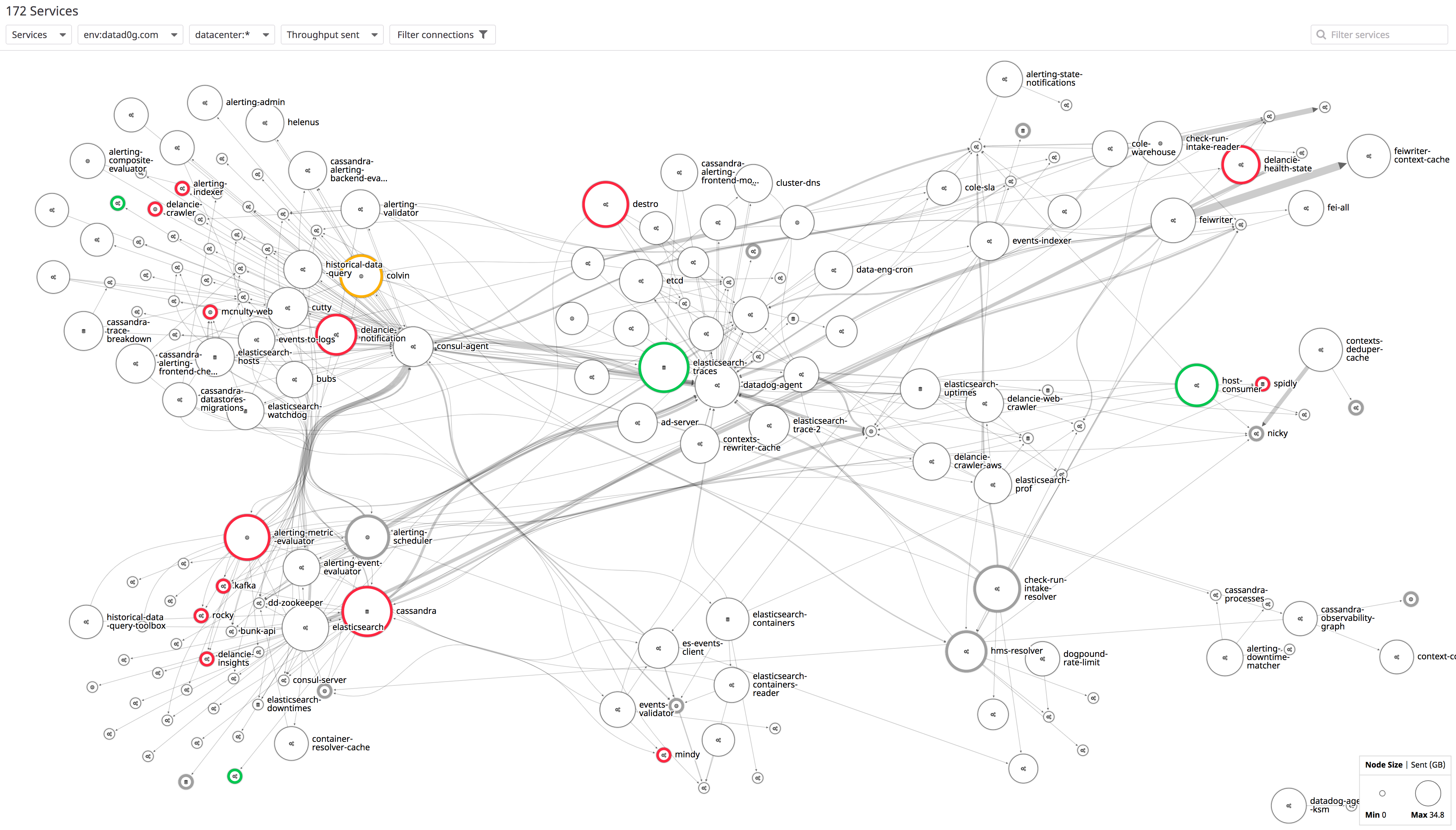
    Additions to the Datadog portfolio include Network Performance Monitoring and Real User Monitoring (RUM) services as well as general availability of a previously announced service for monitoring serverless computing frameworks.

    In addition, Datadog announced it is adding Tracing without Limits to its application performance monitoring (APM) and distributed tracing service that allows DevOps teams to search all traces without live sampling and store the traces matching bad user experiences for the long-term.

    Finally, Datadog is adding support for log rehydration and the ability to generate custom metrics from ingested log data residing within its log management service.

    Ilan Rabinovitch, vice president of product and community for Datadog, said the company continues to invest in expanding the core use cases for which its agent software can be applied. Over time, that approach will enable DevOps teams to rationalize the types of agent software they need to deploy to monitor applications, cybersecurity, infrastructure, networking and user experience, he said.

    Rabinovitch noted that interest in extending the reach and scope of Datadog services into the realm of networking is especially high because DevOps teams today have little visibility into how the various software-defined network (SDN) services provided by cloud service providers are impacting their applications.

    DevOps teams are also now being asked to present IT metrics in a way that reflects actual end user experiences. The RUM service being provided by Datadog achieves that goal by making it easier to track front-end latency metrics such as time to interactive and time to first byte, in addition to providing a geographic location, the operating system and browser types being employed by the end user.

    Rabinovitch noted that as organizations become more dependent on digital business processes, they are moving to instrument every aspect of delivering IT services. For example, APM in the past might have been limited to a handful of mission-critical applications running on-premises. Now, as more digital business applications become distributed across both cloud and on-premises IT environments, the need for visibility across interdependent applications and microservices has become more acute, he said, adding most organizations would prefer to consume monitoring as a service versus having to deploy and maintain that software themselves.

    It’s unclear how being able to apply a common base of agent software might accelerate the convergence of job functions within an IT organization. But it does make it easier for cross-functional IT teams to collaborate and troubleshoot IT environments so all members of a team can use a common management platform to identify issues. In many cases, the amount of time saved by eliminating the need to convene a “war room” meeting whenever a new issue is discovered might in and of itself be priceless.

    — Mike Vizard

  • Datadog and Aqua Security Partner to Provide Seamless Visibility into Container-Based Application Security

    Aqua integrates with Datadog to give DevOps teams real-time security metrics and events

    Seattle, WA –December 11, 2018 – KubeCon/CloudNativeCon – Aqua Security, the leading platform provider for securing container-based and cloud native applications, today announced
    the integration of its platform with Datadog’s cloud monitoring and analytics platform. With this integration, Aqua provides real-time visibility into the security posture of cloud native applications to Datadog users, including information on vulnerable images, untrusted running containers, and security anomalies found by Aqua in the runtime environment.

    For DevOps teams that continuously monitor applications for operational parameters such as performance, bug tracking, and errors, security events are often a blind spot that is handled
    elsewhere although they may directly affect application uptime and resiliency. The integration of Aqua’s granular security information into Datadog’s comprehensive monitoring makes it possible to identify issues quickly and analyze their impact on application availability.
    As organizations shift to more dynamic infrastructure through cloud and container technologies, communication between application and security teams is more important than ever,” said Ilan Rabinovitch, VP Product and Community at Datadog. “By combining Datadog’s deep insights into containerized application performance with Aqua Security’s enforcement of
    security best practices, we are helping organizations bridge the gap between these traditionally siloed teams.

    The integration between Datadog and Aqua CSP features pre-built Datadog dashboards that display:
    – Container images currently in Aqua’s scan queue
    – Known vulnerabilities and security issues found in existing images
    – Containers running from unauthorized images
    – Aqua runtime policy violations and audit events

    Additionally, Datadog users can use the data provided in the Aqua dashboards to set up theirown alerts, aggregate data streams from different applications, and customize how data is
    displayed.
    “We are excited to be partnering with Datadog to deliver a more complete security view to DevOps teams,” said Amir Jerbi, CTO and co-founder of Aqua Security. “In the cloud native era, ensuring security can no longer the exclusive burden of security teams, and instead should be part of the overall operational soundness of applications throughout their lifecycle. Our integration with Datadog creates a valuable shortcut that allows security issues to be detected early and fixed quickly, preventing escalated security incidents in production.”

    About Aqua Security
    Aqua Security enables enterprises to secure their container and cloud-native applications from development to production, accelerating application deployment and bridging the gap between DevOps and IT security. Aqua’s Container Security Platform provides full visibility into container activity, allowing organizations to detect and prevent suspicious activity and attacks in real
    time. Integrated with container lifecycle and orchestration tools, the Aqua platform provides transparent, automated security while helping to enforce policy and simplify regulatory
    compliance. Aqua was founded in 2015 and is backed by Lightspeed Venture Partners, Microsoft Ventures, TLV Partners, and IT security leaders, and is based in Israel and Boston, MA.

    For more information, visit www.aquasec.com or follow us on twitter.com/AquaSecTeam

    About Datadog
    Datadog is a monitoring service for hybrid cloud applications, assisting organizations in improving agility, increasing efficiency, and providing end-to-end visibility across the application and organization. These capabilities are provided on a SaaS-based data analytics platform that enables Dev, Ops and other teams to accelerate go-to-market efforts, ensure application uptime, and successfully complete digital transformation initiatives. Since launching in 2010, Datadog has been adopted by more than 9,000 enterprises including companies like Activision,
    AT&T, Deloitte, Peloton, Samsung, Seamless, The Washington Post, T-Mobile, Turner Broadcasting, and Whole Foods.