Tag: datadog

  • Datadog Dives Into Universal Service Monitoring

    Datadog Dives Into Universal Service Monitoring

    Datadog, Inc. today made generally available a Universal Service Monitoring service that takes advantage of the extended Berkeley Packet Filtering (eBPF) microkernel in a Linux operating system to automatically detect all the services that make up an application environment without changes to the code used to construct them.

    Yrieix Garnier, vice president of product at Datadog, said as application environments continue to evolve IT teams are now trying to track not just individual microservices but also entire business processes such as order-to-cash. Before those services can be instrumented, however, DevOps teams need a simple way to discover them, he noted.

    Within the Linux operating system, eBPF makes it possible to employ a sandbox environment to identify and map the services that make up an application environment, including both internally developed and third-party services regardless of what programming languages were used to build them, added Garnier.

    DevOps teams also gain visibility into the health of every service and deployment through real-time request rate, error and duration (RED) metrics and correlated infrastructure metrics and application logs. They can then expand monitoring capabilities provided via Datadog agent software to employ distributed traces that can be correlated with observability data.

    The Datadog Universal Service Monitoring service is also integrated with the Service Catalog that Datadog makes available to determine which development team created a specific service.
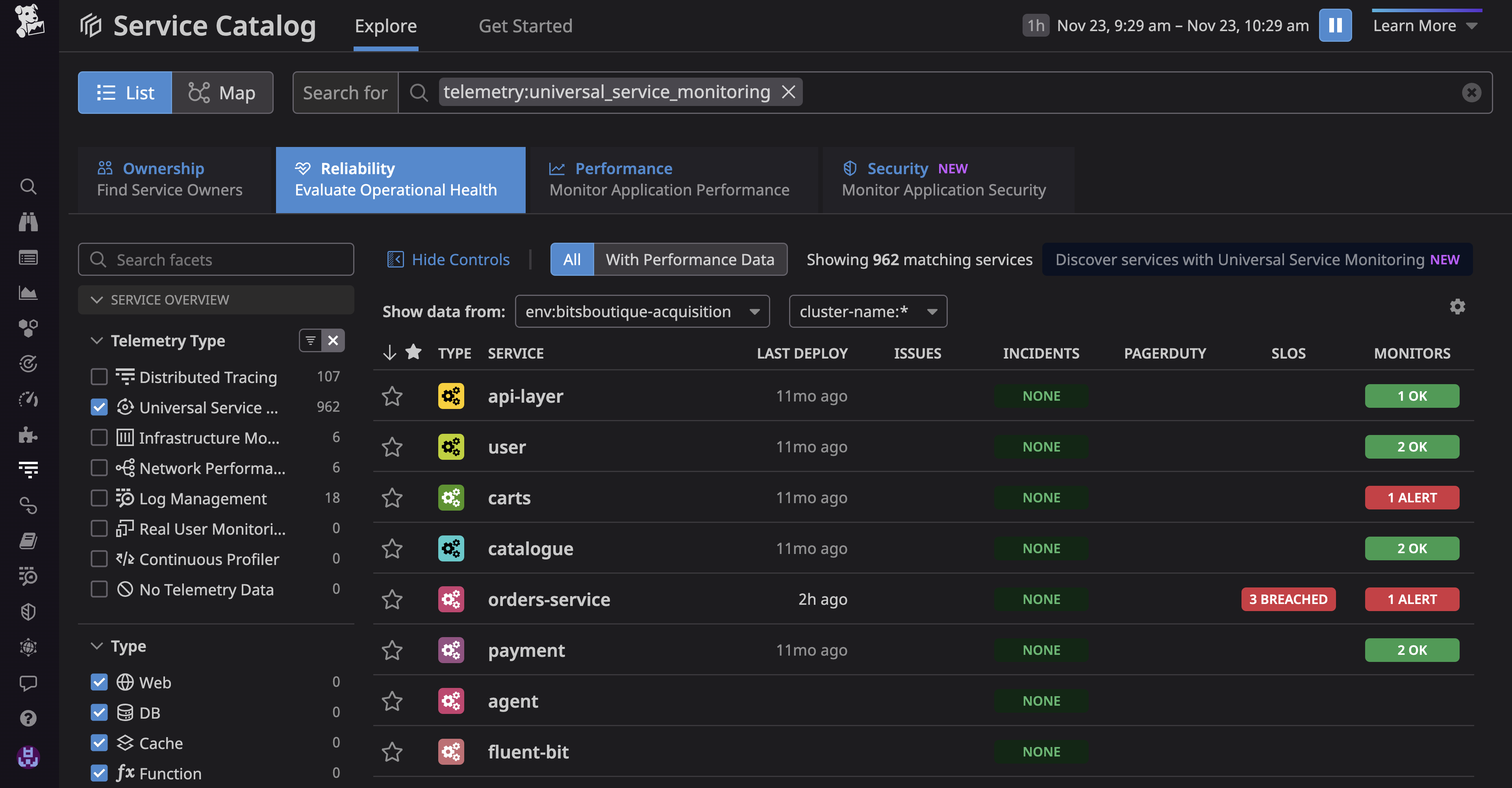
    The goal is to close a visibility gap that has emerged as more IT organizations align their management efforts around specific application services in the age of digital transformation rather than the components that make up a service, noted Garnier.

    DevOps teams today are simultaneously being tasked with diving deeper into application environments to discover issues before services are disrupted and also tracking the services that span multiple application components. Collectively, the expectation is that DevOps teams will be able to ensure that application services are not just available but also consistently delivered. Ultimately, IT organizations are being tasked with removing much of the guesswork that has historically characterized the management of IT.

    Less clear is how much those shifts will ultimately drive the reorganization of IT teams that are still mostly organized around the platforms they support versus the services being delivered. However, as business leaders increasingly appreciate how dependent the overall organization is on application services, the need to manage them in a more comprehensive manner becomes apparent.

    In the meantime, DevOps teams are evaluating whether their existing tools and platforms enable them to accomplish that goal. Datadog is making a case for employing a service it manages on behalf of DevOps teams versus each DevOps team having to construct and maintain its own observability platform. Datadog, most recently, extended the reach of its namesake cloud-delivered monitoring and observability platform to address continuous testing, application security and cost management.

    It will be up to each organization to decide how best to achieve their observability goals. One thing that is certain is the current level of visibility they have into application environments is not nearly sufficient.

  • Datadog Extends Reach of Integrated DevOps Platform

    Datadog Extends Reach of Integrated DevOps Platform

    At its Dash 2022 conference, Datadog announced today it is extending the reach of its namesake cloud-delivered monitoring and observability platform to address continuous testing, application security and cost management.

    In addition, Datadog has made available in beta a Data Streams Monitoring tool that makes it simpler to identify upstream issues that are likely to impact DevOps workflows. Also in beta is a Dynamic Instrumentation tool that makes it possible to employ Datadog agent software to collect data on the fly from specific source code to investigate performance issues. Datadog is also making available in beta a Resource Catalog to make it easier to navigate cloud resources that IT teams are employing and has added a Datadog Workflows tool to create blueprints to for automating repeatable processes.

    Datadog is also expanding the reach of its Watchdog telemetry analysis service infused with machine learning algorithms to add beta support for containers. There is also now a beta of an Event Management tool that DevOps teams can employ to more easily investigate a stream of related alerts using the Watchdog service.

    The Datadog Continuous Testing service, now generally available, provides DevOps teams with a workbench for generating and maintaining tests that can be integrated within continuous integration (CI) workflows. Datadog has also added an Intelligent Test Runner tool, in beta, to enable DevOps teams to only run tests that need to run when a change is made by analyzing code execution paths to increase developer productivity.

    Renaud Boutet, senior vice president of product at Datadog, said the goal is to make it possible for DevOps teams to create and run tests from within the Datadog user interface in parallel using a set of no-code tools without having to employ scripts. The capability will make it possible to automatically generate tests using data collected by the Datadog platform as part of an infinite DevOps workflow loop, he added.

    At the same time, Datadog is making generally available a cloud security management service that combines its existing cloud security posture management (CSPM) service and the cloud workload security (CWS) service to provide an integrated cloud-native application platform (CNAP) at no additional cost. In addition, Datadog is making it possible to block access to application components that are under attack or might be attacked in real-time based on the known vulnerabilities detected using tools that are currently in beta.

    That approach reduces the total cost of cybersecurity by providing IT teams with a single service through which they can manage application security using a platform Datadog gained last year with the acquisition of Sqreen.

    Finally, Datadog is making generally available a cloud cost management tool that leverages its monitoring capabilities to enable organizations to automatically attribute spend to applications, services and individual teams. Changes to spending patterns that impact costs are surfaced alongside the same tools IT teams are already using to monitor their cloud computing environment. That unified visibility increases awareness of costs in a way that encourages DevOps teams to optimize the utilization of multiple classes of cloud resources.

    The services being added are extensions of a Datadog platform that employs a single set of agents it provides. The Datadog platform also supports the open source OpenTelemetry agent to deliver a wide range of services. That approach eliminates the need for IT teams to deploy multiple agents each time they add an additional monitoring, security, testing or cost management tool.

    Datadog has been making a case for an integrated platform that reduces the level of integration effort DevOps teams would otherwise need to expend when deploying separate point products to address monitoring, observability, security and cost management issues. That approach makes it easier for DevOps teams to collaborate and reduces the total cost of DevOps. In contrast, each time a DevOps teams adds a point product to address a specific issue, they need to deploy and maintain a separate set of agents.

    In the longer term, it’s not clear how problematic that agent issue will be once open source OpenTelemetry agent software is more widely employed. However, it may still be years before open source software provides the same capabilities that are available today using proprietary agent software.

    It may take some time before every application is as fully instrumented as it should be, but as monitoring and observability platforms continue to evolve, it is possible to more proactively manage application environments.

  • Datadog Adds Support for OpenTelemetry Protocol

    Datadog Adds Support for OpenTelemetry Protocol

    At the KubeCon + CloudNativeCon Europe 2022 event, Datadog announced it made support for the OpenTelemetry Protocol (OTLP) generally available in the agent software it provides to instrument applications.

    Ilan Rabinovitch, senior vice president of product and community at Datadog, said that capability eliminates the need to install a separate OpenTelemetry collector to aggregate metrics, logs and traces from applications instrumented using the open source OpenTelemetry libraries being advanced under the auspices of the Cloud Native Computing Foundation (CNCF).

    The Datadog Agent can already collect application profiles, network data and infrastructure metrics via more than 500 integrations provided by Datadog. OpenTelemetry extends that capability with a set of application programming interfaces (APIs) and a wire protocol for instrumenting applications.

    Datadog is the latest in a series of providers of observability platforms that added support for the OpenTelemetry project that continues to gain momentum. The goal is to make it less costly to instrument applications using open source agent software that surfaces a consistent set of interfaces. Previously, each observability platform provider developed their own agent software that DevOps teams would need to install. Datadog is making a case for agent software that, in addition to collecting data from existing applications, is now compatible with the OLTP protocol created by contributors to the OpenTelemetry project.

    The issue that DevOps teams will need to come to terms with is that while OpenTelemetry agent software is free, many of them have already installed proprietary agent software to instrument applications. That agent software can often provide additional context that is not yet available in OpenTelemetry. History, however, shows that, in time, open source projects with larger numbers of contributors will outpace the ability of any single vendor to innovate.

    One way or another, DevOps teams will be instrumenting more applications as more microservices-based applications are deployed. The dependencies that exist between microservices make it too difficult to manage an application environment without additional instrumentation. The goal within many DevOps teams is to eventually replace the hodgepodge of monitoring tools that track a limited set of pre-defined metrics with an observability platform that not only aggregates metrics but enables DevOps teams to launch queries and surface IT issues before they become a major issue. In some instances, the rationalization of monitoring tools will help justify the acquisition of an observability platform.

    Observability, of course, is one of the core tenets of any set of DevOps best practices. Achieving it, however, has always been a challenge. Rabinovitch said an observability platform that regularly surfaces critical IT issues without requiring DevOps teams to launch queries to search for anomalies will eventually win the battle for observability supremacy.

    In the meantime, there is already no shortage of observability platforms. The challenge will be determining which one enables the highest level of instrumentation at the most reasonable cost.

  • Ingest OpenTelemetry Traces and Metrics with the Datadog Agent

    OpenTelemetry is a Cloud Native Computing Foundation (CNCF) initiative that provides open, vendor-neutral standards and tools for instrumenting services and applications. Many organizations use OpenTelemetry’s collection of APIs, SDKs, and tools to collect and export observability data from their environment to their preferred backend.

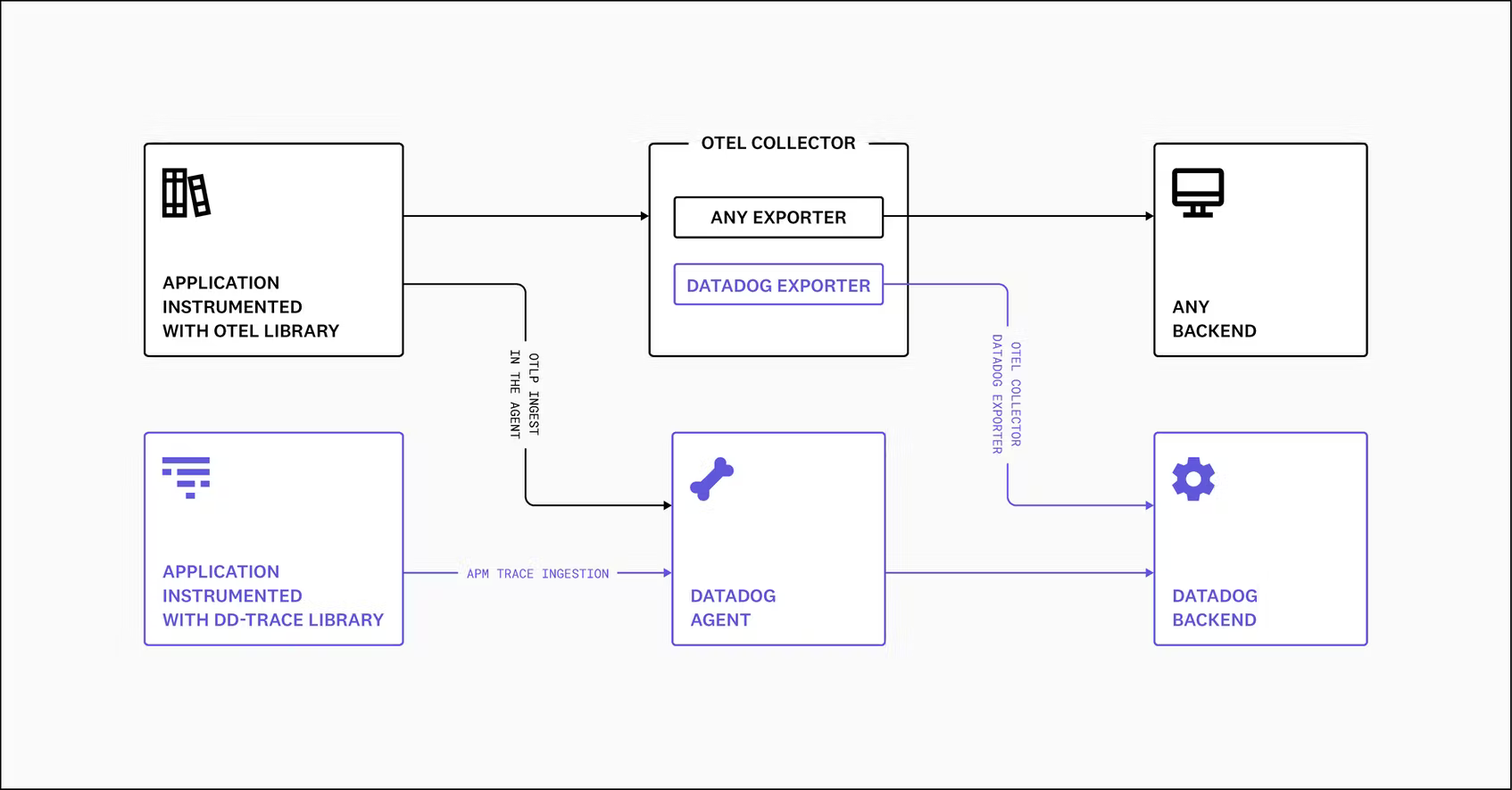
    As part of our ongoing commitment to OpenTelemetry, we are proud to have contributed our distributed tracing libraries to the CNCF community. We also offer multiple solutions to ensure that OpenTelemetry users have the flexibility to easily send their observability data to Datadog support for OpenTelemetry Protocol (OTLP) in the Datadog Agent, enabling you to reliably ingest traces and metrics from applications that have been instrumented with OpenTelemetry libraries. OTLP is a specification for encoding and transmitting telemetry data between sources, intermediaries (e.g., collectors), and backends. With native support for OTLP, the Datadog Agent now enables you to get deep visibility into your OpenTelemetry-instrumented applications without updating your code or migrating away from your existing workflows.

    Send OpenTelemetry traces directly to the Datadog Agent

    If you’ve instrumented your applications with OpenTelemetry libraries, you can export OTLP traces directly to the Datadog Agent (version 7.35+) through gRPC or HTTP, without installing a separate OpenTelemetry Collector. The snippet below shows how you can update your Datadog Agent configuration file (datadog.yaml) to enable the Agent to ingest OpenTelemetry traces over gRPC:

    datadog.yaml

    otlp_config:
    receiver:
    protocols:
    grpc:

    You can also configure trace ingestion by setting environment variables. See our documentation for Kubernetes (including Helm) and other configuration examples.

    Once you’re collecting your OTLP traces, you can start visualizing and monitoring that data with Datadog APM. You can also use this method to collect OTLP-formatted metrics.

    Because the Datadog Agent can also collect application profiles, network data, infrastructure metrics from 500+ integrations, and other telemetry from your environment, you can get rich context around your OTLP traces and gain a better understanding of your systems and applications. You can also connect traces with logs to get a more complete picture of your stack.

    Alternatively, you can export OTLP traces and metrics to our platform by using the Datadog exporter and the OpenTelemetry Collector. This option helps streamline your workflows, for backends.

    Observability with Datadog APM and OpenTelemetry

    Whether you ingest OpenTelemetry data with the Datadog Agent or the Datadog exporter, Datadog APM will enable you to get deep visibility into your applications by:

    – Querying all your traces in real time to troubleshoot business-critical application performance issues.

    – Visualizing dependencies to understand how data flows through your architecture by inspecting the Request Flow Map and Service Map.

    – Understanding key insights from each service with the APM Service Page, which provides a centralized view of telemetry, SLOs, relevant incidents, deployment-tracking data, and more.

    – Automatically detecting performance anomalies, faulty deployments, outliers, and root causes of critical failures with Watchdog, Datadog’s AI engine

    Opening more paths to observability

    Datadog is dedicated to ensuring that our users get deep visibility into their services and applications, regardless of whether they’re using our open source APM libraries, OpenTelementry SDKs, or other OpenTelemetry-compatible instrumentation methods. We are excited to continue instrumentation by providing flexible, extensible solutions for collecting telemetry data from services and applications.

    Read our documentation to learn more about the Datadog Agent’s support for OpenTelemetry. Or, if you’re new to Datadog, get started with a 14-day free trial.

  • Datadog Announces OpenTelemetry Protocol Support

    Datadog expands its existing support for OpenTelemetry by enabling native OpenTelemetry Protocol ingestion in the Datadog Agent

    NEW YORK, NY, May 16, 2022 – Datadog, Inc. (NASDAQ: DDOG), the monitoring and security platform for cloud applications, announced today the general availability of OpenTelemetry Protocol (OTLP) support in the Datadog agent. This new capability brings the full monitoring capabilities of the Datadog platform to OpenTelemetry-instrumented applications, without the need to install a separate OpenTelemetry collector.

    OpenTelemetry is a Cloud Native Computing Foundation (CNCF) initiative that provides open, vendor-neutral standards and tools for instrumenting services and applications. Many organizations use OpenTelemetry’s collection of APIs, SDKs, and tools to collect and export observability data from their environment to their preferred backend system.

    The Datadog Agent now provides native support for OTLP, making it easy to receive metrics and traces from applications instrumented with OpenTelemetry libraries. In addition, because the Datadog Agent can also collect other telemetry – such as application profiles, network data and infrastructure metrics from 500+ integrations – Datadog customers can now access richer context around their OTLP traces and gain a deeper understanding of their systems and applications. Datadog customers can also connect OpenTelemetry traces with logs to get a more complete picture of their stack.

    “OpenTelemetry provides application developers, system reliability engineers, and middleware providers with a consistent API and wire protocol for instrumenting applications and collecting metrics and traces in a vendor agnostic manner,” said Ilan Rabinovitch, Senior Vice President of Product and Community at Datadog. “With this release we’re adding another option that enables customers to use OpenTelemetry with Datadog without having to go through the time consuming exercise of changing the instrumentation of their applications.”

    For more information about Datadog’s support for OpenTelemetry, please visit: https://www.datadoghq.com/blog/ingest-opentelemetry-traces-metrics-with-datadog-agent.

    To learn more about Datadog’s Application Performance Monitoring capabilities, please visit Modern Application Performance Monitoring (APM).

    About Datadog

    Datadog is the monitoring and security platform for cloud applications. Our SaaS platform integrates and automates infrastructure monitoring, application performance monitoring and log management to provide unified, real-time observability of our customers’ entire technology stack. Datadog is used by organizations of all sizes and across a wide range of industries to enable digital transformation and cloud migration, drive collaboration among development, operations, security and business teams, accelerate time to market for applications, reduce time to problem resolution, secure applications and infrastructure, understand user behavior and track key business metrics.

    Forward-Looking Statements

    This press release may include certain “forward-looking statements” within the meaning of Section 27A of the Securities Act of 1933, as amended, or the Securities Act, and Section 21E of the Securities Exchange Act of 1934, as amended including statements on the

    benefits of new products and features. These forward-looking statements reflect our current views about our plans, intentions, expectations, strategies and prospects, which are based on the information currently available to us and on assumptions we have made. Actual results may differ materially from those described in the forward-looking statements and are subject to a variety of assumptions, uncertainties, risks and factors that are beyond our control, including those risks detailed under the caption “Risk Factors” and elsewhere in our Securities and Exchange Commission filings and reports, including the Quarterly Report on Form 10-Q filed with the Securities and Exchange Commission on May 6, 2022, as well as future filings and reports by us. Except as required by law, we undertake no duty or obligation to update any forward-looking statements contained in this release as a result of new information, future events, changes in expectations or otherwise.

    Contact
    Dan Haggerty
    press@datadoghq.com

  • Datadog Enhances Monitoring and Security for Kubernetes

    The new offerings help organizations easily manage the increasing complexity of Kubernetes environments

    NEW YORK, NY, May 16, 2022 — Datadog, Inc. (NASDAQ: DDOG), the monitoring and security platform for cloud applications, today announced a number of enhancements to its platform that simplify the monitoring and security of Kubernetes environments.

    While orchestrated container environments are growing in overall adoption, they are also becoming increasingly time consuming and difficult to manage. To address this complexity and help companies more effectively monitor and secure their Kubernetes environments, Datadog has launched a number of new platform enhancements specifically for Kubernetes users:

    • Container Monitoring: Datadog Operator for Kubernetes, Amazon EKS Blueprints Add-On, Helm integration, and OpenTelemetry Span Ingestion support greatly simplify setting up monitoring in Kubernetes environments. With these enhancements, Kubernetes users can easily deploy and update the Datadog Agent without downtime, get deeper visibility into the health and performance of their dynamic infrastructure, and monitor their entire set of resources using Datadog monitors, dashboards and SLOs.
    • Application Performance Monitoring: APM Service Pages now include detailed pod information. This allows customers to quickly identify issues impacting their containerized applications.
    • Security: Using Cloud Security Posture Management and Cloud Workload Security, Datadog customers can now continuously monitor their Kubernetes clusters for critical misconfigurations, report on CIS benchmarks and detect attacks against Kubernetes infrastructure in real time.

    “Our 2020 research showed that Kubernetes was the dominant container orchestration platform among our customers. That trend has continued through 2021 and 2022 and majority of our customers are choosing to manage their containerized applications through Kubernetes,” said Yrieix Garnier, VP of Product at Datadog. “These latest Kubernetes solutions enable Datadog to provide unparalleled performance and security to these customers as they continue to scale and grow their environments.”

    About Datadog
    Datadog is the monitoring and security platform for cloud applications. Our SaaS platform integrates and automates infrastructure monitoring, application performance monitoring and log management to provide unified, real-time observability of our customers’ entire technology stack. Datadog is used by organizations of all sizes and across a wide range of industries to enable digital transformation and cloud migration, drive collaboration among development, operations, security and business teams, accelerate time to market for applications, reduce time to problem resolution, secure applications and infrastructure, understand user behavior and track key business metrics.

    Forward-Looking Statements

    This press release may include certain “forward-looking statements” within the meaning of Section 27A of the Securities Act of 1933, as amended, or the Securities Act, and Section 21E of the Securities Exchange Act of 1934, as amended including statements on the benefits of new products and features. These forward-looking statements reflect our current views about our plans, intentions, expectations, strategies and prospects, which are based on the information currently available to us and on assumptions we have made. Actual results may differ materially from those described in the forward-looking statements and are subject to a variety of assumptions, uncertainties, risks and factors that are beyond our control, including those risks detailed under the caption “Risk Factors” and elsewhere in our Securities and Exchange Commission filings and reports, including the Annual Report on Form 10-K filed with the Securities and Exchange Commission on February 25, 2022, as well as future filings and reports by us. Except as required by law, we undertake no duty or obligation to update any forward-looking statements contained in this release as a result of new information, future events, changes in expectations or otherwise.page2image47096832

    Contact
    Dan Haggerty
    press@datadoghq.com

  • Datadog Unfurls Application Security Service

    Datadog Unfurls Application Security Service

    Datadog, Inc. today made generally available an Application Security Monitoring (ASM) service that is based on the same agent software that many DevOps teams already use to monitor applications.

    Pierre Betouin, vice president of product for the cloud security platform at Datadog, said ASM is designed to make it simpler for DevOps teams to add additional DevSecOps best practices to their existing workflows. The ASM service is based on a runtime application self-protection (RASP) engine and web application firewall that Datadog gained with the acquisition of Sqreen a year ago.

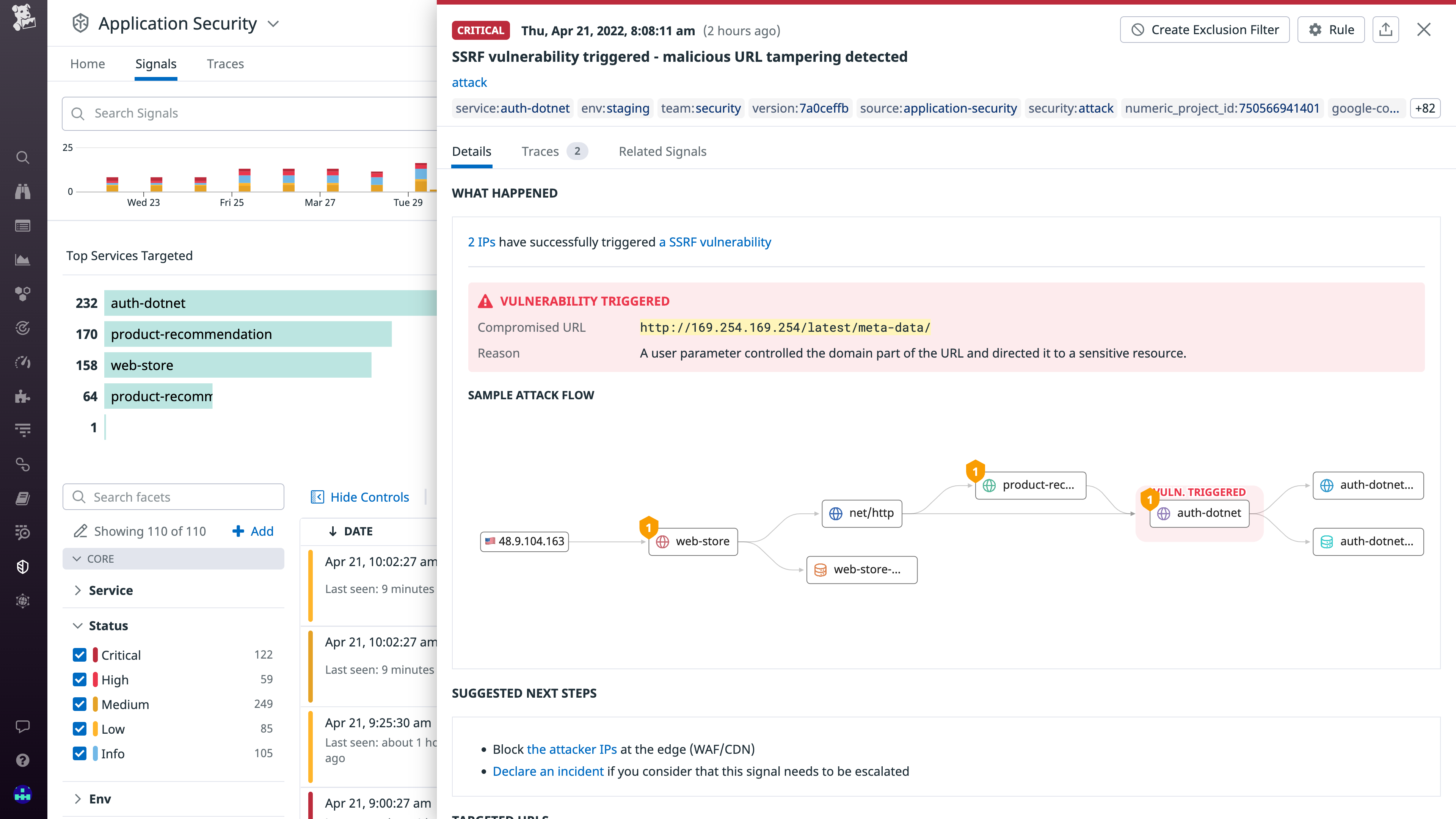
    ASM then employs distributed tracing to discover code-level vulnerabilities such as server-side-request forgeries (SSRFs), SQL injection and cross-site scripting (XSS) flaws. It is designed to extend an existing Datadog Cloud Security Platform that includes cloud security posture management (CSPM), cloud workload security (CWS) and cloud SIEM services.

    The overall goal is to make it simpler for DevOps teams to address application security by eliminating the need to deploy and maintain a separate set of agents within applications, said Betouin. That approach reduces resistance among DevOps teams that would otherwise be concerned about the additional overhead another approach to application security would add to an application environment, he added.

    The number of organizations looking to implement DevSecOps best practices is expected to increase in the weeks and months ahead in the wake of a series of high-profile breaches and zero-day vulnerability disclosures. Many organizations are now performing security reviews across their entire software supply chain as part of an effort to discover any malicious malware that might have been inserted into applications.

    The challenge those organizations face is that as application environments become more dynamic, maintaining application security becomes more difficult as code is continuously updated. The best way to address that engineering challenge is to extend the reach of an observability platform that many DevOps teams already have in place, noted Betouin. Ultimately, the goal is to automate application security as much as possible but that’s not going to be achievable if DevOps teams lack the context required, he added.

    It’s not clear at what rate organizations are embracing DevSecOps best practices. However, it’s clear that DevOps teams are being held more accountable for application security. Most developers are now charged with becoming application security experts overnight, so the only way to effectively ensure application security is to uncover security flaws before applications are deployed in production environments.

    There are, of course, multiple ways of achieving that goal. Datadog is betting that the path of least resistance is via a cloud service that connects to agent software inserted within those applications. DevOps teams have been inserting agent software, in one form or another, into those applications for years. The issue is that with each new agent added there is yet another software component that needs to be deployed and regularly updated. If not carefully tracked, a DevOps team could find itself attempting to manage an entire portfolio of agent software for every platform employed.

  • Datadog Cloud Security Platform Advances DevSecOps

    Datadog Cloud Security Platform Advances DevSecOps

    Datadog has launched a Datadog Cloud Security Platform that promises to advance DevSecOps by identifying potential threats using the same agent software many DevOps teams already rely on to instrument applications.

    Renaud Boutet, senior vice president of product for Datadog, said organizations that rely on the Datadog software-as-a-service (SaaS) platform can now more easily invoke security services based on the same data model used to observe applications.

    The security services provided by Datadog include a cloud security posture management (CSPM) offering that identifies misconfigurations and applications that are not compliant with industry standards such as the Payment Card Industry Data Security Standard (PCI DSS).

    A cloud workload security (CWS) offering, meanwhile, detects threats to production workloads by monitoring file and process activity, while a monitoring tool identifies threats to cloud environments by analyzing operational and security logs. It also provides integrations and threat detection rules that are easy to extend and customize.

    Finally, there is an application security tool, currently in beta, that identifies and blocks attacks that target code-level vulnerabilities, such as SQL injections and cross-site scripting (XSS) exploits.

    Boutet noted that many DevOps teams are reluctant to roll out security platforms that require them to deploy, manage and update an additional set of agents across their application environment. Datadog is now effectively unifying application observability and security in a way that makes it simpler for those DevOps teams to embrace DevSecOps best practices, added Boutet.

    In some cases, the dashboards surfaced by Datadog will be employed by DevOps teams that have assumed responsibility for cybersecurity as part of an effort to shift more responsibility for application security further left, noted Boutet. In other instances, cybersecurity teams will be able to view the same alerts shared with their DevOps colleagues, he added.

    Pressure to address DevSecOps is mounting in the wake of a spate of high-profile software supply chain breaches. While the majority of organizations have not been breached, questions are now being asked at the boardroom level as concerns over application security increase. Many organizations are wondering if they should slow down the pace of application development to ensure better security and to what degree.

    Regardless of the path forward, awareness of application security has never been higher. An executive order issued by President Biden calling for improvements to security will likely have a cascading effect across not just government agencies but also on organizations that do business with those agencies. One way or another, DevOps teams and cybersecurity professionals will be required to work more closely together. The challenge is striking the right balance between security and productivity. Most developers are never going to become world-class security experts. Conversely, most security professionals know next to nothing about coding. That doesn’t mean, however, that efforts shouldn’t be made to educate both camps as much as possible. After all, even a small amount of education can have a profound impact when most of the attacks being made against applications are not especially sophisticated.

  • Datadog to Meld Observability and DevSecOps

    Datadog to Meld Observability and DevSecOps

    Datadog is planning to expand the scope of the security and observability services it provides following the acquisitions of Sqreen, an application security platform provider, and Timber Technologies, a provider of a tool, called Vector, for collecting and normalizing log data.

    Ilan Rabinovitch, vice president of product and community for Datadog, said Vector makes it possible to collect, enrich and transform logs and other observability data from both on-premises and in-cloud environments in a way that makes it easier to route that data to wherever it is needed via a data pipeline.

    Sqreen is a provider of a software-as-a-service (SaaS) platform that detects, blocks and responds to application-level attacks using runtime application self-protection (RASP) capabilities enabled by a web application firewall (WAF) embedded within an application.

    Rabinovitch said as IT continues to evolve, it’s clear organizations are looking to embrace DevSecOps best practices in a way that will require security tools that can be embedded within an application, coupled with observability tools that provide more context about the overall IT environment. That context is especially critical, given the amount of data that needs to be analyzed to determine the potential scope of a security threat to an IT environment, Rabinovitch said.

    The Datadog platform is already widely employed to monitor cloud computing environments. There is an industry wide effort to take monitoring to the next level by enabling observability, which applies analytics to provide more context. Surfacing that context, however, requires the ability to normalize data across a pipeline using Vector, Rabinovitch said.

    Of course, the Vector tools are equally applicable to DevOps workflows that have yet to incorporate security technologies. The goal, now, is to make it easier for IT teams, made up of developers, IT operations teams and security specialists, to collaborate by breaking down the various data silos created by IT and security management tools.

    It’s too early to tell what impact the rise of DevSecOps will have on roles within IT organizations. Most organizations will continue to employ a range of specialists that will be able to work more closely with IT generalists, Rabinovitch said. Managing IT is becoming the equivalent of a barn raising, in that it requires members of a community with different skills to come together for a certain amount of time to accomplish a specific task, Rabinovitch added.

    It’s also not clear whether IT organizations view observability as a distinct capability separate from monitoring, or whether they will simply view observability as the next logical extension of existing tools. At the core of that issue is debate over whether observability platforms need to be acquired separately, as part of an effort to replace existing monitoring tools, or whether those tools will evolve over time to provide observability capabilities.

    Regardless of the path forward, it’s apparent the increased complexity of modern IT environments – made up of microservices, containers and serverless computing frameworks – is about to force that issue.

  • Moogsoft Joins the Datadog Marketplace to Instantly Deliver Actionable Insights About IT Incidents

    The Datadog-Moogsoft integration allows DevOps, IT Ops, and SRE teams to rapidly address service impacts identified by the Moogsoft Observability Cloud and Datadog monitoring and security platform

    SAN FRANCISCO — Feb. 16, 2021 — Moogsoft, the AI-driven observability leader, today announced a new integration with Datadog. Available through the Datadog Marketplace, this new integration enables IT Ops, DevOps, and SRE teams to easily start ingesting events and metrics from Datadog into the Moogsoft Observability Cloud.

    Datadog’s monitoring and security platform provides metrics, traces, logs, and more to provide observability for modern environments. This new integration allows SREs, IT Ops, and DevOps pros to instantly see context-rich Moogsoft-generated incidents from across the full stack in either platform, boosting service availability. Put simply, it slashes the time an SRE must spend sifting through data to get to the cause of a service outage.

    Time spent triaging alerts and identifying incident root cause impairs the value DevOps practitioners and SRE teams can deliver to organizations. Using this new integration, customers can leverage Moogsoft’s algorithms in conjunction with Datadog’s insights to automate the identification of critical, actionable data, then correlate meaningful alerts into context-rich incidents that they can quickly resolve from within the Datadog Incident Dashboard.

    “We hope that this new partnership between Datadog and Moogsoft will enable us to better achieve the true purpose of AIOps, including the ability to detect anomalies as soon as possible and manage the knowledge to mitigate incidents quickly when they occur,” said Diego Devalle, Global Head of Product and Engineering at Guidewire Software.

    “Customers rely on Datadog to quickly be alerted on production issues and help them find resolutions,” said Ilan Rabinovitch, Vice President of Product and Community at Datadog. “The root cause analysis that Watchdog and our partners provide ensures that engineering teams can respond to incidents more effectively. Moogsoft combines Datadog’s findings with those of other toolsets to enrich and  augment the insights available to developers. We are excited to welcome them into the ecosystem of partners available via the Datadog Marketplace.”

    Using this integration, Datadog users can use both platforms to:

    • Achieve more context across incidents: Joint customers can use Moogsoft and Datadog to enrich telemetry from Metrics, Events and Logs APIs, as well as CI data from Datadog’s Topology APIs, with other data from across their environments including configuration database management systems (CMDBs), asset management databases, discovery systems and more.

    • Accelerate identification of root cause: Moogsoft automatically adds key incident information such as location, department, business criticality, service relationships, runbooks and escalation processes.

    • Minimize the impact and time spent on service-impacting outages: Moogsoft and Datadog algorithms automatically surface anomalies to Datadog customers, helping them address incidents before they introduce service impacts.

    • Accelerate Monitoring Transformation: Moogsoft and Datadog automate event correlation across legacy on-premises systems and modern multi-cloud environments in one place, eliminating duplicates and effectively reducing the overall number of incidents across the full stack.

    “The avalanche of data coming from modern environments is simply too much for the human mind to process, and is a major drag on the efficiency of SRE teams,” said Phil Tee, Founder and CEO of Moogsoft. “This integration between Moogsoft and Datadog equips our joint customers with AI to automate the analysis of any data into actionable insights, freeing humans to spend time innovating. Best of all, Datadog users can start seeing these results in the time it takes to make a cappuccino!”

    Additional Resources

    About Moogsoft

    Moogsoft is the AI-driven observability leader that provides intelligent monitoring solutions for smart DevOps. Moogsoft delivers the most advanced cloud-native, self-service platform for software engineers, developers and operators to instantly see everything, know what’s wrong and fix things faster. Founded in 2012, Moogsoft has more than 140 customers worldwide including American Airlines, Fannie Mae, Fiserv, HCL Technologies, SAP SuccessFactors, and Verizon Media. It has established strategic partnerships with leading managed service providers and outsourcing organizations including AWS, Cisco, HCL Technologies, TCS and Wipro.

    Moogsoft® and the Moogsoft logo are proprietary trademarks of Moogsoft Inc. All other products or names may be trademarks of their respective companies.

    For more information about the Moogsoft Observability Cloud and its customers’ success, visit www.moogsoft.com.