Tag: cloud

  • Going Through a Cloud Migration? AIOps Can Help

    Going Through a Cloud Migration? AIOps Can Help

    AIOps can help ease many of the challenges associated with cloud migration

    As businesses seek to compete in the digital economy and better engage with customers through new digital experiences, they have become increasingly reliant on cloud as a critical component of their digital transformation strategies. This has never been more true than during the COVID-19 pandemic, when businesses across all industries are aiming to provide the best digital experiences possible in our new, heavily remote world.

    Gartner validates this reliance on cloud in a recently published report, which states that although IT spending is set to decline in 2020 due to the impact of COVID-19, the pandemic’s increase in remote work has set public cloud services to grow 19% this year.

    There’s no doubt that cloud migration can be challenging, but properly preparing and utilizing tools such as AIOps can help initiate this process and can provide ongoing visibility.

    The Ingredient for a Successful Cloud Migration

    AIOps helps identify and resolve issues before they disrupt the end user during a cloud migration, arming technologists with insights and providing visibility within multi-cloud and containerized environments as companies manage their complex platforms.

    A surge of data can be managed in the cloud but can be difficult to manage without having visibility across the platform. AIOps offers an overview and provides updates and optimization suggestions, which helps businesses be competitive and have control.

    The AIOps and Cloud Migration Process

    AIOps exists to help with big IT challenges and there is a suggested path businesses can use pre-, during and post-migration.

    Pre-Migration

    Before the migration begins, you should measure the existing performance of your applications as a baseline. You can then define performance goals and find bottlenecks you should avoid during your cloud migration. You must evaluate the potential impact of your cloud migration on your IT environment, which AIOps can help with. With robust visibility, you can see results on applications that power your business.

    During Migration

    Once you have migrated your workloads to the cloud, you can utilize machine learning and AI to check which resources might be underused. AIOps on the cloud will provide insight on overused resources, so you can identify instances that are best for your company’s needs.

    Post-Migration

    Being able to monitor your services on the cloud and end user performance gives full visibility into what you are getting from your cloud provider. Needs can change over time, so a cloud migration strategy that incorporates AIOps can identify what can be altered. This functionality helps make it clear which applications could benefit from being moved.

    The reliance on cloud support is only increasing, so the sooner you incorporate AIOps into your IT environment, the faster you can have confidence your services will deliver improved performance for the end user. Why not get the most out of your investment in the cloud by using AIOps to support your business for the long term?

    AppDynamics is sponsoring KubeCon + CloudNativeCon 2020 North America, taking place Nov. 17-20. To learn more about how AppDynamics is supporting businesses in their cloud migration journeys, register for our webinar during the show here.

  • From ‘Cloud Zombies’ to Multi-Cloud Experts

    From ‘Cloud Zombies’ to Multi-Cloud Experts

    A significant risk associated with cloud migration is overspending. For years, zombie-like obedience to AWS has resulted in price lock and escalating fees at many organizations – this is a tale for fighting the cloud zombies.

    Cloud costs around data egress or application bandwidth are often not transparent and thus highly unpredictable. Complicating this problem is the need to rapidly develop and scale large application ecosystems, leading to snap judgments by project engineers to buy tools. Or, cloud purchasing decisions fall to the CFO, who may not be qualified to understand technical nuances. Without cloud spending forethought, it’s easy to enter unsavory pricing commitments.

    However, all of this is changing. As cloud service providers (CSPs) mature their offerings, competitors have risen to take on AWS, unlocking more consumer choice throughout the cloud landscape. In a multi-cloud world, cloud economists are leveraging lift and shift capabilities to optimize performances. Ironically, companies are also seeing cost benefits in retaining some on-premises servers.

    I recently spoke with Scott Leatherman, chief transformation officer at Virtana, to get his take on preventing cloud cost escalation and how IT should streamline multi-cloud environments to stem the cloud budget.

    Zombies in the Cloud

    When the cloud arrived, it promised high performance at a low cost. Companies were happy to offload on-premises servers for the ease of cloud arrangements. For years, there was a “zombie-like loyalty” to cloud platforms, said Leatherman.

    Not much was thought about costs rising in parallel with the astronomical growth of the web, mobile and IoT. Executives penned long-term pricing contracts without a second thought. Then eventually, reality hit. And it came with a hefty price tag.

    Spooky Cloud Expenses

    As cloud-enabled businesses took off, they encountered many hidden fees. To name a few:

    • Egress: Fees for moving data in and out of the cloud.
    • Application: Fees for moving applications to new instances.
    • Workloads: Mounting costs for increasing bandwidth and workloads.

    These and other add-ons could quickly raise a cloud bill from $200 to $200,0000 a month. Complicating this was the fact that many large organizations purchased multi-year cloud subscriptions locked at a specific price.

    Counterintuitively, such cost-savings guarantees are “completely backward,” Leatherman said. As computing power increases exponentially per Moore’s Law, servers become cheaper to maintain.

    “You’ve literally committed yourself to something that is depreciating in cost,” he said. Yet, those savings don’t trickle down to consumers and SLAs have remained pretty flat. “What’s the most frustrating thing for me is that the best way to run this business is to lock people in.”

    The Zombies Become Aware

    In the wake of COVID-spurred digital transformation, cloud zombies are waking up to slash the budget, finding cost-effectiveness in multi-cloud strategies. Some companies are even reaffirming ties with on-premises servers.

    If performance isn’t worth the cost, it defeats the benefits of moving to the cloud entirely. So, how can we smartly optimize our environments for quality performance with leaner financial margins? Leatherman shared some steps to become cloud-smart:

    1. Baseline Your Footprint

    The first step toward reducing cloud costs is maintaining a baseline of all cloud dependencies and private data centers. This should cover a deep cost and performance analysis.

    “You need a baseline in your data center—what can I move? what should I move?” said Leatherman. Unless you have a baseline of what your data center is doing (both private and public), you can never understand what resources should move to the cloud. Powerful apps for monitoring the public cloud could help audit architecture.

    2. Optimize, Optimize, Optimize

    Only after mapping topologies can you can begin to optimize performance. Since usage differs depending on the season, cloud optimization should respond to yearlong application usage trends. For example, ERP software may pull significantly more requests at the end of the quarter and e-commerce spikes during the holidays.

    Organizations should ensure the elastic cloud truly scales to application needs, but only when needed. Ensure systems of orchestration and routing function properly, and diligently search for hidden fees. “The cost that sneaks up on you in the elastic cloud always comes up,” said Leatherman.

    Heavy computation processes, such as machine learning over big data, will require enormous server consumption. For resource-intensive scenarios, Leatherman recommended keeping code lean. Whereas CPU relies on the laws of physics, “application developers are only limited by creativity,” he said.

    Application developers should whenever possible optimize code to avoid redundancies. Doing so yields a positive environmental impact, too—eliminating operational inefficiencies can decrease cloud server usage, which reduces carbon footprint.

    3. Lift and Shift

    GCP, Azure, Oracle and other CSPs mature, the zombie-like loyalty to AWS is fading. “Now that there is parity across cloud vendors, things are changing,” he noted. “The flexibility in the marketplace is really dynamic.”

    In a multi-cloud world, organizations can leverage a hybrid cloud and “lift and shift” toward the best cost optimizations for their specific needs. This is where maintaining a strong baseline will help continually test cost efficiencies among cloud competitors.

    4. Refine Your Tool Procurement Process

    Another solution involves scrutinizing your cloud procurement process and the personnel involved. As mentioned above, new cloud tooling purchasing may occur at the DevOps level or large contracts may be escalated to the CFO office.

    Unfortunately, neither side is in an ideal situation to make smart financial decisions—one faces an urgency to deliver and the other can’t see the trees from the forest (and especially not the termites eating the valuable wood). Many believe a new role is required—The Other CFO—to help optimize the cloud stack.

    5. Retain and Optimize Private Data Centers

    By now, most enterprises are accustomed to having both a data center and a cloud center team. Leatherman argued that ultimately these two teams must work together to avoid outages and reduce the exponential costs of moving to the cloud.

    From a security perspective, there are still significant advantages to maintaining on-premises private clouds and data centers. By leveraging private assets, you aid data protection efforts and have increased control. “Datacenters have value,” he said. “Unless you started there, no one will be 100% cloud.”

    Although cloud migration seems inevitable, through software automation and Moore’s law there is value in on-premises. As a result, Leatherman predicts a rise in private cloud data center optimization and management services by third parties.

    6. AI for Cloud Cost Awareness: DevFinOps

    Finally, AI soon may be available to automatically scan for cloud cost impacts before applications are even deployed.

    Most DevOps teams use container security scanning or automated compliance validation as part of their DevSecOps process. Leatherman suggests future DevOps tooling will similarly evolve to display automated notices that estimate cloud costs for your actions in real-time.

    For example, as engineers are pushing code, a popup could display server utilizations and a cost impact breakdown. Or, inline code validation suggestions could find redundancy to decrease waste. Perhaps we’ll need a new abbreviation for this Developer + Finance + Operation focus—DevFinOps, anyone?

    Such an AI would likely not negate the need for a cloud economist to help manage multi-cloud complexity. “We’ll still need them,” said Leatherman.

    Surprises in a Multi-Cloud World

    COVID–19 is accelerating deployments tagged for much shorter timeframes, forcing many more instances to public clouds. Businesses need to get performance up and meet their SLAs. To reduce expenditures, they must quickly lift and shift to the most performant and cost-efficient environments.

    The gravity is apparent, yet hasty moves now could be disastrous for security and data privacy in the future. Besides rising cloud costs, there are other risks associated with the cloud that increase exponentially with multi-cloud environments. “It’s not just the financial spend, but the security and risk that goes along with it,” Leatherman said. “It becomes really scary how many people have access.”

    Not only must cloud spending decisions shift left, but security must arise earlier in the development cycle as well. Compliance with regulations such as GDPR or HIPPA should also influence how teams manage data between clouds.

    The Cloud is Relatively New

    An IBM-endorsed study found enterprises are only 20% of the way through their cloud journey. Many enterprises are still just at the beginning of their cloud transformations, and 90% plan to expand their cloud footprint in the next year.

    The cloud journey is quite long, and many have quite a way to go. Knowing this, cloud economics will only rise in importance. As I recently covered, cloud expertise is now superior to a university degree.

    Current forces, like the COVID–19 crisis, will no doubt continue to “drive people to the cloud,” said Leatherman. While responding to the imperative to deliver more and higher speeds, it’s essential to be smart, leverage existing assets, and optimize cloud usage at every level possible. “It shouldn’t just be cloud-first,” he said. “It should be cloud-smart.”

  • Dell Launches Project Apex to Deliver IT as a Service

    Dell Launches Project Apex to Deliver IT as a Service

    Dell Technologies today launched Project Apex, an initiative that promises to significantly expand its ambition to deliver IT as a service from the edge to the public cloud.

    Announced at the online Dell Technologies World 2020 conference, this initiative builds on the Dell Technologies Cloud Platform through which Dell manages IT infrastructure as service on behalf of customers.

    Sam Grocott, senior vice president of product marketing at Dell Technologies, said via a single pane of glass organizations will be able to deploy and manage application workloads running on IT infrastructure provided by Dell as well as public cloud service providers using the Dell Technologies Cloud Console, which is currently available as a public preview.

    In the first half of next year, Dell plans to roll out Dell Technologies Storage as a Service (STaaS) for on-premises IT environments, which also can be managed via the Dell Technologies Cloud Console.

    In addition, Dell is reducing the entry-level cost of its existing hybrid cloud offering built on top of Dell Technologies Cloud Platform to $47 per instance per month with a subscription, in addition to making the service available in the UK, France and Germany.

    Dell is also making a pre-approved Flex On-Demand pricing option that charges organizations on a usage basis for IT infrastructure, and has expanded its managed data protection services to include multiple public clouds.

    It’s not clear whether organizations will prefer to rely on Dell to manage their IT versus continuing to manage it themselves or rely on a third-party IT services provider. In theory, organizations will be able to invest more in application development that would eventually consume more IT infrastructure than is consumed today. However, it’s not clear internal IT organizations are prepared to cede control over IT infrastructure and applications to a single IT vendor, especially if they employ IT technologies provided by a broad spectrum of vendors.

    In the wake of the economic downturn brought on by the COVID-19 pandemic, however, Grocott noted the number of organizations that prefer to treat IT as an operational expense has increased substantially. In addition, with more employees working from home organizations are looking for a more flexible approach to IT that is a challenge for them to achieve relying on legacy systems. To facilitate that transition, Dell is expanding the refurbishment and recycling services it makes available to customers.

    In effect, Dell is enabling a cloud operating model to be applied to all of IT regardless of where applications or IT infrastructure is deployed.

    Of course, Dell is not the only IT platform provider with such ambitions. Not only are longtime rivals in the data center expanding the scope of the managed services they provide, but every major provider of a cloud service has also expanded the reach of their offerings to include on-premises and edge computing platforms. It may be a while before this titanic struggle for control over IT plays out, but the one thing that is for certain is the way IT is consumed is changing utterly.

  • Reducing Cloud Infrastructure Complexity

    Reducing Cloud Infrastructure Complexity

    The impact of the cloud and its role in mainstream IT is undeniable. According to IDC, global cloud IT infrastructure spending is projected to reach US$92 billion (SG$126 billion) in 2023. Notably, cloud spending is exceeding the spending on non-cloud IT infrastructure, underscoring the influence of the cloud in modern IT deployments.

    Fast Forward to Cloud

    Why are enterprises and startups alike turning to the cloud? At the forefront is its sheer scalability and how it enables rapid time-to-market. Instead of waiting weeks or months for hardware systems to arrive, cloud infrastructure can be launched and put to work within minutes. Moreover, cloud-based resources such as managed cloud databases reduce the complexity of deploying new services, thereby enabling smaller teams of developers to do more.

    New cloud-centric methodologies have also emerged with the maturity of the cloud. For instance, infrastructure as code (IaC) makes it possible to automate the management and provisioning of an entire technology stack with configuration, replacing error-prone manual deployments. Among others, IaC also supports CI/CD deployments and disaster recovery plans with the ability to easily deploy test environments or even the entire infrastructure stack.

    Cloud proficiency varies across organizations, however. For most, the journey to the cloud began with low-hanging, lift-and-shift migrations or relatively straightforward cloud implementations, such as a website or an online shop. Other enterprises might have started with cloud-native applications within their organization as part of an effort toward rapid experimentation.

    Like most IT projects, cloud deployments are probably implemented with the technologies of the day and by developers and architects who prefer quick results over efficiency. Although this laissez-faire approach yields quick results, it can be inefficient and culminate in systems that are hard to maintain. The situation is worsened over time as additional services or new features are built on top of the initial design.

    Cloud-amplified complexity

    It’s no surprise that deploying well-designed cloud systems is getting more difficult. As organizations look to leverage the cloud in more advanced ways, some are forced to re-architect existing systems, preventing them from realizing the benefits of reduced time-to-market.

    Other factors that increase the complexity of the cloud include the following:

    • Rapid evolution of the cloud: The breakneck growth of the public cloud has birthed new cloud technologies and strategies that did not exist before. For instance, serverless architecture and containers entered the mainstream only in recent years.
    • Deep expertise matters more than ever: While there are more qualified cloud engineers today, there remains a dearth of experts given the sheer demand for them. A team of “been there, done that” experts can enable an organization to move ahead much faster.
    • Larger attack surface: As more systems and workloads are moved to the cloud, IT teams are under increasing pressure to keep up with the dramatically increased attack surface. From catching configuration drift to patching software libraries that are used within the technology stack, having team members with the right mix of experience is invaluable.

    Modern public cloud platforms offer nuanced, broad capabilities that continue to evolve at a rapid pace. Leveraging the right features can bring forth immense rewards not just in terms of cost, but also offer greater reliability and maintainability. Conversely, ignoring good design can lead to cloud sprawl and ballooning cloud costs, tangling the organizations in a web of spiraling complexity that hinders new cloud implementations.

    A Better Cloud Infrastructure Design

    Ultimately, the cloud journey does not end with the successful implementation or migration of individual systems to the cloud. The breakneck pace of development in the cloud means that best practices and optimal strategies are constantly evolving, making it highly challenging for in-house IT to pin down. Moreover, as new cloud capabilities become available, the onus is on enterprises to leverage the right features for the best cloud solution possible, which necessitates constant optimization.

    Getting this right requires the involvement of experts who are well-versed with the latest cloud practices and automation strategies that can be gleaned only from experience, a deep understanding of the latest cloud methodologies, and the evolving capabilities of each public cloud platform. As these cloud experts focus on core designs, in-house IT can keep doing what they do best: keeping users happy and improving productivity and user experience.

    For instance, Indonesia’s streaming service provider Genflix wanted to migrate its video-on-demand (VOD) workflow to Amazon Web Services (AWS). With a library of 10,000 hours of VOD content, efficiency and seamless processing were vital. CloudCover helped Genflix architect an end-to-end media workflow with a serverless computing design in a span of just three months.

    Whether you are rolling out a new cloud-native system from scratch or looking to improve an existing cloud deployment, a review of your cloud deployment might be in order. This isn’t as daunting as it seems and can be initiated through a simple discovery and analysis phase.

    This article is part of a series of articles from sponsors of KubeCon + CloudNativeCon 2020 North America

  • VMware Starts to Gain Some Momentum on AWS

    VMware Starts to Gain Some Momentum on AWS

    The number of IT organizations planning to move application workloads to the cloud that today run on VMware appears to be accelerating in the wake of the COVID-19 pandemic.

    A survey of 1,054 IT and business professionals conducted by Faction, a provider of IT services, conducted in June finds more than half (51%) of all respondents are either accelerating their cloud adoption timeline or moving forward as planned. Among respondents considering deploying workloads on VMware Cloud on AWS the percentage is 8 points higher (59%), with scalability cited as the primary driver by more than half of respondents (52%). A quarter of respondents (25%) planning to make that transition said they plan to add or increase workloads on VMware Cloud on AWS in the next 12 months.

    Top use cases among IT organizations currently running VMware Cloud on AWS are data center extension (26%), AWS integrated applications (22%) and cloud migration (18%). Among those considering VMware Cloud on AWS, the top use cases cited are data center extension (25%), disaster recovery (23%) and test & development (17%).

    VMware may also be starting to gain some traction with cloud-native applications based on Kubernetes. The survey finds that while the VMware Tanzu platform is currently being used by only 1% of all respondents, 18% said they plan to adopt Tanzu in the next two years.

    Duan van der Westhuizen, senior vice president for marketing and product at Faction said the survey shows VMware is making clear gains in the cloud. The biggest issue now is a lack of skills among internal IT departments looking to deploy workloads on VMware Cloud on AWS, said van der Westhuizen.

    Of course, there are multiple ways to migrate application workloads to the cloud. Some IT organizations may opt to refactor applications to run natively on the open source virtual machines provided by AWS. Others may decide to encapsulate applications in containers that can then be deployed on top of any virtual machine. Regardless of the approach, the need to make applications available at a time when local data centers are inaccessible has driven many organizations to reconsider their options. One of the options is to do not do anything at all. VMware makes a variety of tools available via software-as-a-service (SaaS) platforms that IT teams can employ to remotely manage workloads running anywhere.

    It’s not clear to what degree workloads are moving to the cloud, given how unevenly vertical industries have been impacted by the economic downturn brought on by the downturn. The survey finds the top four industries considering VMware Cloud on AWS are technology services, financial services, health care and government. Among those organizations for which COVID-19 has paused or canceled cloud migrations, top factors are budget pressures (75%). Staffing shortages and macro-economic uncertainty each tied at 41%, the survey noted.

    Virtual machine platforms from VMware are not going to disappear from the IT landscape anytime soon. However, given the number of options, IT organizations now have at their disposal, it appears less likely VMware will be able to continue its historic dominance over application workloads in the enterprise.

  • Lenovo Updates Diverse HCI Platform Portfolio

    Lenovo today announced a bevy of updates to its server portfolio that expand the number of options organizations have when it comes to bundling stacks of software with Lenovo hyperconverged infrastructure (HCI) platforms to reduce the total cost of on-premises IT.

    For example, Lenovo in collaboration with Nutanix and AMD, today launched a Lenovo ThinkAgile HX HCI based on AMD EPYC processors, which promises to reduce by 50% the number of servers required to run the Nutanix HCI software stack.

    Lenovo in collaboration with Microsoft today also unveiled Lenovo ThinkAgile MX Azure Stack HCI Edge appliance based on Azure Stack HCI software. That platform runs the same software stack on-premises that Microsoft employs in its Azure cloud to simplify hybrid cloud computing environments.

    In addition, Lenovo added a Diamanti SR630 appliance to its lineup based on storage software developed by Diamanti optimized for instances of Kubernetes running on bare-metal servers.

    Finally, Lenovo in collaboration with VMware added a Lenovo ThinkAgile VX HCI offering that comes bundled with SAP HANA databases running on top of VMware vSphere.

    Kamran Amini, vice president and general manager of server, storage and software-defined infrastructure for the Lenovo Data Center Group, said rather than optimizing HCI infrastructure for one single platform such as VMware, the Lenovo portfolio is designed to provide IT organizations with the flexibility to enable organizations to deploy stacks of Nutanix, Microsoft, Kubernetes or VMware software as they best see fit.

    The economic downturn brought on by the COVID-19 pandemic has been especially challenging for providers of IT infrastructure platforms deployed in local data centers that many IT teams have been not been able to visit in recent months. However, those IT teams have been relying more on the ability to manage Lenovo servers remotely rather than attempting to migrate existing application workloads to the cloud overnight, he noted.

    It’s too early to say what the impact COVID-19 will have had on IT strategies. While many new applications are being deployed in the cloud, there is still a plethora of performance, security and compliance requirements that make it preferable to deploy some classes of workloads in on-premises IT environments. After more than a decade of having public clouds available as an option, the bulk of application workloads in the enterprise continue to run in on-premises IT environments. If it remains relatively simple to remotely manage those systems from home, the pressure to lift and shift workloads to the cloud becomes less intense.

    Amini said the COVID-19 pandemic essentially served as a wake-up call for organizations to modernize IT management processes using platforms that are designed to be managed from anywhere.

    Now that it’s apparent many IT teams will be working remotely a lot more often, many organizations are revisiting their IT strategies. There’s no doubt public clouds will play a larger role in IT going forward. However, the future of IT in general and cloud computing in particular will be, if anything, more hybrid than ever.

  • RackN Transforms Bare-Metal Servers Into a Cloud

    RackN Transforms Bare-Metal Servers Into a Cloud

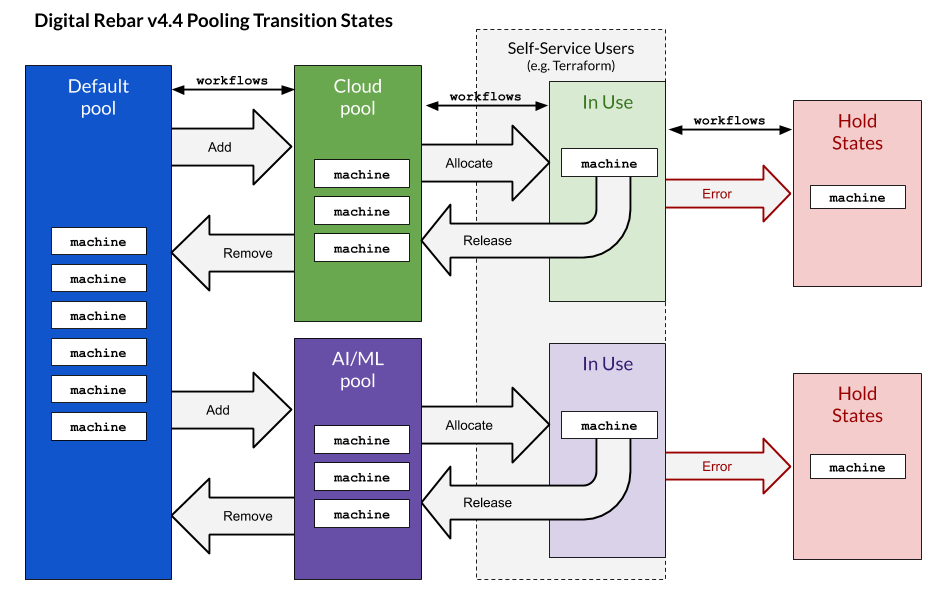
    RackN is making available an update to the RackN Digital Rebar Platform that will make it easier to employ tools such as Terraform to configure bare-metal servers.

    Company CEO Rob Hirschfeld said version 4.4 of the platform adds an application programming interface (API) that enables bare-metal servers to be abstracted into resource groups. IT administrators can request a machine based on an attribute map to provision a collection of bare-metal servers as if they were a cloud platform, he said, noting RackN is also making available workflows to enable IT teams to automate the allocation and reallocation processes more easily.

    At the same time, the latest release of RackN Digital Rebar Platform adds support for Trusted Platform Module (TPM) Secure Boot, an industry standard that ensures only software that is trusted can be loaded onto a machine. Most automation platforms don’t support TPM Secure Boot, which forces IT teams to choose between the benefits of automation and having a secure platform. RackN Digital Rebar Platform is the only automation framework to support (TPM) Secure Boot in VMware environments, Hirschfeld claimed.

    Out-of-band management passwords, TLS certificates and VLANs will also be secure by default with this latest release, he said.

    Hirschfeld said IT teams want to be able to provision bare-metal servers as if they were code in much the same way they provision virtual machines. Just as importantly, they require an automation tool that enables them to just as easily de-provision those machines when it comes time to reallocate them to another workload.

    Achieving that goal, however, should not require IT organizations to hire a site reliability engineer (SRE), he said, noting the RackN Digital Rebar Platform is designed to be employed by the average IT administrator. An SRE could define workflows within the RackN Digital Rebar Platform that are reused by IT administrators; in fact, RackN plans to add support for Git repositories that will make it easier to share workflows, Hirschfeld added.

    While the reasons for deploying workloads in the cloud versus on-premises IT environments are varied, the automation advantage cloud platforms historically have enjoyed over on-premises IT environments is narrowing at a time when interest in deploying Kubernetes clusters on bare-metal servers is rising. It may be a while before most IT teams are able to manage bare-metal servers as if they were just another cloud resource. The main obstacle for achieving that goal now, however, is likely to be a lot more cultural than it is technical.

    In the meantime, IT teams should expect to see bare-metal servers employed more widely in the age of containers. There will, of course, always be a need for virtual machines, at least in the foreseeable future. The challenge is the IT infrastructure environment itself is becoming more diverse as new classes of cloud-native application workloads emerge.

  • Arrcus Expands Network Services Spanning Hybrid Clouds

    Arrcus Expands Network Services Spanning Hybrid Clouds

    Arrcus has added virtualized distributed routing (VDR) and multi-cloud networking (MCN) capabilities to ArcOS, a network operating system (NOS) that can be deployed on-premises or in the cloud.

    Company CEO Devesh Garg said these additional capabilities provide the programmatic network services that IT organizations require to foster deployments of hybrid cloud computing environments.

    Arrcus MCN provides the ability to securely connect workloads and data across any cloud, while VDR eliminates the need to rely on physical routers that require their own chassis, he said.

    Arrcus has been making the case for a disaggregated approach to networking that eliminates dependencies on physical infrastructure. Instead, IT teams can deploy ArcOS on a cloud service or any white-box appliance they choose in an on-premises IT environment. That approach eliminates the possibility of becoming locked into specific network hardware platforms, he said.

    Garg added it also provides DevOps teams with a consistent foundation on which to deploy distributed applications. Rather than having to navigate different NOSes running in the cloud and on-premises IT environments, ArcOS presents a consistent set of application programming interfaces (APIs) for accessing network services.

    In fact, the need to programmatically invoke those network services is what’s driving the convergence of network operations and DevOps teams, he noted. As applications become more distributed in the age of the cloud, IT organizations are looking for more efficient ways to expose network services on-demand.

    That convergence, however, will take time. Many networking teams still tend to prefer to acquire routers and switches as physical devices that include a NOS rather than deploying an operating system on infrastructure they select and manage. However, as DevOps teams continue to push for access to network services that can more easily scale up and down as required, it’s now only a matter of time before software-defined networking services become a default requirement.

    In fact, Garg said, the rise of microservices will force that issue as DevOps teams look to deploy applications that will be updated frequently.

    In addition, he noted, the rise of edge computing platforms and 5G wireless networking services will simultaneously push organizations toward virtualized network services.

    It’s not clear at what rate network services are being transformed. Software-defined networking services are already readily available in the cloud. Progress in on-premises IT environments has been tied to the willingness of IT organizations to fund upgrades to core network infrastructure. The challenge many IT organizations now face in the wake of the economic downturn brought on by the COVID-19 pandemic is finding a way to achieve that goal cost-effectively. White-boxes provide a less costly alternative to switches from vendors such as Cisco Systems and Arista Networks. At the same time, the total cost of delivering network services across a hybrid cloud computing environment can decline when a common NOS is employed across all platforms.

    Regardless of the path forward, the one thing that is certain is legacy network infrastructure has become a major bottleneck at a time when IT organizations need to be more agile than ever.

  • How COVID-19 Has Affected Digital Transformation

    How COVID-19 Has Affected Digital Transformation

    The current COVID-19 pandemic may have changed the way many of us work and impacted productivity, but digital transformation marches on. With technology arguably more important than ever, digital transformation needs acceleration, and companies are beginning their journey with the cloud. That’s according to results from a survey by cloud service provider Ancoris and the Cloud Industry Forum (CIF).

    The survey, which was conducted in the UK by Vanson Bourne prior to the lockdown, is comprised of responses from IT companies and business decision-makers in digital transformation to understand how they were utilizing next-generation technologies and the cloud. According to the results, 80% said they had their digital transformation strategies at hand, compared to today. With the novel coronavirus putting more pressure and less time on these companies to plan, only 18% of them have a strategy in place. “The very survival of office-based organization has hinged on their ability to adapt and go remote as quickly as possible,” Ancoris CEO David McLeman noted, which is putting pressure on companies to pivot as quickly as possible.

    Before the lockdown, the cloud was considered a vital element of their digital transformation efforts for 25% of respondents in the business and professional services sectors, 23% in the public sector, 22% in retail and surprisingly low 19% of respondents in the financial sector.

    Among other key findings: twenty-eight percent of businesses already have their digital transformation strategies fully in place, while 54% have begun their implementation. Businesses are also seeing the importance of the cloud, as 93% of respondents said their companies use it in some sort of way. And 25% of respondents said that they don’t get enough assistance from partners in helping them make strides in digital transformation.

    McLeman emphasized the importance of having external partners now and after COVID-19. They play a “leading role” in helping companies digitize, he said, and will be an “increasing integral component on ongoing digital transformation” post-COVID-19.

  • PagerDuty Looks to Streamline IT Incident Management

    PagerDuty Looks to Streamline IT Incident Management

    PagerDuty has added more automation and analytics capabilities into its portfolio of incident management tools, at a time when organizations are looking to significantly reduce the total cost of IT.

    Jonathan Rende, senior vice president of product at PagerDuty, said the general release of Intelligent Triage advances the level of AIOps that can be applied to incident management by eliminating a raft of manual tasks.

    Intelligent Triage aggregates signals from more than 375 monitoring, observability and ticketing tools, which are then grouped based on relationship and elevated depending on the impact on the business. That level of contextual data makes it possible for IT teams to increase productivity while dramatically reducing alert fatigue, said Rende.

    At the same time, PagerDuty is adding support for integration with Microsoft Teams alongside existing support for Slack. IT teams are increasingly relying on these collaboration tools to process requests for help from end users, he noted.

    In some cases, IT teams are communicating with one another via these media or employing built-in tools embedded in the PagerDuty incident management platform. In either case, workflows across IT teams are now occurring in near real-time, said Rende.

    Finally, PagerDuty is adding a Dynamic Service Directory to give DevOps teams a central knowledge base that identifies owners and experts for each service and their associated run books, in addition to making available a mobile status dashboard to allow remote teams to collaborate more effectively when incidents arise. That capability is especially critical at a time when many IT staffs continue to work from home as part of the effort to combat the COVID-19 pandemic, said Rende.

    In general, IT organizations are looking to automate incident response whenever possible to both minimize costs and potential disruptions. Businesses are more dependent on IT services than ever. However, as more applications are deployed the nosier the IT environment becomes. Discerning which alerts are stemming from the same root cause issue becomes more relevant as organizations either limit headcount or even look to reduce it during a time of widespread economic uncertainty.

    Of course, regardless of the state of the economy, most IT professionals would rather not have to waste time on manual tasks that don’t add a lot of value to the business. Most IT professionals need to free up more time to achieve more pressing goals. Every minute spent on chasing down an alert that winds up being yet another wild goose chase just piles on more stress.

    Advances in automation and AIOps have been coming at a steady pace for the last several years. The adoption of these new capabilities to manage incidents has been uneven at best. In the wake of the economic downturn brought on by the pandemic, it’s now more a question of how soon IT organizations will be tapping into these capabilities to streamline the management of IT. After all, many IT managers are going to conclude there’s no sense in letting a good crisis go to waste.