Tag: CI/CD

  • CircleCI Surfaces More DevOps Insights

    CircleCI Surfaces More DevOps Insights

    CircleCI today announced it is making it easier for DevOps teams to determine the amount of resources being consumed by its continuous integration/continuous delivery (CI/CD) platform to help make application development teams more efficient.

    Kunal Jain, senior product manager for CircleCI, said via the application programming interface (API) that CircleCI exposes DevOps teams can now determine, for example, which workflows are taking the longest to run or what tests might be creating bottlenecks into the CI/CD pipeline.

    Armed with that insight DevOps teams can also optimize how credits to employ the CircleCI platform are allocated across their DevOps teams, added Jain. That capability should make it easier for DevOps teams to predict how much they are spending per month to run their CI/CD platform, said Jain. Many more IT organizations may opt to access CI/CD platforms using a software-as-a-service (SaaS) approach that limits the need for them to invest in their own IT infrastructure or in some cases even manage the platform.

    DevOps teams have always been sensitive to efficiency but given the current economic climate, minimizing costs is becoming a higher priority for many organizations. As such, DevOps teams need more insights into, for example, how to best break up workflows to keep CI/CD platform costs to a minimum, said Jain. In fact, Jain says the total cost of operating a CI/CD platform is likely to now play a bigger role in selecting a platform as IT leaders demand more visibility into DevOps processes.

    Of course, some DevOps teams may find themselves competing for credits based on how efficient they are. Teams who are more efficient than others could also allow IT leaders to reallocate credits as they best see fit based on the progress being made. In a previous era where compute resources were largely considered to be a nominal cost, many DevOps teams may find access to IT infrastructure might no longer be taken for granted.

    CircleCI claims it runs more than 30 million independent jobs run every month. The company last year committed to exposing more API endpoints to help DevOps team better understand the languages, architectural patterns, code testing patterns, delivery success rates and team practices being employed. Like most providers of CI/CD platforms, CircleCI has made a commitment to making available a much broader range of actionable insights to DevOps teams via its API.

    At this point, it’s unclear what the impact the economic downturn brought on by the COVID-19 pandemic might have on DevOps adoption. Undoubtedly, many organizations will put a hold on some application development projects as they reassess their priorities. On the other hand, with more people working from home, digital business transformation initiatives that require new applications are likely to become a higher priority as organizations seek to reinvent how they engage their end customers. Those projects may even be accelerated as part of a larger business continuity strategy. Regardless of the number of application development projects being launched, the scrutiny of how IT resources are being allocated and consumed is about to increase substantially.

    — Mike Vizard

  • DevOps for the Rest of Ops

    DevOps for the Rest of Ops

    The IT pro gig usually includes a basic headwind. They’re part of a cost center, and budget for resources and staff are limited by design unless they’re managing a strategic initiative, which—at least for a while—is more generously funded.

    Early adopters of DevOps, Agile or site reliability engineering (SRE) teams have been budget beneficiaries when tied to transformation projects—as has always been the case for high-visibility IT initiatives. Fortunately, DevOps has proved more helpful and stickier than some other “next big things,” and for some organizations it’s the engine behind growth and even actual digital transformation success.

    IT pros—pragmatic as always—have taken note of DevOps potential, even while keeping lights on, systems up and reliably delivering the critical services businesses have depended on for decades. The question for IT leaders is, how can IT teams realize some of the benefits of DevOps, while operating inside traditional IT organizations?

    As DevOps has finally slid off the hype peak and into the shed of useful tools, experience has distilled out a couple of conclusions. First, the tenets of DevOps—breaking down walls, shared feedback loops and learning to love automation—don’t only apply to new or cool apps. They’re even more helpful in traditional IT. For example, the rise of automation isn’t driven by a conspiracy to replace admins with robots, it’s a necessity to shrink the toil of manually wrangling all the new complexity of cloud and cloud-native tech on-premises.

    Second, many of the ideas behind DevOps and resulting practices are a direct attempt to fix issues in IT that have frustrated IT teams for years. Ask any IT pro if they’d like to move all deployment to Monday through Thursday, 9 a.m. to 4 p.m., instead of midnight Saturday nights. That team will go nuts for CI/CD. Better, it turns out you don’t have to do all the DevOps things to get many of its advantages.

    But even if your business still operates from the C-suite down, entraining quarterly budget spending, waterfall models and lots of walled silos, there’s an opportunity to adapt DevOps processes and culture to deliver progress on truly transformative initiatives to help grow the business. The trick is figuring out which DevOps practices are valuable and which ones are more useful to developers.

    Luckily, focusing on just four can get your team most of the benefits without (much) disruption, and development teams are eager to share its growing body of new techniques and successes. We’re working in an interesting epoch of IT history, a potential democratization of DevOps for everyone, DevOps for the rest of ops.

    Continuous Delivery

    Until recently, some IT pros were skeptical, even suspicious that the development teams’ goal has been to automate them out of a career. Others felt developers were demanding everyone to learn how to program full-stack and invent a way to move fast and break things just as they can (more safely) do. A few admins have even had unpleasant encounters with some DevOps proponents when they showed interest. Nobody likes reflexive replies, such as “You use Oracle and DB2? Switch to MongoDB and come back later” to eager 101 questions, even if they’re just from a handful of community members. It’s especially unpleasant for developers and IT pros alike because that’s not how operations works. We share, we’re open, we’re helpful. We came to tech to help end users get more out of technology.

    Instead, successful teams often start by identifying tools supporting fundamental operations goals, without the distraction of any particular technology or vendor, and seek buy-in from both developers and ops. Because if you’re in operations, you’re the team that must:

    1. Find a way to get software into reliable production.
    2. Maintain functional, useful governance.
    3. Maintain apps for years more than anyone thinks they’ll possibly be online.

    Operations knows this because it has always been the last mile of delivery and deployment, it cares about availability and SLAs, and defines process for breakfast.

    One of the first tools associated with DevOps is CI/CD pipelines, which are literally implementations of automated policy about how code goes from origination to production. But, overlooked in many DevOps blogs is the last step of CD because it’s not for the faint of heart. That’s unfortunate—operations is good at figuring out that last mile.

    When operations teams embrace CI/CD/Continuous Deployment, they’re rewarded for investment in automation in the best possible way: less night and weekend work. As a result, the pipelines they build aren’t ephemeral experiments but production-grade CI/CD because it’s part of production itself. And as change velocity increases and error rates decrease, many teams refuse to go back to manual deployment unless they’ve exhausted all other options. Pipelines don’t replace IT pros, they improve work-life balance.

    When the operations teams present developers with standardized, battle-tested nozzles through which changes get more quickly deployed with fewer errors, the reaction is usually excitement. It allows developers to mate their build, unit test, packaging and delivery head ends to the typically complex delivery/deployment operations pipeline. Best of all, ops teams tend to include monitoring, security and even cost governance into their processes, resulting in effective controls being automatically and reliably applied. Further, ops metrics create and enrich the feedback loops dev need to improve code over time based on real-world performance, not dev or test data. In environments like that, culture change is more organic based on shared goals, success and the flexibility to let each team do what they enjoy most.

    Start Breaking Stuff Fast

    Operations teams can have a little envy when it comes to breaking things. They’re technologists just like developers, and like most people attracted to technology, they like to learn by disassembling, recombining and otherwise hacking tech to learn the intricate details of how it works. But unlike a developer testing code, experimental configurations or other normal laptop environment one-offs, operations absolutely can’t experiment. IT is risk-averse by commandment, for good reasons.

    “Get a lab!” sounds like an obvious suggestion, and it is—but it’s a great example of easier said than done. Because IT is a cost center, labs are often seen as duplication and waste because their value is harder to justify in a budget presentation. But with a little unconventional use of the monitoring data you already have, that’s not necessarily true. Operations regularly correlates change events with performance histograms in the ongoing search for improved reliability. Consider adding before and after metrics to changes tested in a lab environment first. You’ll likely find you can prove the more realistic the pre-deployment testing, the lower the error rate and higher the performance of that system.

    But the mechanism behind improved quality isn’t the lab itself or data it produces. It’s the team’s experimentation—and some blood, sweat and tears shed—impossible in a production environment. IT also allows operations to invite developers to go on deployment and tuning ride-alongs. Developers can use whatever tools they prefer, make changes, probe and otherwise disassemble the lab stack as needed. And from a communications and culture perspective, this can be helpful.

    Operations lab environments also allow IT pros to separate hype from reality on their own. They can install the latest shiny new tools for evaluation, try new methodology or even test significant platform architecture redesigns. In short, they can break whatever they want without affecting production and provide both feedback to developers and a place for dev to experiment with changes. Here again operations can be the lead, with new avenues for communication, cooperation and culture change.

    Monitor Your Success

    Most developers aren’t data driven, they’re functionally driven. They love data-informing design and are good with tools that wrangle it into something useful, but at the end of the day their job is to build code that does things. IT pros have monitoring in the DNA because detailed performance data collected over time is how they initially validate hunches but also break down conclusion bias. But while everyone seems to understand the value of metrics and data, it’s not usually considered a tool for DevOps communication.

    As mentioned earlier, feedback loops are a fundamental principle of DevOps. Changes go into production, production generates data sent back to developers to guide future changes to further improve service quality. It’s a virtuous cycle, and both teams value it highly. The trick is in creating a language between dev and ops about what to collect, how it’s used and the stewardship of feedback over time. Step one is to sweep away preconceptions on both sides and start fresh.

    A common approach is to bring a small—one-pizza small—team together and start with a blank whiteboard. The goal is to matrix the inventory of what’s already available with what’s helpful, then identify gaps for both teams. Development teams are hungry for the incredible richness of coverage operations can offer, while operations is eager to mine new instrumentation the development team relies on for troubleshooting and internal application performance monitoring (APM).

    APM for hybrid applications is a great example of both teams learning how to create ensemble visibility into hybrid on-prem/cloud-native services. High performing operations teams ensure they add metrics dev teams need, and developers discover that the “impossible” information to debug pesky apps has been collected for years and is an API call away. Once again, a little conversation can lead to relief, and earned changes to hearts and minds.

    Reward Success With Big Dreams

    The final common experience of developers and IT pros both are never really done. Code can always be improved, and service delivery can always get better. But because we’re human, sometimes we get tired, stuck or bored, and it’s easy to take a break, especially after a big win. That’s natural. There are years of deferred work and technical debt lying around, and no time for perfectionism, especially in enterprise IT. This critical aspect of DevOps needs to remain a focus of any team adopting DevOps techniques—remembering DevOps is never done. It’s a culture of continuous, collaborative improvement and evolution. This shared understanding sustains the bonds between dev and ops.

    When teams innovate, when they continue forging closer relationships and when they share improvements as the team culture changes, they start asking bigger questions. We’re conditioned in IT to accept that certain things can’t be achieved because, reasons. As a result, sometimes suggestions and questions that could finally resolve the team’s most bedeviling challenges might not always be made or asked.

    Track your “impossible” ideas which drive progress, then promote successful ones while sharing details of why they worked. This in turn helps socialize the value of success resulting from openness and encourages great ideas that may have been sitting on the bench for a long time.

    Again, you’re investing in more metrics and signals, but not limited to performance data. When you dream big, especially as you untangle the enormous expectations of digital transformation into operations changes, you’ll start to rely on new metrics. For example, business metrics tied to corporate objectives, behavior signals accurately reflecting CSAT, change and error rate data helping teams decide when to add new versus when to fix and new ways to assure leadership operations have everything under control. When managers are confident IT pros can safely transform gear, services and staff without interrupting the business, the most sought-after DevOps goal can come into focus: A new freedom to innovate at speed.

    — Patrick Hubbard

  • Compuware Shifts Mainframe App Testing Left

    Compuware Shifts Mainframe App Testing Left

    Compuware today announced it is making it easier to shift application performance testing further left on to the shoulders of developers by adding support for a REST application programming interface (API) to its application performance management (APM) platform for mainframe applications, along with a plug-in for Jenkins continuous integration/continuous delivery (CI/CD) environments.

    Sam Knutson, vice president of product management for Compuware, said during the current economic downturn brought on by the COVID-19 pandemic, organizations will find it is now more imperative to shift more responsibility for managing all aspects of application development toward developers. Many organizations simply won’t be able to afford to retain IT specialists such as application testers, said Knutson.

    Instead, most organizations soon will be looking to automate as many aspects of DevOps as they possibly can with an eye toward enabling developers to achieve goals with as little intervention as possible from IT operations teams, he noted.

    In addition, Knutson said the trend of convergence between mainframe and distributed computing teams within IT organizations is about to accelerate. In fact, there may soon be no such thing as “mainframe DevOps,” he noted; rather, the mainframe will be just another mainstream platform on which applications are deployed.

    The economic downturn may limit the number of new mainframes being deployed. However, given that the total cost of computing on the mainframe tends to be lower than distributed systems, the number of workloads running on existing mainframes could increase as organizations deploy more Linux-based applications on the venerable platform.

    The API Compuware is adding to its Strobe APM platform will help accelerate the development and deployment of those applications by making application testing a more integrated element of a DevOps workflow, said Knutson. Automated tests can be run within the code delivery pipeline using Compuware Topaz for Total Test, the Topaz Utilities plugin or Compuware Hiperstation. Development teams can be notified when performance tests are completed via communications tools such as Slack and Microsoft Teams.

    Knutson said Compuware decided to build a plug-in for Jenkins because it is the most widely deployed CI/CD platform in mainframe environments.

    Despite the pending merger with BMC Software, IT organizations can count on the fact that the Compuware portfolio of DevOps tools for mainframe environments will continue to be supported and updated, he said, pointing out that this latest announcement represents the 22nd consecutive quarterly update to the Compuware portfolio of DevOps tools for mainframes.

    It’s too early to say what precise impact the economic downturn may have on DevOps adoption in mainframe environments. However, it’s safe to say that doing more with less is going to be the order of the day for some time to come. As such, the rate at which IT organizations that rely on mainframes to run their mission-critical applications will be embracing best DevOps practices is likely to increase.

    In fact, rather than incurring the costs of replacing those mainframe applications the priority now is much more likely to be modernizing them as much and as soon as possible.

    — Mike Vizard

  • Akamai Extends Scope of DevOps Integrations

    Akamai Extends Scope of DevOps Integrations

    Akamai today extended its DevOps strategy to provide tighter integrations with continuous integration/continuous (CI/CD) platforms and IT automation tools such as Terraform from HashiCorp.

    In addition, Akamai is adding support for serverless computing functions to Akamai EdgeWorkers, a JavaScript-based framework through which application logic can be executed on the edge of the Akamai content delivery network (CDN) now as a microservice.

    Greg Griffiths, product marketing manager for DevOps solutions at Akamai, said the latest additions will make it easier for DevOps teams to view the Akamai CDN as a natural extension for deploying applications. Akamai launched its first DevOps initiative last year. The goal is to make possible for DevOps teams to spin up new properties and make configuration changes from within the context of their CI/CD workflows, he said.

    Terraform support, meanwhile, will make it possible for DevOps teams to programmatically provision and manage properties and DNS zones as code, added Griffiths.

    As part of that effort, the Akamai Pipeline can now synchronize with the Akamai Control Center to capture any manual configuration changes in a way that then allows them to be incorporated into a CI/CD workflow, he noted.

    Akamai has been making a case for deploying applications as close to the network edge as possible using its CDN to reduce network latency. As part of that effort, EdgeWorkers allows developers to spin up microservices as needed. Those microservices can now access data embedded in the function, including all the data from the HTTP request such as cookies, headers, URL and query parameters.

    DevOps teams can now also more easily conduct A/B testing and feature experiments using cached content in addition to delivering different application experiences by modifying the path to cached images and other content based on variables such as customer location or time of day.

    Other new capabilities being added by Akamai include the ability to modify both the path and query arguments for a request and determine to which origin any request should be routed.

    Griffiths said now that more organizations are leveraging the Akamai CDN as a vehicle for delivering applications at the network edge, the next big initiative will be to make it easier to leverage the company’s managed security services to embrace DevSecOps.

    It’s not clear to what degree DevOps teams have embraced CDNs as a vehicle delivering applications. Organizations have, however, been leveraging CDNs to deliver web applications for years now. By providing tighter integration with CI/CD platforms Akamai is essentially making the CDN just another target for deploying applications at the end of a DevOps workflow. That capability may prove critical as organizations move to deploy more application code on edge computing platforms involving use cases that require data to be processed and analyzed in near real-time.

    Of course, Akamai is not the only CDN providers with similar ambitions. It is, however, already the largest, so from a DevOps perspective most organizations will soon encounter an Akamai point of presence somewhere soon, if they have not already.

    — Mike Vizard

  • OverOps Allies With SonarQube To Improve Application Quality

    OverOps Allies With SonarQube To Improve Application Quality

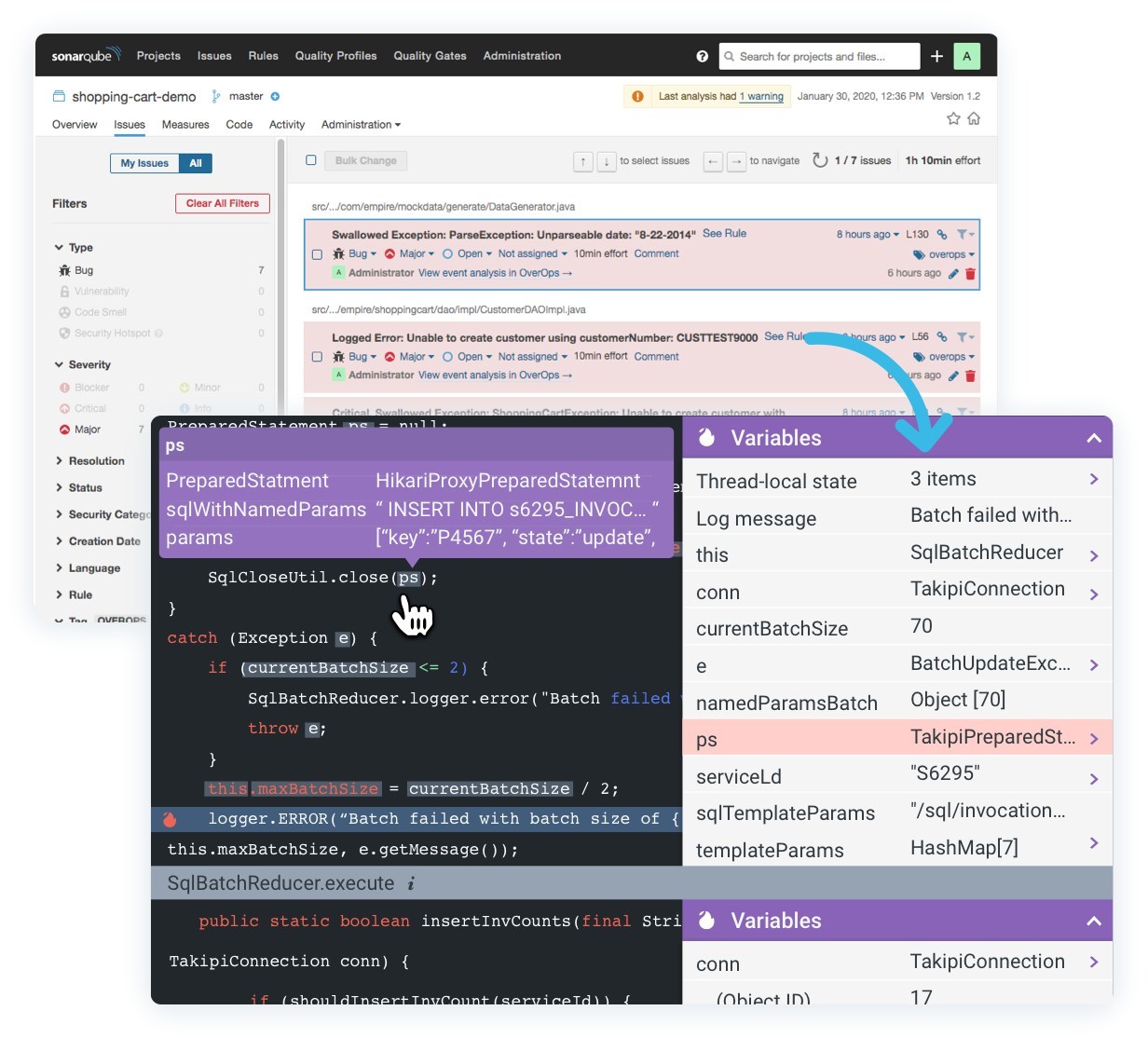
    OverOps, a provider of tools for dynamically analyzing code at runtime, has partnered with SonarQube, a provider of static analysis tools for source code, to enhance application quality by unifying code analytics.

    Chen Harel, vice president of product for OverOps, said the two companies have collaborated to create a plugin through which DevOps teams can now more easily analyze source code before it gets deployed in a production environment.

    The goal is to equip DevOps teams with the tools required to assure application quality as more responsibility for maintaining applications continues to shift left on to the shoulders of developers, said Harel. In the absence of tools to analyze code, he noted, developers are not going to be able to identify, for example, potential vulnerabilities in source code and errors at run-time.

    The plugin also allows issues identified by OverOps at runtime to be fed back into the SonarQube tools for analyzing source code to identify issues that previously would not have been discovered, he added.

    Specifically, when the OverOps plugin is installed, it automatically creates an event rule for Java code based on new, critical, resurfaced and unique runtime errors. When a quality gate fails a release based on these criteria, users can view the issues directly within their SonarQube dashboard. OverOps then provides a direct link to the event analysis containing the full context behind the error, including the stack trace, variable state and system state.

    As a result, Harel said DevOps teams are going to be able to reproduce an issue much faster, which should result in much shorter times to remediation. Without such tools, DevOps teams can spend weeks reproducing an error that only takes a few minutes to actually fix.

    Harel said with both the OverOps and SonarQube tools included as part of the gates set up within a continuous integration/continuous delivery (CI/CD) platform, it becomes possible to substantially improve the overall quality of the applications being developed. That’s critical because developing applications faster often results in more errors having to be addressed, said Harel.

    There’s a lot of debate these days concerning the degree to which the adoption of DevOps might be increasing the total cost of IT. It’s a lot more expensive to fix an application after it’s deployed in a production environment than it is to address issues as they arise in the application development process. As such, there’s a lot more focus on code analytics to help ensure that DevOps processes are churning out not just more code faster but also higher quality applications.

    Of course, the level of DevOps sophistication tends to vary widely by organization. However, as more gates that address application quality assurance are erected on CI/CD platforms, the better the DevOps outcome will become. The challenge is making sure the DevOps culture being fostered prizes application quality as much as it does how much code is being written and deployed how fast.

    — Mike Vizard

  • 2nd Watch Allies With GitLab for Managed DevOps Service

    2nd Watch Allies With GitLab for Managed DevOps Service

    2nd Watch today launched a managed DevOps service based on the continuous integration/continuous deployment (CI/CD) platform from GitLab that it will operate on behalf of customers in addition to coaching them on how to adopt best DevOps practices.

    Stefana Muller, a senior product manager, said the 2nd Watch Managed DevOps service combines the managed and professional services capabilities of 2nd Watch into a single offering. That approach is required because when it comes to DevOps most organizations need as much help transitioning their culture as they will operating their CI/CD environment, she said.

    One of the major challenges organizations face when trying to embrace DevOps is they typically spend a lot of money upfront only to see those efforts flounder when changing the internal culture of the organization becomes too difficult, Muller said. As part of an effort to smooth that transition, 2nd Watch DevOps experts will assess an organization’s readiness to adopt DevOps tools and processes and then train internal teams on DevOps fundamentals such as managing infrastructure as code and Git principles. The assessment is based on a Culture, Automation, Lean Practices, Measurement and Sharing (CALMS) methodology.

    The 2nd Watch service is built around an on-premises edition of the GitLab CI/CD platform that it will host and upgrade on behalf of a customer on either an Amazon Web Services (AWS) or Microsoft public cloud platform. The DevOps service will focus on enabling organizations to build both monolithic and microservices-based applications faster because no organization today has fully transitioned to microservices. The company already provides a managed Kubernetes service for building and deploying applications based on a microservices architecture.

    2nd Watch chose to partner with GitLab because of the completeness of that CI/CD platform, which among other things includes integrated security modules that can be employed to advance DevSecOps practices as well, Muller said, noting that longer-term, 2nd Watch is planning to layer a more robust set of managed DevSecOps services on top of the GitLab platform.

    Managed DevOps offerings are starting to proliferate as the number of services providers that have attained certifications from multiple IT vendors has increased. It’s not clear to what degree organizations will prefer to rely on these services just yet. However, it’s is apparent many organizations are trying to shift as much of their limited resources to building application code versus managing IT infrastructure. It’s also possible that as the COVID-19 coronavirus pandemic becomes more widespread many organizations will need to rely on external service providers to manage their DevOps environments.

    Regardless of the motivation, organizations that are at the beginning of their DevOps journey clearly will need more help than those that are further along the DevOps maturity curve. The decision most organizations will need to make is to what degree will they rely on a managed DevOps service to accelerate their transition versus opting to rely permanently on an external IT service provider to manage one of their most critical IT environments.

    — Mike Vizard

  • Better Apps and Better Security When You Shift Left

    Better Apps and Better Security When You Shift Left

    Tens of thousands of people and hundreds of cybersecurity vendors descended on San Francisco at the end of April. While the RSA Conference was the primary draw, there are a number of peripheral events that go on throughout the week as well, such as the Cloud Security Alliance Summit, the CIO/CISO Interchange, BSides San Francisco and the Qualys Security Conference.

    I was able to attend some of the Qualys Security Conference and I had the opportunity to see Alex Mandernack, security solution architect for product management at Qualys, presenting on the need to shift left when it comes to cybersecurity.

    Mandernack outlined some of the issues organizations face today when it comes to security. Migrating to the cloud and embracing DevOps culture means more ephemeral, elastic environments and compressed development time frames. He pointed out that these trends make security more challenging, but also described the opportunity they present to change our approach to streamline and improve security.

    The Traditional Pipeline is Broken

    The traditional model of application development is much more linear. Each app team builds their own image—often in a silo or vacuum disconnected from other teams. Penetration testing is conducted on a sporadic or infrequent basis, and eventually the app is deployed. Vulnerability scans are run on the app in production, and issues or deficiencies are reported back to the developers to address or incorporate into the next build.

    The process is slow and cumbersome. It also has the potential to introduce redundancies that waste resources and make the organization less efficient. As companies embrace DevOps and move to the cloud, the traditional development pipeline simply doesn’t work—especially not for security.

    DevOps, and Cloud, and Containers — Oh My!

    The cloud and DevOps fundamentally change the development lifecycle. Development time frames are compressed, and the process is a self-feeding, iterative circle rather than a repeating linear approach. The traditional approach of identifying and resolving security issues after an application is deployed won’t work in a DevOps environment because by the time issues are identified and fixed, the app itself may have already moved on to the next version.

    Cybersecurity and the development pipeline have enough challenges with the cloud and DevOps, but there is also a newer technology trend that exacerbates the problem—containers. Containers are designed to get code quickly and to operate fast. They are also built for scalability—spawning and spinning down hundreds or thousands of containers constantly to keep pace with demand.

    There is a diverse array of tools and platforms associated with cloud, DevOps and containers. Organizations often employ a complex collection comprised of some combination of AWS, Azure, Docker, Kubernetes, OpenShift and others. The result can quickly become a black hole when it comes to security—which is why it’s important to push security left into the CI/CD pipeline.

    Shift Left to Help Security Teams Do Better

    In a DevOps culture, developers and security teams need to think about security sooner. It’s important to get the security tools into the process earlier. Thankfully, with the DevOps lifecycle and the tools commonly used within a DevOps environment, it can be done.

    For starters, companies should build a golden image. Developers shouldn’t have to patch and update the base operating system before they even start developing. The golden image takes a baseline operating system such as Ubuntu or CentOS, and completely patches and configures it so everyone has a standard, consistent image to develop on.

    With the golden image in place, the next step in shifting security left is to implement testing and scanning in the CI/CD pipeline. Put vulnerability information at the fingertips of developers as they’re developing and implement vulnerability gates in the pipeline to ensure that applications that don’t comply with policies and meet minimum requirements are not allowed to be deployed.

    New Role of the Security Team

    Part of shifting security left includes providing tools that make security self-service for the DevOps team. Automating actions with scripting, APIs and CI plugins ensures that security is simplified and streamlined to provide value for developers.

    In this shift left scenario, the security team has to redefine its role in the process. The security team is still vital, but rather than being the police or a roadblock in the development process, the role of security focuses on verifying and auditing the process. The security framework should have dashboards and live data that enable the security team to monitor activity and identify trends that may need further attention.

    Better Security, Faster

    There is often conflict between developers and security teams, but there doesn’t need to be. Mandernack stressed that developers don’t want to create insecure apps either.

    Shifting security to the left into the CI/CD pipeline streamlines the whole process. Ultimately, the result is higher quality, more secure applications that are developed faster.

    — Tony Bradley

  • Don’t Let ‘Hindsight 2020’ Be Your DevOps Strategy

    Don’t Let ‘Hindsight 2020’ Be Your DevOps Strategy

    The idea of DevOps originated a little over a decade ago with a desire to ensure efficiency in the overall software development and delivery process. Constant operational hurdles that have been hampering flawless and frequent delivery of applications have led organizations to think beyond and to come up with continuous improvements in their processes and tooling. Thus, DevOps has evolved into a solid practice to aid enterprises with an end-to-end feedback enabled framework that spans across various functions and stakeholders to design, develop and deliver quality software.

    The IT landscape over the last few years has changed significantly. Companies are building secure applications and large volumes of workloads are being transformed to the public cloud. Nowadays, firms are actively applying AI technologies to transform their businesses more than they were just a few years ago. Some companies are still investing heavily on building their own complex AI platforms involving expensive infrastructure, but most companies have realized the value in leveraging AI as a service offered by leading cloud providers.

    Digital initiatives and IoT have further increased the use of cloud-based services and the need for automated deployment and delivery of applications and services. Seamless integration of the CI/CD pipeline for on-premise or deployment to the cloud is possible only with a solid DevOps practice. For organizations that are ambitious and striving to get ahead of the game in order to accelerate the growth of their businesses, DevOps is indispensable.

    To successfully implement some of the current major trends in IT, organizations are required to have a mature DevOps practice in place.  In October 2019, Gartner published its predictions on technology trends for 2020. We’ll pick a few from those to discuss the crucial role that DevOps is expected to play in them, and the critical success factors for companies to be advanced forward.  

    Strategic Trends in IT and the Role of DevOps

    Hyperautomation

    Gartner’s analysis on strategic technology trends for 2020 has hyperautomation as the number one trend. Hyperautomation, which enables organizations to function as autonomous digital enterprises, will be leveraging latest technologies such as 5G networks, intelligent edge devices, advanced data analytics, expanding RPA with AI, etc. Firms aspiring to implement AI and ML on a grand scale will want to take advantage of the diverse range of complex machine learning algorithms implemented on scalable cloud infrastructure and offered as services.

    Instead of recreating everything from scratch, organizations will simply upload their data to the cloud and train algorithms based on their business processes and needs. For hyperautomation initiatives to be successful, organizations need to implement end-to-end fully automated DevOps processes with the relevant tooling to specifically address the varied needs from several perspectives. Speed, agility and ensuring an error-free repeatable process will be basic requirements for hyperautomation.

    On-demand deployment of transient infrastructure on the cloud, driven by infrastructure as code and configuration as code will be a primary requirement for rapid development and testing of artifacts that form components of hyperautomation. Fully automated pipelines for the creation and deployment of containers will become a core requirement not only for hyperautomation but in general for most applications. The involvement of DevOps to manage data virtualization, obfuscation and uploading data to the cloud will become more significant to increase the overall efficiency of the automated CI/CD pipelines for hyperautomation projects. 

    Democratization of IT

    Democratization of technology is about making technology more accessible to common people. Gartner has predicted this to be another major trend for 2020. Smartphones and the internet have already played a major role on this front and have enabled people with the technology, tools and data to help make better decisions. Democratization of technology in the IT world is about enabling the IT community and it gets more and more interesting day by day.

    With container technologies such as Docker Desktop that can run on a user’s laptop, a developer now has access to pre-configured container images of various operating systems and other platforms that can be pulled from container registries within seconds. Cloud services such as IaaS, SaaS and PaaS add to this by providing more independence to the development teams apart from making the entire process agile and faster. Democratization at these levels also leads to setting a different level of expectations on the overall velocity of development and delivery of applications. All these services in isolation, i.e. when not connected together through a strong DevOps process and toolset, will not produce the expected level of agility and speed.

    An end-to-end DevOps process works all the way: from triggering the build of a container image as the code is built, deploying an environment on the cloud, integrating with other components, testing artifacts with automated testing and finally to producing a production-worthy artifact. When IT teams get more democratic, they will run their domain the way they perceive beneficial and produce the best possible outcome with quality and speed to make their teams and the organization successful. DevOps will be the means to achieving that goal.

    Internet of Things

    Edge devices are getting smarter by the day. Mass manufacturing of intelligent controller boards, such as the ESP 8266 and ESP 32, is making it extremely cheap to build edge devices with data storage and processing capabilities locally within the device itself instead of communicating with a cloud based central system for command and control. However, such intelligent devices need to be kept up-to-date on security patches, bug-fixes, firmware updates, etc. A solid DevOps framework that integrates testing of patches/fixes, and deploys tested artifacts to remote edge devices is an absolutely essential component of an organization’s IoT ecosystem.

    Some controller boards run light-weight versions of Linux and have the capability to additionally run a Docker engine. This helps ensure consistency through deployment of updated containers via a DevOps pipeline to the edge devices. Convergence of cloud and digital transformation initiatives, especially in IoT over the last few years, has widened the scope of DevOps. Major cloud providers are already offering several services to integrate edge devices with a full-fledged CI/CD pipeline leveraging DevOps processes and tools. 

    Blockchain

    Application developers and IT managers spend a great deal of time either fixing bugs or recovering systems from breakdowns caused by bugs. If best practices, processes and tools are put to proper use, this wasted effort can be greatly reduced and the entire development and delivery process could be made more efficient. Blockchain demands building a strong foundation in IT and raises the need for higher quality in software development, delivery and IT operations on the whole.

    Organizations have to take a closer look at their current capabilities and process maturity before embarking on a journey involving blockchain. Firms that have faced failures with blockchain can certainly vouch for the fact that the failure wasn’t caused by the concept of blockchain or the algorithms that drive it. Rather they had resulted because the rest of the IT systems weren’t reliable enough to keep up with the strict demands of the blockchain systems. DevOps and automation will certainly help improve the security, quality, reliability and repeatable deployment of applications. When the systems that feed the blockchain application go through such increments of improvement, the net effect is that the organization is getting closer to implementing a solid blockchain solution.

    Success Factors

    Firms are moving fast toward the cloud for IaaS and PaaS services. As DevOps, CloudOps and SecOps are converging, CIOs are becoming conscious about building organizations that encapsulate these functions under one leadership in order to set shared goals and ensure synergies across these functions. Organizations with strict compliance requirements and governance would need to involve their operations teams to lay the rules regarding using cloud services.

    Application development teams and users are still dependent on several operations teams to design and implement secure cloud connectivity and to establish the rules around using cloud services. While a strong governance is absolutely essential, there is a high possibility for firms to lose their agility and get caught once again in a mess if these operational processes are not smoothen and streamlined. For the strategic initiatives on implementing the new trends to succeed, it is vital for DevOps to be able to operate without any hurdles.

    Below are a few critical success factors worth considering.

    Dev and Ops in a Box

    Organizational structure plays a key role in determining the success of DevOps. Keeping applications development, DevOps and infrastructure operations very closely aligned with overlapping goals, KPIs and roadmaps is a key to success. Companies that operate these functions independently without proper alignment fail to establish an organization-wide DevOps culture and rarely reap the full benefits of DevOps.

    Full-Stack Engineers for DevOps

    It is important to develop a DevOps culture across the company. At the same time, it is equally important to bring in experts who can evangelize DevOps and take a completely fresh look at how things are done. Experienced DevOps professionals can pin-point areas for improvement, and additionally help accelerate the adoption rate of DevOps. Settling for high-quality resources that have full-stack experience is absolutely essential if you are in for a long run with DevOps. Global companies should seriously consider placing such experienced resources close to the development and operations teams. While it may be cost-effective to recruit resources offshore, that may not be such a good idea if your active development and infrastructure teams are onshore. 

    Trained Internal Resources

    Training internal resources are extremely important in order to carry out the recommendations from experts and to make DevOps a habit. Trained resources have to be deployed immediately to work on DevOps initiatives alongside the experts. To establish synergy and increase collaboration, it is a good idea to send development and operations resources to some common training courses and sessions.

    Wrapping Things Up

    Research organizations are closely observing the direction in which most organizations are moving toward in order to improve their speed, efficiency, agility and their overall ability to provide services that are secure and reliable. Business strategy and technology feed each other and as a result, some key trends in technology emerge from time to time.

    We looked at some of the trends that are going to be prominent in 2020 and the role that DevOps would have in implementing these technologies. Regardless of any specific technology, it is important to automate the integration and delivery of applications. DevOps processes and tooling will help a great deal in accelerating the pace of implementing new technologies and leveraging them in business applications.

    The organization of IT teams and a focus on recruiting the right talents will determine the overall success of DevOps. Training internal staff would help sustain the culture of DevOps in companies and fuel further growth in this space. DevOps will not be an optional function any more. It will be an essential component of the culture, and firms that adapt themselves sooner to this culture will be the ones most successful in implementing the current and future trends in technology.

    — Sridhar Asvathanarayanan

  • The Definition of Faster in the Age of App Capital

    The Definition of Faster in the Age of App Capital

    Businesses want speed. One of the impacts of digital transformation—and the associated pressure to succeed in an app economy—is the desire to move at speed. Nearly half (48%) of organizations are driven by digital transformation to deploy faster according to our State of Application Services 2019.

    But it’s not all about deployment. It’s also about development and responsiveness to threats and changes in demand.

    Organizations want to develop and deliver apps faster. They want to adapt to unpredictable changes in business conditions faster. They want to respond to attacks faster.

    So, how are they going to get it?

    Faster Development

    Deploying more frequently implies you’re first developing faster. That often means adoption of speed-oriented Agile methodologies. GitLab’s 2019 Global Developer Report: DevSecOps found that the majority (54%) are choosing Scrum, while 37% go for Kanban.

    Componentization

    Methodologies aren’t enough if application architectures aren’t well-suited to development styles. Smaller, focused teams sprinting toward frequent releases isn’t really a good fit for developing new features or fixes for traditional and monolithic applications. Componentization through the adoption of microservices and more distributed forms of architecture fit more naturally with modern architectural and operational principles. It’s no surprise that, on average, more than 80% of a modern application is made up of third-party components, heavily weighted toward open source.

    APIs

    Adoption of APIs, as well, is no surprise amongst those seeking faster development through componentized application architectures. APIs decouple implementation from interface and allow teams to make modifications to processing without impacting the use of APIs from other components or applications. This is a common pattern, with an impressive 64% of organizations creating APIs today for use in either internal or external use cases. Nearly 50% of those organizations rely on APIs to get ideas to market faster according to Jitterbit’s State of API Integration 2018.

    Automation (CI/CD)

    The build pipeline, too, has to keep up if frequently deployment goals are to be met. That means CI/CD tools that seamlessly move code from commit to test to release. The most popular CI and build tools in GitLab’s survey were, unsurprisingly, GitLab (61%) followed by Jenkins (36%) and Travis CI (12%). Notably, our own research finds Jenkins in use by 16% for network automation as well—a promising result if organizations are seeking to extend DevOps beyond delivery into deployment.

    Faster Deployment

    Developing faster doesn’t get ideas to market faster. That requires deployment. While born-in-the-cloud technology companies have mastered the delivery-deployment divide with ease, many established enterprises find this transition challenging. Existing organization structures as well as the continued need to support traditional and monolithic applications introduces conflicts that can be challenging to integrate with modern operational demands. But there is no doubt that organizations must overcome these challenges for those applications requiring faster and more frequent deployments.

    Continuous Deployment

    Don’t be fooled; established organizations are embracing automation and applying it to the deployment pipeline. The issue is often that traditional IT structures introduce inconsistent automation and self-service efforts. We see this play out in our own research, where strongly siloed team structures continue to impact automation efforts across IT.

    Team structures matter and organizations whose compass is pointed at automated pipelines will need to address the cultural aspects of continuous deployment if they want to consistently deploy faster.

    Public Cloud

    Traditionally, the inability to achieve continuous deployment has pushed developers and app owners to turn to the public cloud, because it eliminates the obstacles in the slower, enterprise deployment path. The disparity in opinion on frequency of deployments is, in part, a contributor to the issue. Our 2018 NetOps/DevOps survey found that while 55% of DevOps and 52% of cloud architects felt their organization did not deploy frequently enough, only 30% of NetOps and the same percentage of operations agreed. 

    But it’s not the only driver. Digital transformation is certainly a factor; 33% of respondents in our State of Application Services indicated they are intentionally moving to deliver apps from the public cloud as a result of embracing digital transformation initiatives. The ability to easily integrate application services and subsequently automate operation is a huge boon to organizations seeking a faster route to frequent deployment.

    Containers

    In the cloud—but also on-premises—continuous deployment often requires the ability to adopt per-app pipelines and application services that support the model. Increasingly, organizations are turning to containers because of their ability to support rapid updates and operate seamlessly in highly volatile environments. We see containers in demand not only to support modern application architectures such as cloud native—the top container use-case at 33% of respondents to Diamanti’s 2019 Container Adoption Benchmark—but also for infrastructure. The demand for on-premises application services in containers has consistently grown year over year in our own research, rising from just 4% in 2017 to 15% in 2019.

    Faster Responses

    Not everything is about delivery and deployment. Organizations also need speed when it comes to security and operations. In today’s world, where more than half of all app interactions are conducted by bots, it’s important for organizations to respond quickly with a reject message to avoid falling prey to exploits or infection. 

    Real-Time Threat Analytics

    One of the ways organizations are seeking to speed up their ability to respond to attacks is through the adoption of real-time threat analytics. With security continuing to be a top priority and consistent challenge, it was no surprise to see this category ascend into the top five strategy trends and technology in 2019 with 41% of respondents tagging it.

    The availability of intelligent security application services will accelerate as machine learning and automation continue to apply their considerable capabilities to the problem of identifying troublesome traffic faster.

    Orchestration Included

    Machine learning isn’t the only way in which infrastructure and application services are getting smarter. As the need for faster responses to capacity and processing grow along with users, infrastructure and application services are evolving to include orchestration as a core capability rather than an add-on. Application service platforms with integrated orchestration layers will mean services that scale along with demand—on-demand. While such capabilities exist today—indeed, they are part and parcel of cloud and containers—the capabilities to automatically scale up and down based on application and user defined requirements is not native to most systems today. But they will be.

    Faster Identification of Bad Actors

    Finally, organizations need to combat bots for both business and security purposes. Whether organizations need to stop scraping—a real threat to business—or prevent bots from probing for vulnerabilities, identifying bad bot actors faster is critical today. Checking a box (I’m not a robot) isn’t enough today as bots are growing more intelligent and are able to foil such primitive techniques.

    Organizations are turning to Bot Defense services capable of applying more modern, successful techniques to quickly identify and block bad actor bots. We’ve seen the use of bot defense services grow quarter over quarter in response to this need, and expect this trend to continue.

    Faster Development, Faster Deployment, Faster Responses

    When it comes to business’ need for speed today, we wind up looking at processes. Development processes are automated to gain speed with CI/CD. Deployment processes are automated to gain speed with continuous deployment and cloud. Scaling and security processes are being automated by systems and the introduction of orchestration as native to application service platforms.

    Faster, it turns out, relies on an organization’s ability to automate processes across development, deployment and security. 

    — Lori MacVittie

  • What Is DevSecOps and How to Enable It on Your SDLC?

    What Is DevSecOps and How to Enable It on Your SDLC?

    For the past three to four years, all the companies around the IT world have adopted agile and different application development methodologies that leverage the work for different departments or areas and helps them to develop new products and release new features to improve their processes and infrastructure.

    In this new Agile and DevOps world where everybody on a team is involved in the rapid-changing and evolution of their application, we are promoting accountability for everybody in terms of security—this is when DevSecOps joins the party.

    What is DevSecOps?

    DevSecOps is a new model that provides accountability for the security implementation in the application; from the planning, design, development, QA/testing, to release and when operating on a production environment.

    When implementing DevSecOps on the Software Development Lifecycle (SDLC), an organization will experience the continuous integration and will notice that the costs for compliance are reduced, code is constantly being analyzed, tested, delivered and released properly.

    DevSecOps enables the process of implementing security to everybody and makes them accountable.

    Why Is It important?

    As I stated previously on this blog, on this rapid-changing era, everything is evolving at a very accelerated pace. We continue to discover vulnerabilities and breaches across platforms and operating systems, patches are released constantly but we—as part of the operating team of a company—cannot afford the risk of having a vulnerability on any side of our IT system/application.

    Main Benefits

    • Reduces vulnerabilities present on your code.
    • Reduces vulnerabilities present on your IaC technologies.
    • Reduces the number of ways to exploit your application
    • Reduces downtime.
    • Improves your application stability, availability and security.

    How Can I Enable DevSecOps on My Current DevOps Pipeline or SDLC?

    DevSecOps is a must-have methodology that needs to be integrated into your DevOps process/pipeline to help you improve your security on your SDLC.

    There are five important phases that need to be followed in order to enable DevSecOps on a current DevOps pipeline or in the SDLC. Here are the crucial phases to enable it:

    Phase 1: Secure Local Development. Start by implementing secure working-environments. When you are developing an application, in most cases you will use open source technologies. Docker is a great helper at this phase since it automates the infrastructure and services deployments on local machines. So when you are using this ready-to-go docker environment, make sure that you are using the most recent/updated versions of the Docker Images and scan them for vulnerabilities. Even the images from official providers have vulnerabilities that need to be patched.

    Phase 2: Version Control and Security Analysis. Enable Vulnerability while uploading your source code.  Having multiple hands or people working at a piece of code can lead to vulnerabilities, especially when they are remote. Git systems have been a great improvement for collaboration between team members and code. When a team member uploads a piece of code, I strongly suggest that you enable automated testing for security on your code dependencies and core. Some good alternatives to do it are Snyk or Sonatype’s Nexus.

    Phase 3: Continuous Integration and Build. When creating the development image/package, you’ll need to make sure that your build tool or system has the proper security in place. It uses https:// protocol, it’s properly hardened and secure, it’s available and protected for attack mitigation or even not accessible via the internet. The tools that you can use here are Jenkins, Circle CI, AWS CodeBuild, Google Cloud Functions, Azure DevOps.

    Phase 4: Promotion and Deployment. When deploying to an environment, insert the environment variables through your CI/CD tool and try to manage them as secrets. Proper encryption and management of these are recommended in order to enhance your security protocols.

    Phase 5: Infrastructure Security. When your app is deployed, make sure that you have an IDS (Intrusion Detection System). Tools such as OSSEC or Wazuh will help on this matter to protect all your hosts.

    Once your code gets to the production, it doesn’t mean that it will be 100% secure. New vulnerabilities are disclosed every day but this cycle will help you and your team to test your code against all the repository of known vulnerabilities, at the time of monitor, configure, reconfigure, adapt and deploy solutions to the environment.

    Tools and Processes

    These are the tools you will need to enable in your DevSecOps process:

    • CI/CD Tool.
    • Secrets Manager.
    • Version Control System.
    • Docker Orchestration tools.
    • Security Analysis tools.

    And these are the processes:

    • Automated regression testing.
    • Dynamic testing.
    • Automated Vulnerability Assessment.
    • Automated Integration.
    • Promotion.
    • Automated Deployment.

    What Is the Ideal Workflow for DevSecOps?

    1. A developer creates a new code and integrates it into the VCS.
    2. Members from the QA team retrieves the code to perform the static code analysis to identify security flaws or functional tasks.
    3. A test environment is created automatically using IaC such as Terraform, CloudFormation, Chef or Puppet and the security configurations are added to the system.
    4. The test automation suite is performed to the application with a tool usually Selenium or any other tool that performs backend, UI, integration, security and API tests.
    5. After the test suite is performed and successful the new changes are sent to the production environment.
    6. The new version of the code is now going to be monitored in the production environment using an APM or Cloud-native monitoring tool.

    Following these points you are ensuring that your application is following TDD practices improving the code quality, compliance, increasing the number of releases of code to production and reducing the time to market which is essential for any organization.

    What Are the Challenges When Enabling DevSecOps?

    • Enabling too Many Tools: Enabling too many tools can become a problem on your SDLC, especially when your team is not used to work and relate with DevOps/security tasks. The main recommendation here is to start slow. Start by enabling only the necessary tools to get your team familiar with the process and add more when you feel your team is prepared for it.
    • Getting Used to the Methodology: It will take some time for all the team to get used to the DevSecOps methodology/culture and also to keep following it in order to be compliant with the normative that your business demands. Try to always stay up-to-date and coaching your team for the newest technologies.
    • Chasing Perfection on the Process: Keep in mind that all the DevSecOps process won’t be perfect, but it will get mature over time. Teams always try to chase perfection and this only leads to more problems with even more integrations or dependencies.

    Conclusion

    In the end, I think every organization must make the effort to shift to a DevSecOps methodology or process and come up with a multidisciplinary team with a focus on security. That’s how an organization will transition from doing DevOps to DevSecOps. Allowing all their collaborators to have accountability on the part they are actively developing.

    — Guillermo Vélez