Tag: business transformation

  • JFrog CEO Sees Slight Slowdown in New DevOps Projects

    JFrog CEO Sees Slight Slowdown in New DevOps Projects

    Following the company’s filing of its first quarterly report as a public company, JFrog CEO Shlomi Ben Haim said this week the rate at which new application development projects being launched since the onset of the COVID-19 pandemic in the spring has declined.

    While most existing application development initiatives launched prior to the pandemic are continuing apace, Ben Haim said it might not be until next year that the velocity of new projects increases.

    JFrog revenue for the third quarter was $38.9 million, an increase of 40% from $27.8 million for the third quarter of 2019. Revenue for the first nine months of 2020 was $108.1 million, an increase of 46% from $74.0 million for the first nine months of 2019. In the current fourth quarter, JFrog is projecting revenue between $40.9 million and $41.9 million, with full-year results falling between $149 and $150 million.

    Ben Haim said most of the new activity on the JFrog platform stems from a free tier the company launched last month. Much of that individual developer activity hopefully will lead to more formal projects being launched next year, he added.

    The biggest challenge DevOps teams have encountered is keeping existing projects on track as most members began to work remotely almost overnight. While application development was often distributed across teams prior to the pandemic, many organizations are still working through how to optimize workflows now that most, if not all, their DevOps teams will be working from home well into the next year.

    The economic impact of the COVID-19 pandemic has varied widely by industry. Some industries have been adversely impacted to the point where there is not enough revenue to fund new IT projects. Other vertical industries are accelerating investments in digital business transformation initiatives that research firm IDC projects will grow at a 15.5% compound annual growth rate (CAGR) to reach $6.8 trillion by 2023. Many of those initiatives are becoming the core business continuity strategy around which entire companies are being reorganized.

    In fact, Ben Haim noted most of those digital business transformation projects are being driven by cloud-native microservices that require a DevOps platform, which is why the total addressable market for DevOps platforms still remains north of $22 billion, he said.

    It’s not clear whether DevOps teams will return to an office once a COVID-19 vaccine has been approved and distributed. In the short term, however, the number of lockdowns around the globe is again on the rise.

    In the meantime, whether DevOps teams are more productive working from home than in the office has yet to be proven. The one thing that is certain is managing DevOps teams has never been more challenging. As such, Ben Haim said the most important thing for any DevOps team to make sure they are prioritizing their efforts around the projects that will have the most immediate positive impact on the business.

  • GitLab Makes Building Secure Mobile Apps Easier

    GitLab Makes Building Secure Mobile Apps Easier

    GitLab has made 60 enhancements to its namesake continuous integration/continuous delivery (CI/CD) platform to address a range of things from DevSecOps processes to collaboration, at a time when most DevOps teams continue to work remotely.

    With help from external contributor support for the Mobile Security Framework (MobSF), version 13.5 of GitLab adds an all-in-one tool for penetration-testing, malware analysis and security assessment that runs both static and dynamic analysis of code running on Android, Apple iOS or Windows platforms. GitLab is also making available a user interface to configure its existing static analysis security tools.

    On the collaboration front, GitLab has added support for Group Wikis to provide a central place to collaborate as well as an enhanced Snippets tool to facilitate code-sharing among group members. Snippets with multiple files are now supported inside a single Snippet.

    GitLab is also making available additional templates for deploying to Amazon Web Services (AWS), as well as a GitLab CI/CD template for Terraform and integration with Gitpod, a tool that makes it easier to spin up development environments.

    Finally, GitLab has made feature flags a core part of its platform and added support for a Timeline view to make it easier to navigate incident discussions. It also included the ability to store other binary types in GitLab that are not yet supported via raw package feeds and attach binary assets to releases.

    Brendan O’Leary, senior developer evangelist for GitLab, the COVID-19 pandemic has accelerated digital business transformation initiatives that often depend heavily on secure mobile computing applications that rely on rapid development. As the DevOps teams tasked with building these applications are working from home to help limit any spread of the pandemic, the need for tools to facilitate collaboration across distributed development teams has become critical, he said.

    It’s not clear to what degree the need to work from home is influencing the selection of CI/CD platforms just yet. The trend toward working remotely was well underway prior to the pandemic. At this juncture, however, it’s clear most development teams will be working remotely well through 2021. Most IT organizations will need to revisit some early assumptions about how to optimize DevOps practices across a distributed workforce now that many of them have had firsthand experience, noted O’Leary.

    The challenge is some developers may thrive while working from home while others struggle. In the absence of collaboration tools, it becomes more challenging for managers to ascertain what specific issues need to be addressed. Of course, even if a vaccine is discovered. there will be no going back—the way applications are built and deployed in a modern enterprise has been forever altered. The issue now is determining how best to move forward as the COVID-19 pandemic continues waxes and wanes.

  • Low-Code the ‘Connective Tissue’ of Transformation

    Low-Code the ‘Connective Tissue’ of Transformation

    Low-code is helping enterprises bridge siloed data, systems and workers for faster digital transformation

    Enterprises today are racing to digitally transform their business-technology systems. Those enterprises that create the most satisfying digital customer experiences and successfully streamline internal processes in their back offices will be rewarded with not only increased sales but a more agile technology architecture that will adapt more readily to changing business demands.

    An increasingly important aspect of successful digital transformation is making it possible for non-programmers to develop some of the digital functionality they need on their own with low-code and so-called “no-code” development capabilities.

    Low-code vendors are increasingly improving their wares, such as OutSystems’ recent announcement to use artificial intelligence to help accelerate low-code development. As Mike Vizard reported, OutSystems released its “AI Assist,” enabling IT teams to better visualize complex application architectures. Earlier this month, Airtable announced it raised an additional $185 million to invest in its low-code platform. In contrast, Microsoft announced new Microsoft Power Platform capabilities, such as the ability to build custom apps, automate Microsoft Teams workflows and AI bots.

    The low-code push is driven by the demands for professional developers to be able to do more, as well as creating an ability for non-programmers to build apps and software functionality they need. The typical enterprise has weeks, if not months, of application development backlog.

    Earlier this year, a survey commissioned by intelligent automation vendor Kofax, “The Kofax 2020 Intelligent Automation Benchmark Study,” found that low-code platforms should improve efficiency across an organization. The survey of 450 automation and AI decision-makers worldwide found respondents believe that a low-ode platform must result in reduced workloads (67%) and improve efficiency (70%). Respondents said such benefits are made possible when low-code platforms provide strong integrations with current technology (74%) and are easy to learn (73%) and use (71%).

    The Kofax survey respondents believe an intuitive automation platform that is capable of accommodating IT and business line managers and citizen developers provides for increased employee productivity (52%), improved customer experience (49%) and improved operational efficiency (45%).

    In the effort to digitally transform themselves, such low-code outcomes would be welcome. According to the Kofax report, while firms often automate the digitization of information (58%) and front desk interaction (52%), these efforts don’t provide the amount of value that they should because they are siloed. The survey found that this results in technical debt (46%) and delays (35%), and limits scale (34%).

    Ideally, the right low-code platform can help professional and non-professional developers knock down such siloes and more readily succeed at their digital transformation efforts. That is critical, since the dramatic rush to digitize since the novel coronavirus pandemic.

    Chris Huff, chief strategy officer at Kofax, said while the novel coronavirus pandemic has accelerated enterprises’ move to digitize their business, the pandemic’s business impact has also increased the complexity of workforce collaboration. Organizations, he said, must effectively federate their operations to effectively manage that complexity and automate at scale.

    That means CIOs and line-of-business executives must work together to connect currently siloed data, systems and workers throughout the enterprise. And the enterprise can maximize value, Huff said, when citizen developers focus on increasing automation and building solutions to business problems and effectively managing and maintaining digital workflows. In this way, he noted, low-code intelligent automation is the “connective tissue” that enables geographically dispersed teams to work successfully.

  • 3 Steps for Organizational Agility in the COVID-19 Era

    3 Steps for Organizational Agility in the COVID-19 Era

    While COVID-19 forced a fundamental shift in the way we work nearly overnight, many companies have been able to continue operations with minimal disruption, effectively transitioning to a remote workforce with speed and agility. These organizations that were further along in their digital transformation journeys before the start of the pandemic faced minimal disruption in the transition to remote work, allowing them to maintain operations during a very critical time.

    As we enter the next chapter of work, the trend of “working from anywhere” will continue as the status quo. But how can companies completely overhaul their processes in a way that lets employees remain productive, while still giving them the ability to connect and collaborate? While there’s no one-size-fits-all approach to managing this shift, it’s clear that mastering both speed and agility will be key.

    Achieving Agility

    To help achieve both during this critical time, organizations must take three key steps: automating workflows, enabling citizen development to build low-code and no-code applications and investing in centers of excellence.

    Automating Business Critical Digital Workflows

    Think about all of the business-critical processes that span today’s organizations—communications that are routed around in email and tracked in spreadsheets—each of these processes are digital workflows that can be automated. In fact, today’s workers spend over 30% of their days squandered in redundant or administrative tasks that can easily be automated.

    Automating these workflows is the catalyst that starts the change in making organizations more agile. When done right, automating and digitizing workflows will fundamentally improve business operations and boost speed and productivity. And by incorporating advanced automation and machine learning into workflows, companies can also improve decision-making speed and effectiveness—meaning employee time is spent on strategic tasks that create value for the company.

    Digitizing internal business operations also means IT leaders can spend less time thinking about yesterday’s problems and more time focused on solving tomorrow’s challenges. The COVID-19 crisis is pushing IT leaders to prioritize productivity, shift resources to innovation and increase the speed at which companies operate—all of which require creating great experiences for workers. Automating workflow digitization can drive efficiency and productivity, as well as create an environment for better decision-making.

    Fueling Innovation With Citizen Developers

    The COVID-19 pandemic is pushing organizations to be more agile, creating more demand for citizen programming. With low-code and no-code platforms that generate code automatically with point-and-click or visual interfaces, non-technical employees are boosting productivity throughout the organization by creating applications that simplify employee workflows across departments.

    While the idea of unlocking employee productivity with low-code/no-code tools is not new, the pandemic has illuminated the value of these tools with companies racing to come up with quick, digital solutions that help navigate remote work needs and remain agile. Before the pandemic, the Achilles’ heel of low-code/no-code projects was they lacked the right organizational setup to make them successful. But now IT leaders recognize the need to expedite the app development process and are embracing low-code efforts to digitally transform at a much faster rate.

    In action, citizen development enables organizations to transform existing applications while creating new ones. It empowers end users to create customizations and configuration changes on their own, while letting developers and other IT leaders work on more complex applications and stay focused on keeping operations up and running.

    After all, to remain agile during this rapidly evolving landscape, companies must be able to create, deploy and scale apps quickly to respond to employee and business needs. For example, the city of Los Angeles doubled down on low coding to build a portal that supports drive-through COVID-19 testing—in less than 48 hours. The app gives individuals the option to easily conduct drive-through testing so they don’t have to wait in line and risk exposure. After launching the app, 50,000+ tests were booked in a couple of weeks with 1.5 million visitors, and the app has scaled to serve 25 locations throughout the county.

    Low-code applications such as this one are truly becoming the saving grace to help organizations and individuals as they continue to navigate new challenges and uncertainty, enabling an amazing “force multiplier” impact on businesses and ultimately allowing them to be more agile during this critical time.

    Scaling Delivery With a Center of Excellence

    The final step in achieving organizational agility is creating a center of excellence to help continue digitizing business workflows. A center of excellence brings together business and IT teams for strategy, business engagement and delivery and innovation to help organizations reach value, speed and agility much faster. A center of excellence also removes the organizational silos that can crop up in the transition to remote work by eliminating barriers and consolidating workflows.

    Furthermore, a center of excellence can provide best practices and no-code tools to empower citizen developers while allowing developers themselves to tackle more complex issues for the business. After all, having a center of excellence means citizen developers can easily access the information required to build low-code apps and developers have a streamlined way to deliver software updates more rapidly to different lines of business.

    When done right, the payoff is significant. Successful centers of excellence are able to realize—and accelerate—time to value across the enterprise, empowering teams to be more productive, innovative and agile in everything they do.

    The Agility Bottom Line

    The COVID-19 pandemic has given many businesses the rare opportunity to pressure test their digital transformation progress and overall organizational agility. Work is never returning to the way it once was, and businesses that are changing their operations to be more agile will adapt faster to this environment.

    Delivering speed and agility at scale has never been more important, but getting there doesn’t happen overnight. By doubling down on automating workflows, driving innovation with citizen developers and scaling delivery with centers of excellence, organizations can take the fast path to speed and agility at scale.

  • Jump Over the Hidden Barriers to Digital Transformation

    Jump Over the Hidden Barriers to Digital Transformation

    Digital transformation is critical to success in the new normal. Here’s how to achieve it in an uncertain economy

    Bit by bit, we’re reopening the economy. No one knows how long it’ll take to get the economy back on track or what kind of regulations there will be to keep everyone safe. But we do know it’ll take a great deal of tech to get the machinery running again.

    Consumer expectations have changed. Many in-demand employees have learned how much they prefer the flexibility of working from home—so much so that startups and even large corporations are launching “work from home forever” plans (and we can expect companies in other sectors of the economy to follow), and they need to adjust their tech to make this possible.

    Digital transformation—the term we seem to be stuck with—will be the answer; companies that put it off now have to play catch-up.

    Everyone’s trying to regain lost customers. They also don’t want to lose their top employees, who now expect to have a remote workplace (or at least the option of one).

    We’re in a reluctant revolution, and many companies are short on cash because incoming revenue isn’t quite what it was before. There’s never been such a big need for digital transformation while keeping a close eye on the budget line.

    Speak the Language of Business

    Before COVID-19, a McKinsey survey concluded transformation is more challenging to pull off than traditional change efforts: Fewer than one-third of organizational transformations succeed at improving a company’s performance and sustaining those gains.

    A key reason for the failures: a lack of clear, measurable business goals. Right now, no matter the business, eyes everywhere are on IT. To push through the transformation, you need to benefit not just yourself but your organization. You need to be able to speak the language of business, and here’s how you can do it.

    Make It C-Suite Friendly

    If you’re going to ask the company to support your program, talk about it in a way the C-suite can understand. Think about the use case they’ll be most interested to hear about. Shortening customer wait times? They’ll care. Aiding supply chains? They’ll listen.

    Remember, they’ll want numbers, too. The C-suite will do a cost-benefit analysis, but you should preempt this by conducting one beforehand. This shows your commitment to making the company more successful and inspires trust in the project through data. Avoid using too much technical jargon; doing so will get glassy-eyed looks and perhaps inspire them to give some other department a budget increase or greenlight a different project.

    Develop Your Soft Skills

    Never make the C-suite do your work for you: Make them understand the value of your plans. Doing so may develop your soft skills.

    At SolarWinds, we goad each other with the line, “Explain it to me like I’m 5.” If we can’t do it, then we know we don’t understand the concept well enough to “sell” someone else on it.

    Explain your program to someone using simple language and measurable goals, but explain it so clearly a 5-year-old can understand it.

    And remember, if you’re working remotely, you’ve lost the possibility of a hallway conversation. You can’t meet somebody in an elevator and throw them a pitch. You may only get a moment on a Zoom call. So work on your game. Practice your pitch on someone not involved—even a loved one at home—who can give feedback on the level of comprehension for the end goal.

    It’s not always as simple as you think, and sometimes you’ll need to go above and beyond. This may mean taking a course, reading a book, or watching a YouTube video to improve communication. But do it anyway. You’re learning a new language, so use every tool at your disposal to relay your transformation pitch.

    Develop the Process Documents

    Once you have approval for your initiative, nurture it. Make sure it succeeds.

    If the program has been customized, explain why and give out customized documentation. Your goal is to turn end users and the staff into evangelists.

    In departments I’ve worked in over the years, I’ve often noticed a failure in this area. No one properly explained the goal. They maybe have buttoned down the tech, but the humans didn’t understand why they were using it instead of something else. They couldn’t explain it to someone new because no one produced the process documents.

    And when they can’t explain it, here’s what always happens: One person makes an effort and becomes the department expert. False information develops. No one wants the program to succeed because they hate it. You end up with a boondoggle.

    Clean Out Your Closets

    While working from home, you probably focused on your closets and were amazed at the stuff jammed in there.

    Do the same at work. What’s the business value for those apps you have? Do you have multiple systems in different departments?

    Use monitoring to assess usage. You may save money when you realize there are plenty of apps on hand you’re not using to their full capability.

    You could also discover you already have the functionality you need—you just didn’t know it because only one department used the app.

    I’ve worked with a lot of companies where one person was using an app nobody else knew about. Someone had to approve the budget line, but it was a blip on the radar. When you have ten blips on the radar, it can add up. Do you need all those blips?

    I can’t count the number of times I’ve seen people with oddball applications somebody built at some point. Clean out the closets. Taking inventory will help you find ways to work toward business efforts at little to no additional cost. Saving the business money while achieving progress toward digital transformation during this time is a big deal.

    Monitor Your Whole Stack

    If you can monitor from the database to the network connection and then from the application to the front end, you get the entire story without the guesswork. This is why I like to monitor the whole stack.

    You can correlate this data and see what went wrong. You get the information capable of helping you fix the problem and prevent it from happening again.

    But monitoring is different than alerting. I’ve come across this countless times: People set up too many alerts, which they later ignore because of fatigue. No one wants to discover their website has been down for a half-hour and no one knew about it because the emails were ignored.

    Instead, start by setting up monitoring on anything potentially important. Then get alerts on actionable things: You need to know about them because you can do something about these issues when you receive an alert. If you’re not going to work on issues until the next day, maybe you don’t need an alert at 2 a.m. Better still, automate actions where you can with alerting.

    Conclusion

    It’s a confusing time. No one knows how this story will end, so let’s button up the details. Learn how to speak the language of the business sending you a paycheck.

    Help those paychecks keep coming by thinking in terms of what will help the company transform and succeed. Then communicate those thoughts in the language of business.

    Monitor your stack and clean up: If you can clean out the mess, you’ll save money, and maybe you’ll be ready for what’s to come.

  • AppDynamics Survey Sees Rush to Digital Transformation

    AppDynamics Survey Sees Rush to Digital Transformation

    A survey of 1,000 IT professionals in organizations with annual revenue of at least $500 million conducted by AppDynamics, a unit of Cisco Systems, finds nearly three-quarters (74%) report digital transformation projects which typically would take more than a year to be approved are now being signed off on in a matter of weeks.

    The research also finds 95% of respondents changed their technology priorities during the pandemic, with 88% identifying digital customer experience as being a priority now.

    In addition, some 71% said some digital transformation projects have been implemented within weeks versus the months or years it would have taken to implement a similar initiative before the pandemic. At the same time, 66% of respondents noted the pandemic has exposed weaknesses in their digital strategies, creating an urgent need to accelerate initiatives.

    Not surprisingly, the survey also finds 81% of respondents said the pandemic has created the biggest technology pressure their organization has ever experienced, with 61% under more pressure at work than ever before. Almost two-thirds (64%) said they are now being asked to perform tasks and activities they have never done before.

    Despite the enormous pressure technologists are facing, 87% said this period of time is an opportunity for technology professionals to show their value to the business. In fact, 80% of survey respondents report that the response of their IT teams to the pandemic has positively changed the perception of IT within their organizations.

    The survey specifically identifies managing spikes in website traffic (81%), lack of unified visibility and insight into the performance of the technology stack and its impact on customers (80%) and managing mean time to resolution (MTTR) with a remote IT department (70%) as major challenges.

    IT teams during this time need clear goals and objectives (90%), real-time data at the point of need (89%), autonomy and accountability (88%) and the freedom to experiment and take risks (87%), the survey finds.

    Angie Mistretta, chief marketing officer at AppDynamics, said the survey mirrored an earlier AppDynamics report that tracked a rise in the use of search terms such as “digital experience monitoring” and “application performance management (APM).”

    In general, Mistretta said it’s also apparent the rate at which application workloads are moving into the cloud is accelerating as organizations look to deploy more resilient applications based on cloud-native technologies such as Kubernetes that are designed from the ground up to access remotely.

    It may take time for IT organizations to master cloud-native platforms to deploy microservices-based applications. As such, the number of monolithic applications being lifted and shifted into the cloud remains considerable. Once those applications are shifted, many IT teams will only then start to modernize those applications.

    Naturally, AppDynamics is betting many more organizations will require access to an APM platform to navigate this brave new world of legacy and emerging digital business applications in the cloud. The challenge for IT teams, however, is there have never been so many APM options available.

  • Survey Suggests DevOps Drives Digital Business Transformation

    Survey Suggests DevOps Drives Digital Business Transformation

    A survey published this week by New Relic, a provider of IT monitoring services, suggests there is a high correlation between organizations that have embarked on digital business transformation initiatives and adoption of best DevOps practices.

    Revealed at the Futurestack conference hosted by New Relic, the survey 750 global senior IT decision-makers of enterprises with 500 to 5,000-plus employees in Australia, France, Germany, UK and the U.S. conducted by the market research firm Vanson Bourne finds roughly 50% of organizations in the U.S. have completed or are close to completing their digital transformation journeys.

    The same survey finds nearly two-thirds of U.S. respondents in the region claim they’ve adopted DevOps practices.
    Buddy Brewer, group vice president and general manager for client side analytics at New Relic, said the challenge most organizations face in terms of DevOps is they lack access to real-time analytics. DevOps teams may have access a raft of metrics, but all the data they have only tells them how many times something occurs on average. Roughly half of end users may be having a satisfactory application experience, but the half that are not are the company’s most important customers, noted Brewer.

    Overall, the survey finds that that there’s nothing easy about modernizing IT environments to drive digital transformation initiatives. Nearly three-quarters (72%) expect the technology team to deliver more innovations and updates. However, more than 50% said they find their complex new software and infrastructure difficult to manage and monitor for performance issues.

    Nearly half the respondents (48%) also admitted end users or customers are likely to tell them about a problem before they know about it and 46% said they are told about these issues before they know how to fix them.

    At the same time, 79% said the rest of the business has higher expectations in how digital systems perform and 63% admitted that because of pressure to respond to business needs, they work longer hours to observe and manage software performance. Almost half (46%) said C-suite executives want daily updates about how software systems are performing and 40% said CEOs also want more answers when outages or performance problems happen.

    More than half (56%) of all respondents acknowledged that it is impossible to properly assess all the machine data being collected. Just as troubling, a third said they are challenged on business benefit metrics for their digital transformation projects.

    The survey identifies the top five digital transformation challenges:

    1. Separate parts of the organization are moving at different speeds to embrace digital transformation.
    2. Shortage of skilled employees.
    3. Restricted budgets.
    4. Understanding and measuring business benefits.
    5. Continued resistance to shutting down legacy systems.

    As always in the case of IT professionals, however, hope springs eternal. A full 89% said they believe artificial intelligence and machine learning algorithms will become important element for managing digital systems. That may indeed come about one day. However, until that day arrives, DevOps teams should count on the fact that every digital business transformation project that gets launched equates to a lot more hard work for them.

    — Mike Vizard

  • Leading Business Transformation From the Top

    Leading Business Transformation From the Top

    From their inception, new agile digital disruptors have realized the importance of centering their business objectives around value and technology, making it vital for traditional incumbents to follow suit. If waterfall organizations ignore this challenge, their ability to innovate and react quickly to market changes and new customer demands is threatened. To change and succeed, the active involvement from the C-suite is essential to instill a cultural shift, placing value and people (employees and customers) at the center of any transformation.

    Sounds easy, doesn’t it? Well, actually, it is.

    At the heart of any transformation, there are common themes among agile organizations that, if implemented correctly, can have a major impact on productivity, innovation and the ability to grow market share, while enhancing the customer experience.

    Be Value-Driven

    Being value- and purpose-driven should be at the center of any organization wanting to be more agile, with a strong focus on the customer. To serve the customer, your organization, team and individual purpose must be explicit and aligned to one another. This ensures that every team member is directing their energies for the same goal to unlock the full potential of the business.

    On the surface, you may think this is already happening. Some boards are setting objectives related to the customer or efficiency, but too often this message gets diluted due to an inconsistent approach to determining value and prioritization. Often, decisions are not based around customer value because customer thinking isn’t extended throughout the value chain. Frequently, when decisions are taken in isolation, work that could offer true customer value is missed altogether. For example, fixing certain tech debt is often prioritized without the consideration of customer value, which contributes to waste. Value may be lost due to legacy processes, such as planning, budgeting and forecasting, which can slow organizations down.

    A lack of feedback loops and continuous planning can also impact business velocity, with the board needing to listen to product teams, as they are closest to the customer. This ensures that any reprioritization by the board is based on value, which is then filtered down once again, giving the product teams confidence to make decisions that will positively impact the customer. Traceability is increased further by implementing a story hierarchy, allowing everything from initial concepts, features and detailed user stories with acceptance criteria in a structured, easy-to-follow way.

    Do

    1. Ask what the value of any initiative is, even at the feature level, making sure it aligns with the organization’s objectives.
    2. Create true transparency of organizational alignment via a consistent hierarchy of work.
    3. Understand and organize around your value, helping teams relate to the customer and your goals. Too often teams are functional or system-based and don’t appreciate the end user experience, making systems thinking harder to achieve.

    Don’t

    1. Prioritize based on effort, which is a typical waterfall anti-pattern. Small, easy, quick wins will only reduce the capability to deliver true value.
    2. Set up projects to deal with regulatory change. Consider these as any other non-functional requirements and add to the product teams’ backlog.
    3. Organize in functional silos with work having to be passed between them to be completed.

    Create Teams Around Products

    In the world of agile, teams siloed by function rather than products don’t work. They’re too removed from the customer, require process hand-offs and often have competing objectives, resulting in work not focused on value. Small product teams stay close to the customer and quickly adapt to sudden market changes and differing customer demands. When done well, these teams are consistently more productive, morale is higher and better-quality products are released to market faster, with a lower risk of failure than traditional methods.

    To do this, teams need to be carefully constructed with the right multiskilled people who complement the product, including non-IT roles, such as sales and marketing. They should ideally be no larger than 10 to 12 people or “two pizzas” (see Brooks’ Law), which makes them highly productive and accountable, empowered by clearer visibility and effective collaboration. Organizations with large monolithic systems will find this challenging due to the amount of responsibility placed on the team. Breaking these down into loosely coupled microservices can help by reducing the scope of accountability to a manageable size.

    By having teams work this way, products can have funding associated to them, with product teams directly mapping to this. This makes it easier to track ROI, which is a better metric to measure output compared to capex or opex. As a result, legacy reporting needs to change, too; the metrics you really need are cycle time, right first time (quality) and customer experience. These are then used by product teams to understand how they are contributing value. All these metrics can be generated automatically and made available through dashboards; gone are the days when PMs and PMOs need to chase developers for updates.

    Do

    1. Value teams and individuals in value creation roles and remunerate them accordingly, considering product ROI. In particular, rockstar engineers should be able to increase ROI, and should be retained at all costs.
    2. Break monoliths down into microservices. These are smaller in scope and more manageable for a single team.

    Don’t

    1. Set up project teams, which by nature are short-lived and reduce accountability. Empirical data shows that stable teams are 60% more productive and 60% more responsive to customer input than teams that rotate members.
    2. Track value through project accounting metrics–opex/capex split doesn’t help make decisions, it only creates management overheads that demotivate people.

    Create an Engaging Working Environment

    Globally, two-thirds of employees are not engaged. This means employees turn up for work but do not apply themselves and offer minimal effort. By having an agile mindset, implementing a set of principles based around value that everyone works to, gives employees the confidence when making decisions. Even if the outcome isn’t exactly what was expected, having a fail-fast attitude can allow continuous learning and improvement to flourish—the only way to evolve is to fail. It also helps create a culture where engaged employees feel valued and psychologically safe.

    With an engaged workforce, people collaborate more, helping knowledge and skills to be shared, boosting innovation. This notion is supported by the Medici Effect, where the greatest innovations are created by the “intersection of ideas, concepts and cultures …” This environment doesn’t just have an impact on innovation: According to Gallup Business Journal, engaged employees can be directly related to increased revenue. That isn’t all: Compared with disengaged teams, engaged teams show:

    • 24% to 59% less employee turnover.
    • 10% higher customer ratings.
    • 21% greater profitability.
    • 17% higher productivity.
    • 28% less shrinkage.
    • 70% fewer safety incidents.
    • 41% less absenteeism.

    Leaders should make space and time for diverse new ideas to emerge but must maintain an overall sense of purpose. It is their responsibility to help people resist the urge to converge quickly on a solution without feeling they lack direction.

    Do

    1. Empower your people by trusting them to do their jobs, which in turn will create value for the customer. As Richard Branson said, “I have always believed that the way you treat your employees is the way they will treat your customers.”
    2. Embrace failure and learn from it. The fastest way to innovation is through experimentation and learning. Delivering in smaller increments reduces the risk and investment and gives results quicker.

    Don’t

    1. Assume you have all the answers. Allow your employees to develop a collaboration of ideas to identify one possible solution to a product or process design challenge and find seven possibilities.
    2. Expect innovation to happen in a vacuum. It’s not the responsibility of a few individuals but rather one big team. Value new ideas from your employees and create an environment where innovation can flourish and is rewarded.

    Outside-In Focus

    Although trust in your employees and understanding their motivations promote increased productivity, if organizations ignore their customer pain points and don’t have the ability to adequately respond to customer feedback, all other efforts will be in vain. Leaders need to consider what is happening outside the organization and be aware of customer demands, as well as market trends and behaviors.

    In one of the most recognized cases, Blockbuster’s demise, many consider digital disruption paved the way to administration. In reality, it may well have been the company’s difficulty to innovate quickly enough compared to more nimble competitors. Blockbuster was savvy enough to see the rise of Netflix as a threat, but internal legacy processes made it more difficult to react. When it did act, its traditional way of working led to a proposed solution costing circa $400 million, which led to investors struggling to see ROI, so deemed it too risky.

    A more agile organization could have responded quicker and with smaller increments (MVP), making its overall solution cheaper. Further analysis would have also identified that the cost of technology advancement would decrease and support services would evolve. Being set up as an agile organization and assessing outside influences, Netflix had also foreseen the move from the traditional VHS-versus-DVD market to what customers really wanted: video on demand.

    This is no longer a choice; all leaders must be aware of outside influences (PESTEL) and emphasize the use of consumer analysis and encourage their employees to put themselves into the end user’s situation. By doing this, agile organizations can adapt to market forces and customer feedback quickly, helping to prioritize the backlog and provide value.

    Do

    1. Take feedback from the customer early, feature toggling and canary testing are great ways of enabling this.
    2. Constantly research, analyze and understand the effects outside influences can have with business and customer alignment, and the impact on value.
    3. Respect your competitors and the new kids on the block. They may have seen something you don’t.
    4. Understand how technology can and will change consumer expectations and habits. Evolve your products accordingly.

    Don’t

    1. Rely on past successes to survive. Phrases such as, “We’ve always done it this way,” and, “We’re too big to fail” should never be spoken.
    2. Dismiss information (shoot the messenger) because it’s a tough pill to swallow and will require significant change within your organization.

    If the above organizational attributes are not realized, the chances are that your business is not agile, so a shift in mindset is necessary to establish a new way of working. This will only happen if the CEO leads from the front, embraces agile personally and creates an engaging working environment where work is prioritized by value and people (employees and customers). Then, and only then, can innovation thrive, boosting productivity and helping your business to react fast enough to changing market forces and remain competitive.

    — Louise Cermak

  • Digital Business Revolution: Why DevOps is the New Enterprise Value Chain

    Digital Business Revolution: Why DevOps is the New Enterprise Value Chain

    Ongoing industry disruptions are forcing businesses to change their operational model; that’s the only way to avoid and survive digital bankruptcies.

    In North America, Sears Canada filed for bankruptcy, while Toys R Us and Weight Watchers were on the verge of it. In Europe, particularly, in France, banks including Societe Generale and leading retailers including Carrefour are anticipating it through ambitious and innovative digital transformation programs.

    The cheap access to innovative technologies enabled by cloud services providers including Amazon Web Services (AWS) has caused a proliferation of innovative tech startups and technology companies, making competition tougher for established businesses.

    The innovative digital products and services they deliver are slowly but surely substituting conventional ones. As an example, Weight Watchers’ weight-loss programs did not resist innovative wearable devices, such as the Fitbit Tracker, that helped millions around the world lose weight. Trackers measure data such as the number of steps walked, heart rate, quality of sleep, steps climbed and many other personal metrics involved in people’s health.

    Digital products and services are becoming customer consumption standards, accelerarated innovation life cycles are now the competitive advantage to have and DevOps in its entirety is the capability companies must equip themselves with to make substantial digital profits.

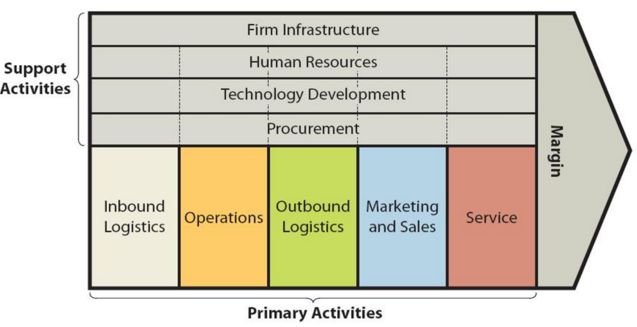
    In 1985, Harvard’s Strategy professor Michael Porter unveiled to the business world in his best-selling book, “Competitive Advantage,” the concept of value chain. It ‘s been revolutionizing business practices for more than 30 years, and inspired approaches as varied as Michael Hammer’s Process Reengineering, Toyota’s Lean Production, Total Quality Management (TQM) and even Software Capability Maturity Model (CMM).

    The value chain’s principle is the notion that in every single company there’s a subset of interactions, staff and skills, processes and practices and tools and infrastructure that repeatedly generates expected benefits. That subset is what’s meant by the value chain; to succeed, businesses must continuously optimize it.

    Today, software development is the foundation of digital products and services; it’s becoming the fundamental industrial activity. By providing the technological, organizational, and operational framework that will enable digital profits, DevOps is replacing the value chain as Porter designed it. It’s the competitive instrument businesses need to make big gains.

    This article, inspired from my next book, “The DevOps Revolution: The IT Organization of the Digital Age,” explains why DevOps is about to revolutionize the way companies tackle their digital business.

    Michael Porter’s Value Chain: Purpose, Foundations and Principles

    The value chain, through focusing companies on their added-value activities and resources, has been revolutionizing businesses’ ability to compete for 30+ years and made several thousands business leaders successful around the globe.

    Figure 1 – The Original Porter’s Value Chain

    What you must know is, the underneath principle is, only a subset of the company’s activities—Primary activities and Support activities—can repeatedly generate expected benefits. That subset is what’s meant by value chain.

    Let’s discuss them!

    Creating Value: The Primary Activities

    The objective of the primary activities is to create value. They include seven activity groups:

    • Inbound Logistics
    • Operations
    • Outbound Logistics
    • Marketing and and Sales
    • Services

    Inbound Logistics performs supply chain functions. It’s a group of key supply chain processes and associated experts, tools and infrastructure. The mission is to make sure the company gets on time the best material to manufacture top products and services.

    Operations refers to manufacturing functions. It puts together the company’s top experts, engineers and product managers to design, develop and test products and services. They take advantage of key processes and industry best practices to make the company’s products and services as innovative and profitable as possible.

    Outbound Logistics performs distributions functions. It’s a subset of the company’s top distribution partner relationships management (PRM) experts mobilized across the company using top distribution processes, practices and tools to make sure the company’s productions and services are properly distributed across its partner networks and make a profit.

    Marketing and Sales, as the names suggest, perform marketing and sales activities. It is a group of the company’s top marketers and salespersons mobilized through top marketing and sales processes and practices to make sure the business make profits.

    Services refers to post sales activities. It’s a group of the company’s best customer relationships management (CRM) experts and associated top processes, practices and tools mobilized to make sure customers have the best experience with the company’s productions and services.

    Making Value Creation Sustainable: Support Activities

    The primary activities do not generate value on their own; they need levers. Their purpose is to be the value chain’s support activities, making sure the company generates sustainable value. They include four activity groups:

    • Firm Infrastructure
    • Human Resources
    • Technology Development
    • Procurement

    Let’s how they enable value creation activities!

    Firm Infrastructure is a group of high-level executive experts appointed to guarantee the company’s infrastructure profitability. Such executive experts include chief information officers (CIOs),  chief technology officers (CTOs) and chief enterprise architects (CEAs), and they rely on top processes, practices and tools such as ITIL, IT Services Capability Maturity Model (CMM) and TOGAF to guarantee the company’s infrastructure profitability.

    Human Resources is a group of the company’s selected recruiting and human resource management experts and the associated top processes, practices and tools. Its mission is to not only make sure the company has the top experts it needs, but also get from them their maximum contribution.

    Technology Development relates to research and development (R & D) activities. It’s an elite of experts dedicated to monitoring markets trends and developing product ad service prototypes likely to create value for the company. They rely on extremely sophisticated product and service engineering processes, practices and infrastructure.

    Procurement relates to a selected group of the company’s investment decision experts. Relying on top financial processes, practices and tools, this group’s mission is to guarantee the maximum return on the company’s investments.

    Why DevOps is the New Value Chain

    Contrary to what many thought leaders, experts and solution vendors pretend, DevOps is unknown; it can’t be narrowed to the complex toolchains IT vendors have been selling to CIOs. Things aren’t that simplistic.

    DevOps According to Chef’s Adam Jacob’s Perspective

    Adam Jacob, co-founder and CTO of Chef, wrote a memorable, article about DevOps: “The Secret of DevOps: It’s Always Been About People, Not Technology.” Relying on his experience working with the inventors of DevOps—Jesse Robins, John Allspaw, Paul Hammond—he provides an unprecedented and accurate perspective of DevOps.

    He reminds this, “Becoming better at building and delivering software is the stake. It’s not an optional piece of their strategy: It’s the future of how their customers want to work with them. Software is table stakes for survival.”

    He adds, “But the real answer lies in looking at what John, Paul, and Jesse were doing in 2009—not in the specific technical choices they made, but the style in which they worked, the essence of what they believed made them high functioning and successful. … Then the challenge begins: how to apply this new style to businesses trying to become better at building and delivering software.”

    He proceeds, “DevOps is about bringing together all the people you need to build and run your business effectively, and empowering them to move as quickly as possible towards their goals. Tools matter. Make no mistake, trying to change the way you work without changing the mechanisms by which you do that work is a futile exercise in excruciating failure.”

    Then concludes, “Fundamentally DevOps is about taking the behaviors and beliefs that draw us together as people, combining them with a deep understanding of our customers’ needs, and using that knowledge to ship better products to our customers.”

    DevOps’ Fundamental Building Blocks

    What’s interesting in Adam’s rhetoric is, two groups of key words and sentences help to bring out two fundamental components of DevOps.

    People, customers, work, work style, beliefs, bringing together people, empowering people are part of the first group. It relates to what experienced and qualified business transformation experts refers to as operational model.

    Technology and tools—and make no mistake, tools matter—don’t the change the way you work without changing the mechanic underneath are all part of the second group. It relates to what experienced and qualified business transformation experts refer to as a technology platform, known by DevOps experts as continuous delivery (CD) platform.

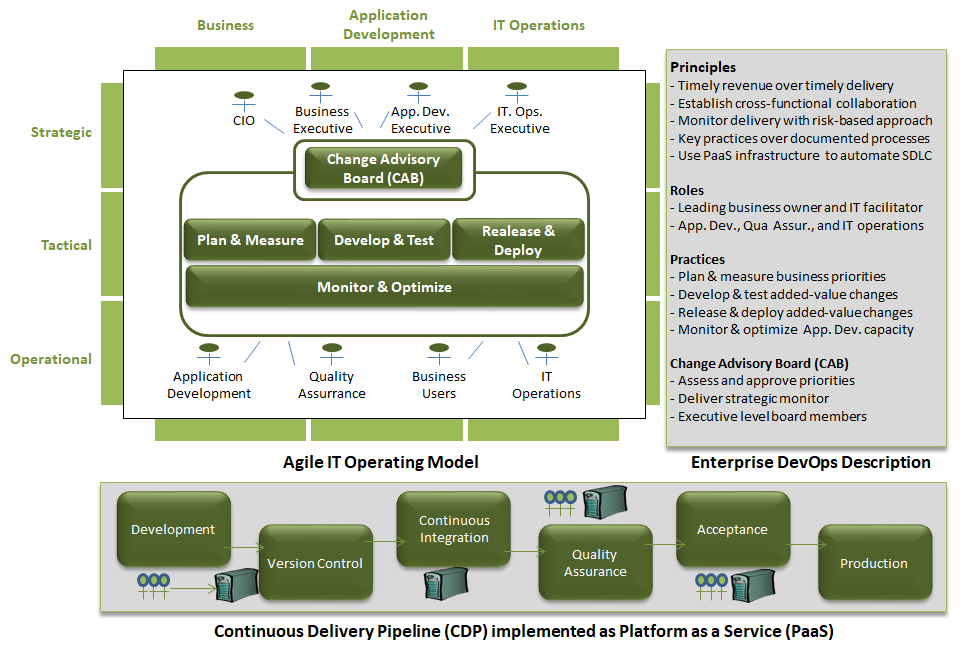
    The following picture is a DevOps model derived from Adam’s perspective. It makes easy its understanding:

    Figure 2 – DevOps as the New Enterprise Value Chain

    As illustrated, DevOps can be modeled as two-components business capability including:

    • The operational model
    • The CD platform referred to in this article as DevOps automation toolchain

    Let’s see how these two components are making DevOps, the powerful business capability CIOs have been expecting!

    The DevOps Automation Toolchain

    The automation toolchain or CD platform is what many either refers to as or confuse with DevOps. It conceptually structures software deployment in four steps:

    • Source
    • Build
    • Test
    • Deploy

    Each stages uses one or more products as illustrated in the following table:

    Figure 3 – Automation Toolchain Features

    The Agile and Lean Operational Model

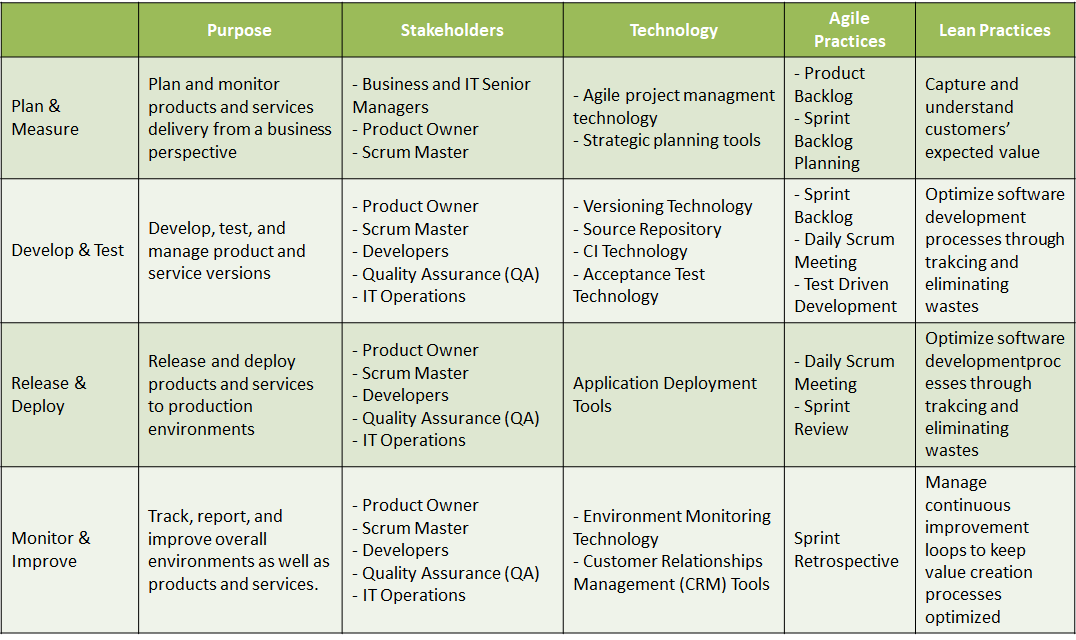
    The operational model is the poor relation of DevOps; it’s totally either unknown or ignored by 98 percent of business leaders and their CIO. It’s where agility, flexibility, responsiveness and even innovation culture are implemented. It organizes the application development effort in a four-step circular life cycle:

    • Plan & Measure
    • Develop & Test
    • Release & Deploy
    • Monitor & Improve

    Each stage mobilizes specific staff and skills, uses specific processes and practices, tools and infrastructure and, more importantly, specific Agile and Lean practices. The following table summarizes each stage:

    Figure 4 – DevOps Agile and Lean Operational Model Features

    Why DevOps is The New Enterprise Value Chain

    One of the problems with the value chain as Michael Porter thought it is, it has a compartmental vision of the business with two categories of activity divided each in several processes and associated staff, skills and tools.

    This perspective nurtures organizational silos and prevent cross-functional collaboration. It slows down problem-solving and decision-making and inhibits innovation culture.

    The value chain as Michael Porter thought it didn’t help Sears Canada to avoid digital bankruptcy, it didn’t prevent Toys R Us and Weight Watchers get on the verge of it.

    Where DevOps brings value and fills the gaps of today’s value chain is, it not only provides a business capability that’s easy to deploy but also an organizational, operational and technological framework embedding the Agile and Lean practices, as well as the automation toolchains companies need to survive their industry disruptions and make substantial digital profits.

    Key Takeaways

    Industry disruptions are a reality and properly transform the business is the only solution. Sears Canada, Weight Watchers and recently Toys R Us learned it the hard way.

    In 2018 make DevOps transformation your priority investment decision, I’m not talking about DevOps’ automation toolchain but DevOps a business capability which includes the Agile and Lean operational model and the automation toolchain.

    — Philippe Abdoulaye