Tag: artificial intelligence

  • How to Make a Self-Healing IT Infrastructure a Reality

    How to Make a Self-Healing IT Infrastructure a Reality

    In 2019, enterprises worldwide reported that every hour of infrastructure downtime cost them an average of $301,000- $400,000. If a system is down for five hours, that’s $1.5 million lost—and that’s on the low end. Five hours of downtime can impact companies for months down the road. It’s in the hands of DevOps practitioners to ensure systems are up and running and budgets are kept in line. But if they don’t have the proper tools on hand that allow them to juggle their responsibilities while adding value to the business, it makes their jobs that much more difficult—or, dare I say, impossible.

    Teams simply can’t afford to go offline to fix incidents, but neither can they afford to manually sift through data to find the root cause. By automating the incident management process, developers have more time to focus on building new products and capabilities that drive revenue. With a self-healing IT infrastructure, teams can tackle these issues before they become larger issues costing millions of dollars.

    Imagine you’re running to catch a bus and your heart rate increases, but when you sit down, it doesn’t come back down to a normal rate. This could quickly become a much larger, even fatal issue. In this instance, the body should “self-heal” to get back to a normal rate. On a similar note, a self-healing IT infrastructure allows teams to quickly get back on track by fixing issues before they become a $1.5 million problem.

    Let’s look at how DevOps practitioners can turn a self-healing IT infrastructure into a reality.

    Self-Healing Infrastructure Needs Observability and AI

    Observability is the practice of collecting deep data from applications and services to provide insights through three core components: logs, traces and metrics. While these three components are essential to a self-healing infrastructure, they are most powerful when used together. Similar to our senses of sight, hearing and touch, they each tell us something different but are equally important. When combining the power of all three, development teams can determine where, when and how an incident occurred and take action as needed.

    We all know the pain of traditional monitoring tools. They don’t surface immediate issues or identify root causes. They rely too heavily on developers to interpret and analyze immense amounts of data then sift through it in a tedious and time-consuming process requiring extra budget for more human power, and extra time to identify and remediate incidents. Using today’s cloud-native self-service approaches to combine observability and artificial intelligence, teams can set up tools themselves that automate the process of gathering and correlating metrics, logs and traces at machine speed to provide a complete, intelligent and actionable picture of what’s happening and why. And that’s where a self-healing IT system starts.

    The Future Is Within Reach

    By ingesting observability data, applying AI to analyze that data and create insights around root causes, then leveraging automation in a closed-loop, dev teams can not only see what’s happening but also take action on it for remediation. When this closed-loop process is done intelligently at machine speed, that’s when self-healing becomes a reality.

    The idea of a self-healing IT infrastructure doesn’t have to be a distant vision. In fact, the democratization of cloud computing and advanced data science have put the required observability technology within reach of teams of any size with any budget. When artificial intelligence and observability come together, DevOps practitioners can operate less and innovate more.

  • Applitools Integrates Testing Platform With GitHub

    Applitools Integrates Testing Platform With GitHub

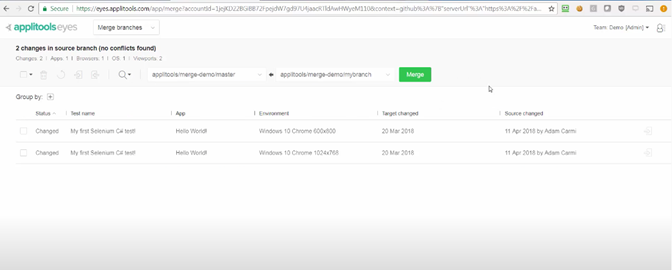
    Applitools announced today that its test automation tools have been integrated with GitHub and GitHub Actions in addition to being available on the Microsoft Visual Studio App Center.

    Company COO Moshe Milman said these integrations make it possible to add testing tools that incorporate machine learning algorithms, dubbed Visual AI, to a DevOps workflow using the Applitools Eyes testing platform. Those tests are run on a cloud platform dubbed Ultrafast Grid.

    The goal is to make it possible to easily correlate code changes across different versions of updates to web and mobile applications using any testing framework and programming language, said Milman. Visual AI can now be applied to every build and pull request, he noted.

    When feature branches are created, Applitools instantly mirrors those feature branches to create a new set of baseline images. That approach simplifies the automated testing of all feature branches without impacting the trunk and its tests, he said, noting as pull requests are merged back in, the integration automatically updates the target branch with the source branch’s baseline images in a way that ensures no conflicts exist between branches.

    The Applitools approach to AI testing also provides developers with more control based on the application use cases, he added. For example, different settings can be applied to test a medical application that requires perfect alignment of pixels versus an e-commerce application that may not require as much fidelity. Developers can then resolve regression issues by employing root cause analytics.

    In general, Milman said the number of organizations that are applying DevOps processes now to the development of both web and mobile applications is increasing. Mobile applications are core to digital business transformation initiatives that have accelerated in the wake of the COVID-19 pandemic. Many of those applications are being built using components that typically are shared through repositories such as GitHub, which Milman noted creates the imperative to integrate testing tools with code repositories and other DevOps platforms.

    It’s still early days as far as applying AI to application testing is concerned. However, it’s now more a matter of when versus if organizations will be relying more on AI to test applications. As the number of testing platforms that include AI capabilities expands, each IT team will need to evaluate which approaches provide the most accurate testing.

    Nor is it clear to what degree AI might reduce the need for dedicated application testing teams. More responsibility for testing applications has been shifting left toward developers for several years now. Nevertheless, an independent test review of an application before it is deployed is always a good idea. AI capabilities in testing tools should reduce the most common mistakes the developers seem to make regularly.

    As part of an effort to make it tools more widely accessible, Applitools also makes Applitools Eyes along with its GitHub integrations available for free for open source projects hosted on GitHub that sign up to be part of Applitools’ open source plan.

    Regardless of how DevOps teams gain access to those tools, the future of application testing promises to be a lot let less monotonous.

  • Tricentis Applies Visual AI to Improve Application Testing

    Tricentis Applies Visual AI to Improve Application Testing

    Tricentis this week announced it has added visual test design and automation technology based on artificial intelligence (AI) to its Tosca platform.

    Dave Colwell, vice president of AI and machine learning at Tricentis, said Tosca 14 automatically recognizes and identifies visual user interface elements and controls across any form factor to identify the most appropriate tests to run as an application is being developed. That approach enables testing to be shifted further left during the application development process as successive iterations of an application are developed, he said.

    While AI has been incorporated into other AI tools, Colwell said Tricentis is applying the same types of machine learning algorithms that are employed to enable self-driving cars to detect objects to the testing of controls included on an application screen.

    Colwell said it’s now only a matter of time before most developers routinely expect testing capabilities based on visual AI technologies to be included in testing tools. Rather than having to continually encounter the same design issues, visual AI will enable developers to craft applications that end users will employ much faster.

    Given the large numbers of applications that many end users haven’t embraced because of user experience issues, there’s clearly a base of developers who could use some advice from AI tools that have been trained to identify common problems that have affected previous generations of applications. Tricentis is now not only committing to providing testing tools but also curating the content required to train AI models.

    It may take a while for developers to fully trust those recommendations, but the number of potential issues that could be averted earlier in the application development life cycle has significant implications for the productivity of DevOps teams. In theory, at least, the number of applications successfully moving through the build process should increase. The amount of testing required after an application is created should also decline as well.

    Less clear is to what degree the shifting of testing of visual elements of an application might have on dedicated application testing teams. Arguably, IT organizations should be able to devote more resources to building versus testing applications.

    Whatever the outcome, AI is not going away. Providers of testing platforms are now effectively engaged in an algorithms arms race. In fact, it’s becoming increasingly apparent AI will be applied with greater frequency across the entire application development and deployment life cycle. It may take a while for IT organizations to adjust to that new reality, but the fact remains that organizations that don’t incorporate AI into their DevOps processes will be at a distinct disadvantage compared to those that do. Members of DevOps teams would be well-advised to start assessing what manual processes today are most likely to be automated by algorithms tomorrow.

    In the meantime, the overall quality of the user experience should also soon improve—assuming, of course, the AI models being created to test applications are indeed being trained properly.

  • ServiceNow Partners With IBM on AIOps

    ServiceNow Partners With IBM on AIOps

    ServiceNow and IBM this week announced that the Watson artificial intelligence for IT operations (AIOps) platform from IBM will be integrated with the IT service management (ITSM) platform from ServiceNow.

    Pablo Stern, senior vice president for IT workflow products for ServiceNow, said once that capability becomes available later this year on the Now platform, IT teams will become on average 20% more productive. This is good timing, as most teams currently are struggling to adapt to the increased demand for IT support from employees working from home and in the office in the wake of COVID-19 pandemic.

    Mike Gilfix, vice president of cloud and integration and chief product officer for Cloud Paks at IBM, said IT teams will also be able to proactively identify anomalies in IT environments 60% faster.

    IT teams interact with IBM Watson AIOps via a chatbox interface such as Slack. The platform will surface recommendations based on ServiceNow data and enable IT teams to query IBM Watson AIOps to provide a faster mean time to resolution for IT incidents, said Gilfix. That capability is provided via a configuration management database from ServiceNow that tracks the operational state of all business services in real-time.

    IBM Watson AIOps, which can be deployed in the cloud or on-premises, also can surface additional context the next time similar issues arise, in addition to being able to record actions and insights for auditing purposes. IT teams can also feed data from other systems into IBM Watson AIOps to automate a wider range of processes.

    AIOps platforms won’t be replacing IT professionals anytime soon. However, IT teams that are not able to access AIOps platforms will find themselves working harder than their peers. As IT environments become more complex, the number of potential issues that can adversely impact end user experience are moving beyond the capabilities of an IT team’s ability to track manually.

    AIOps platforms, meanwhile, continue to advance in sophistication. Given the structured nature of IT environments, IBM Watson AIOps is now able to have a significant impact on productivity with 24 hours of being deployed, Gilfix said. As part of this launch, IBM is expanding its global ServiceNow services offering to include additional capabilities that provide advisory, implementation and managed services on the Now Platform. IBM also has formed an AIOps Elite Team that will help prepare organizations to transition to AIOps free of charge.

    IT may take a while still for IT teams to adjust culturally to AI, but there are many rote tasks that many IT professionals would like to see eliminated. Over time those tasks conspire to increase the level of drudgery IT professionals experience as they perform the same repetitive tasks. In theory, at least, AI should reduce overall IT staff fatigue in a way that could reduce turnover while at the same time freeing up resources to tackle more complex IT challenges.

    It may take some time for IT teams to trust the recommendations surfaced by an AIOps platform, but the more those platforms learn about the IT environment, the more accurate those suggestions become.

  • OutSystems Employs More AI to Accelerate Low-Code Development

    OutSystems Employs More AI to Accelerate Low-Code Development

    OutSystems today at its online NextStep 2020 conference announced it is making more extensive use of artificial intelligence (AI) to accelerate the building and deployment of low-code applications.

    The company unveiled AI Assist to automate, guide and validate processes throughout the application life cycle and Architecture Dashboard, which employs machine-learning algorithms to enable IT teams to visualize complex application architectures.

    OutSystems is also adding Workflow Builder to visually map complex business processes and automatically generate workflow-based applications, and Experience Builder, which enables developers to rapidly prototype mobile applications based on common patterns and flows.

    Finally, OutSystems has added Integration Builder to simplify integration with packaged applications such as those from SAP and Salesforce.

    Mike Hughes, senior director of product marketing for OutSystems, said the AI capabilities being added extend an existing TrueChange capability based on machine learning algorithms that checks for bugs and architecture errors, analyzes the impact of changes to components and application dependencies, provides team and architectural governance and monitors performance in real-time. The goal is to automate as much of the DevOps process as possible on behalf of developers of low-code applications, he said.

    In general, he noted, low-code tools are being embraced by professional developers to accelerate the development of even the most complex applications. In fact, while low-code tools may make it possible for end users to participate in the development process, there are not many so-called citizen developers building low-code applications on their own.

    Adoption of low-code platforms is accelerating at a time when many organizations have increased their reliance of software-as-a-service (SaaS) applications. While each SaaS platform makes available either a low-code or no-code tool for customizing the application environment, Hughes says enterprise IT organizations require tools that enable them to build and deploy custom applications and workflows than span multiple SaaS platforms and on-premises applications. That issue becomes especially apparent to any organization looking to accelerate digital business transformation initiatives in the wake of the COVID-19 pandemic, added Hughes.

    In fact, he noted, the one thing the pandemic has reminded everyone is that change is the only constant. IT organizations need flexible application development and deployment tools more than ever.

    Of course, there’s no shortage of options when it comes to low-code and no-code tools. In fact, Hughes said the distinction between these tools is starting to blur as platforms such as OutSystems make different capabilities available to different classes of developers depending on the use case.

    In the meantime, as the number of low-code applications that are being developed continues to increase, organizations should make sure they have the DevOps processes in place needed to deploy and update these applications more frequently. After all, it doesn’t take long for a backlog of low-code applications waiting to be deployed by an IT team to build.

  • NVIDIA to Create AI Powerhouse by Acquiring Arm for $40B

    NVIDIA to Create AI Powerhouse by Acquiring Arm for $40B

    NVIDIA has announced its intention to acquire Arm from SoftBank for $40 billion as part of an effort to create a juggernaut that will build processors optimized for artificial intelligence (AI) applications that span edge computing deployment to the cloud.

    Under the terms of the proposed deal, Arm will operate as a subsidiary of NVIDIA and will continue to headquartered in Cambridge, UK. NVIDIA will pay to SoftBank a total of $21.5 billion in NVIDIA common stock and $12 billion in cash, which includes $2 billion payable at signing. SoftBank will retain a 10% stake in NVIDIA.

    NVIDIA CEO Jensen Huang during a conference call also committed to licensing the software NVIDIA uses to make graphical processor units (GPUs) using the same licensing model Arm has employed to encourage manufacturing partners to create processors based on its designs. In theory, that approach could substantially lower the cost of GPUs once the deal closes.

    However, because of all the regulatory approvals required, Huang said NVIDIA could not commit to a timeframe for the close of the deal. Previously, Huang noted it took NVIDIA a year to close the acquisition of Mellanox, a provider of storage and networking infrastructure.

    In addition to providing processors that drive gaming and CAD/CAM applications, GPUs from NVIDIA are widely employed to train AI models more efficiently than x86 processors from Intel or AMD. Processors from Intel are used more often to run the inference engines for an AI model once it is deployed. With the acquisition of ARM, NVIDIA gains access to processor technology that is emerging as a rival architecture for deploying AI models on a wide range of server and mobile computing platforms. Currently, Arm is best known for providing processors for mobile computing devices such as smartphones, which eventually will also be infused with a wide variety of machine and deep learning algorithms.

    In the meantime, many organizations continue to struggle with implementing AI. It typically takes a team of data scientists six months or more to build an AI model. Once that model is built, it then needs to be incorporated into an application as part of a DevOps workflow. In the meantime, business assumptions may change, rendering the AI model irrelevant. That requires the data science team to build a new AI model. In addition, as new data sources become available, AI models need to be updated. Most organizations are just now defining the processes for building and deploying those models, otherwise known as machine learning operations (MLOps), using many of the principles that were first defined by DevOps teams.

    Once those MLOps processes are defined, of course, IT teams then need to meld MLOps and DevOps workflows to keep applications that are updated more frequently synchronized with the AI model on which those applications increasingly depend.

    At this point, it’s clear every application will incorporate some level of AI. However, the speed at which AI might become pervasive is not likely to be all that fast anytime soon.

  • Eggplant Employs AI to Surface Test Recommendations

    Eggplant Employs AI to Surface Test Recommendations

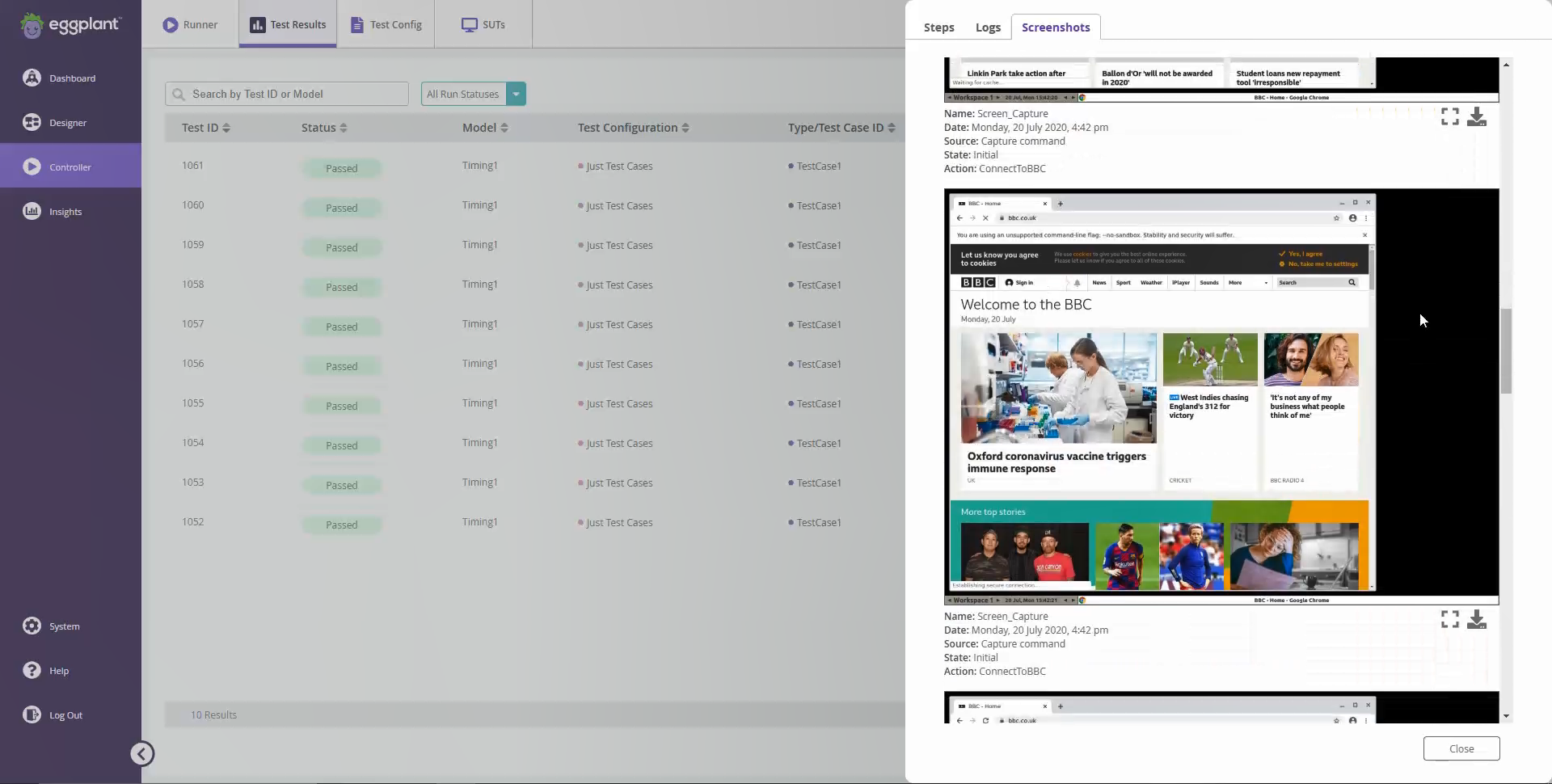
    Eggplant this week announced it has extended the capabilities of its application testing platform infused with machine and deep learning algorithms to now include recommendations to help improve tests.

    In addition, the latest update to the Digital Automation Intelligence (DAI) Platform makes it easier to onboard new members to an application testing team.

    Finally, Eggplant is making it easier to capture snapshots of the testing environment to more easily identify areas that require additional test development.

    Eggplant COO Antony Edwards said the goal is to extend a low-code platform that employs modeling tools to make testing more accessible to both developers and end users. There is simply not enough testing expertise available to keep pace with the rate at which applications are now being developed thanks mainly to the rise of DevOps, he noted.

    By employing a testing platform based on a low-code platform that enables tests to be created using modeling tools, it becomes feasible to include more end users in the testing process, he said. Generally, end users have the best understanding of how an application should function, so including them in the testing process also yields higher quality applications that will be accepted sooner, Edwards added.

    Eggplant, which was just acquired by Keysight Technologies, has been making a case for applying artificial intelligence (AI) to application testing to increase the overall capacity of testing teams. Using AI makes it possible to conduct more than 100 tests in parallel because most of the mundane tasks associated with building and updating tests have been automated, said Edwards.

    There will always be a need to include humans in the testing process, but Edwards noted AI can augment the capabilities of testing teams in a way that not only allows more tests to be conducted faster but also ensures more resources are allocated to writing code, versus continually debugging applications.

    Many IT organizations are now caught up in a vicious DevOps cycle. They can develop more applications faster, but the more applications they develop the more time they need to spend debugging them. Ultimately, organizations find themselves spending more time debugging existing applications than developing new ones. AI-infused testing tools break that cycle by identifying issues before applications are deployed, which is when they are easiest and least costly to fix.

    Breaking that cycle has become more of an imperative because in the age of microservices, the overall application environment is becoming more complex, Edwards said. Most testing teams are not going to be able to create the tests needed to assure the quality of those applications unless it becomes possible to generate more sophisticated tests using modeling tools that automate much of the process.

    Naturally, it may take some organizations time to trust the tests and recommendations generated by an AI platform. However, in the wake of the economic downturn brought on by the COVID-19 pandemic, it’s apparent DevOps processes need to be streamlined. Arguably, one of the best places to begin that process is by automating as much of the application testing process as possible.

  • The Role of AI, ML-Powered DevOps in Digital Transformation

    The Role of AI, ML-Powered DevOps in Digital Transformation

    Global businesses are in the midst of an enormous digital transformation wave. As we step into the realm of industry 4.0, exponential technologies are becoming a fundamental segment of traditional business settings.

    Despite having access to transformative technologies, however, many organizations fail to embrace disruption and harness their potential to stay ahead of the curve. Much of this stems from their inability to foster a collaborative environment wherein myriad teams and operating IT systems work in unison to achieve their goals. Without a strong foundation of infrastructure automation and well-chosen team collaborations, embarking on the digital transformation journey is difficult. And to do that, adopting a DevOps mindset is necessary. In essence, organizations need to incorporate DevOps practices to transform, compete and protect their new value pools without sacrificing quality, stability and productivity.

    Digital Transformation and DevOps

    DevOps helps enterprises succeed with digital transformation by triggering a paradigm shift in the cultural mindset of the business, breaking down silos and driving continuous change and rapid experimentation.

    There are multiple benefits of merging DevOps with a digital transformation strategy. First, this methodology breaks down the silos between IT and business operations, thereby ensuring consistent levels of productivity, efficiency and service delivery. This has a direct impact on companies’ time-to-market. Second, bug fixes are much easier due to the automation of toolchains. Third, the automation that DevOps introduces improves developer/IT productivity as they can focus more on innovation rather than being caught in a cycle of bug-fixing and firefighting.

    Despite DevOps’ contribution to digital transformation, its adoption in many industries is still slow due mainly to scarcity of skills and the right toolset. Complete automation remains elusive. Additionally, patchy adoption has given rise to a two-paced overall technology environment—one part is fully integrated with DevOps and the other part is users still mulling over the “how” of tightly integrating it in the overall process.

    Advanced technologies such as artificial intelligence and machine learning could resolve these issues. They can alleviate operational complexities in DevOps to help organizations transform at a faster pace. The following are some of the benefits offered by these technologies.

    Better Automation

    The need to rely on manual processes can be reduced with AI- and ML-based technologies, which has an enormous impact on data analysis. Organizations can use powerful AI data mapping techniques to automate data transformation processes with ease and speed. They can make use of the predictive ability to accelerate the process, increasing accuracy by leaps and bounds. This transformed data can be easily integrated using another solution AI integration, and so it becomes easier for users to work on data for extracting business intelligence and streamlining decision-making. This entire process takes only a few minutes to complete. Plus, since the need for manual intervention is curtailed, developers who previously were mired in handling transformation operations can move on to more strategic tasks such as governance, control and resource planning.

    Better Security Through Intelligent Anomaly Detection

    AI and ML-powered technologies, with their highly precise features, augment system security to deliver better performance. With a centralized logging architecture, users can record and root out suspicious activity on the network. These technologies togehter with DevOps can help mitigate the impact of threats and hacker attacks to help companies drive their digital transformation initiatives with precision.

    Better Team Collaboration

    In any organization, two teams function in parallel: the developer team, which has the responsibility to code fast, and the operations team, which ensures minimal disruption. While maintaining this balance can be difficult, transformative technologies such as AI and ML can help these two teams work in unison, improving collaboration by helping them have a single, unified view into system issues across the business ecosystem.

    Better Customer Experience

    AI-based technologies can have a direct impact on organizational productivity and performance. They can develop and launch their products faster (keeping customer expectations in mind) with lower TCO. Plus, DevOps-inspired service teams are able to provide a higher level of service, resulting in more satisfied customers

    AI-powered technologies are critical to kickstart DevOps performance and ultimately drive digital transformation initiatives. Infusion of AI not only improves enabling faster development and deployment cycles through automation, but also enables better collaboration and uncovers and remediates key issues, helping businesses unlock digital transformation value.

  • Juniper Networks Brings AI to SD-WANs

    Juniper Networks Brings AI to SD-WANs

    Juniper Networks today announced it can now apply the same artificial intelligence (AI) engine it uses to automate the management of wireless local area networks (LANs) to software-defined wide area networks (SD-WANs).

    Based on an AI engine that Juniper Networks gained when it acquired Mist Systems, the Juniper Mist WAN Assurance cloud service streams telemetry data gathered from Juniper SRX devices to an AI engine that advises IT teams on how to best set WAN service levels as part of a larger transition to intent-based networking.

    As part of that initiative, Juniper Networks is also providing access to a Marvis conversational interface originally developed by Mist to enable IT teams to verbally issue commands, replacing the traditional command-line interface (CLI).

    Christian Gilby, director of product marketing for Juniper Networks, said as the number of remote branch offices that IT organizations need to manage increases at a time when travel is limited, the need to apply AI to SD-WANs has never been more apparent.

    Rather than return to central offices in the wake of the COVID-19 pandemic, Gilby noted, many organizations are shifting staff to smaller remote offices to enable collaboration while continuing to minimize potential exposure to anyone who might be infected.

    The challenge is that many IT teams tasked with managing the WANs that connect those remote offices aren’t growing during the downturn caused by the pandemic. AI provides a way to troubleshoot and optimize WAN performance without having to increase network operations headcount, Gilby said.

    Platforms such as the Juniper Mist WAN Assurance cloud service provides the added benefit of never forgetting anything they learn or taking a day off.

    Gilby said it’s not likely AI systems will replace the need for network operations teams anytime soon. However, Juniper Mist WAN Assurance is part of a larger wave of AIOps technologies that are augmenting existing IT staff. It may take a while for them to trust the optimizations being made by AIOps platforms, but the more data those systems collect, the more accurate they become over time.

    In the case of a cloud service, the machine learning algorithms that drive the AI models are being trained continually using anonymized data collected from thousands of systems.

    The launch of Juniper Mist WAN Assurance comes at a time when more organizations are looking to embrace SD-WANs as a way to more easily scale the delivery of network services when employees are working from home for the foreseeable future. In many cases, IT teams are now dropping Mist wireless routers into home offices to extend the reach of SD-WAN services in a way that can be managed and optimized using the same core AI technologies, said Gilby. In its most recent quarter, Juniper Networks reported a 170% rise in orders year-over-year for Mist wireless LANs.

    It remains to be seen how much or how quickly networking operations will be transformed by AI. However, at this point, that transformation is all but inevitable.

  • AIOps Greasing the Wheel of Digital Security amid COVID-19

    AIOps Greasing the Wheel of Digital Security amid COVID-19

    Amid the most challenging era for business infrastructures and transformations, AIOps (AI for IT Operations) can help industries operating in the digital environment to be vigilant when it comes to network operations or the digital security measures.

    AIOps has the potential to significantly align well with the cybersecurity needs of a company. A cybersecurity department in every organization needs to be active with respect to the latest and innovative security-related solutions. Threat detection and data security are crucial for every business entity.

    The corporate networking infrastructure for communication purposes is always under the threat of unauthorized third-parties that try to access confidential communications. Whether they are wireless, wired or connected to internet of things (IoT) devices. AIOps, through its intelligent algorithms, detects the communication requests and their source to accept them and restrict the fraudulent entities from becoming part of the legitimate network. Visibility and speed are two important aspects of platform security. If the source of the incoming request is known, it would be easy to verify it.

    The following are some of AIOps applications:

    Regulatory Framework

    General Data Protection Regulation (GDPR) corresponds to the protection of online customer data online. Businesses are required to ensure enough security measures to protect the personal and financial information of customers stored in an online account from identity theft and data breaches. AIOps can be used to secure the data from unauthorized third-party access in order to comply with the regulatory requirements.

    Real-time Data Processing

    In this era, communications, connection, data transmission and storage activities are performed online. Real-time data collection and processing in AIOps help streamline the operations and ensure the security of platforms in a centralized database. Technologies are shaping future investments. Enterprise management with respect to the performance attributes such as data analysis and monitoring for controlled access are in high demand. Advanced automation techniques have become possible with the innovative AIOps that help undergo operations in efficiently, eliminating the time-consuming and frustrating manual tasks. Machine learning and artificial intelligence algorithms collectively help reduce the overall response time, provide optimal user experience and protect network systems.

    Applications of AIOps amid the COVID-19 outbreak pave the roads for leading challenges. The rapid digital transformations during the pandemic are giving birth to various challenges with respect to security, user experience and the downfall of industries. Businesses are revamping operational infrastructure and fraudsters are actively exploiting vulnerabilities in the digital environment. The density with which the fraud is increasing each passing day is high. AIOps, under these circumstances, help businesses take into consideration vigilant security measures. The innovative solutions employ AI algorithms for the security of online platforms.

    Information Security and AIOps

    Information security highlights three major factors: confidentiality, integrity and availability. Confidentiality takes into account the need for protecting confidential customer information. Integrity keeps the form of data intact and availability ensures that the data is present at the moment when it is required. AIOps help ensure this CIA triad of information security through its high potential applications online security.

    High-scale data breaches, identity theft, account takeover frauds, malicious executables injection and similar cyberattacks are due to the uncontrolled access over user accounts and data. The list of fraud calls for stringent actions that AIOps provides in the form of digital security. The AI-powered identity verification systems help verifies the identity of customers online before onboarding them. Biometric sign-in every time while accessing the accounts help mitigate the risk fo fraud and bad actors that become the reason for malevolent activities. The spoofing detection and prevention techniques use AIOps that identify the spoofing elements in user-uploaded identity proofs and discard their communication request, which in return curb the likelihood of cyberattacks.