Tag: artificial intelligence

  • Enterprise ML Investments on the Rise

    Enterprise ML Investments on the Rise

    The second wave of enterprise artificial intelligence and machine learning (AI/ML) adoption is building, and is expected to crest in 2021, as many organizations increased and accelerated their investments in tools and people.

    That was one of the unmistakable conclusions of our 2021 enterprise trends in machine learning report: 83% of the companies we surveyed said their AI/ML budgets had increased year-over-year, and we found that the average number of data scientists they employ has increased by 76% year-over-year. These changes came even as many organizations tightened their overall spending and refocused their strategic priorities amidst all of 2020’s disruption and uncertainty related to the COVID-19 pandemic. These companies aren’t simply moving forward with their AI/ML initiatives in spite of the pandemic; they’re doubling down on their investments because of it.

    Many organizations have begun to understand just how critical ML is to remaining competitive in uncertain and rapidly evolving conditions. When we ran a separate survey during the summer of 2020 to find out how businesses adapted to the pandemic’s impacts, it revealed a renewed sense of urgency around AI/ML investments: 43% of respondents said that AI/ML mattered “way more” to their business than they’d previously realized.

    Our independently conducted 2021 report included input from more than 400 leaders and practitioners across a diverse mix of technical and business functions, all of whom have a stake in their organization’s AI/ML strategy. They’re not just increasing their spending and staffing, either – they’re accelerating their pursuit of a growing number of enterprise ML use cases, with customer experience and automation leading the way.

    You need to be doing this, too. The second major wave of enterprise AI/ML adoption is underway, and you can still capitalize on the immense opportunities ahead. But the time to act is now. Organizations that take a “wait-and-see” approach are at risk of being left behind, particularly as so many other companies are scaling up their investments. Not only are your competitors increasing their AI/ML budgets (evident in the 83% YoY increase mentioned above), but they are moving their initiatives to the top of their strategic priority lists. Approximately three out of every four respondents (76%) in our 2021 report said they are prioritizing AI/ML over other IT initiatives, with 28% reporting that it is their top priority overall. These companies have realized that their success is directly tied to their ability to adapt to rapidly changing business conditions — and that AI/ML is the key to doing so.

    This is no longer the sole purview of elite technology companies. Companies of all sizes, across just about every industry, can get up and running with AI/ML, thanks in large part to the spread of easy-to-use tooling. The opportunities are more accessible than ever. You don’t need a ton of time or resources to get started — and it’s absolutely crucial that you do so soon.

    Your competitors are actively pursuing AI/ML initiatives today, regardless of your specific industry. We’re seeing many longstanding enterprises begin to drive huge transformations of their businesses and industries with AI/ML. More and more use cases are being pursued in legacy industries, from insurance to agriculture, healthcare to financial services and more. The bellwether financial firm JPMorgan Chase, for example, has even built an entire AI research program and data platform. There are virtually no industries where this is irrelevant. So, you need to act with urgency, as this second wave of enterprise adoption intensifies.

    You also need to build for operational efficiency and scale. We think of this as industrializing your machine learning operations (MLOps). While easy-to-use tools reduce the barrier to entry, they only get you partway to your destination. Invest in repeatable, automated processes or you’ll hit a wall of technical debt and other potential issues. MLOps paves the road to tightly integrated, well-aligned technology stacks, processes and teams that make it easier, not harder, to deploy more models in the future. This isn’t something you can wait on; if you’ve manually bootstrapped the deployment of even a handful of models to production, you need MLOps. Without it, you’ll quickly accrue unnecessary technical debt that will inevitably hinder your organization’s ability to scale and deliver meaningful business value.

    This is already a significant issue. Our 2021 report found that, while many organizations are increasing budgets and prioritization, it’s taking them longer to get models into production. Data scientists are still spending too much of their time on operational tasks, a problem that worsens as the number of models in production increases. This tells us that even as many organizations increase their spending and hiring, they’re actually allocating more of their growing resources toward manually scaling their AI/ML initiatives instead of investing in the operational efficiency that will maximize results.

    There’s a better way. Organizations no longer need to take a DIY approach to MLOps. There are robust solutions that can simplify many of the complex issues involved in scaling your AI/ML initiatives in production. Our report found that companies that use third-party MLOps solutions see improved outcomes compared with companies that go it alone and build and maintain everything themselves. They spend less on infrastructure, deploy models to production faster and tie up less of their data scientists’ time on model deployment.

    The pattern here is clear. Regardless of your particular industry, more and more businesses are identifying a growing list of use cases for AI/ML that can help transform their businesses and boost their competitiveness. They’re industrializing their AI/ML initiatives with MLOps to ensure their technology stacks, processes, and people are well-aligned. And, by doing so, they’re positioning themselves to rapidly adapt to and act on changing signals in their businesses.

    Don’t make the mistake of thinking AI/ML doesn’t apply to you or your industry. Doing so would mean missing out on potentially massive strategic opportunities, from new or growing revenue streams to increased efficiencies throughout your business operations. Your competitors are doing it; it’s easier than ever to get started and third-party MLOps solutions can help minimize technical debt and other operational complexity that will otherwise limit the positive business impacts of your initiatives.

    You can absolutely get in on the second wave of enterprise adoption, but the time to act is now. You can’t afford to wait.

  • 5 Best Machine Learning Use Cases

    5 Best Machine Learning Use Cases

    Many industries are struggling with the ongoing COVID-19 pandemic, and the IT industry itself and the broader trend of transition to remote work over the last year revealed many areas where traditional approaches to managing businesses created unnecessary waste. Data science and its counterpart, machine learning, revealed that expansion in the ways technology can facilitate new ways of working is nearly limitless.

    Machine learning uses powerful algorithms to discover insights based on real-world data. These insights can then be used to make predictions about future outcomes. As new data becomes available, machine learning-enabled programs can automatically adapt and produce updated predictions. As with any tool, machine learning is not a silver bullet. However, there are many situations in which the technology can outperform linear and statistical algorithms.

    Here are five of the most common use cases where machine learning can make a big difference:

    When engineers can’t code rules for certain problems. Many human-oriented tasks (such as recognizing whether an email is spam) aren’t solvable using simple (deterministic), rule-based solutions. Because so many factors may influence an answer, engineers would have to write and frequently update billions of lines of code. In addition, when rules depend multiple factors and when those rules overlap or need fine-tuning, it becomes difficult for humans to code precise rules. Fortunately, machine learning programs don’t require users to encode actual patterns. These programs only need proper algorithms to extract patterns automatically.

    When you need to scale a solution to millions of cases. In finance, for example, you might be able to manually categorize a few hundred payments as either fraudulent or not. However, this becomes tedious or impossible when dealing with millions of transactions. As user bases grow, it’s no longer feasible for organizations to process payments by hand – end-users today want answers about their money in milliseconds, not minutes or hours. Machine learning solutions are effective at handling these types of large-scale problems with little to no human intervention.

    When you can do it manually, but it’s not cost-efficient. There are situations in which in-house experts could process many requests quickly and accurately, but at a high cost. For instance, imagine you assess DMV forms for in-state and out-of-state car purchases to determine their validity before passing them on. In this situation, the business processes are well-defined, optimized and serialized. It may take only a few minutes to check each form thoroughly. But allocating so much manual labor to this work is likely not the best use of your budget. Machine learning, on the other hand, offers predictable, pay-as-you-go pricing for fully scaled operations.

    When you have a massive dataset without obvious patterns. Consider this – you’ve successfully prepared a well-curated dataset and know the underlying problem you’re trying to solve. However, you don’t see any explicit patterns in the data, preventing you from encoding those validations. Plus, there are many typos, missing fields, and other human-caused errors with no validation in place. You may even know the data is poor quality and can manually determine every affected row. But you can’t see any actual connections between valid and invalid records. Machine learning algorithms can solve this problem. They can find hidden connections between data points that aren’t clear to humans. Tools like interpreting tracers can even describe how machine learning models arrived at their conclusion(s).

    When you live in an ever-changing universe (adaptive). The world, and its problems, are always changing. A problem you solved yesterday can, today, easily mutate into something else entirely, rendering your previous solution inefficient or even useless. For example, if your organization processed medical appointment records to extract diagnoses, procedure information and billing codes, your rules might have to evolve constantly. However, you can’t make updates in real-time, 24/7. Meanwhile, incorrectly labeled items could lead to insurance rejections, huge fines and legal penalties. One major advantage of machine learning methods is that they can learn from data across the entire life cycle of your application – from the first line of code written to the moment when the model is finally shut down. Moreover, it’s important for production-grade systems to have feedback loops so that you can catch the moment when your model no longer solves problems correctly.

    It’s important to remember that machine learning is a tool – it’s not magic. Machine learning models are, essentially, advanced math-based algorithms, which identify patterns in data and learn from them. However, when properly applied to the right use cases, machine learning can reduce the amount of time spent on error-prone manual IT operations, adding significant business value and greatly reducing IT costs.

  • AIOps Builds Organizational Efficiency, Survey Finds

    AIOps Builds Organizational Efficiency, Survey Finds

    Enterprises entered 2020 with big plans. Post-pandemic, AIOps could help them achieve those goals, according to a new research survey from Digitate and CorporateLeader.

    Enterprises entered 2020 with the best-laid plans; many had efforts lined up to expand their use of cloud services and continue their steady efforts to digitally transform their businesses. Then the pandemic happened, and business and IT teams found themselves scattered and with a new playbook: make the organization as effective as it can be while working remotely.

    This sudden shift to remote work exacerbated existing challenges within organizations, from managing hybrid environments, personnel management challenges and teams finding themselves struggling to adjust. Meanwhile, enterprises still had to focus on staying ahead of their competitors technologically. All of these challenges meant there was no room for wasted or time-consuming efforts to manage the underlying business-technology systems.

    To help increase efficiencies, some contend that the answer is artificial intelligence for IT operations, or AIOps. Proponents of AIOps say that AI is needed to augment human decision-making today because of the complexity of modern enterprise environments. Today’s environments often find their operational data spread across on-premises and multiple cloud systems. The result is difficulty in managing infrastructure issues as they arise, and the considerable time it takes to identify and fix IT issues.

    According to a survey of leading European IT analysts and advisories, conducted in fall 2020 by operations automation software provider Digitate and executive network forum CorporateLeaders, the drudgery of managing routine tasks was the most commonly cited reason for turning to AIOps, which was followed by “no proactive capability of detection and correction of system issues” at 64% and “no flexibility to scale with business needs,” also cited by 64% of respondents.

    When respondents were asked to identify the key benefits of AIOps, they highlighted common strategic and operational issues that hinder performance. According to respondents, these include the removal of manual processes (91%), improvements in agility and reliability (82%) and reach predictability (73%). More swift problem resolution also was cited by 73% of respondents.

    In a case study shared within the CorporateLeaders report, Marion Fokkinga, technology advancement manager at Netherlands-based semiconductor maker NXP explained that NXP’s move to AIOps was driven by the company’s swift expansion. “Since 2015, we have been busy with multiple merger and acquisition projects,” Fokkinga explained. “As a result of this, there was less time for innovation and transformation in IT and in the business.”

    The company set out to automate routine operations tasks with AIOps so that their resources could be freed to focus on higher-value tasks. According to Fokkinga, AIOps enables tasks, such as report generation, that previously consumed half a workday to be completed in several minutes. Saving time is the most significant result, said Fokkinga. With AIOps, NXP reports a 97% improvement in incident response time and a 95% reduction of manual effort in some of its supply chain planning work.

    Of course, in the current treacherous business environment, there’s a lot more at stake than simply building enterprise operational efficiencies. Over time, it may come down to the very success of the organization. According to the survey, a full 82% of respondents said that AIOps is necessary to the future growth and transformation of their business. “Respondents who went on to give qualitative answers later in the survey explained that the complexity of hybrid and multi-cloud infrastructures, increasing transactional volumes and the criticality of online business systems make it impossible for traditional IT systems to manage every application and infrastructure without recourse to automation. It was highlighted that the overwhelming amount of data in today’s Operations are simply beyond human analysis capacity,” the report stated.

    One respondent said that, through AI, the performance of some tasks and decisions were improved, as routine tasks were eliminated. That has to be welcome news to enterprises struggling to remain competitive while simultaneously striving to remain productive and agile during a global pandemic.

  • Accelerating AIOps with the Mainframe

    Accelerating AIOps with the Mainframe

    AIOps uses artificial intelligence by combining big data, analytics and machine learning to enhance IT operations. To successfully adopt and scale AIOps, it is critical for enterprises to add the mainframe to the equation. Adopting AIOps requires a holistic approach focused on business processes and workflows. The resiliency of a workflow depends on the health of every link in the chain. In order to be successful, you need visibility and insight throughout the entirety of the workflow.

    In this interview, Maneesh Goyal, AIOps Offering Management program director at IBM, explains how AIOps is changing IT operations and why the mainframe is so critical to the success of AIOps adoption.

    Maneesh is a DevOps expert with over 24 years of experience leading operations and management across hybrid and public cloud environments, including IBM Z. He is also one of the distinguished speakers presenting at Open Mainframe Virtual Summit, along with Mürsel Taşgın, mainframe systems manager at Credit Bureau of Turkey. During their session, Maneesh and Mürsel will discuss how organizations such as Credit Bureau of Turkey are accelerating AIOps by leveraging the wealth of operational data on IBM Z to make quick and accurate decisions in order to improve resiliency.

    Learn more about IBM’s AIOps framework and assessment to determine the next step for your business by attending Maneesh and Mürsel’s session at Open Mainframe Virtual Summit on Feb. 11. To check out the full agenda or to register for free, visit the Open Mainframe website.

  • Measuring the Business Benefits of AIOps

    Measuring the Business Benefits of AIOps

    Staffing levels within IT operations (ITOps) departments are flat or declining, enterprise IT environments get more complex by the day and the transition to the cloud is accelerating. Meanwhile, the volume of data generated by monitoring and alerting systems is skyrocketing, and Ops teams are under pressure to respond to incidents more quickly.

    Faced with these challenges, companies are increasingly turning to AIOps – the use of machine learning and artificial intelligence to analyze large volumes of IT operations data – to help automate and optimize IT operations. But before investing in a new technology, leaders want assurances that it will bring value to end users, customers and the business at large.

    Leaders looking to measure the benefits of AIOps and build KPIs for both IT and business audiences should focus on key factors such as uptime, incident response and remediation time and predictive maintenance to prevent outages that could affect employees and customers.

    AIOps KPIs include employee productivity, customer satisfaction and web site metrics such as conversion rate or lead generation. AIOps can help companies cut IT operations costs through automation and rapid analysis; it can support revenue growth by enabling business processes to run smoothly and deliver excellent user experiences.

    Specific IT and Business Benefits

    AIOps can digest operational data and spit out actionable recommendations for keeping important systems running at peak efficiency. These are the most-cited benefits of the technology:

    • Alert management: In most cases, the first problem AIOps systems will address is reducing the volume of noise: the torrent of alerts that inundate IT operations. AIOps uses clustering and pattern matching algorithms to eliminate as much as 90% of false alarms and other redundant or irrelevant alerts, making it far easier for staffers to focus on what really matters.
    • Incident prioritization and routing: AIOps systems can learn, over time, which types of alerts should be sent to which teams, reducing redundancy and confusion when, say, networking and database teams both get the same alert related to an incident.
    • Event correlation: AIOps can correlate alerts and event data to identify the root cause of an outage or application slowdown so that IT teams can respond faster.
    • Advanced anomaly detection: AIOps systems can identify anomalies to proactively detect abnormal conditions and relate them to business impact. For example, AIOps can predict if a system will run out of disk space based on projected growth or seasonal patterns, even if the growth is non-linear. Or, if there’s a sudden increase in the number of failed server requests, the technology can determine whether the server in question is handling a mission critical task or simply performing routine backups.
    • Automation: AIOps can be used to handle routine tasks such as backups, server restarts and other low-risk maintenance activities which otherwise involve heavy manual effort.
    • Predictive analytics: A more advanced use case could involve predicting events before they happen – such as detecting when network bandwidth is reaching its limit or storage capacity is nearing threshold.

    Seven KPIs for AIOps

    These common KPIs can measure the impact of AIOps on business processes:

    1. Mean time to detect (MTTD): This KPI refers to how quickly it takes for an issue to be identified. AIOps can help companies drive down MTTD through the use of machine learning to detect patterns, block out noise and identify outages. Amid an avalanche of alerts, ITOps can better understand the importance and scope of an issue, which leads to faster identification of an incident, reduced downtime and better performance of business processes.
    2. Mean time to acknowledge (MTTA): Once an issue has been detected, IT teams need to acknowledge the issue and determine who will address it. AIOps can use machine learning to automate that decision-making process and quickly make sure that the right teams are working on the problem.
    3. Mean time to restore/resolve (MTTR): When a key business process or application goes down, speedy restoration of service is key. ITOps plays an important role in using machine learning to understand if the issue has been seen previously and, based on past experiences, to recommend the most effective way to get the service back up and running.
    4. Service Availability: Often expressed in terms of percentage of uptime over a period of time or outage minutes per period of time, AIOps can help boost service availability through the application of predictive maintenance.
    5. Percentage of automated versus manual resolution: Increasingly, organizations are leveraging intelligent automation to resolve issues without manual intervention. Machine learning systems can be trained to identify patterns, apply solutions, such as previous scripts that were executed to remedy a problem, and take the place of a human operator.
    6. User Reported versus Monitoring Detected: IT operations should be able to detect and remediate a problem before the end user is even aware of it. For example, if application performance or web site performance is slowing down, ITOps should get an alert when the issue can be measured in milliseconds; they can then fix the issue before the slowdown worsens and affects users. AIOps enables the use of dynamic thresholds to ensure that alerts are generated automatically and routed to the correct team for investigation, or automatically remediated when policies dictate.
    7. Time savings and associated cost savings: The use of AIOps, whether it’s to perform automation or more quickly identify and resolve issues, will result in both operator time savings and business time-to-value improvements. These have a direct impact on the bottom line.

    These seven AIOps KPIs can be correlated to business KPIs around user experience, application performance, customer satisfaction, improved e-commerce sales, employee productivity and increased revenue. ITOps teams need the ability to quickly connect the dots between infrastructure and business metrics so that IT is prioritizing spend and effort on real business needs. In the future, as machine learning matures, AIOps tools may even recommend ways to improve business outcomes or provide insights as to why digital programs did or did not succeed.

  • AI Everywhere Requires MLOps and NetDevOps to Intersect

    AI Everywhere Requires MLOps and NetDevOps to Intersect

    As xOps workflows become more prevalent in IT, it’s inevitable to see overlap and intersection between them. In networking, NetDevOps has been a hot topic for the past three years. NetDevOps focuses on bringing automation, simulation and validation workflows to network operations. The goal is to reduce errors in production configuration deployment, reduce time to production and create a collaborative workflow across cross-functional teams and network team members.

    MLOps followed a similar trajectory, but with a focus on machine learning workflows. As networking evolves and machine learning and artificial intelligence (ML/AI) start to become more prevalent in all of IT, it’s inevitable that these different operational workflow methodologies start to intersect. NetDevOps evolved out of DevOps, applying lessons learned from software development workflows and applying them to network development. As the conversation shifts to ML/AI, the question currently facing many cutting-edge networking professionals in the data center space is, “Where do NetDevOps and MLOps intersect?”

    The Intersection of MLOps and NetDevOps

    Machine learning and artificial intelligence are most commonly applied to networking in three basic ways:

    • Autonomic networks
      • Intent-based configurations
      • Network devices that self-configure based on contextual information
    • Self-healing networks
      • React to network events to mitigate downtime
    • Telemetry analysis and correlation
      • Take streaming telemetry data and correlate it in a meaningful way

    All the above applications can be implemented in fairly simple ways, and many networks today have at least some variation of these technologies already applied. The challenge is that the majority of these current implementations don’t use true ML/AI. They tend to use decision trees or switch-case conditionals to create conclusions. These conclusions are reached by feeding in a pre-coded set of expected outputs. This requires large datasets, which already exist for fields like image recognition. For instance, it’s fairly easy to confirm the technology is seeing pictures of a banana; although, if the data set is, say, 100,000 images, it may take a very long time to do so manually. ML engineers tend to use existing datasets for this exact reason, but the problem is, few of these datasets exist today in the networking realm.

    Creating a solid, structured ML workflow requires a model that can be trained. This model can iterate multiple times and derive conclusions that do not need to be preprogrammed. In essence, we are trying to create these big datasets ourselves (using automation, of course) instead of relying on existing ones. But to develop such a model, certain foundations are required.

    NetDevOps Foundations

    The first foundation required for ML workflows in NetDevOps is a structured configuration model. This is mostly implemented using automation and standardized data structures. While models like OpenConfig and YANG exist, they are not comprehensive across all features commonly implemented in data centers, so most data models will have to be customized for the use case. Using this data model, and implementing it with automation technology, the ML workflow has an easy way to deploy configuration across an entire network’s fabric without having to configure each node by hand.

    The second foundation required is an environment that allows idempotent configuration iteration so the model can train itself. Idempotence refers to any function you can repeat several times without changing the final result. This is where network simulation is critical. A comprehensive network simulation platform allows the ML system to apply the standardized configuration model, and iterate over configuration evolution. That allows the application to make small configuration tweaks to allow for a nearly unlimited dataset.

    Finally, a good foundation in network MLOps requires telemetry. Historically, telemetry was used as a method to correlate logs and identify problems. Most telemetry solutions have fallen short, though, when it comes to root cause identification and action plan recommendation. These problems are much harder to solve.

    One approach could use a simulation platform to iterate configurations and architectures that eventually lead to matching production logs with simulation attempts. This methodology would train the AI model to identify which triggers affect which nodes. In this methodology, we have two independent tracks; the first to correlating logs to identify patterns and trends in the data, and the second iterating on a network architecture until the logs generated match those from production.

    This solution creates many interesting parallels to existing AI/ML solutions. For instance, iterating on a network would be equivalent to IBM’s DeepBlue learning chess, or AlphaGo learning to play Go. The model trains by playing games, in simulation, against themselves, over and over. With every iteration, they learn something new about how each decision influences an outcome. Given enough iterations, the machines become unbeatable. Matching logs from simulation to production is similar to AI/ML in facial and voice recognition, too. In recognition software, pattern matching is used to train a model that becomes increasingly efficient at identifying images the more data it is fed.

  • Reserved.ai Applies Machine Learning to Rein in Cloud Costs

    Reserved.ai Applies Machine Learning to Rein in Cloud Costs

    Reserved.ai has added a new artificial intelligence (AI) tool to more accurately predict cloud computing workloads and rein in cloud spending. The company says its Purchase Planner tool uses machine learning to optimize cloud computing workloads by automatically purchasing cloud reserve instances based on the forecasts it generates.

    Purchase Planner leverages the machine learning algorithms Reserved.ai created to monitor and forecast when organizations should optimally reserve instances on a public cloud. The forecasts are based on customers’ current application workload requirements, as well as what the AI platform estimates overall demand for reserved instances is likely to be in the months ahead.

    The Purchase Planner tool is currently available on Amazon Web Services (AWS), and there is also a public beta edition available for Microsoft Azure clouds with support for Google Cloud Platform (GCP) planned for this quarter.

    Reserved.ai CEO Aran Khanna said Purchase Planner enables Reserved.ai to automatically purchase reserved instances on the AWS cloud. If, for any reason, those reserved instances are not required, Khanna said Reserved.ai will buy them back from customers.

    Given thriving demand for reserved instances on public cloud, Khanna said reselling those instances minimizes any financial risk for the company.

    Historically, many IT organizations have over-provisioned their cloud resources to mitigate the cost of having to purchase cloud instances on demand. In the wake of the economic downturn brought on by the COVID-19 pandemic, Khanna said more IT teams are attempting to optimize their cloud costs by reducing the number of reserved cloud instances they anticipate they’ll need based on their current cloud infrastructure consumption. Achieving that goal requires a massive amount of guesswork that can be more accurately calculated by machine learning algorithms, Khanna said.

    Khanna said the Reserved.ai platform provides the added benefit of requiring only 15 minutes to install, with a minimal infrastructure footprint required.

    Capacity optimization as an IT discipline has been around for decades. In the age of the cloud, however, IT organizations lost visibility into capacity utilization and cloud computing costs as developers spun up virtual machines. Now, finance teams require IT teams to, at the very least, maximize the number of workloads run while more accurately predicting cloud costs. Any actual reduction in cloud spending is a secondary benefit. The challenge today is that most cloud optimization efforts rely on the manual efforts of IT teams, and often, they’re unable to keep pace with the rapid rate of change in the cloud.

    Understanding the true cost of cloud computing will be more critical in the months ahead, as more organizations look to compare the cost of running one type of workload on the cloud versus another. Gaining visibility into those costs today will only be feasible when IT teams can rely on AI platforms capable of analyzing those costs in near real time. Otherwise, by the time an IT team becomes aware of an opportunity to reduce costs, the opportunity has already been seized by another organization.

    Regardless of how IT teams rein in cloud costs in the months ahead, the goal should be to maximize the number of workloads that can run without increasing the budget. After all, most organizations today are focused on maximizing their existing cloud investments to the fullest extent possible.

  • Broadcom Extends AIOps Platform Reach

    Broadcom Extends AIOps Platform Reach

    Broadcom today extended the reach of its artificial intelligence for IT operations (AIOps) platform to provide full-stack observability via integrations with 15 third-party data sources including Dynatrace, Datadog, AppDynamics, PagerDuty, Splunk, ServiceNow, SolarWinds and Microsoft Systems Center Operations Manager.

    In addition, Version 2.0 of AIOps from Broadcom now captures data at the chip level to enable IT teams to triage network congestion and packet loss in real-time.

    The latest release also adds visualizations and dashboards for different IT personas along with a recommendation engine that enables IT teams to automate tasks once the root cause of an issue is surfaced by the platform.

    Sreenivasan Rajagopal, director of products and strategy for Broadcom Enterprise Software, said the new approach allows IT teams to decide what level of automation to apply based on the complexity of the problem and potential risk to the business.

    Collectively, these capabilities are intended to make it easier to align people and processes with business outcomes by creating a continuous feedback loop, he said, noting it takes about 90 days for the machine learning algorithm embedded within AIOps from Broadcom to start delivering on that promise.

    Other capabilities included as part of the latest release are additional machine learning topology and correlation capabilities, causal graphs and intelligent situational analysis for automatic root cause analysis, noise mitigation, alarm clustering and anomaly detection. Broadcom has also added a library of machine learning algorithms, natural language processing and an ontological graphical topology to enable situational correlation.

    Finally, Broadcom has added capacity analytics tools that can be applied to specific groups of services that IT teams are collectively managing and maintaining.

    Rajagopal said it’s now only a matter of time before AI is applied more broadly to enable IT teams to become more agile. AIOps won’t replace IT staff as much as it will simply augment the capabilities of the IT staff, he noted.

    AIOps also will prove vital as older members of the IT team retire, Rajagopal added. Newer members of the IT staff will be able to become productive much faster if they can rely on insights and recommendations surfaced by an AIOps platform.

    It’s not clear to what degree AIOps platforms will exist as a separate entity apart from traditional IT services management (ITSM) platforms that are also being infused with machine learning platforms. Broadcom is making a case for a distinct new IT operations platform that relies on data to align people, processes and platforms. The single biggest obstacle in terms of achieving IT agility is not the tools as much as it is people in different roles who can’t empathize with one another because there is no common source of data that every stakeholder can access, said Rajagopal.

    Regardless of the AIOps path chosen, it’s clear that many of the existing tools IT teams rely on to manage IT environments are slowly becoming obsolete. In fact, there may come a time soon when IT teams won’t even consider an IT management platform that doesn’t have some level of AI capability.

  • OpsRamp Makes AIOps Platform Simpler to Configure

    OpsRamp Makes AIOps Platform Simpler to Configure

    OpsRamp today took the wraps off an update to its namesake artificial intelligence platform for IT operations (AIOps) that makes it easier for IT organizations to declaratively configure the software-as-a-service (SaaS) platform.

    Ciaran Byrne, vice president of product management for OpsRamp, said the goal is to enable IT teams to embrace AIOps without having to hire a small army of consultants.

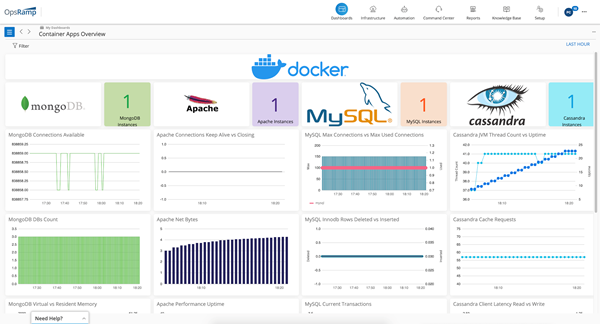
    The OpsRamp Fall 2020 Release adds a revamped user interface that provides access to a set of wizards that discover the assets that make up a specific IT environment and subsequently automate the configuration process.

    OpsRamp has also added curated dashboards that enable IT teams to launch queries using the Prometheus Query Language (PromQL), developed for the open source monitoring tool being advanced under the auspices of the Cloud Native Computing Foundation (CNCF).

    The latest edition of the AIOps platform also adds monitoring capabilities for containerized workloads and Kubernetes clusters. In addition, IT teams can monitor other cloud services including AWS ECS, Azure Functions, Azure Hyperscale (PostgreSQL) and Azure SQL Managed Instance.

    OpsRamp has also added IT process automation capabilities that can be triggered by alerts, updates to resources or on a recurring schedule. An OpsQ bot now also recommends automation workflows. Alternatively, IT teams can require manager approval before a process is launched.

    In general, Byrne said the goal is to improve the mean time to value for an AIOps platform managed by a team of data scientists who have extensive experience applying machine learning algorithms to IT processes.

    Efforts to automate IT have increased sharply now that most IT staff are working from home to help combat the COVID-19 pandemic. However, few organizations are able to set up and configure an AIOps platform in an on-premises IT environment on their own, especially now that outside consultants are no longer being invited to spend weeks working on projects, Byrne said, noting a SaaS-based approach makes it possible for IT organizations to take advantage of an AIOps platform while continuing to work from home.

    In general, the downturn in the economy has increased interest in AIOps because IT staff ranks are either remaining the same or shrinking even as IT environments continue to become more complex. Longer-term, Byrne said it’s not clear that hiring Level 1 and 2 IT administrators will be sustainable as AIOps platforms continue to automate processes.

    DevOps teams, of course, are especially keen to automate as many IT processes as possible, which is why there is a high correlation between organizations that have embraced DevOps and early adopters of AIOps.

    It may still be a while before AIOps is widely employed, but it’s now only a matter of time before machine learning algorithms are pervasive across IT. The challenge now is figuring out where the handoff between man and machine for managing IT ultimately will lie.