Tag: application testing

  • Applitools Integrates Testing Platform With GitHub

    Applitools Integrates Testing Platform With GitHub

    Applitools announced today that its test automation tools have been integrated with GitHub and GitHub Actions in addition to being available on the Microsoft Visual Studio App Center.

    Company COO Moshe Milman said these integrations make it possible to add testing tools that incorporate machine learning algorithms, dubbed Visual AI, to a DevOps workflow using the Applitools Eyes testing platform. Those tests are run on a cloud platform dubbed Ultrafast Grid.

    The goal is to make it possible to easily correlate code changes across different versions of updates to web and mobile applications using any testing framework and programming language, said Milman. Visual AI can now be applied to every build and pull request, he noted.

    When feature branches are created, Applitools instantly mirrors those feature branches to create a new set of baseline images. That approach simplifies the automated testing of all feature branches without impacting the trunk and its tests, he said, noting as pull requests are merged back in, the integration automatically updates the target branch with the source branch’s baseline images in a way that ensures no conflicts exist between branches.
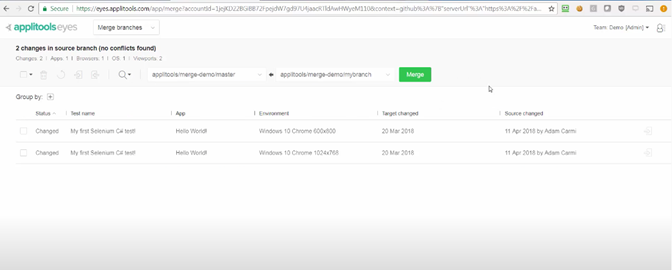
    The Applitools approach to AI testing also provides developers with more control based on the application use cases, he added. For example, different settings can be applied to test a medical application that requires perfect alignment of pixels versus an e-commerce application that may not require as much fidelity. Developers can then resolve regression issues by employing root cause analytics.

    In general, Milman said the number of organizations that are applying DevOps processes now to the development of both web and mobile applications is increasing. Mobile applications are core to digital business transformation initiatives that have accelerated in the wake of the COVID-19 pandemic. Many of those applications are being built using components that typically are shared through repositories such as GitHub, which Milman noted creates the imperative to integrate testing tools with code repositories and other DevOps platforms.

    It’s still early days as far as applying AI to application testing is concerned. However, it’s now more a matter of when versus if organizations will be relying more on AI to test applications. As the number of testing platforms that include AI capabilities expands, each IT team will need to evaluate which approaches provide the most accurate testing.

    Nor is it clear to what degree AI might reduce the need for dedicated application testing teams. More responsibility for testing applications has been shifting left toward developers for several years now. Nevertheless, an independent test review of an application before it is deployed is always a good idea. AI capabilities in testing tools should reduce the most common mistakes the developers seem to make regularly.

    As part of an effort to make it tools more widely accessible, Applitools also makes Applitools Eyes along with its GitHub integrations available for free for open source projects hosted on GitHub that sign up to be part of Applitools’ open source plan.

    Regardless of how DevOps teams gain access to those tools, the future of application testing promises to be a lot let less monotonous.

  • Tricentis Applies Visual AI to Improve Application Testing

    Tricentis Applies Visual AI to Improve Application Testing

    Tricentis this week announced it has added visual test design and automation technology based on artificial intelligence (AI) to its Tosca platform.

    Dave Colwell, vice president of AI and machine learning at Tricentis, said Tosca 14 automatically recognizes and identifies visual user interface elements and controls across any form factor to identify the most appropriate tests to run as an application is being developed. That approach enables testing to be shifted further left during the application development process as successive iterations of an application are developed, he said.

    While AI has been incorporated into other AI tools, Colwell said Tricentis is applying the same types of machine learning algorithms that are employed to enable self-driving cars to detect objects to the testing of controls included on an application screen.

    Colwell said it’s now only a matter of time before most developers routinely expect testing capabilities based on visual AI technologies to be included in testing tools. Rather than having to continually encounter the same design issues, visual AI will enable developers to craft applications that end users will employ much faster.

    Given the large numbers of applications that many end users haven’t embraced because of user experience issues, there’s clearly a base of developers who could use some advice from AI tools that have been trained to identify common problems that have affected previous generations of applications. Tricentis is now not only committing to providing testing tools but also curating the content required to train AI models.

    It may take a while for developers to fully trust those recommendations, but the number of potential issues that could be averted earlier in the application development life cycle has significant implications for the productivity of DevOps teams. In theory, at least, the number of applications successfully moving through the build process should increase. The amount of testing required after an application is created should also decline as well.

    Less clear is to what degree the shifting of testing of visual elements of an application might have on dedicated application testing teams. Arguably, IT organizations should be able to devote more resources to building versus testing applications.

    Whatever the outcome, AI is not going away. Providers of testing platforms are now effectively engaged in an algorithms arms race. In fact, it’s becoming increasingly apparent AI will be applied with greater frequency across the entire application development and deployment life cycle. It may take a while for IT organizations to adjust to that new reality, but the fact remains that organizations that don’t incorporate AI into their DevOps processes will be at a distinct disadvantage compared to those that do. Members of DevOps teams would be well-advised to start assessing what manual processes today are most likely to be automated by algorithms tomorrow.

    In the meantime, the overall quality of the user experience should also soon improve—assuming, of course, the AI models being created to test applications are indeed being trained properly.

  • Eggplant Employs AI to Surface Test Recommendations

    Eggplant Employs AI to Surface Test Recommendations

    Eggplant this week announced it has extended the capabilities of its application testing platform infused with machine and deep learning algorithms to now include recommendations to help improve tests.

    In addition, the latest update to the Digital Automation Intelligence (DAI) Platform makes it easier to onboard new members to an application testing team.

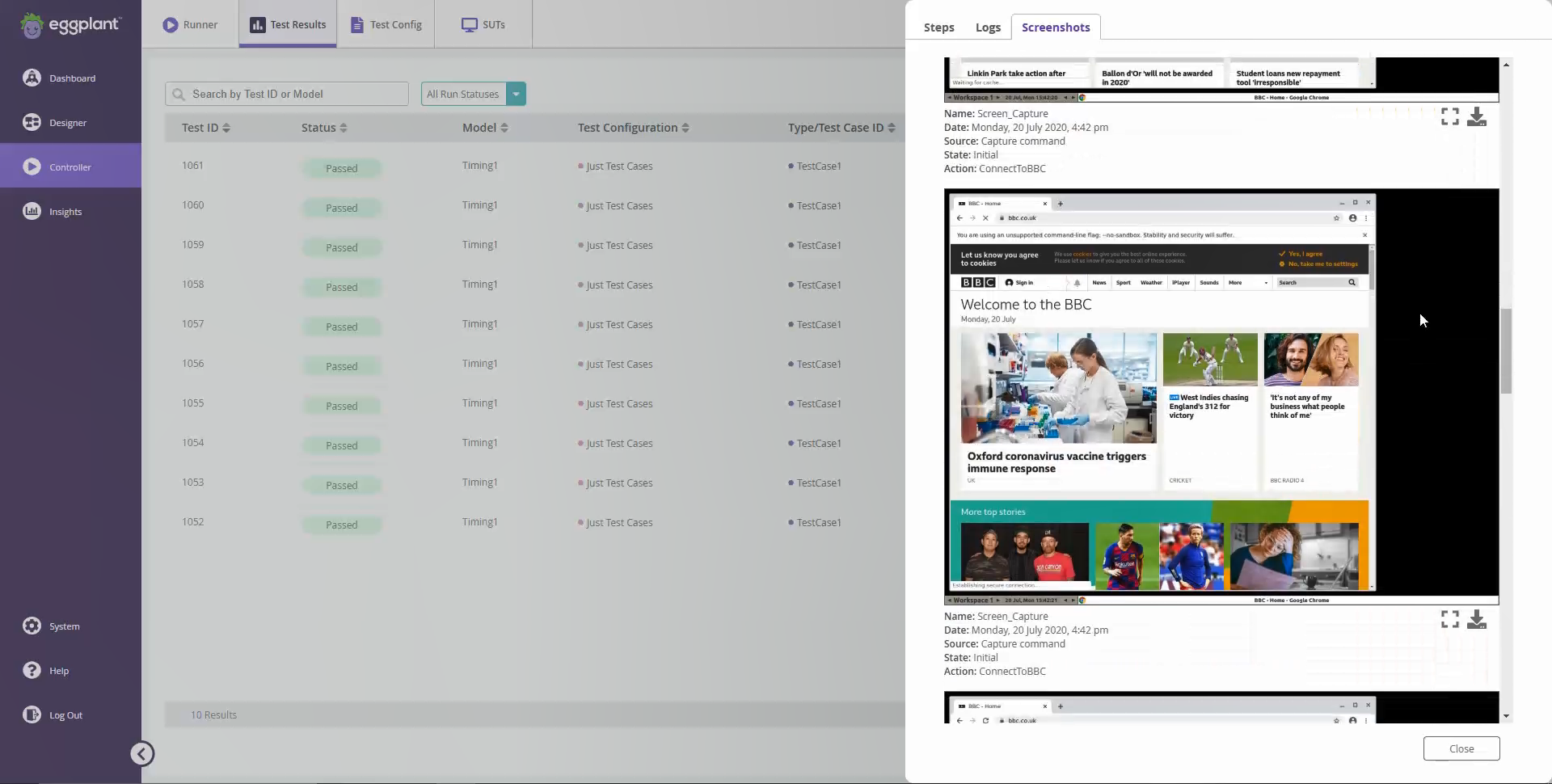
    Finally, Eggplant is making it easier to capture snapshots of the testing environment to more easily identify areas that require additional test development.

    Eggplant COO Antony Edwards said the goal is to extend a low-code platform that employs modeling tools to make testing more accessible to both developers and end users. There is simply not enough testing expertise available to keep pace with the rate at which applications are now being developed thanks mainly to the rise of DevOps, he noted.

    By employing a testing platform based on a low-code platform that enables tests to be created using modeling tools, it becomes feasible to include more end users in the testing process, he said. Generally, end users have the best understanding of how an application should function, so including them in the testing process also yields higher quality applications that will be accepted sooner, Edwards added.

    Eggplant, which was just acquired by Keysight Technologies, has been making a case for applying artificial intelligence (AI) to application testing to increase the overall capacity of testing teams. Using AI makes it possible to conduct more than 100 tests in parallel because most of the mundane tasks associated with building and updating tests have been automated, said Edwards.

    There will always be a need to include humans in the testing process, but Edwards noted AI can augment the capabilities of testing teams in a way that not only allows more tests to be conducted faster but also ensures more resources are allocated to writing code, versus continually debugging applications.

    Many IT organizations are now caught up in a vicious DevOps cycle. They can develop more applications faster, but the more applications they develop the more time they need to spend debugging them. Ultimately, organizations find themselves spending more time debugging existing applications than developing new ones. AI-infused testing tools break that cycle by identifying issues before applications are deployed, which is when they are easiest and least costly to fix.

    Breaking that cycle has become more of an imperative because in the age of microservices, the overall application environment is becoming more complex, Edwards said. Most testing teams are not going to be able to create the tests needed to assure the quality of those applications unless it becomes possible to generate more sophisticated tests using modeling tools that automate much of the process.

    Naturally, it may take some organizations time to trust the tests and recommendations generated by an AI platform. However, in the wake of the economic downturn brought on by the COVID-19 pandemic, it’s apparent DevOps processes need to be streamlined. Arguably, one of the best places to begin that process is by automating as much of the application testing process as possible.

  • Micro Focus Extends AI Testing Tools Reach

    Micro Focus Extends AI Testing Tools Reach

    Micro Focus has extended the capabilities of a family of Unified Functional Testing (UFT) testing tools infused with artificial intelligence (AI) to include support for both web-based and mobile applications.

    In addition, UFT testing tools will now allow a single script to automatically run on multiple platforms and browsers, eliminating the need to create multiple scripts for each platform.

    A crowdsourced feedback mechanism to improve recognition of objects such as a new widget has also been added to improve the AI model embedded in Micro Focus testing tools ability to recognize unique user interface paradigms.

    Finally, Micro Focus is making available an AI software development kit (SDK) and natural language processing (NLP) engine that makes it possible for both technical and non-technical users to create tests.

    Archie Roboostoff, product director for Micro Focus, said the natural language capability will make it possible to include end users of an application more easily in the functional testing process.

    As the responsibility for testing continues to shift left, he said, it’s become more important to automate as much of the functional testing process as possible. Developers and end users typically don’t have the time or often the expertise needed to build these tests.

    The challenge organizations face is the more application code they build and deploy, the more time they often spend on debugging applications. Many organizations wind up diverting resources from application development projects just to keep pace with the rate at which applications are now being built and deployed, noted Roboostoff.

    The paradox is that diversion of resources conspires to constrain the rate at which any additional applications are built. AI can play a critical role in breaking that logjam by reducing the time need to surface issues faster, said Roboostoff.

    At the same time, Micro Focus UFT tools further streamline the testing process by applying the AI capabilities it developed for mobile applications to web-based applications, he added.

    It’s not likely AI will eliminate the need for humans to test applications anytime soon. However, there are many routine issues that regularly manifest across different application development projects. As developers test more of their own code before it is officially promoted within the context of a DevOps process, it should be possible for development teams to rely on AI tools to surface issues they can address long before anyone knows they even existed.

    As is the case with every AI tool, an IT organization will need to gain confidence in the AI model embedded within any testing tool. The more AI tools are exposed to code, the more accurate they become.

    Regardless of the level of comfort with AI, it’s apparent application testing needs to become more automated. In the wake of the economic downturn brought on by the COVID-19 pandemic, most organizations will not be in a position to throw more bodies at application testing. The issue, of course, is most organizations have never been more dependent on applications to drive revenue at a time when most individuals are working and shopping from home more than ever to help contain the spread of COVID-19.

    The difference between success and failure during this so-called “new normal” will often come down to the level of testing applied to the applications on which many businesses are now almost solely dependent.

  • Keysight Technologies Jumps into App Testing by Acquiring Eggplant

    Keysight Technologies Jumps into App Testing by Acquiring Eggplant

    Keysight Technologies, a provider of tools to test and measure embedded systems and mobile computing devices, has acquired Eggplant, a provider of a platform that automates application testing, for $330 million.

    Dr. John Bates, CEO of Eggplant, said the acquisition enables Keysight to expand the scope of its testing portfolio beyond hardware. Keysight traces its lineage back to Agilent Technologies, which it spun out of in 2014. Agilent was spun out of Hewlett-Packard in 1999. Keysight retains the test and measurement portfolio that began with HP back in 1939.

    Bates said Eggplant, which has annual revenues of $38 million, will operate for now as an independent arm of Keysight. Over time, however, there should be increased opportunities to converge testing of applications software running on embedded systems that increasingly are being deployed at the network edge, he noted.

    Eggplant’s Digital Automation Intelligence (DAI) platform is designed to automate the entire testing lifecycle process as part of a larger best DevOps practice. The rate at which application tests can be built and run winds up being a bottleneck as applications are being built. The DAI platform is designed to automate the creation of UI tests and then launch them against application code to eliminate as much testing friction as possible. IT teams can also track user behavior to create user journeys based on their interactions with applications and store tests created using modeling tools provided by Eggplant in its cloud service.

    Eggplant has been investing in deep learning algorithms that, for example, automatically identify and classify user interface (UI) elements such as buttons and text fields across any platform and then generate all the automation assets needed to instantly run an automated test.

    With the rise of DevOps, there’s now more application code to be tested than ever. As such, testing backlogs within many IT organizations are growing. The challenge is finding a way to thoroughly test applications without resulting in missed deployment deadlines. When those deadlines are in danger of being blown, testing typically is the first thing to be scaled back. Of course, when an application has to be rolled back, the primary reason often is because a key component was not tested properly.

    Bates noted testing becomes even more complicated as organizations embrace microservices. The level of dependency between microservices spanning multiple platforms makes testing even more challenging, he said, adding IT organizations will need to rely on automated testing platforms to test applications at levels of unprecedented scale.

    It’s not clear to what degree the COVID-19 pandemic may have accelerated demand for applications based on emerging 5G wireless services. Some organizations are forging ahead while others may be delaying initiatives as they cope with the economic impact of the pandemic. One way or another, a raft of applications running on a wide variety of edge computing platforms will need to be tested. Chances are good a much larger percentage of those applications soon will be tested by machines rather than humans that can’t scale to meet the challenge.

  • Survey Shows Accelerated Shift to Cloud, With Caveats

    Survey Shows Accelerated Shift to Cloud, With Caveats

    A survey of 250 IT leaders published by Snow Software, a provider of software asset management software, finds 91% are changing their cloud strategy in the wake of the economic downturn brought on by the COVID-19 pandemic.

    The survey also finds twice as many respondents report they are accelerating cloud migration (45%) and digital transformation (41%) projects versus those putting cloud migration (22%) or digital transformation (21%) initiatives on hold.

    At the same time, however, nearly a third of respondents (32%) said they are asking their cloud vendors for extended payment terms, while 31% are renegotiating their cloud contracts. Around 10% of respondents indicated that they would not be able to pay their cloud bills last month.

    More than three-quarters of respondents (76%) said they have increased their use of cloud platforms such as Amazon Web Services (AWS), Microsoft Azure and even private clouds.

    In addition, more than half of respondents (55%) noted an increase in the use of collaboration tools such as Slack, Teams or Google Chat, while 52% said they have seen an increase in the use of cloud-based videoconferencing software such as Zoom, Cisco WebEx or GoToMeeting.

    Overall, 60% of IT leaders said they are continuing to increase cloud use.

    Jesse Stockall, chief architect for cloud management for Snow Software, said the results show the cloud has played a critical role in enabling employees to work from home. In many cases, the first thing to be shifted to the cloud was application testing environments. With development teams working from home the only way to effectively set up a testing environment is in the cloud.

    At the same time, Stockall said entire applications have been lifted and shifted to the cloud using containers. Rather than refactoring these applications, IT teams decided to encapsulate entire applications in a container that could be deployed on any virtual machine. IT teams then will spend the next few months converting those monolithic applications into a series of microservices that can run natively on cloud computing platforms, he noted.

    Stockall expects that approach to lifting and shifting applications first and modernizing them second to accelerate as more organizations conclude working remotely is now part of the new normal. Employees may soon head back into the office, but many more of them increasingly will access applications from home. Business and IT leaders are also unsure whether a second wave of the pandemic might make local offices and data center once again inaccessible, he added.

    Many IT organizations will also be replacing legacy virtual private networks (VPNs) with software-defined wide area networks (SD-WANs) to make cloud applications more accessible, Stockall, noted.

    The COVID-19 pandemic may prove to be a seminal moment in the history of cloud computing; while cloud computing has been around more than a decade, the bulk of applications still run on-premises. However, once many local data centers became inaccessible overnight, strategies that called for either replacing or modernizing those applications are being accelerated.

    It’s not clear how many of those on-premises applications might be retired altogether. Whatever the outcome, there’s never been more focus on where application code is being built and deployed.

  • Eggplant Injects AI Into Application Testing

    Eggplant Injects AI Into Application Testing

    Eggplant has infused its automated testing platform with deep learning algorithms that automatically identify and classify user interface (UI) elements such as buttons and text fields across any platform and then generate all the automation assets needed to instantly run a test.

    In addition, Eggplant has made it easier to visualize the overlap between common application failure patterns that can be used to automatically optimize testing.

    Finally, Eggplant has also revamped its own user interface to make it easier to deploy its platform across multiple test machines.

    Company CTO Gareth Smith said in the months and years ahead it’s apparent AI will be playing a much larger role in application testing. There are simply too many platforms on which application code is now being deployed for testing teams to keep pace manually.

    Each platform requires tweaks to the user interface to optimize the customer experience. At a time when many organizations are accelerating digital business transformation initiatives, the user application experience has never been more critical, he noted.

    Eggplant’s Digital Automation Intelligence (DAI) platform is designed to automate the entire testing lifecycle process as part of a larger best DevOps practice. The rate at which application tests can be built and run can be a bottleneck as applications are being built. The DAI platform looks to first automate the creation of UI tests and then launch them against application code to eliminate as much testing friction as possible, said Smith.

    IT teams also can track user behavior to create journeys based on user interactions with applications and store tests created using modeling tools provides by Eggplant in its cloud service. That approach not only accelerates the application development process, but it also serves to reduce the total cost of application development, which is critical at a time when IT budgets are squeezed because of the economic downturn brought on by the COVID-19 pandemic.

    As part of that effort, Eggplant provides DevOps teams with access to an application programming interface (API) through which they can self-service their own tests. That may not eliminate the need for a separate testing function within the application development process, but Smith noted it does make it easier for developers to discover potential issues on their own versus having to wait on application testers to discover them.

    Regardless of who conducts the testing, the rise of DevOps means there’s more application code to be tested than ever. As such, testing backlogs within many IT organizations are growing. The challenge is finding a way to conduct application testing that doesn’t result in application deadlines being missed. After all, when deadlines are missed, typically the first thing that gets scaled back is testing. Many DevOps teams convince themselves that any issues that come up can be addressed in the next update.

    Of course, once end users reject an application because issues were never discovered during testing, it’s not uncommon for an application to be rolled back. Rather than having to choose between those two evils, it might be better for all concerned to rely more on automation and AI to accelerate the testing process as much as possible.

  • Micro Focus Updates LoadRunner Testing Tools

    Micro Focus Updates LoadRunner Testing Tools

    Micro Focus has revamped its venerable line of LoadRunner testing tools as part of an effort to both unify code bases and provide tighter integration with third-party application performance management (APM) tools from AppDynamics, a unit of Cisco Systems.

    Vicky Giavelli, director of product management for performance engineering at Micro Focus, said Micro Focus in now in the first stages of unifying the code base of instances of LoadRunner that run on-premises and the cloud to enable DevOps teams to more flexibly test applications regardless of where they are deployed.

    DevOps teams can already share licenses across LoadRunner products and rapidly scale up or down based on seasonal or ad hoc demands, she noted.

    As testing continues to shift left, Giavelli said, Micro Focus continues to invest in aligning the LoadRunner family of application testing tools with multiple DevOps platforms. LoadRunner tools currently support more than 50 application protocols and technologies and more than 52 scripting technologies in addition to providing integrations with open source continuous integration/continuous delivery (CI/CD) tools and data visualization platforms such as Grafana and InfluxDB.

    The alliance with AppDynamics extends that strategy by making it easier for DevOps teams that employ LoadRunner to consume and share data with users of one of the most widely employed APM platforms, she noted.

    Giavelli said Micro Focus continues to enhance the user experience of a testing platform that has been widely employed now for a quarter-century. While competition has increased considerably during that time, the LoadRunner family of tools has maintained its base among application testers, she said, while extending its appeal to developers, who increasingly are taking responsibility for testing as part of an integrated set of DevOps processes.

    Of course, it’s still not clear how far left toward developers application testing might shift. While the consensus might be that more testing on the part of developers is good, application testers may provide a more unbiased opinion about how well an application accomplishes the ultimate business goal.

    Regardless of the role of testing within the organization, the one thing that everyone agrees on is it should be easier to generate meaningful tests that reflect real-world use. No matter who does the testing, the goal is to not have to roll back an application once it is deployed in a production environment. As applications become more complex, Micro Focus continues to invest in machine learning algorithms and other forms to advanced analytics to identify potential issues sooner than later, noted Giavelli.

    It’s too early to say how the battle between application testing vendors will play out in the months ahead. The one thing that is certain is that in the wake of the COVID-19 pandemic, application testing has never been more critical. More organizations than ever are building digital business applications to make it easier to engage with their customers, at a time when many of them might not be returning to an office anytime soon. The issue, of course, is that not many of their end users will be especially tolerant of issues such as a mobile computing application that doesn’t live up to expectations the first time it’s deployed.

  • Rubrik Looks to Meld Data Management and DevOps

    Rubrik Looks to Meld Data Management and DevOps

    During its FORWARD Digital Summit event last week, Rubrik made a case for the melding of DevOps and data management.

    The company announced that its Polaris Data Management Platform, delivered as a software-as-a-service (SaaS) platform, has added the ability to protect workloads running on virtual machines on the Google Cloud Platform (GCP). Rubrik already provides support for Amazon Web Services (AWS) and Microsoft Azure clouds.

    In addition, Rubrik announced it has extended its AWS data protection support to include the Amazon Relational Database Service along with support for the OneDrive cloud service from Microsoft. Rubrik already provides support for Microsoft Office 365.

    While most of the revenue Rubrik generates comes from data protection delivered as a service, president Dan Rogers said Rubrik is really a provider of a data management platform. With more applications heading into the cloud, it’s now only a matter of time before DevOps teams start to leverage the Rubrik application programming interface (API) to make the Polaris platform a vehicle for accessing large amounts of data, he said, noting Polaris is built from the ground up using GraphQL APIs and metadata that make it programmatically accessible.

    Of course, Polaris today is accessed most often by IT operations teams via a graphical user interface (GUI). That approach allows Polaris to bridge legacy approaches to data management alongside emerging DevOps environments. It’s not clear to what degree DevOps teams are programmatically invoking platforms such as Polaris, but as applications are developed and deployed at faster rates DevOps teams have a vested interest in a platform that makes it easier to access the data those applications require.

    Rogers also noted data protection platforms play a major role in application development and testing environments. Developers need to be able to recover the previous iteration of the application following a crash.

    IT teams are also making extensive use of the backup capabilities provided by a data protection platform to migrate data from on-premises IT environments into the cloud.

    Rubrik is not the only provider of a data management platform being delivered via a set of SaaS applications. The company has been making a case to initially replace on-premises data protection offerings with a cloud approach that in addition to data protection software makes data management tools available to address tasks such as data governance and compliance as well as metadata management.

    It’s not clear to what degree data management and protection will be automated. However, in the wake of the COVID-19 pandemic, Rogers noted more organizations will be accelerating the rate at which IT management platforms of all types are accessed as a cloud service. With many IT operations teams now working from home for what may be an extended time period, organizations will be migrating to platforms that lend themselves more easily to being remotely accessed, he said. In fact, it’s already apparent that in some cases IT teams—like it or not—may never be returning to an office again.

  • How to Compare and Contrast APIs to Improve DevOps Processes

    How to Compare and Contrast APIs to Improve DevOps Processes

    The cloud is driving digital transformation, from web applications to mobile applications, from partner integrations to API monetization. Even custom applications are moving into the cloud. If you draw a line through all these trends, APIs would be at the heart of it all.

    We know we need to eat our vegetables to keep our heart healthy, but sometimes it is easier to order takeout after a long day of work. Healthy API hygiene works the same way. In a perfect world, developers would register their API specifications and blueprints in an API catalog, and they would keep them up-to-date as the application changes. But this is a tedious manual process, and sometimes after a long day of work it is easier said than done.

    An API catalog is critical for improving the DevOps process through quality assurance and testing. Furthermore, the production environment for APIs can be subject to even harsher and more hostile access and usage patterns compared to the Dev and Test environments, which tend to be more self-contained. The good news is that by maintaining an API catalog, DevOps can gain more visibility into the contrast between these environments to identify gaps that should be closed. The end result is an improved DevOps process that drives the production of better products and services.

    There are a number of approaches to creating an API catalog, from manually logging APIs into Wikis, spreadsheets and vendor solutions, to more automated discovery tools. An API catalog should include meta information, such as the creator, the date it was last modified, which application it belongs to and so forth. At a deeper level, an API catalog should also include the parameters such as the data type, the bounds for the data type, the transport mechanism, the authentication and authorization mechanism, and a brief description about the data carried within the parameter.

    Compare and Contrast APIs from Dev to Test and Test to Production

    During the application testing phase, which is subject to quality assurance, regressions, performance and interaction cases, an API catalog should be updated and compared against its development state. The contrast between the development API catalog and those generated from the test environment can help identify:

    • An API listed in the Dev catalog, but not in the Test catalog, which would indicate that QA has not tested the API or its payload; therefore, the QA process could be improved.
    • An API listed in the Test catalog, but not the Dev catalog, which would indicate that the Dev catalog was incomplete; therefore, you cannot assume it is a “golden” image. This also suggests an area for improvement in the DevOps process because the developer has not maintained an up-to-date API catalog. Automated tools can help even more here since they generate an API catalog where there is none.

    There is a third scenario, where an API isn’t recorded in the Dev catalog, and it doesn’t show up in the Test catalog, but may later show up in the production traffic. This is considered an unpublished or “out of spec” API.

    Likewise, when moving from test to production environments, the API catalog should be updated to mirror real-world application access. The contrast between the Production API catalog and the Test API catalog can help identify:


    • An API listed in the Test catalog, but not the Production catalog, which could identify an API that is not being used. This would indicate that QA testing did not align with the real-world use of the application and suggest that development cycles could be prioritized elsewhere.


    • An API listed in the Production catalog, but not in the Test catalog, which would indicate the API catalog did not capture the most up-to-date specification. This is one example of a Shadow API, an API that was intended to be part of the application, but has not gone through the required processes related to testing and application security.


    Additionally, identifying an API in the Production catalog, but not in the Test catalog can be useful in identifying threat actors searching for vulnerabilities to exploit an unpublished API.

    Comparing and contrasting dev, test and production environments can help identify opportunities for improvement. However, manually creating and maintaining an API catalog is often neglected because of its tedious nature. DevOps needs automated tools to help discover APIs, generate blueprints and store them into the catalog. It is too much of a burden for developers to manually document APIs, but a continuously updated API catalog is the most important key to derive success using the compare and contrast methodology.

    — Ravi Balupari