Tag: application release

  • LaunchNotes Adds Communications Tool for App Release

    LaunchNotes Adds Communications Tool for App Release

    LaunchNotes today launched a namesake software-as-a-service (SaaS) platform for managing the communications surrounding the release of an application.

    Company co-founder Jake Brereton said LaunchNotes streamlines internal and external communications for DevOps teams, eliminating the need to employ a collaboration tool such as Slack or a project management application.

    Each message can be designated as either a private communication for the internal DevOps team or shared publicly with business shareholders. Instead of having to subscribe to yet another Slack channel, business stakeholders now have a dedicated and easier means to track the progress of application releases, said Brereton.

    Communications surrounding application releases have always been problematic. Most applications are developed using multiple platforms, so standardizing the communications tools provided by those platforms isn’t usually practical. LaunchNotes is designed to provide an easy way to manage communications regardless of the platform employed to build and deploy an application, Brereton said.

    DevOps teams can also post things such as articles that might, for example, explain the history of any given application development project, he added.

    Interest in application release timetables has never been higher. In the age of digital business, more organizations than ever have come to equate with revenue the rate at which applications are deployed and updated. However, it’s not always been easy for business leaders to decipher the release notes that DevOps team members routinely share with one another. LaunchNotes is meant to provide a means for DevOps teams to communicate privately with one another while creating a separate channel within the same platform to share frequent updates in plain language in real-time with other members of the organization.

    The issue with Slack and other communications platforms is they have become too noisy, noted Brereton. In the stream of updates being provided about things going on inside the organization and beyond, it can be easy to miss a critical update about an application release.

    LaunchNotes has been available through a private beta involving 60 organizations. The company views its platform as a complement to project management applications rather than a replacement. The sole focus is on streamlining DevOps communications, said Brereton.

    To one degree or another most DevOps teams suffer from a failure to communicate. Most of the time that failure is not because a message wasn’t shared; rather, the medium employed to deliver that message made it easy to miss or be misconstrued. If the medium is the proverbial message, then DevOps teams might be better off employing a medium designed specifically for optimizing application release cycles.

    Of course, many organizations will continue to employ the communications tools that are most readily available. However, those general-purpose communications platforms also make it easy for users to be distracted by everything from messages from human resources about the latest form to be filled out to who won the football pool this week.

  • 5 Tips for Launching New App Features

    5 Tips for Launching New App Features

    Are you looking to improve your organization’s mobile app? For some the process may be relatively straightforward. But ensuring you cover all steps correctly will go a long way to a successful app feature release. Here are five practical tips to successfully launch a new app feature.

    Include the App Feature Release at the Start

    While you’re still in the planning phase for a new feature, it’s a good idea to think about how you will release it. This is something often done within the design process.

    Things you should incorporate into this decision include:

    • Who will see this app feature first? (Are there internal or external beta groups?)
    • How will this feature’s success be measured?
    • Who will see the app feature once it’s in a steady state? (Will the feature be only for VIP customers or for everyone?)
    • Is there important timing tied to this release, such as an event or special time of the calendar year?

    Tools that will help you with this step include product delivery and tracking tools.

    Build Awareness

    Awareness around a release is important for both internal and external groups. Within your organization, do teams have the support they need to be successful? Think about what your sales, marketing, customer success or any other team will need in terms of understanding the app feature being released, and how to answer any questions they might face. Externally, awareness should be tied back to how you will measure success.

    Tools that will help you accomplish this include go-to-market plans, centralized information repositories and any other tools that will help your teams (and customers) stay connected, informed and collaborative.

    Measure the Release of the App Feature

    After the release has happened, how will you know if it was successful? Because you already thought about success metrics in the planning stage, you should be ready to measure whether the feature was successful or not.

    Tools that will help with this include those that surface sales and ops metrics. Also, it’s important to consider these together—look at performance and monitoring metrics, support requests by volume and qualitative feedback from customers and prospects.

    Celebrate and Recognize

    Take time to celebrate your wins. Shipping software is like exercising a muscle: The more frequently you do it, the easier it is to execute. If you ship less frequently, the process begins to atrophy and the action becomes more difficult. Celebration (even for small wins) motivates to continue practicing the act of shipping and results in more stable services and products.

    Reflect and Iterate

    Software is never done, and neither is a process for software delivery. After the release has occurred and you’ve paused to enjoy the moment, now it’s time to reflect on what went well and what didn’t. Reflect on both process and product. Tie process back to culture—consider the tools that you use for the process, what enabled you to do more and what was a hindrance. Use this feedback and apply what you learned from measuring success in the planning phase for the next release. Learn how you can adjust and improve upon what you shipped.

    — Adam Zimman

  • XebiaLabs Injects Predictive Analytics Into DevOps Platform

    XebiaLabs Injects Predictive Analytics Into DevOps Platform

    XebiaLabs is moving to take the guesswork out of DevOps following the launch of a set of tools that leverage machine learning algorithms to predict when and how the release of an application is most likely to go awry.

    The Risk Prediction Module being added to the XebiaLabs DevOps platform comes on the heels of XebiaLabs’ move to make its XL JetPack software for automating application deployments available on the Amazon Web Services (AWS) Marketplace. XL JetPack is an automation framework based on YAML files and a declarative programming framework that enable DevOps teams to push applications into production on a cloud platform in as little as 15 minutes.

    XebiaLabs CEO Derek Langone said that while DevOps advancements have been made in terms of achieving continuous integration, the goal of achieving continuous delivery has proven to be more elusive. As automation frameworks such as XL JetPack become more accessible, however, IT operations teams will be better able to keep pace with the rate at which organizations want to be to deploy and update applications, he said.

    It’s becoming increasingly apparent that a combination of automation frameworks and machine learning algorithms will enable DevOps teams to make a significant leap forward in terms of application release lifecycle management. Because of all the nuances of the different platforms that IT organizations are trying to leverage, it’s become a major challenge to roll out an application manually. As the number of applications that need to be released at roughly the same time increases, managing the release cycle process is moving beyond the capabilities of an IT team made up of mere mortals.

    The Risk Prediction Model from XebiaLabs promises to increase the odds of success by applying predictive analytics infused with machine learning and other proprietary XebiaLabs algorithms to identify DevOps bottlenecks before they are encountered. Capabilities provided by that module include alerts that warn the team when a release is likely to be delayed or to fail before the release pipeline starts running; a Risk Forecast view that summarizes predicted delays and failures for every task in the release process; an overview of statistics for similar releases to provide historical context; and forensics tools that uncover flaky automated tests, problematic build setups, long-running deployments and time-consuming manual tasks. That Risk Prediction Module is meant to complement the risk scoring capability that XebiaLabs already includes in its platform.

    Arguably, the biggest barrier to DevOps adoption today continues to be the level of expertise required to succeed. But as the combination of predictive analytics infused with machine learning algorithms and algorithms that can discern instantly how changes to the IT environment will impact applications become more common, the level of expertise required to master DevOps processes should decline. As that transition occurs, the number of organizations embracing DevOps more broadly should increase.

    In the meantime, DevOps teams would be well-advised to consider to what degree they might next want to rely on predictive analytics to prescriptively automate processes with eye toward eliminating the need for as much human intervention as possible.

    — Mike Vizard

  • DevOps in the Age of Digital Transformation

    DevOps in the Age of Digital Transformation

    Digital transformation is one of the hottest buzzwords in the technology industry today. While it tends to be overused, the term does represent a widespread, ongoing movement that will set a standard for the next generation of enterprises.

    Digital transformation is all about keeping up with the pace of innovation and using technology to achieve business goals. A key differentiator in the age of digital transformation is customer experience. Consumers are increasingly engaging with brands on digital platforms, whether it be a website, social media profile or mobile app. The foundation of all these platforms is, of course, software.

    Agile software delivery is key because it helps organizations innovate faster and gets new software in the hands of consumers sooner. This requires new, more productive ways of working for enterprise IT teams. Development teams have already undergone several “transformations” in recent years, from the siloed waterfall approach to agile methodology and now DevOps. Software is the true differentiator in the age of digital transformation, and many companies are using DevOps to ensure their software meets the standard.

    Here are a few best practices for using DevOps to keep up with the pace of digital transformation:

    • Automate wherever possible. We no longer collect the work of multiple engineers over multiple sprints into a release. To out-innovate the competition in the digital transformation era, a team must release the work of a single engineer as soon as it is ready. This is usually accomplished through a CI/CD pipeline directly from the source repository through automated testing and then deployment into production, preferably without any human intervention. Choosing the right tools for your IT environment will cut costs, time and room for error.
    • Align the goals of development and security. DevOps isn’t limited to just the development and operations teams. Without security, all progress made in the digital transformation era is at risk to cybercriminals. The accelerating software development life cycle means little time for security analysis or penetration testing when the release candidate is ready to deploy. To ensure a piece of software is secure before pushing it to market, security standards must be included in the definition of “done.” Preventative scanning will not only train developers to write secure code, but will allow the software to pass the assurance tests included in any good CI/CD pipeline.
    • Measure ROI. Measuring the impact of DevOps can be extremely difficult and up to interpretation because of the focus on culture and processes. However, it’s important for DevOps teams to gain continued executive buy-in and dedicated resources by proving their value. The value of DevOps is determined in terms of achieving improved business outcomes. There are specific questions to ask to help determine ROI: How long does it take to release a code change? How long does it take for a product to reach a customer’s hands? The ability to continually deliver quality software faster results in a positive customer experience, ultimately improving brand reputation and revenue.

    While keeping up with the competition is necessary in the digital transformation era, putting customer experience first is how the true leaders succeed. By shortening the software development cycle, DevOps speeds the pace of innovation for an organization and helps earn customer trust and retention. Implementing these best practices can help a business use DevOps to place software and customer engagement at the heart of its digital transformation.

    — Pete Chestna

  • Release Automation: Delivering the Big Quality Payoff

    Release Automation: Delivering the Big Quality Payoff

    Have you ever gone down the path of testing the latest release of an application only to find out that you had the wrong version?

    Maybe you accidentally grabbed the wrong build or you didn’t have the correct configuration file for the environment you were testing against—or your database wasn’t updated correctly, or the script you were using was still pointing to a prior version of the software.

    Whatever the case, we can agree that keeping track of all the various artifacts, database schema changes, configuration parameters and other components needed to accurately test and deploy an application is both time-consuming and prone to errors.

    Today, many companies are looking to DevOps, continuous delivery and agile development methodologies to shorten their application delivery cycles and reduce the number of errors and the costs associated with application deployment processes. Nearly all enterprise companies are software companies, and their mere existence depends on delivering differentiating products and services via software to their customers.

    It’s imperative to be able to react to customer demands and competitive pressures quickly, if not immediately, to stay ahead of the competition. Gone are the days of yearly release cycles.

    Today we see companies deploying new capabilities into production environments on a monthly, weekly or even daily basis. At some companies, hundreds, if not thousands, of deployments are occurring across dev, test and production environments daily. The old methodologies we once used simply can’t support this type of volume and cadence.

    Employing Release Automation

    So, how are these companies transitioning to this new way of thinking? In a word—automation; specifically, by automating early and often.

    Everything about your release process is a candidate for automation. This includes environment provisioning and configuration automation, build automation, test automation and release and deployment automation.

    A customer of ours recently implemented CA Release Automation, and within eight weeks had automated 90 percent of its deployments. Deployments that once took more than five hours and a team of people now take a matter of minutes.

    “This not only saves us a huge amount of time, but it also mitigates the risk of human error being introduced by manual processes,” said Tim Dallmann, platform engineer at Jewelers Mutual.

    Another customer, a major airline, implemented CA Release Automation and immediately reduced their production outages from an average of 237 over a three-month period, down to 15, seven, six and five over the following four months.

    And Molina Medicaid Solutions reduced their cost of human error by 90 percent, all the while responding quicker to emergency deployment requests and improving deployment quality.

    Automation is critical, but I believe these results prove that implementing a framework to manage and deploy release processes in addition to automation works even better.

    Increased Flexibility and Visibility

    Continuous delivery helps break down barriers often seen between development and operations teams. It provides, even forces, a more collaborative approach and automation is a key enabler of this.

    “One of the best things about automation is that it gives us the flexibility to skill-up end users—deployments in our test environments are no longer solely the responsibility of the operations or IT teams,” explained Dallmann.

    With an application release automation (ARA) solution, artifact, build, configuration and release processes are no longer tracked with spreadsheets or embedded in complicated scripts.

    Increased visibility into these processes ultimately enables all stakeholders to take a more active role in the release process, and access to real-time information can significantly reduce the amount of time and resources needed to resolve and recover from problems when they do occur.

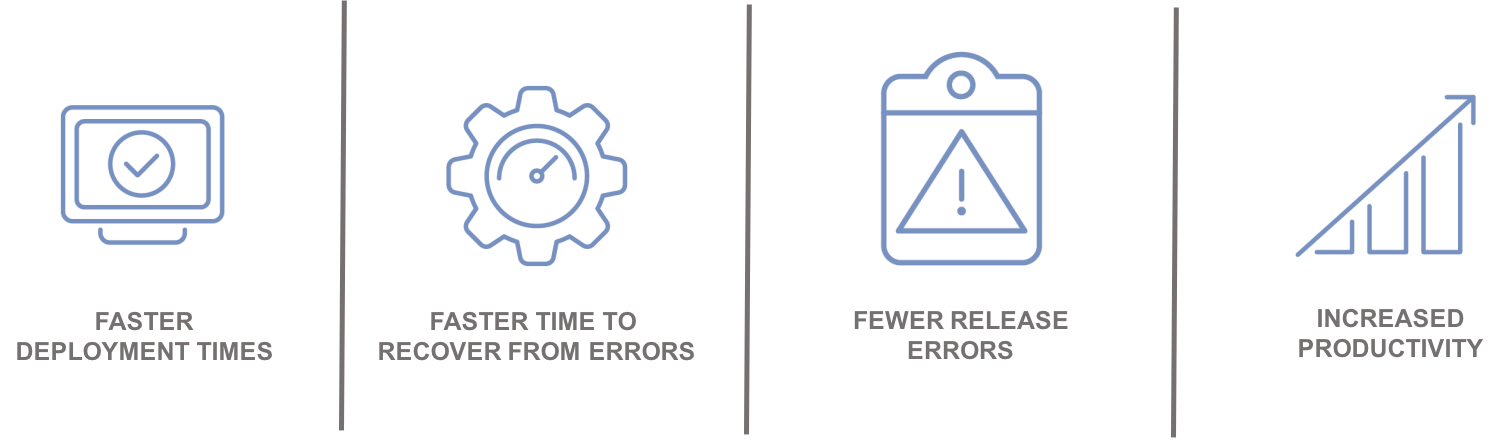
    Automation leads to:

    Integrating with the Ecosystem

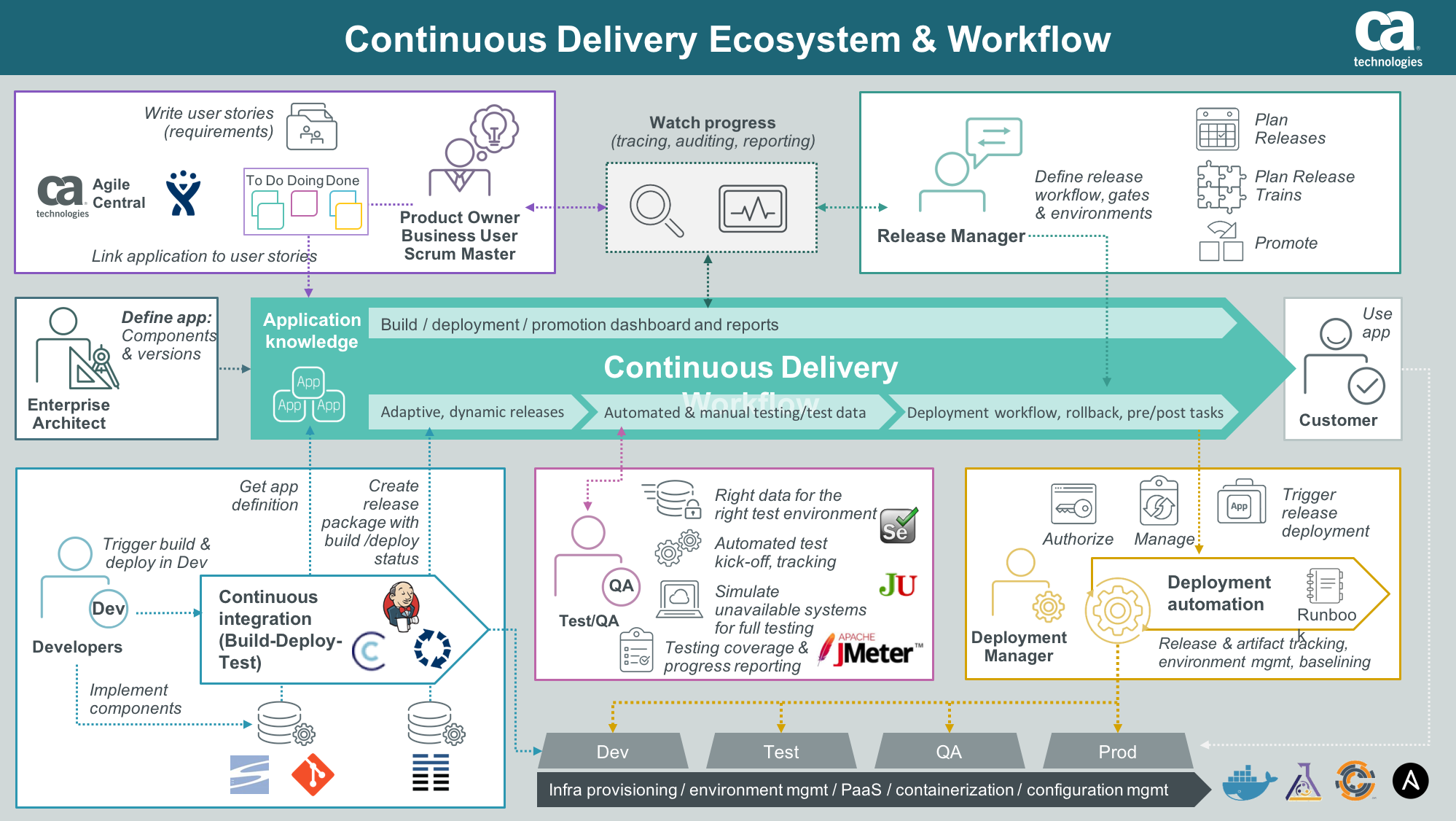
    An enterprise ARA solution can help you create a single control point to streamline all your application delivery processes for better predictability and reduced risk. A critical component of this is the ability to integrate and orchestrate tools and technologies required along the continuous delivery pipeline, including source control, automated testing tools, provisioning and configuration management solutions and change management and performance management solutions.

    Integration with an application lifecycle management solution can provide even further alignment, governance and traceability between development projects and what is ultimately being tested and promoted to production.

    “By integrating the two solutions, we will have a complete audit trail of deployments to help us understand how, where and by whom stories have changed,” said Phil Nickolai, director of application services at Jewelers Mutual.

    “What we really needed was a solution to streamline our whole way of working,” he said. “We had numerous people working on projects, competing for resources and causing complexity. Now we’re back in control and getting smarter every day.”

    The Time Is Now

    Let’s get rid of the problem that exists between the keyboard and information kept in spreadsheets, scripts or emails. Not only will you stop wasting time testing the wrong version of an application, but you can also ensure you have the right test data, the appropriate test cases and the correct configuration parameters for your environment.

    Stress-inducing release weekends and nights become a thing of the past. Developers can spend more time on developing innovative capabilities that generate revenue and keep customers coming back for more.

    — Tim Mueting

  • Webinar: Unifying your Application Release and Configuration Automation

    RECORDING

    SLIDES

    [seoslides embed_id=”25ec04fb3359″ script_src=”https://devopsy.kinsta.cloud/embed-script/unifying-application-release-configuration-automation/18313/” overview_src=”https://devopsy.kinsta.cloud/slides/unifying-application-release-configuration-automation/” site_src=”https://devopsy.kinsta.cloud” site_title=”devopsy.kinsta.cloud” title=”Unifying your Application Release and Configuration Automation” /]


    — Jules Louis

  • Simulation: The ‘Aha’ Moment for DevOps Adoption

    Simulation: The ‘Aha’ Moment for DevOps Adoption

    Every IT transformation requires that people, process and technology align and work together to achieve success. As organizations begin to appreciate the benefits of a DevOps approach and look to change to a DevOps model of software development and release, there will be significant pressure on people, process and technology to support that change properly.

    The technology and process changes required to enable DevOps to work efficiently shouldn’t be underestimated. Considerable time and investment is required in embracing the automation technologies that support a proper DevOps environment, and in developing the processes that make best use of that technology.

    But DevOps cannot work unless your people are ready to change. Development teams and IT operations—who traditionally have worked in silos—must work together, integrate seamlessly and understand not only their roles and responsibilities within the new environment but also the roles and responsibilities of those around them.

    And therefore, like every change, the real key to success is your people.

    Creating Successful Change

    The benefits of taking a DevOps approach are numerous: By moving toward more frequent delivery with reduced elements of change, you lower risk and increase system stability. Although automation is costly to implement, it allows teams to work far more efficiently, increases reuse, reduces errors and brings development teams closer to the customer. New functionality released continually and rapidly can be validated in the market, feedback can be received, lessons can be learned and improvements implemented quickly.

    But in making such a radical cultural shift, how do you ensure you change the mindset of people who have been used to working in a certain way? How do you provide your people with the helicopter view of what that future state will be, instill in them your fervor for change and provide them with the understanding and motivation necessary to embrace new ways of working? How do you ensure everyone is rowing in the same direction? Because without that, your change—already difficult and challenging—will become impossible.

    The Key to Change

    The key to any successful change is communicating your vision to your people. But providing your staff with a clear vision of what that future state could be is enormously difficult. You can outline the benefits of change, explain to them what good will look like, tell them what is in it for them, and all of these are hugely important.

    But there is no substitute for allowing people to actually feel what your future state will be like.

    Nothing compares to parachuting them into a situation where they can work through the changes required in a risk-free environment, experience the pitfalls and live the successes. As you move them to a fully functioning and productive DevOps environment, you will accelerate buy-in from your team rapidly, and give them a much more profound understanding of your vision and future state.

    The Power of Simulation

    Simulation training is one of the most effective tools to explain complex concepts and operating models quickly and convincingly. A presentation on DevOps—or almost any other topic—is not a productive method of showing someone the difference it can make to their work or their business. It’s the difference between reading a script and performing a play. More and more, companies are using simulation training as a shortcut to inform, educate and convince their teams of the value of large-scale organizational change—and DevOps is a prime example. 

    One of the key benefits of the simulation model is that people learn together. Your team learns at the same pace, working toward the same goals—and, as a result, they collectively show each other the value of change. With a traditional change program you need each employee to go on his or her own journey to recognize and adopt your vision. With a group simulation you take everyone present down the road toward a collective “aha” moment. Once that moment has happened you have an instant group of advocates who can go out to the business together and begin to effect change on a much more fundamental level.

    Simulation Brings Agility to Adoption

    Providing a simulated environment in which to train is not new; it has been used extensively and successfully by the military for decades. Commercial pilots train on simulators to provide them with as close to a real-world experience as possible of some of the life and death decisions they may need to make in an emergency. They understand the power of experiential learning.

    Simulating a DevOps model brings that power of experiential learning to your business, allowing you to immerse your people in a concentrated and deeply focused environment where they face the same challenges as they will in the real world.

    In one short morning they get to experience building a culture of DevOps themselves, making mistakes, understanding them and learning from them. It demonstrates the business value and positive impact of a DevOps approach in only a few hours, and can accelerate the adoption of DevOps across the enterprise, successfully turning DevOps opponents into advocates.

    In a world where the quality of your software can make or break your organization, it is critical to create an environment where developers and operations are not only aligned and more efficient, but also empowered and able to concentrate on developing and releasing products that add the most value to the business.

    Rome wasn’t built in a day, and you can’t effect convincing organizational change in a single morning. However, by immersing your team in a simulation, you can take a giant step forward and create a team of advocates who will go out and sell your vision for you.

    About the Author/Andrew Macintosh

    A_Macintosh_PhotoAndrew Macintosh is a Creative Solutions Director for G2G3. He works with clients across the globe, helping to understand requirements and craft technology based solutions to engage staff and customers, internally and externally. Prior to joining G2G3 Andrew ran a production company and worked within the TV industry for 12 years.

  • Webinar: Application Release Automation at Scale

    Webinar: Application Release Automation at Scale

    Logo_EC_corp_Large_Web_RGB

    Organizations of all shapes and sizes depend on feature-packed application releases to keep end users productive and happy. As application complexity grows, managing deployments manually becomes more difficult and slows down the pace of business.

    Join Amy DeMartine, Sr. Analyst at Forrester research and Mike Hamrick, Software Configuration Management Lead at Lockheed Martin, servicing CMS Centers for Medicare & Medicaid Services, as they discuss:

    1) How Application Release Automation (ARA) solutions eliminate error-prone manual work, decrease risk and increase uptime

    2) How Infrastructure and Operations teams in large organizations overcome modern service delivery challenges

    3) Best-practices and tools for overcoming the challenges of ARA at scale


    Event recorded Thursday April 2nd, 2015

    Click here to register to see it On Demand


    Video

    Slides

    [seoslides embed_id=”a3d2f6e4e229″ script_src=”https://devopsy.kinsta.cloud/embed-script/electric-cloud-webinar/6046/” overview_src=”https://devopsy.kinsta.cloud/slides/electric-cloud-webinar/” site_src=”https://devopsy.kinsta.cloud” site_title=”devopsy.kinsta.cloud” title=”Electric Cloud Webinar” /]