Tag: appdynamics

  • Cisco Acquires Splunk to Create Observability Powerhouse

    Cisco Acquires Splunk to Create Observability Powerhouse

    Cisco today revealed it has signed a definitive agreement to acquire Splunk for $28 billion in cash. The deal will add Splunk, one of the most widely-used platforms for managing IT operations, to Cisco’s portfolio, joining the AppDynamics observability platform in addition to a wide range of IT infrastructure equipment.

    Chuck Robbins, CEO of Cisco, told industry analysts the combined entity will be one of the largest software companies in the world. The Splunk and AppDynamics platform creates a comprehensive observability platform spanning applications, networks and hybrid cloud computing environments, Robbins added.

    By combining AppDynamics with the data collected by the Splunk platform, the combined company will be able to provide greater insights into IT operations than any other company, added Robbins.

    Splunk CEO Gary Steele said the acquisition represents the next natural, logical step for Splunk and furthers its long-term partnership with Cisco to keep IT environments secure and resilient. The two companies will also be able to apply artificial intelligence (AI) more effectively to IT operations, he added.

    In its most recent quarter, Splunk reported revenues of $911 million, with cloud revenue accounting for $445 million, or 29%, of the total. Total Splunk revenues are forecasted to be between $3.925 billion and $3.95 billion for fiscal 2024.

    Splunk previously acquired SignalFX, a provider of an observability platform, in 2019. It’s not yet clear how the platform might be integrated into the AppDynamics platform, but Robbins said there is little overlap between the observability platforms the two companies currently provide.

    The Splunk acquisition comes at a time when it’s becoming more apparent that the need for observability extends well beyond DevOps workflows as organizations become more dependent on software.

    Each IT organization will need to determine how long it will wait for the Splunk acquisition to close before investing further in observability. Historically, acquisitions of this scale have been accompanied by price hikes to help fund the merger once the deal is concluded.

    In the meantime, IT and DevOps leaders will likely revisit the way IT is managed in the months ahead. Splunk came to prominence at a time when most workloads were running in on-premises IT environments. While the bulk of workloads continue to run in those environments, many workloads deployed in the cloud are being managed using platforms designed specifically for those environments. Splunk has been making a case for a hybrid cloud computing approach that assumes the management of on-premises and cloud computing environments will become more unified.

    In theory, economic headwinds are driving more organizations in that direction to reduce the total cost of managing IT. But it’s just as feasible to extend cloud tools to on-premises IT environments as it is to extend legacy tools to the cloud. Despite the inevitable outcome, Splunk rivals will spend the better part of the next year coming up with offers to switch platforms both before and after the deal eventually closes.

  • Cisco AppDynamics Survey Surfaces DevSecOps Challenges

    Cisco AppDynamics Survey Surfaces DevSecOps Challenges

    A survey of 1,150 large enterprise IT professionals from the AppDynamics unit of Cisco suggested application security progress is being made slowly and steadily as organizations continue to embrace DevSecOps best practices.

    The survey finds that while more than three-quarters of respondents (76%) believe that DevSecOps is essential for organizations to effectively protect against a multi-staged security attack on the full application stack only 43% reported their organization has already started to implement DevSecOps workflows while another 46% said they are currently considering making the shift.

    More than three-quarters of respondents (78%) also said a lack of a shared vision between application development and security teams presents a challenge to application security over the next 12 months. More than half (55%) said they currently considered security to be more of an inhibitor of innovation than an enabler. Nevertheless, 81% admitted a lack of application security skills and resources is now an issue for their organization, with 79% acknowledging that securing the full application stack is now a priority for their organization.

    A full 92% admitted that the rush to rapidly innovate and respond to the changing needs of customers and users during the COVID-19 pandemic has come at the expense of robust application security. Well over half of respondents (58%) also noted their organization often ended up in ‘security limbo’ because they didn’t know what security issues to focus on and prioritize. A total of 88% acknowledged their organization could be doing more to secure the full stack of modern applications across the entire application life cycle.

    Not surprisingly, 93% said it’s important to be able to contextualize security so that they can correlate risk in relation to, for example, application performance, end user experience and business metrics. However, more than two-thirds (68%) reported that their current security solutions work well in silos but not together. A total of 85% stated that cultural changes to support the shift to a DevSecOps approach are important to improve application security.

    AppDynamics Executive CTO Gregg Ostrowski said it is apparent organizations are still wrestling with not just application security technologies but also people and process issues. The most critical issue is to knock down the silos that exist in organizations that often result in one team demonizing another, he added.

    Overall, application security is becoming more challenging as the attack surface expands. A full 89% of technologists reported that their organization experienced an expansion in its attack surfaces over the last two years, with almost half (46%) noting that this expansion is already increasing cybersecurity challenges. One of the primary drives of that expansion as been the rise of the internet-of-things (IoT) applications (59%), rapid adoption of cloud computing platforms (56%) and digital business transformation initiatives (51%).

    On the plus side, more than three-quarters of respondents (76%) said they believe artificial intelligence (AI) will play an increasingly important role in addressing application security challenges. The issue, of course, is how soon those advances might be made at a time when attacks against software supply chains are clearly on the rise.

  • AppDynamics Survey Reveals High IT Stress

    AppDynamics Survey Reveals High IT Stress

    A global survey published today by AppDynamics, a unit of Cisco, suggests the last year took a substantial toll on IT teams at a time when many organizations either launched or accelerated digital business transformation initiatives.

    The survey, of 1,050 IT professionals in organizations with revenue of more than $500 million, finds organizations, on average, implemented digital business transformation initiatives three times faster in 2020 than they did in 2019 in response to the economic downturn brought on by the COVID-19 pandemic. That increased level of activity, however, appears to have come at a significant cost. The survey found 89% of respondents felt they are under immense pressure at work, with 84% admitting to having difficulty switching off after work.

    The survey also found stress levels are, not surprisingly, rising as well, with 81% of respondents experiencing increased frustration and 63% conflicting more with colleagues.

    The root cause of these issues cited most often include new sets of priorities and challenges (80%), technology sprawl and a patchwork of legacy and cloud technologies (78%), acceleration to cloud computing (77%) and multiple, disconnected monitoring solutions (74%).

    A full 85% also identified cutting through noise generated by increasing volumes of data to identify root causes of performance issues will represent a significant challenge in the year ahead. A total of 92% also noted the ability to link technology performance to business outcomes will be what’s really important to delivering on innovation goals over the next year.

    Three-quarters (75%) of respondents said they are already struggling to manage overwhelming “data noise.” Nearly three-quarters (73%) also noted they fear the inability to link IT performance with business performance will be detrimental to their business in 2021. Three-quarters (75%) of respondents also noted their organization needs to connect full-stack observability to business outcomes within 12 months in order to remain competitive. Two-thirds of respondents (66%), however, said right now they do not have the resources and support they need.

    AppDynamics regional CTO Gregg Ostrowski said the survey makes it clear that existing approaches to merely monitoring IT platforms are not going to be sufficient, at a time when observability across the full stack of IT platforms being employed is now absolutely essential. Rather than convening war rooms where IT teams responsible for different platforms compare reports in the hopes of identifying the root cause of an issue, Ostrowski said modern observability platforms provide a holistic view of IT environments that IT teams need to proactively resolve issues before they impact the business.

    That level of visibility will also play a crucial role in reducing the stress levels of IT teams that, in many cases, are now in danger of suffering from burnout, Ostrowski added. Of course, the more fatigued an IT team is, the more likely it is mistakes will be made.

    It’s not clear to what degree IT teams are embracing observability as a core IT management concept. The AppDynamics survey noted that 71% of respondents are wary of misleading claims from vendors who are re-labelling monitoring tools as observability platforms. Regardless of how observability is achieved, the general consensus remains: whatever observability means within the context of IT, most organizations lack it.

  • AppDynamics Partners With Cisco to Secure Application Runtimes

    AppDynamics Partners With Cisco to Secure Application Runtimes

    AppDynamics today announced its agent software, which it provides as part of its observability platform, now has the ability to enforce application security policies.

    Developed in collaboration with the security business unit of parent company Cisco, the Cisco Secure Application offering, available from AppDynamics, can detect attacks, identify deviations in application behavior and block attacks automatically.

    Gregg Ostrowski, a regional CTO for AppDynamics, said the goal is to make it simpler for IT teams that employ AppDynamics for monitoring and observing their IT environments to also embrace DevSecOps best practices. In effect, IT teams can now piggyback security for application runtimes on their existing investment in AppDynamics, Ostrowski said.

    The AppDynamics approach provides the added benefit of easy integration with the Cisco security tools to improve collaboration between DevOps and cybersecurity teams, Ostrowski said. Security details correlated with the application topology make it easier to share context in a way that identifies the actual business relevance of any security event, he added.

    As organizations accelerate digital business transformation initiatives, Ostrowski said the need to embrace DevSecOps best practices is becoming more urgent. The level of risk attached to these types of projects is significantly higher than with previous generations of applications, Ostrowski said.

    While most organizations appreciate the need for greater application security, there’s a debate about how best to achieve that goal. There’s general agreement that developers need to be more involved. However, shifting responsibility for application security to the proverbial left often comes at the expense of developer productivity. AppDynamics is making a case for enabling IT teams, that may already rely on its application performance management (APM) platform, to enforce policies defined by the cybersecurity team.

    Of course, there’s still a need to provide developers with the tools required to write more secure code in the first place. The debate is over how involved in the cybersecurity management process developers need to be after applications are deployed in a production environment.

    Arguably, the goal should be to enable both teams to accomplish their respective tasks in a way that doesn’t require a constant stream of meetings and updates. In the event a vulnerability is discovered, it’s critical for security teams to determine the threat level that vulnerability represents. Otherwise, remediation of that vulnerability will be just one more item in a long list of patches that developers are already working on.

    Regardless of approach, there are now myriad ways to improve overall application security. In effect, the same defense-in-depth approach that IT organizations have relied on to secure network perimeters can now be applied to application security as applications are both constructed and deployed. The most significant challenge is not so much finding the tools required to improve application security, as defining the processes through which best practices can be consistently applied.

  • DevOps Chats: App Attention Index and The Era of Digital Reflex, with AppDynamics

    DevOps Chats: App Attention Index and The Era of Digital Reflex, with AppDynamics

    Application performance company AppDynamics (acquired by Cisco in 2017) recently released its 2019 edition of the App Attention Index Report. The 2019 report is subtitled The Era of Digital Reflex. Joining me on this episode of DevOps Chats is Steve Long, AppDynamics regional CTO and technology strategy.

    Digital connections are a near-constant. Interacting with our world through digital apps and transactions are omnipresent: making a restaurant reservation using OpenTable, making payments using an app or our smartphone digital wallet and checking our smartphones to plan and move through our day. Thus the name of the report, The Era of Digital Reflex.

    In addition to insights from the report, Steve and I talk about measuring the customer’s experience, tying performance back to the desired business outcoming, strategies for finding problems and reducing the time it takes to fix problems. Join us on this compelling discussion about application performance, customer experience and business outcomes.

    As usual, the streaming audio is immediately below, followed by the transcript of our conversation.

    Transcript

    Mitch Ashley: Hi everyone, this is Mitch Ashley with devopsy.kinsta.cloud, and you’re listening to another DevOps Chat podcast. Today I’m joined by Steve Long. He’s regional CTO and technology strategy with AppDynamics. Today we’re going to be talking about the 2019 edition of the App Attention Index Report findings, The Era of Digital Reflex. Whoa, that sounds heavy. Steve, welcome to DevOps Chat.

     Steve Long: Thanks for having me today, Mitch. It’s a pleasure to be here today.

    Ashley: Sorry, I kind of put on my ‘60s accent. “Whoa, man, heavy.” Would you start out be introducing yourself? Tell us a little bit about what you do and of course, in case somebody doesn’t know what AppDynamics does and what AppDynamics is about.

    Long: Yeah, sure, absolutely. So I’ll go back a little bit in time. I was a vice-president of technology operations for a media company and then my last job before joining AppDynamics, I was a chief information officer for a financial tech company, a large banking services company. And I joined AppDynamics because–for two reasons. One was finding problems in the sea of–no longer a needle in the haystack–it’s a needle in a needle stack, at this point. With all of the complexities happening, it changed my career. And when Cisco and AppD joined and that merger took place, I couldn’t think of, you know, two companies that I would love to be part of, that when they joined–you know, after I left being a chief information officer to come and help drive technology strategy for AppDynamics.

    So AppDynamics is a application performance management company that back in the dawn of the day I became one of their first 30 customers, about nine years ago, and really attaching to the run time and basically looking and analyzing your application performance. If the application is the north star of your business and typically how businesses are driving revenue and transactions, we’re at the forefront and the heart of that, to be able to tap into that and give an MRI to what’s happening in your cloud, your data centers and what’s happening with the complex technology running in the business.

    So that’s a little bit about AppDynamics. We’re an application performance company and part of Cisco, and driving businesses to really see into what’s happening in their technology ecosystems.

    Ashley: Excellent. Well you share something with me, and that is both the kind of end consumer of technology like this is a CIO but also a tech person in the product, the tech vendor. So that’s fantastic. I enjoy sharing that with you. Now tell us a little bit about the App Attention Index Report and what that’s about–what it measures, what kind of information that it discloses for us.

    Long: Yeah, so “The Era of Digital Reflex” is the title, but at the core we’ve really entered into really consumers saying they use digital services almost like you would a human, like an extension of your body, like a reflex. And today we’re doing that almost automatically or unconsciously. And that shift in consumers–like if you look past five years ago, we had to proactively do that. Now, with something in the palm of your hand, you don’t realize it, but now you’re relying on digital services like every day and it’s really helping you get your jobs done and your life duties, and you’re taking decisive actions by it being a reflex.

    And it’s kind of a wake-up call for the industry and businesses, because at this point we’re looking at the performance of these applications being application loyalty and it’s taken over to be the new brand loyalty. So if businesses really want to stay competitive, they really have to have a really flawless experience for their users. Otherwise it impacts their brand loyalty and their application loyalty and other things. So that’s the heart of the report at a high level.

    Ashley: Makes total sense. I mean, you’re talking about our digital world and our connection to it. It’s not only true today, but it’s even more so–every day there’s a new function we do on our phones, on our computers, on our TVs, on whatever device is connected to some cloud somewhere. It’s almost all a digital transaction.

    Long: Yeah, absolutely.

    Ashley: So tell us a little bit about this year’s report–what some of the findings were. What would be some of the most interesting things that came out of it?

    Long: I’d like to actually use an example that I have personally, and it’s based on the report. So I actually had a lunch with colleagues, a friend and a customer last week, and it was about six of us. And I said, “Hey, just out of curiosity, how many applications have you guys used today?” And to a one, they looked at their phone and all kind of raised their heads back up and one rattled 13, one 17, one 12, one 19. I was like, “How did you do that?” And they were like, “Well we tend to close out our applications at the end of the day and it’s 2 p.m. and I counted up from the last application used to now.” And I was blown away. And so I did the same thing and went back to the last one that I hadn’t closed and counted and I was at all 11 at that point in time, at 2 p.m. And I thought to myself, “Wow, okay.”

    And then I asked–the secondary question was, “Well, did any of those give you any problems? And I’m relating back to the app index, because if it had a problem, what did you do?” and the first example that came back was, “I had a reservation at a restaurant last night and I had to go close one and go to the other because it didn’t have my reservation, so I ended up having–for every application that I have, I have a competitor.” And if it’s really sticky, maybe like banking or something else, maybe they don’t, but they’ve got a few ride shares, a few travel apps, a few restaurant apps. And it’s really that wake-up call, because the metric that comes out of the report is about 55% of the people can’t go without their mobile device for up to four hours.

    I did that today before this, just to see if I could do it. And right before I got on here I had to give up, because I needed to see if I had a notification or a text or something that I had missed. And so personally it is that reflex, that extension. It’s what we do now unconsciously.

    Ashley: I think I’d rather hold my breath than try to live without my digital–

    Long: No doubt. No doubt.

    Ashley: So when you count the number of applications that people are using, do you count like, for example, on your phone you can look to see, how much battery time did you consume with different applications is another way to measure effectively kind of usage. How do you look at it?

    Long: Well I mean, it’s habitual. So we just looked at ones that were open. But I mean, if I go back and look at my day, my alarm goes up and I pick up my phone. And the first thing I did there was, “Now that I have my phone in my hand, I’m going to look at an application.” My schedule, maybe my e-mail, maybe a text. And we’re basically saying now that the first thing we do is not talk to humans; it’s to look at our apps. And nowadays–you know, if I go back five or six years, my house is now fully connected. So I’m looking at my security camera and any events, I’m looking at my thermostat. Did I leave my air conditioning or heat on? Is my car charged? You know, and do I need to set the thermostat in there? Is it 100 degrees out and do I need to put the AC on before I get in my car? And all of a sudden I’ve got energy usage tools.

    So these applications can be anything from a browser-based service, but they’re there to help you with your life. And then as you get to work it becomes even more–more of a need, with reminders and you know, calendaring and everything going on in your work world and sharing documents and collaboration. And that’s why at 2 o’clock you can hit somebody who’s had 20 and in a day they can be hitting 30 to 50. So it’s pretty amazing what these digital services are doing and how intrinsic they are to our daily lives.

    Ashley: Well it’s amazing, because one of the things–I’m guessing I’m probably not part of your report–but occasionally I’ll look to see how many connected devices or IP addresses have been allocated in my home. And it has gone from a dozen to two dozen to over 70 in a year and a half.

    Long: Wow.

    Ashley: And that’s just as I kind of went to a connected home. And every one of those is not just talking to stuff in the home. It’s talking to the cloud, you know, for the temperature management, for the door locks, for the security system, whatever–it’s all talking to something, if not me or one of my family members through an app on the phone or browser.

    Long: And think about when they don’t work and they can’t talk to that cloud or digital service. And since it’s an extension of your human interactions, now you can have expectations that are super high that you just had a disruption, and it can impact your mood. It can cause frustration. It can do things that you don’t even know are happening. And that’s why we call it–you know, it’s a reflex now. It’s intrinsic, it’s unconscious and it can cause strife in our lives when it doesn’t work.

    Ashley: That’s a really good point, because we always think about networks as end consumers as speed, but the reliability has also gone up significantly, and it’s going to have to increase in reliability moving forward, because that’s–it’s a reflex, it’s a dependency, it’s an expectation, it’s a customer satisfaction measure, right? Of what that experience is like.

    Long: Yeah, and I think the expectation just a few years ago was much lower, and every year that goes by–I think three quarters of the people we queried–that their expectations had gone up. And it’s growing and growing, and the tolerance levels now have also become more important, and these services are just more important because they’re prompting a higher demand and better experiences, so that businesses can help you with your daily lives. And so the  net of it all is we’re hungry for very positive digital experiences, and we’re willing to pay for that and have them be more personalized and know who you are and kind of know what you want, and that’s a huge differentiator between businesses competing with each other.

    Ashley: Interesting. As you looked at this data, were there different ways that you slice and dice, segmented–you know, home versus business or mobile versus browser or any of those kind of ways of looking at the information, to gather some interesting facts?

    Long: Yeah, we did. We have a crosscut of that. Mainly though looking at the consumer base side and how it interacts with the businesses and how the expectations of the consumer are there and need to be met and exceeded. The experiences need to grow. I know in our daily interactions from AppD, we look at e-commerce companies and banking and a number of different online services, and it’s pretty clear that the performance, the loyalties are pretty clean cut when you have a performing app versus a non-performing app. And the impact it has on the consumer. And so those can transcend almost every industry. It’s almost industry-less, where the application performance wins.

    You know, every hundred milliseconds of latency–you know, that causes some level of distress, and when you start to get into situations where something might take 10 seconds, in industry A that might be acceptable because it’s a longer-term type of transaction. But in industry B, which may be more of a real-time field, like I need a ride or I need a stock trade or I need something like that, 10 seconds is unacceptable. And if you’re not able to measure that and have application performance, you can’t dissect what your problem is because ultimately it’s your business transaction which leads to your experience–a journey that you’re going through, your business journey–and at the end of that rainbow is the actual business outcome that you’re looking for. And whether that’s a sale or moving money or buying a ticket or a new shirt, that’s the key, is having that business outcome.

    And the more we tie application performance to that business outcome, we’re better off as a business. At AppDynamics we look at all of the way to the edge, to the browser, to the device, to the data centers, to the cloud, but we also tack into that the ability to look at money or what the business KPI that’s being impacted. Because if you have a seasonal event like an inventory level dropping or a loss of money or you’re making more money because of a promotion, wouldn’t you want to know that your performance or your lack of performance–what the impact is to businesses?

    Ashley: It’s interesting too, because it wasn’t very long ago–I mean, maybe just a few years ago–where we’re almost solely reliant on things like an NPS measurement or call times–things that we do in the call center. And outside of that, you know, one person tells five people when they have a bad experience and you don’t really know those kinds of things. But now, in this age of data for everything, you know, the last time somebody used my Lyft app, “Oh, it was poor performance. We haven’t seen them in three weeks.” Maybe they went to Uber. I may not know that, but I know what their last–there’s data there to mine and to go after, where some of the telemetry information about performance could indicate some symptom that might’ve led to a consumer change in behavior.

    Long: Yeah, and it’s no longer–we talk about expectations and not meeting them, but the downside is that is your reputation risk. I mean, if you get an issue reported to you from internal or you know, somebody inside, that’s one thing, versus it being reported to your call center–that’s another thing–versus somebody switching to a competitor and posting it on a social media site. Now you’re not only worried about stock price and revenue risk; you’re talking about reputation risk. And that reputation risk really does tie back into those expectations not being met, at whatever level it is. So reputation and how, you know, media out there is picking up on that and promoting that when it’s negative–for a reason, because it’s a shared experience.

    Ashley: This may be a bit of an impossible question, so I recognize that up front. Is it possible to measure what customers’ expectations are? Is it too big of a moving target? Is it too many variables? Or is it something we can get a handle on? How do you address that?

    Long: Well, I firmly believe we can. And say that coming from the customer side of AppDynamics, but also–you know, businesses know their business, their KPIs, what outcomes they’re looking for. And if you don’t measure it, you can’t really make change in a positive way. So we see digital transformation–Agile–you know, we’re seeing BizDevOps–those are all things to really move businesses to become more efficient, drive the right decisions around the right business outcomes they’re looking for. And you know, I always say you do have to focus on the application performance. Being a past CIO, I tried to put myself in the customer’s shoes. I mean, if you don’t have a robust way to look at application performance then you don’t have that safeguard or those guardrails that you can put up to make sure that, you know, number one, your mission-critical applications are working, but number two, it’s the user experience. And being able to measure that and seeing that all the way from the edge to your cloud services.

    And the dependencies. I mean, think about it, the number of SaaS providers, cloud providers, third-party data that you’re touching just to execute a login on any application site, it could span hundreds of transactions. And if any one of those little things go wrong, you’re not focusing on application performance or you can’t measure it, and it could have a negative user experience.

    Ashley: Very good point. Because there are very few, maybe if any, closed ecosystems, to throw the “ecosystem” word in there. You really are reliant on a lot of other providers to come together to deliver that overall experience, that service, that functionality.

    Long: Yeah, and that’s how you get your business outcomes. So I do think that it’s achievable and you know, that performance and correlating it to the business performance and the business outcome–that’s really the objective companies are setting, and why they’re moving to APM and companies that are expanding out to give them business metrics on top of APM and consumer metrics on top of APM. Because it’s that trifecta. And if you think about it, there’s lots of ways you can look at logs or network flow data, but at the application, since it’s the central north star of the business, it’s the most granular and contextual data that you can get to see whether or not your business is performing. So that when you have that granular and contextual data down to the line of code maybe not performing, you’re able to look at the two most important metrics to any company, which is finding and fixing problems and reducing the time it takes to get to solutions on either side of that. So the faster you find them and fix them–whether it’s a ten-second issue that you can automate out of your system, or if it turns out to be a ten-hour outage, those are radical, you know, separations that we see in companies by just implementing the right tool set, the right performance measurements and really driving their businesses to reduce those risks in any company.

    Ashley: Okay. Maybe one last thing to kind of touch on–were there any other interesting findings, notable things? Maybe kind of a small little quirk thing that was “Wow, we didn’t expect to see that,” any other things to glean from the report?

    Long: No, I think we’ve covered it. At a high level I always suggest, put yourself in the consumer’s shoes. Really have a robust way to look at performance, and tie that back to the business outcomes. Because ultimately the business teams have a really hard time understanding IT and engineering, but the IT teams actually can make that leap. They can tend to look at the business challenges and situations, take that complex technology of all the ecosystems and translate that into showing the business what’s actually happening under the covers in a meaningful way. And that’s the basis of the report, is that the expectations are rising, the issues are out there. Finding them and fixing them, and really, put yourself in the consumer’s shoes, because it’s only going to grow, the dependency. And the flawless application wins.

    Ashley: Great. How do folks get a hold of this? How do they get to The Era of Digital Reflex report?

    Long: It’s posted on our AppDynamics website. It’s AppDynamics.com, and you can go ahead and get it there, and we’d be happy to share that.

    Ashley: Excellent. For you to download, I assume?

    Long: Yep, sure is.

    Ashley: Nice. Okay, well excellent. Thank you so much, Steve. Appreciate you being on DevOps Chat with us.

    Long: Thanks, Mitch. It was a pleasure, and I appreciate the invite.

    Ashley: Absolutely. I want to thank my guest today, Steve Long, regional CTO with AppDynamics. And of course we want to thank you, our listeners. We appreciate the time that you spend listening to us and ____ some feedback that you give. This is Mitch Ashley with devopsy.kinsta.cloud. Have a great day, and be careful out there.


    — Mitchell Ashley

  • AppDynamics Delivers Latest App Attention Index Report, Revealing Emergence of The Era of the Digital Reflex

    Application Loyalty is the New Brand Loyalty as Consumers Demand a Flawless Digital Customer Experience

    San Francisco – October 15, 2019 –  AppDynamics, a Cisco company and the world’s largest and fastest growing APM vendor, today released the latest report in its App Attention Index research series, revealing the emergence of ‘The Era of The Digital Reflex’ – a seismic shift in the way consumers interact and engage with digital services and applications. The global study, which examines consumers’ reliance on applications and digital services, also identified how these digital dependencies impact consumers’ expectations of the businesses and brands they engage with, their increasing intolerance of performance problems and the urgency with which brands must take action in order to remain relevant and competitive in a world where application loyalty is the new brand loyalty.

    Growing Reliance on Applications and Digital Services

    Modern technology has transformed the way we live, work and play, making digital experiences a fundamental part of everyday life. However, many consumers are unaware of how much their use of digital services has evolved. While the average person estimates that they use seven digital services each day, in fact they are using more than 30 digital services on a daily basis. While 68 percent recognize they use many more digital services than they are consciously aware of, they also acknowledge the positive impact digital services have on many aspects of their daily lives.

    • 70% say digital services have helped reduce stress.
    • 68% claim digital services have improved their productivity at home and work, an increase from 43% in 2017.

    The Era of The Digital Reflex

    The use of digital services has evolved to become an unconscious extension of human behavior – a ‘Digital Reflex.’ While consumers used to make a conscious and deliberate decision to use a digital service to carry out a task or activity, they now happen spontaneously, with the majority (71%) of consumers admitting that digital services are so intrinsic to their daily lives that they don’t realize how much they now rely on them. As these digital reflexes become habitual, consumers are becoming increasingly dependent on devices and digital services, relying on them to complete many of their daily tasks.

    • 55% can only go without a mobile device for up to 4 hours before they find it difficult to manage tasks in their everyday life.
    • 61% admit they reach for their mobile phone before talking to anyone else when they wake up.

    Poor Digital Performance Impacts Daily Life and Buying Decisions

    The Era of the Digital Reflex sees more than three quarters of consumers (76%) reporting that their expectations of how well digital services should perform are increasing, compared to only 62 percent in 2017. This marked increase in consumer expectations is further evidenced with the majority (70%) of respondents claiming to be less tolerant of problems with digital services than they were two years ago. This increasing intolerance for problems is prompting consumers to demand a better and higher performing digital customer experience from the brands they engage with:

    • 50% would be willing to pay more for an organization’s product or service if its digital services were better than a competitor’s.
    • Over the next three years, 85% of consumers expect to select brands on the variety of digital services (web, mobile, connected device, etc.) they provide.
    • More than half of consumers (54%) now place a higher value on their digital interactions with brands over the physical ones.

    Application Loyalty is the New Brand Loyalty

    Businesses need to pay attention because consumers now have a zero-tolerance policy for anything other than an easy, fast and exceptional digital experience. The research shows that in the event of performance issues, consumers will take decisive action such as turning to the competition (49%) and actively discouraging others from using a service or brand (63%) without notifying the brand and giving them a chance to make improvements.

    “In The Era of the Digital Reflex, consumers will no longer forgive or forget poor experiences. A great digital performance is now the baseline for any business, but the real winners will be those that consistently exceed customer expectations by delivering a flawless experience,” said Danny Winokur, General Manager, AppDynamics. “Cisco and AppDynamics help the world’s best companies achieve greatness with their applications by providing critical real-time data on application and business performance to pinpoint bottlenecks and enable immediate action.”

    How Brands Can Survive in the Era of The Digital Reflex

    Many businesses are already investing heavily in digital innovation to drive customer loyalty and revenue, but failure to monitor the performance of those applications and digital services puts brands at significant risk of unhappy customers, or even losing those customers to another brand. However, there are simple steps that brands can take to meet these challenges and in turn, exceed increasing digital customer experience expectations:

    • Focus on application performance – implementing a robust application performance management solution enables organizations to safeguard the performance of mission critical applications and user experience in production.
    • Align performance to business outcomes – measuring and analyzing the performance of applications and correlating this to business performance ensures that digital services are always aligned to business objectives, such as customer experience and revenue.
    • Make decisions and take action based on factual insight – delivering exemplary digital experiences requires real-time monitoring of the full technology stack, from the customer’s device to the back-end application to the underlying network. However, it’s critical that enterprises choose solutions that take an AIOps approach, turning the monitoring of data into meaningful insights quickly or automatically using machine learning and AI.

    Customer Quotes:

     “There’s a huge opportunity to redefine what proactive means for businesses. Today, it’s seen by many as hoping that they spot a problem before the customer does, or before people start complaining on social media. Consumers today will not tolerate poor digital performance, so businesses need to move to a model where proactivity means identifying the issue before it evens happens.” Arnaud van Rietschoten – Vice President IT Service Management and Digital Workplace, the Emirates Group.

    “AppDynamics brings visibility to some of the dark corners of IT, exposing the detail in even the most challenging areas to explore. It helps IT infrastructure teams by giving them visibility of how everything in the IT stack is performing, whilst also being critical for the business application owners who are focused on developing digital services to grow revenue and improve customer experience. Often these two teams work quite independently, until of course there’s a performance issue and everyone is called to a war room and starts pointing fingers at one another, trying to ascertain where the problem (and blame!) lies. AppDynamics removes the barrier between these teams, and provides end to end visibility so that they can work together, quickly pinpoint anomalies, identify the exact root cause and then collaborate to rectify the problem before it impacts the customer.” Oliver Presland, Vice President, Global Product Management, Ensono

    “Customers today expect a lot more – they want to be delighted by every experience. As Canada’s leading retailer, Loblaw is committed to meeting and exceeding these growing demands…We have to shift from being a traditional retail company to a technology company that also happens to be a retailer. It’s a big task – we operate close to 20 different grocery banners, own one of the country’s largest pharmacy chains and an apparel brand too! We also operate Canada’s largest loyalty programme with over 18m active users – to put that into context, it’s close to two thirds of Canada’s adult population. We believe passionately in the importance of evolving the online grocery experience, and making it easier for Canadians to do their shopping.” Hesham Fahmy, VP Technology, Loblaw Digital

    “As a business, Paychex has transformed from a payroll company into a human capital management (HCM) company. This has meant transforming into a technology company, too, with digital services at the heart of how we engage with our customers. Their expectations are increasing rapidly – they want things faster, better, and more cost effective than ever before. To meet these expectations, we have spent the last 18 months focused on introducing a continuous delivery and continuous improvement model, and with it, a significant amount of automation of processes and systems. This allows us to focus on driving innovation and enables us to respond and react far faster to customer needs with an improved customer experience.” Heather Fry, Director of Product Development, Paychex

    Research Methodology

    The research included interviews with more than 7,000 consumers, including 2,000 interviews in both the United States and the United Kingdom, and 1,000 interviews within Germany, France and Australia.

    The research was conducted by Insight Avenue in March 2019.


  • DevOps Deeper Dive: DevOps Arms Race Heats Up

    DevOps Deeper Dive: DevOps Arms Race Heats Up

    A massive amount of capital is pouring into DevOps companies as organizations finally begin to realize the extent to which they depend on software. While Marc Andreesen may have penned his famous “Software Is Eating the World” opinion piece way back in 2011, it’s only now that many organizations are starting to realize they are software companies that also manufacture something or specialize in the delivery of some type of digital service.

    The most recent example of a massive injection of capital into the DevOps space came in the form of a $268 million investment in GitLab earlier this month. That move followed the acquisition of SignalFx, provider of an application performance management (APM) platform, by Splunk in a deal valued at just over $1 billion.

    Arguably, DevOps vendors have been gearing up for this fight for the better part of the last decade. Way back in 2014, New Relic picked up $115 million after going public. Three years later, Cisco Systems acquired AppDynamics for $3.7 billion.

    Now all these companies are racing to build the platform through which organizations of all sizes will transform themselves into true software companies by embracing best DevOps practices infused with large amounts of artificial intelligence (AI).

    DevOps as a concept has been around now for the better part of a decade. However, it’s only now that organizations are embracing DevOps across the entire application development life cycle. Previously, organizations embraced DevOps within isolated areas of the IT organization. Today, there is a much more concerted effort underway to apply DevOps practices to build and deploy software on an industrial scale.

    Achieving that goal, however, will require a lot more than simply adding higher levels of automation to a continuous integration/continuous deployment (CI/CD) platform. As business leaders realize how dependent the organization is on new applications to drive additional revenue, they are demanding more visibility into the software delivery process. Every delay to a software project now has revenue implications for the business.

    As more organizations come to that realization, it becomes apparent that monitoring software continuously as it is being built and after its deployed is now crucial to the business, said New Relic CEO Lew Cirne.

    “If mission-critical software not working, then the business is not working,” he said. “You must watch it all; you can’t pick and choose.”

    To become the de facto standard within an organization for monitoring those processes, DevOps vendors are racing to build DevOps platforms capable of operating at unprecedented levels of both scale and speed, said SignalFx CTO Arijit Mukherji.

    “The scale of the data has increased,” Mukherji noted. “Everything needs to happen in real-time.”

    DevOps platforms need to be extended to include support for everything from distributed tracing to machine learning algorithms, which organizations will rely on to identify the patterns employed to build AI models, he added.

    That level of investment requires a lot of additional capital that DevOps vendors either need to raise or, in the case of SignalFx and AppDynamics, tap into as a subsidiary of a larger company.

    The rise of microservices is further exacerbating those challenges as the number of dependencies within and between smaller segments of code increases. That fundamental shift in application architecture will require organizations to re-engineer DevOps processes across both the application and infrastructure levels of the entire IT environment, said Matt Cleve, director and global lead for Business iQ at AppDynamics.

    “Real-time visibility into the entire application stack is going to be a lot more important,” Cleve said.

    AppDynamics and parent company Cisco together will be in a unique position to deliver on that promise, he added.

    A recent survey conducted by the Harvard Business Review (HBR) on behalf of AppDynamics finds only 22% of IT organizations have access to any kind of real-time IT metrics.

    Widespread adoption of best DevOps practices has been a long time in coming. What is clear now, however, is that the organizations that take full advantage of DevOps by the end of this decade will thrive the most through the next.

    — Mike Vizard

  • AppDynamics Applies AIOps to Automate IT

    AppDynamics Applies AIOps to Automate IT

    AppDynamics, a unit of Cisco, today announced it is melding the worlds of AIOps and application performance management (APM) with the launch of Cognition Engine.

    At the same time, AppDynamics is making good on a promise to integrate metrics drawn from Cisco Application Centric Infrastructure (ACI), the software-defined networking (SDN) that Cisco is embedding in all its networking equipment.

    Finally, AppDynamics also announced Serverless Agent for AWS Lambda, which marks the first time the company’s APM platform has been extended to include the ability to capture metrics from every single invocation of a serverless computing framework.

    Matt Chotin, senior director of technology strategy at AppDynamics, said Cognition Engine represents an ambitious effort based on machine learning algorithms and predictive analytics to create a central nervous system for IT spanning applications, infrastructure and the network. The days when applications and infrastructure were managed in isolation are now coming to an end, he said.

    Available at no extra charge to AppDynamics customers, Cognition Engine infuses the Business Transaction data model underpinning the AppDynamics APM services with machine learning algorithms to run diagnostics and automate root-cause analysis in a way that reduces resolution times from minutes to seconds. The machine learning algorithms evolve constantly as data is gathered continuously using streaming analytics to ingest, processes and analyze millions of records per second. The Cognition Engine automatically understands how metrics correlate and instantly knows when there’s been a break in correlation among datasets.

    Cognition Engine also automatically isolates metrics that deviate from normal behavior to identify the top suspects of root cause for any application issue. As an open platform, that information then can be shared with orchestration and automation systems embedded within third-party incident response, intelligent workload placement and cloud cost optimization tools and platforms.

    These types of capabilities are now becoming an absolute requirement because IT in general is becoming too large and dynamic to manage relying on manual processes, said Chotin, adding what’s needed is a shift toward an AIOps mindset that automates the management of routine IT tasks at scale.

    AIOps is, of course, not so much a thing that can be purchased as much as it is a collection of technologies spanning machine learning algorithms, predictive analytics and other technologies that are employed in unison to automate IT operations. It usually takes a while for algorithms to learn a specific IT environment. But once they do, they bring with them the benefits of a more sophisticated approach to managing IT at scale (and they never take a sick day or decide to take another job). Of course, AIOps is not likely to replace the need for IT staff entirely. But roles and functions within IT organizations most certainly will evolve in the months and years ahead.

    In the meantime, organizations will increasingly vet AI models before deploying them in production environments. While AIOps will advance the state of IT as it is known today, the most worrisome thing about any form of current AI technology is being catastrophically wrong at a level of scale that is nearly impossible to recover from.

    — Mike Vizard

  • AppDynamics Taps into SAP Applications

    AppDynamics Taps into SAP Applications

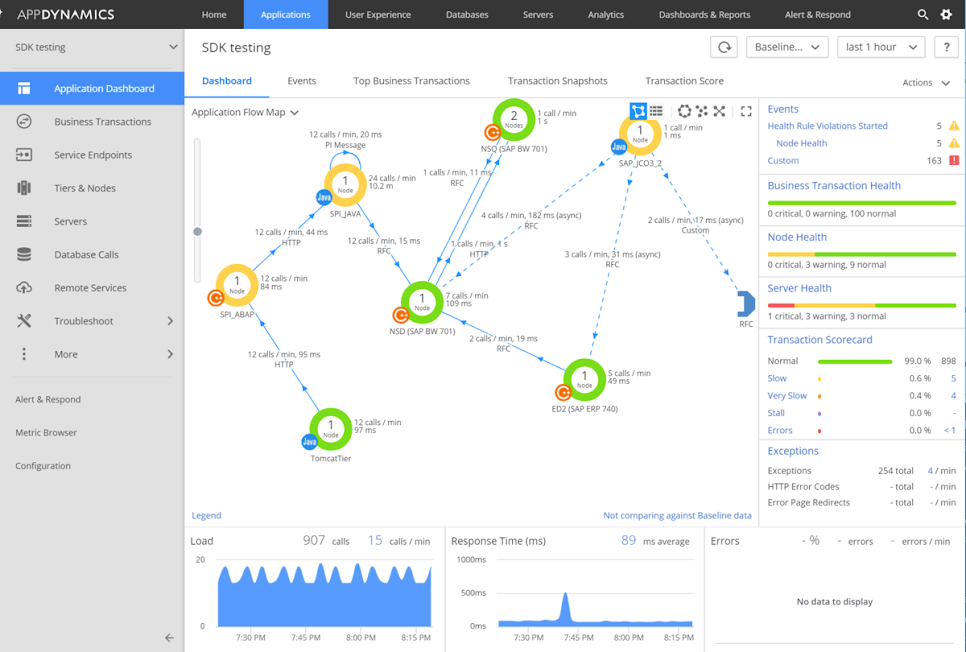
    Application performance management (APM) is starting to be  employed more widely as more organizations embrace digital business transformation. As the number of digital business processes spanning multiple applications increases, so does the need to understand what’s occurring inside both greenfield and legacy applications. In fact, at the heart of many of those digital business processes are enterprise resource planning (ERP) and customer relationship management (CRM) applications from SAP. To make it possible to gain insights into those applications AppDynamics, a unit of Cisco Systems, announced today it is making available AppDynamics for SAP.

    Jonah Kowall, vice president of market development and insights at AppDynamics, said his company is now able to support ABAP, the proprietary language SAP developed to build its applications. That language also has been employed extensively by IT organizations to customize those applications.

    SAP currently is trying to transition its customers to building custom applications on a cloud framework based on the Cloud Foundry platform-as-a-service (PaaS) environment. Most of those applications are be written in Java or the new Jakarta platform that replaces Java. SAP has also provided a software development kit and application programming interfaces (APIs) for tapping into S/4 HANA ERP applications.

    But there is a massive installed based of ABAP applications running in enterprise IT environments. Much of that code is now being integrated with other applications as part of a larger digital business transformation initiative.

    Kowall said those extensions are now driving organizations to apply an agent for the AppDynamics APM to custom applications written in ABAP. Historically, enterprise IT organizations only applied APM to their most critical applications. But as organizations move to digitize business processes, they now need to able to track transactions spanning multiple applications. Given the reliance many organizations have on SAP applications, it’s inevitable those transactions will involve SAP applications that were customized using ABAP.

    In addition, Kowall noted that being able to discover precisely where those custom applications are involved in any transaction is pivotal when it comes to upgrading to the SAP S/4 HANA applications, which are based on the SAP in-memory database, or lifting and shifting a legacy SAP application into the cloud.

    Kowall said organizations that have used ABAP to customize SAP applications now will have visibility down to the code level, including queries being made to the underlying database. From a DevOps perspective, that capability will go a long way to breaking down yet another silo in the enterprise. AppDynamics expects the first order of business for many organizations will be simply to create a performance baseline for their ABAP applications, which in many cases are likely to be an eye-opening experience, he said.

    The focus on digital business transformation is likely to spur adoption of DevOps processes over a much broader swath of the enterprise. Rather than simply apply DevOps processes to new applications, many organizations soon will extend DevOps into the realm of legacy application environments as well. That may take some time to play out, given the scope of the cultural changes involved. But at this point, those changes are now all but inevitable.

    — Mike Vizard

  • NodeSource, AppDynamics Ally for Node.js DevOps

    NodeSource, AppDynamics Ally for Node.js DevOps

    The prevalence of Node.js as the most widely deployed instance of JavaScript is putting a lot of pressure on DevOps teams to find ways to automate the management of Node.js applications. To provide the visibility needed to achieve that goal, NodeSource has announced it has integrated its N|Solid development environment with the application monitoring tools developed by AppDynamics.

    Pravin Halady, product manager for NodeSource, says one of the things that differentiates N|Solid, which is based on Node.js, most is the amount of telemetry data NodeSource is able to collect from Node.js applications. The alliance with AppDynamics provides a mechanism for DevOps teams to now tap into that data to better manage those applications alongside the panoply of existing applications they need to support and manage, says Halady.

    AppDynamics already supports Node.js. But Halady says the alliance with NodeSource provides deeper visibility into, for example, asynchronous activity. Advanced metrics can be used to augment the basic Node.js metrics that AppDynamics currently provides to better ensure service level agreements (SLAs) are both achieved and maintained, Halady says.

    Adoption of Node,js exploded across the enterprise once it became feasible several years ago to deploy JavaScript code on both the client and the server. That capability in many ways fulfilled the early promise of Java in the eyes of many developers. But DevOps teams have been slow to include support for JavaScript applications within their DevOps processes, mainly because of a lack of visibility. Now that the base of Node.js applications in the enterprise has reached a level of critical mass, tools vendors such as AppDynamics are looking to provide that visibility by expanding the scope of support they provide for Node.js.

    Halady says NodeSource chose to partner with AppDynamics in part because in the wake of AppDynamics being acquired by Cisco Systems, it’s clear that NodeSource needs to participate in the end-to-end visibility platforms that larger companies are starting to build. Cisco has already made significant investments in a Cisco Tetration analytics application in addition to committing to imbuing the IT infrastructure environment it provides with machine-learning algorithms. That data will then be combined with data about applications collected by AppDynamics to identify the source of any potential performance issue faster. NodeSource, adds Halady, will look to foster similar agreement with other providers of application monitoring tools.

    In the meantime, DevOps team can take heart in the fact the Node.js Foundation is making providing visibility into DevOps environments a higher priority. The number of Node.js applications in the enterprise is only expected to increase. There’s a high correlation between usage of Node.js and containers that collectively are being used to facilitate the development of microservices. As those microservices bgin to replace monolithic applications developed originally developed in languages such as Java, the size and scope of the DevOps challenge exponentially increases.

    Application development in the enterprise is going to be polyglot well into the next decade. Today there are more programming languages being actively used in the enterprise than any time in history. In fact, the days when IT operations could mandate what technologies developers can employ are long over.

    — Mike Vizard