Tag: alan shimel

  • Mobile Apps and Big Data Megatrends Drive Application Performance Management

    Mobile Apps and Big Data Megatrends Drive Application Performance Management

    As the megatrends of Big Data, mobility and cloud continue to reshape the IT landscape many companies are responding by refocusing their solutions to provide better visibility and support for these technologies.  Case in point is AppDynamics new Spring 2014 release announced yesterday (full disclosure, AppDynamics is a sponsor on devopsy.kinsta.cloud but that sponsorship has nothing to do with editorial content, just banners).

    Jyoti Final_1I had a chance to catch up with Jyoti Bansal, founder and CEO of AppDynamics yesterday. Jyoti made it very plain that mobile applications are quickly tipping the bar in terms of what types of applications his customers are asking for support on. That along with enhanced NoSQL support and support of some for some of the hottest languages being used in development today (Node.js and Scala) lead the way in his company’s latest release.

    Gartner has weighed in on the increasing importance of monitoring mobile app performance.  Jonah Kowall, research vice president at Gartner, in a recent report states, “driven by the increasing significance of mobile application endpoints and increasingly dynamic Web technologies, end-user-experience monitoring will become even more important to enterprises. In fact, it is likely to shift its center of gravity from monitoring the end-user experience of individual applications to monitoring and analyzing end-user behaviors across the entire portfolio of applications available to an end-user at any given endpoint.”

    Personally I don’t think any of us need Gartner to tell us that there is an app for just about anything and many of them are mobile. Mobility is changing the way so many of us work. Mobile apps are poised to overtake web browsing sometime this year says Jyoti.

    If anything is bigger than mobile though it may be Big Data. It seems that Big Data is everywhere. I saw an interesting stat the other day, something along the lines of 90% of all the data stored in the world is less than two years old. I guess that explains why we didn’t hear as much about Big Data before that.  In any event there is big money being poured into Big Data solutions. Evidence of this is Intel’s Cloudera investment, $740m for 18% of the company. Cloudera is a Hadoop distributor of course and part of the AppDynamics new Big Data support is for enhanced Hadoop features.

    NoSQL companies have also been a big beneficiary of the Big Data megatrend  and VC investment of course. One of the biggest beneficiaries is MongoDB (again in full disclosure, devopsy.kinsta.cloud is a media sponsor of MongoDB World).  Matt Asay who has written here on devopsy.kinsta.cloud and is also the VP of Marketing and Business Development had this to say about AppDynamics new NoSQL support. “Together with AppDynamics and MongoDB, organizations can now leverage application performance management solutions to gain further insight into their MongoDB-based applications. This partnership allows users end-to-end visibility for optimal performance in production, an important feature for companies as they scale their MongoDB deployments.”

    To be accurate all of these new features in the Spring 2014 release of AppDynamics have actually been available already for at least a few weeks or months. In my conversation with Bansal I asked him that if he didn’t see a little irony in the fact that a DevOps enabler like AppDynamics still did somewhat traditional software releases instead of some sort of continuous delivery.  Bansal said that these once a quarter releases are really just packaging up features that are released in a continuous fashion over the preceding quarter.  These quarterly releases serve as a checkpoint, version control if you will.  In actuality though AppDynamic customers have been getting this functionality as it comes out.

    Application Performance Management seems to be a very hot area. In large part because of the mega trends of Big Data, mobility and cloud. It remains to be seen if these solutions will become part of (by acquisition or partnership) the bigger Application Development Lifecycle Management (ALM) market.

  • Episode 2 of devopsy.kinsta.cloud Podcast

    Episode 2 of devopsy.kinsta.cloud Podcast

    Mitchell Ashley and I are joined this week by Stephen Wilson of Compuware. Stephen is a regular blogger here on devopsy.kinsta.cloud, but is also the technical evangelist at Compuware.  Steve gives us his background and a brief description of what Compuware does.  Then we all talk a bit about Steve’s last article here on devopsy.kinsta.cloud,  Don’t worry testing team, DevOps is here!. While some say that testing is a big loser in DevOps and many testing/QA teams feel a threat to their job security, Stephen says not true.  In fact DevOps makes the testing team superstars. Tes.com ting teams should embrace DevOps as it will make their job easier and more powerful, but not less important.  Steve talks about the concept of “continuous testing”.  All of this in just about 13 minutes.

    Enjoy!

    [soundcloud url=”https://api.soundcloud.com/tracks/142563047″ params=”color=ff5500&auto_play=false&hide_related=false&show_artwork=true” width=”100%” height=”166″ iframe=”true” /]

    Also if you would like to be a guest on a future devopsy.kinsta.cloud podcast write us at podcast@devops.com

  • DevOps: The Last Great Hope for Application Security?

    DevOps: The Last Great Hope for Application Security?

    Once upon a time, there was a great battle between speed and security.  Development wanted to go fast.  But, Security wanted to slow down and be safe.

    “We must protect our gilded apps”, cried the application security team.

    “Speed is cherished by our people”, declared the development team.

    For years, they endured the pain of testing late in the lifecycle, sorting through reams of false positive reports, and dealing with the added cost of pushing bad software out the door.  They knew there had to be a better way…

    And then came, The DevOps Revolution.  The DevOps team had an answer.  “Let’s bring Application Security and Development closer together — and shift its focus further to the left”.  The DevOps team knew that by introducing awareness of security vulnerabilities and policies early in and across the software development lifecycle — without creating a time-consuming tax on development — that both teams could win.

    During an evening event named “Wining Not Whining” at the RSA Conference 2014, we gathered some of the top DevOps experts and influencers and asked them “Why is application security so important to the DevOps revolution?”

    Listen to what they had to say:

  • Around the DevOps Blogs and News Scene

    Around the DevOps Blogs and News Scene

    It was another busy week in the DevOps media world; not just here on devopsy.kinsta.cloud either. We had almost 30 new original features and blogs published this week. You should take some time and read them before running off and reading any of the articles and blogs I mention here. But then again I am biased, so take it from where it comes.

    Besides the devopsy.kinsta.cloud articles, I wanted to call out to two different articles over on Information Week. One is a guest post from Rackspace CTO, John Engates. It is called DevOps: ITs only chance of keeping up. In it the Engates calls out that breaking down barriers between development and operations, as well as other barriers in IT is the only hope for IT departments to keep up with the pace of business.  I spoke about this with one of my friends and he thought of it as a chicken and egg question.  Does DevOps make business go faster or does business going faster make us do DevOps?  Of course the answer is probably “C”, all of the above.  Anyway it is a great article by John and after you read enough here on this site, you should head over and take a read.

    The other article on Information Week is by my Facebook friend Lorna Garey.  Lorna was a participant in a recent DevOps State of the Union event I attended in Boston some weeks back.  We both heard firsthand from some companies where DevOps allows IT to perform at a high level. Lorna writes that DevOps is creating a digital divide. It is creating a class of haves and have nots. Much like those with fiber internet and those with sub-5mbps DSL.  This is going to create inherent advantages to those who have DevOps over those who do not.  For me there is an easy answer, everyone should do DevOps if they want to.

    everyone-has-a-voice-that-deserves-to-be-heard_designAnother topic that has been active here on devopsy.kinsta.cloud and on other DevOps discussions is whether or not DevOps is a title and real job. I don’t care what you call it, there are certainly people doing it for a living, but that is just IMHO.  According to this article in ITproportal, the number of DevOps engineer jobs in the UK has tripled over the last two years. In another report based on the same Rackspace data, Computer Weekly declares that “It is official, DevOps is a real job“. So I guess that ends that discussion, said no one ever.

    Finally I have been having a good time monitoring the Twitterverse as the @devopsdotcom stream grows over these past weeks. I would say overall the reaction has been pretty positive. The DevOps community has embraced what we are trying to do with open arms and have been more than eager to help out and even be involved. But you can’t please everyone. One person in particular  thought we have come “late to the conversation” with “little credibility  beyond buying devopsy.kinsta.cloud”.  Hey there will always be some of that. But for the record we didn’t buy the domain and as I said in my first post three weeks ago, we aim to post a big tent here at devopsy.kinsta.cloud.  There is plenty of room for old DevOps folks and even more room for all of the new DevOps folks to come. We all don’t have to agree, but this site is here to give everyone a platform to add their voice to the discussion.  I don’t think you need a union card or have to pass any literacy test to particiapte.

    Have a good weekend!

  • devopsy.kinsta.cloud Podcast

    devopsy.kinsta.cloud Podcast

    Mitchell Ashley and I have been doing podcasts together since about 2007 or so. Back then the subject matter was security. But now with the launch of devopsy.kinsta.cloud we are launching a new series of podcasts on DevOps. In doing so we are joining a small field of quality podcasts on DevOps. Podcasts like DevOps Cafe and Arrested DevOps have set a high bar of quality. Eventually Mitchell and I hope to join them.  Our podcasts will be shorter than some of the others though. They will be supplemented with Mitchell or my notes from the show.

    So here is our first episode. We really just introduce Mitchell and I to the audience and talk a little about some of the stories on devopsy.kinsta.cloud over the last week.  In the future we will have guests and dive a little deeper into the world of DevOps.

    [soundcloud url=”https://api.soundcloud.com/tracks/142516025″ params=”color=ff5500&auto_play=false&hide_related=false&show_artwork=true” width=”100%” height=”166″ iframe=”true” /]


  • Chuck Norris doesn’t need DevOps, but have we beat “What is DevOps” to death yet?

    Chuck Norris doesn’t need DevOps, but have we beat “What is DevOps” to death yet?

    Chuck-Norris-Card (1)Some interesting and lots of the usual around the DeOps blog beat last week and over the weekend. An interesting piece by Daniel Bryant on his Tai-Dev Blog on why “Chuck Norris doesn’t do DevOps”. It is actually a video of a presentation he gave at the recent London Java Community event and is the subject of a talk that Bryant has been working on for some time.  You can also see the slides from the show on slideshare here.

    Chuck Norris doesn’t do DevOps because he doesn’t have to. Chuck can do everything and he can do it by himself. He has no need to work with Dev or Ops, he does it all. But for the rest of us, to get something done we have to work as part of a team. As such we need DevOps to help us work better, faster deeper. So until we are all as good as Chuck Norris, we need to keep at it.

    To understand why Chuck Norris doesn’t do DevOps, do we have to also define DevOps?  Hasn’t been there enough good descriptions of what DevOps is?  Usually when you keep seeing people trying to solve the same issue over and over again, it generally means it hasn’t been done satisfactorily to date. Is this the case with a definition of DevOps? You would think so by how “What is DevOps” blog posts we see.

    Vishal Biyani on his blog last week writes exactly that. It is actually part of one of a multi-part series of blog posts that will according to Biyani cover:

    • Getting basics right: What is DevOps anyway? (This post)
    • It’s all about delivering: CI & CD
    • Configuration Chaos :  Managing your infrastructure, as code!
    • Monitor, measure and move: From logs to performance and beyond
    • Putting it all together: Collaborate, communicate and continuously improve
    • Further Reading

    Giving Biyani credit he refers back to Magnus Hedemark at Redhat. The first part explains the basic premise behind DevOps, a brief history and the motive behind the DevOps movement.

    I think this is what we should do more often. Refer back to a well written definition that we can point to with consistency rather than having as many definitions of DevOps as there are stars in the sky. An example is OlinData who back in January wrote a well done “what is DevOps” post.  It is no worse than countless others I have seen.  The issue, how many more people will write their own definition instead of just pointing at OlinData’s or Dev2Ops.com definition or any others.

    As long as we spend so many cycles defining what DevOps is, we are wasting cycles that we could be using on doing DevOps and expanding DevOps knowledge. I think we have beaten the what it is fairly well by now, let’s move on.

    An example of moving on is the “BlueMIx” 100 Days announced by IBM and written about on this IBM blog. I will be writing more about IBM and BlueMix, but suffice to say here, IBM is scheduling 100 workshops around the world to help Developers do DevOps with some pretty cool tools from Big Blue.  It promises to be a great event if you can get to one in your area.

    Another good example of blogs moving DevOps forward is the Ranger4 blog. They had a good post up with the 7 Habits of Highly Effective Continuous Delivery Experts.  Good article that take it to the next level.

    Anyway, that is my report today. For those that notice these things, I will be handling the Cup o’ Joe blog here for a while, as reading blogs is something I do.  You can write me at ashimmy@devops.com if you have something on your blog you want us to mention.

  • Perforce: The biggest little secret in DevOps

    Perforce: The biggest little secret in DevOps

    Quick can you name a company that is 15 years old, never took a dime of venture money, has over 250 employees, over 10,000 customers and was widely profitable from day one? Until last week me neither. That was when I  was briefed by Dhruv Gupta, Director, Product Marketing and Bob Dever, Director, Corporate Marketing for Perforce.

    perforce customersPerforce is a DevOps powerhouse. Take a look at the customer cloud to the right to get an idea of who some of the 10,000+ customers they have are. Perforce is all about version control. They do that and do it well. Whether you are talking about version control of your code, documents or analytics, Perforce has a solution for you.

    When you think about it, you can see why Perforce is such a DevOps play.  DevOps is all about continuous delivery or at least rapid release.  How can you accelerate your releases without keeping track of the different versions? Without version control you quickly have a mess. Perforce has in some ways enabled continuous delivery and rapid iteration. They truly are the biggest, little secret in DevOps.

    For many years Perforce was really the only choice in town for version control (there were others, but it became a leader in the space pretty quickly) but the rise of GIT, a distributed version control system (DVCS) gave some an alternative. But GIT lacked the enterprise features (read security and team management) that larger organizations needed.  Its popularity among lone wolf and smaller dev teams though was unmistakable. It is easy.

    Perforce has recognized this and has just released a new hybrid version of their solution. This hybrid version allows developers and dev team managers to use GIT and Perforce’s P4 in one hybrid version control platform. A best of both world solutions give DevOps teams the ability to move fast with GIT and have the security and enterprise functionality that P4 allows.

    When you start thinking about DevOps Unicorns like Netflix for instance or Salesforce, the sheer magnitude of what Perforce is managing comes into clarity. In Salesforce for instance you have 3,000 Engineers making 4,000 – 9,000 Code Changes a day with 550,000 Tests / Hour. Keeping versions straight is not the kind of thing you do in a spread sheet.

    It in a Continuous Delivery environment where Perforce really shines. They are making a big bet on enterprises adopting the Continuous Delivery model. However there are some fundamental questions to answer first. According to Perforce though you need to define what does Continuous Delivery mean to you? They conducted a survey:

     perforce cd


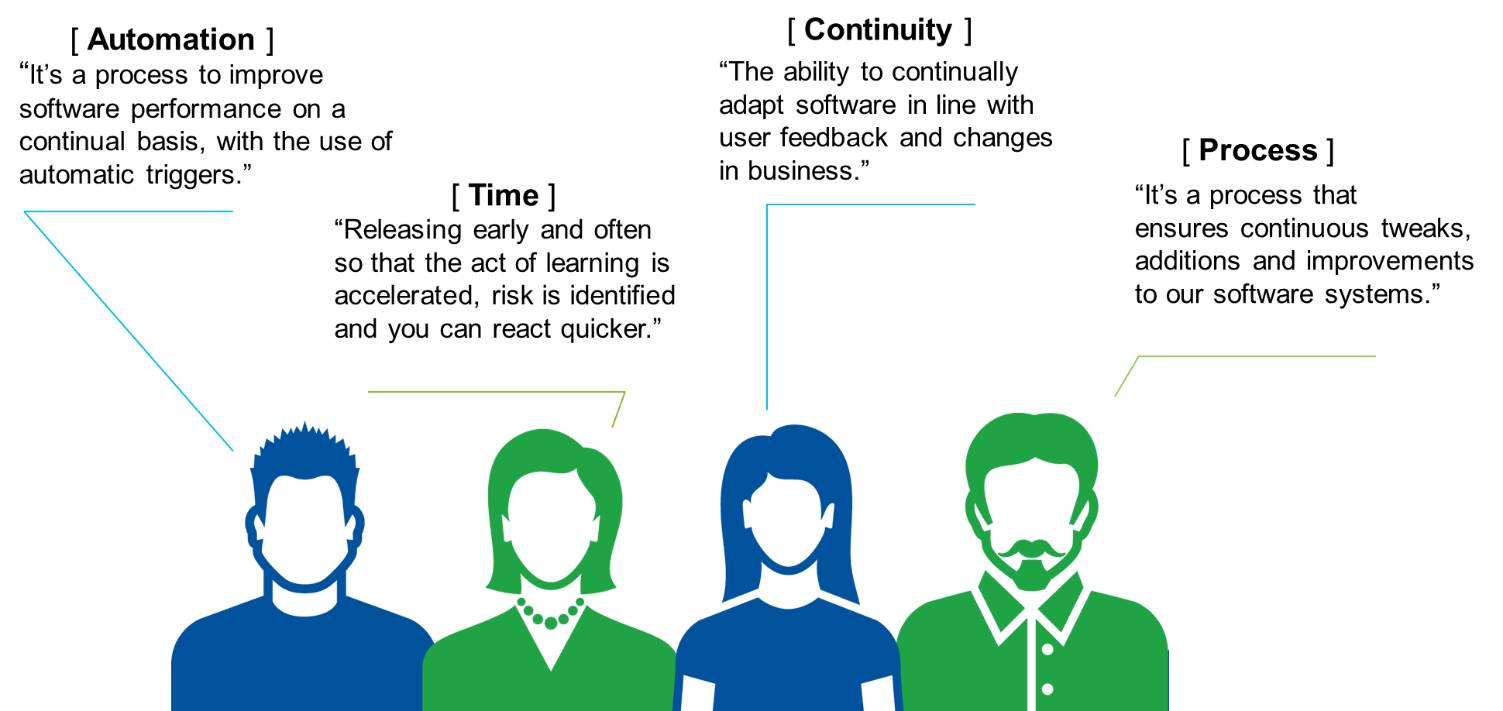
    According to Perforce they think of Continuous Delivery as this:

    • Deliver working product to users as quickly as possible
    • Every change (check-in) leads to a potential release
    • Give business the option to release – what, when, to whom
    • A change in process and culture

     perforce cd pipeline

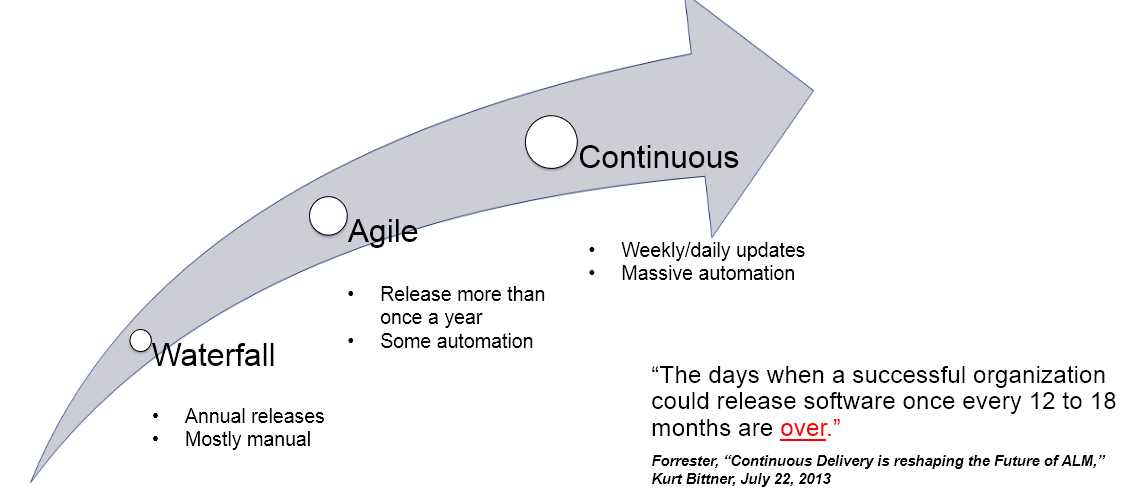
    Most importantly though, Continuous Delivery is not just something Perforce thinks is crucial. Waterfall release models are obsolete and even Agile is just a way stop towards Continuous.

     perforce cd arrow


    According to Perforce’s own survey they see Continous Delivery attaining critical mass:

     perforce cd adoption

     Is this a case of when you are a hammer everything is a nail or are we at the dawn of the age of Continuous Delivery? Perforce is making a bet that it is. They are already very successful, any more and they may just lose their status as the biggest, little secret in DevOps.

  • Is DevOps Ready to Cross the Chasm to Mainstream?

    Is DevOps Ready to Cross the Chasm to Mainstream?

    There are just a handful of business books that I have read that have had a profound influence on me.  One was Gene Kim’s “The Phoenix Project”, another was Eliyahu Goldratt’s “The Goal”. A third one was Geoffrey Moore’s, “Crossing the Chasm: Marketing and Selling Disruptive Products to Mainstream Customers”.  Even though written in the early 90’s, it is as relevant today as it was then.  Though our technology has changed (dare I say advanced), the adoption curve of who uses it has remained static.

    When I look at the world of DevOps today, to me it is on a classic chasm model.  The real question is will it or rather how quickly will it make the hop over the chasm into mainstream. The picture above is a great representation of the chasm. Most technologies go through the enthusiast period, moving to the visionary.  I would say that DevOps has been in this visionary period for a few years now.

    In order for any technology to jump the chasm it needs to build up enough momentum and critical mass to successfully make the jump.  Now there are some technologies that never build up enough critical mass to successfully jump over to the pragmatist’s cliff of mainstream adoption.

    Back in my StillSecure day’s NAC had a tough time making the jump. It was not until mobile technology and BYOD served as ignitions that NAC made the cross-over to mainstream.  But enough about NAC lets return to DevOps.  For DevOps the Cloud and virtualization have been ignition points.  Using software to replace hardware has allowed for rapid deployment, automation and continuous delivery models that characterize DevOps.

    With so many pundits and analysts predicting that this is the year Cloud goes mainstream (I thought it did already), DevOps will not be far behind. As disruptive as Cloud is, could it be as disruptive if not for DevOps? There is a symbiotic relationship between the two.

    But it is not just Cloud alone. DevOps has other boosters that will help it over the chasm. SDN is another big boost.  Software will eat the world according to Marc Andresseen. It may very well start with networking hardware.  But software is eating more than hardware.

    One of the hottest trends in security (and one you will see featured here in the SecOps neighborhood of blogs on devopsy.kinsta.cloud) is Software Defined Security.  It may sound like marketing speak to you, but it involves putting security right into the virtual, software stack.  It is DevOps for security.  In fact DevOps and security is something you are going to hear more about from the likes of Josh Corman, Dave Mortman and Dwayne Melançon and others.  Their “Rugged DevOps” discussion is ripping through the security industry for the last year or more.

    All of the above aside the real key for DevOps to making the leap is that instead of just enthusiasts and visionaries being involved, what Moore calls “the Pragmatists” get involved.  These pragmatists are not hung up on labels or new versus old.  They just want to get the job done. If DevOps will help them get the job the done, that is good enough for them.

    The pragmatists make up a good chunk of the mainstream market.  The silent majority if you will.  To win these pragmatists over DevOps just has to show that its benefits are real, quantifiable and worthwhile. The good news is that the Pragmatist are the first group on the other side of the chasm.

    Having the Pragmatist as the first part of the mainstream is a good thing, because after that it gets harder to gain traction.  According to the Chasm model after the Pragmatists come the Conservatives.  Though not quite reactionary, this group doesn’t like change. They won’t change until they are nearly forced to by business pressures. They will resist adopting DevOps just because it is different than what they do now.  Generally technology has to be pretty mature, its benefits well established before this group will consider doing anything more than a small trial.  With DevOps representing as much a change in philosophy and culture as it does new tools, this is a really bitter pill to swallow for the Conservatives.

    I would think we are years away from DevOps making real traction into this group. Especially when there are still some folks who claim that DevOps is DOA, DevOps is much ado about nothing, that it is doomed to failure. But hey there are people who still say that the science doesn’t point to climate change and that we should teach creationism in schools.

    Call me the eternal optimist though. I do think that as Cloud and the other catalysts behind DevOps continue to expand, DevOps will be swept up even into the conservative base.

    Between Conservative and Pragmatist, a large slice of the market is spoken for. Added to the pre-chasm market and DevOps is well beyond critical mass.  Whether the last segment of the market, the skeptics ever adopt is not even relevant.  Many of these skeptics have a bone to pick. As I have grown older I am convinced that they are just wired to be skeptics.  They literally look at everything through a half empty glass.

    So there is little doubt in my mind that DevOps will not be a stillborn technological movement. It has the catalysts, the benefits and most importantly timing and circumstances are lined up to help push this from the early adopter crowd and right over the chasm into the mainstream. What’s more is I think this is already under way and will be much quicker than most people think.

    This is all a big reason why we launched devopsy.kinsta.cloud.  There is a big enough critical mass now to support a site dedicated to DevOps like this.  But as we cross the chasm to mainstream, we want to ride the crest of the wave, helping to bring DevOps to pragmatist, conservative and anyone else who would benefit from it.

  • devopsy.kinsta.cloud Pitches a Big Tent

    devopsy.kinsta.cloud Pitches a Big Tent

    If you are reading this you have already discovered one way or another, that the new devopsy.kinsta.cloud website has launched. I am proud to say that I have been one of a team of folks who have been working hard on devopsy.kinsta.cloud for many months and weeks now.  I will serve as editor-in-chief and as a co-founder. Anyone who has started a business knows that I am also chief cook and bottle washer. That is OK though. This is not my first start up. Staying up until 2:30 or 3:00 am working on the site reminded me of how alive you feel when you are building a business. If only you could bottle that. We know we have much more to do to realize our vision. But we think we have enough to introduce you, the DevOps community to devopsy.kinsta.cloud

    So what is devopsy.kinsta.cloud? Frankly, it is a big tent.  What we have tried to do is create a destination for the burgeoning DevOps community to gather.  Our goal is to have something for everyone with an interest in DevOps. We realize that many DevOps devotees are highly technical.  All of the culture and business discussions are nice, but how can you do more, faster and better? Our aim is to give you lots of information, education and resources to help in your everyday work. We want bloggers and writers who are living the DevOps life and are sharing their own experiences with you.  In fact, we also welcome you to participate fully by sharing your own experiences and thoughts as well. We are always looking for people who have something to add to the conversation.  That last phrase says it all. We want to add to the conversation.  But that conversation can’t be just for those who are technical. We want a bigger tent than that.

    I have met and there are many people who know little about DevOps. They have heard the name and are curious though. What they do know is that somehow this could help them transform their organizations into what my friend Gene Kim calls a high powered IT organization.  They are faced with a world where the rules have changed. Iterations take place daily if not hourly, automation is not nice to have, it is mandatory, software has replaced hardware for many. How can they succeed in this environment? DevOps is a key. We want devopsy.kinsta.cloud to have a place under our big tent for these people.  Whether they are C-level executives looking to leverage DevOps in their business, VCs looking for insights into their next investment or even job seekers, exploring what talents and skills they will need to succeed, devopsy.kinsta.cloud has a place for them under our big tent.

    Another goal of devopsy.kinsta.cloud is to be more than just a place with great articles, stories and DevOps related content.  We want to be a linchpin of the community.  Though not ready in time for our launch, you will shortly be seeing several other parts of devopsy.kinsta.cloud.  We will have a community forum Q&A section shortly.  If you have a question you can ask. Either someone from our staff or maybe someone in the community will answer. Maybe more than one person will answer even.  Maintaining these Q&As will over time build up a great knowledge base which will always be available to the community.

    Additionally, we want to facilitate and help all of the great meetup and user groups that are out there dedicated to DevOps.  I have spent a lot of time these past months going to meetings, observing, listening and understanding.  We know that these groups need speakers for monthly meetings, sponsors to supply food, drink and often a place to meet. Help with local community outreach and connecting with other groups to share ideas, experience and learning are also somethings these groups need.  The good news is there are plenty of people and organizations out there who want to help you.  Our mission will be to help match these groups together to strengthen these grass root groups. We have lots of room under the big tent to help in this mission.

    Holding a local DevOps Days or workshop?  Need sponsors, speakers, logistic support? devopsy.kinsta.cloud can help you too.  Local groups do more to further the DevOps cause than anyone. We want to help and encourage more of it.

    In the not too distant future devopsy.kinsta.cloud will also be more involved with conferences that play on bigger stages. Whether it be as a media sponsor, covering and reporting on the goings on or providing speakers and content ourselves, we will be on the scene. We plan on holding our own conferences with multi-track sessions, keynotes, exhibits and of course social activities.  Stay tuned for details in the coming months.

    Is this an ambitious agenda? You bet it is.  But if you aren’t going to go big, you might as well stay home.  We are being helped by some people who know how to succeed.  We will be announcing shortly some of the people who are behind devopsy.kinsta.cloud and who will be helping out.  I am proud to call these people my friends and am honored that they are lending a hand. One person I want to mention now though is my devopsy.kinsta.cloud  co-founder, Martin Logan.  When I first started talking about the idea of a DevOps community site I registered a bunch of domains, but knew that devopsy.kinsta.cloud would be the best domain name.  I found Martin as owning the domain and reached out to see if he would perhaps sell it for a reasonable sum.  A few hours later we were partners!  Martin is a real, live DevOps dude.  He understands what DevOps is about. None of this is possible without him.

    For now take a look around our site. Be sure to sign up for our newsletter in the top right column.  The site look and feel will be changing daily as we continue to iterate in the DevOps way.  Most of all there will always be fresh content.  We should be averaging about 100+ new content articles a month.  There will be something for everyone!

    You can reach out to me anytime with comments, suggestions, complaints or questions at ashimmy@devops.com.

    Thanks for stopping by and enjoy!