Tag: ai

  • Heat Cooks Twitter DC | AI Will Kill All Humans | Patreon Layoffs, CSAM Claim

    Heat Cooks Twitter DC | AI Will Kill All Humans | Patreon Layoffs, CSAM Claim

    Welcome to The Long View—where we peruse the news of the week and strip it to the essentials. Let’s work out what really matters.

    This week: Twitter is in a “non-redundant state” thanks to a hot summer, AI is likely to eliminate us, and Patreon fires 80 staff amid nasty allegations (TW: Child safety). (more…)

  • Dynatrace Extends Reach of Application Security Module

    Dynatrace Extends Reach of Application Security Module

    Dynatrace has extended the Application Security Module it provides for its observability platform to protect against vulnerabilities in runtime environments, including the Java Virtual Machine (JVM), Node.js runtime and .NET CLR.

    In addition, Dynatrace has extended its support to applications built using the Go programming language.

    The Dynatrace Application Security Module leverages existing Dynatrace tracing and artificial intelligence (AI) technologies to detect threats in real-time and then apply appropriate policies to automatically secure applications. At the core of the Dynatrace approach to application security is its OneAgent software for application instrumentation, which collects data and feeds it back to an observability platform that includes an AI engine dubbed Davis.

    Amit Shah, director of product marketing for application security at Dynatrace, said by extending the Application Security Module to support runtimes in the most widely adopted programming languages Dynatrace is now providing real-time visibility and vulnerability analytics across the entire application stack, which includes custom code, open-source and third-party libraries, language runtimes, container runtimes, and container orchestrators.

    The Dynatrace platform not only identifies vulnerabilities across each of these layers automatically but also analyzes them to reduce false positives by only surfacing alerts concerning code that is actually running, noted Shah. Without those capabilities, it becomes impossible for development teams to prioritize their application remediation efforts in the absence of any context, he added.

    In general, achieving and maintaining application security will require more responsibility to shift both left and right, said Shah. While it’s critical to discover as many vulnerabilities as possible before applications are deployed it’s also crucial to make it simpler to discover vulnerabilities in runtimes after an application is deployed, he noted. The goal is to enable DevOps teams to employ the same observability platform they are using to manage and optimize applications to also ensure application security, Shah added.

    That Dynatrace approach provides the added benefit of also avoiding the need to convene a “war room” to discover where all the vulnerabilities in those application environments might reside once they are discovered, Shah noted.

    The primary application security challenge organizations face is the rate at which applications are now being deployed. Cybersecurity teams, because of a chronic shortage of talent and expertise, can’t keep pace. As a result, more responsibility for application security is being shifted left toward developers and DevOps teams as well as right toward IT and security operations teams. In effect, application security is finally becoming a team sport within IT organization as cybersecurity teams focus more of their efforts on securing runtime environments, noted Shah.

    It may be a while before that approach has a major impact in terms of reducing the number of vulnerabilities being regularly introduced into application environments. However, as more tools and platforms that specifically address application security are deployed, the overall state of application security will steadily improve.

    In the meantime, however, the volume of attacks aimed at the application layer of the IT stack will, unfortunately, continue to increase as cybercriminals focus more of their efforts on exploiting both now and zero-day application vulnerabilities that are increasing in volume with each passing day.

  • Techstrong TV: Scratching the Surface of Testing Through AI

    Techstrong TV: Scratching the Surface of Testing Through AI

    Mark, Torsten and Alan discuss the findings of the “Disrupting the Economics of Software Testing Through AI” report. The report identifies critical factors that hinder software engineering and DevOps teams including the escalating costs of quality control, and growing complexity associated with the increasing release velocity, number of smart devices, operating systems, and programming languages. The video and a transcript of the conversation are below.

    Announcer:                 This is Digital Anarchist.


    Interviewer:                Hey, everyone. Welcome to another segment here on Techstrong TV. I am really happy to tell you, introduce our guests for this next segment. First of all, he’s a returning guest with us. He’s from our friends at Applitools. It’s Mark Lambert. Hey, Mark. How are you, man?


    Interviewee 1:             Fantastic. Thank you, Alan. Great to have you – for you to have me on. Yeah, great to talk to you.


    Interviewer:                Absolutely. And then joining Mark and I today is Torsten Volk. Torsten is – I just drew a blank – EMA, right? Enterprise Management Associates?


    Interviewee 2:             Yes, exactly.


    Interviewer:                Yep. And we were talking off camera. Torsten is actually a friend of our friend, Andi Mann, who he knew or was his predecessor at EMA 11 years ago.


    Interviewee 2:             Yeah.


    Interviewer:                And, Torsten, welcome to Techstrong TV. It’s great to have you on.


    Interviewee 2:             Thank you very much. It’s awesome to be here.


    Interviewer:                Thank you. So, guys, look, Applitools, leader in visual testing. We’ve had, beyond Mark we’ve had many Applitools people on over the last almost two years now of doing Techstrong TV, so I think our audience is familiar. But just in case people aren’t, Mark, how about a little quick Applitools backgrounder?


    Interviewee 1:             Sure, yeah. So Applitools is known for inventing Visual AI, so helping software development teams accelerate their releases by mimicking the human eye and brain and how we as humans analyze computer screens, highlighting differences and issues within your UI so you can do not only visual testing, but also fundamentally change and modernize your functional test automation. So it’s really the glue that plugs right into your existing practices, so Selenium, Cypress, we support over 50 SDKs. There’s a free account as well, so you can get in there and get going, kind of feel the water, so to speak. But what we’re seeing is that it’s helping leading brands accelerate their digital experiences, and really it ties directly into the research obviously that Torsten’s been doing around AI and how that can help organizations disrupt the economics of software testing.


    Interviewer:                Love it. And, Torsten, look, I know EMA from before 2010 even, but for those folks who maybe, you know, a lot of our audience are technical people. They may not necessarily follow the analyst beat. Why don’t you give them a little EMA background?


    Interviewee 2:             My boss describes it always as the industry and analyst firm for enterprise grade solutions, and in the beginning – I’ve been here for a while. In the beginning I was always a little bit wondering, you know, what does that really mean? And what it at the end of the day means is we have all of those emerging technologies coming up, especially in the area of artificial intelligence and cloud native applications and intelligent automation, and what we are looking at is really how can we leverage those capabilities within an enterprise setting. So once the dust has settled and we’ve all gorged ourselves, you know, by consuming the leading edge of all of those tools, the question then is how do I expand that footprint of those tools across the enterprise so that the enterprise as a whole is more competitive in the end. So basically projecting those constraints of all of those cool new products and technologies into the enterprise, that is really what EMA is all about. And my specific practice is focused, as you can see in the background here, as one of my research graphics is focused on looking at machine learning, deep learning, reinforcement learning, and how those capabilities can enhance the enterprise.


    Interviewer:                I get it. Great use of the background, Torsten. Thank you. All right. So, Mark, we’ve got all that out of the way. Let’s jump into what we really want to talk on today, and I’m gonna let you kick it off if it’s okay.


    Interviewee 1:             Yeah, I’d love to. Thank you. So yeah, so recent report from EMA, and Torsten is the author and I’ll kind of throw the ball to him very quickly, obviously, but really talking about how artificial intelligence and machine learning is revolutionizing the software testing space, and is really important right now because there’s so much buzz around AI, machine learning, and kind of where it comes in. You want to understand where does the rubber meet the road? What is impactful today? What’s impactful for the future? And then what’s, what are the drivers that are getting us there? So I mean, Torsten, I’ll turn over to you, and maybe kind of like talk about some of the capabilities that you talk about in the report and the challenges that they, that you’ve seen come into play.


    Interviewee 2:             We started that report by looking at the key pain points, like we start almost all of our reports. Right? What is not sustainable anymore in a specific discipline, and in this case it’s test engineering. And we have pressure factors. One of them is that we, the business needs us to release software a lot more often, and in a really granular manner where somebody’s asking for a feature capability and the software development team is expected to release that thing very quickly, ideally in an ongoing manner. So that is one part, and the second part is that the end users are very, have become very much more diverse than they even were in the recent past, where we have multiple charts where we show the escalation of the number of devices with different screens, different processors, a different network connection, different interfaces for your fingers and for voice control. And all of those things make testing much, much more difficult, and one of my favorite parts always is the little war stories that you get told. Right?

    So in the beginning when we look at al the material that we have, we talk to a lot of developers and test engineers and DevOps guys, and my war stories or their war stories always started with, “Oh, yeah, regression testing, Torsten. That is really not doable anymore. This is kind of a dreamland that you are living in as an analyst if you think that we can regression test all of those releases. It’s just too much, and it would take forever to be able to do that.” So if we can’t regression test, we are running a significant risk, Mark, that something goes awry. Right? We always are sure that in theory things should work, but in real life there are combinations of technologies, of code functions, that they then don’t work. And that’s where we start with artificial intelligence and this whole pair of eyes, Mark, that you are describing, right, where you say, “Oh, yeah, my test engineers don’t have to be that pair of eyes that check through dozens of boxes and just say yes, yes, yes, yes, yes everywhere, and then also overlook some things.

    But that pair of eyes is something more. It’s something that has a certain degree of – when I say understanding, I think I’m gonna embarrass myself, but it has a certain degree of ability to comprehend – maybe that’s the same word – but to pick up things of a similar character and to categorize and cluster things in a manner that makes sense for human beings then to review, Mark. Right? And that is –


    Interviewee 1:             Yeah.


    Interviewee 2:             – where a tool like Applitools is very interesting, and also unique in the marketplace, right, where it’s a pair of eyes that you guys are building.


    Interviewee 1:             Yeah, and I think that talks – I mean your research touches on several different areas where AI comes in, and visual inspection, which is obviously where Applitools fits, is really a highly impactful and the most impactful today of those techniques because it does so many different things. So first of all, obviously there’s the streamlining of the manual review effort. Right? So I’ve got this explosion of devices. How do I check them all? Well, because of the high level of accuracy of Applitools Visual AI, and it’s been trained on over a billion images and has got four nines of accuracy, so what that means is as a human I don’t have to review tens or hundreds of screenshots. I’m just focused in on a very small subset. But that’s just the first part of it, because then you layer on top of that and this explosion of release velocity, increasing device combinations, and as well as the, just the complexity of the application and so many things out of your control, you need help in reviewing the volumes of data and really saying, okay, all of these things kind of look like the same.

    So and then bringing them together. I talk about basically sorting your visual review into different stacks of paper, so for example I might have 76 screens that have a visual defect, but I can break those down into two categories of 40 and 36. And those types of techniques go beyond just the basic pixel dipping approach, which is the one that would be a traditional visual testing technology, and really the ability to categorize that you talk about, Torsten, is the key driver that, or the key foundation that all of these things get built on top of. So it’s a really powerful technique, and as I said earlier plugs right into existing, so you don’t have to rip and replace. That’s one of the things that a lot of AI technology today is say, okay, it’s great, but you have to build it all new in this track. The thing that is really powerful with Applitools is we plug right into your existing frameworks, open source as well as third-party commercial tools, and then we elevate the process with the dashboard to really enable cross-team collaboration. So it’s not just your testers or your test automation or developers that are engaged. Your domain experts, even other parts of the team like UI, UX design, for example, get to be involved in that collaboration process.


    Interviewee 2:             Yes, and we see often that communication is key, and it’s not happening in testing where we have those more and more decentralized product teams that are doing their own thing with their own toolkits and pipelines, but they’re not really benefiting from what other teams are finding. And so coming back to that horrible list approach, right, where you have, you check those boxes or you don’t check them. Right? So it’s a very monotonous affair as a human being to review this, but then once you’ve reviewed it usually it comes back to you again and again, and then it comes back and hits other people in that organization because there is no communication and there’s no unified platform to retain that knowledge. Right? And with reinforcement learning, you can teach the system what it needs to come back to a human with, and then what it shouldn’t. So if one team makes decisions, all the other teams are benefiting from that and it’s less and less of this toil type of task where you just also as a human tend to make mistakes and it’s just not scalable. Right? So that whole scalability aspect is an interesting one that deep learning and reinforcement learning brings us there, Mark.


    Interviewee 1:             Yeah, you hit on the key things. Right? You’re scaling to meet the current demands of release velocity, shorter release cycles. But the other thing I always think about when I think about AI machine learning and how it can help us from a software quality perspective, it’s an assistive technology so you’re reducing or removing mundane and repetitive tasks, which in themselves are error prone. Humans are great at creative work. We’re terrible at boring, monotonous things  because we miss stuff. Whereas leveraging AI, and especially Applitools Visual AI, it’s highlighting those things. So that same example I talked about, 76 screens, you’re gonna miss stuff. If you’re looking at them all and you’re like, oh, it’s the same. It’s the same. It’s the same. But the Visual AI will identify key differences between the 76 images to really kind of like focus and improve the efforts.


    Interviewee 2:             Yeah. And that gets even when you look a little bit into the future, Mark. I know that you can’t share roadmap items, but that whole idea of having a Visual AI can go even beyond just user interface testing, right, where you can do sanity checks in certain areas, where you say, “Oh, yeah, no, that number can never be a billion because of what I know about the data in the background.” Right? And a lot of the things that come through that we continuously see coming through when you release and then you don’t want to be the one in the test team to hold off a, to hold back a release in the middle of the night.

    It’s funny that when I was young and had a ton of hair still, that was what happened, and it’s still happening today just as much, right, where people think, “Oh, no. I shouldn’t be the one who says that. I think it’s all fine. Let’s sign off on that.” Right? So the release data kind of getting mushy and mushy and mushier in those areas, and that ability to say, “Oh, yeah, I had somebody look over it, and something horrible had happened,” some compliance violation or some crazy numbers in the shopping cart that can never add up. Can be even simple things where it’s, oh, this cost a billion dollars, or it’s euros instead of dollars but we are in a certain country. Those are things that you can catch more and more.


    Interviewer:                Fair. Guys, I feel like you didn’t let me, I didn’t get much of any words in here –


    Interviewee 1:             We feel the same way.


    Interviewer:                – but it’s okay. You know, I would – but I try to be a good host and let the guests talk, and you guys had it. Right? This is something, Torsten, you’re obviously very, very passionate and involved in and, Mark, it’s kind of, it’s your life. Right? And so I let it go. However, we are just about out of time, believe it or not, and we went on here for 15-plus minutes on this. But –


    Interviewee 1:             Can I just let people know where they can get the report? Would that –


    Interviewer:                That’s what I was going to ask you.


    Interviewee 1:             Sorry, I just wanted to make – yeah. So –


    Interviewer:                Go ahead.


    Interviewee 1:             – yeah, go to applitools.com/ema and you’ll be able to download the full report and access all the information there. So yeah, thank you, Alan.


    Interviewer:                Thank you, Mark. So it’s applitools.com/ema.


    Interviewee 1:             Yes.


    Interviewer:                Which also happens to be where Torsten works, at EMA, Enterprise Management Associates. Guys, it sounds like it was a really worthwhile research project here with some really good results and really good findings and insights. Look, this whole, there’s a reason Applitools has been as successful as it has. The whole idea of AI and testing is like peanut butter and chocolate in some way, and we can – but we barely scratched the surface in a lot of ways, right? There’s so much more yet to be done, and looking forward to hearing more about it in the future.


    Interviewee 1:             Yeah.


    Interviewer:                All right.


    Interviewee 1:             Thank you, Alan. Look forward to talking again soon.


    Interviewee 2:             Thank you.


    Interviewer:                All righty. Excellent. Torsten Volk, EMA, of course Mark Lambert from Applitools here on Techstrong TV. We’re gonna take a break and we’ll be right back with our next guest.


    [End of Audio]

  • Techstrong TV: The Use of AI in Low-Code

    Techstrong TV: The Use of AI in Low-Code

    In this talk, Dave Wright, Chief Innovation Officer of ServiceNow, talks about how low-code is accelerating organizations’ AI journeys and is expanding into new, scalable use cases as we move into a post-COVID-19 world. The video and a transcript of the conversation are below.

    Recorded Voice:         This is Digital Anarchist.


    Charlene O’Hanlon:   Hey, everybody. Welcome back to TechStrong TV. I am Charlene O’Hanlon and I’m here now with Dave Wright, who is the chief innovation officer over at ServiceNow. Dave, thanks so much for taking a couple minutes and talking with me today. Always appreciate it.


    Dave Wright:              No, thanks for the opportunity.


    Charlene O’Hanlon:   Okay, great. So first, I’m really interested in your title, chief innovation officer. What’s that all about? Tell me.


    Dave Wright:              So it has multiple roles I suppose. Part of it is looking at how we understand what customers are doing with the products, so looking at customer stories, building out reference cases. Some of it is looking at what we do around the world of evangelism and looking at how we talk about what the technology does.

    And a lot of it is around looking at new technology and trying to understand, is that new technology gonna impact us in any way, or do we need to potentially look at some of these new areas of areas that we can move into to as well. So, it’s pretty cool. I get to spend a lot of time researching things. I get to speak to people, everyone from psychiatrists and sociologists all the way through to technologists. So it’s a pretty cool job.


    Charlene O’Hanlon:   Yeah, sounds pretty nifty. All right. Well, I wanna talk to you about low-code and it’s something that – We’ve been talking a lot about low-code over the last 18 months or so. It seems to have – I almost kind of feel like we’ve jumped the shark on the topic, but I wanna talk to you about artificial intelligence and the use of AI in low-code as organizations are swiftly adopting it and recognizing the real value that low-code has for the business.

    Obviously, AI is kind of icing on the cake, if you will, if it’s done correctly. So, interested in getting your thoughts on the role of AI in low-code and maybe kind of see what’s going on in the industry, what you’re seeing there.


    Dave Wright:              So I think a lot of times when people produce low-code applications, one of the things they’re really trying to drive is adoption of those applications. So when you build something, it’s gotta be better than whatever people were using before. And I think that when people start to integrate artificial intelligence into those low-code apps, what actually does is it starts to elevate the experience a little bit.

    So, it makes sure that the application you create actually delivers smarter outcomes. And this can be anything from ease of use of the application. So how do you start to process data and collect data in a different way? Or it can be the actions that the application then takes. So how does it learn from more and more people using the system to gradually improve and modify the experience to make it easier to use?

    So I think those are elements that you see people building in conversationally, or you see people building in with ML models. I think there’s probably a second part of the conversation, and maybe we’re not quite there yet, but I think in the future, you’ll actually start to see artificial intelligence influence the coding side of low-code. So actually helping people develop those applications as well, but we can go into that a bit more later.


    Charlene O’Hanlon:   Yeah. Well, that’s actually kind of one of the things that I was thinking about, because if we’re talking about low-code as a business enabler, so obviously we’ve got a lot of folks out there creating code or creating applications using low-code, and who don’t really have that experience in coding.

    So I imagine AI is kind of like a tutor to – That’s how I view it as AI within the low code application being used as kind of maybe the conscience of the voice of reasons. Like, “Are you really sure you wanna do that in that application?” Or just kind of helping them build a better application and user experience as part of that.

    So I guess we’re kind of talking about two different things. We’re talking about low-code and AI, because we could be building AI application using low-code technologies, or we could be using AI within the low-code application.

    So, are both of them kind of happening right now? And then, do we really need to distinguish exactly what we’re talking about in our conversation? And we could be talking about both of them, which is fine. I’m totally okay with that, but –


    Dave Wright:              So I think the both happening, the one that’s happening the most is people using AI within low-code applications. So that’s gonna happen on multiple levels. So it could be I’m building an application where part of it is collecting data or it’s interfacing to a person. So that might be the inclusion of things like virtual agents.

    And this is where you start to get into the real benefit of low-code developments. When you’ve got pro-code developments, you go out there and you build something, you’ve got a program of entirely skill that can build out exactly the interface you want, can build out the data structure.

    When it comes to something like that, building a national language understanding conversation, , it’s not the programming that’s hard, it’s the subject matter expertise, it’s knowing what to ask and what to ask next.

    So if you can put that capability to build those conversations into the hand of the SMA without them having to be some programming god, then it means that the conversations flow more naturally and you get what you want. So I think being able to enable people to build those types of interfaces when they haven’t got the programming skills, really speeds up what happens in the world of low-code development.

    And then I think you have the second part of it, where perhaps it’s using machine learning algorithms to then simplify processes. So, a great example of that is, let’s say you build an application and in that application, you’re gonna describe a certain type of request that you’ve got or something that you need.

    And what you do in a traditional non-AI powered system is, then you walk the user through some system where they had to categorize what type of issue it was. And then based on the categorization, you’d pass it to someone to execute. But if you can put, let’s say a machine learning step in that, where it looks at the description, and it goes, “Okay, based on this, I know what type of request this is, so I’m gonna categorize it.”

    Then you start to, A, remove the potential for human failure, where someone miscategorizes, but you also start to think about how you design your interfaces, because now you don’t need drop-down lists.

    So you merge and you take that app, you mobilize it, you put it on a mobile device. You can have a much more cleaner, simpler interface, because a lot of the work around data collection and data determinations being done by ML algorithms sitting in the background.


    Charlene O’Hanlon:   That’s interesting. I hear so much about low-code actually being used within an organization to create kind of those secondary internal business applications or internal business processes, and then kind of leaving the big stuff, the customer-facing stuff out to the developers themselves. But it sounds like, with this infusion of AI into the low-code applications, that may not necessarily be true forever?


    Dave Wright:              Probably not. I mean, I think the use case that you talked about them, where people are doing it for business applications, or maybe not business applications, the way I see people building them are applications for core operations. And it depends which area of business you go to.

    So you might go to a financial Institute and they’re looking at how they do loan processing, or you might go to a hospital and they might be looking at how they do clinician onboarding or how they set own emergency medical centers. So it tends to be something that’s very close to your core business, what you’re all about, that things don’t necessarily come off the shelf and that you need that specialist knowledge to build. So that’s where you see it now.

    I think moving forward, perhaps we start to see this concept of people using it for much wider use cases and starting to build bigger and bigger applications, or perhaps even more interesting, starting to chain the applications together. So there is also wrong application is actually driving something in another.

    And then we have concepts like the bigger AI models that we start to see emerging now. So some of these large language learning models, the GCP three-type concepts where you are starting to look at the capability to be able to describe an application and then have AI build that application based on the description. That’s an interesting development, and it’ll be interesting to see where that goes in the next two or three years.


    Charlene O’Hanlon:   Yeah, that is definitely something that I think is fascinating, but it’s also slightly frightening if you just tell the robot to go build something or the machine to go build it. So, with that in mind though, are we starting to see a shift in the way developers, their roles moving forward, because we are in effect kind of taking away at least some of the remote or the rote tasks that they do these days, kind of the lower through low-code and AI. So how do you see that changing, how developers view their jobs and what they actually do?


    Dave Wright:              So I think a lot of the things with artificial intelligence in the role of developments will be the same that we’ve seen the way that artificial intelligence works in the regular world. So what most people use artificial intelligence for is to either improve the accuracy or remove the mundaneness to try and take some of the stuff that people just don’t wanna focus on away.

    And I think that’s where you’ll start to see the first AI use cases in the world of developments where people are looking at standard routines that they use, or they’re looking at tasks that they just – They wanna focus on the complex side of it and have the simple side of the stuff just built from –

    So that coordination and that orchestration of being able to take what you need to be able to build the application. I think it’ll be it more AI as an assistant to programmers. I did a presentation a few weeks ago and someone said, “Does this mean AI is gonna replace all the programmers in the world?” And that’s not true. It’s no more than it’s gonna replace all the artists in the world, so that [crosstalk] in the thought process still sits in a program’s mind.


    Charlene O’Hanlon:   Yeah. And there’s also a level of experience and expertise that developers bring that low-code never could. If you’ve got somebody working with a low-code technology who is not a developer, they might not see the things that might trip up the program the way a developer might see.

    So I firmly believe that obviously there will always be a place for developers in the development environment, but I do certainly see the value of low-code. Even though I was joking at the top of our conversation that I kind of feel like low-code may have jumped the shark, but I think that there are so many different and practical use cases for low-code technology in organizations that are technology organizations, or they just happen to build sneakers or something like that.

    There’s always gonna be an application there where a part of what they do, whether it’s customer-facing or internal, they won’t necessarily have to even bother the developers or the IT part of the organization to get those things done. So yeah, I think low-code is actually going to kind of permeate the entire organization moving forward. It’s a matter of time. And I think AI is gonna be a huge enabler for that.


    Dave Wright:              I think so. I mean, if I look at our world, if I look at ITS ServiceNow’s world and how people build up on the platform there, we’ve done things like introduced the concept of app engine studio to make it simple for people to build apps if they can’t code. But then even on top of that, more and more people have said, “Hey, can we have standard templates?”

    Because a lot of people are gonna say, “Well, I’m gonna build an application.” And all the application really is, is an approval process, the way to track something being approved, or it’s a way to track leave, or it’s a way to track something that’s really simple that people do every day. “Can you just give me a template that allows me to go in and be able to do that?”

    So we’ve seen that concept already start to emerge, but the thing that always surprises me is, I’ll speak to businesses and some people say, “Well, even though you call it low-code people still need a bit of skill to be able to build these things. But I always think the irony of that is I’ve seen people do things in Excel that I couldn’t do in a million years.

    The complexity of the stuff they’ve got in the background, it’s like, “Wow, I don’t know if I can build a low-code app.” We’ve moved on quite a bit now, the concept of low code is available to everyone.


    Charlene O’Hanlon:   I think it’s amazing and I think it’s great technology. And we’ve been covering low-code on devopsy.kinsta.cloud for, going on five years now. So, it’s obviously been a technology that’s kind of been waiting in the wings for its moment. And the pandemic really highlighted its value to organizations.

    And I firmly believe it is here to stay and I’m excited about seeing how it can be extended in an organization and really bring a lot more business value than it is currently. So Dave, thank you so much for having the conversation with me, always enjoyable. And hopefully, maybe this time next year, we can have another conversation on the same topic and see where we are compared to where we are today.


    Dave Wright:              I would love to do that. All right. Thanks so much.


    Charlene O’Hanlon:   It sounds great. All right. All right. Well, thanks again, Dave, for your time. I really do appreciate it. All right, everybody, please stick around. We’ve got lots more TechStrong TV coming out. So stay tuned.


    [End of Audio]

  • Iterative Adds Registry to GitOps Portfolio for ML Models

    Iterative Adds Registry to GitOps Portfolio for ML Models

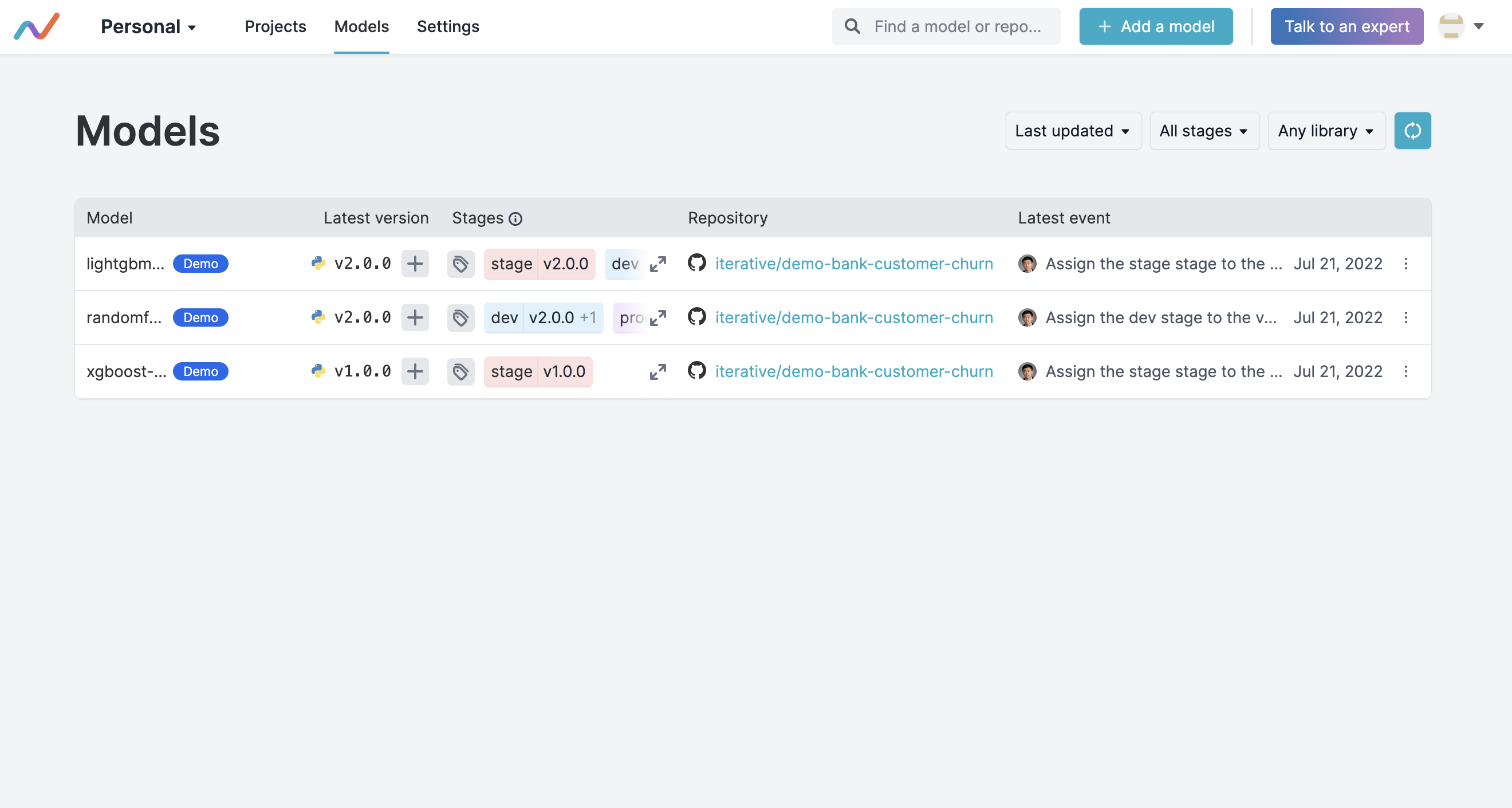
    Iterative added a registry for machine learning models to its portfolio of Git-based tools for infusing artificial intelligence into applications.

    Iterative CEO Dmitry Petrov said the Iterative Studio Model Registry is intended to make it easier for application development teams to track which models are being used as the number of applications infused with AI capabilities continues to grow.

    The Iterative Studio Model Registry, accessible via a graphical interface, command line interface or application programming interface (API), makes it simpler to explore models, including history, versions and stages, via a central dashboard. Teams can also identify the experiment that produced the model and track how, when and by whom a model version was created.

    The Data Versioning Control (DVC) platform created by Iterative exposed a Git-like interface to enable organizations to track multiple versions of data sets, models and pipelines across a machine learning operations (MLOps) workflow. That approach enables those models to be stored in a Git repository alongside other software artifacts versus requiring organizations to deploy a separate platform just to store ML models.

    Providers of platforms used by data science teams have been making a case for separate repositories for tracking the artifacts used to construct an AI model. Iterative contends it is more efficient to employ Git repositories where other types of software artifacts are already being stored because, after all, an ML model is just another type of software artifact.

    That approach also makes it simpler for DevOps and data science teams to collaborate because the DevOps team will have more visibility into what AI models will eventually need to be incorporated into an application, noted Petrov.

    The challenge organizations face is the cultural divide between data science and application development teams. Data science teams today typically have defined their own workflow processes using a wide range of graphical tools. However, as it becomes obvious that almost every application is going to be infused with machine learning and deep learning algorithms to some degree, the need to bridge the current divide between DevOps and data science teams will become more acute.

    In fact, DevOps teams should assume that many more AI models are not only on the way but that those models will need to be continuously updated. Each AI model is constructed based on a set of assumptions; however, as more data becomes available, AI models are subject to drift that results in less accuracy over time. Organizations may even determine that an entire AI model needs to be replaced because the business conditions on which assumptions were made are no longer valid. One way or another, the updating and tuning of AI models are likely to soon become just another continuous process being managed via a DevOps workflow.

    No IT organization can, of course, manage what it can’t track. Registries have become an essential component of a DevOps workflow as the volume of types of artifacts that make up application environments has increased. It remains to be seen to what degree ML models become just another software artifact but one way or another someone in the IT organization needs to know what model is being employed in which application for what purpose.

  • VW CEO Fired for Dev Fails | Fiber Shortage Hits | Google Fires Blake Lemoine

    VW CEO Fired for Dev Fails | Fiber Shortage Hits | Google Fires Blake Lemoine

    Welcome to The Long View—where we peruse the news of the week and strip it to the essentials. Let’s work out what really matters.

    This week: Herbert Diess is out at VW because software is hard (yo), fiber optic cable is hard to find, and the guy who said LaMDA was sentient is dumped by Google. (more…)

  • Cloud Giants Shun Wind Power? | LaMDA not Sentient? | MS IE RIP?

    Cloud Giants Shun Wind Power? | LaMDA not Sentient? | MS IE RIP?

    Welcome to The Long View—where we peruse the news of the week and strip it to the essentials. Let’s work out what really matters.

    This week: Warren Buffett asks too much for wind energy, it’s “completely ridiculous” to say Google’s chatbot LaMDA is sentient, and Microsoft finally kills Internet Explorer. (more…)

  • Apple Allows 50% Fee Rise | @ElonMusk Fans: 70% Fake | Microsoft Salaries up by 100%?

    Apple Allows 50% Fee Rise | @ElonMusk Fans: 70% Fake | Microsoft Salaries up by 100%?

    Welcome to The Long View—where we peruse the news of the week and strip it to the essentials. Let’s work out what really matters.

    This week: Apple lets devs increase subscriptions “without consent,” Twitter has more than 19% spam accounts, and we dig into the claim that Microsoft is about to double salaries. (more…)

  • Tabnine, GitLab Build Custom Apps Faster With AI

    Tabnine, GitLab Build Custom Apps Faster With AI

    Tabnine today revealed it has integrated its code completion tool with the GitLab continuous integration/continuous delivery (CI/CD) platform. Tabnine’s platform employs artificial intelligence (AI) to accelerate application development.

    Brandon Jung, vice president of ecosystems and business development at Tabnine, said the goal is to make it easier for developers to automatically write code based on custom models created using AI. Those models would reside in the CI/CD platform provided by GitLab. Developers can now create custom models of their private source code, he noted.

    The Tabnine AI assistant can then be trained on a customer’s private code, style and security best practices that have been defined by an internal DevOps team, added Jung. That assistant, accessible from within a developer’s integrated development environment (IDE), is conversant in 35 programming languages.

    The code completion tool doesn’t eliminate the need for developers to write code; instead, it completes code once developers start writing it based on the model stored in the CI/CD platform.

    Nima Badiey, vice president of global alliances for GitLab, said the overall goal is to increase developer productivity at a time when organizations are launching more application development initiatives than ever. Many of those applications are being constructed using multiple programming languages that each individual developer may not have equally mastered.

    In addition, an AI model will, over time, improve the quality of the code being created, noted Badiey. That should make it easier to review code that is more accurate because it was created with the aid of a machine, he added.

    In general, GitLab has been moving to incorporate AI within DevOps workflows. The company last year acquired UnReview, a provider of a tool that uses machine learning algorithms to identify which code reviewers to assign to a project based on both the quality of their previous efforts and their current workloads.

    It’s not clear to what degree AI will be pervasively embedded within DevOps workflows. However, it’s now just a matter of time before algorithms are more widely employed. Organizations that employ DevOps today devote significant resources to maintaining platforms that could be simpler to manage if more tasks and processes were automated. In theory, more resources could be then devoted to building applications versus maintaining DevOps platforms.

    One way or another, more organizations are moving to increase developer productivity. Developers are both hard to find and retain, so organizations have a vested interest in finding ways to increase the rate at which an existing pool of developers can build applications capable of driving a wider range of digital business transformation initiatives. Of course, an increase in the rate at which applications are developed also has significant implications for the rate at which they might need to be deployed.

    Not everyone in IT is, of course, entirely comfortable with AI. Nevertheless, most DevOps organizations are highly committed to automating as many processes as possible. The only thing that will be different going forward is determining to what degree those processes will be automated by humans versus a machine.