Tag: ai

  • SapientAI Emerges From Stealth to Apply AI to App Testing

    SapientAI Emerges From Stealth to Apply AI to App Testing

    SapientAI emerged from stealth today to automate the writing of test code using a combination of generative artificial intelligence (AI), machine learning algorithms and data science.

    Fresh from raising $5 million in seed funding, SapientAI CEO Rishi Singh said the goal is to leverage AI to push application testing further left using an AI Test Coder the company built.

    The concept of AI Test Coder is similar to the co-pilot capabilities that GitHub and Google are providing to help developers write better code faster, but also goes beyond generative AI to add deeper analysis and contextual understanding to the tests it automatically generates, noted Singh.

    In the longer term, the ability to use AI to create tests will result in the deployment of more secure, higher-quality applications because there will be no need to short-shrift application testing processes in the interest of meeting deadlines, added Singh.

    Prior to the rise of AI, building application tests has historically been prone to error. AI Test Coder is designed to be a plug-in for an integrated development environment that will leverage the large language models (LLMs) created by OpenAI and cloud service providers to employ natural language to create tests based on an analysis of the application environment created using a combination of machine learning algorithms and data science techniques, said Singh.

    As part of the effort, AI Test Coder instantly inspects all software code to understand the software testing environment, including any incorrect assumptions that stem from errors and bugs, before generating any test code. It then leverages code intelligence to understand existing code and automatically identify and detect patterns to anticipate any new software issue that may arise. AI Test Coder also locates where code changes will have an effect before any test code is created. This eliminates time that would otherwise be wasted on manually debugging code.

    Once those steps are completed, Test Coder then generates more accurate tests without relying on the current trial-and-error approach to testing that can slow application development, said Singh.

    In effect, AI Test Coder provides each developer with their own assistant dedicated to managing testing tasks that ultimately improve quality assurance, including removing many of the vulnerabilities that create application security issues that have become the bane of software supply chains.

    It’s too early to determine precisely what impact AI will have on application development and deployment, but many of the manual tasks that create a sense of drudgery are about to be eliminated. That means the overall pace at which applications can be built and deployed is about to be greatly accelerated. DevOps teams are likely to find themselves pushing more code simultaneously through pipelines than ever.

    Naturally, AI will soon be applied to not just writing code and tests faster, but also DevOps workflows. The issue now is determining which of the tasks that today require manual intervention will be eliminated in a way that enables DevOps teams to focus more of their time and effort on more complex challenges.

  • Google Previews Generative AI Service to Improve Code

    Google Previews Generative AI Service to Improve Code

    Google is previewing an instance of a generative artificial intelligence (AI) service that surfaces code recommendations to make it possible to build high-quality applications faster.

    Specifically, Duet AI for Google Cloud surfaces code recommendations in real-time, generates full functions and code blocks and suggests fixes for vulnerabilities and errors in the code that it discovers. It also promises to enable DevOps teams to create custom large language models (LLM) based on their own code. In fact, GitLab and Tabnine are, respectively, already integrating LLMs running on Google Cloud with their continuous integration/continuous delivery (CI/CD) platform and testing tools.

    Chen Goldberg, vice president of engineering for Google, told attendees at the Google I/O 2023 conference that Duet AI for Google Cloud will fundamentally change how developers will be able to build applications, regardless of their skill level.

    Duet AI for Google Cloud was trained using data collected from Google Cloud using sample code and documentation to fine-tune behaviors and patterns.

    Duet AI for Google Cloud is available under an AI Trusted Tester Program and provides developers with many of the same capabilities that can be found in the GitHub Copilot tool that is based on the LLMs created by OpenAI.

    In addition to making Duet AI for Google Cloud accessible via both its tools and managed services, Google said it also plans to integrate the service with multiple integrated development environments (IDEs).

    It’s still early days as far as the use of generative AI within DevOps workflows is concerned, but it’s clear that the amount of code being created by developers is about to increase exponentially. Hopefully, AI technologies will also one day help software engineers find ways to manage the massive volume of code moving across their DevOps pipelines.

    Generative AI platforms will fundamentally change the way humans interact with machines. Instead of requiring a developer to create a level of abstraction to communicate with a machine, it’s now possible for machines to understand the language humans use to communicate with each other. Using a natural language interface, developers will soon be asking generative AI platforms to not only make suggestions but also debug applications and, eventually, write the code used to create an application.

    At this point, like it or not, the generative AI genie is out of the proverbial bottle. Just about every job function imaginable will be impacted to varying degrees. In the case of DevOps teams, the ultimate impact should involve less drudgery and toil as many of the manual tasks that conspire to make managing DevOps workflows tedious are eliminated.

    In the meantime, DevOps teams should spend some time identifying which tasks will become automated by generative AI and other technologies that employ machine and deep learning algorithms. It doesn’t make much sense to onboard new members to a DevOps team only to discover that the tasks assigned to that individual are about to be automated. Hopefully, when all these AI technologies are finally implemented, the entire DevOps experience will be better than ever.

  • 8 Ways ChatGPT Can Help Developers

    8 Ways ChatGPT Can Help Developers

    ‘Adapt or perish’ is the mantra in the tech world, and it holds particularly true if you’re a developer.

    Because of how dynamically technology evolves, developers face greater pressure than most to be ahead of the curve in adapting and becoming proficient in the best tools becoming available as a result. ChatGPT is the latest such tool.

    While there has been talk of ChatGPT being a “job killer” and horror stories are making the rounds about a dystopian future in which it renders half of humanity meaningless, the reality is much more nuanced. The market will evolve as it has with the advent of any technological advance, and those who can leverage such leaps to their advantage will continue to be effective.

    For developers, ChatGPT represents a chance to introduce efficiency in their tasks, scale up productivity and minimize errors and deficiencies. Used wisely and appropriately, it can help developers become better at their jobs by honing their abilities and enabling them to work more creatively within their existing functions.

    Here are just some of the few areas where ChatGPT can bring tremendous value to developers:

    Testing

    Writing code is a complex process. Debugging it is harder. And in between those two is the process of actually testing the code. ChatGPT allows developers to enable real-time or prompt-driven code testing at different instances to ensure the coding process becomes more efficient.

    ChatGPT provides a wide array of suggestions and assertions based on the functions and variables used in that particular code to allow for wholly tailored testing of the code for that particular environment. Doing so can be particularly helpful in the subsequent debugging and documentation phases.

    Debugging

    Ask any developer what the worst part of their job is, and debugging is likely to be relatively high on their list. As an old saying goes, “An average developer spends hours writing code and days debugging it.”

    However, with ChatGPT, that may soon become a thing of the past; it can be leveraged to debug thousands of lines of code for error identification and then debug again based on any error message received.

    Regardless of whether you’re a seasoned veteran or just starting out, in this particular case, ChatGPT can be invaluable when scanning code and suggesting possible fixes. Used effectively, this can help developers perform their functions more efficiently by eliminating the laborious hours spent identifying the problem to fix.

    Furthermore, this should prove particularly helpful when writing test cases and documenting the debugging process to identify what caused the bug in the first place.

    Documentation

    As mentioned above, ChatGPT can be leveraged to assist in or, in some limited cases, perform the entire process of documentation.

    It can analyze complex code, contextualize and understand its logic and develop an appropriate explanation of the code’s functionality. More importantly, the specific language used in such documentation can be adjusted to ensure it is tailored to the skill and comprehension level of the person reading it.

    Imagine not having to explain and re-explain how the code works based on who reads the documentation. As a result, developers can spend more time coding rather than documenting what their code does.

    Code Generation

    The most exciting, if not the most effective, way ChatGPT promises to revolutionize what it means to be a developer is code generation. With its code generation functionality, ChatGPT effectively functions as a personal coding assistant that understands the users’ coding preferences and natural language and turns that into executable code.

    Doing so promises to bring unparalleled efficiency to all code generation, as simple command prompts can be used to produce code. In other words, code generation that would have taken minutes can now be done within seconds.

    Moreover, this allays the fears of complete code generation by ChatGPT, as programmers can assume an oversight role over its generated code. This, coupled with some of the other benefits discussed, has a lot of time-saving potential and it can maximize productivity.

    Data Preprocessing

    Machine learning is yet another exciting aspect that promises to drive the future of coding and development in general. ChatGPT can be used across the board to clean, transfer and appropriate particular datasets to be used for testing and training.

    With the ability to deal with issues such as missing values and miscoded variables, ChatGPT can enhance the overall value that can be driven from any particular dataset while bringing more efficiency to the table.

    3D Designs

    This is where the expansive aspect of ChatGPT, as mentioned earlier, comes into play. ChatGPT is more than just a programming developer’s friend. ChatGPT is fully capable of being integrated into the Unity Editor. This is particularly significant as this allows for extensive 3D modeling and in-game designs.

    Digital prompts can be converted into usable 3D images and models, allowing faster and more elaborate renders. This promises better productivity, with the scale of in-game designs set for unprecedented growth in terms of both details and content.

    Threat Detection

    ChatGPT is already pushing the limits and boundaries in terms of generating and documenting code. Additionally, it addresses another vital issue related to coding and programming as a whole: Identifying potential vulnerabilities.

    Using security tools such as a firewall or password manager is not enough protection. ChatGPT can be leveraged to generate code and peruse and review existing code to weed out any potential vulnerabilities. Not only can it point out potential vulnerabilities, but it also helps carry out parallel quality assurance to enhance the overall security and quality of that code.

    Pair that with the conventional and reliable privacy and security elements, and you’ve generated near-impenetrable code for secure deployment.

    Customized Extensions

    Perhaps the most hyped-up benefit of ChatGPT is the proliferation of extensions available since its release. While the use of automation to oversee the completion of tedious and monotonous tasks is nothing new, ChatGPT allows for an unprecedented degree of customizable extensions. Developers can generate extensions based on their own usage patterns and preferences.

    Final Thoughts

    As is the case with any new technological wonder, ChatGPT is a resourceful tool, but its full potential can only be leveraged by those that understand it and know exactly where and how ChatGPT may prove most productive. However, the very fact that we do not yet understand the full extent of its capabilities should be cause for caution.

    ChatGPT has already faced mounting criticism related to how it handles users’ data privacy, particularly that of minors.

    It is critical for organizations to devote appropriate resources to fully assess exactly how ChatGPT may bring the most value to them without negatively impacting security and data privacy.

  • 4 Risk Factors Devs Should Consider for ChatGPT Integrations

    4 Risk Factors Devs Should Consider for ChatGPT Integrations

    It’s only been a couple of months since OpenAI introduced its latest low-cost API for developers to leverage ChatGPT in their applications and already many engineering teams have jumped headlong into new integrations. But developers experimenting with the possibilities of how ChatGPT can boost their software should temper that with some risk analysis and threat modeling before deployment. So say a range of cybersecurity and risk experts, who warn organizations that leverage the ChatGPT API in their software that they’ll need to navigate a minefield of privacy, data governance, and security operational risks.

    “I use ChatGPT Pro and think it’s an exciting tool for holiday cards, poems for my kid, writing inspiration, first drafts and search,” says Patrick Hall, data scientist and co-founder of BNH.AI, a boutique law firm focused on minimizing legal and technical risks of AI. He’s also the author of the upcoming book Machine Learning for High-Risk Applications. “I get concerned about generative AI used as a consumer product in high-risk domains, such as consumer finance or the law.”

    With that framing in mind, the following are a few of the areas that experts like Hall suggest that developers, DevOps teams and CTOs start thinking about to avoid some potentially costly unintended consequences of ChatGPT integration in their software.

    Data Privacy and Governance Concerns

    One of the most immediate and obvious risk concerns IT leadership, DevOps teams and privacy experts are worried about is what happens to sensitive data when users enter it into a ChatGPT-backed prompt—whether directly or through an app using the API. Be it a customer entering personally identifiable information (PII) into an external-facing app or an employee entering proprietary company information in an internal tool using ChatGPT’s API, these use patterns open up a world of data exposure and regulatory compliance concerns. The good news is that OpenAI does not use data submitted through the API to train its models, but this shouldn’t automatically give devs peace of mind. They’ll need to be sure that using generative AI in an app truly aligns with their company’s privacy policies and with any local, federal or international data privacy laws their firm is beholden to, said Hall.

    “Although OpenAI appears to maintain a robust security and privacy program and there are steps you can take on your own to limit data sharing, some people are still worried,” said Walter Haydock, founder and CEO of StackAware.

    Among Haydock’s side projects, he is currently developing a tool for sanitizing data before sending it to OpenAI. Called GPT-Guard, it’s still in beta and it would need to be run on a local machine or in the cloud to sanitize data before sending it via API. But it provides some rapid prototyping of the kind of methods and tools developers may need to think about as they design their applications to interact with ChatGPT.

    Intellectual Property Infringement

    Developers should also be thinking through intellectual property infringement concerns when it comes to the responses generated by an app tapping into ChatGPT, Hall said.

    “Devs need to consider whether a generative AI system may be coughing up other people’s licensed or copyrighted intellectual property as responses,” he said.

    This is likely going to be a tricky situation that will likely be tested by the courts in the coming years. For example, will applications using ChatGPT be required to compensate licensed copyright holders for certain kinds of responses using their material? These are the kinds of questions that developers and the organizations they work for should be asking themselves, said Frank Huerta, CEO of Curtail Security and a longtime DevOps expert.

    “For example, what’s the mechanism for resolving IP and copyright disputes?” he asked. “Is ChatGPT going to have its own IP? Is it going to generate it—and will it put that in the public domain? Who owns the copyright to a generated response? None of that has been considered yet, and it’s going to come up fast.”

    Adding New Cybersecurity Threat Vectors

    In addition to all of the concerns about the data, developers integrating ChatGPT into their applications also need to consider what that does to the software’s attack surface. ‘Never trust user input’ has always been a good rule of thumb for developers, and that advice is just as true for large language model (LLM) prompts as anything else.

    A recent example scenario laid out by a data scientist on Twitter showed one of the myriad ways that malicious actors could carry out prompt injections in the same way they’d carry out a SQL injection. In that scenario, if a recruiter used ChatGPT to crawl LinkedIn profiles for a certain keyword and send an email to the people whose profiles included that keyword, it’d be possible to add text to a profile that sends an email chiding the recruiter for using an automated tool to send out emails. That’s a fairly low-stakes example, but it shows the possibility for injection attacks, said Andy Patel, a security researcher for WithSecure who has been digging into AI risks.

    “So, if you are integrating it, you should think about things like that. You should think about the fact that people will determine that you are using a large language model to do something, to automate something, and then they’ll essentially SQL injection attack it,” he said.

    Problems With Bias

    Finally, developers and software design teams should be cognizant of the potential problems that AI bias can introduce into their software if they lean on the generated output from ChatGPT to trigger actions or to inform the user.

    “Generative AI systems continue to make wrong, offensive or otherwise problematic content. Being wrong can give rise to negligence issues and biased content can lead to discrimination issues,” Hall warned. “Don’t embarrass yourself, offend others or run afoul of the law by not testing and further protect yourself by screening the heck out of generated content.”

  • The Right Tool for the Job: AI Edition

    The Right Tool for the Job: AI Edition

    (Actually, the right job for the tool.)

    We are currently in a really weird space with regard to AI capability. For my AI friends, I will make the disclaimer that what we call AI today is not actually AI, it is more akin to LiSP “AI” than actual intelligence (and, in reality, is firmly somewhere in between). In short, we have great language processing tools that we call AI but that have no cognitive ability—but, man, are they useful.

    And the suddenness with which the rest of the world realized they were useful was nothing short of astounding. One day we are using AI algorithms to process test results and filter security data; next thing you know, our business people are bringing up AI and how advanced it is in every meeting.

    They’re not wrong, but we need to differentiate the technologies. The promise and danger of chatbots is not the same as the promise and dangers of AI in security (where it can be used by attackers as easily as defenders, btw). We’re going to have to work out the concerns and benefits in real-time, but we need to start by pushing back and making clear that it is not a panacea, any more than the last 50 technologies that came along. It has great promise to change the world, but so did VMs and Java and containers and …

    This one seems bigger, but that’s largely because it came on so fast and with seemingly broad applicability. But in the end, it is good at processing large datasets and noticing both patterns and anomalies in the data. This is a great, hugely powerful tool, but for things with sparse data? Totally useless. This is critical to remember moving forward. AI that monitors a certain aspect of security in the organization can detect patterns and anomalies, but unless the dataset is massive, there will be a lot of false positives along the way, and a more traditional tool is preferred. If that same AI (same software, algorithm, etc.) is being trained on data from hundreds of companies? Sign the check, it’s probably going to be better and more forward-looking than your current solution.

    And that’s the key. It took the entirety of the World Wide Web—including, I might add, The Gutenberg Project—to train the language processors, so unless that security AI has a massive dataset, it’s not likely ready for prime time.

    In IT, look to AI today (and this will change relatively rapidly, so check back often) for large dataset processing and for advanced automation. Those are the two real use cases. More will come, but right now, the ability to find patterns in large datasets or to say, in real-time, “A+B+C = block that port!” are the biggest viable use cases.

    Over the years, I have grown ever more skeptical of claims about removing the need for developers. Those claims have been made so many times that my friends and I have a stable of jokes about them. Java, XML, 4GLs, RoR, UI generation tools—the list goes on and on. And each one created even more code. I expect AI will be the same, but there is no denying it can offer initial frameworks, much like mobile UI generation tools do. We’ll have to see how much change that bit introduces.

    And keep rocking it. While I hope my readers don’t need reminding not to upload their source code to any of these AI tools, I will point out that your (Dev and Ops) source is so proprietary and critical that employers freak out when it is uploaded to an AI chatbot. No one cares what is done with chatbot-generated source, but the DevOps team’s source is considered critical. Sleep well knowing that.

  • GitHub Revamps Search Engine for Code Repository

    GitHub Revamps Search Engine for Code Repository

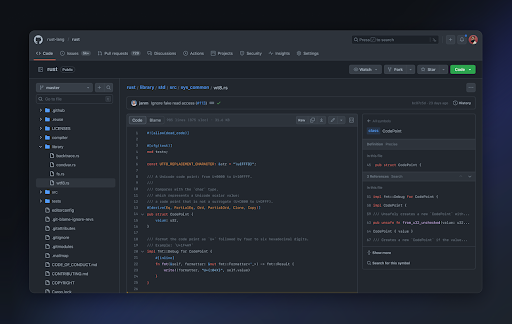
    GitHub today unveiled a new search engine it has developed to make it simpler and faster to browse and navigate the world’s largest code repository.

    A completely redesigned search interface now provides suggestions, completions and the ability to slice and dice results, while a redesigned code view tool has integrated search, browsing and code navigation.

    Mario Rodriguez, vice president of product for GitHub, said the popular code repository provider decided to create a new search engine to improve developer productivity. There are more than 200 million GitHub repositories that can now be more easily explored, he noted. The updated search engine also makes it much easier to search for specific vulnerabilities that might exist in a codebase, added Rodriguez.

    This latest addition to the GitHub portfolio is part of an ongoing effort to inject more intelligence into software development using tools such as GitHub Copilot that employ generative artificial intelligence (AI) to make developers more productive, he said.

    During uncertain economic times, there’s always going to be more focus on productivity. Organizations of all sizes are reluctant to hire additional full-time developers, so any effort to make existing developers more productive is welcome. The challenge is the DevOps teams that support those developers are now under increased pressure to reduce or eliminate as many bottlenecks as possible. In most instances, that will require increased investments in automation and AI to enable greater amounts of code moving through multiple pipelines to be managed at an unprecedented scale.

    In the meantime, instead of focusing on metrics such as recovery times, DevOps teams might want to focus more on how much they are improving developer productivity. After all, developers are an expensive asset, so in the age of digital business transformation, most business executives are squarely focused on increasing the rate at which applications are being built and deployed. In many cases, the amount of profit and revenue being generated by any business is now a direct reflection of the pace at which quality software is developed and deployed.

    One way or another, a new age of software development is dawning. Most of the innovations being brought forward are focused on issues that impact developers, but it’s only a matter of time before AI is also increasingly applied to DevOps workflows. As more organizations begin to realize how much of a bottleneck manual steps in DevOps processes have become, the willingness to invest in more advanced platforms should increase.

    The challenge, as always, is there are a lot more developers than software engineers, so the immediate focus is on developer productivity. That’s not necessarily a bad thing, but in the absence of any advances on the back end of the software development process, it is likely to aggravate an imbalance that most DevOps teams strive daily to correct.

  • Honeycomb Taps ChatGPT to Simplify Observability

    Honeycomb Taps ChatGPT to Simplify Observability

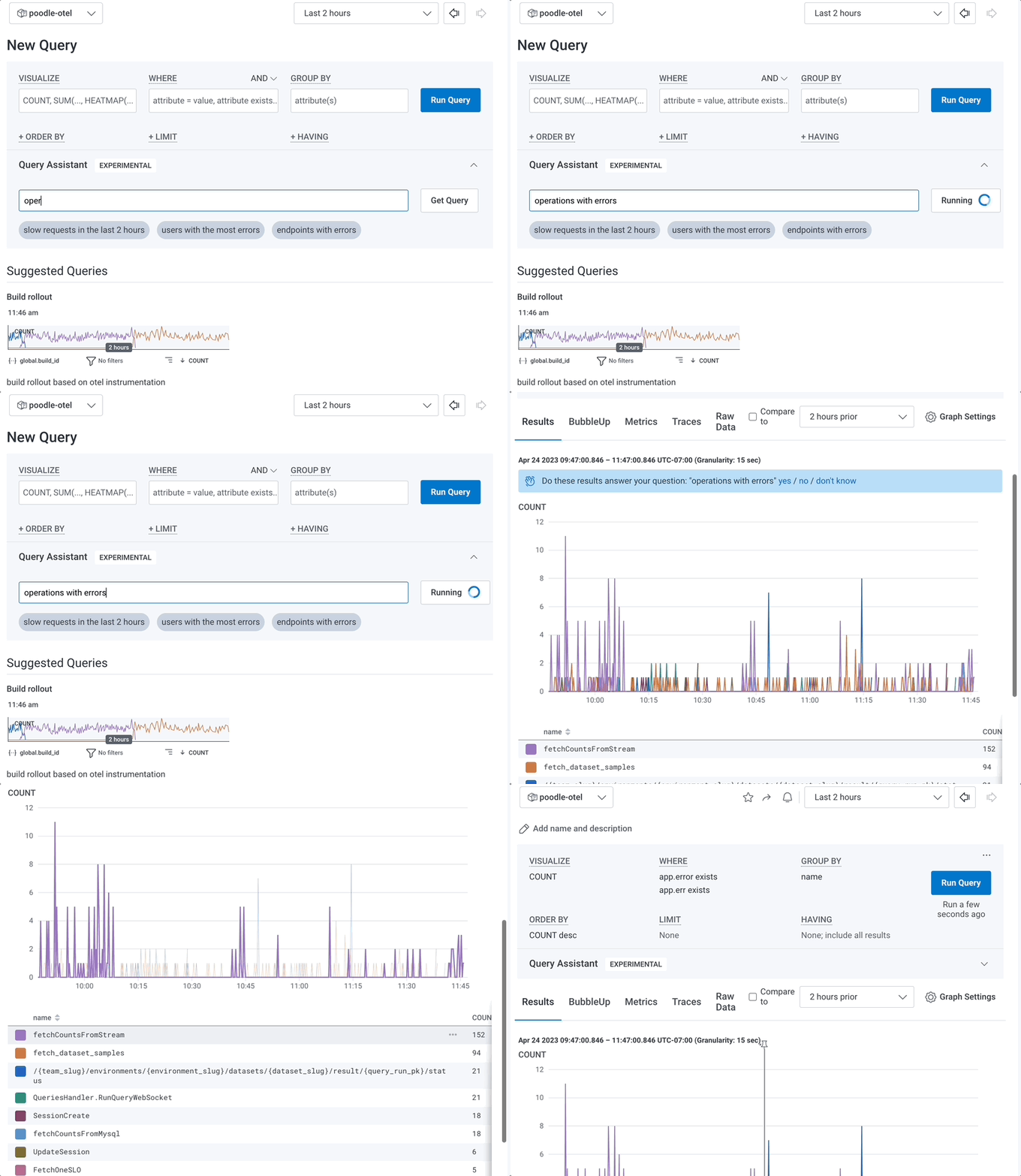
    Honeycomb today added a Query Assistant to its observability platform that uses OpenAI’s ChatGPT generative artificial intelligence (AI) platform to launch queries via a natural language interface rather than having to master a query language.

    That capability complements an existing tool based on machine learning algorithms, dubbed BubbleUP, that DevOps teams already use to debug code.

    Honeycomb CTO Charity Majors said both tools make the Honeycomb observability platform more accessible to IT teams that are tasked with managing complex application environments. Those teams are not going to be able to accomplish that goal without relying more heavily on AI to determine the root causes of an issue.

    Generative AI augments DevOps teams by making it possible to build a relevant, modifiable query that they can continuously iterate as IT staff investigate an issue. This approach means teams don’t necessarily need a deep understanding of code behavior and the underlying infrastructure it depends on, noted Majors.

    That’s critical, because not every IT professional immediately knows what query to launch. One of the challenges with adopting any observability platform is they require a a DevOps team member to frame a query to generate a result. If multiple queries are required, coding them in a query language becomes a cumbersome task.

    As AI continues to improve, algorithms should be able to automatically surface more issues. But given all the dependencies that exist in modern application environments, there will still be a need for a DevOps specialist to ensure application availability and optimize performance, at least for the foreseeable future.

    In general, generative AI represents a significant leap forward compared to AI for IT operations (AIOps) platforms that, in comparison, are not nearly as useful, noted Majors.

    It’s still early days as far as measuring the impact AI will have on DevOps workflows. But the AI genie is already out of the proverbial bottle. Many of the low-level tasks that tend to make DevOps jobs tedious will soon be automated. As a result, job roles within DevOps teams will need to evolve.

    Less clear is what impact the rise of generative AI might have on the adoption of observability platforms. While there is no shortage of observability platforms, adoption has been limited by the number of DevOps professionals that could master a specific query language created for that observability platform. The ability to rely on a natural language interface instead reduces the need to use a proprietary query tool.

    In the longer term, the simpler it becomes to use DevOps best practices, the more widely they will be adopted. AI platforms should enable more organizations to embrace DevOps in a way that reduces the level of cognitive load currently required.

    In the meantime, there’s no doubt that current DevOps professionals are cautiously watching the rise of generative AI, much like everyone else. The difference is that most DevOps professionals are not going to want to work for organizations that don’t provide access to AI-infused tools and platforms that make their jobs easier.

  • GitLab Allies With Google to Bring AI to DevOps

    GitLab Allies With Google to Bring AI to DevOps

    GitLab extended its alliance with Google as part of an effort to bring more generative artificial intelligence (AI) capabilities to DevOps workflows.

    The GitLab suite of software-as-a-service (SaaS) applications already reside on the Google cloud platform to provide GitLab with the foundation of data required to train those AI models. Over the course of the last two months, GitLab has already added numerous capabilities that rely on multiple types of AI technologies.

    For example, there is now an experimental Explain This Vulnerability capability that provides a natural language summary of an issue in a way developers and cybersecurity teams can easily comprehend.

    Taylor McCaslin, a product group manager for data science and AI/machine learning for GitLab, said going forward, most of the AI focus is going to be on leveraging generative AI capabilities. Those capability will be enabled by Google using a large language model (LLM) that GitLab developed for DevOps workflows. That approach enables GitLab to surface more accurate recommendations based on validated data compared to the general purpose LLM that was used to create the ChatGPT service.

    In addition, GitLab can continuously update the AI models it is running on the Google Vertex AI cloud service using the data from its SaaS application environment which is continuously monitored and updated, McCaslin noted.

    It’s not clear what impact AI may have DevOps workflows, but GitLab is forecasting a 10x improvement. That will be accomplished by, for example, surfacing code that can be used to remediate a vulnerability. Today, many vulnerabilities are not addressed simply because developers don’t have enough time to write a patch.

    A recent GitLab survey, however, suggested developers are already embracing AI to improve productivity, with 62% of developers using AI and machine learning algorithms to check code. More than a third (36%) also rely on AI and machine learning algorithms to review code.

    At this juncture, the one thing that is certain is AI and other associated technologies are going to make developers more productive. It’s not nearly as apparent what impact increased amounts of code moving simultaneously through DevOps pipelines is going to have on the software engineers that manage those processes. The expectation is that similar types of AI advances will also enable more code to flow through those pipelines without, hopefully, further exacerbating any existing bottlenecks that might exist.

    In the meantime, it’s clear the AI genie is out of the bottle. There will soon be more LLMs for all kinds of tasks. DevOps teams should start planning today based on the assumption that many manual tasks that conspire to make software engineering tedious are going to fade away. As such, the roles with a DevOps team are going to change and evolve. The assumption those DevOps teams should make is that these changes will be for the better. After all, the reason organizations embraced DevOps in the first place was to ruthlessly automate IT processes—AI is simply the latest iteration of that commitment.

  • Sendbird Adds API to Invoke ChatGPT From Mobile Apps

    Sendbird Adds API to Invoke ChatGPT From Mobile Apps

    Sendbird today added an application programming interface (API) to its low-code platform for building mobile applications that enables developers to add bots that communicate with OpenAI’s ChatGPT.

    Shailesh Nalawadi, head of product for Sendbird, said this API makes it possible to add the ability to communicate directly with the generative artificial intelligence (AI) platform from within both new and existing applications in just a few minutes.

    Most developers will add natural language processing (NLP) interfaces to complement the graphical user interfaces that most mobile applications today surface, added Nalawadi. It will be up to each development team to determine how best to employ that capability, but Sendbird envisions, for example, a health care application being able to invoke ChatGPT to answer queries, he noted.

    In the longer term, Sendbird will provide APIs to enable mobile app developers to invoke a wide range of large language models (LLMs). LLMs are increasingly being developed for generative AI platforms and are being optimized for a range of use cases.

    While OpenAI’s generative AI model is being widely used thanks mainly to Microsoft, there are already LLMs that are being created for a narrower range of use cases using much less data. DevOps teams should expect APIs invoking any number of generative AI platforms from within applications to become commonplace in the weeks and months ahead as more end user come to expect to be able to engage these platforms from within almost every application Sendbird’s chatbot API can now be invoked by more 1,300 existing mobile applications alone.

    In general, developers have tended to employ chatbots sparingly because they are often too scripted and inflexible. ChatGPT, conversely, provides a much more open-ended user experience. Organizations can also feed historical conversations or customer relationship management (CRM) data to ChatGPT to drive more personalized and accurate responses, given the veracity of some of the data used to train ChatGPT.

    A recent survey of digital quality testing professionals conducted by Applause, a provider of a platform for accessing a networking of independent testers, found nearly one-third (30%) of respondents are dissatisfied with their current chatbot, IVR and conversational assistant experiences, with wrong answers (29%) and a lack of understanding (24%) as the top two reasons cited. The results indicate there is plenty of opportunity for improvement.

    Nearly three-quarters (74%) said they had a positive experience with the ChatGPT generative artificial intelligence (AI) platform, with more than two-thirds (67%) reporting the platform provided helpful answers to questions. In terms of work-related tasks, most said ChatGPT would either be “very” (43%) or “somewhat” (37%) helpful.

    It’s apparent now that generative AI platforms are about to change the way humans engage with machines. Instead of always creating an abstraction to interface with a machine it’s now feasible for interactions to occur between them using language humans readily understand. As such, the way applications are built and employed is about to fundamentally change in ways that are difficult to predict.