Tag: ai

  • 4 Things to Consider When Integrating Generative AI

    4 Things to Consider When Integrating Generative AI

    Generative AI has emerged as one of the most influential innovations of the past two decades. ChatGPT gained 100 million users in record time, and new generative AI-powered point solutions emerge every day.

    Considering the current state of VC funding, the surge of investment dollars in AI companies is remarkable. Microsoft’s $13 billion investment in OpenAI and AWS’ $4 billion investment in Anthropic (who themselves just raised a $850 million Series C round) demonstrate the tremendous excitement around Generative AI and how it will shape the future of tech.

    As newer companies like Adept and Cohere are emerging, existing SaaS companies are integrating generative AI capabilities into their products and services. However, in the race to join the hype, many companies are building first and strategizing later. Before diving headfirst into building a generative AI solution, companies should carefully consider a few crucial factors, including model selection, usage tracking, monetization and customer transparency.

    1. AI Model Selection: To Build or to Buy?

    Companies must first consider whether to build a generative AI model from scratch, or whether to use a pre-existing model from one of the major AI vendors. This decision depends on the level of customization and control desired, as well as the resources and expertise available.

    Building a from-scratch model is likely infeasible due to the inaccessibility of the necessary hardware. The GPUs needed for cutting-edge model training and inference are currently only built by NVIDIA, and there is stiff competition and long lead times for any company looking to acquire the product. What’s more, large cloud and AI companies like OpenAI, Google, Meta and Tesla already have built systems with up to 100,000 of these chips. New companies looking to enter the scene would face a steep climb to assemble the infrastructure needed to even begin to compete with the current classes of models.

    Small or new companies do not have the funding or time to invest in building their own infrastructure or generative AI models, so a key business decision is to select the best vendor and model for the use case. While ChatGPT is the most well-known, there are other specialized models that can be better suited for certain use cases. For example, OpenAI’s DALL-E is built for image generation, while Anthropic’s Claude 2 is built to perform better with specialized tasks such as legal and math and to handle long-form inputs.

    Regardless of the AI vendor you choose, you will be charged based on your usage with them, which, by extension, is your customers’ usage. Tracking this usage is critical to your generative AI solution becoming profitable.

    2. Metering AI Service Usage: The Key to Success

    Implementing usage metering for generative AI services is crucial at both the individual user level and at the global or system-wide level. This is because usage tracking is valuable to all business functions and is a critical element of any modern PLG strategy.

    For example, customer-facing teams can leverage usage data to proactively track account health and to contextually recommend new solutions and approaches. Usage history provides valuable intelligence to account teams for up-selling, cross-selling, and contract renewal. Product teams can identify usage patterns and customer segments, as well as areas of friction or improvement for new feature development.

    Usage data also plays a major role in developing pricing plans that align with customer expectations and overall market trends. It can be used to inform pricing plan development and optimization to ensure the rates are sensible for the level of consumption and value being realized. Without tracking usage, this becomes a guessing game or a futile exercise in “gut feel.”

    Usage data is imperative to calculating your internal costs. Vendors commonly charge according to a usage-based model for these generative services–per word, per token or per generation are some common models. In any case, having accurate, granular usage data is a must-have for calculating internal costs and, in turn, customer-facing pricing.

    3. Monetizing Generative AI Services: Usage-Based Pricing Strategy

    In the rush to beat competitors to market and offer generative AI services to customers, do not neglect to lay the groundwork for monetization from day zero. It is much easier and more efficient to build with monetization in mind from the start than it is to backtrack and try to monetize a service once it has been offered, particularly when usage-based pricing is involved.

    Usage-based pricing has emerged as the optimal pricing strategy in the AI domain. This is because service usage varies over time for each customer. These services are priced by the vendors according to a usage-based pricing model. Since the backend costs of the service are elastic, the frontend, customer-facing pricing should also be elastic.

    As a roadmap to monetization, follow these steps:

    -Meter service usage to understand segments and patterns

    -Calculate internal costs of usage using vendor pricing

    -Using the information from steps 1 and 2, build customer-facing pricing

    -Track revenue and margins and continue to iterate with pricing as needed

    4. Customer Transparency: On-Demand Access to Usage and Billing Data

    Prioritizing transparency and clear communication with customers is non-negotiable. Ensuring that usage and billing data can be seen at any point in the billing cycle helps foster trust between the company and its users and eliminates billing surprises when the invoice is delivered.

    Adopting Transparent Communication Builds Trust With Customers

    Invest in creating a customer-facing application, portal or experience that allows for on-demand access to usage and billing data. The beauty of combining this level of visibility with usage-based pricing is that customers are empowered to pay for only what they use while viewing usage statistics on demand and modulating usage as needed in real-time to keep the spend within an acceptable range.

    In practice, usage data is available on a per-query level from the vendor’s APIs. For example, for any generation action, OpenAI will show the precise number of tokens consumed for both the prompt and response, as well as all details around the model type and context needed to identify the per-token rate from the vendor pricing. It is important to collect this data and build a user-friendly way to display it back to customers in an app, portal, or website that allows for on-demand access and browsing.

    Conclusion

    While planning to build a product with generative AI, take all of the above factors into account. Do not make the mistake of racing to deliver a technology solution without also considering the business implications and monetization strategy. With all the hype, excitement and investment around generative AI in 2023, it is akin to a modern-day gold rush. Don’t show up to the gold rush without a shovel.


  • At Some Level, We’re Doing Security Wrong

    At Some Level, We’re Doing Security Wrong

    Years ago, right here in this blog, I pointed out that the worst of gamification was being applied to information security–play the game until you lose. I wish I could say we were past that, but we are not. And I think it is time for us to have a bit of a rethink (as my UK colleagues would say).

    Consider this. Twenty years ago, breaches were relatively common and we were concerned enough to enact laws about data, security, etc. Today, breaches are relatively common. In the intervening years, we implemented more and more security.

    The problem is that our environments—from mainframes to today—have grown increasingly complex. Our mission to make applications more useful and accessible makes them more vulnerable at the same time. And the changes are constant.

    If we were doing this right, breach notifications would be super rare, and we’d all want to know if it was a broken machine or human at fault—kind of like aircraft crashes are handled and reported in most of the world. Instead, we go out to a site like haveibeenpwned to see if we’ve been impacted, shrug and assume that the free credit monitoring service from the last five breaches should have us covered financially, and we move along.

    Internally, there is a post-mortem that closes whatever hole the attacker got through or exfiltrated data through and carry on, knowing full well that a different attack is coming.

    We are currently staring longingly at the bright lights of AI, hoping it can protect us from unknown vulnerabilities going forward. A bit of critical thinking will make it obvious that this is simply keeping up with attackers who also have access to AI and are using it to refine and launch even more complex attacks.

    The problem is that we all see the non-stop changes to attack vectors and architectures and don’t know how we could protect more broadly—and that is the appeal of trainable AI. We hope that it can rapidly generalize from its training to detect previously unknown attacks and, given enough inputs, can computationally detect attacks humans might miss in the sea of data. But that is still a point solution, in my opinion.

    How attackers approach the problem and what tools (both tooling and vulnerabilities) they have available are constantly changing, but the goals are unchanged. And I think we have to adapt our thinking to address those goals instead. Policy enforcement is a step in that direction—but, again, that means we’re protecting against the known.

    I don’t have the answers. I keep thinking of two approaches—airplanes are routed around a ton of threats to get their cargo to its destination safely, and that seems to be analogous to the problem. And hardened fortresses that literally ignore current mentality of “the perimeter is everywhere” and take the core, important bits of applications and lock them away even more tightly than we do today, with single-API access to a given bit and the API is monitored and analyzed constantly.

    But those are both sweeping, drastic approaches, and that may be our problem. Security spaces are merging slowly, but we still have a largely “That’s ops, that’s dev” mentality in security (as just one example of why sweeping overall protections are problematic). So, maybe with merges, the time will come that this is naturally resolved. But we’re not there yet.

    If you think about it, we’ve solved much more intractable problems, as the phone in your hand or the online game you enjoy spending a bit of time on demonstrate—we in IT and Dev are capable of amazing feats if we set clear goals and commit to both developing and implementing a solution. We just need those clear goals, and fighting today’s attack and hoping against hope another won’t come tomorrow just isn’t it.

  • Tray.io Automation Framework Leverages AI to Build Integrations

    Tray.io Automation Framework Leverages AI to Build Integrations

    Tray.io today added an automation framework to an integrated platform-as-a-service (iPaaS) service that leverages an existing Merlin artificial intelligence (AI) engine to identify the most efficient way to automate a workflow.

    The Tray Universal Automation Cloud service can be invoked via three distinct application programming interfaces (APIs) to programmatically create those workflows using a Tray Code low-code or Tray Build no-code tool or via a Tray Chat natural language interface. A Connectivity API provides access to more than 600 connectors, while a Trigger API enables developers to drive event-driven processes. An Authentication API provides a method for managing authorizations. The platform also provides access to testing, error handling and debugging tools.

    Tray.io CEO Richard Waldron said that approach provides IT teams with a composable framework for building integrations that leverages a set of large language models (LLMs) that the company has embedded within its Merlin AI engine to enable IT teams to optimize workflows.

    In addition, the underlying platform takes advantage of Kubernetes, Docker containers and serverless computing frameworks to dynamically scale as required, he added. In contrast, rival legacy iPaaS environments are not as elastic, which enables Tray.io to base its pricing on actual usage of a modern IT platform, noted Waldron.

    The overall goal is to provide a single platform that any type of developer, including business professionals, can invoke to automate workflows, said Waldron.

    As the overall codebase that DevOps teams manage continues to increase, the number of required integrations between applications and processes continues to increase exponentially. Rather than relying on lower-level code to create those integrations, an iPaaS provides the means to automate and simplify building integrations and enable developers to spend more time writing the business logic that will drive a new application. Historically, most of the integrations required to drive, for example, a digital business transformation initiative required a significant amount of low-level code to be developed and maintained.

    Tray.io is now making a case for an iPaaS that takes advantage of AI to more easily invoke generative AI capabilities to optimally create those integrations based on workflow attributes.

    Each organization will need to determine how heavily to rely on AI platforms to build integrations, but these advances—alongside generative AI tools that developers have already embraced to build software—are making developers more productive than ever. That accelerated pace of application development will require DevOps teams to automate as many processes as possible. One option for achieving that goal is for organizations to rely more on an iPaaS to enable developers to build integrations in a way that doesn’t necessarily always have to flow through a DevOps pipeline.

    One way or another, thanks to the rise of AI, the way software is built is about to change drastically. The challenge and the opportunity now is to determine how best to reengineer workflows in a way that best aligns with the goals of the organization.

  • Generative AI: The 90% Rule

    Generative AI: The 90% Rule

    There is a concept we need to solidify that I will call the 90% Rule—until someone smarter than me comes up with a better name. The 90% Rule is simple: Generative AI will be able to do 90% of the work in areas that it is good at. Right now, that would be writing, but coming up soon will be image generation and coding and, not too long after that, video generation. For those of you buried in the space who are offended, I’m not rating it as advanced as it is for specialists; the point of generative AI is not to let AI specialists do things, but to let average people in the space do so. And that list is representative of the current space.

    This is just based upon the state of things at the moment I wrote this blog, but that seems to be the immediate order. I’m only talking generative AI here—AI for things like filtering test results is a completely different beast (that might just meet that 90% rule … Hmmm). I can tell generative AI to write a story, a script or code for me, and tweak the results. The amount of tweaking certainly depends on the topic and how much time I spent zeroing it in, but 90% seems right. There are those looking far ahead to a time that will herald the arrival of our AI overlords, but for the foreseeable future, we will not be ditching authors, coders and ops people. Our jobs will just change.

    Crikey—given the last few decades, a change to our jobs that means less work is not a terrible thing. Today, writers have to be publishers and marketers, coders have to be ops and ops have to be coders and the entire group has increasingly had to be security and architecture specialists, too.

    Let’s celebrate a tool that says, “Here’s a start, make it useful in your specific situation.” I know I will. I sometimes contract people to do initial research for me and send me links and short descriptions. I encourage them to use generative AI to do so. I do not contract people with my level of knowledge for this work, so they’re going to have things I need to read carefully and follow the links for—they’re not specialists, after all. Generative AI suffers from this syndrome, too, but that means there is no difference for me and they can work smarter, not harder. It’s not like they are writing content; merely providing introductory research through a scan of web properties.

    As time goes on, I expect they will become specialists. But not in the things I pay them to research—in making generative AI do what they want. I would argue the person I contract with the most often is better than me at it, just because she’s doing it regularly. That skill set will inevitably be transferrable, and I may lose her to a full-time position making the I in generative AI actually mean something, and I’m great with that. Meanwhile, I’m getting the background info I need to do my job(s).

    Embrace it. Aim for 90%. Turn out even more rockstar-level apps for the org, and maintain them with less effort. This is where we’re headed, and it’s entirely possible you’ll be less buried in work for some of that time. Win/win. Go out and enjoy. The business will thank you for being even more productive … then waste that extra time you created by implementing new projects. But that’s in the future; use AI in the short term to get some breathing room and still be the force behind the apps.

  • JFrog swampUP: Addressing the Advent of AI

    JFrog swampUP: Addressing the Advent of AI

    At JFrog SwampUp 2023, the buzz with all about AI, especially with JFrog’s announcement of Machine Learning (ML) Model Management capabilities. These conversations around AI and ML reflected these technologies’ growing influence and importance in the DevOps world. How much of the generative AI conversation is just hype, though? And what does that mean for AI and ML as a whole? Alan Shimel, CEO of Techstrong Group, and I sat down with Stephen Chin, VP of DevRel at JFrog, to find out.

    As far as Chin is concerned, even as more companies create and leverage AI models, these models must be managed like any other software component. Chin said JFrog Artifactory acts as a staging ground to operationalize models using DevSecOps best practices. Algorithms and models will continue to grow in size and complexity, and they will require robust processes around deployment and management – just like any other software artifact. The key, Chin said, is to think of ML as just another development language and leverage tools that standardize and streamline working with it. Compared to traditional enterprise applications, though, DevOps workflows for AI/ML are still relatively immature, but Chin said JFrog’s new model management capabilities aim to provide that missing automation and governance using DevSecOps best practices for governance, security, and licensing compliance.

    Additionally, Chin noted that AI/ML have become essential for development teams to keep up with the explosive demand for code. At this point, AI has become table stakes. In the AI arms race, the winners are those who understand AI has become a vital development tool to enhance productivity. In terms of job security, the losers are the ones who can’t keep up with the volume of code. According to Chin, you are out of the running if you don’t embrace AI.

    Looking ahead, AI will not make developers obsolete, though – quite the opposite. Given the quasi-unlimited appetite for new code, Chin emphasized that developers who embrace AI will have more work than ever. One way to think of it is that AI provides a new form of “outsourcing” to boost human productivity, much like previous waves of innovation in computer science.

    When it comes to security, there are still challenges that need to be addressed; code generated by today’s AI solutions still has significant drawbacks like potential data bias, lack of explainability and simple errors. In the long term, though, Chin believes AI itself will provide the solution to secure an exponentially growing codebase, given its superior scale. Just as AI will make individual developers more productive, it can also supercharge security teams – but it can also empower bad actors. The key will be continuing to democratize the benefits to even the playing field. AI promises to be a transformative technology on the scale of the Bronze Age or Quantum computing, Chin said, but the path forward will require humans and machines working together to ensure it’s used for good.

    It’s clear that the pace of innovation in AI and ML is rapidly accelerating. As these technologies become further democratized and integrated into developer workflows, they promise to transform how software is built and secured, Chin said. Companies must take advantage of this technology innovation by providing the pipelines and governance for this software revolution, he added. Chin believes the future will likely see a more symbiotic relationship between humans and AI assistants collaborating to generate, refine and safeguard code. By proactively shaping the responsible use of these technologies, it’s possible to maximize the benefits while minimizing the risks. While this journey has only just begun, the destination is an exciting new era of human potential unlocked by AI, Chin said.

  • Google De-Recruits 100s of Recruiters ¦ ARM Valued at $45½B in IPO

    Google De-Recruits 100s of Recruiters ¦ ARM Valued at $45½B in IPO

    Welcome to The Long View—where we peruse the news of the week and strip it to the essentials. Let’s work out what really matters.

    This week: Google fires hundreds of recruiters, and ARM gets a sky-high valuation. (more…)

  • Will ChatGPT Replace Human Software Developers? Probably Not

    Will ChatGPT Replace Human Software Developers? Probably Not

    Since the release of ChatGPT, there has been a great deal of hype around generative AI and how companies can leverage it to cut costs and democratize software and application development. Naturally, with discussions of cost-cutting and democratization come whispers about what will happen to software developers.

    This is a real and valid concern, but software developers’ skills, expertise and creativity are still very much needed.

    While generative AI and AI code generation tools like ChatGPT have shown some promise and potential benefits, they are still in their infancy—like many other innovative technological advancements. We also don’t know what scenarios they may present down the road or their true abilities when the technology matures. For instance, how will it integrate with other technologies? We don’t know what will happen when a ChatGPT-generated line of code breaks or needs to be changed. We don’t know if it can provide a novel solution to a unique problem or what security threats it will present.

    Given these unknowns, technology executives should think twice about replacing experienced and creative technology talent, such as software developers, with AI code generators.

    Will ChatGPT create novel code to solve a unique problem never encountered before? Probably not.

    A Tale as Old as Time (Or at Least a Decade)

    The technology industry has been searching for and developing new ways to make certain software development tasks much easier and more streamlined for years. One example of this is low-code/no-code.

    The notion of simplifying application development and replacing software developers with laypeople (citizen developers) has been around for more than a decade now, as low-code and no-code solutions have grown more popular. These solutions have promised that companies don’t need technical talent to get their software and app projects off the ground.

    However, if you look at the impact of these solutions today, their use can result in large amounts of technical debt and almost always require the skill of experienced software developers.

    The reason? Building complex software and applications is extremely difficult; it’s an art.

    Low-code and no-code solutions have their rightful place and can make things easier if a company is looking to launch a simple app or static web page. These solutions can increase the pace of development and time-to-market and enable everyday people without any development skills to facilitate them. However, they are not actually a complete solution and often overlook aspects of development that a human software developer would typically address. Without a skilled expert involved, low-code/no-code platforms often can’t solve a unique problem a company has.

    So, how does this relate to AI code generators like ChatGPT? Here’s how.

    A Similar Situation—With One Key Difference

    When thinking about their place in the development process, AI code generators are not that different from low-code or no-code solutions. The thinking is that they will also enable non-technical individuals to create software and applications with ease.

    Yet, there is one key difference—they promise expertise, too. But is the expertise coming from the AI code generator or the person piloting it? The answer is simple; it is not from the code generator.

    There have been examples of companies and individuals that have tried using ChatGPT to build code, and they have appeared to be successful. However, without the input of the individuals using it, it never would have been able to create the code on its own unprompted.

    This means that the expertise of skilled, human software developers is still very much needed, especially when building intricate software and apps that require complex functionality such as optical character recognition (OCR), internet-of-things (IoT) connectivity and more.

    A Future With Software Developers

    Because of the expertise still required to create elaborate and innovative software and applications, AI code generators will not replace software developers anytime soon, if ever.

    The technology used in these tools is still in its infancy, presenting many lingering questions and potential challenges. We will see this confirmed by the trials and tribulations experienced by the few companies and executives attempting to replace software development teams with tools such as ChatGPT.

    Knowing AI code generators follow a similar path as low-code and now-code solutions, companies and executives should use them as developer enablement tools. These tools should complement the work of software developers by empowering them to focus on the complex tasks software and apps today require.

  • JFrog Extends DevOps Reach to Manage and Secure AI Models

    JFrog Extends DevOps Reach to Manage and Secure AI Models

    At its swampUP 2023 conference, JFrog today added additional security capabilities to its continuous integration/continuous development (CI/CD) environment as well as making it possible to manage machine learning models within the context of a DevOps workflow.

    The latest edition of the JFrog Software Supply Chain Platform adds an integrated static application security testing tool (SAST) to scan source code alongside the existing JFrog Xray tool for scanning binaries.

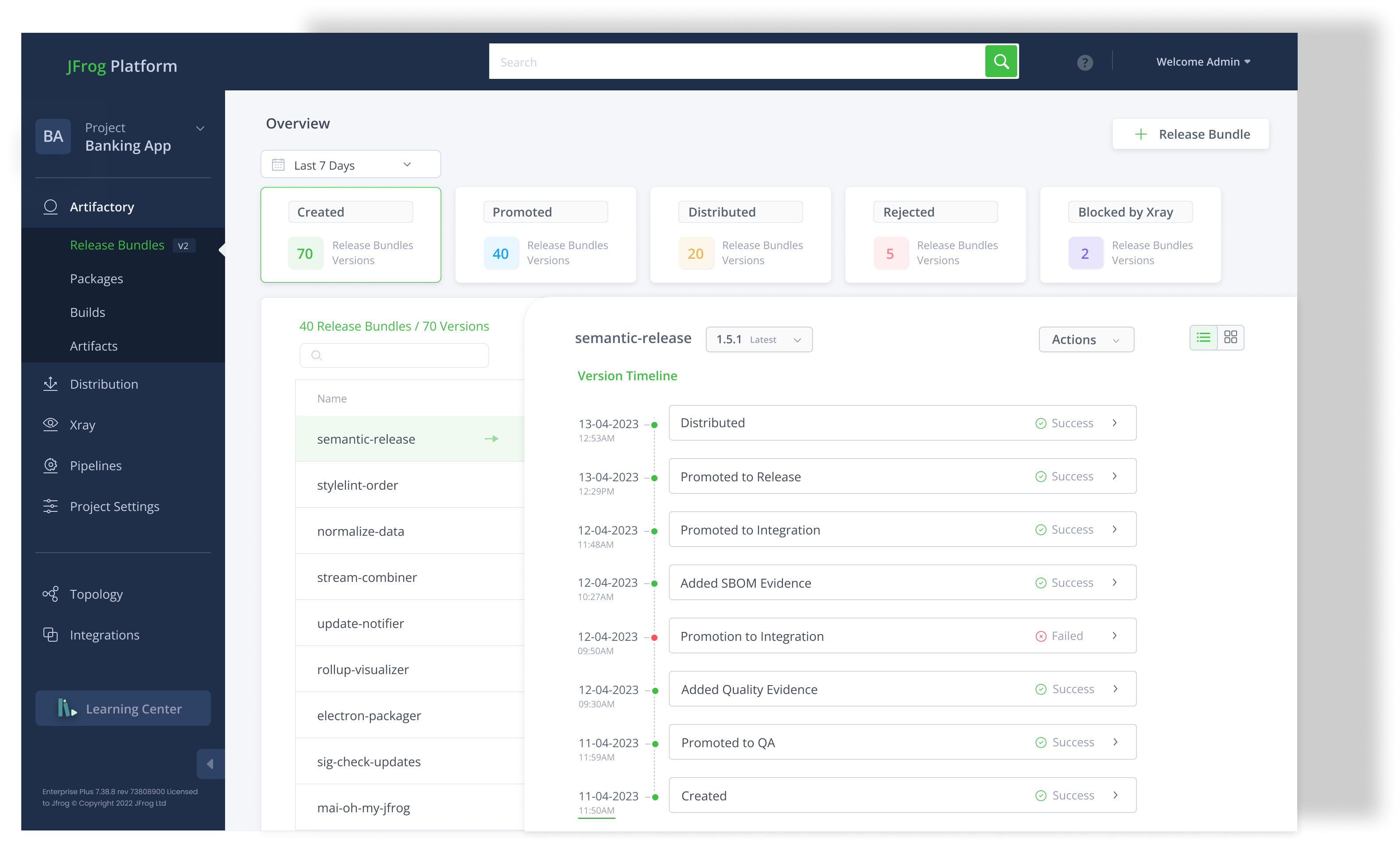
    JFrog has also added an Open-Source Software (OSS) Catalog to the JFrog Curation service to make it simpler for DevOps teams to discover specific packages that have been determined to be secure. JFrog is also adding Release Lifecycle Management (RLM) capabilities that enable aggregating software artifacts into an immutable software package that serves as the single source of truth as multiple iterations of an application are developed. JFrog RLM uses anti-tampering systems, compliance checks and evidence capture to collect data and insights to ensure the immutability of signed binaries.

    Finally, ML Model Management capabilities, available in beta, are being added to the platform to make it possible to store AI models, run AI models from Hugging Face, a provider of open source AI models, as a proxy in cache via an application programming interface (API) and apply DevSecOps best practices to govern, secure and ensure licensing compliance.

    JFrog CTO Yoav Landman said that as DevOps teams become more familiar with AI models, it’s becoming increasingly clear they are managed like any other software artifact incorporated into a DevOps pipeline. He noted that the approach provides the added benefit of helping to ensure AI models have not been poisoned by malicious data and prompts that would deliberately cause a hallucination.

    Most AI models today are created by data scientists using machine learning operations (MLOps) best practices that each organization defines. In some instances, those processes include what is known as a feature store that enables data scientists to track which components are being used at any given time. However, once a model is completed, it needs to be integrated into an application—a process that, from a DevOps perspective, is best facilitated by storing an AI model in a Git repository alongside other components that need to be managed.

    It’s still early days as far as the convergence of DevOps and MLOps practices are concerned. Going forward, as it becomes apparent almost every application will be invoke some type of AI model, the need to integrate these workflows is becoming a more pressing concern.

    It’s now only a matter of time before AI models become a pervasive element of the software development life cycle as they are continuously retrained and updated. It will generally fall to DevOps teams to manage the deployment and updating of those AI models in collaboration with the data science teams that train them. The immediate challenge, of course, will be to bridge the significant cultural divide between two very different types of IT professionals.

  • Tips for Increasing Developer Velocity in the AI Age

    Tips for Increasing Developer Velocity in the AI Age

    These days, everyone is trying to improve release frequencies. Under mounting pressure to deliver more, many software teams are considering new strategies to enhance their developer velocity, like AI-assisted code development and platform engineering. AI has been a boon for automatic code generation, but all the code in the world doesn’t matter if you can’t deploy it into production efficiently.

    Another point is that velocity isn’t always measured productively, said Dori Exterman, chief evangelist of Incredibuild and a self-proclaimed ‘productivity freak.’ Too often, managers place value on quantitative elements, such as points per sprint and unrealistic metrics, when they really should be considering the quality of these components and how easy they are to maintain in the long run.

    I recently chatted with Exterman and other experts about tactics organizations can use to enhance their development velocity. Below, we’ll consider some helpful methods, from optimizing testing automation to creating internal development platforms (IDPs) and evolving your CI/CD processes. Essentially, optimizing the plumbing will be necessary to match the productivity of instant code generation—otherwise, the vision of continual release will remain stunted.

    New AI, Same Plumbing…

    No tech article today can mention developer productivity enhancements without a nod to AI. Just take the interest in Copilot, for example. Among GitHub Copilot users, 40% of the code they’re checking in is now AI-generated and unmodified, according to a Microsoft executive. And GitHub reported that 88% of Copilot users feel more productive when using the tool.

    In contrast to past hype cycles, the latest AI wave is not just a passing fad—it will have long-lasting effects, said Exterman. However, most of our current DevOps processes were constructed for manual code writing, not for the era of AI-assisted development.

    If you quadruple the amount of water you use but use the same plumbing system, you can’t push more water through, said Exterman. Similarly, if you amplify the amount of code you’re producing but don’t evolve your build processes, staging and testing, then DevOps suddenly becomes the new blocker.

    Ways to Accelerate Developer Velocity

    So, how can we improve development efficiency and productivity in the age of AI? Here are some actionable strategies for overcoming these bottlenecks and improving developer velocity.

    Accelerating the Plumbing

    Exterman stresses the importance of leveraging AI to enhance the foundational processes of development. This involves using techniques such as distributed computing and smart test selection to streamline build and testing processes. By optimizing these foundational steps, development teams can ensure that their coding efforts translate into efficient and rapid progress.

    Optimizing Testing through AI

    AI’s potential not only lies in code generation—it extends to optimizing testing processes. Exterman suggests tools like Launchable that allow AI to prioritize tests that matter most. This strategic approach to testing enables teams to focus on high-impact areas while maintaining comprehensive test coverage.

    Embracing Test Automation

    Exterman underscores the importance of comprehensive test automation. Rapid iteration loops are essential for maintaining velocity, and automation facilitates fast feedback cycles. This approach ensures that each code change undergoes rigorous quality checks, preventing errors from propagating downstream.

    Keeping an Eye on Technical Debt

    One of the potential downsides of increasing programming velocity is the accumulation of more technical debt. As more development occurs, the temptation to compromise on documentation, unit testing and best practices grows. Exterman emphasizes that velocity must be pursued in tandem with managing technical debt to ensure the long-term health of projects.

    Investing in Platform Engineering

    Recently, we’ve witnessed a paradigm shift toward platform engineering. Just over half of IT organizations have already embraced platform engineering, according to the 2023 State of DevOps Report. Exterman emphasizes the need for a robust internal developer platform that supports the seamless transition of code from development to staging and production. For instance, tools like Terraform and Earthly play a pivotal role in establishing testable environments and reproducible builds.

    “Bring more data services closer to the developers,” said Venkat Ramakrishnan, VP, product management and engineering, Portworx by Pure Storage. “Choose platforms that provide easy-to-deploy services that developers can consume and provide visibility and control into the underlying costs.”

    Enabling Observability

    Observability, according to Exterman, is also important for gauging efficiency. The ability to continuously monitor and log processes enhances the overall development cycle. One report from Splunk even found that 64% report their investment into observability has exceeded their expectations. Tools from New Relic and Datadog, for example, offer insights that tie quality, delivery and productivity together, enabling teams to make informed decisions.

    Evolving CI/CD With Continuous Merge

    One method to progressing CI/CD is continuous merge, a new concept that can be implemented with tools like gitStream that aims to decrease the window between a pull request, review and merge.

    “CI/CD has done wonders to improve the quality and efficiency of the software development toolchain, but it mainly focuses on things that happen after code has been written and reviewed,” said Ori Keren, CEO and co-founder of LinearB. “Continuous merge is a mindset that extends CI/CD practices further upstream to improve the quality and efficiency of the code review process. We’ve reached a point where code review times frequently cause the most significant delays in the software delivery process; continuous merge is how we fix that.”

    Using Cloud-Agnostic Platforms

    Cloud-native development has become more popular as organizations seek to design software architectures bred for the natural scalability of the cloud. Simultaneously, both technology and business motivators are resulting in a multi-cloud condition. In this scenario, IT really needs agnostic, open platforms to retain flexibility and reduce bottlenecks.

    “Enable developers to build their apps in a cloud-agnostic way so they can scale their apps globally,” said Ramakrishnan. “Much of developer and app momentum is lost when scaling apps. Helping the application teams architect it right by providing cloud-agnostic application platforms like Kubernetes enables developers to move faster, scale faster and reach their customers everywhere.”

    Measuring Developer Velocity

    The above tips should help improve velocity, but how exactly should you measure success? Well, measuring developer velocity goes beyond simply tracking the number of points completed in a sprint, reiterated Exterman. He emphasizes the importance of focusing on the ability to deliver high-quality products to the market swiftly. He underscores the need for a fast feedback loop for addressing bugs and iterating quickly. AI plays a role here, too, aiding in test writing and enabling continuous delivery.

    End Benefits of Improved Developer Velocity

    Exterman concludes by highlighting the real-world benefits of increased developer velocity. Faster bug-fixing and release cycles, particularly crucial in industries like gaming, result in improved user experiences and customer satisfaction. He emphasized the significance of aligning key performance indicators (KPIs) and objectives and key results (OKRs) with the aspects that truly matter, promoting a culture of measured and sustainable progress.