Category: News

  • Third Annual DevOps Dozen Winners Announced

    Third Annual DevOps Dozen Winners Announced

    We are very pleased to announce the winners of the third annual DevOps Dozen Awards. In many ways this year was a watershed year for the DevOps Dozen, as the process of selecting, voting and choosing the winners was much more refined and mature. In each of the 12 (it is a dozen, after all) categories the winners were absolutely deserving of the award and recognition.

    Many thanks to our all-star panel of judges: Jayne Groll, Robert Stroud, Helen Beal, George Hulme and Ericka Chickowski. I was the tie-breaker judge and had to cast a vote in just one category. I should also say that almost all of the categories were very tight. Every one of the finalists was deserving of the recognition!

    These awards are a reflection of some of the great work being done in the DevOps community. They are not exhaustive; there are many, many worthy companies, people, projects and products out there. But here is our take on the best of the best in DevOps.

    So, without further ado, here are the 2017 DevOps Dozen winners:

    Best DevOps Open Source Project
    best open source solution Jenkins is the winner of the Best DevOps Open Source Project for 2017. Originally created in 2004 as a fork of “Hudson,”  Jenkins is one of jenkinsthe leading open source automation servers available. Jenkins has an extensible, plugin-based architecture, enabling developers to create 1,400+ plugins to adapt it to a multitude of build, test and deployment technology integrations. In 2017, Jenkins surpassed 155,000 active installations (these are active installations that report usage back to the Jenkins project—only a fraction of total installations), and approximately 1.5 million users, making it the most widely deployed continuous delivery automation server in the world. Learn more: https://jenkins.io/

    Best DevOps Commercial Solution

    devops dozen commercial solution ElectricFlow from ElectricCloud is the winner of the Best DevOps Commercial Solution for 2017. ElectricFlow is an enterprise-grade DevOpselectric cloud release automation platform that simplifies provisioning, build and release of multi-tiered applications. A shared, model-driven approach to managing environments and applications allows teams to coordinate multiple pipelines and releases across hybrid infrastructure in an efficient, predictable and auditable way using the tools and stacks teams already know and love. Learn more: http://electric-cloud.com/products/electricflow/

    Best DevOps Solution Provider Executive

    devopsdozen SP exec
    The winner in this category was actually a 1/1a entry of the CloudBees team of CEO Sacha Labourey and CTO Kohsuke Kawaguchi. Sacha’s Sacha and KK Cloudbeesbackground prior to CloudBees was as CTO and key person at JBoss. KK was a Sun engineer when he first became involved with Hudson and later founded Jenkins. Together, they have built CloudBees into a powerhouse in the DevOps and CI/CD space. While working closely with the Jenkins community, they also have been instrumental in the continued growth and popularity of the Jenkins project. Together, they are a formidable team worthy of this award!

    Best DevOps Solution Provider

    DD best devops solutions provider
    CA Technologies, which now includes Automic, BlazeMeter, Runscope and Veracode, is the winner of the Best DevOps Solution Provider for 2017. From a toolchain perspective, CA Technologies provides the widest array of highly automated solutions necessary to build and optimize integrated workflows across application development, delivery and operations. Spanning the entire application life cycle—including planning, development, testing, release and operations—only CA Technologies offers the full range of capabilities needed to deliver secure, quality applications quickly with an unparalleled customer experience.

    Most Innovative DevOps Solution of the Year

    most innovative devops solutionThe Most Innovative DevOps Solution of the Year 2017 goes to Habitat from Chef, the leader in Continuous Automation. Habitathabitat is a SaaS-based service that provides the fastest way to package apps simply and consistently for deployment and management across flexible cloud-native architectures such as those comprising Docker Swarm, Kubernetes and Cloud Foundry, both on-premises and in-cloud. Habitat gives developers and operations teams complete control over the containerized application life cycle. Learn more: https://www.habitat.sh/

    Best DevOps Evangelist


    devops evangelist
    Derek Weeks VP and DevOps Advocate at Sonatype (co-founder of All Day DevOps) is the Top DevOps Evangelist for 2017. This year All Day DevOps offered 100 free onlinederek weeks sessions led by DevOps practitioners to 33,000 professionals around the world. Since its founding, the community has attracted, educated and supported more than 40,000 DevOps professionals. The conference also brought attention to more than 250 DevOps-related communities, meetup groups and organizations that are helping to educate practitioners around the world. In 2017, Derek delivered 18 DevSecOps-related keynote addresses, conference speeches and meetup presentations in the United States and Europe. He also produced more than 75 DevOps-related blogs over the year, covering topics from continuous delivery to DevSecOps, modern infrastructure and cultural transformations. The blogs not only delivered first-hand experiences, but also highlighted the work of more than 40 DevOps practitioners from different companies around the world.  The blogs can be seen at Sonatype, All Day DevOps, devopsy.kinsta.cloud and Dzone. In addition, Derek championed a number of DevOps reports and surveys in 2017, including the “State of the Software Supply Chain Report” and “2017 DevSecOps Community Survey,” to shed light on industry best practices and areas in need of attention or evolution.

    Best DevOps Transformation

    devops transformation
    CapitalOne was the judges choice for Best DevOps Transformation for 2017. Over the past few years, the 20-year-old financial services giant capital onehas been transforming itself, tapping DevOps to establish a continuous software delivery cycle. Topo Pal, a senior director and senior engineering fellow, told a packed room at the recent DevOps Enterprise Summit in San Francisco the company’s journey suits its entrepreneurial spirit. “We consider ourselves a startup, and like any startup, we have different DNA,” said Pal. “For instance, we build our own software.” All the better for adopting DevOps. The company does just about everything (including back-end processing) in the public cloud now, with a focus on building microservices using open source technologies. Having spent the previous three years building out automation steps, scaling DevOps, adopting open source and cloud and starting to measure its success, Capital One is now turning its attention to continuous delivery. Learn more:

    Best DevOps Transformation Leader


    devops transformation leader
    Paula Thrasher is the winner of the Best DevOps Transformation Leader for 2017. Paula is Director of Digital Services at CSRA Inc. Paula paula thrasher Thrasher has 20+ years experience in IT and has spent the last 15 years trying to implement Agile culture in the federal government. Her first Agile project was in 2001; since then, she has led more than 15 programs and projects as an Agile developer, technical lead, Scrum master or Agile coach. Her teams have helped two federal agencies migrate applications to Amazon AWS GovCloud and done some other amazing DevOps ninja work along the way. Paula is also the executive lead for CSRA’s corporate giving group’s search for a STEM charity and joined forces with Girls Who Code to bring summer programs and after-school clubs focused on closing the gender gap in IT. She also participated in the DevOps Forum 2017, co-authored a paper on DevOps learning in organizations,”Continual Learning: Building a DevOps inspired Career Track,” and peer reviewed other paper topics produced by the forum this year. Paula has spoken publicly at multiple industry conferences including AllDayDevOps  2017, Red Hat Government Symposium and DevOps Enterprise Summit 2017.

    Best New DevOps Solution Company
    nClouds is a provider of DevOps and cloud services, products, and solutions, specializing in modern infrastructures on AWS — and winner of Best New DevOps Solutions Company for 2017. They work as an extension of their customers’ teams to build and manage modern infrastructure solutions that deliver innovation faster. nClouds is a certified AWS Advanced Consulting Partner with 250+ DevOps AWS implementations, 500+ deployed pipelines, and 10,000+ managed servers. They call their new SaaS offering, nOps, modern change management at the speed of DevOps. nClouds was named to CIOReview “20 Most Promising DevOps Solution Providers – 2017” and “20 Most Promising IT Service Management Providers – 2017”.

    Best DevOps Book/eBook
    best DevOps“The DevOps Adoption Playbook” by Sanjeev Sharma of IBM won the Best DevOps Book Award for 2017. The book lays out a clear “how-to” devops adoption playbookfor DevOps, including topics such as value stream mapping, how to lead the transformation of culture and scaling DevOps to the enterprise. As Sanjeev himself says, the book started from a Powerpoint deck of best practices he created to take in everything he had learned.

    This book represents the culmination of years of learning by not only Sanjeev, but by IBM in general, and includes some of the leading names in DevOps that he learned from during this time. Sanjeev also stays true to the “playbook” paradigm, making references to cricket, soccer and other sports throughout. It is a good read and well-organized. To learn more, listen to this DevOps Chat: ‘The DevOps Adoption Playbook’ by Sanjeev Sharma.

    Best DevOps Presentation of the Year
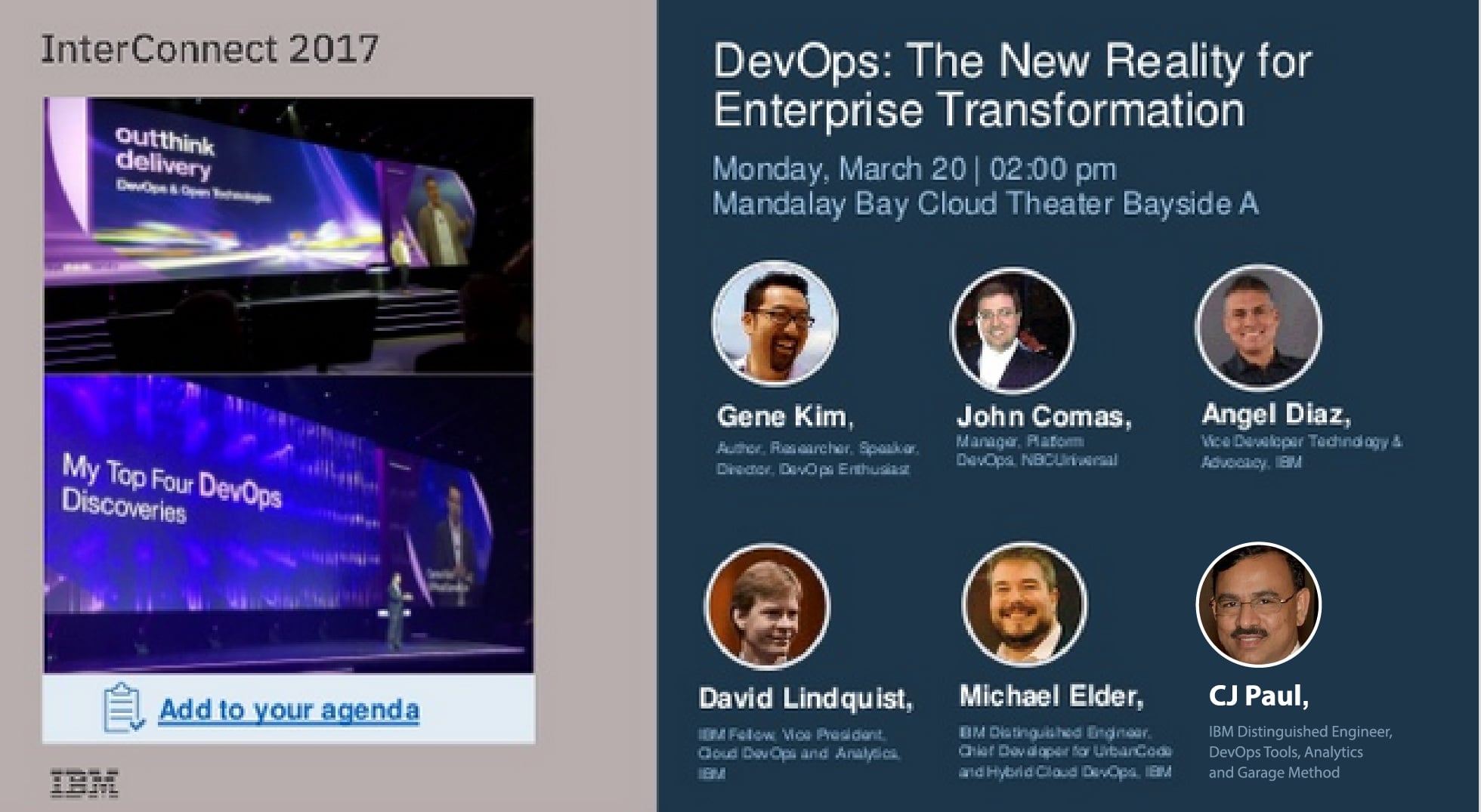
    devops presentation“DevOps: The New Reality for Enterprise Transformation,” a 45-minute keynote presentation at IBM InterConnect 2017, is the winner of the Best DevOps Presentation for 2017. It features Gene Kim, John Comas, NBCUniversal and IBM execs and  distinguished engineers including David Lindquist, Angel Diaz, CJ Paul and Michael Elder. Are you dabbling in DevOps? Maybe you’ve run a great pilot project or have a terrific two-pizza team that’s innovating new apps. How do you scale their success to your whole organization? The answer lies with a combination of cultural, personal and technical transformations that blend methodologies and cloud-native approaches with proven automation patterns and existing on-prem development. The presentation includes client stories and demonstrations of the latest IBM solutions to help companies transform their teams and build, deploy and manage their apps for large-scale enterprise IT environments.

    Best devopsy.kinsta.cloud Article of the Year

    “Continuous Integration vs. Delivery vs. Deployment: What’s the Difference?” by Chris Tozzi won the Best devopsy.kinsta.cloud Article of the Year devopsy.kinsta.cloud articleAward for 2017. Christopher Tozzi has covered technology and business news for nearly a decade, specializing in open source, containers, big data, networking and security. He is currently Senior Editor and DevOps Analyst with Fixate.io and Sweetcode.io.

    Again congratulations to the winners—well-deserved recognition for all of your efforts.

    For those interested in next year’s DevOps Dozen, information will be out in July or August of this year.


    — Alan Shimel

  • 5 Key 2018 Tech Predictions for the C-Suite

    5 Key 2018 Tech Predictions for the C-Suite

    The most important digital trends for C-level business leaders to consider in 2018 relate to digital transformation, artificial intelligence (AI), internet of things (IoT), General Data Protection Regulation (GDPR) compliance and cybersecurity. Read on for insights and predictions about why these topics will matter so much to C-suites in 2018.

    Prediction 1: Digital Transformation—All Aboard!

    As one of the armaments of business innovation and disruption, digital transformation has become such a buzzword that it turns people off. But in 2018, fates likely will be sealed. A company has either transformed, is on its way to doing so, is actively planning its transformation or has decided not to get on that train. That last group won’t be invited to the AI party and are making themselves targets for disruption. According to Forrester, more than 60 percent of executives believe they are behind in their digital transformation. That’s OK, as long as they keep moving. CEOs need to fund this expensive endeavor from the outset and not try to make it pay for itself. Nickel-and-diming digital transformation could be the last mistake a CEO makes.

    Prediction 2: By 2020, AI Will Be a Game-Changer

    Every so often a technology comes along that has the potential to completely change everything around it. The last such technology was cloud computing. And like cloud, which had several precursors, AI has been around for a long time. AI and machine learning/deep learning are catching up to the initial promise, and that will become more evident as the next few years unfold.

    The best options for near-term success with AI are business intelligence and decision support. Some enterprises are using machine learning/deep learning to plumb big data—especially unstructured data such as text and video—to drive new forms of data analytics.

    Even so, many companies will strike out with AI/machine learning largely because it’s no paint-by-numbers endeavor. Companies need talented people who know how to harness this technology, but those people are scarce and don’t come cheap. Companies need businesspeople actively making sure that the technology serves the business need, potentially in charge of the project. And companies need the right data. An AI-based decision-support system, a common application of the technology, is fueled by quality data. Do you have it? This HBR.org article, “A Survey of 3,000 Executives Reveals How Businesses Succeed with AI,” will help get your organization oriented toward AI success.

    AI is likely to be a largely experimental for the next year to two years as organizations give it a shakedown cruise. But early adopters have had some success, and many see potential for AI to deliver revenue growth.

    Ultimately, AI and machine learning/deep learning will be looked upon as major advances with far-reaching effects, much like cloud computing and the internet. In 2018, it may not seem that way as enterprises experimenting with it feel the pain of separating the hype from the reality, adjusting business processes to make it work, cultural resistance from tech teams and a lack of available talent. Stick with it to reap eventual rewards.

    Prediction 3: IoT—A Thousand Points of Entry?

    Enterprise implementations of IoT functionality are very popular these days. But security vulnerabilities and issues are both inherent and legion with this technology. It simply hasn’t been thought through. In 2018, the disregard for IoT security solutions will come home to roost for several major corporations. Until the security issues are resolved, IoT will begin to be seen by some, at least, as a promising technology that’s not ready for prime time.

    Prediction 4: The GDPR Powder Keg

    By the end of 2018, some companies will be getting out of European markets, while others will look for a means of circumventing the EU’s GDPR. Still others will be scrambling to comply. And a last group will be doing what they’re doing now: taking the risk that the cost of the penalty is less than the cost of compliance. Forrester predicts that 80 percent of firms will not fully comply with GDPR. The unfortunate part is that, while a company may be able to ride out a steep fine on non-compliance, damage to its brand may be irreparable or very slow to heal.

    Companies also can’t just throw money at GDPR—it probably will require new companywide policies and a shift in cultural thinking about personally identifiable data and the individuals behind them. Some companies are going to find it very difficult to make that cultural change.

    Prediction 5: Cybersecurity Needs New Thinking

    Customer experience and security are at odds with each other. Passwords don’t work. Biometrics aren’t completely safe. Security awareness is treated as an afterthought. Security breaches are an everyday headline. What’s it going to take to make society wake up? There is a huge need for a new type of user authentication system, as just one example. There are significant opportunities for those that can deliver new technologies, new products and new solutions. We need to think differently about cybersecurity. We need to teach it in schools. In 2018, we will hit bottom. It will become apparent to all of society that our security measures are antiquated and have no hope of meeting the rising threat from many quarters. As the digital world continues to assimilate more and more of our previous analog way of life at a rapid clip, security has trailed far behind. Cybersecurity desperately needs innovation.

    — Scot Finnie

  • Strap in, CIOs: Analysts Predict Wild Ride for 2018-2020

    Strap in, CIOs: Analysts Predict Wild Ride for 2018-2020

    Digital transformation is the underlying theme of many of the 2018 and beyond IT predictions made recently by analyst firms Forrester, Gartner and IDC. Technologies such as cloud, AI, data analytics, big data, blockchain, IoT, conversational interfaces, DevOps and cybersecurity will also force CIOs to perform a juggling act. The rapid evolution of these technologies combined with the business opportunities they unlock will create a pressure cooker for CIOs, become an everyday topic of discussion for C-suites and possibly even a preoccupation of boards of directors.

    We’ve analyzed the predictions by the three research firms and have gathered the key themes as the seven most pressing issues for the C-suite next year and beyond:

    1. CIOs are at a Crossroads, Representing Both Challenge and Opportunity

    Forrester believes that CEOs will make digital business a top priority in 2018 and CIOs will lead the digital transformation at most companies. In a November report, “CIOs Make the Chief Digital Officer Obsolete,” Forrester summed up: “In 2018, boardroom discussions will focus on digital. Key questions will revolve around platform-based business models, new partnership ecosystems, and new ways to organize for success. CIOs will build new skills and competencies to help drive this change.”

    The challenges for CIOs during this period will demand that they step up, expanding their digital skill sets and employing technologies with both eyes focused on business value. Forrester predicts that CIOs will need to orchestrate the underlying technologies and supplier relationships for companies to manage their platform-based business approach. CIOs would also be smart to leverage cloud computing and open source software, and build on containers, APIs and microservices.

    CIOs also may need to develop new leadership skills to direct their company’s digital transformation. That includes displaying a laser-like customer focus, attracting the necessary talent, restructuring their organizations and developing the culture required to deliver tangible business results. Doing so, Forrester said, “will present CIOs with the opportunity of a lifetime, allowing them to demonstrate the level of trust and performance that their senior peers and boards require, and positioning them as leaders of the digital transformation — even the enterprise.”

    IDC’s November “Worldwide CIO Agenda 2018 Predictions” offers predictions that dovetail with Forrester’s view:

    • By 2020, 60 percent of CIOs will implement an IT business model and culture that shifts focus from IT projects to digitally oriented products.
    • By 2020, 60 percent of the CIOs who have crossed the digital divide will prevail in C-suite turmoil in competition to become digital business leaders for their enterprises.

    Advice to CIOs: Find a leadership coach. Choose one or two lieutenants you trust to delegate important roles to. Find a senior product manager-type person in your company to help you become more knowledgeable about generating business value. Make a point to talk to your CEO about the advantages of digital transformation. Develop a plan for adopting a new digital governance model. What should your digital platform look like?

    2. Digital Transformation Becomes Real for Most Companies in 2019-2020

    We’ve been hearing for a couple of years that companies are digitally transforming their businesses. The truth is that those companies represent the leading edge and they are a small minority. Most CIOs are still stuck doing more with less, the hangover from the last recession. CEOs: Your CIO needs more budget to position your company for digital success over the next few years. IDC predicted that “through 2019, 75 percent of CEOs and their enterprises will fail to meet all their digital objectives, dragged down by conflicting digital transformation imperatives, ineffective technology innovation, cloud infrastructure transition and underfunded end-of-life core systems.”

    That’s a lot of failure. CEOs and CIOs are going to need to work together to make digital transformation a reality. It’s not just about updating your technology, it’s about business innovation.

    Key points on digital transformation from IDC’s CIO 2018 predictions:

    • By 2019, 60 percent of CIOs will complete infrastructure and application replatforming using cloud, mobile and DevOps, clearing the deck for accelerated enterprise digital transformation.
    • By 2019, 60 percent of IT organizations will have deployed digital transformation platforms supporting new customer- and ecosystem-facing business models.
    • By the end of 2019, digital transformation spending is expected to reach $1.7 trillion worldwide.

    3. AI is No Panacea

    Forrester named one of its 2018 prediction reports “The Honeymoon for AI Is Over.” Conventional analytics are undergoing full disruption, largely because AI is perceived to be the solution to both programming analytics and solving the big data riddle. And while it’s likely that AI/machine learning will be able to help with both problems, you can’t just snap your fingers and make it so. Harnessing AI successfully requires specialized engineering talent, quality data, objective planning and some trial and error. According to a Forrester survey, 70 percent of respondents say their firms will have implemented AI in the next 12 months. They chose decision management as their most important use. One of the key points to remember is that the decision-making abilities of it machine learning tool can’t over calm a lack of quality data. Forrester warns: “Don’t be fooled by vendor claims that more intuitive human-to-machine interfaces are [a magic potion] that reduces the need for data and metadata management and curation.”

    Quick AI predictions from IDC:

    • By 2019, 40 percent of digital transformation initiatives will be supported by cognitive/AI capabilities, providing timely critical insights for new operating and monetization models.
    • By 2020, 85 percent of new operation-based technical hires will be screened for analytical and artificial intelligence skills, enabling the development of data-centric digital transformation projects without hiring new data-centric talent.

    4. One-Third of Enterprises will Abandon Big Data Repositories in 2018

    Has your company built a large data lake that hasn’t delivered any significant business value? Well, 2018 may be the year when you rethink that decision, according to Forrester.

    On the other hand, Forrester believes that AI will be able to resolve the longstanding issue of the boundary between structured and unstructured data because of vendors including Digital Reasoning, Expert Systems and Stratifyd.

    As you make your move to digital transformation, having more actionable data based on your pool of big data, especially unstructured text data, could deliver book valuable business insights. This might not be the best time to give up on big data. Especially if you’re actively engaged with AI.

    5. Blockchain: Confusing, Skills Gap, Steeped in Hype—but Full of Potential

    Blockchain will begin to show next year just how difficult it will be to employ but, at the same time, that it’s worth exploring.

    “By the year 2020, the banking industry will derive $1 billion of business value from the use of blockchain-based crypto-currencies,” states Gartner’s October “Top Strategic Predictions for 2018 and Beyond.” “When compared to the estimated $7.6 trillion that is the industry gross output of the world’s banking industry, $1 billion may not seem like much. However, the value is more about the tacit endorsement of crypto-currency as a legitimate option by the banking industry.” Cryptocurrency is just one application of blockchain.

    Advice: Build your blockchain ecosystem early, Forrester recommends in its 2018 prediction report, “Be Ready to Face the Realities Behind the Blockchain Hype.” “The blockchain terminology will remain confusing,” Forrester noted. “The term ‘blockchain-inspired’ is already a common descriptor for software that has some of the characteristics of blockchain or reflects some of the principles of the blockchain network, but isn’t a blockchain in the true sense.” There is a growing skills gap pertaining to software engineers and security professionals who have experience with blockchain. It’s a nascent technology; make sure your team sets realistic goals.

    6. IoT Hits Prime Time, but it Might Not Be Ready

    By 2020, IoT technology will be in 95 percent of new product electronics designs, Gartner said. IoT’s growth is very rapid, even for the computer industry. But that growth comes at a cost. The technology has not overcome what many believe to be rampant security vulnerabilities. “Through 2022, half of all IoT security budgets will be spent on fault remediation, recalls and safety failures rather than protection,” Gartner predicted.

    Forrester is far more positive about the business advantages of IoT in its report, “IoT Moves from Experimentation to Business Scale.” Its predictions are also more detailed in the several areas where IoT might gain traction in 2018. But the security issues are not lost on Forrester, either. The research firm predicted: “IoT will be at the center of broader and more damaging cyberattacks. The Mirai botnet was a harbinger of future IoT security-related attacks and breaches. … Most firms still haven’t shown a consistent commitment to mitigating IoT-specific threat vectors.”

    Advice: IoT is an accident waiting to happen. For B2C companies, the consumer backlash could be fierce if there is a major incident. Make 2018 be the year that you start plugging up those IoT security vulnerabilities and protection gaps.

    7. Most Companies Won’t Comply with GDPR in 2018

    The European Union’s General Data Protection Regulation (GDPR) takes effect May 25, 2018. Forrester predicted in its November report, “A Year of Reckoning,” that 80 percent of companies will fail to comply with the GDPR. Perhaps more to the point, Forrester additionally predicts that 50 percent of those non-compliant firms will do so intentionally, “meaning they have weighed the cost and risk, and are taking the path that presents the best position for their companies.” The other half of the 80 percent will try to comply but will fail.

    Advice: It seems likely that some large company will be made an example of. You don’t want that to be your company.

    Takeaways

    Those are the standout IT-related issues for the C-suite in 2018 and beyond. If you weren’t tuned in to some of them, knowing is half the battle right? Well, probably not. These are tough challenges. Each organization has its own strengths and weaknesses. But generally speaking, if you parse this list by investing time and budget on the first four while minimizing the potential downsides of last three, you’ll be doing very well.

    — Scot Finnie

  • Node.js Foundation Embraces HTTP/2

    Node.js Foundation Embraces HTTP/2

    The latest version of Node.js will significantly increase the DevOps challenges surrounding the most widely used version of JavaScript in the enterprise. Node.js 8 adds the ability to support HTTP/2, a major revision of the core internet protocol that, in addition to being significantly faster, enables developers to make multiple requests over a single connection as well as set up pipelines for making a series of requests.

    Myles Borins, director of the Node.js Project and member of the technical steering committee at The Node.js Foundation, notes that while HTTP/2 eventually will be supported by multiple programming languages, DevOps teams most likely will encounter it first in web and mobile applications built using Node.js.

    Borins says HTTP/2 also should go a long way to accelerating the adoption of microservices applications—the majority of which are being built using Node.js.

    Node.js 8, available under a Long-Term Support (LTS) license, is 20 percent faster than its predecessors, Borins says. It is based on the JavaScript V8 engine that makes use of Turbofan and the Ignition compilers and interpreters, which equates to lower memory consumption and faster startup time across Node.js applications.

    Other new features include an Async/Await capability that allows developers to write more linear code versus relying on callbacks and a series of Experimental ES Modules that provide a standard pattern for writing modular JavaScript code that can run on both the web and in Node.js.

    Node.js 4 is now scheduled to be designated for end-of-life status in April, and Node.js 6 will face a similar fate soon after. The Node.js Foundation is encouraging organizations that have deployed Node.js applications to refresh them because security patches and updates soon no longer will be available for the core engines used in Node.js 4 and 6 applications. Node.js API (N-API), a project that enables modules to run against new versions of Node.js, is still considered experimental. That project is being lead jointly by Google, IBM, Intel, Microsoft, nearForm, NodeSource and individual contributors.

    The Node.js Foundation also announced that work has begun on Node,js 9, which is focused on modernizing legacy application programming interfaces (APIs) and implementing a new error system that associates a unique code with all errors in place of relying on traditional error messages.

    The Node.js Foundation estimates there more than 9 million instances of Node.js deployed across the web today, so managing Node.js applications across their life cycle has become a significant DevOps challenge. While Node.js is not the only programming language gaining momentum across the enterprise, the Node.js community is highly focused on increasing the robustness and manageability of Node.js applications in a way that should eventually please even some of the most hardcore fans on rival languages such as Java or even COBOL.

    — Mike Vizard

  • IBM Adds Cloud Foundry PaaS to Cloud Private

    IBM Adds Cloud Foundry PaaS to Cloud Private

    As IT organizations are being asked to provision and support an ever-growing number of platforms, they increasingly require an approach that abstracts away as much of that complexity as possible. With that goal in mind, IBM created IBM Cloud Private, an on-premises platform that automates the deployment of a private cloud based on Kubernetes container orchestration software. This week, IBM announced it is extending the reach of IBM Cloud Private to include support for the open-source Cloud Foundry platform-as-a-service (PaaS) environment.

    IBM Cloud Private is designed to be deployed on top of virtual or physical servers, including instances of hyperconverged infrastructure based on software from Nutanix. Michael Elder, an IBM distinguished engineer for IBM Cloud Private, says IBM has developed tools for automating the provisioning of not only underlying infrastructure, but also containerized and legacy versions of IBM middleware such as IBM DB2 databases, the Open Liberty Edition of WebSphere application server and IBM Microservice Builder. In addition, Elder says IBM Cloud Private can be employed to deploy a variety of open-source databases, including MongoDB and PostgreSQL.

    Also available for an additional fee with IBM Cloud Private are a plethora of DevOps tools including APM, Netcool, UrbanCode, Cloud Brokerage, Jenkins, Prometheus, Grafana and ElasticSearch. Regardless of the platform employed, IT organizations should be able to apply a consistent set of DevOps processes to manage either Kubernetes or Cloud Foundry, Elder says.

    IBM is also addressing security issues by including Security Vulnerability Advisor to scan containers and an ability to encrypt all data in flight.

    Elder says many IT organizations will deploy 12-factor applications on a PaaS environment alongside containerized applications running on Kubernetes. IBM Cloud Private is designed to provide a common management framework for managing both environments. However, IBM is not extending that management framework to the IBM public cloud. Elder says the company determined that attempting to create a common management framework for both would result in too much complexity, especially for administrators of public cloud services that require a much more streamlined user interface experience.

    Most IT organizations could, of course, craft their own private cloud. IBM Cloud Private simplifies that process by providing all the pieces required under a common management framework. Rather than spending months putting those elements together, IBM is making a case for an integrated platform that enables IT organizations to concentrate more of their efforts on deploying applications instead of managing infrastructure.

    The debate occurring across the IT industry now is to what degree will container-as-a-service (CaaS) environments based on Kubernetes supplant traditional PaaS environments. IBM, as a major supporter of both Kubernetes and Cloud Foundry, is clearly betting there will be room for both. The Cloud Foundry Foundation recently furthered that goal by adding support for a Kubernetes runtime.

    Thus far, however, the complexity of standing up a PaaS environment has limited the adoption of Cloud Foundry to Fortune 1000-class IT organizations or cloud service providers. Meanwhile, CaaS environments based on Kubernetes increasingly are being stood up by developers and then handed over to IT operations to manage. Given that disparity in deployment models, it may not be too long before the number of CaaS environments simply overwhelm the number of instances of traditional PaaS environments.

    — Mike Vizard

  • Akamai Gives DevOps Teams More Control

    Akamai Gives DevOps Teams More Control

    When most DevOps teams think about platforms, it’s usually a conversation about some form of software sitting on a server in a data center. But many web and mobile applications employ a content delivery network (CDN) as the platform on which they depend most to run. Akamai Technologies is moving to provide DevOps teams with much greater visibility into and control over what’s occurring across its namesake CDN.

    Ari Weil, senior director of industry marketing at Akamai, says CDNs now play a pivotal role in enabling IT organizations to deploy web and mobile applications in the cloud. To provide DevOps teams with more control over those deployments, Akamai is committing to treat the core CDN as code that can be programmatically invoked in addition to providing real-time visibility into applications running on Akamai and simplyfing the modification of applications in production, says Weil.

    As part of that effort, Weil says, Akamai is expending the range of application programming interfaces (APIs) that it exposes via toolsets spanning frameworks such as Terraform, Varnish and WordPress. The goal is to expand significantly the level of scripting and automation enabled by the Akamai CDN. Akamai is also making available a testing suite that DevOps teams can employ to test and fix applications in real time.

    Akamai is making it possible to deploy custom configurations and code across Akamai’s CDN in minutes, including the ability to remove content in seconds and revert to past configurations whenever necessary.

    Akamai has also released mPulse Lite, a free version of a digital performance management tool that identifies ways to improve application performance and the end user experience, and its IoS mobile application and companion IoS watch app to specifically optimize the performance of iOS applications accessing the Akamai CDN.

    Most DevOps teams are hyperfocused on what occurs inside the data center. But in the age of extended enterprise the level of dependency on caching and security services provided enabled by a CDN has never been greater. The fact that Akamai has also begun a more DevOps initiative is also testament to how far the DevOps movement has been able to extend its influence. Historically, providers of external services have been reluctant to provide any visibility into how their network services operate.

    Weil notes that it’s apparent the developers are also exercising more influence and control over IT. As such, providers of external services are now under more pressure to programmatically expose their services in much the same way as any other cloud service. In fact, many cloud service providers are leveraging their global footprint to make available CDN services that rival Akamai.

    Regardless of the CDN chosen, developers are under more pressure than ever from the business to optimize the end user application experience. Mobile and web applications are core to any digital business transformation initiative. In the face of that pressure, DevOps teams are finding that having more control over the CDN used to deliver those applications is now an absolute necessity.

    — Mike Vizard

  • BMC to Infuse AI Across Software Portfolio

    BMC to Infuse AI Across Software Portfolio

    At its recent BMC Exchange event, BMC Software announced it will be infusing machine learning algorithms and other artificial intelligence (AI) technologies across its entire portfolio of IT operations software.

    The first instance of BMC software to make use of machine learning algorithms is the latest version of TrueSight AIOps platform, which ingests data from multiple data sources to automate processes across BMC service desk, IT operations and tools for managing DevOps processes. BMC also is working with IBM to employ the cognitive computing services known as the IBM Watson cloud service across its portfolio.

    In addition, the company launched TrueSight Cloud Cost Control, a tool for managing and tracking usage of cloud services across multiple providers, and BMC SecOps Policy Service, which easier to embed compliance and testing via an external service that gets included in their software development processes.

    Finally, BMC announced it has signed an alliance with Amazon Web Services (AWS) under which the two companies will work to accelerate the migration of application workloads to the AWS public cloud.

    Dan Streetman, a senior vice president for worldwide sales and marketing at BMC, says his company is developing a product strategy around three major themes:

    • IT organizations will require management tools that will work across multiple clouds;
    • As part of general “shift left” developers now expect to be able to programmatically invoke IT operations and security services; and
    • IT professionals now expect the tools they use to manage IT to have the same types of advanced capabilities that consumer applications provide via speech interfaces such as Apple Siri or Microsoft Cortana. Various IT and customer service desks also soon will use speech interfaces to provide a highly automated self-service experience to end users.

    In fact, given the complexity of the IT tasks that now need to be managed, Streetman says a race is now on between IT vendors to live up to those expectations. Much less of a concern, he says, is any notion that AI technologies might one day replace IT professionals that by and large are already overtaxed; rather, it is apparent that IT vendors are now being evaluated on their ability to maximize existing investments in IT professionals that are already in short supply. The real opportunity is to free IT professionals to enable them to concentrate on higher-value tasks.

    Naturally, it remains to be seen how various AI technologies will impact the management of IT. It certainly will take a while for IT administrators to put their faith in AI. But as those technologies continue to mature, there may soon come a day when IT professionals look back with wonder at all the things they used to have to accomplish one manual task at a time.

    — Mike Vizard

  • Google Launches Software Supply Chain Initiative

    Google Launches Software Supply Chain Initiative

    Maintaining the integrity of a software supply chain is an issue that has long bedeviled IT organizations. With the rise of microservices based on containers, however, this issue has become more acute. As a result, software supply chains are an issue that Google now plans to tackle.

    Google, along with JFrog, Red Hat, IBM, Black Duck, Twistlock, Aqua Security and CoreOS, is taking the lead on an open-source Grafeas initiative that aims to create a standard application programming interface (API) through which metadata about the software components that make up an IT environment can be more easily captured. The whole software supply chain issue has become even more challenging now that enterprise IT organizations regularly make use of open-source software within larger applications. There are now more dependencies on software modules that are being created and updated outside the IT organization, most of which are not prepared to keep track of the modules’ history.

    One of the first instances of Grafeas is going to manifest itself in the form of Kritis, a policy engine that Google has developed for the Kubernetes container orchestration engine. Because of its long history with Kubernetes, Stephen Elliott, product manager for developer platforms at Google, says Google tends to approach every issue these days through a container prism. But the expectation is that the Grafeas API will be more broadly applied to collect data about and enforce policies across a broad range of types of software components, he says.

    Elliott says that while there is no shortage of tools for managing software life cycle, each of those tools generate their own proprietary metadata. Grafeas promises to provide a consistent means to, for example, identity developers, determine when the code was checked in and built, what vulnerabilities have been detected, and what tests were passed or failed. Trying to manage those issues is at the heart of any approach to DevOps. A standard API would not only go a long way toward simplifying those issues, it also should also serve to make many of the tools DevOps teams rely on today more interoperable. That would also go a long way toward preventing IT organizations from finding themselves locked into a specific set of DevOps tools.

    Obviously, the launching of an initiative represents only the beginning of a process that should extend well into 2018. The number of IT vendors that have a vested interest in software supply chain issues exceeds that number that has signed on to the Grafeas initiative, and when this API issue is addressed by an industry standards body remains to be seen. Google is betting that as IT organizations become more familiar with microservices-based containers, there will be lot more support for addressing these issues now than anytime in the past. In the meantime, IT leaders should take some comfort in the fact that, at the very least, the IT vendor community is starting to better appreciate their software supply chain pain.

    — Mike Vizard

  • GitHub Applies Data Science to Managing Code

    GitHub Applies Data Science to Managing Code

    Over the last several years GitHub has emerged as one of the primary repositories around which application development now revolves. At its recent GitHub Universe 2017 conference, the company revealed how it is extending that central role to provide DevOps teams with the addition of a dependency graph that can be employed to alert DevOps teams when a module of code has been updated and a security alert service that will notify them anytime a patch has been made available for a specific module.

    Miju Han, engineering manager for data science for GitHub, says both new capabilities are examples of how the company is applying advanced algorithms and data science techniques to make it easier to manage DevOps processes that revolve around GitHub.

    In addition, Han says GitHub is making available a news feed through which DevOps teams can track updates to groups of modules stored in the repository, as well as a tool through which they can explore a curated set of modules.

    Han says his company intends to combine a variety of emerging data science tools to simplify the daily workflow that revolves around GitHub. As the repository has become more widely used, the sheer volume of code and related updates a DevOps team is supposed to track has become, in many cases, overwhelming. That’s why the company is now pouring resources in several data science research projects with an eye toward making it simpler to navigate the repository.

    The latest annual edition of an Octoverse report published by GitHub finds that there are now more than 24 million developers in 1.5 million organizations around the world accessing 67 million GitHub repositories. A total of 25 million of those repositories are public. The most popular programming languages in use across GitHub are JavaScript (2.3 million projects); Python (1 million projects); Java (986,000 projects) and Ruby (870,000 projects). In terms of pull requests, GitHub notes that Python surpassed Java in popularity in the last year. The company also notes that half of the largest companies in the U.S. based on revenue are employing GitHub repositories.

    There is no shortage of repositories being employed inside and out of enterprise IT organizations, including an enterprise edition of GitHub that the company claims has been implemented by 45 percent of the Fortune 100 list of the world’s largest companies.

    Arguably, the biggest challenging many organizations now face is trying to reconcile the various code repositories in use. Just about every provider of an application development platform provides access to a code repository. In addition, providers of everything from container frameworks to application lifecycle management (ALM) often provide similar capabilities. Keeping track of what version of any given piece of code resides where at any given time has become a significant challenge.

    The good news is that providers of repositories are starting to address that issue on their own platforms, which means it stands to reason that one day soon tools for managing code across heterogeneous repositories may not be all the far off. In the meantime, DevOps teams can take some comfort in the fact that the management tools they rely to manage all the code are about to become a whole lot smarter.

    — Mike Vizard

  • Machine Learning Is Working for CIOs, Vendor Survey Finds

    Machine Learning Is Working for CIOs, Vendor Survey Finds

    AI’s time has finally come, if a new survey commissioned by ServiceNow is to be believed. Its results showed that nearly 90 percent of CIOs are at least dabbling with machine learning, with 53 percent calling it an area of strategic focus for their companies. What’s more, almost 70 percent of the CIOs surveyed say decisions made by machines will soon be more accurate than those made by humans.

    The new survey was conducted by Oxford Economics on behalf of IT and enterprise software-as-a-service vendor ServiceNow. The survey, titled “The Global CIO Point of View,” was completed by 500 CIOs in 11 countries across 25 industries.

    The report also fits neatly with evidence from other sources that CIOs are in charge of digital transformation. Just under 75 percent say they lead their company’s efforts to gear up for full-fledged digital business. Business intelligence derived from data analytics has always been a pillar of digital transformation. But with some 85 percent of CIOs reporting that machine learning provided “substantial value” or “transformative value” to the accuracy as well as rapidity of decisions, it’s beginning to change the way some organizations operate, according to the report.

    Within three years, two-thirds of the respondents expect to be making an investment in machine learning. Today, one-third are investing. The size of spend as a percentage of the overall IT budget is relatively modest, however: something like 5 percent for machine learning.

    One of the reasons for the move to machine learning is that sometimes you just have to do things smarter. “We were heading to a tipping point almost where there was just so much work coming in,” said Dave Wright, chief innovation officer, ServiceNow, talking about IT shops. “There was just so much work coming in; the workload just continued to increase year over year. CIOs want to know, ‘How do I get to the point where I can deal with this, because I can’t constantly throw heads at it.’” That’s why the report advises that companies direct their early machine learning efforts at the most commonly used services, freeing resources for more rewarding efforts.

    Machine Learning’s Obstacles Aren’t What You Think

    Machine learning technology has matured so much in recent years that it’s no longer the prime obstacle for CIOs. Instead the challenges are outdated business processes, incomplete insufficient skill sets, lack of quality data, insufficient data sources, risk assessment conflicts and budget limitations. When data is siloed across the company, accessing all the right data for the best decision-making is not always easy or possible. There’s also some inertia built into the organizational structures of most companies; the notion of making business decisions based on machine learning (a.k.a. “decision automation”) may require some handholding, for example. Technology is not the problem.

    Early adopters to machine learning, which represent just under 10 percent of the survey sample, share some characteristics and ways of doing things: They prioritize talent. They are working on better business processes and have a road map for future changes developed by monitoring mistakes made by machines. The road map is also guided by the need to implement policies and processes that improve data quality. They have strong technology foundations, with an emphasis on data analytics, cloud, mobile and IoT. And they expect results. Nearly 90 percent of this 10 percent of early adopters expect decision automation to support topline growth.

    What may be more interesting is that, of the other 90 percent of the CIO respondents, nearly 70 percent expect to develop revenue from machine learning. Looking at the data behind this report, the CIOs who’ve gotten their feet wet with machine learning are very excited by its prospects.

    The report outlines five steps to achieve value from machine learning that are worth a quick summary:

    1. Build your technical foundation so as to improve data quality. Successful companies had already invested significantly in analytics, for example.
    2. Prioritize automation of the most common business use cases; they will return the greatest business benefit.
    3. Build an exceptional customer experience. If customers see the man behind the curtain in a machine learning-based tool, it may become a very negative experience for them. Spend extra time making the entire customer journey seamless.
    4. Attract employees with new skills and double down on culture.
    5. Measure and report. The benefits of machine learning may not be obvious to all. CIOs must set expectations, develop success metrics and build a sound business case to acquire funding. Build some success stories.

    — Scot Finnie