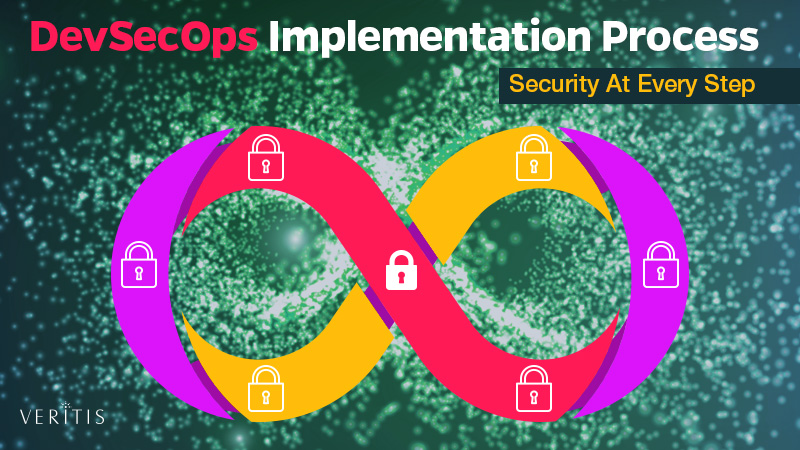
DevSecOps is changing our perspective toward security and is equipping us to deal with its challenges in an intelligible manner. The systematic approach of DevSecOps helps us add value to our business processes while ensuring security.
Here’s a summary of the key inputs and a recipe for a successful software development project. Implementing DevSecOps with the primary goal of enhancing security requires a step-by-step procedure.
It requires the unification of culturally disparate teams of Security, Operations, Development and Test for the sole purpose of building a product marked by quality and backed by security.
The DevSecOps process will require effective planning, design and release, which will be put together with a collaborative toolchain of technologies to bring about a common goal.
Furthermore, as organizations continue to rely on automated delivery, avenues are created for testing opportunities beyond traditional bugs. In-house experts will be able to identify potential loopholes, design errors and even code weak spots.
Being able to identify weak spots and flaws well in advance helps organizations maintain a competitive front in the market and trustworthiness before its target audience.
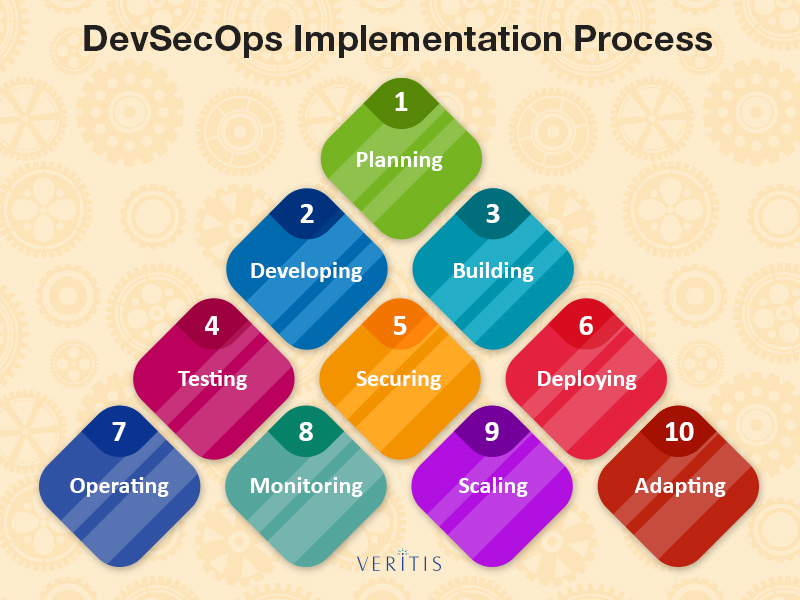
DevSecOps Implementation Process and Road Map
1) Planning: Planning is the first approach to any task at hand and the core focus of DevSecOps—security—begins from here. In the planning stage, DevSecOps professionals must go beyond creating feature-based descriptions. The focus should also be on security and performance, acceptance test criteria, application interface and functionality and threat-defense models.
Tech terminology: Acceptance Test Criteria is used by DevSecOps professionals to understand user preferences and behavior to a software application behavior.
2) Developing: Developers should approach DevSecOps with a “how to do it” approach, rather than a “what to do” approach. It is important for developers to bring together available resources for guidance, have reliable practices and a code review system in place for themselves and for others in the team to follow.
3) Building: Automated build tools can uplift the whole DevSecOps implementation process tremendously. These tools ensure test-driven development, standards for release artifact generation and utilize tools to ensure the design aspect is in alignment with the team’s coding and security standards through statistic code analysis.
They can also be used to identify vulnerable libraries being used in your application and replace them with new ones.
4) Testing: Automated testing in DevSecOps should utilize strong testing practices including front-end, back-end, API, database and passive security testing.
Tech Terminology: Passive Security Testing is a developmental stage testing where security testing is not conducted directly on the target.
5) Securing: Traditional testing methods always remain in place in DevSecOps exercise. However, somewhere down the line, there is a tendency to identify issues toward the end of the development process.
Through advanced practices such as security scanning, we tend to become more aware of the issues and can determine if the threat is a serious one or not.
6) Deploying: Automated provisioning and deployment can fast-track the development process while making it a more consistent one. Infrastructure-as-code tools can perform the aforementioned audit properties and configurations and ensure secure configurations across the IT infrastructure.
7) Operating: Regular monitoring and upgrades are the Operations team’s important tasks. DevSecOps teams ensure to deploy infrastructure-as-a-code tools to update and secure the entire organization’s infrastructure in a quick and efficient manner with no scope for human error. Operations personnel have to be especially watchful of zero-day vulnerabilities.
Tech Terminology: Zero-Day vulnerabilities are a software breach that remains unknown to software productions personnel and can eat away at a computer program and other components such as a network.
8) Monitoring: Constantly keeping a watch for irregularities in security can save an organization from a breach. Hence, it is essential to implement a strong continuous monitoring program with real-time to keep a track of system performance and identify any exploits in their early stages.
9) Scaling: Gone are the days when organizations spent precious hours and money on the maintenance of large data centers. With the introduction of virtualization solutions and the cloud, organizations can scale their IT infrastructure or replace it in the event of a threat, which would be impossible to do with a traditional data center.
10) Adapting: Continuous improvement is key to any organization’s growth. An organization will only be able to achieve the desired growth of it evolves in its practices including DevSecOps practices—security, functionality and performance. Therefore, an organization should adapt to continuous improvement and external changing trends.
The DevSecOps is in itself a process of innovation that substantially adds value to an organization.
Point to Remember: Security is everyone’s responsibility.
The position of DevOps Engineer is gaining some serious respect, and with that comes cash.
In Dice’s recently released “2019 Tech Salary Report,” DevOps Engineer now ranks in the Top 5 of all tech salaries, with an average of $111,683. The survey is based on the responses of 10,780 technology professionals conducted between Oct. 22 and Dec. 13, 2018.
It’s the first time that the title of DevOps Engineer has appeared in the Top 5, according to Dice. The one caveat is that the position might not be as popular as the annual salary suggests; rather, more professionals now identify with this position.
What it does mean is that the DevOps Engineer title is now ranked with more established tech titles, including senior leadership positions CEO, CIO, Vice President and Director, with an average salary of $142,063; System Architect, at $129,952; Tech Management, including Strategist and Architect, at $127,121; and Product Manager, at $114,174.
Overall, the average salary for tech workers remained relatively flat year over year. In 2018, the average salary totaled $93,244, a less than 1 percent increase from 2017, when the average salary stood at $92,712, according to Dice.
In an email, Dice CTO Klavs Miller noted that the increasing use and adoption of various cloud-based technologies is pushing enterprises to invest more in DevOps engineers to take advantage of that compute power to develop new apps.
“Many DevOps Engineer job requirements include a heavy focus on the creation of infrastructure as code, essentially transforming operations into the management of codebases that create infrastructure (in cloud services or native cloud infrastructure rather than servers and hardware),” Miller wrote. “We are also seeing and experiencing first-hand that more and more organizations are moving toward having combined development and operations teams around a domain, rather than splitting along traditional functional lines.”
In his email, Miller noted that while there might be few tech pros that use the “DevOps Engineer” title, it doesn’t mean that there’s an actual lack of engineers with the skills to help enterprises with their DevOps projects.
Instead, it’s a matter of looking for talent that might already be there.
“There is probably a shortage of talent that label themselves as ‘DevOps Engineers,’ but employers should look at the skills required by those roles instead,” Miller noted.
“There’s a growing demand for a skill that is still evolving with market trends,” he added. “As an example, DevOps is not nearly as common as its more common sibling, software engineers, but it has become more popular each year according to our salary survey and among employers who are sourcing Dice for these positions.”
The types of enterprises looking for DevOps talent are varied. Right now, insurance company Geico and hardware store giant Lowe’s are each looking for specific DevOps titles, according to Dice.
If private business isn’t your area, the Louisiana Economic Development agency is currently advertising for an entry-level DevOps position.
In addition to specific tech titles, the Dice report shows that several types of programming languages that are now associated with the DevOps discipline are commanding significant salaries in the market.
For instance, those with expertise in Google’s Golang programming language can command salaries of up to $132,827, according to the Dice survey.
A little further down the line, and keeping with Miller’s emphasis on cloud-based technologies driving much of the DevOps conversation, those with knowledge of Amazon’s DynamoDB and Redshift can command salaries of more than $125,000 on average, the study found.
Additionally, platform-as-a-service (PaaS) skills can net a developer an annual salary of more than $122,000.
In his email, Miller noted that it’s difficult to draw a direct line between needs for certain programming languages and the growing popularity of DevOps. The growing reliance on cloud and the types of digital transformation projects enterprises are engaged with now show how the market has shifted.
“There are some assumptions that we can’t confirm, but DevOps shares programming languages with other roles that are also in demand, as employers adopt cloud-based technology and open source becomes more pervasive in companies’ tech stacks,” Miller added.
OverOps is adding a series of dashboards to its analytics platform that employ machine learning algorithms to identify which software application anomalies in a pre-production environment are likely to have the most impact on a production environment.
Company CTO Tal Weiss said one of the biggest challenges DevOps teams face is prioritizing which issues to fix first in an application. The Reliability Scoring capability being added to the company’s namesake platform for analyzing code employ machine learning algorithms to keep track of introduced errors, regressions and slowdowns during every phase of pre-production. In addition to enabling DevOps teams to visually identify the root cause of an issue via a single click, that data is then used to identify which issues will impact reliability.
Weiss noted that the Reliability Scoring can also be employed to set thresholds of acceptable application performance that would also be used to determine whether there is an issue. The data collected using that capability then can be fed back into a continuous integration/continuous deployment (CI/CD) platform to set up gates that would then prevent suspect code from being promoted, he said.
The primary benefit, however, should be a major reduction in the number of troubleshooting instances any DevOps team should need to engage in after an application is deployed in production, said Weiss. In fact, the Reliability Dashboards will provide a central mechanism through which developers, testing professionals and IT operations teams can collaboratively track and measure the progress of an application development project, he added.
The Reliability Scoring tool OverOps developed employs “micro-agents” that operate between application code and the hardware. Weiss said those micro-agents can not only capture data that was never previously available, they deduplicate, classify and gate critical issues as they move into staging and production. The Reliability Dashboards visualize that data in Grafana, a set of open source tools for visualizing data. DevOps teams can also opt to feed that data into any existing dashboards they may already have in place.
In general, Weiss said the metrics surfaced by the Reliability Dashboard are critical to justifying investments in DevOps over the long term. Organizations expend a lot of time and effort making the transition to DevOps. But most of them don’t really know to what degree they are getting better at building and deploying applications. Reliability Scoring dashboards provide the historical context required to make those assessments, he said.
Far too many DevOps teams are still starved for data needed to make critical decisions. In the absence of that data, teams address issues as they arise, rather than based on the impact they might have on the business. Worse yet, it’s difficult to identify new issues over those that might be another manifestation of a known issue that suddenly becomes a much higher priority.
Regardless of the root cause of any problem, however, DevOps teams would do well to remember things that get measured are usually the first things to get fixed.
Cisco Systems this week launched an IoT Dev Center as part of an effort to foster development of a new generation of applications that will be deployed at the network edge.
Announced at the Cisco Live EMEA event, the IoT Dev Center provides access to sandboxes and tutorials for building highly distributed IoT applications that Cisco envisions will be deployed directly on top of Cisco routers and switches. To facilitate that effort, Cisco also launched a series of ruggedized switches and routers, which, in addition to usingCisco ASICs for processing network traffic, can be configured to include x86 processors that enable low-latency applications to be deployed at the edge.
The Cisco IoT Dev Center also provides access to a DevNet Ecosystem Exchange, through which organizations will be able to discover IoT applications optimized for Cisco infrastructure.
Susie Wee, senior vice president for the DevNet community at Cisco, said the IoT Dev Center is an extension of the company’s ongoing efforts to build a DevOps community around Cisco infrastructure. From Cisco’s perspective, IoT represents an instance of edge computing.
Cisco is attempting to extend its current dominance over networking infrastructure to include both networking gear for IoT environments and two-node hyperconverged infrastructure (HCI) platforms intended to be deployed at the network edge. Each of those systems will be connected via the Cisco Application-Centric Infrastructure (ACI) software-defined network (SDN), which Cisco says enables intent-based networking when infused with advanced analytics.
Cisco claims it already has 40,000 customers using some element of its portfolio to drive an IoT application. As that ecosystem continues to evolve, Wee said it’s apparent that both operational technology (OT) teams, which historically have been responsible for embedded systems, and enterprise IT teams will need to embrace best DevOps practices to deploy, manage and update IoT applications. While embedded systems deployed by OT teams were not frequently updated, IoT applications will take advantage of containers and other microservices-based technologies to add new functionality more frequently and, when required, update systems to remediate potential vulnerabilities. By the end of the decade, many of those applications will be connected via 5G wireless networks that will provide enough bandwidth to make continuously updating edge applications much more practical than it is today.
Less clear going forward is the degree to which networking teams will become part of a larger DevOps teams. As more applications get deployed on switches and routers at the edge, it’s obvious networking teams will play a critical role. The issue is to what degree. In many cases, networking teams will attempt to provide developers with access to a defined set of resources they can access via a self-service portal. But there are also likely to be instances when developers will want programmatic control over network resources that can be invoked via application programming interfaces (APIs).
Naturally, Cisco is not the only networking vendor with similar edge computing ambitions. But while most IoT initiatives remain relative nascent, the next major battle for control over the network edge is more likely be determined by the sophistication of the processes enabled as it is the core underlying infrastructure.
Salt Security, fresh off raising an additional $10 million in funding, announced a platform that promises to advance the state of DevSecOps by making it possible to detect when application programming interfaces (APIs) are being probed by cybercriminals looking for weaknesses to exploit.
Salt Security CEO Roey Eliyahu said the Salt Security API Protection Platform employs machine learning algorithms to first establish a baseline for how APIs are being invoked across an IT environment. The software-as-a-service (SaaS) platform then monitors activity to surface any anomalous behavior indicative of cybercriminals engaging in reconnaissance of API traffic flows, he said.
Armed with that analytics, DevOps teams can then prioritize fixes to any potential security hole cybercriminals might be able to exploit. That approach advances DevSecOps because the Salt Security technology makes it possible to feed requests to address those security issues directly into a continuous integration/continuous deployment (CI/CD) platform—critical, he said, because all too often developers are unclear regarding what cybersecurity professionals are asking them to fix whenever a cybersecurity issue arises.
Eliyahu noted that, in today’s business environment, security has become a major concern. According to the Open Web Application Security Project (OWASP), nine of the top 10 vulnerabilities in its current Top 10 report include an API component. Insecure APIs were ranked as the third most severe threat to cloud computing in 2018 by the Cloud Security Alliance (CSA), and Gartner predicts that by 2022 API abuses will be the most frequent attack vector resulting in data breaches for enterprise web applications.
The challenge organizations face is each API is unique to each application and the organization that builds them, which means each has unique logic and, by extension unique vulnerabilities, said Eliyahu. Existing cybersecurity tools lack granular understanding of these because they are designed to protect organizations from known attacks. Attacks that target API logic go unnoticed by these tools because they appear to be authenticated use cases, and then employ subtle methods to probe each for unique vulnerabilities, he noted.
To thwart those attacks, the Salt Security technology automatically discovers all APIs and associated functionality, said Eliyahu. That’s important because it’s not uncommon for organizations to lose track of the many that might have been exposed over the course of an application’s lifetime.
APIs in general are often overlooked because much of the focus in any organization tends to be on business logic. But as the number of applications and services continue to proliferate across the enterprise, the number of APIs being exposed has increased dramatically. Those numbers will increase more as organizations embrace microservices to build applications that are more easily updated.
The issue, of course, is how to secure APIs that often are developed and maintained by teams that weren’t involved in the integration of the original application. Because of that issue, API management has emerged as a discipline unto itself within many organizations. The challenge now is finding a way to ensure those APIs are employed as intended, versus becoming an avenue for data exfiltration that no one is aware of until it’s long too late.
We are pleased to announce the 2018 DevOps Dozen honorees. When I launched the DevOps Dozen, I hoped they would grow to reflect and recognize the best of the best in the maturing DevOps space.
This year, there is no doubt in my mind that the winners are unsurpassed in the DevOps community. In fact, the whole process of nominations was open; from the the public making the selections of finalists; the judges and the criteria they used, it really does represent our best efforts.
Congratulations to each and every one of the winners in the 12 categories. It is quite an accomplishment to make it this far into the process. But congratulations not only to the honorees—all of the finalists should be proud to be part of such an impressive list.
Since the nomination process was opened, our team has gone through thousands of votes to pick out the finalists in each category. It was not an easy task, as we couldn’t automate (DevOps) it; we had to do it by hand. Also, many thanks to the judges for making the hard calls and thanks to everyone here at devopsy.kinsta.cloud for helping out.
So, without further ado, here are the 2018 DevOps Dozen winners:
Best DevOps Open Source Project
Jenkins X is the winner of the Best DevOps Open Source Project for 2018. Jenkins X enables developers to take advantage of Kubernetes to develop cloud-native applications without having to learn the intricacies of Kubernetes. Developers can quickly establish CD best practices and cloud development by using the Jenkins X guided workflow that takes full advantage of GitOps, or environments managed as code. The power of GitOps allows developers to easily define, manage, deploy and scale environments with full history and traceability. Jenkins X leverages and packages many other open source projects of the Cloud Native Computing Foundation community around Kubernetes such as Knative, Helm, Prometheus and Vault, providing automatic integration with them and saving users the trouble of integrating all of these components themselves.
Learn more: https://jenkins-x.io/
Best DevOps Commercial Solution
JFrog Artifactory from JFrog is the winner of the Best DevOps Commercial Solution for 2018. JFrog Artifactory is the world’s only universal repository manager, with more than 5 million developers worldwide supporting development organizations across more than 4,500 global enterprises, and supporting all major packaging formats (more than 25), build tools and CI server. In 2018, JFrog Artifactory also won an Innovator award from IDC and the Firestarter award from 451 Research. Artifactory integrates with your existing ecosystem, supporting end-to-end binary management that overcomes the complexity of working with different software package management systems, and provides consistency to your CI/CD workflow. Artifactory is available in OSS and commercial versions, supporting hybrid development and deployment across the enterprise. Learn more: https://jfrog.com/artifactory/features/
Best DevOps Solution Provider Executive
The voting in this category actually resulted in a tie between two of the leading CEOs in the DevOps space. Sacha Labourey is the CEO and founder of CloudBees, the company powering the continuous economy by building the world’s first end-to-end system for automating software delivery. Sacha is also a member of the board of advisors and an investor at Codenvy (formerly eXo Platform), as well as a board member and investor at Wallix. He is praised as being a visionary with a strong understanding of technology and business. Sacha is experienced in open source, cloud computing, software development and more.
Shlomi Ben Haim is co-founder and CEO of JFrog. He brings more than 20 years of experience in building profitable, high-growth information technology companies. Shlomi is a recognized visionary in the DevOps space, having now guided a company from its inception with just three co-founders (along with Yoav Landman and Fred Simon) to a privately held, global DevOps company with a billion-dollar valuation. With the releases of JFrog Xray and the JFrog EnterprisePlus platform in the last two years, Shlomi continues to foresee market dynamics and push JFrog forward to deliver next-generation solutions.
Best DevOps Solution Provider
Electric Cloud was recognized for the third year in a row by Gartner as the leading solution in Application Release Orchestration, scoring highest in three out of three use cases in Gartner’s 2018 critical capabilities for application release orchestration. In Q4, 2018, Forrester ranked Electric Cloud as a leader in the newly released report, “The Forrester Wave™: Continuous Delivery and Release Automation (CDRA).” Additionally, ElectricFlow has been selected by EMA Research as a Top 3 enterprise software product in its new report, “EMA Top 3 Enterprise Decision Guide for Artificial Intelligence (AI) and Machine Learning (ML).” The report provides pragmatic guidance to enterprises on how to optimally benefit from AI and ML and continuously release better software. Electric Cloud is also the founding partner of DevOps Enterprise Summit USA.
Most Innovative DevOps Solution of the Year
CA Brightside is the winner of the Most Innovative DevOps Solution for 2018. CA Brightside is the first cross-enterprise DevOps solution designed to greatly improve the productivity and efficiency of development teams to control, script and develop for the mainframe like any other cloud platform. CA Brightside is also a foundational element of the Open Mainframe Project’s Zowe initiative, the first open source project for the mainframe which strives to attract a new generation of IT administrators to mainframe platforms and make it easier to include mainframes within the larger scope of an integrated set of DevOps processes that span multiple platforms. CA Brightside is designed to make it easy to integrate the mainframe into enterprise DevOps workflows by allowing development teams to control, script and build for the mainframe just like they would for any other cloud platform through the use of familiar open source tools such as Jenkins, Gradle and IntelliJ via a command line interface (CLI). Learn more: https://www.ca.com/us/products/ca-brightside.html
Best DevOps Evangelist
Chris O’Malley, Compuware’s president and CEO, is the Top DevOps Evangelist for 2018. Chris is a highly vocal, incredibly passionate evangelist for DevOps and, more specifically, Agile and DevOps on the mainframe. Having led the Agile transformation at Compuware, he speaks from the heart. No other executive in the industry comes close to exhibiting the energy Chris brings to every engagement, whether it’s a customer meeting or a LinkedIn update. Chris is unwavering in his commitment to make Compuware customers successful and believes DevOps on the mainframe plays a critical role in facilitating that success. Since late 2014, Chris has spearheaded an effort to educate the marketplace on the benefits of DevOps and Agile on the mainframe, as well as create a new generation of mainframe software that speeds this effort. Chris’ extensive media coverage and social outreach in 2018, included more than 25 articles, blogs, interviews, podcasts and conference presentations. Check out a few of his recent posts on ZDnet, Forbes, InformationWeek, eWeek, devopsy.kinsta.cloud Chat, AgileCXO and DevOps Enterprise Summit, as well as more than a dozen LinkedIn posts in 2018.
Best DevOps Transformation
Capital One was the judges’ choice for Best DevOps Transformation for 2018. As one of the most well-known brands in America and among the top 10 largest banks in the nation based on deposits, Capital One offers a wide range of financial products and services to commercial clients, small businesses and individual consumers, both online and in-person at branch locations. The company was founded on the vision that the power of information, technology and testing could be harnessed to bring highly-customized financial products directly to consumers. The thousands of software engineers, testers and other professionals in the Capital One software development organization are making this vision a reality. Beyond their financial success and size, Capital One has a well-known and well-deserved reputation in the tech industry for being one of the most innovative and open source-friendly enterprises in the market.
George Swan is the winner of the Best DevOps Transformation Leader for 2018. George is director of Engineering Solutions at Autodesk, where his responsibilities include modernizing and optimizing Autodesk’s development and deployment capabilities using CI/CD solutions and best practices. George spearheaded the Engineering Solutions team tasked with modernizing the development and deployment solution based on CI/CD methodologies. The team built a source code solution using GitHub Enterprise and a binary management solution using Artifactory. Next, Autodesk standardized on CloudBees Core for orchestration and began implementing secure, automated Jenkins Pipelines. These pipelines enabled both continuous integration and more frequent deployments with shorter lead times via continuous delivery. Swan and his team delivered amazing results: “Productivity increased up to 10X. There is a team within Autodesk that saw a 10X improvement in productivity when they adopted CI/CD. If we can replicate even a fraction of this across the engineering organization, that will have an incredible impact.”
ShiftLeft Inc., winner of the Best New DevOps Solutions Company in 2018, is an innovator in application-specific cloud security, delivering the industry’s first fully automated security-as-a-service (SECaaS) solution that understands the unique security needs of each version of each application and creates custom security and threat detection for it. With ShiftLeft, DevOps can make threat detection part of their CI/CD process. ShiftLeft’s approach allows teams to both protect their applications immediately and enhance the security posture of their code. The company was founded by a team with extensive backgrounds in security and cloud infrastructure who were early innovators of technologies such as sandbox, next-generation firewall, next-generation electronic payment network and fraud modeling, as well as several open source initiatives. Headquartered in Santa Clara, Calif., ShiftLeft is backed by Bain Capital Ventures and Mayfield. For more information, see https://www.shiftleft.io/.
Best DevOps Book/eBook
“DevOps for the Modern Enterprise,” by Mirco Hering of Accenture, won the Best DevOps Book Award for 2018. In his book, Mirco, a thought leader in managing IT within legacy organizations, lays out a road map to success for IT managers, showing them how to create the right ecosystem, how to empower people to bring their best to work every day and how to put the right technology in the driver’s seat to propel their organization to success. But just having the right methods and tools will not magically transform an organization; the cultural change that is the most difficult is also the most impactful. Using principles from Agile, Lean and DevOps, as well as first-hand examples from the enterprise world, Mirco addresses the different challenges that legacy organizations face as they transform into modern IT departments. Mirco’s book is also featured by BookAuthority in the list of “26 Best New DevOps Books to Read in 2019.” View on Amazon.
Best DevOps Presentation of the Year
“Project to Product: Practical Realities at a Large Scale Enterprise,” a 30-minute presentation at DevOps Enterprise Summit London 2018, is the winner of the Best DevOps Presentation for 2018. The presentation featured Carmen DeArdo, currently working as senior VSM strategist at Tasktop, and Nicole Bryan, vice president of Product at Tasktop. Carmen DeArdo was the DevOps technology director at Nationwide Insurance, where he was part of the leadership team implementing DevOps practices and technologies across the 20+ IT areas at Nationwide. He is considered a DevOps industry leader, speaking at conferences and writing regularly on these topics at devopsy.kinsta.cloud. He is also regularly interviewed by analysts (e.g. Forrester) and technical publications such as TechBeacon for research and articles. He has presented at previous DOES U.S. conferences. Check out Carmen’s Reflections from DevOps Enterprise Summit 2018 as well.
Nicole has more than 20 years of experience in software and product development, focused primarily on bringing data visualization/infographics and human factors considerations to the forefront of Agile and DevOps. She is passionate about increasing representation of women in technology and improving how software is created and delivered—making the experience enjoyable, fun and even delightful.
The panel of DOES18 speakers included Cornelia Davis, senior director of technology at Pivotal; Damon Edwards, co-founder and Chief Product Officer of Rundeck; Mik Kersten, CEO of Tasktop; Tom Limoncelli, SRE at StackOverflow.com; Gene Kim, founder of IT Revolution and co-author of “The DevOps Handbook,” “The Phoenix Project” and “Accelerate”; and Electric Cloud’s Sam Fell and Anders Wallgren.
Thanks to everyone who voted and nominated candidates. Stay tuned for 2019 DevOps Dozen and, as always, thanks for supporting devopsy.kinsta.cloud and the rest of the MediaOps family of communities. If you have questions, please write us DD@devops.com.
Google also plans to localize its cloud learning and certification programs in Japanese, French, German, Spanish and Portuguese to make them accessible to more people.
Rochana Golani, director of Google Cloud learning and enablement for Google, said Google is trying to increase the number of qualified engineers available to manage IT infrastructure as code. Most of the IT operations community is made up of IT administrators that don’t have much in the way of actual programming skills. The Google cloud certifications are all steeped in the site reliability engineer (SRE) principles that Google defined in 2003. As a more prescriptive instance of a DevOps practice, the goal is to make the skills needed to successfully transition to DevOps more widely accessible, said Golani.
Google is especially keen to increase the number of networking and security professionals that have demonstrated cloud skills, as the critical role these functions play in cloud application environments is often underestimated, added Golani.
Those challenges likely will only increase as organizations increasingly embrace microservices based on containers running on Kubernetes clusters that eventually will be tightly coupled to serverless computing frameworks. In fact, the first era of the cloud was defined by a comparatively simple replacement of virtual machines from on-premises IT environments with similar virtual machines residing on a shared public infrastructure. The next wave of the cloud is being defined more by so-called cloud native applications constructed using microservices. That approach is inherently more flexible from a business perspective, while paradoxically being more difficult to manage from an IT perspective.
On the upside, however, DevOps in general and SRE disciplines more specifically enable IT organizations to operate more hand in glove with the business as it grows and evolves.
Of course, none of that is achievable without the skills required to achieve that goal. Savvy IT professionals naturally will pursue certifications that enable them to earn higher salaries. But organizations that encourage their personnel to achieve those certifications should be able to at the very least engender more loyalty among IT professionals they help advance their skills.
In the meantime, it should be apparent that transformation is all but inevitable. Not every workload will move into to the cloud. But the principles applied to managing workloads in the cloud will be increasingly applied within on-premises IT environments. Those on-premises IT environments may not be as programmable and resilient as a public cloud, but the need to process data locally is not going to go away anytime soon. The challenge IT organizations are facing today is how best to define a set of best DevOps practices that can span both environments.
As part of an effort to attract more DevOps teams, Split is making available a free managed feature-flag service for up to five users within an organization.
Based on the same commercial managed service Split provides today, company president Trevor Stuart said the free service provides those five users with unlimited feature-flagging and unlimited usage in the hopes that the number of DevOps teams employing feature-flagging will rise to the point where the organization will opt to pay to consume the paid managed service. The free managed service also includes user segmentation capabilities to provide control over how many end users might be exposed to any new feature.
The paid managed service provides access to additional capabilities such as integrations, access and permissions, team collaboration and full-stack experimentation.
Stuart noted many DevOps teams are today attempting to incorporate feature-flagging into their processes by implementing one of more than 40 different open source projects. However, many of them quickly discover that building and maintaining a feature-flag platform is a difficult undertaking. Many developers decide that building a feature-flagging platform is a challenge they want to take on because it provides a critical set of DevOps capabilities. But when those developers leave the organization, the DevOps team is suddenly left with a platform no one else in the organization knows how to support, he said.
Feature flags, also known as feature toggles, provide a means for DevOps teams to test and add new capabilities to their applications without having to take the entire application offline. Feature-flagging also enables phased application rollouts that make it easier for DevOps teams to assess new functionality as it is added. Any problematic update can be turned off with a single click. The downside is they generally result in more branches of applications that need to be managed carefully within the context of a DevOps process. Because of that complexity, vendors such as Split have been making the case for employing platforms that enable DevOps teams to more easily incorporate feature-flagging within a DevOps process.
Stuart said the ultimate goal is to provide a more controlled approach to experimentation. Instead of randomly testing new features on end users, feature-flagging makes it possible to more easily test features on specific end users, said Stuart.
It may be a while longer before feature-flagging is adopted more pervasively. But as DevOps teams become increasingly more sophisticated, there’s little doubt feature-flagging won’t become more commonly employed. The simple truth is that uncontrolled application experiments on end users usually are not appreciated. Savvy DevOps teams are finding ways to test application functions in real-world scenarios with minimal disruption to the majority of end users.
The only real issue now is determining how best to go about implementing feature-flagging at a time when most DevOps teams already are struggling to keep pace with their existing application development and deployment projects.
AppDynamics, a unit of Cisco, today announced it is melding the worlds of AIOps and application performance management (APM) with the launch of Cognition Engine.
At the same time, AppDynamics is making good on a promise to integrate metrics drawn from Cisco Application Centric Infrastructure (ACI), the software-defined networking (SDN) that Cisco is embedding in all its networking equipment.
Finally, AppDynamics also announced Serverless Agent for AWS Lambda, which marks the first time the company’s APM platform has been extended to include the ability to capture metrics from every single invocation of a serverless computing framework.
Matt Chotin, senior director of technology strategy at AppDynamics, said Cognition Engine represents an ambitious effort based on machine learning algorithms and predictive analytics to create a central nervous system for IT spanning applications, infrastructure and the network. The days when applications and infrastructure were managed in isolation are now coming to an end, he said.
Available at no extra charge to AppDynamics customers, Cognition Engine infuses the Business Transaction data model underpinning the AppDynamics APM services with machine learning algorithms to run diagnostics and automate root-cause analysis in a way that reduces resolution times from minutes to seconds. The machine learning algorithms evolve constantly as data is gathered continuously using streaming analytics to ingest, processes and analyze millions of records per second. The Cognition Engine automatically understands how metrics correlate and instantly knows when there’s been a break in correlation among datasets.
Cognition Engine also automatically isolates metrics that deviate from normal behavior to identify the top suspects of root cause for any application issue. As an open platform, that information then can be shared with orchestration and automation systems embedded within third-party incident response, intelligent workload placement and cloud cost optimization tools and platforms.
These types of capabilities are now becoming an absolute requirement because IT in general is becoming too large and dynamic to manage relying on manual processes, said Chotin, adding what’s needed is a shift toward an AIOps mindset that automates the management of routine IT tasks at scale.
AIOps is, of course, not so much a thing that can be purchased as much as it is a collection of technologies spanning machine learning algorithms, predictive analytics and other technologies that are employed in unison to automate IT operations. It usually takes a while for algorithms to learn a specific IT environment. But once they do, they bring with them the benefits of a more sophisticated approach to managing IT at scale (and they never take a sick day or decide to take another job). Of course, AIOps is not likely to replace the need for IT staff entirely. But roles and functions within IT organizations most certainly will evolve in the months and years ahead.
In the meantime, organizations will increasingly vet AI models before deploying them in production environments. While AIOps will advance the state of IT as it is known today, the most worrisome thing about any form of current AI technology is being catastrophically wrong at a level of scale that is nearly impossible to recover from.
Kong today announced today two offerings that rely on artificial intelligence (AI) to automate the management of application programming interfaces (APIs).
The first offering, dubbed Kong Brain, collects data from any existing platform to auto generate documentation, which can then be used to automate the configuration of the Kong Enterprise API management platform.
The second offering, dubbed Kong Immunity, leverages machine learning algorithms to analyze traffic patterns to first define normal traffic and then train models to automatically detect any anomalies and issue alerts when those anomalies are detected.
Kong CTO Marco Palladino said Kong Brain is intended to make it easier to manage APIs across a modern IT environment by making it possible to continuously reconfigure APIs as new code is added to any platform connect to Kong Enterprise.
In addition, Kong Brain makes it simpler to visually map services and their endpoints to provide deeper visibility into API traffic and the health of any given service, said Palladino.
Kong Immunity, meanwhile, enhances the overall security of the IT environment by identifying potential threats before they proliferate across the API ecosystem, he notes.
Available under an early access program, Kong Brain and Kong Immunity represent the first steps toward employing AI to layer a central nervous system that automates governance, security ad documentation while increasing the reliability of the overall API ecosystem, Palladino said.
As microservices specifically and IT in general continue to evolve, the number of dependencies that will exist across the IT environment will far exceed the ability of any IT staff to manage manually. That issue will become especially acute as more organizations embrace applications based on microservices, Palladino said, because each microservice within that application has its own set of APIs that need to be managed. While Kong Enterprise can support both microservices and traditional monolithic applications, Palladino expects the proliferation of microservices across multiple cloud platforms to force the need to adopt API management platforms infused with AI.
Obviously, the introduction of AI into IT environments will have a profound impact on API management and associated DevOps processes. While developers typically create APIs, responsibility for managing APIs has been shifting to IT operational teams. By adding AI to API management platforms such as Kong Enterprise it should become significantly easier for any enterprise to manage APIs at scale. Of course, AI models don’t work out of the proverbial box. But as the machine learning algorithms that drive those AI models become more familiar with the IT environment, the more automated the management of the APIs distributed across that IT environment becomes.
What impact AI will have on DevOps processes remains to be seen. But it’s increasingly clear that AI will be applied across the IT operations spectrum. In theory, the more automated IT operations becomes the more resources any organization should be able to shift toward developing more applications, which naturally generates more APIs to be managed. It may take a little more time before most organizations have enough confidence in AI to make that transition. But at this point, it’s not so much a question of whether AI will be applied to IT operations as much as it is to what extent.



 native applications without having to learn the intricacies of Kubernetes. Developers can quickly establish CD best practices and cloud development by using the Jenkins X guided workflow that takes full advantage of GitOps, or environments managed as code. The power of GitOps allows developers to easily define, manage, deploy and scale environments with full history and traceability. Jenkins X leverages and packages many other open source projects of the Cloud Native Computing Foundation community around Kubernetes such as Knative, Helm, Prometheus and Vault, providing automatic integration with them and saving users the trouble of integrating all of these components themselves.
 manager, with more than 5 million developers worldwide supporting development organizations across more than 4,500 global enterprises, and supporting all major packaging formats (more than 25), build tools and CI server. In 2018, JFrog Artifactory also won an Innovator award from IDC and the Firestarter award from 451 Research. Artifactory integrates with your existing ecosystem, supporting end-to-end binary management that overcomes the complexity of working with different software package management systems, and provides consistency to your CI/CD workflow. Artifactory is available in OSS and commercial versions, supporting hybrid development and deployment across the enterprise. Learn more:
 CEO and founder of CloudBees, the company powering the continuous economy by building the world’s first end-to-end system for automating software delivery. Sacha is also a member of the board of advisors and an investor at Codenvy (formerly eXo Platform), as well as a board member and investor at Wallix. He is praised as being a visionary with a strong understanding of technology and business. Sacha is experienced in open source, cloud computing, software development and more.
 three use cases in

 Chris O’Malley, Compuware’s president and CEO, is the Top DevOps Evangelist for 2018. Chris is a highly vocal, incredibly passionate evangelist for DevOps
  and, more specifically, Agile and DevOps on the mainframe. Having led the Agile transformation at Compuware, he speaks from the heart. No other executive in the industry comes close to exhibiting the energy Chris brings to every engagement, whether it’s a customer meeting or a LinkedIn update. Chris is unwavering in his commitment to make Compuware customers successful and believes DevOps on the mainframe plays a critical role in facilitating that success. Since late 2014, Chris has spearheaded an effort to educate the marketplace on the benefits of DevOps and Agile on the mainframe, as well as create a new generation of mainframe software that speeds this effort. Chris’ extensive media coverage and social outreach in 2018, included more than 25 articles, blogs, interviews, podcasts and conference presentations. Check out a few of his recent posts on

 George Swan is the winner of the Best DevOps Transformation Leader for 2018. George is director of Engineering Solutions at Autodesk, where his responsibilities include modernizing and optimizing Autodesk’s development and deployment capabilities using CI/CD solutions and best practices. George spearheaded the Engineering Solutions team tasked with modernizing the development and deployment solution based on CI/CD methodologies. The team built a source code solution using GitHub Enterprise and a binary management solution using Artifactory. Next, Autodesk standardized on CloudBees Core for orchestration and began implementing secure, automated Jenkins Pipelines. These pipelines enabled both continuous integration and more frequent deployments with shorter lead times via continuous delivery. Swan and his team


 “DevOps for the Modern Enterprise,” by Mirco Hering of Accenture, won the Best DevOps Book Award for 2018. In his book, Mirco, a thought leader in managing IT within legacy organizations, lays out a road map to success for IT managers, showing them how to create the right ecosystem, how to empower people to bring their best to work every day and how to put the right technology in the driver’s seat to propel their organization to success. But just having the right methods and tools will not magically transform an organization; the cultural change that is the most difficult is also the most impactful. Using principles from Agile, Lean and DevOps, as well as first-hand examples from the enterprise world, Mirco addresses the different challenges that legacy organizations face as they transform into modern IT departments. Mirco’s book is also featured by
  “
“
 “
“