Category: News

  • Continuous Delivery Challenge Looms Large in 2022

    Continuous Delivery Challenge Looms Large in 2022

    As 2022 kicks off, it’s becoming apparent that the major DevOps challenge organizations will face is mastering best practices that enable continuous delivery.

    A global survey of more than 19,000 software development professionals conducted by the Continuous Delivery (CD) Foundation found 44% of respondents use either continuous integration or deployment. However, less than one in five (18%) use both practices to automate the entire software delivery life cycle. Continuous integration is currently the most popular DevOps-related activity (32%) followed by continuous deployment at 29%, the survey found.

    The survey also found that only 14% of respondents said, on average, that they can go from code checked-in to successfully running that code in production in one day. Just 10% said they routinely deploy code to production each day. Nearly a third of respondents said they still manually approve code deployments to production.

    Tracy Miranda, executive director for the CD Foundation, said it’s clear there is a need for a better understanding of continuous delivery as a distinct DevOps discipline that stands apart from continuous integration processes. While the two DevOps practices are complementary, she noted that continuous delivery requires a level of engineering expertise that many developers either lack or are simply not interested in gaining.

    In fact, the survey found more than a quarter of respondents (26%) are not involved in DevOps-related activities at all. At the same time, however, the survey revealed that 80% of respondents that work for companies with two or more employees are involved in DevOps to some degree. Nearly 60% of enterprise developers that participated in the survey employ a continuous integration/continuous delivery (CI/CD) platform, as opposed to 48% of developers working in small businesses and 42% of contractors. However, it’s clear from the survey results that much of that activity is focused on continuous integration rather than continuous delivery.

    The survey revealed, for example, that less than a quarter of respondents (23%) are involved in infrastructure provisioning and management at all. That compares to nearly a third (32%) that are involved in application and infrastructure monitoring. Only 20% are involved in creating automated tests, Collectively, the survey results make it clear there is still a long way to go in terms of shifting responsibility for DevOps practices further left toward developers.

    One reason continuous delivery is so challenging is that automating deployments across platforms has never been especially easy. Each platform tends to be customized to the point where it is difficult to automate application deployments. In effect, each platform is its own unique type of “snowflake.”

    However, with more attention focused on the integrity of software supply chains in the wake of a series of high-profile breaches, Miranda noted that automating software delivery will play a major role in achieving automation goals by reducing the need to rely on manual processes that are more easily compromised.

    At the same time, more organizations are starting to embrace Kubernetes clusters—this can simplify automation of software delivery across a set of platforms that all share a common application programming interface (API), she noted.

    The growing complexity of application development projects, coupled with increased reliance on software to drive digital business transformation initiatives, will also accelerate the adoption of continuous delivery best practices, added Miranda.

    One way or another, application deployment in 2022 is shaping up to be a lot more automated than it was in previous years. The only thing left to be determined now is the degree to which that goal can be achieved.

  • NPMs Sabotaged as OSS Sustainability Crisis Continues

    NPMs Sabotaged as OSS Sustainability Crisis Continues

    A long-simmering debate over the sustainability of smaller open source projects moved beyond the theoretical when two widely used open source node packaged modules (npm) were deliberately sabotaged this week, allegedly by a primary contributor.

    Colors.js is an npm that has been downloaded more than 3.3 billion times, with more than 19,000 projects depending on it. Faker, meanwhile, has been retrieved 272 million times, with over 2,500 projects depending on it. Colors.js enables organizations to print colorful text messages on the console, while faker is used to generate fake data for testing applications. Developers that pulled a recently published Colors.js version found their applications caught in an infinite loop, printing ‘LIBERTY’ ‘LIBERTY’ ‘LIBERTY’ followed by a sequence of gibberish non-ASCII characters. Functional code, meanwhile, was also removed from Faker.

    Ax Sharma, senior security researcher for Sonatype, a provider of an open source software security platform, noted these actions occurred in the wake of the series of zero-day vulnerabilities that impacted the widely used Log4j logging tool for Java applications. Sharma first reported the update issues with Color.js and Faker.

    The small team of contributors that work on the Log4j project found themselves creating multiple updates to the package to address vulnerabilities of varying severity on the common vulnerabilities and exposures (CVE) list. There is some debate, however, over how many of those vulnerabilities warranted a CVE listing given their severity, said Sharma.

    That issue has now emerged as a flashpoint for contributors to smaller open source projects. These contributors contend that larger organizations are taking advantage of their efforts without making any substantial contributions to a project in return, much less compensating any of the contributors for their time and effort. The recent updates made to the npms are, essentially, a protest statement, explained Sharma.

    It’s not clear whether other contributors to small open source projects might follow suit, but the debate over the sustainability of these projects has become heated. Many contributors to open source software assume that the organizations who use the free software they created should assume responsibility for securing it. That “user beware” approach to security is understandable for contributors that are not compensated for their efforts. However, when asked to patch open source projects used by billion-dollar organizations—and do so on an urgent, emergency basis—the resentment among those volunteer contributors rises sharply.

    Fortunately, some effort is being made to address these issues. The Open Source Security Foundation (OpenSSF), an arm of the Linux Foundation, raised $10 million to help maintainers embrace best practices and better protect open source projects from malicious code. Google has pledged $1 million to help open source developers adhere to National Institute of Standards and Technology (NIST) guidelines in response to the Biden administration’s recent executive order on cybersecurity. Administered as a pilot program by the Linux Foundation, that effort is part of a larger $10 billion commitment that Google previously made to open source security.

    White House national security adviser Jake Sullivan also recently sent a letter to major software companies and developers inviting them to discuss initiatives to improve open-source software security. The first step is a one-day discussion this month hosted by Anne Neuberger, the deputy national security advisor for cyber and emerging technology. In the letter, Sullivan specifically noted that while open source software has accelerated the pace of innovation, much of it is maintained by volunteers. This is now a key national security concern, he noted.

    It’s not clear how this emerging open source sustainability crisis will play out. However, DevOps teams might want to consider how dependent they are on open source projects whose contributors might have issues with how their work is being exploited.

  • CNCF Takes LitmusChaos Platform to the Incubation Level

    CNCF Takes LitmusChaos Platform to the Incubation Level

    The technical oversight committee (TOC) for the Cloud Native Computing Foundation (CNCF) announced today it is elevating the open source LitmusChaos application testing platform to the incubation level.

    LitmusChaos is a chaos engineering platform donated to the CNCF by ChaosNative in 2020. Since then, it has seen adoption within production environments by more than 25 organizations, including Intuit, Lenskart, Orange, Red Hat and VMware.

    ChaosNative CEO Uma Mukkara says LitmusChaos was developed to provide DevOps teams with a chaos engineering platform built using containers that makes it easier to scale up and down than existing monolithic alternatives. The platform itself, however, can be used to test both monolithic and microservices-based applications.

    The platform consists of a Chaos Operator based on a software development kit (SDK); a ChaosHub for hosting and sharing experiments; Litmus Workflows that declaratively chains experiments (either in sequence or parallel) to build a chaos scenario; a centralized control plane, dubbed ChaosCenter, to design, schedule and monitor Litmus Workflows; Litmus Probes for creating chaos scenarios that automate steady-state validation and remediation actions and a Chaos Observability tool to export Prometheus metrics.

    In total, there are now more than 400 contributors to the LitmusChaos project and more than 4,000 pull requests have been made. Mukkara said since the beginning of this year, Litmus operator installations have grown to more than 2,000 per day. Going forward, the goal for 2022 is to significantly increase the number of LitmusChaos integrations there are for a wider range of DevOps platforms, added Mukkara. Additional sets of experiments for Kubernetes and non-Kubernetes targets, improved observability and integration with other platforms—via the open source OpenTelemetry agent software also being advanced by the CNCF—is also planned.

    In general, it’s still early days as far as the adoption of chaos engineering with DevOps workflows is concerned. However, Mukkara said that as more organizations embrace observability to better understand IT processes, the number of organizations that also use chaos engineering to test IT resiliency should also increase. In fact, as IT environments become more complex—thanks mainly to the rise of microservices-based applications—chaos engineering approaches to testing may someday be required, noted Mukkara.

    In the meantime, there are still a lot of IT professionals that are uncomfortable with chaos engineering approaches to testing that deliberately break underlying services to test the resiliency of an application. The core idea, however, is that no application should have a single point of failure that could lead to it becoming unavailable. In theory, a microservices-based application won’t fail because when a service becomes unavailable calls are automatically rerouted to another service. The performance of that application will degrade, but it won’t go offline. The challenge is that building an application that achieves that level of resiliency using microservices requires a significant amount of DevOps expertise.

    Regardless of how an application is constructed, the one thing that is clear is how dependent organizations are on applications to drive revenue. As such, the tolerance for application failures—or performance degradation—has never been lower.

  • GitLab Revamps Observability Strategy After Acquiring Opstrace

    GitLab Revamps Observability Strategy After Acquiring Opstrace

    GitLab plans to make observability a more integrated element of its continuous integration/continuous delivery (CI/CD) platform after acquiring Opstrace.

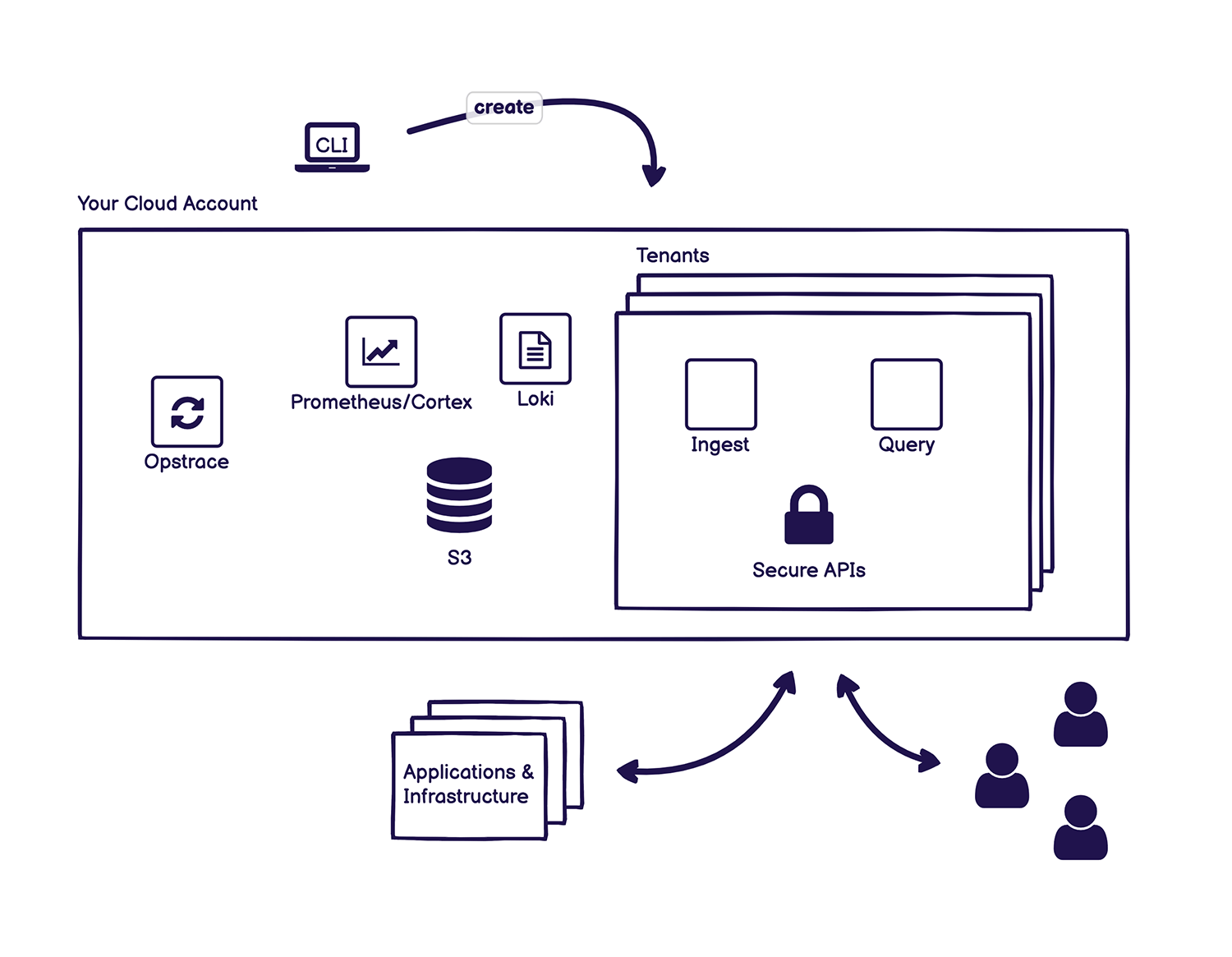
    Opstrace’s open source project exposes a horizontally scalable application programming interface (API) created by Cortex for Prometheus, an open source monitoring platform being advanced under the auspices of the Cloud Native Computing Foundation (CNCF). It then makes use of a Loki API to collect log data.

    DevOps teams can also point an existing instance of Prometheus to Opstrace or any instance of Fluentd or Promtail software they are using to collect log data, with support for a wide variety of other APIs, such as the Datadog agent, planned. A command line interface (CLI) is provided to set an instance of Opstrace that creates a controller through which the collecting of log data is managed.

    Kenny Johnston, senior director for product management for GitLab, said as part of an ongoing effort to make observability more accessible, GitLab plans to integrate Opstrace by default with GitLab Monitor for organizations that use either the self-managed version of GitLab or the software-as-a-service (SaaS) platform.

    Opstrace currently collects logs and metrics and support for distributed traces is planned. The goal is to extend the overall scope of observability capabilities that GitLab already provides within its CI/CD platform, noted Johnston. The goal is to make it simpler for DevOps teams to employ observability capabilities and interrogate data to optimize workflows without acquiring a separate observability platform, he added.

    GitLab is betting that, as Prometheus continues to gain traction, more DevOps teams will prefer to extend its reach into the realm of observability rather than having to manage a separate platform.

    Although observability has always been a core tenet of DevOps best practices, achieving it has proven to be a challenge. At best, most organizations can continuously monitor IT environments based on predefined metrics that identify when a specific platform or application is performing within expectations. Observability combines metrics, logs and traces—a specialized form of logging—to instrument applications in a way that makes it simpler to troubleshot issues without having to rely solely on a limited set of pre-defined metrics that have been created to monitor a specific process or function.

    The rate at which DevOps teams will embrace observability will naturally vary. In 2022, the biggest obstacle might not be the technology as much as it is simply understanding what queries can help DevOps teams better understand the root cause of an IT issue before there is a major disruption. In the long term, it’s expected that machine learning algorithms will leverage the data collected by observability platforms to automatically identify issues that might lead to a disruption long before it actually occurs.

    One way or another, the ability to discern events even within the most complex IT environment is steadily improving. Whether that’s accomplished as an extension of monitoring or by embracing true observability may not be all that relevant—as long as the ultimate goal is achieved.

  • Intel Expands Scope of OneAPI Toolkit Initiative

    Intel Expands Scope of OneAPI Toolkit Initiative

    Intel has made available a 2022 edition of its oneAPI toolkit through which it makes processor extensions accessible to DevOps teams.

    James Reinders, chief evangelist for Intel software products, said the goal is to make it simpler for DevOps teams to expose extensions to any company’s processors in the runtimes developers use.

    At its core, the oneAPI toolkit is a collection of APIs that Intel created for x86, graphics processing units (GPUs), application-specific integrated chips (ASICs), field programmable gate arrays (FPGAs) and other classes of processors.

    Reinders noted that developers have never had as much ready access to so many different processor classes before. The challenge organizations face, however, is making it simpler for developers to take advantage of those capabilities in a way that doesn’t require them to write low-level code, he added.

    The oneAPI 2022 toolkit adds additional capabilities including the world’s first unified compiler implementing C++, SYCL and Fortran, data-parallel Python for CPUs and GPUs, advanced accelerator performance modeling and tuning and performance acceleration for artificial intelligence (AI) and ray tracing visualization workloads. Collectively, Intel said it has made 900 new and enhanced features available via the oneAPI toolkit in the last year, including deeper Microsoft Visual Studio Code integration, support for Microsoft Visual Studio 2022 and Microsoft WSL2 for Linux development on Windows.

    As IT continues to evolve it will become more routine for developers to invoke heterogeneous classes of processors within the same application, said Reinders. Those capabilities will drive an explosion of software development innovation through the rest of the decade and beyond, he added.

    Intel is especially focused on making it easier for developers to invoke inference engines that take advantage of processor extensions to run AI workloads, Reinders said. Going forward, most applications will take advantage of machine learning algorithms that run inference engines optimized by Intel via extensions to its processors. As those workloads are constructed, integrating AI models within DevOps workflows will become the next major challenge, noted Reinders.

    It’s too early to say how simplified access to heterogeneous processors, also known as XPUs, might change the application development landscape. The one thing that is clear is IT organizations now have more options than ever. The issue now is finding a way to invoke all those capabilities in a way that doesn’t overwhelm developers. DevOps teams will play a key role in deciding which processors and associated extensions to make available to their development teams.

    In the meantime, the battle for processor dominance will only intensify in the months ahead. DevOps teams will need to decide how comfortable they are using processors manufactured by a single company like Intel or whether they want to employ a mix of processors provided by multiple vendors. Regardless of what they decide, it appears APIs will play a critical role in making it easier to benefit from advances in processor technologies.

  • Theranos’s Holmes VC Reverb | 5G C-Band Marches On | Mozilla Jumps Shark

    Theranos’s Holmes VC Reverb | 5G C-Band Marches On | Mozilla Jumps Shark

    Welcome to The Long View—where we peruse the news of the week and strip it to the essentials. Let’s work out what really matters.

    This week: The conviction of Theranos CEO Elizabeth Holmes leads to greater scrutiny of startups, higher-frequency 5G NR is creeping towards reality, and Mozilla gets criticized for promoting climate-harming scams.

    1. Holmes Case Causes Valley Rethink?

    First up this week: Elizabeth Holmes has been found guilty of defrauding Theranos investors. But how will the affair change Silicon Valley’s startup-and-funding culture?

    Analysis: Don’t fake it—just make it.

    This could be a seminal moment, causing investors to look more closely at startup founders and their outlandish promises. On the other hand, key Theranos investors—e.g., Murdoch, Cox, DeVoss—hardly fit the mold of Silicon Valley VCs.

    David Streitfeld: The Epic Rise and Fall

    F. Scott Fitzgerald’s creation … Jay Gatsby … was a bootlegger [and] sold fake bonds. Ms. Holmes chose Silicon Valley, the last and greatest of all human dreams. [She] was a natural salesperson, as good at bending reality as Steve Jobs himself.
    …
    She and her deputy and boyfriend, Ramesh Balwani … thought they could brazen it out in the Silicon Valley tradition until they had something that actually worked. [But] the verdict signaled the end of an era. In Silicon Valley, where the line between talk and achievement is often vague, there is finally a limit. … It is an epic rise and fall that will be chewed over in the coffee shops and juice bars of Palo Alto, Calif., until the tech industry departs [for] off-world colonies.
    …
    So where does this conviction leave … her investors and former fans? Ripe for the next huckster that comes along, probably. Some Silicon Valley promises are so sweet we just can’t get enough of them. Immortality. Crypto. Flying cars. Mars. Digital harmony. Wealth beyond compare.


    Think different, thinks DeanonymizedCoward:

    [There’s a] fine line between bombastic marketing spam, “fake it ’til you make it” pitches, and outright fraud. … The first is repugnant and sometimes unethical, but generally legal.
    …
    [But] If your product requires bull**** to get funded—even if it ultimately works—you’re a fraud. … Regulatory reforms … and a sort of corporate death penalty … can fix a lot of this by making it less financially practical to engage in ****ty behavior.


    Who else is to blame? Ask DS999:

    I am sure some of her investors didn’t really care whether it worked. They just wanted to get in early, ride the hype train up, and sell before actual results mattered.


    2. FAA and 5G Carriers Kiss and Make Up

    Higher-frequency 5G NR is creeping towards reality in the U.S., thanks to the FAA backing down. After the aviation regulator had vetoed C-band deployment—based on precious little evidence—it looks like as much as 280 MHz of extra spectrum is now ready to switch on.

    Analysis: Nomadic DevOps gets more bandwidth

    While band 77 is nowhere near the much-vaunted “FR2” extremely high frequency bands, this is a useful chunk of extra spectrum for mobile and nomadic apps. Next stop: ubiquitous Ka-band.

    Jon Brodkin: FAA agrees not to seek any more 5G delays

    The Federal Aviation Administration tentatively agreed not to seek any more 5G delays from AT&T and Verizon, potentially ending a battle over the aviation industry’s unproven claim that 5G … will interfere with airplane altimeters. [Their] C-Band spectrum licenses are for the frequencies from 3.7 GHz to 3.98 GHz.
    …
    The deal incorporates voluntary commitments that AT&T and Verizon previously made, including “C-Band radio exclusion zones” around airports for six months. [They] modeled the exclusion zones after those used in France, which are 910×2100 meters.
    …
    Assuming there are no further problems, AT&T and Verizon would be able to use their spectrum licenses without extra restrictions after July 5. … President Biden applauded the agreement … calling it “a significant step in the right direction.”


    In summary? Here’s Dieter Bohn:

    The agency in charge of airplanes is mad about wireless things. But the agency in charge of wireless things and the companies that make them lost a game of chicken.
    …
    GREAT JOB AMERICA. … I always said I wanted Internet Service Providers to be Dumb Pipes, but I never expected them to be this dumb.


    Has anyone read the FAA’s detailed report? bburdge has:

    I can see why the FAA is backing down here now, it only makes sense when your key report could be paraphrased as: “We got a couple grad students to run some basic model comparisons … using altimeter data from the aviation industry (with a proven track record of lying to us) and then went golfing for eight months before publishing … but didn’t bother … to actually test anything.”


    3. Mozilla Forgets its Values

    Firefox custodian, the Mozilla Foundation, has angered many by promoting a “grossly irresponsible” “Ponzi scheme” that harms the environment. What is this awful thing? I hear you ask. It’s cryptocurrency.

    Analysis: Imaginary money is bad—is this the last straw for Mozilla?

    Less than a year ago, Mozilla said it wants to be carbon-neutral, but it’s already reneged on that promise: Distributed proof-of-work systems require … well, work. And that work uses ridiculous amounts of energy per DeFi transaction. Electricity production is a zero-sum game, so cryptocurrencies and NFTs cause climate change by emitting ridiculous amounts of CO₂e.

    Liam Proven: Mozilla founder blasts browser maker

    A few days ago, Mozilla Foundation invited netizens on Twitter to send in cryptocurrency donations. … This move by the Firefox browser maker rapidly drew criticism.
    …
    As recently as September, Moz’s web-standards lead Tantek Çelik slammed cryptocurrencies as being unsustainable, stating: “[They] are harmful for sustainability. … Their energy requirements grow without any discernible upper bound, which is grossly irresponsible given the global environmental crisis.”
    …
    Mozilla has accepted crypto-coin donations for years, perhaps as part of its long-ongoing efforts to alienate its own users: It’s only the payment provider that changed.


    Chief among critics was Jamie “jwz” Zawinski:

    I founded Mozilla and I’m here to say **** you and **** this. Everyone involved in the project should be witheringly ashamed of this decision to partner with planet-incinerating Ponzi grifters.
    …
    Stop saying you were promised flying cars. Unless you were born in 1935, you weren’t promised flying cars, you were promised a cyberpunk corporate dystopia.


    It’s a shark-jump moment thinks Jeremy Keith:

    The most convincing argument I’ve heard yet for switching away from Firefox as my main browser comes from Mozilla. I wasn’t expecting that plot twist.


    The Moral of the Story: What is safety to one is not always safety to another.


    You have been reading The Long View by Richi Jennings. You can contact him at @RiCHi or tlv@richi.uk.

    Image: Benjamin Hayward (via Unsplash)

  • New Relic: Observability Tops 2022 DevOps Agenda

    New Relic: Observability Tops 2022 DevOps Agenda

    If 2021 was the year when IT organizations became aware of the need for observability, then the coming year should see observability aspirations realized.

    A report published by observability platform provider New Relic postulates that there are no less than 11 factors converging in a way that will make observability an absolute requirement for organizations.

    At the top of that list is a simple fact: Observability is now required to drive digital business transformation initiatives that typically span multiple processes. In fact, a global survey of 1,300 IT leaders, software engineers and developers conducted by New Relic found 90% of respondents view observability as critical to the business.

    Second, as a result, observability is now starting to be applied in both pre- and post-production environments as organizations take a more holistic approach to managing the software development life cycle, the report noted.

    Third, the report suggested that IT teams are looking to make better-informed decisions based more on facts than intuition. To do this, teams are using data collected from across the enterprise application environment. In fact, the fourth factor advancing observability in the enterprise is that the cost of instrumenting application environments is dropping, which the report notes is making it easier to collect relevant data.

    The fifth and sixth factors reflect a desire to rationalize the number of monitoring tools that IT teams currently use and the fact that usage-based pricing has simultaneously made it less expensive to leverage observability platforms as needed.

    The seventh factor is the overall shift toward open source software that enables observability platform providers to collectively leverage innovations faster. The eighth factor, closely linked to the open source trend, is the rise of more complex open source platforms such as Kubernetes that require much higher visibility to successfully deploy and manage.

    The ninth trend identified in the report is increased adoption of DevOps best practices that encourage IT teams to view observability as a core tenet of any IT management strategy. The tenth factor cited by the report is the need to drive increased collaboration among IT professionals.

    Finally, the eleventh factor driving further adoption of observability is the need for increased application reliability as more organizations appreciate their dependence on software to deliver essential services.

    Buddy Brewer, a group vice president and general manager for New Relic, said now that observability platforms are becoming more accessible, the next big challenge will be teaching IT professionals what questions to ask as they troubleshoot both legacy monolithic applications and a wide range of emerging microservices-based applications. The results of those queries then need to be easily shared with both developers and internal IT operations teams that must work together to maximize application performance and availability, he added. The latter requirement is why New Relic decided to acquire CodeStream to make telemetry data available with integrated development environments (IDEs), noted Brewer.

    There is, of course, no shortage of observability platforms for IT teams to adopt. In fact, the biggest challenge now is getting every application stakeholder to agree to standardize on an observability platform—no small feat, as many DevOps teams may already have a preference for one approach over another.

  • Rails 7 FTW | WFH is SOP | 586M Passwords Dumped

    Rails 7 FTW | WFH is SOP | 586M Passwords Dumped

    Welcome to The Long View—where we peruse the news of the week and strip it to the essentials. Let’s work out what really matters.

    This week: Ruby on Rails 7.0 is go, working from home is still de rigueur, and HIBP gets far, far bigger.

    DHH is Excited

    First up this week: Ruby on Rails version 7.0 is now in production. It promises less bloat, better security and even more developer efficiency.

    Analysis: Last chance for greatness

    Talk to devs about Ruby on Rails and you’ll hear a wide range of opinion—all the way from “obsolete memory hog” to “productivity secret weapon.” But its important promise seems to be to encourage devs to use better design patterns.

    Paul Krill: Ruby on Rails 7 rejiggers JavaScript support

    Ruby on Rails 7, the latest version of the web application framework, is now available as a production release. … It gives developers a “no-Node” approach to front-end development while still providing access to NPM packages and modern JavaScript.
    …
    Most Rails applications will not require Node.js, given the new defaults. … Other improvements:
    …
    Encrypted attributes have been added to Active Record, enabling applications to offer at-work encryption in addition to traditional at-rest and in-transit. … With asynchronous query loading, two unrelated queries can be run concurrently. … The Spring application preloader is no longer on by default, as faster computers have made it unnecessary.


    Let’s hear from Rails creator David Heinemeier Hansson—AKA DHH:

    Seven is … the culmination of years of progress on five different fronts at once. … The part that really excites me … is how much closer it brings us to the ideal of The One Person Framework. A toolkit so powerful that it allows a single individual to create modern applications upon which [to] build a competitive business.
    …
    It’s been well over twenty years for me now, and a big release like this still makes me giddy. … What a glorious time to be working in web development.


    What a whatnow? Here’s bb_matt:

    I don’t pretend … it’s a “glorious time to be working in web development,” except for one important aspect: … Experienced programmers coming over from software development and starting to make amends [with] strong typing, robust CI/CD, a focus on TDD, a focus on domain modeling.
    …
    99% is still total **** though—but then again, so is most software.


    Home Working Ain’t Gone Away

    A month ago, my long-suffering editor permitted me to write, “WTH? We Wanna WFH.” And survey after survey says tech workers work better at home. After the last 21 months, there’s simply no denying it.

    Analysis: Genie out of bottle—no going back

    If you’re under the misapprehension that DevOps is somehow “special” and your workers will be glad to return—think again. Find a way to make it work, or work will stop—and your business will die.

    Steven J. Vaughan-Nichols: How to lure employees back to the office? You can’t. Not now. Not ever.

    Months have gone by, and the great resignation keeps rolling along. … People don’t want to catch COVID-19 [but] bosses still think they can force skilled workers to return to offices. … That’s not going to happen.
    …
    The problem? Many executives and owners haven’t gotten the clue yet. [But] any doubts you may have about people not doing a good job unless you’re looking over their shoulders should have vanished by now. … The monthly academic WFH research.com survey has found almost six out of 10 workers reported being more productive working from home. … In the Dice State of Remote Work report … 53% of technologists listed greater productivity as one of the main benefits.
    …
    It’s simple: It works better for them and for your company. … Anyone who’s been paying attention … must agree. You can either go along with the flow, or you can fight it and first lose your staffers and then your company


    So what do DevOps managers think? One of them is kozikow:

    100% remote is not great either. … When there was a long period of 100% remote during Covid, there were some issues. … We developed a policy that Mondays are required, Wednesday are encouraged, rest is work from home. … It was shared decision of the team.
    …
    I think that most people who are strongly against hybrid work just have to live in a miserable place like SF. … It’s unfortunate that so many software companies are in the Bay Area.


    But you couldn’t pay some people enough to go back—people such as this Anonymous Coward:

    No way in hell they’d ever be willing to pay me … to come back into an office. … No having to go out in ****ed up weather, no fighting traffic and … dangerous drivers, plus I get all that commuting time back.
    …
    And I don’t have to put up with Linda cooking fish in the microwave.


    Have I Been Pwned? There’s a 38% Higher Chance

    This week saw a huge bump in the size of Troy Hunt’s already-massive database of stolen credentials. In case you’ve not seen it, HaveIBeenPwned.com is an amazing free service that lets apps securely check a user’s password isn’t already used elsewhere on a compromised site.

    Analysis: Build the API into your auth flow ASAP

    The UK’s equivalent to the FBI has donated a huge trove of credentials—after deduping, it’s added more than 225 million new passwords to the database. Frankly, if you still allow your users to rely on any of the 847 million passwords in HIBP, it would be negligent.

    Simon Sharwood: National Crime Agency finds 225 million previously unexposed passwords

    Troy Hunt, of Have I Been Pwned (HIBP) fame, yesterday announced … the NCA shared 585,570,857 [creds] with HIBP, and Hunt said 225,665,425 … he hasn’t seen before in the 613 million credentials HIBP already stored. [HIBP] lets anyone conduct a secure search of stolen passwords to check if their credentials have been exposed.
    …
    The NCA’s statement to Hunt did not reveal the source of the password trove [but said they] “were able to identify a huge amount of … passwords in a compromised cloud storage facility. … It became clear that these credentials were an accumulation of breached datasets known and unknown.”
    …
    [The] release brings the total Pwned Passwords count to 847,223,402, a 38 percent increase.


    How’s this relevant to DevOps? Troy Hunt explains:

    In the last month, there were 1,260,000,000 occasions where a service somewhere checked a password against … HIBP’s Pwned Password API. … There are all sorts of amazing Pwned Passwords use cases out there. For example … checking their customers’ passwords on every registration, login or password change to see if it’s previously been breached.
    …
    The UK’s National Crime Agency has done some wonderful work over the years to combat cybercrime. … Today’s release is about turning on the firehose of new passwords and making them immediately available to everyone for free. Having this open to the community, owned by the community and supported by the FBI and NCA is an enormously pleasing result.


    Time for a metaphorical thought experiment. LenKagetsu obliges:

    You were told by a reliable source that an unknown person … posted a high-res image of … your house key … on the internet. Would you change the locks?


    The Moral of the Story: Never switch horses in midstream


    You have been reading The Long View by Richi Jennings. You can contact him at @RiCHi or tlv@richi.uk.

    Image: David Emrich (via Unsplash)

  • Quali Adds Free Tier to DevOps Automation Platform

    Quali Adds Free Tier to DevOps Automation Platform

    Quali has added a free tier of service to its Torque platform for automating infrastructure provisioning and application workload deployments.

    In addition, the company has updated the software-as-a-service (SaaS) platform to provide blueprints through which it provides tighter integration with Terraform, an open source infrastructure-as-code (IaC) tool, along with support for custom tags to make it easier to generate reports and dashboards that provide greater visibility into infrastructure costs.

    Quali CEO Lior Koriat said the free tier is intended to make the Torque platform more accessible to both small teams of DevOps professionals and individual users. It includes the ability to build environments on Amazon Web Services (AWS) or the Microsoft Azure cloud in addition to providing integration with a variety of DevOps tools and platforms and access to a sample blueprint library. Support for the free tier is provided via an existing community edition of the platform.

    Koriat said Torque takes IaC a step further by also making it possible to automatically deploy complete application environments on top of infrastructure provisioned as code using blueprints rather than low-level Terraform scripts. The goal is to increase developer productivity by extending Terraform so that developers can spin up environments across multiple cloud computing platforms via self-service, he added.

    That approach also sharply reduces the chances a cloud platform will be misconfigured, which Koriat noted is the bane of cloud security professionals’ existence. Most developers lack the cybersecurity expertise required to ensure cloud computing environments are configured properly. Simplifying the provisioning of infrastructure is especially critical when developers employ complex platforms such as Kubernetes, added Koriat.

    At the same time, Quali’s Koriat said IT leaders want more visibility into how cloud resources are being consumed as the number of workloads deployed in these environments steadily increases. Developers tend not to remember to de-provision cloud resources when no longer needed, which Koriat noted conspires to increase cloud costs unnecessarily.

    It’s not clear just yet how quickly DevOps teams might be moving away from relying on lower-level tools toward automation frameworks accessed via a SaaS platform. However, as application environments become more complex, it becomes even more challenging to provision and manage IT environments—especially since many DevOps teams are still working from home to help limit the spread of the COVID-19 pandemic.

    One way or another, the amount of time and effort spent managing IT infrastructure needs to be reduced. After all, while application environments are increasing in both size and complexity the number of individuals that make up a DevOps team remains largely the same. The need to rely more on automation frameworks has reached a tipping point that is becoming increasingly obvious to all concerned.

    As more organizations start to operate as software companies in the age of digital business transformation, it’s clear the way IT has been managed in the past is about to fundamentally change. The issue now is determining which automation framework lends itself best to enabling DevOps teams to achieve that goal.

  • Red Hat Adds Service to Customize RHEL Images

    Red Hat Adds Service to Customize RHEL Images

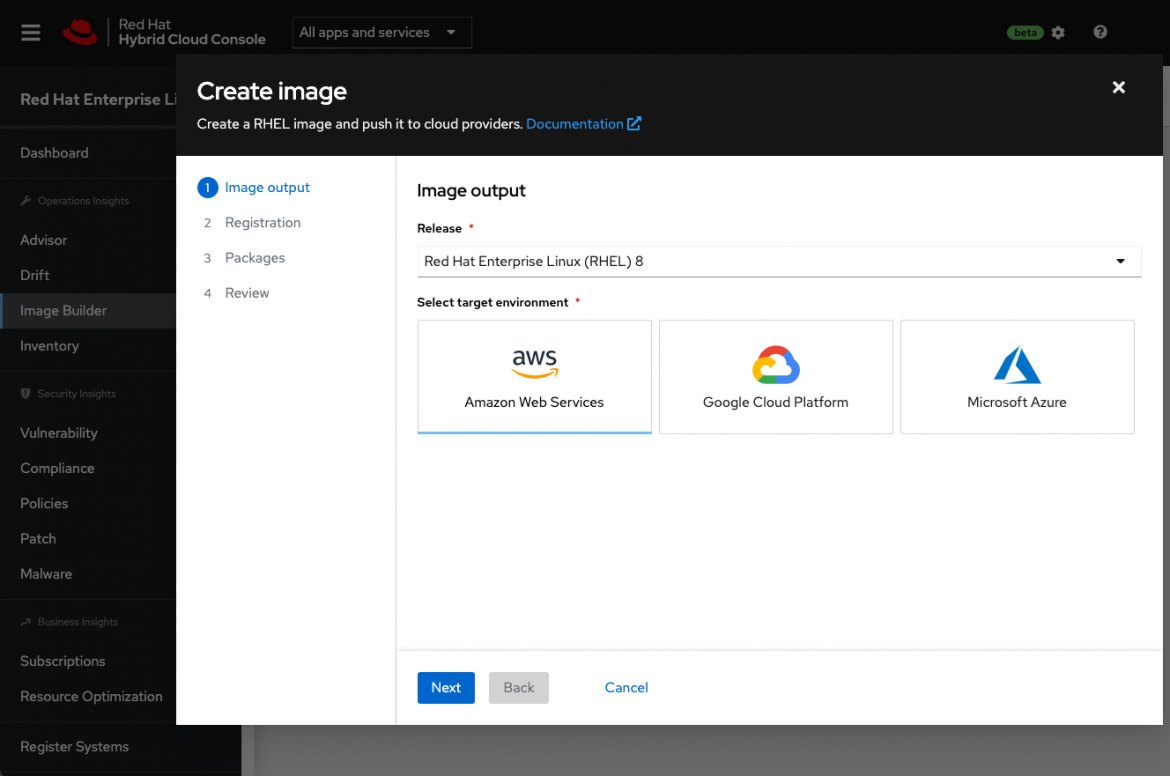
    Red Hat this week announced a public beta of an Image Builder service that streamlines the process of building customized instances of the Red Hat Enterprise Linux (RHEL) operating system.

    Scott Herold, director of product management for RHEL at Red Hat, said the Image Builder service enables an IT team to define a “gold” template for each target deployment environment that only contains the RHEL code required. Initially, Image Builder is configured to default to build a minimal, recommended RHEL server image for Amazon EC2, Microsoft Azure and Google Cloud Platform (GCP) cloud services.

    Future updates to the service will add support for VMware vSphere platforms as well as downloadable images and installation media for physical servers, customized filesystem layouts and versions 9.0, 8.5, 8.4 and 7.9 of RHEL. The service itself is accessed via the Red Hat Hybrid Cloud Console that is currently being made available in beta.

    Herold said building or installing operating systems is often a slow, tedious and error-prone process that needs to be manually performed in a slightly different way for each platform. Each physical server or edge computing platform requires different configurations and workflows. As a result, the chances mistakes will be made is high; Image Builder can greatly reduce the possibility of mistakes because there is no guesswork required, noted Herold.

    IT teams can also opt to include additional content from Red Hat in those builds to further streamline deployment processes, noted Herold. Those images can then be automatically registered with Red Hat to ensure future updates are received.

    The ability to customize those images also serves to reduce the overall size of the codebase that needs to be secured, added Herold. At a time when there is increased focus on software supply chains in the wake of a series of high-profile security breaches, many IT teams are revisiting their software deployment processes, he noted.

    Ultimately, Herold said Red Hat is moving toward providing IT teams with a more cloud-like experience regardless of where they deploy Red Hat’s curated open source software. The goal is to reduce as much friction as possible so that IT teams can more easily manage infrastructure at scale, he added.

    One way or another, the entiree software deployment process is becoming more automated. Much of the drudgery that has historically made it challenging to deploy and manage IT platforms at scale can be traced back to manual processes created when organizations ran a much smaller number of applications in on-premises IT environments. As IT teams increasingly deploy more applications in the cloud and at the network edge, it’s become more apparent that manual legacy processes won’t scale—especially when it’s already challenging to hire and retain IT personnel.

    It’s not clear how quickly IT teams will modernize software deployment processes using automated DevOps processes. Simple inertia is often a powerful force to overcome; however, most IT professionals can easily find something more compelling to do with their time that doesn’t involve using manually customizing operating system images.