Category: News

  • AWS re:Invent — Top 4 Things We Learned This Week

    AWS re:Invent — Top 4 Things We Learned This Week

    Welcome to The Long View—where we peruse the news of the week and strip it to the essentials. Let’s work out what really matters.

    This week, four things that caught my eye from Amazon Web Services’ re:Invent 2022 conference: SnapStart turbocharges Lambda, Graviton3E ARM HPC SoC, AWS continues hiring, and AWS’s origin story. (more…)

  • Nobl9 Adds Free Tier to SaaS Platform for Managing SLOs

    Nobl9 Adds Free Tier to SaaS Platform for Managing SLOs

    Nobl9 this week announced it is making available a perpetual free tier of its software-as-a-service (SaaS) platform for managing service level objectives (SLOs).

    The free tier was announced at the AWS re:Invent 2022 conference and the company also revamped its pricing. Nobl9 Teams Edition (formerly Nobl9 Hydrogen) now includes 50 SLOs, up from 25, for $850/month. Nobl9 Enterprise Edition also has doubled the included SLOs from 75 to 150.

    Finally, Nobl9 also launched SLOcademy to help educate IT teams on how best to create and manage SLOs.

    The Nobl9 platform simplifies the creation and tracking of SLOs using metrics and observability data collected from more than 24 widely used DevOps tools including Prometheus as well as services provided by Datadog, New Relic, Dynatrace, Google, Amazon Web Services (AWS) and Splunk.

    Kit Merker, chief growth officer for Nobl9, said the company’s platform collects signals from logs, metrics and traces to define what normal should look like for any given service. The free tier of the platform has some limitations, but it does provide access to the full-featured platform to enable IT teams to get started managing SLOs.

    SLOs, of course, are not a new idea. They have been used as a metric to track the performance of IT services for decades. It’s not clear whether reliance on SLOs has waned over the years or if application environments simply became too complex to track meaningful metrics. However, as applications are increasingly viewed as services, it’s now only a matter of time before SLOs become more widely adopted across a modern application environment. The challenge, of course, is that defining an SLO is a lot easier than maintaining it—especially within today’s highly dynamic cloud-native application environments where services with lots of dependencies tend to come, change and go unexpectedly.

    Nobl9 is making a case for an SLO-as-code approach that makes it simpler to track service levels. A recent survey of more than 300 IT managers and executives conducted by Dimensional Research on behalf of Nobl9 found only 29% of respondents had no plans to implement SLOs. A full 94% of respondents that have or plan to implement SLOs intend to map them directly to business operations, with 91% reporting that they expect that effort to improve decision-making. More than 80% also said their organizations are planning to increase the use of SLOs, with 87% indicating SLOs should improve overall microservices performance.

    The challenge is that most organizations have limited visibility into their IT environments. The survey, for example, found less than half of respondents (46%) had visibility into all their IT environments. Only 45% and 35% claim to have visibility into containers and microservices, respectively. More than three-quarters (78%) said hybrid clouds make observability more difficult. Ironically, 45% of companies reported they already employed 11 or more observability and monitoring tools. On the plus side, 31% have hired site reliability engineers (SREs) while nearly half (46%) planned to create that role.

    It may be a while before most IT teams are organized around the concept of applications as services but as the management of IT continues to evolve it’s now just a matter of time before that approach becomes more the rule than the exception.

  • GitLab Unfurls Dedicated SaaS Edition in the Cloud

    GitLab Unfurls Dedicated SaaS Edition in the Cloud

    GitLab today made available to a limited number of customers a single-tenant version of the software-as-a-service (SaaS) edition of its continuous integration/continuous delivery (CI/CD) platform.

    David DeSanto, vice president of product at GitLab, said the GitLab Dedicated option provides all the benefits of a cloud platform without running afoul of any potential compliance issues.

    Designed to be deployed on a cloud platform selected by the customer, DeSanto said the single-tenant edition of the platform makes sure that all the data stored in the cloud is isolated. In addition, the access to GitLab Dedicated is provided via a private network connection, he added.

    Initially, GitLab Dedicated is being made available on the Amazon Web Services (AWS) cloud with support for other cloud platforms planned for 2023 once it becomes generally available.

    GitLab is, in effect, trying to strike a balance between a lower-cost multitenant edition of the platform or, alternatively, requiring organizations to deploy an on-premises edition of the platform themselves, DeSanto said.

    In general, GitLab expects this latest version of the platform to appeal most to organizations that operate in highly regulated industries. However, the number of organizations looking to isolate their data in a private cloud to better protect their software supply chains is expanding, he noted.

    In the wake of a series of high-profile breaches and vulnerability disclosures, the number of organizations that are reviewing their software supply chains has increased. Less clear is the degree to which organizations will look to lock down their existing CI/CD platform versus replacing it with a more secure modern alternative that can be more easily accessed via the cloud.

    The challenge, of course, is replacing a CI/CD environment is not trivial, so organizations will need to consider the time and effort made over the years to customize their CI/CD environment. In some instances, that customization provides a meaningful competitive advantage. In other cases, however, the weight of maintaining all those customizations has become more troublesome than it’s worth.

    Each individual organization will need to decide to what degree they will want to manage the DevOps platforms used to construct applications. More organizations are deciding they prefer to devote as much of their resources as possible to writing code instead of managing the underlying CI/CD platform used to create their applications, said DeSanto.

    Regardless of approach, the number of organizations adopting DevOps best practices to build and deploy applications faster continues to increase. A CI/CD platform accessed via the cloud lowers the barrier to entry for smaller organizations that typically don’t have the skills and resources required to manage DevOps platforms.

    In the meantime, SaaS-based approaches should significantly increase the number of applications being constructed using DevOps workflows. The level of DevOps adoption will naturally vary by organization. However, the total number of custom applications being used to drive, for example, digital business transformation initiatives should considerably expand in the months and years ahead as more applications are built and deployed at incredible speed.

  • Datadog Dives Into Universal Service Monitoring

    Datadog Dives Into Universal Service Monitoring

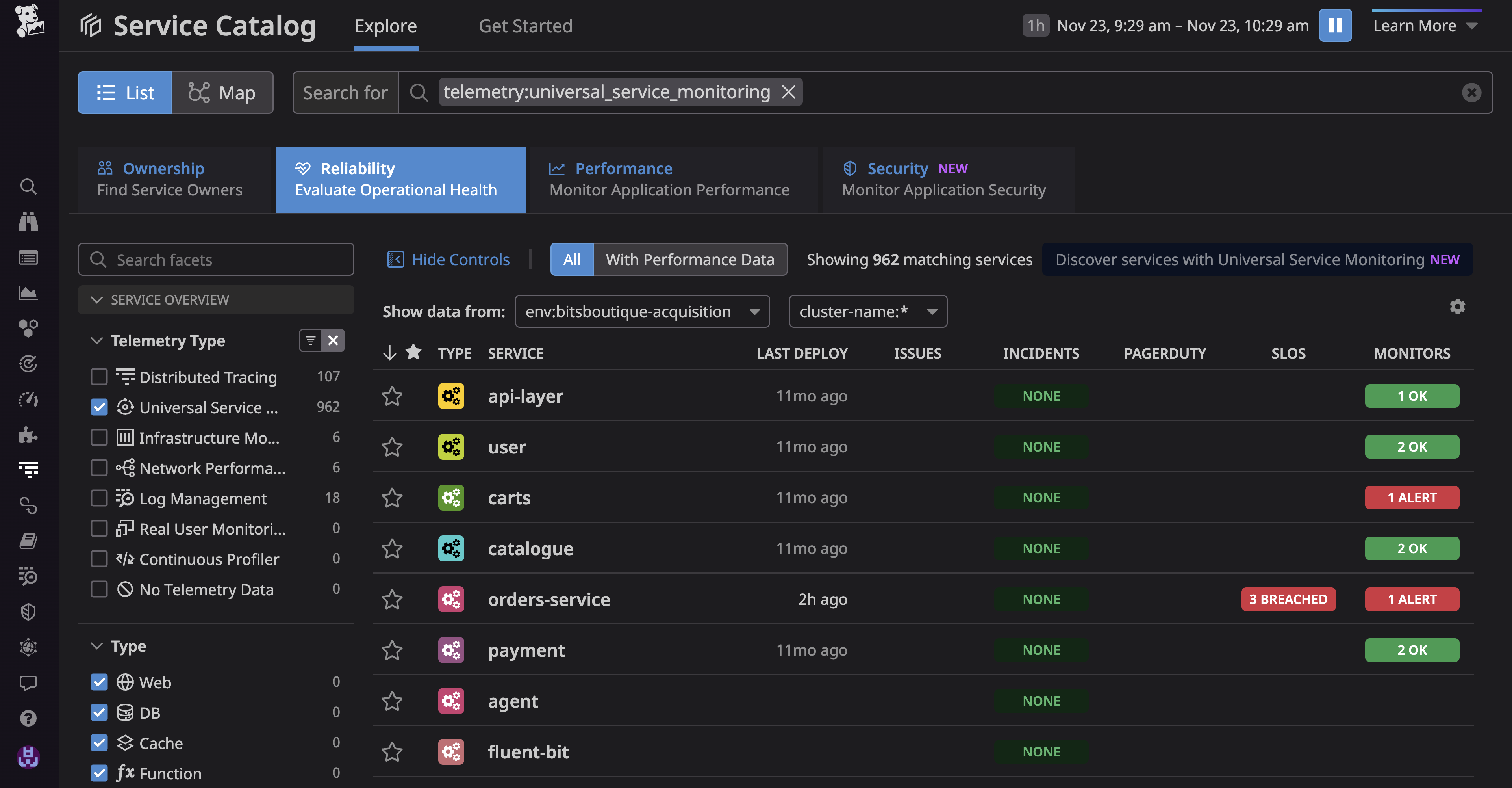
    Datadog, Inc. today made generally available a Universal Service Monitoring service that takes advantage of the extended Berkeley Packet Filtering (eBPF) microkernel in a Linux operating system to automatically detect all the services that make up an application environment without changes to the code used to construct them.

    Yrieix Garnier, vice president of product at Datadog, said as application environments continue to evolve IT teams are now trying to track not just individual microservices but also entire business processes such as order-to-cash. Before those services can be instrumented, however, DevOps teams need a simple way to discover them, he noted.

    Within the Linux operating system, eBPF makes it possible to employ a sandbox environment to identify and map the services that make up an application environment, including both internally developed and third-party services regardless of what programming languages were used to build them, added Garnier.

    DevOps teams also gain visibility into the health of every service and deployment through real-time request rate, error and duration (RED) metrics and correlated infrastructure metrics and application logs. They can then expand monitoring capabilities provided via Datadog agent software to employ distributed traces that can be correlated with observability data.

    The Datadog Universal Service Monitoring service is also integrated with the Service Catalog that Datadog makes available to determine which development team created a specific service.

    The goal is to close a visibility gap that has emerged as more IT organizations align their management efforts around specific application services in the age of digital transformation rather than the components that make up a service, noted Garnier.

    DevOps teams today are simultaneously being tasked with diving deeper into application environments to discover issues before services are disrupted and also tracking the services that span multiple application components. Collectively, the expectation is that DevOps teams will be able to ensure that application services are not just available but also consistently delivered. Ultimately, IT organizations are being tasked with removing much of the guesswork that has historically characterized the management of IT.

    Less clear is how much those shifts will ultimately drive the reorganization of IT teams that are still mostly organized around the platforms they support versus the services being delivered. However, as business leaders increasingly appreciate how dependent the overall organization is on application services, the need to manage them in a more comprehensive manner becomes apparent.

    In the meantime, DevOps teams are evaluating whether their existing tools and platforms enable them to accomplish that goal. Datadog is making a case for employing a service it manages on behalf of DevOps teams versus each DevOps team having to construct and maintain its own observability platform. Datadog, most recently, extended the reach of its namesake cloud-delivered monitoring and observability platform to address continuous testing, application security and cost management.

    It will be up to each organization to decide how best to achieve their observability goals. One thing that is certain is the current level of visibility they have into application environments is not nearly sufficient.

  • Zilliz Unfurls Managed Vector Database Service

    Zilliz Unfurls Managed Vector Database Service

    Zilliz this week made generally available a managed cloud service that can now be spun up in less than five minutes. The service is based on the company’s open source Milvus vector database.

    Frank Liu, director of operations for Zilliz, said the managed Zilliz Cloud service running on the Amazon Web Services (AWS) cloud will make vector databases much more accessible to a wider range of application developers.

    Vector databases are gaining traction because they provide artificial intelligence (AI) application developers with a more efficient method for managing the unstructured data need to train AI models. Currently, many of those teams are relying on labels and tags to classify and manage data. The Milvus vector database employs deep learning algorithms and its own AI model to create and store, index and manage vectors to more efficiently classify data, said Liu.

    Based on a cloud-native architecture that, for example, employs Kubernetes to scale consumption of cloud resources more efficiently, Zilliz Cloud can also scale to process tens of billions of high-dimensional vector data for data-intensive applications, he added. The company claims Zilliz Cloud delivers up to 10 times greater throughput and five times lower latency for read and write operations for data-intensive workloads.

    Other attributes of the managed Zilliz Cloud include support for multi-language software development kits (SDKs), a web-based graphical user interface to search and explore data, SOC 2 compliance, network isolation using IP whitelists and full data encryption in transit (TLS).

    In the future, Zilliz also plans to add support for Microsoft Azure Cloud and Google Cloud Platform in addition to graphical processor units (GPUs) to optimize the performance of its deep learning algorithms.

    Potential use cases for a vector database span everything from image retrieval and video analysis to fraud detection to drug discovery. Organizations that already use Milvus, which is being advanced under the auspices of the LF AI & Data Foundation, include eBay, Shopee and SmartNews.

    In general, the rise of data-intensive workloads is driving more organizations to embrace DataOps best practices to optimize the management of massive amounts of data. Organizations that build AI models are typically at the forefront of those efforts given the massive amounts of data typically required to train AI models. The challenge organizations have historically faced is not many have the internal expertise required to manage a vector database. The Zilliz Cloud eliminates the requirement by relying on the expertise of a team of database administrators trained by Zilliz to operate a managed service.

    It’s not clear at what rate organizations are embracing vector databases to build AI models. As the next era of applications are constructed, it’s only a matter of time before the machine learning operations (MLOps) practices used to build AI models converge with DevOps practices used to build the applications in which those models will be embedded. The challenge is the data science teams that build AI models tend to also have a distinct DataOps culture all their own; DevOps teams will need to find a way to embrace and extend that.

    In the meantime, the number of types of databases being used to build applications will only continue to expand so it will be up to each DevOps team to know when to manage each one themselves versus relying on a managed service.

  • VMware Brings Java 17 Support to Spring Boot Framework

    VMware Brings Java 17 Support to Spring Boot Framework

    VMware this week made a Spring Boot 3.0 update for building microservices-based Java applications that is based on the latest long-term support release for the Java Standard Edition (SE) platform.

    Michael Minella, senior director of software engineering at VMware, said the latest edition of the framework supports Java 17. The hope is that adding this support will encourage organizations to move from Java 8 to the latest long-term release of the platform without requiring multiple upgrades to other previously released editions of Java SE.

    In addition, Spring Boot 3.0 now also natively supports a high-performance Java development kit (JDK) known as GraalVM along with version 6.0 of the Spring framework for building Java applications using OpenJDK, an open source version of Java SE that VMware made available earlier this month.

    VMware added support for Micrometer and Micrometer Tracing to improve the observability of Spring applications that will increasingly include multiple microservices dependencies.

    Finally, VMware also added support for Jakarta Enterprise Edition (EE) 10, an open source extension of Java SE that is being advanced under the auspices of the Eclipse Foundation.

    Minella said support for Java 17 coupled with GraalVM provides a stable foundation for building Java applications that are significantly faster than applications that rely on Java 8—still the most widely used edition of the platform. DevOps teams should begin to adopt a new standard for building and deploying the Java applications that still dominate enterprise IT environments, Minella said.

    There is, of course, no shortage of programming languages being used to build enterprise applications. After three decades, however, Java continues to dominate, in large part because of the sheer number of developers that have Java programming skills.

    It’s less clear how quickly legacy Java applications will be updated to run on Java 17 and the GraalVM. Now that Java 17 is supported in Spring Boot—the most widely used framework for building Java applications—the pace of adoption for the latest long-term release of the Java SE platform should accelerate in 2023.

    In addition, Minella noted the latest edition of the Spring framework will put organizations in a better position to take advantage of forthcoming advances such as Project Loom, an OpenJDK effort to replace threads with a lighter-weight concurrency model based on fibers that are managed via the Java runtime rather than the underlying operating system.

    Collectively, these and other technologies will make it less expensive to run Java applications that are significantly faster than previous generations of applications, he added.

    Most DevOps teams will find themselves managing a mix of Java applications—constructed using multiple variants of the core Java SE platform—for many years to come. However, it’s probable most new Java applications will be based on Java 17. In addition, there will be efforts to modernize legacy applications based on previous iterations of Java SE. As a result, most DevOps teams working in enterprise IT environments should expect to see an increase in the overall number of Java-based projects using microservices moving through their pipelines in the months ahead.

  • Rezilion Adds Windows Support to Dynamic SBOM Tool

    Rezilion Adds Windows Support to Dynamic SBOM Tool

    Rezilion has added support for Windows applications to its tool for dynamically generating software bills of materials (SBOMs).

    Rezilion CEO Liran Tancman said in addition to existing support for Linux applications, it’s now possible to analyze all the components that make up a Windows application runtime environment in real-time.

    That capability also makes it possible to search for and pinpoint the location of components, such as the Log4j vulnerability, across millions of files and on thousands of hosts, containers and applications, he added.

    Rezilion has created a searchable proprietary next-generation vulnerability database (NGVDB) that identifies which issues impact specific classes and functions. In addition to surfacing remediation suggestions, the capability also reduced the number of false positives that IT teams would otherwise have to track down.

    The SBOM tool the company provides builds on that capability to provide insights into the complete attack surface of an application that could be exploited by cybercriminals.

    In general, the components of a Windows application are more challenging to track and analyze because of the many different frameworks created to build them over the last few decades. However, with more than half of all applications running on Windows, the need to create SBOMs for those applications has become a more pressing concern, especially in the wake of an executive order issued by the Biden administration that requires federal agencies to provide SBOMs for every application they use.

    It’s not clear how many enterprise IT organizations will be following suit, but the general expectation is that SBOMs will soon be a lot more prevalent than they have been. In the wake of a series of high-profile cybersecurity breaches, there is now more scrutiny of software supply chains than ever.

    The challenge, of course, is determining which vulnerabilities to remediate first once they are identified in an application. There are simply too many vulnerabilities to patch all at once, so DevOps teams need to be able to identify which vulnerabilities are the most severe. For years, cybersecurity teams have been creating spreadsheets filled with long lists of vulnerabilities, but there is usually no context provided in terms of how severe a vulnerability is. As a result, developers would allocate a small portion of their time to applying patches that are prioritized based on intuition and level of complexity rather than severity.

    It may still be a while before most organizations that build software are able to consistently create accurate SBOMs. It may be even longer before the organizations that consume those SBOMs have the processes in place to operationalize them. In theory, an organization, if necessary, should be able to prevent software from being deployed based on the list of components included in the SBOM. However, that decision is not always straightforward. There is usually a range of reasons for including a potentially vulnerable component in an application that needs to be considered.

    One way or another, the overall security of applications is about to steadily improve. The only issue is how much pain will need to be experienced to achieve that goal.

  • A DevOps Thanksgiving: What Are You Thankful For?

    A DevOps Thanksgiving: What Are You Thankful For?

    As crazy as it seems, here we are on the cusp of another Thanksgiving. This year has gone by so quickly, and as we enter the holiday season and the end of 2022, those of us in the DevOps community have much to be thankful for. First and foremost, I’m so happy to once again see my colleagues and friends in-person at conferences and events around the world. I’m looking forward to resuming travel not just in the U.S. but the rest of the world and seeing DevOps enthusiasts share their knowledge, their experiences and further the state of DevOps.

    While we are thankful for the resumption of a more normal lifestyle, we also need to pause to acknowledge and mourn for those we’ve lost during this terrible pandemic. Their lives and the time taken from all of us during these past years can never be replaced.

    They say every dark cloud has a silver lining; if there was a silver lining for DevOps during the COVID-19 pandemic, it was the unprecedented pace of digital transformation. Make no mistake—digital transformation is powered by software development and DevOps powers software development. It wasn’t just the sheer number of applications or lines of code that were developed and deployed during these past few years, but the accelerated maturity of software supply chain software pipelines that became the de facto standard for how software is developed and deployed; that was greatly accelerated as a result of the push to digital transformation.

    It was not just software development that was accelerated, software supply chain attacks gave rise to an entirely new subset of security. Software supply chain security and SBOMs are now everyday words in the security lexicon. While I’m not happy about an entirely new class of attacks, I’m grateful for the response the White House and the U.S. government gave to our industry as a whole to address software supply chain attacks. I’m also grateful for the continued evolution of tools and techniques, people and processes around DevOps.

    While some look to make marketing hay by proclaiming that DevOps is dead and other such nonsense, the truth is that DevOps is thriving. It is the way software is developed today. In fact, in conjunction with cloud-native, it would seem that we have a whole new stack and an entirely new way that software is created.

    Looking forward, on the horizon we continue to see the development of AI that is making a real impact on observability, testing and application management. I think we’re also on the verge of AI having a profound impact on software development, as well. Low-code/no-code development tools paired with AI promise to take some of the most mundane software development tasks and automate them. This will free up overworked software developers to focus on higher-value software development tasks.

    Despite macroeconomic conditions putting a damper on the entire tech space (if not the entire world economy), I remain enthusiastically bullish about the continued growth and maturation of DevOps and I am excited to see what the weeks, months and years ahead bring. I am grateful to be involved in our industry during these heady times, and I’m grateful to you, our readers, supporters and the community for your continued support of our company.

    To that end, I wanted to announce that we’re trying something new this year at Techstrong Group, and we hope you’ll join us. We want to know what you believe makes tech strong—and we’re asking people to record a quick TikTok video or LinkedIn video with the hashtag #Techstrong. We’ll select the winners and are giving away two (2) Sony PlayStation5 game consoles to the best two entries as selected by our judges. You can get all the details on our social media channels on Twitter, Facebook and LinkedIn.

    So, now you know what I’m grateful for—we really want to hear what you’re grateful for and what you think makes tech strong! Throughout the holidays and the new year, we wish you health and happiness—and know that tech will remain strong!

  • CircleCI Will Use AI to Increase Collective DevOps Intelligence

    CircleCI Will Use AI to Increase Collective DevOps Intelligence

    CircleCI has committed to adding additional collective intelligence capabilities to its continuous integration/continuous delivery (CI/CD) platform that will leverage machine learning and other forms of artificial intelligence (AI) to optimize application development and delivery.

    CircleCI CEO Jim Rose said that as the company’s namesake CI/CD platform continues to collect more telemetry data from multiple customers, it becomes feasible to create AI models that will optimize everything from application testing to reliability and performance.

    As part of that strategy, CircleCI has also added capabilities such as test splitting recommendations that employ machine learning algorithms to estimate the expected time savings of enabling parallelism on test jobs.

    In addition, CircleCI is creating a team of analysts and data scientists to develop additional AI capabilities based on the data collected via the cloud version of the company’s platform.

    The decision to invest more in developing AI capabilities follows the acquisition of Ponicode, a provider of a unit testing platform, earlier this year. That platform uses AI to augment application testers by providing capabilities such as syntax validation, on-hover hints and autocompletion capabilities to improve the accuracy of software developed using Visual Studio Code. The goal is to integrate that AI testing technology within the CircleCI platform to make it possible to apply algorithms to individual developers’ code as well as to code aggregated from multiple developers within a build as it is continuously updated across a DevOps workflow.

    The workflows make up a software supply chain that, in many regards, functions like any other type of supply chain, noted Rose. As such, there is plenty of opportunity to apply AI models to optimize those workflows in the same way AI is being applied to optimize other types of supply chains, he added.

    It’s still early days as far as applying AI to DevOps processes is concerned, but it’s clear there is a need to further automate a wide range of manual processes. It’s not likely that AI is going to replace the need for DevOps engineers any time soon, but it will reduce a lot of the toil that currently hinders productivity. The challenge, of course, is that it takes a lot of telemetry data to train an AI model, which typically can only be efficiently gathered and stored with a cloud platform. Less clear is whether AI capabilities might drive more organizations to shift away from legacy CI/CD platforms deployed in an on-premises IT environment where there might not be enough telemetry data available to effectively train an AI model.

    The one thing that is certain is there is now a race to apply AI to DevOps workflows. Organizations that have adopted DevOps typically are highly committed to automation, but the amount of AI applied to those workflows has been limited thus far. In the coming year, however, chances are good the amount of AI being applied to DevOps workflows will steadily increase, especially as many DevOps teams struggle to keep pace with complex application environments.

  • DevOps, Drought and Climate | Meta❤️PTP

    DevOps, Drought and Climate | Meta❤️PTP

    Welcome to The Long View—where we peruse the news of the week and strip it to the essentials. Let’s work out what really matters.

    This week: Data centers cause climate change, and Meta is rolling out Precision Time Protocol. (more…)