Category: News

  • Automation Challenges Holding DevOps Back

    Automation Challenges Holding DevOps Back

    A survey of 500 IT and engineering leaders in the U.S. published today finds organizations build an average of 6.7 internal applications per year themselves in addition to investing in 7.7 separate platforms to build applications.

    Commissioned by Internal, a provider of platforms for building application development environments, the survey also found organizations are spending 40% of their time building and maintaining these internal tools and workflows. While more than three-quarters (76%) of respondents said that this work is necessary, it distracts from building applications that drive business revenue. A total of 82% said a lack of true flexibility and customization is the top reason so much time is spent on building and managing internal tools and workflows.

    A full 94% of respondents said they want a more collaborative platform that enables technical and non-technical users to build internal tools/workflows faster together. The survey also found 91% of respondents believe a platform that encompasses application development and workflow automation would save development time.

    Internal CEO Arisa Amano said one thing that holds IT teams back is that managing the platforms used to build applications requires too much programming expertise. Internal is making a case for a graphical approach to building application development environments so IT administrators can easily construct them using a drag-and-drop interface on behalf of an application development team. That approach makes it possible to allocate more programming resources to building applications, she said.

    More organizations than ever are revisiting how applications are built as the number of projects increases despite an uncertain global economy, noted Amano. Organizations of all sizes are reluctant to hire additional full-time engineers even as digital transformation initiatives demand a growing number of custom applications, she added. The only way to effectively address those conflicting goals is to adopt a platform that automates much of the workflow associated with building an application development environment, said Amano.

    It’s not clear how willing DevOps teams are to replace the platforms they use today to build those environments, but many organizations are still relying on bespoke platforms they built and continue to maintain. Many of those platforms are made up of a collection of tools that DevOps teams cobbled together over the years. However, many of the software engineers that initially built those integrations may have since moved on and the documentation left behind is likely to be scant, noted Amano.

    Most DevOps teams in 2023 will continue investing in higher automation levels to accelerate application development. The quandary they all face is whether to continue to invest in the platforms they have already or migrate to a platform that makes it simpler to build and maintain an application environment using automated workflows built and maintained by a vendor. Regardless of what they choose, it’s certain the days when organizations could afford to throw engineers at every integration challenge have come to an end.

  • Cisco AppDynamics Survey Surfaces DevSecOps Challenges

    Cisco AppDynamics Survey Surfaces DevSecOps Challenges

    A survey of 1,150 large enterprise IT professionals from the AppDynamics unit of Cisco suggested application security progress is being made slowly and steadily as organizations continue to embrace DevSecOps best practices.

    The survey finds that while more than three-quarters of respondents (76%) believe that DevSecOps is essential for organizations to effectively protect against a multi-staged security attack on the full application stack only 43% reported their organization has already started to implement DevSecOps workflows while another 46% said they are currently considering making the shift.

    More than three-quarters of respondents (78%) also said a lack of a shared vision between application development and security teams presents a challenge to application security over the next 12 months. More than half (55%) said they currently considered security to be more of an inhibitor of innovation than an enabler. Nevertheless, 81% admitted a lack of application security skills and resources is now an issue for their organization, with 79% acknowledging that securing the full application stack is now a priority for their organization.

    A full 92% admitted that the rush to rapidly innovate and respond to the changing needs of customers and users during the COVID-19 pandemic has come at the expense of robust application security. Well over half of respondents (58%) also noted their organization often ended up in ‘security limbo’ because they didn’t know what security issues to focus on and prioritize. A total of 88% acknowledged their organization could be doing more to secure the full stack of modern applications across the entire application life cycle.

    Not surprisingly, 93% said it’s important to be able to contextualize security so that they can correlate risk in relation to, for example, application performance, end user experience and business metrics. However, more than two-thirds (68%) reported that their current security solutions work well in silos but not together. A total of 85% stated that cultural changes to support the shift to a DevSecOps approach are important to improve application security.

    AppDynamics Executive CTO Gregg Ostrowski said it is apparent organizations are still wrestling with not just application security technologies but also people and process issues. The most critical issue is to knock down the silos that exist in organizations that often result in one team demonizing another, he added.

    Overall, application security is becoming more challenging as the attack surface expands. A full 89% of technologists reported that their organization experienced an expansion in its attack surfaces over the last two years, with almost half (46%) noting that this expansion is already increasing cybersecurity challenges. One of the primary drives of that expansion as been the rise of the internet-of-things (IoT) applications (59%), rapid adoption of cloud computing platforms (56%) and digital business transformation initiatives (51%).

    On the plus side, more than three-quarters of respondents (76%) said they believe artificial intelligence (AI) will play an increasingly important role in addressing application security challenges. The issue, of course, is how soon those advances might be made at a time when attacks against software supply chains are clearly on the rise.

  • Jellyfish Adds Tool to Visualize Software Development Workflows

    Jellyfish Adds Tool to Visualize Software Development Workflows

    Jellyfish today unveiled a tool that identifies bottlenecks in software engineering processes using data the company collects via Git repositories and project management software from Atlassian.

    Krishna Kannan, head of product for Jellyfish, said Life Cycle Explorer provides managers with a tool that makes it simpler to identify the root cause of a process breakdown.

    Life Cycle Explorer goes beyond providing simple top-level metrics to calculate the time consumed at each stage of a workflow for any given process and then visually map it to surface trends, noted Kannan.

    That makes it possible to identify gaps, see where work areas overlap—indicating parallel processes—and drill into how outlier events may be impacting the overall life cycle of a development project.

    The launch of Life Cycle Explorer comes at a time when there is more focus on the efficiency of DevOps teams than at any time in recent memory. During uncertain economic times, organizations of all sizes are looking to optimize DevOps workflows to ensure maximum efficiency because many organizations are hesitant to hire additional full-time engineers.

    The important thing to remember when analyzing DevOps workflows is there is no such thing as the optimal “Goldilocks” workflow that can be universally applied, noted Kannan. Instead, most DevOps leaders will discover one team excels at one segment of a DevOps workflow while others are more efficient elsewhere. Life Cycle Explorer makes it easier to identify those best practices in a way that makes them simpler to replicate when appropriate, said Kannan.

    Life Cycle Explorer follows the addition of a benchmarking tool and DevFinOps offering that addresses cost capitalization reporting for research and development. The core Jellyfish engineering management platform is designed to ingest data from the tools an organization already uses to build applications and then applies proprietary algorithms to create a comprehensive view of workflows across an organization. The challenge many organizations encounter today is they often lack visibility into workflows that have each been individually constructed by a diverse range of DevOps teams working on very different types of software projects.

    At the very least, DevOps teams need to establish a baseline that surfaces the current rate at which software development occurs. Once that baseline is established it then becomes possible to measure the impact changes to software engineering practices are having. Today many organizations make educated guesses about what changes are needed without really understanding the impact they might be having across the entire software development life cycle.

    Of course, it will be up to each organization to determine the degree to which they want to measure workflows. The Jellyfish platform makes it simpler to identify workflow issues, but there are also value stream management (VSM) platforms that track the impact software engineering workflows are having on specific business goals. Those VSM platforms are typically much more challenging to implement and maintain. The Jellyfish approach focuses more narrowly on improving the efficiency of DevOps teams.

    Regardless of approach, things that are not measured are not being managed. At a time when organizations are more dependent on software than ever, the need to manage software development life cycle as efficiently as possible has become a lot more important.

  • New Relic Bolsters Observability Platform

    New Relic Bolsters Observability Platform

    New Relic has updated its observability platform to include the ability to better detect and track errors in addition to monitoring vulnerabilities.

    At the same time, an instance of the New Relic observability platform that runs natively on the Microsoft Azure cloud platform is now also generally available.

    Manav Khurana, general manager for observability product and chief growth office for New Relic, said the alliance will enable Microsoft Azure customers to consume New Relic as part of their existing Microsoft Azure services contract.

    New Relic already provides an errors inbox to track issues, but is now adding a tool to track the impact an error might have by correlating data across traces and logs. The company has also integrated its platform with Slack to make it simpler for IT teams to generate alerts when vulnerabilities are introduced into codebases and manage errors more collaboratively.

    Similarly, New Relic is also looking to foster greater collaboration between software engineering and cybersecurity teams. A New Relic Vulnerability Management tool with no additional configuration required captures security signals generated via the company’s Telemetry Data Platform in a way that can be analyzed using an interactive application security testing (IAST) tool that New Relic gained with its acquisition of K2 Cyber Security. Additional IAST capabilities available in preview include the ability to leverage a patented deterministic technique to identify and provide automated vulnerability validation that highlights a proof-of-exploit.

    The overall goal is to provide more visibility and context for organizations that are implementing best DevSecOps practices, said Khurana.

    It’s still relatively early days as far as the integration of observability platforms into DevOps workflows is concerned. A recent survey conducted by New Relic found most organizations don’t expect to have robust observability practices in place by 2025. While most organizations have tools to monitor predefined metrics today, there is a significant gap between observability platforms that enable IT teams to determine the root cause of an IT issue and monitoring platforms that generate an alert whenever a threshold is exceeded.

    In fact, many organizations have too many monitoring tools that often surface conflicting or redundant alerts, noted Khurana.

    One way or another, more codebases are being instrumented. As that process continues to evolve, the agents embedded in that code make it simpler to collect the logs and traces needed to advance observability. The challenge, as always, is that it takes time for the number of fully instrumented applications to exceed the number of legacy applications that are either partially instrumented or not instrumented at all.

    As IT environments become more complex, the need for observability is becoming much more pressing at a time when most IT teams are more short-handed than ever, noted Khurana.

    Regardless of approach, there’s no doubt that observability, with patience, will impact the management of IT for the better.

  • Five Great DevOps Job Opportunities

    Five Great DevOps Job Opportunities

    DevOps.com is now providing a weekly DevOps jobs report through which opportunities for DevOps professionals will be highlighted as part of an effort to better serve our audience.

    Our goal in these challenging economic times is to make it easier for DevOps professionals to advance their careers.

    Of course, the pool of available DevOps talent is still relatively constrained, so when one DevOps professional takes on a new role it tends to create an opportunity for others.

    The five job postings shared this week are selected based on the company looking to hire, the vertical industry segment and, naturally, the pay scale being offered.

    We’re also committed to providing additional insights into the state of the DevOps job market. In the meantime, for your consideration:

    LinkedIn

    SiriusXM
    Washington, D.C.
    Director – Client Build and Release Management
    $166,000 to $300,000

    SimplyHired

    Dataflix
    Remote
    DevOps Engineer
    $140,000 to $190,000

    ZipRecruiter

    Bay Systems
    Mountain View, California
    Senior Full Stack Developer
    $120,000 to $174,000

    Monster.com

    GlobalLogic
    Remote
    Senior DevOps Engineer
    $120,000 to $130,000

    Indeed.com

    Leidos
    Ashburn, Virginia
    DevSecOps Engineer
    $97,000 to $202,000

  • Atlassian Extends Automation Framework’s Reach

    Atlassian Extends Automation Framework’s Reach

    Atlassian this week extended its namesake automation framework to include its Confluence collaboration software. In addition, it’s now possible to automatically create bi-directional branches in Bitbucket, GitHub or GitLab platforms from within the company’s Jira project management application.

    At the same time, it’s now possible to automatically generate feature flags from within Jira through integration with the feature management platform created by LaunchDarkly and automate alert and incident responses stemming from the Amazon Web Services (AWS) cloud.

    Dilani Kahawala, head of product for the automation platform at Atlassian, said these extensions to the Atlassian Automation framework are part of a larger ongoing effort to remove the silos within software engineering teams and the rest of the business.

    DevOps teams, for example, will now be able to expand the number of those automated actions being taken because change requests can be automatically created. Atlassian estimated that IT teams will spend 25% less time managing change requests and save 115 hours per month.

    To save more time, templates that automatically create Wiki pages in Confluence can be spun up at the completion of every sprint.

    Since it first launched for Jira in 2020, Atlassian claims more than 10 billion automated actions have been executed across the Atlassian platform.

    Kahawala said as more organizations realize how dependent they are on software to drive revenue, the need to close the divide between software engineering teams becomes much more pressing. She noted that changes to the timetable for one project can have a cascading effect across the entire business. At a time when organizations are counting on digital business transformation initiatives to remain competitive, the speed at which organizations share updates across silos is critical, said Kahawala.

    At the same time, organizations are also striving to become more productive in an uncertain global economy. Automating rote tasks makes it possible for development teams to spend more time writing code, added Kahawala.

    Less clear right now is whether businesses can absorb the pace of change that is enabled by modern software development. Historically, business leaders complained that their dependency on IT was holding the business back because it took too long for IT teams to implement changes. Today, however, many organizations routinely deliver code updates to mission-critical applications daily. While not every delivery may involve a major new update, it’s apparent that the pace of innovation is now occurring at speeds many organizations find challenging to absorb.

    As organizations continue to adopt best DevOps practices, the pace of innovation is only going to accelerate further. The challenge—and the opportunity—is to ruthlessly eliminate as many manual tasks as possible to accelerate the pace of innovation. After all, software engineering pros have better ways to spend their time than manually creating yet another branch in a continuous integration/continuous delivery (CI/CD) platform or, worse yet, reenter data into a project management application.


    Join the makers of Jira for a brand-new (free) Agile & DevOps event. Atlassian Presents: Unleash is designed to help your team collaborate from discovery to delivery to running great software. Get first access and “cheat codes” to the newest Jira Software features and products from Atlassian; network with peers, industry experts, and Atlassian product leaders; and solve real-life challenges around your Jira and toolchain configuration and workflow. Live in Berlin or digitally on February 9. Register for free.

  • GitLab Strengthens Remote DevOps Management

    GitLab Strengthens Remote DevOps Management

    GitLab this week moved to provide remote developers with access to a more secure continuous integration/continuous delivery (CI/CD) platform while at the same time adding a dashboard that makes it simpler to track the overall status of application development projects.

    David DeSanto, chief product officer for GitLab, said GitLab Remote Development takes advantage of an instance of the GitLab CI/CD platform running on a Kubernetes cluster. That cluster is accessed via a Web-based integrated development environment (IDE) to eliminate the need for developers to create development environments on their local desktops.

    That capability reduces developers’ time and effort on tasks other than code and gives organizations more centralized control over the intellectual property being created, noted DeSanto. Organizations will no longer have to worry, for example, about theft of a developer’s laptop that has sensitive data on it, he added. In addition, organizations will be able to more easily create “golden” images that can be consistently accessed by developers residing in multiple locations.

    In addition to making it easier to centrally manage a distributed team of developers, GitLab is also adding a GitLab Value Streams Dashboard that provides senior executives with access to metrics that assess the overall health of an application development project. While GitLab has always provided metrics to DevOps teams, DeSanto said this dashboard, available as a private beta, makes it possible to identify, for example, bottlenecks that might result in delayed delivery of an application.

    Value stream management (VSM) is, of course, not a new idea. The issue that DevOps teams are trying to come to terms with is whether they need to adopt a dedicated VSM platform. The other option is to simply provide a set of dashboards that enable senior IT and business executives to track projects’ progress without deciphering a set of much lower key performance indicators (KPIs). Previously, the GitLab platform surfaced a lot of nitty-gritty details that don’t provide the context senior executives required, noted DeSanto. The Value Streams Dashboard metric surfaces KPIs based on DevOps Readiness Assessments (DORA) metrics from Google alongside other flow metrics.

    These latest offerings are part of a larger case being made for an integrated DevOps platform that reduces the total cost of application development by eliminating the need for organizations to integrate various tools themselves. Each DevOps team can employ as many of the modules GitLab makes available as they need. Once invoked, they take advantage of the same data store as every other element of the GitLab platform. That capability is becoming more critical as organizations embrace platform engineering to reduce the cost of application development using DevOps best practices, said DeSanto.

    It’s not clear how much interest there is in replacing legacy CI/CD platforms that, in some instances, have been in place for nearly a decade. However, as the pace at which applications are being built and deployed continues to accelerate, there is no doubt that organizations of all sizes will need to modernize application development processes.

  • Microsoft Outage Outrage: Was it BGP or DNS?

    Microsoft Outage Outrage: Was it BGP or DNS?

    Welcome to The Long View—where we peruse the news of the week and strip it to the essentials. Let’s work out what really matters.

    This week: All of Microsoft’s cloud services go down, everywhere except China. Redmond’s IaaS, PaaS and SaaS—including GitHub—were dead for several hours, and are still running unreliably—despite Microsoft saying it’s fixed the problem. (more…)

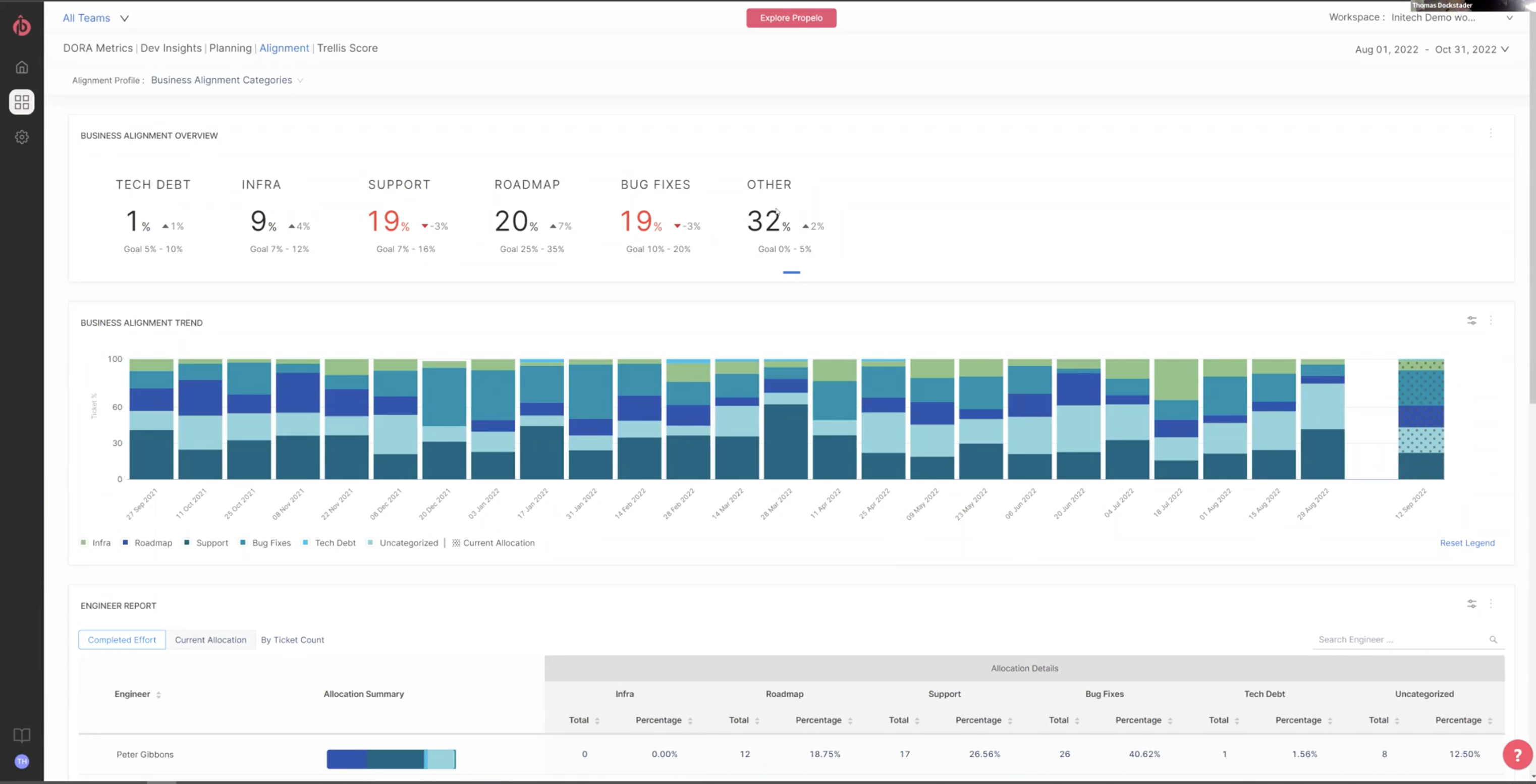
  • Harness Acquires Propelo to Surface Software Engineering Bottlenecks

    Harness Acquires Propelo to Surface Software Engineering Bottlenecks

    Harness this week announced it has acquired Propelo, a provider of an analytics tool that identifies bottlenecks in software engineering processes. Terms of the acquisition were not disclosed.

    The Propelo offering will be made available as a module, dubbed Harness Software Engineering Insights, that organizations can choose within the company’s overall continuous integration/continuous delivery (CI/CD) platform.

    Scott Sanchez, chief marketing officer for Harness, said Propelo is unique in that all the integration required to collect data from a wide range of DevOps platforms is already baked into the tool. As a result, DevOps teams can instantly collect telemetry data from not just the Harness platform but also CI/CD platforms such as Jenkins, GitLab and Azure. In addition, there are integrations with more than 40 third-party tools, such as the Jira project management software from Atlassian.

    Those integrations enable the Harness Software Engineering Insights module to surface insights aligned with the DevOps Readiness Assessment (DORA) metrics from Google and the satisfaction, performance, activity, communication and efficiency (SPACE) frameworks.

    In an uncertain global economy, there is more focus than ever on increasing the productivity of DevOps teams, noted Sanchez. More organizations are going to be reluctant to hire as many full-time employees as they once did, so more attention is being paid to getting the most out of existing investments, he added.

    That focus on productivity will naturally lead to a re-examination of workflows to identify bottlenecks in DevOps workflows that, if eliminated, would help increase the pace at which software is being developed, said Sanchez. In some instances, the software development life cycle (SDLC) processes companies are using are as much as 20 years old, he noted.

    The acquisition of Propelo is the latest addition to a portfolio of DevOps tools designed to be deployed alongside existing platforms, noted Sanchez. Organizations that have been using platforms such as Jenkins are not going to rip and replace overnight, he added. The Harness portfolio is designed to be deployed alongside existing platforms to enable organizations to modernize their DevOps workflows in a much less disruptive way than rival DevOps platforms, said Sanchez.

    Harness initially developed a CD platform before acquiring Drone to add a complementary CI capability. It then acquired ChaosNative to add a chaos engineering tool, based on the LitmusChaos open source tool, that is now being advanced under the auspices of the Cloud Native Computing Foundation (CNCF).

    It’s not clear how quickly organizations will modernize legacy DevOps platforms. Still, in many cases, workflows and pipelines that were designed for a different era of application development are not able to support the pace at which modern cloud-native applications are being developed. It will, of course, be up to each DevOps team to determine whether adding additional DevOps tools and platforms makes economic sense; application developers tend to naturally gravitate toward organizations that reduce as much development friction as possible.

    In an era where organizations are counting on developers to drive digital transformation initiatives, the underlying DevOps tools and platforms employed to build applications can easily make the difference between success and failure.

  • What DevOps Needs to Know About ChatGPT

    What DevOps Needs to Know About ChatGPT

    OpenAI’s generative pre-trained transformers (GPTs) bring powerful AI language models to every IT community. Within the past few months, ChatGPT has become an incredibly popular derivative of GPT. GPT also has the potential to shake up the DevOps and DevSecOps communities. This article will provide an overview of GPT, its history, current status and future effects on IT, especially DevOps. 

    Learning Overview

    Understanding the difference between supervised and unsupervised learning is essential before understanding GPT. Machine learning and artificial intelligence (AI) use unsupervised and supervised learning approaches. A supervised model uses labeled data to predict outcomes, while an unsupervised model does not. In general, supervised models have some limitations. They need a large amount of annotated data to learn a particular task, which is often unavailable, and they also need to generalize beyond the task for which they were trained. 

    A generative language model is a class of statistical models that differ from discriminative models. You can, for example, generate photos of animals that look like real ones using a generative model. Whereas with a discriminative model, you can determine whether an animal is a dog or a cat. Generative models can assign probabilities to a series of words, such as those that predict the next word or sentence. A generative pre-trained transformer is unique because it uses both unsupervised and supervised learning from unsupervised unlabeled text and follows up with discriminative supervised fine-tuning. 

    GPT-based models—ChatGPT, for example—always return the text “I am” when asked, “I think, therefore …” On the other hand, if you ask ChatGPT, “Why did the rabbit cross the road?” it may respond thusly: 

    “The age-old riddle still awaits an answer: Why did the rabbit cross the road? It’s a mystery that has stumped people for centuries and will likely remain an enigma for years to come.” 

    In this way, we can better understand how GPT-3 works. When asked, “Why did the rabbit cross the road?” most humans will answer, “To get to the other side.” A Google search for “Why did the rabbit cross the road?” mainly yields joke punchlines on the first page of the results. GPT doesn’t differentiate between humorous or cynical answers or specific matter-of-fact answers. The model makes only guesses based on the data. Since, in this example, most of the highest-ranked answers are jokes, GPT’s answer is enigmatic at best. GPT is not pixie dust; it doesn’t have a sense of humor, is not sentient, doesn’t understand juxtapositions and, most importantly, doesn’t evaluate context. As another example, I asked a GPT-3 tool to provide biographical information about two individuals. Abraham Lincon was the first. Approximately ten paragraphs of accurate facts were generated by the GPT-3 tool. Second, I used Gene Kim, the author of The Phoenix Project and The DevOps Handbook. GPT-3 began inventing facts about the companies he worked for by the second paragraph. Additionally, it suggested that he had spoken at TEDx. While a Dr. Gene Kim has spoken at TEDx, that Dr. Kim is an opthamologist.

    History of GPT

    GPT was released for the first time on June 11, 2018. Sometimes it is referred to as the  GPT-1 model. A large dataset of online books was used to train it. A database called BookCorpus also was used for training. There were 7,000 unpublished books in the original BookCorpus dataset at the time of training. 

    OpenAI’s GPT-2 model was created in 2019 as a direct scale-up of the original GPT model. There were ten times as many parameters and ten times as much data in that training set. The GPT-2 dataset was based on an internal OpenAI dataset called WebText. A focus was placed on the quality of the documents when scraping web pages for this tool. The authors scraped all Reddit outbound links receiving at least three upvotes. GPT-2 used about 40GB of Internet text, 8 million web pages, and 1.5 billion parameters. In neural networks, parameters are often used as synonyms for weights (found more often in statistics literature). Parameters in GPT are the weights and biases of the dataset and generally indicate the power. 

    As the third-generation language model, GPT-3 was introduced in May 2020. It has 175 billion parameters, making it more accurate than its predecessors—an increase of tenfold in capacity over the next largest NLP model available. Sixty percent of GPT-3’s weighted pre-training dataset is filtered Common Crawl. Common Crawl is a nonprofit organization that crawls the web and makes its archives and datasets freely available. Since 2011, Common Crawl has collected petabytes of data. About 37% of the GPT-3 sources were WebText2 and other sources, while about 3% came from Wikipedia. OpenAI Codex was also included with GPT-3, which generated code and served as the basis for GitHub’s Copilot. 

    As part of its training, GPT-3 used data available until November 2019. Thus, GPT-3 was unaware of events beyond January 2020. COVID-19, for instance, was unknown to it. Even so, it did have extensive knowledge of coronaviruses, pandemics, Wuhan and SARS. As of September 22, 2020, Microsoft, through a considerable investment, received exclusive permission to use GPT-3; others can still access GPT-3’s public API, but Microsoft is the only one with access to the underlying model. OpenAI developed DALL-E in January 2021, which generated images using GPT-3. OpenAI introduced models in the “GPT-3.5” series on November 30, 2022, including the now-famous ChatGPT, derived from a model from the GPT-3.5 series. Unlike GPT-3, GPT-3.5 includes data up until November 2022.

    Current Status

    I have used several AI language model tools in the past few years based on GPT-3. It is used by Grammarly and by some useful writing tools like Jasper.ai and Wordtune. I also have had great success with GPT-3 research tools like Frase.io and Genei.io. One of my more recent go-to tools is called QuillBot. In my experience, these tools are aids, not replacements for writing. When I first started using these tools, I was writing a book about Dr. W. Edwards Deming. I would get inaccurate information about Dr. Deming’s childhood from a GPT-3-based tool. One time, it said he had six siblings. In fact-checking, GPT-3 confused Dr. Edwards Deming with Dr. Richard Deming. With surgically precise input, the results could be more accurate. One of my findings was that if I used a GPT-3 on a well-known subject, the information was primarily precise; however, lesser-known topics produce fewer facts. Furthermore, I learned from the documentation that when people talk about training GPT-3 models, what they really mean is that you can input a maximum of 2,048 linguistic tokens, which is about 1,500 words. In GPT-3, content is predicted by analyzing past context, one word at a time. The content you input to GPT-3 significantly impacts its output. As a result, it pulls words from a shortlist and calculates their probability of being used. A great set of tutorials on using GPT-3 can be found on Jasper.ai. This figure shows how Jasper (which is based on GPT-3) word prediction works.

    Image source

    People have accomplished some remarkable things by using the 2,048 tokens creatively, but complex training still needs to be improved. Due to the Microsoft deal, the original GPT models were close sourced, and robust training of GPT-3 models is unlikely to happen any time soon. 

    Future Effects on IT

    Where does all the hype come from? Despite its limitations, GPT-3 has created some unique industry artifacts. DALL-E and Copilot by Github are excellent tools. On September 8, 2020, the Guardian published an article titled, “A robot wrote this entire article. Are you scared yet, human?” This article was written by GPT-3. Using GPT-3, some full-blown novels have also been written; they’re not horrible, but they could have been better. According to a study conducted by Drexel University in 2022, systems based on GPT-3 could be used to screen for Alzheimer’s disease at an early stage. Just five days after its launch, ChatGPT surpassed one million users. It took 41 months for Netflix to reach one million users and 10 months for Facebook to reach one million users. By the end of the first quarter of 2023, ChatGPT will have over one billion users. Based on GPT-3.5, ChatGPT is more robust and up-to-date. 

    How smart is ChatGPT? Using a verbal-linguistic IQ test and Raven’s ability test, ChatGPT has an IQ of 147. GPT-3.5 has passed the United States bar exam, CPA exam and U.S. medical licensing exam. People often ask if it is plagiarism to use GPT-3. Technically, the answer is no. The GPT datasets are estimated to represent 300 years of pre-training with a connection of trillions of words. However, using these tools for rewriting other people’s work is, from an ethical viewpoint, plain and straightforward plagiarism. A recent set of tweets by Greg Brockman, president and co-founder of OpenAI and Sam Altman, CEO of OpenAI, sums up the current status of ChatGPT.

    What Does This Mean for DevOps Practitioners?

    AI learning models based on GPT-3 are here to stay. From grammar correction to proposal writing to code generation, GPT-3 has revolutionized everything. In my opinion, GPT-3 still needs to solve some challenges before it is of actual value to DevOps and DevSecOps patterns and practices. For example, a great use case for GPT-3 is training it to deal with organizational incidents. If a GPT model could be trained this way, it would become an excellent tool for providing adaptive diagnostics. Based on the current GPT implementation, this is very difficult or impossible. Another example would be to train the model with the organization’s IT risk policies and enable predictive solutions. The opportunities are endless. 

    An alternative to GPT-3 is InstructGPT, which OpenAI describes as more truthful and less toxic. It has also been noted that GPT-3 can generate untruthful outputs. GPT models aren’t generally aligned with their users. InstructGPT models follow instructions much better than GPT-3. Furthermore, InstructGPT produces more truthful and less toxic outputs. Therefore, they generate fewer harmful outputs and more facts.  The InstructGPT models use human feedback as part of the training model. Some of the real power behind ChatGPT is that it uses InstructGPT along with GPT-3.5. Some of my upcoming research will focus on prototyping some of the complex opportunities DevOps and DevSecOps practitioners currently face using InstructGPT.