Category: News

  • Sysdig Launches Wireshark Foundation

    Sysdig Launches Wireshark Foundation

    Sysdig this week announced there is now a Wireshark Foundation that will oversee future development of the widely used open source traffic protocol analyzer.

    Gerald Combs, who is now director of open source projects at Sysdig, along with Loris Degioanni, CTO of Sysdig, launched Wireshark in 2006 to enable teams to monitor network traffic, learn protocols and packet basics and troubleshoot network problems. There are more than 2,000 contributors and Wireshark has been downloaded more than 60 million times in the last five years alone.

    The Wireshark Foundation will provide a framework for long-term stewardship and sustainability. The foundation will be led by Sheri Najafi as executive director, and Janice Spampinato, Hansang Bae, Najafi, Combs and Degioanni will serve on the board.
    Combs said rather than donating Wireshark to an existing foundation, it was decided to set one up to formalize many of the community processes that have evolved over the past two decades.

    Degioanni said the foundation will also ensure Wireshark remains relevant long after its creators eventually retire. Wireshark has a graphical user interface (GUI) that provides IT teams with an easy-to-understand traffic protocol analyzer. However, as applications become more distributed, additional types of IT professionals, including DevOps teams, are analyzing network traffic. Similarly, cybersecurity teams are using these tools to help track down the source of anomalous activity.

    It’s not clear whether network operations (NetOps) and DevOps workflows are merging, but the level of collaboration has increased. As networking increasingly becomes software-defined, it’s clear that developers will employ application programming interfaces (APIs) to manage networks as code in much the same way they do infrastructure in the public cloud. Most of those networking APIs are comparatively low-level, but with the rise of services meshes, it’s clear networking services are becoming more accessible.

    The biggest challenge is distinct cultures that have arisen around networking and application development. IT organizations will need to decide whether to provide development teams with the ability to programmatically invoke networking services on their own or through a self-service portal managed by a NetOps team. Regardless of who is responsible for managing the network going forward, the divide between DevOps and NetOps is already starting to narrow. The biggest challenge is simply finding a common language to express core concepts that eliminates any sense of fiefdom that might exist between them. After all, any conflict that arises can usually be attributed to a simple failure to communicate.

    In the meantime, in the age of edge computing, network latency issues are becoming even more challenging. An application based on microservices architecture is especially sensitive to network latency issues that are difficult to troubleshoot over an extended network. Tools that make those issues more obvious are crucial.

  • LinkedIn Job Scams: Out of Hand ¦ 4-Day Workweek: Let’s Get Serious

    LinkedIn Job Scams: Out of Hand ¦ 4-Day Workweek: Let’s Get Serious

    Welcome to The Long View—where we peruse the news of the week and strip it to the essentials. Let’s work out what really matters.

    This week: Don’t get scammed looking for a job, and momentum grows for the 32-hour working week. (more…)

  • Despite Tech Layoffs, Developer Shortage Continues

    Despite Tech Layoffs, Developer Shortage Continues

    Well over one-third (37%) of respondents to a recent industry survey reported that recruiting developers with the needed skills would continue to be a challenge through 2023. More than 2,000 developers and IT professionals participated in the Infragistics survey from December 2022 to January 2023.

    The survey also found developers and IT professionals are just as concerned (37%) when it comes to their organization’s ability to keep employees safe. The survey also found respondents believed they are working with limited resources (36%).

    “Over the past three years, workers have been faced with a series of unexpected challenges—the COVID-19 pandemic, an economic downturn and a volatile work environment–which is pushing employers to do more to assure workers are protected. Employers that take steps to protect their employees will be more likely to retain them, especially in light of the developer shortage,” the report said.

    The three technical jobs survey respondents said were the most difficult to recruit are DevOps engineers (16%), data analytics developers (16%) and IT security engineers (13%).

    The report found that while nearly all developers (89%) worked with a designer or design team, less than half of a developer’s time (43%) is spent on actual application coding. In most cases, low-code/no-code tools are filling in gaps left by vacant roles and helping organizations keep up with the necessary pace of development. “The lack of skilled developers challenge is being solved by the use of low-code/no-code tools in [more than] three-quarters (77%) of organizations,” the report said.

    Looking ahead, the survey found that software developers planned to improve project management (30%), improve designer/developer collaboration (30%), use software that will work for citizen developers (27%), use remote staff (25%) and incorporate a data catalog/analytics catalog (25%).

    “The biggest software development challenges in 2023 will be the inability to keep pace with innovation in developer tools (28%), difficulty with third-party integration (267%), struggle to manage workload (26%), security threats (26%), project management (26%) and client expectations that are too high (26%),” the report said.

    Despite the rough patch that rattled the industry throughout the second half of 2022, the survey results indicated developers are optimistic for the rest of this year. According to the survey, the software development industry plans to:

    • Adopt new technologies/applications (38%)
    • Expand into new markets (35%)
    • Take on new projects (32%)
    • Increase revenue (31%)
    • Increase requests for proposals (31%)

    Finally, the survey found business intelligence and embedded analytics are increasing in usage. More than 80% of developers currently incorporated these tools into their products, up 3% from the previous year’s survey.

    Embedded analytics in apps is also on the rise. Almost half, or “48% of developers were embedding analytics into client apps in 2022, compared to 31% in 2021. And 75% of software developers expected their organization’s focus on business intelligence to increase in 2023,” the report stated.

    The top three reasons software developers incorporate embedded analytics: Improving customer satisfaction (32%), gaining a competitive advantage (30%) and making data-driven decisions (25%).

    According to the report, customers included embedded analytics in their requirements in the hope they would improve productivity (42%), increase sales/revenue (39%), understand business problems (33%) and make better business decisions (32%).

  • Vercel Adds Observability Tools to Web Application Framework

    Vercel Adds Observability Tools to Web Application Framework

    Vercel today announced it has added a suite of observability tools to its platform for building web applications using Next.js, an instance of the open source React framework based on a JavaScript library.

    Vercel CTO Malte Ubl said the Vercel Monitoring tools make it simpler for developers to troubleshoot applications without relying on a DevOps team to surface data. Instead, developers can take advantage of Vercel Monitoring tools to access metrics that track user interface and application programming interface (API) issues, he added.

    That capability is not intended to replace the need for observability tools employed by DevOps teams. Instead, the goal is to provide metrics that are specific to issues that developers encounter as an application is being built or after it has been deployed so they can be addressed.

    Developers can select from pre-made queries provided by Vercel or create their own by defining what metrics they want the Vercel Monitoring tools to track, including bandwidth and web traffic spikes and requests by bots that are indicative of a cyberattack. In total, there are more than 500 potential errors that developers can track. Logs then make it possible to drill down into errors and issues once they are identified to pinpoint the root cause of an issue.

    As more responsibility for applications shifts left toward developers, there’s a clear need for tools that provide more visibility into the applications they develop. Many of the issues that DevOps teams encounter today could have been resolved if developers had been aware of them earlier.

    The Vercel platform employs caching, routing and a React framework to optimize application performance in a way that reduces the dependency on backend infrastructure to optimize application performance. That approach puts less strain on backend infrastructure as more requests are automatically processed using a framework that spans clients and servers. In effect, developers can take advantage of frameworks such as React to treat the underlying IT infrastructure as if it were serverless whenever possible with tools that have a familiar JavaScript construct. The overall goal is to increase developer productivity at a time when many organizations are much more focused on the issue.

    As a result, DevOps teams will need to make some adjustments as more applications capable of providing richer experiences are built and deployed without relying as much on backend infrastructure. That shift has implications for everything from the amount of network bandwidth consumed to the performance of web applications. Frameworks such as Next.js also tend to increase the overall rate at which web applications can be built and deployed.

    One way or another, it’s clear that the way web applications are being built is fundamentally changing. The only issue now is determining to whether DevOps teams are prepared to absorb that level of change across an ever-increasing portfolio of applications that still need to be deployed, secured, updated and optimized.

  • The Economic Downturn and DevOps Hiring Trends

    The Economic Downturn and DevOps Hiring Trends

    An analysis of more than 494,000 interview requests for software engineers coupled with a survey of more than 1,300 software engineers and 120 hiring professionals found a lot more employers prefer to hire DevOps professionals who work in the office—but resistance to working in an office (rather than working remotely) remains high.

    The survey also found that, despite the preference for hiring local software engineers, more than half of hiring professionals (52%) are filling positions on fully remote teams while another 40% are focusing on hybrid teams.

    The interview requests analysis conducted by Hired, a provider of a platform for vetting potential employees, found that nearly three-quarters of interview requests (72%) were for software engineers with more than six years of experience. Backend engineers received 59% of all interview requests.

    Hired CEO Josh Brenner said the survey makes it clear that organizations are less inclined to hire less experienced talent. In fact, there’s a decided shift toward DevOps professionals that have degrees versus individuals that are largely self-taught, he added.

    Hiring those individuals, however, remains challenging. More of them are willing to consider other employment options given the current state of the economy, but more than two-thirds of engineers (68%) said they are not worried about losing their jobs in the next six months.

    However, enterprise IT organizations are now finding it easier to hire DevOps engineers because competition from startup companies and technology vendors such as Google and Microsoft slackened in the wake of a series of ongoing layoffs, noted Brenner.

    Competition for software engineers is also impacted by geographic region, with the Los Angeles area seeing the largest negative impact on local salaries, decreasing by 6% to $152,000. Philadelphia had the greatest amount of growth, with local salaries increasing by 7% to $150,000. Despite demand for remote engineering talent, growth in salaries for these positions has flattened. The San Francisco Bay Area had the highest salaries for remote roles at $180,000, followed by Seattle ($175,000) and New York ($169,000). The percentage of active engineering positions “open to remote” fell to 69%, the survey found.

    The highest-paying markets for in-office jobs, in contrast, were San Francisco ($180,000), Seattle ($169,000) and New York ($162,000).

    Software engineers, as always, are motivated to work for organizations based on new challenges and continuous learning (69%), building products/solutions and problem-solving (66%) followed by earning potential and career stability (60%), the survey found. When learning a new skill, the survey found the biggest motivator remained the simple joy of learning new things (40%) followed by the fact that their current job required it (25%).

    Regardless of the state of the economy, it’s clear that demand for DevOps expertise continues to outstrip available supply. However, software engineers may be unable to command as high a salary as they did a short while ago. Of course, no one can be sure what lies ahead, but economies do eventually rebound. In the meantime, DevOps professionals would be well-advised to continue to invest in their own skills to maximize their earning potential, no matter which direction the economic pendulum swings.

  • Five Great DevOps Job Opportunities

    Five Great DevOps Job Opportunities

    DevOps.com is now providing a weekly DevOps jobs report through which opportunities for DevOps professionals will be highlighted as part of an effort to better serve our audience.

    Our goal in these challenging economic times is to make it easier for DevOps professionals to advance their careers. Of course, the pool of available DevOps talent is still relatively constrained, so when one DevOps professional takes on a new role, it creates an opportunity for others.

    The five job postings shared this week are selected based on the company looking to hire, the vertical industry segment and, naturally, the pay scale offered.

    We’re also committed to providing additional insights into the state of the DevOps job market. In the meantime, for your consideration:

    Monster.com

    LongTail Ad Solutions
    New York, New York
    Senior DevOps Engineer
    $170,000

    LinkedIn

    TuneIn
    New York, New York
    Staff Infrastructure Automation Engineer
    $166,000 to $249,500

    SimplyHired

    The Hartford
    Remote
    Senior Staff Software Engineer
    $123,120 to $184,680

    Indeed.com

    Volunteer Corporate Credit Union
    Nashville, Tennessee
    Senior DevOps Engineer
    $109,000 to $139,000

    Dice.com

    MRoads
    Phoenix, Arizona
    DevOps Engineer- Associate
    $100,000 to $120,000

  • WTH? WFH is 6× Pre-Covid ¦ Plus: Agile Sucks (Redux)

    WTH? WFH is 6× Pre-Covid ¦ Plus: Agile Sucks (Redux)

    Welcome to The Long View—where we peruse the news of the week and strip it to the essentials. Let’s work out what really matters.

    This week: Working from home is here to stay, and Agile is still a failure. (more…)

  • Nobl9 Adds Service Level Analyzer to SLO Management Platform

    Nobl9 Adds Service Level Analyzer to SLO Management Platform

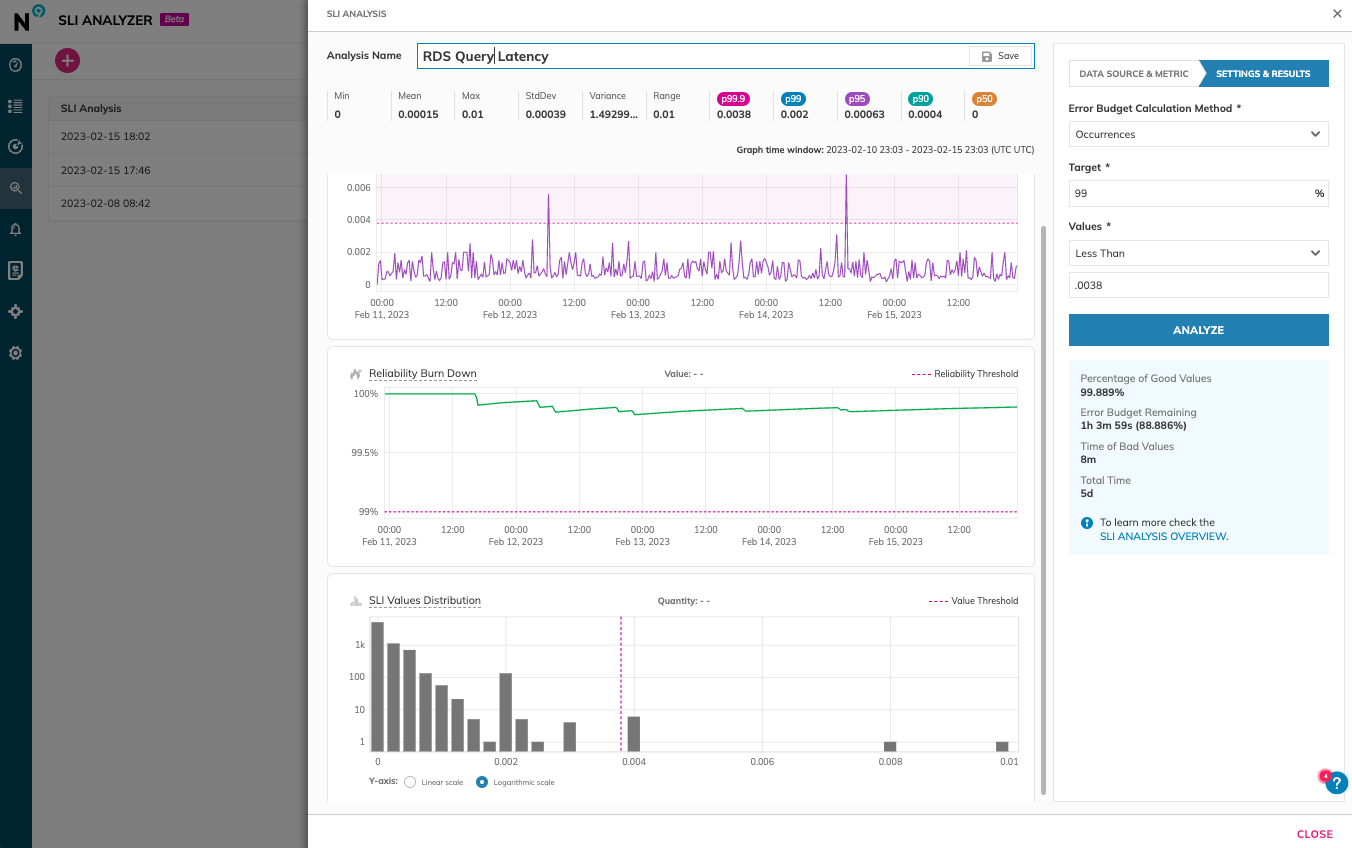
    Nobl9 today added a free tool for analyzing service level objectives (SLOs) to its platform to enable DevOps team to more accurately set reliability goals.

    Brian Singer, chief product officer for Nobl9, said Service Level Analyzer collects metrics and observability data from more than 24 DevOps tools and platforms that can then be used to create an SLO via a single click.

    Included as part of the free tier of the Nobl9 service, Service Level Analyzer also enables DevOps teams to more easily update SLOs as error budgets and error budget burn rates change over time based on actual incidents that have occurred, added Singer.

    DevOps teams can also perform “what-if” analysis to test out the impact of different targets and thresholds on error budgets, he added. That capability ultimately reduces costs because DevOps teams become less likely to overprovision resources to ensure application performance and resiliency, noted Singer. In effect, Service Level Analyzer is providing DevOps teams with an observability tool that spans the entire software development life cycle, said Singer.

    Nobl9 is trying to spur greater adoption of SLOs by making available an open source SLO specification that defines a common interface for constructing SLOs across a DevOps workflow. SLOs, of course, are not a new idea. They have been employed as a metric to track the performance of IT services for decades. However, as more microservices-based applications are built and deployed, it’s becoming more challenging to maintain SLOs across applications because they have many more dependencies than legacy monolithic applications.

    Ultimately, each DevOps team needs to provide some sort of objective benchmark that assesses their overall effectiveness at delivering application services. SLO-as-code is intended to make it simpler to gather the metrics that confirm whether service levels are being achieved. As organizations become more dependent on software to drive digital processes, those SLOs are then tracked across everything from financial services to supply chains.

    In general, DevOps teams are more comfortable with the SLO concept, said Singer. The biggest challenge is making them simpler to implement, he added. The Service Level Analyzer lowers the bar for implementing an SLO by making historical data stored in DevOps tools and platforms more accessible, noted Singer. Rather than having to manually collect that data and then normalize it in an external repository, Nobl9’s Service Level Analyzer automates that process on behalf of a DevOps team using actual data versus relying on less precise statistical analysis, said Singer.

    As IT environments become more distributed, the number of dependencies that exist across application environments only continues to expand. IT teams can spend weeks trying to discover the root cause of issues that are negatively impacting application performance, only to discover that, for example, calls to an application performance interface (API) are being rerouted in a way that significantly increases latency. Tools that enable DevOps teams to more easily understand the relationships between all the services that make up an application environment are more crucial than ever.

  • Tricentis Extends Mobile Testing Reach

    Tricentis Extends Mobile Testing Reach

    Tricentis has added the ability to test native iOS and Android applications to its Testim software-as-a-service (SaaS) platform.

    Previously, the Testim platform was designed to test web applications, but is now being extended as organizations build and deploy more native mobile applications. Capabilities of the Testim Mobile platform include codeless authoring of mobile tests to eliminate the need to write and maintain Appium, Espresso or XCUITest scripts and the ability to set up, configure and manage mobile devices in minutes using the Tricentis Mobile Agent.

    Additionally, applications can be uploaded to the cloud to enable collaboration across testing teams as they opt to run tests on real or virtual devices. DevOps team can also customize tests with JavaScript, branch tests, and run tests from a scheduler or continuous integration (CI) build.

    Tricentis CTO Mav Turner said Tricentis is moving to implement a consistent set of mobile testing services across its entire portfolio of testing platforms now that mobile applications are equal, first-class citizens alongside web applications. The primary driver of that shift has been the COVID-19 pandemic, which saw more organizations relying on external-facing mobile applications to engage customers, partners and employees working remotely, he added.

    Testing those applications is more critical than ever because the cost of failure—in terms of impact to the business—is now much higher as more organizations depend on software to drive business processes, noted Turner.

    The goal is to make it simpler to test these applications as they are being developed to ensure quality, he added. The challenge is that many developers don’t have a software engineering mindset. Hence, they need to rely more on testing platforms infused with artificial intelligence to discover issues relating to, for example, scalability and security, said Turner.

    Most organizations are trying to shift more responsibility for testing toward developers as part of an effort to remediate issues earlier in the software development life cycle. It’s more challenging for developers to remediate issues after an application has been developed simply because they have lost context. Testing platforms infused with AI capabilities make it easier for developers to identify issues at the time they are writing code. In the future, Tricentis expects to take advantage of generative AI platforms to make it easier to author tests using a set of best practices that can be easily reused, noted Turner.

    That approach doesn’t necessarily eliminate the need for a dedicated quality assessment review, but it does allow testing teams to focus more of their time and effort on testing the application experience versus identifying lower-level errors that many developers routinely make.

    Over time, the quality of applications should steadily improve as many of the low-level mistakes that developers make are eliminated. That should improve everything from application security to the user experience as applications are continuously updated. In the meantime, organizations that embed testing within DevOps workflows are steadily reducing the number of issues that need to be addressed just before applications are supposed to be deployed.

  • Logz.io Integrates ChatGPT With Observability Platform

    Logz.io Integrates ChatGPT With Observability Platform

    Logz.io has integrated the ChatGPT generative artificial intelligence (AI) platform with its Open 360 observability platform to extend its automated recommendation capabilities to reduce mean-time-to-remediation.

    ChatGPT, developed by OpenAI, is based on a large language model that Logz.io uses to enrich crowdsourced data. That approach enables ChatGPT to surface links to related information and best practices for resolving IT issues.

    Logz.io CTO Asaf Yigal said the company has integrated ChatGPT with its existing AI engine, dubbed Cognitive Insights, that applies machine learning algorithms to identify anomalies indicative of potentially critical IT issues. The company expects to be able to add other generative AI capabilities as additional advances are made, he added.

    The Logz.io Open 360 platform is based on open source OpenSearch, Prometheus and Jaeger software that the company has infused with machine learning algorithms. The integration with ChatGPT is enabled via an application programming interface (API) that OpenAI has provided.

    The overall goal is to employ AI to surface the most relevant issues a DevOps team needs to focus on without having to search huge volume of logs, tracing and metrics data, said Yigal. Generative AI platforms solve a fundamental cognitive load problem created today as DevOps teams collect more data, noted Yial. The more data a DevOps team collects, the harder it becomes to determine what’s going on in an IT environment, said Yigal. He added that generative AI platforms make it possible to analyze massive amounts of data at a scale that isn’t otherwise achievable.

    AI tools should make it possible to manage IT at a level of scale that eliminates many of the low-level data engineering and analytics tasks that previously required manual effort from a DevOps engineering team. It’s not clear how many other DevOps tools and platforms will be invoking generative AI capabilities in the months ahead, but DevOps teams should assume that large language models will soon be augmenting DevOps teams in ways that previously would have been thought unlikely.

    For example, discovering vulnerabilities in software running in production environments is about to become trivial as artificial intelligence (AI) platforms such as ChatGPT evolve. A generative AI platform can identify code vulnerabilities in much the same way as a traditional scanning tool. An AI platform, however, could theoretically monitor code repositories and scan them for vulnerabilities as updates and commits are being made in real-time. DevOps teams should be able to use generative AI platforms to discover and remediate these issues before code is deployed in a production environment.

    It’s just as probable bad actors will use the same platform to achieve the same goal, so from that perspective, many DevOps teams will now find themselves in an AI arms race to improve DevSecOps workflows.

    There are still lots of issues to be worked out in terms of the overall accuracy of generative AI platforms, but they will only become more intelligent as processors continue to advance. The issue now will be determining precisely where the man-machine interface for DevOps teams is today and in the future.