Category: Features

  • Critical Vulnerability Discovered in Open Source Backstage Platform

    Critical Vulnerability Discovered in Open Source Backstage Platform

    Oxeye today disclosed that it has discovered a critical vulnerability in the open source Backstage software used to build developer portals. Backstage was originally created by Spotify.

    A 1.5.1 update to the Backstage platform remediated a sandbox escape vulnerability that can occur via a third-party Scaffolder plug-in that could be used to conduct unauthenticated remote code execution (RCE).

    Oxeye CTO Ron Vider said Oxeye worked with Spotify to responsibly disclose the issue and enabled a patch to be created prior to the disclosure of the vulnerability, which Spotify gave a 9.8 out of 10 severity rating.

    Backstage is now being advanced under the auspices of the Cloud Native Computing Foundation (CNCF), but is already widely used by organizations such as American Airlines, Netflix, Splunk, Fidelity Investments, Epic Games and Palo Alto Networks, as well as by Spotify.

    The vulnerability is another example of a potential template-based attack through which run shell commands can be manipulated to inject malware into an application development environment.

    In general, separating the logic from the presentation layer as much as possible can greatly reduce exposure to the most dangerous template-based attacks.

    Vider said Oxyeye is focusing its vulnerability research on cloud-native platforms such as Backstage that are generally being used to build modern applications based on a microservices architecture. It’s not clear to what degree organizations have transitioned away from more monolithic approaches to building applications, but it’s clear that a much larger percentage of applications are now being constructed using microservices.

    Cybercriminals, of course, are targeting these platforms as part of a sustained effort to compromise software supply chains in the hope that the malware they inject will find its way into multiple downstream applications. Those attacks, in turn, are convincing more organizations to embrace DevSecOps best practices to better ensure the integrity of their software supply chains. The challenge is many of those attacks are being aimed at open source software projects that don’t always have enough resources to quickly develop a patch in the event a zero-day vulnerability is disclosed.

    While it’s impossible to know the extent to which cybercriminals are already exploiting vulnerabilities in DevOps platforms, the level of cybersecurity scrutiny being applied has dramatically increased in the wake of a series of high-profile breaches. The Biden administration has even gone so far as to issue an executive order requiring federal agencies to better secure their software supply chains. As a result, DevOps teams should expect there to be a lot more DevOps platform vulnerability disclosures in the months ahead, and that those vulnerabilities will require immediate patching.

    Like it or not, software supply chains are going to become more secure. The only thing left to be determined is the level of pain that will be experienced as more vulnerabilities are discovered in the DevOps platforms that were used to construct them.

  • Codenotary Automates SBOM Creation

    Codenotary Automates SBOM Creation

    Codenotary today launched a tool that enables an application to automatically generate a software bill of materials (SBOM) by adding a single line to its source code.

    Codenotary CEO Moshe Bar said TrueSBOM makes it possible to self-report the components used to construct applications to any organization that uses them for the first time. In contrast, existing SBOMs only provide a snapshot of the components of an application at the time it was initially created, he added.

    IT organizations are being asked to trust application providers that all the modules specified in the SBOM are the only components being used. Codenotary is making a case for an approach that enables the organization consuming that software to spin up an SBOM in real-time on demand.

    From a DevSecOps perspective, adding a single line of code to the application to enable TrueSBOM should also eliminate the need to create and maintain separate text files to generate an SBOM.

    Awareness of the need for SBOMs has skyrocketed since the Biden administration’s executive order made it clear that federal agencies would require them from any software provider starting next year. Many enterprise IT organizations are likely to follow suit as part of a larger effort to better secure software supply chains in the wake of a series of high-profile cybersecurity breaches.

    That approach also makes it a lot simpler for organizations to accurately pinpoint where components are actually running any time a new zero-day vulnerability is discovered, added Bar.

    Priced at $1,450 per application stack per year, there are also lower-cost instances of TrueSBOM available for applications based on either a serverless framework or using the portable WebAssembly (Wasm) format.

    Most internal DevOps teams already have a good handle on what software components are being employed with the applications they deploy, said Bar. The issue is that the organizations that use that software can’t easily verify what components are being employed, he added. That’s problematic because an organization may have decided to prohibit deployment of a specific software component because of a known vulnerability. Rather than trust a text file created by the provider of an application, TrueSBOM allows the user of an application to maintain control over their software environment, noted Bar.

    It’s not yet clear how most organizations will operationalize SBOMs now that more of them are being created. Ideally, organizations should be able to approve only software that has components that have been verified to be secure. Armed with those insights, over time, it should become simpler to start reducing security technical debt with more secure applications, added Bar.

    The challenge, of course, is that the Codenotary solution requires the addition of one line of code to an application. However, as SBOM mandates become more stringent, the number of application providers that are anxious to comply with rules for securing software supply chains should increase. The issue now is finding a way for both the developer and consumer of that software to streamline a verification process that, in its current form, is too cumbersome to effectively manage.

  • Five Great DevOps Job Opportunities

    Five Great DevOps Job Opportunities

    DevOps.com is now providing a weekly DevOps jobs report to highlight career opportunities for DevOps professionals as part of an effort to better serve our audience.

    Our goal in these challenging economic times is to make it easier for DevOps professionals to advance their careers.

    Of course, the pool of available DevOps talent is still relatively constrained, so when one DevOps professional takes on a new role it tends to create an opportunity for others.

    The five job postings shared this week are selected based on the company looking to hire, the vertical industry segment and, naturally, the pay scale being offered.

    We’re also committed to providing additional insights into the state of the DevOps job market. In the meantime, for your consideration:

    Dice.com

    ApTask
    Remote
    DevOps Architect
    $160,000 to $200,000

    SimplyHired

    FluentStream
    Remote
    DevOps Engineer
    $150,000 to $200,000

    LinkedIn

    The College Board
    Remote
    Senior DevOps Engineer
    $144,000 to $150,000

    ZipRecuiter

    Ushur
    Santa Clara, CA.
    Senior DevOps Engineer
    $130,000 to $140,000

    Indeed

    Element 84, Inc.
    Remote
    Senior DevOps Engineer
    $119,000 to $140,000

  • Aqua Security Claims Compliance With Biden’s Executive Order

    Aqua Security Claims Compliance With Biden’s Executive Order

    Aqua Security this week claimed it is the first software supply chain security platform provider to meet the attestation requirements as defined by an executive order issued to federal agencies last year by the Biden administration.

    A supplementary memo issued by the Biden administration required federal agencies to collect compliance attestation letters for all software they use by September 14, 2023. Those attestation letters need to confirm that the software development environments they employ are secure, that sources of code are trusted and that code vulnerabilities have been remediated, provenance for data and code is being tracked using a software bill of materials (SBOM) and that these processes are being consistently maintained.

    Eilon Elhadad, senior director of supply chain security for Aqua Security, said Aqua Security was able to meet those requirements within 100 days of the issuance of that memo. The Aqua Security platform for securing software supply chains is based on a platform it gained with the acquisition late last year of Argon, a provider of a set of tools that provides an agentless approach to integrating with continuous integration/continuous delivery (CI/CD) platforms that maps the development environment. Armed with those insights, it then becomes possible to prioritize and automate the remediation of vulnerabilities based on security best practices and compliance rules, noted Elhadad.

    The Argon platform also includes code-tampering detection technology that performs validity checks to make sure the integrity of the build process has not been compromised.

    Naturally, there’s plenty of time for other security platform providers to comply with the requirements set forth in Biden’s executive order. However, software development teams are also in a race against time. In the wake of a series of high-profile breaches, it’s become apparent how vulnerable software supply chains really are. Cybercriminals have increased their efforts to compromise developer credentials so they can embed malware in software components and activate them downstream if future application incorporate that component, noted Elhadad.

    It’s not clear how closely enterprise IT organizations are tracking the efforts of the U.S. government to secure its software supply chain, but any entity that builds software used by any of those agencies will be impacted. Advocates of DevSecOps best practices within enterprise IT organizations will undoubtedly use the Biden administration’s requirements to define a minimum baseline for securing software supply chains.

    In the meantime, a new front has clearly been opened in the cybersecurity war. The more applications are targeted, the greater the impetus for shifting responsibility further left toward application development teams becomes. The challenge is not just scanning the code being written by developers, but also making sure the software build created by development teams has not been compromised by bad actors that have inserted themselves into the process, noted Elhadad.

    Given the magnitude of the effort required, it’s not likely that every software supply chain will be secured any time soon. However, the responsibility for securing those software supply chains is weighing more heavily on DevOps teams.

  • HPE Adds VMware Cloud Platform to Managed GreenLake Service

    HPE Adds VMware Cloud Platform to Managed GreenLake Service

    At the VMware Explore 2022 Europe conference, Hewlett Packard Enterprise and VMware, Inc. this week extended their alliance to integrate instances of the VMware Cloud platform into the managed HPE GreenLake service.

    Hang Tan, chief strategy officer for HPE, said for the first time HPE is managing the entire VMware Cloud stack in addition to its servers and storage platforms via a service that is based on a consumption pricing model. The goal is to reduce the total cost of IT by not requiring IT teams to overprovision IT infrastructure resources to run VMware Cloud, he said.

    Previously, IT teams could have deployed VMware Cloud on the HPE GreenLake service in a more disaggregated fashion, but that would have required separate billing processes, added Tan.

    Many organizations are currently revisiting their IT strategies during increasingly challenging economic times, noted Tan. The managed HPE GreenLake service enables IT teams to devote more of their internal IT resources to building and deploying applications rather than managing IT infrastructure, he added.

    It’s not clear how many organizations are transitioning toward a subscription model for consuming on-premises IT infrastructure, but in the cloud era it’s apparent that more of them are comfortable consuming IT as a service. HPE reported that the HPE GreenLake service supports more than 120,000 users accessing more than one exabyte of data worldwide. Among the top 100 HPE customers, nearly 80% have already adopted the HPE GreenLake platform, the company claims.

    The challenge many organizations face is they still need to deploy and update application workloads in on-premises IT environments for both performance reasons and to meet various compliance mandates. The HPE GreenLake service is an effort to bring a cloud operating model to on-premises IT environments running not just VMware Cloud but also a wide range of other rival software stacks that HPE already supports.

    Naturally, organizations that have embraced DevOps workflows would need to align the way they build and deploy applications to a managed service. IT teams that find that challenging, however, could opt for a self-service edition of the HPE GreenLake service that provides IT teams with more control over the underlying infrastructure being consumed as a service, noted Tan.

    Regardless of approach, it’s apparent that some type of as-a-service approach to consuming IT infrastructure is being more widely employed across what are becoming highly distributed computing environments. Each organization will need to determine for itself to what degree treating IT more as an operating versus capital expense makes the most economic sense.

    However, there’s no doubt that infrastructure cycles are generally going to be less disruptive when they are included as part of a multi-year services agreement. IT teams may also find it easier to take advantage of ongoing artificial intelligence (AI) advances when IT environments are managed on their behalf by a vendor.

    One way or another, the way IT infrastructure is managed is continuing to evolve at a time when organizations are starting to focus more of their efforts on applications that are becoming more difficult to build, deploy, secure and maintain.

  • IBM Adds Fully Managed VMware Service to Cloud Portfolio

    IBM Adds Fully Managed VMware Service to Cloud Portfolio

    At the VMware Explore 2022 Europe conference, IBM this week announced an IBM Cloud for VMware-as-a-Service offering that integrates instances of VMware Cloud with the infrastructure-as-a-service (IaaS) platform managed by IBM in the cloud.

    Rohit Badlaney, vice president of product management and strategy for IBM Cloud, said now that VMware Cloud can be consumed as a subscription service, it’s now possible for IBM to integrate it with its cloud platform to create a fully managed service. Previously, IT organizations would have had to separately license VMware Cloud and deploy it on IBM Cloud themselves, he noted.

    In general, Badlaney said IBM is focused on working with organizations in highly regulated industries that need to run complex workloads in the cloud. IBM is not interested in competing against other cloud service providers to run workloads on commodity infrastructure, he added.

    The majority of applications that run in the cloud today consume a narrow range of memory and storage resources. The IBM cloud is clearly more focused on providing higher-margin services to complement the cloud infrastructure it makes available via its data centers. Less clear is to what degree monolithic applications running in on-premises IT environments are being lifted and shifted to the cloud. While there is clearly a segment of organizations that no longer want to operate their own data centers, the bulk of applications continue to run in on-premises IT environments. The reasons for this include everything from performance requirements and security concerns to regulatory compliance issues.

    However, since most on-premises applications run on VMware virtual machines, much of the focus on cloud migration has revolved around platforms that would not require IT teams to refactor applications to run on a different virtual machine platform. IBM is also betting that, given the current state of the global economy, more organizations will soon be opting to not manage their own data centers. Cloud platforms managed by a third party would enable those organizations to focus more of their own internal IT efforts on application development and deployment.

    Each organization will need to determine for itself whether to treat IT as an operating versus a capital expense, depending on which approach makes the most economic sense. Organizations that have embraced DevOps workflows would need to align the way they build and deploy applications to a managed service.

    In theory, of course, a managed cloud computing service makes IT teams more agile and efficient. Less IT infrastructure winds up being overprovisioned by developers that can programmatically spin up resources on demand. Of course, there are a lot of IT stacks other than VMware Cloud that can be deployed in the cloud. IBM, for example, makes available the Red Hat OpenShift platform to run cloud-native applications on Kubernetes clusters. IBM has not yet committed to offering the VMware Tanzu platform for running those types of applications.

    Not every application is going to wind up running in the cloud, but what is certain is that application environments are becoming more complex to manage in the next era of cloud computing.

  • Fastly Adds Observability Tools for Edge Computing Environments

    Fastly Adds Observability Tools for Edge Computing Environments

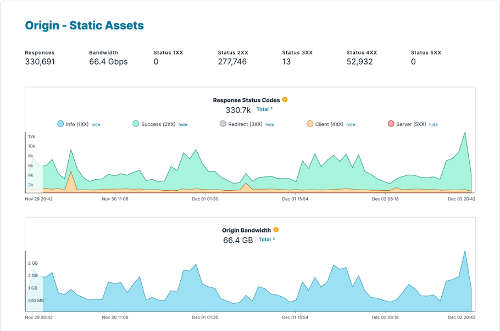
    Fastly, Inc. this week added a set of observability tools to its portfolio that are optimized for edge computing platforms connected to its content delivery network (CDN).

    Laura Thomson, senior vice president of engineering at Fastly, said the company is now providing a set of tools that enable DevOps teams to capture logging data and metrics in real-time via a single console.

    The first two available tools are Origin Inspector—to observe network traffic flows including HTTPS response codes—and Domain Inspector—to access metrics based on both historical and real-time data. In total, Fastly is now providing access to more than 200 metrics spanning client, origin, cache, web application firewall (WAF), Compute@Edge, Image Optimization services and others that cover 100% of the data generated since the service was spun up.

    There is no sampling of data, and the company is also providing integrations with 33 storage and analysis services provided by either Fastly or a third party, noted Thomson. IT teams can now log any aspect of HTTP requests and responses through a large variety of logging formats, including the Common Log Format, JSON or as a key/value store. IT teams can also store their own logs to make sure they retain complete control over access.

    Over the next several months, Fastly will continue to expand this portfolio of observability tools, including an Edge Observer dashboard it is providing to customers that are deploying applications at the edge, added Thomson.

    In general, observability tools are being used to not only improve processes and overall customer experience but also identify and block suspicious activity. Fastly is making a case for observability tools that enable DevOps teams to achieve those goals without necessarily having to deploy a separate observability platform.

    Of course, most DevOps teams have been continuously tracking various pre-defined metrics for years. Observability tools, in contrast, are designed to make it feasible to interrogate logs, metrics and traces so that IT teams can discover issues before there is a disruption to services. The challenge, of course, is that not every IT team necessarily knows how to shape the queries required to discover the root cause of a potential issue.

    One way or another, DevOps teams will need to be able to remotely diagnose edge computing issues as the number of workloads deployed on these platforms expands. IT teams are not going to be able to travel to the physical location of every edge computing platform every time an issue arises. In many ways, the rise of edge computing will force a transition to observability tools that will enable IT teams to more proactively manage IT environments rather than respond after a metric has already exceeded its threshold.

    It’s not clear to what degree that approach will prevent IT issues from occurring, but the amount of time required to detect and remediate issues should dramatically decline as more visibility into IT environments, including edge computing platforms, is gained.

  • Rust Momentum Intensifies | Elon Says No WFH

    Rust Momentum Intensifies | Elon Says No WFH

    Welcome to The Long View—where we peruse the news of the week and strip it to the essentials. Let’s work out what really matters.

    This week: People won’t shut up about Rustlang, and Musk mandates Twitter teams return to the office. (more…)

  • GitHub Previews Free CI/CD Migration Tool Due in 2023

    GitHub Previews Free CI/CD Migration Tool Due in 2023

    At its GitHub Universe event, GitHub today unveiled a bevy of updates to its cloud service, including a forthcoming set of migration tools. The tools will automate migrations from legacy continuous integration/continuous delivery (CI/CD) platform to GitHub Actions.

    GitHub Actions Importer is already being used by a small group of enterprise IT organizations to migrate workflows and template the GitHub CI/CD platform.

    Damian Brady, senior manager for developer advocacy at GitHub, told conference attendees that these free tools will become more broadly available in 2023. GitHub Actions Importer will be distributed as a Docker container that manifests itself as an extension of the GitHub command line interface (CLI).

    One of the biggest challenges the company has faced in driving adoption of its platforms is that many DevOps teams don’t want to rebuild the templates and workflows they are already using on their existing CI/CD platform, he noted.

    Other GitHub Actions extensions include native integration with software development tools for building internet-of-things (IoT) applications and support for personal access tokens (PATs) that enable more granular control over permissions and repository access.

    Other security capabilities include expanded access to audit log events in the enterprise edition of GitHub, an ability for maintainers of open source repositories to privately share vulnerability reports and support for Ruby as one of the programming languages now supported by a CodeQL tool for discovering vulnerabilities.

    Additional extensions to existing services for developers also were previewed, including an ability to interact with the GitHub Copilot tool for automating code writing using voice commands. Dubbed “Hey, GitHub!” the tool is available as an experiment being advanced by the GitHub Next research team.

    Finally, the company previewed enhancements to code search-and-view capabilities in the Codespaces tool that will now be made available for free for up to 60 hours per month to developers.

    GitHub claims its CI/CD platform is now being used to process 10 million builds a day, most of which are employing code accessed via its repository. It’s not clear how that compares to other CI/CD platforms, but it’s apparent the GitHub Actions CI/CD platform has gained a significant amount of traction as GitHub continues to make a case for creating tighter integrations between its repository and CI/CD platform. GitHub is also clearly signaling it will spend a lot more time wooing organizations that already have a legacy CI/CD platform installed.

    In the meantime, the next era of DevOps has arrived as workloads become both more complex to build and deploy across highly distributed computing environments. Many of the CI/CD platforms that organizations deployed are now straining under the weight of multiple customizations and extensions that have been made over the years. Each DevOps teams will need to decide whether maintaining those platforms makes the most technical and economic sense or if they should migrate to a more modern platform.

    Regardless of what they decide, one thing that is certain is that DevOps teams won’t be getting larger, so the need to invest in higher levels of automation has become pressing.

  • CloudBees Demos Orchestration Capabilities of ReleaseIQ Platform

    CloudBees Demos Orchestration Capabilities of ReleaseIQ Platform

    At the online DevOps World 2022 event today, CloudBees demonstrated for the first time the capabilities of the application release management platform it gained last month through the acquisition of ReleaseIQ.

    Shawn Ahmed, chief marketing officer and interim chief product officer at CloudBees, told conference attendees that the ReleaseIQ platform will provide application development teams with visibility into precisely how their code is making it into production environments.

    Armed with those insights, it then becomes possible to understand exactly how the way commits are made during a build process are, for example, creating a workflow bottleneck, he added.

    The ReleaseIQ platform is designed to enable DevOps teams to both create and maintain pipelines using a no-code tool. That enables greater transparency into workflows via dashboards that also provide optimization recommendations.

    CloudBees already provides a Flow orchestration engine within its continuous delivery platform. However, ReleaseIQ provides a similar capability across multiple continuous integration/continuous delivery (CI/CD) platforms using a SaaS platform that is more accessible. ReleaseIQ can also be integrated with multiple platforms including CloudBees CI, Jenkins, CircleCI, GitLab, Bamboo, ArgoCD and others.

    Naturally, the current level of DevOps maturity varies widely by organization. However, as more organizations realize how much they depend on software to drive digital business transformation processes, the need to further automate application development and delivery becomes more apparent. While CI is widely used today, the number of organizations that have consistently implemented CD to automate application release management is still fairly limited. The underlying infrastructure that software is deployed on typically has a unique set of application programming interfaces (APIs) that each CD platform needs to support. Platforms such as ReleaseIQ provide a higher level of abstraction that simplifies managing the pipelines that deliver software.

    CloudBees is essentially positioning ReleaseIQ as the orchestration engine for both unifying pipeline management and, ultimately, enabling value stream management across increasingly complex application development environments. It may take a while to fully realize that ambition, but with the acquisition of ReleaseIQ, the company is now pursuing a more cloud-centric approach toward enabling DevOps teams to, for example, more easily reuse pipelines.

    DevOps teams, of course, have created a lot of scripts over the years to provide orchestration capabilities. The issue is that those scripts tend to be brittle in the sense they don’t scale especially well over time. They also tend to be poorly documented and challenging to maintain if the script writer leaves the organization. It’s not uncommon for new members of a DevOps team to replace a script with one they wrote simply because they’re more familiar with how it’s constructed.

    More than a decade after the launch of the Jenkins CI/CD platform, there are still plenty of manual DevOps processes that should be more automated. A no-code orchestration platform may prove to be a significant step toward automating a wide range of tasks that consume more time than they should.