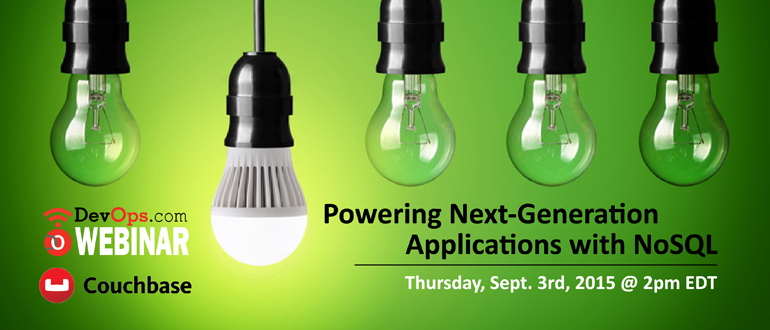
Today’s enterprise applications require extreme database performance and scale to keep up with growing business and user demands.
In the past, scaling your database meant adding more nodes to your clusters, regardless of what services those clusters powered. Now, with features like multi-dimensional scaling, enterprises can optimize their database infrastructure with unparalleled precision to power the next generation of business applications.
Join Shane Johnson, Sr. Product Marketing Manager at Couchbase, as he discusses the shift to next-generation enterprise applications and how NoSQL databases like Couchbase power them.
Topics include:
How a shifting business model is fueling the need for next-gen apps
The important characteristics that make these new apps different
Strategies for funding, building, and succeeding with your company’s next-gen apps
Alan Shimel, Editor-in-Chief devopsy.kinsta.cloud, An often-cited personality in the security and technology community and a sought-after speaker at industry and government events, Alan has helped build several successful technology companies by combining a strong business background with a deep knowledge of technology.
Shane Johnson is the Manager of Product Marketing at Couchbase. Prior to Couchbase, he occupied various roles in developing and evangelism with a background in Java and distributed systems. He has consulted with organizations in the financial, retail, telecommunications, and media industries to draft and implement architectures that relied on distributed systems for data and analysis.
In this webinar we’ll discuss the basics of SSH authentication – passwords, keys, and MFA, oh my! We’ll also investigate some common patterns of key propagation — how do you get your users’ keys onto the appropriate machines — including:
* Manual distribution
* LDAP
* Puppet/Chef configuration
* Advanced techniques
We’ll also highlight the different challenges involved when doing this against different IaaS vendors (AWS and GCE), in a locally-hosted environment, and in the hybrid of the two.
Alan Shimel, Editor-in-Chief devopsy.kinsta.cloud, An often-cited personality in the security and technology community and a sought-after speaker at industry and government events, Alan has helped build several successful technology companies by combining a strong business background with a deep knowledge of technology.
About the Panelists
Topher Marie, CTO of JumpCloud
Topher is the CTO and Co-Founder of JumpCloud. Previously he spent five years at Symplified as its lead engineer holding a variety of titles including Architect and Development Manager. The bulk of his time was spent wrestling with the concepts and mechanisms of provable identity – SAML, IWA/Kerberos, PKI, OAuth, OpenID, and multi-factor authentication to name a few. Topher holds Bachelor and Master of Science degrees from the Colorado School of Mines in the area of Math with emphasis in Computer Science. He also spent several subsequent years at that university as a part-time professor for both computer science and pure math courses.
The concepts of communication, collaboration, abstraction, automation and orchestration are cornerstones of the rapidly growing DevOps movement. At the same time, reliance on elastic infrastructure has exploded, making manual security provisioning and management infeasible. Applying security policies based on static parameters and making manual rule changes just before production leaves little time for provisioning the policies. This impacts release quality, increases risk of errors and slows down the DevOps cycle. Now security teams have an opportunity to learn from the DevOps experience.
Attend this informative webinar to learn:
Common pitfalls associated with using traditional security solutions in DevOps environments
Key ingredients to look for in a security solution that matches the speed of DevOps
Real-life case studies of companies who have adopted DevOps methods to security
Alan Shimel, Editor-in-Chief devopsy.kinsta.cloud, An often-cited personality in the security and technology community and a sought-after speaker at industry and government events, Alan has helped build several successful technology companies by combining a strong business background with a deep knowledge of technology.
Amrit Williams has more than 20 years of experience in information technology and is currently the CTO of CloudPassage. Previously Amrit was the Director of Emerging Security Technologies and CTO for mobile computing at IBM. Prior to IBM, Amrit was a research director in the Information Security and Risk Research Practice at Gartner, Inc. where he covered vulnerability and threat management, network security, security information and event management, risk management, and secure application development. Previously, Amrit was a director of engineering for nCircle Network Security, and undertook leadership positions at Consilient Inc., Network Associates, and McAfee Associates.
Continuous delivery (CD) of applications is rapidly becoming a differentiator in this application economy. CloudBees, the enterprise Jenkins company, recently announced the availability of the CloudBees Jenkins Platform to help organizations adopt CD. This new enterprise offering from CloudBees brings CD to the masses with the new Team Edition, while enabling enterprise CD deployments powered by Jenkins at scale with the Enterprise Edition. At the same time, the Jenkins open source community, in conjunction with CloudBees, released six new plugins to support the use of Docker containers within Jenkins-powered CD and CI processes. Docker is powerful new technology that allows teams focused on delivering software to standardize their development and production application environments for reduced risk and accelerated application delivery. Leveraging Docker containers in a CD process managed by Jenkins is the ultimate way to deliver better software faster.
Join Tracy from CloudBees as she talks about Cloudbees’ new enterprise offering and the changes happening in the Jenkins community to provide first class support for Docker in the creation of CD pipelines. In this webinar, Tracy will introduce features in the latest release of the CloudBees Jenkins Platform to
help manage Jenkins’ across the organization and walk through six common delivery patterns with Jenkins and Docker. Tracy will then tie it all together with a demo of an end-to-end delivery pipeline with Docker.
Continuous delivery with Jenkins and application containerization with Docker are rapidly becoming two of the foundations of the DevOps movement. Check out this webinar to learn how you can adopt these new tools and techniques in your own DevOps transformation.
Alan Shimel, Editor-in-Chief devopsy.kinsta.cloud, An often-cited personality in the security and technology community and a sought-after speaker at industry and government events, Alan has helped build several successful technology companies by combining a strong business background with a deep knowledge of technology.
About the Panelists
Tracy Kennedy is an associate product manager for CloudBees and is based in Richmond, Virginia. Prior to her current role, Tracy has worked at CloudBees as a solutions architect and a developer success engineer. In her free time, she enjoys rock climbing, grand strategy games, and reading. Read more about Tracy in her Meet the Bees blog post and follow her on Twitter.
Udaypal Aarkoti is the Director of Solution Architecture at CloudBees. He believes in complete end to end automation and that continuous delivery is the future of application delivery. Prior to CloudBees he lead the middleware solution architecture team at Red Hat.
In the application economy, you have to deliver software as if your business depends on it … because it does! It’s a bold statement, but true. Think of nearly every interaction a person might have today—be it for work, commerce or play. Most have a digital dimension, which relies on digital technology and platforms.
In order to survive and grow, every company needs to become a technology company and every business needs to become a digital business. Successful transformation requires Continuous Delivery, the new business imperative that enables you to rapidly develop and deliver applications that drive superior user experiences and engage your customers and staff.
But the traditional “software factory” or process for transforming an idea into a customer experience is throttled by a number of bottlenecks in the delivery pipeline. That means delivering innovative, high-quality applications, faster and more frequently can be a chaotic and complex process, particularly if your application delivery systems and processes were designed to only push out one or two releases a year.
Join moderator Alan Shimel, devopsy.kinsta.cloud; and experts Georg von Sperling, DevOps and Technology Evangelist at CA Technologies and Julie Craig, Research Director at Enterprise Management Associates (EMA) on July 21, 2015 to discuss ways to overcome today’s application economy challenges with solutions designed to transform your software delivery lifecycle into a continuous delivery pipeline of digital innovation.
Recorded: Tuesday, July 21, 2015
Recording
Q&A
1. Based on your experience tell me : continuous delivery versus traditional development. The continuous delivery model is perfect for every business ?
GvS: As a goal, yes, absolutely. Because continuous delivery practices enhance what is already being done and simply promote good behavior over creation of waste. Removing bottlenecks to increase quality, frequency and velocity simply makes sense, regardless of the business you are in. Now, that said, continuous delivery is not necessarily perfect for every business if you define it as continuously delivering to production. But what development organization would shun away from getting early and amplified feedback in User Acceptance Test (UAT)? To accomplish this, you still require every one of the concepts in continuous delivery.
ANBU: If you think of achieving Continuous delivery as a means to achieve modularity & lose-coupling in order to achieve higher workforce productivity, every business will be motivated to do it. As a concept, it is perfect for every business, but the objectives of the process and their order of their importance will vary industry to industry. As long as you make these adjustments, you will benefit a lot.
2. One of our struggles is the impact of Continuous Delivery on our Environment Strategy and the Mechanics used to maintain them. For example, applications dependent on other applications / components will require those other applications / components in the environment infrastructure in which testing is occurring. How do you see Compnay Environment Strategies changing to support Continuous Delivery? When does it become necessary to change an application’s architecture to reduce or remove these dependencies? Or are there testing methodologies that can accurately test changes without the need for large QA Environments?
GvS: The path with the least resistance is seemingly learned from the airplane manufacturing industry. When there is a new wing design that is required to undergo quality validation, the dependent systems and datasets are so complex, they could not have ever released those designs if they threw up planes into the air with different passenger or luggage loads (data) in different weather conditions (environment) attached to a full airplane body (dependencies). Likely, this would have resulted in the same adverse effects that we experience when pushing a digital asset from our IDE to the first environment – often catastrophic. Virtualizing dependent services with actual behavior – just like in a wind tunnel – is a good approach. This also allows discovery of the dependencies in consumable, shareable format which, should you find additional needs to revisit the architecture, actually aid in the process of redesign.
ANBU: I would recommend a model-based approach in your situation. In your stated example, if you model ‘infra-as-code’ and try to achieve modularity at that level, so that developers and testers call it out during their plan/design/development process to make their ‘availability and use’ defined, the problem can be solved. It requires an assessment on all the functional components (infra included) in order to model it. There are tools out there that would help you achieve such a modeling.
3. How do you measure the success of DevOps other than faster & quality releases? are there any metrics that can be collected periodically?
GvS: In the context of Continuous Delivery, there are many metrics that can and should be captured. Many more in the context of DevOps. We could likely devote an entire session on this. Let me focus, however, on continuous delivery metrics. On top of focusing on business-oriented outcomes, much like in DevOps, some operational metrics could be captured. Examples are:
– Lead time to production. Measuring cycle time from the work starts to the time the team’s definition of ‘done’.
– Defect resolution time. Really successful teams can fix defects as quickly as they are discovered. The more left-shifted the defect discovery is, the more quickly they are resolved.
– Production defect leakage. Measure both: new defects found and defects previously found and still made it to production.
– Defects. It is bad enough to ship buggy apps. Continuously doing so is even more terrible. Measure at each stage in the cycle, and notice a left-shift if CD is going well.
– Broken build time. The longer a build sits around broken, the commitment to quality is just not there.
– Production downtime during deployment. If you achieve zero-downtime, you can stop measuring here.
– Regression test duration. Teams with manual practices will measure in months or weeks. CD teams will likely measure in minutes or hours. Also include lead-time to regression test.
– Performance test outcomes. If you find tons of functional bugs in performance testing, there is likely a bottleneck not addressed early in the cycle.
– Touches. Number of tickets, emails or other communication required to do a deployment in each stage. If it isn’t “zero-touch”, there is improvement potential.
This is not a complete list, but certainly one to start with
ANBU: GVS’s response is complete.
4. How do you get legacy code/systems into the CD model? Or is CD only for new code/projects/systems?
GvS: The practices advocated with CD aren’t specific to the tenure of the project or the age of the technology. They are arguably all good practices and make perfect sense. Now, if you are an enterprise on the journey to adopt CD practices, the recommendation is certainly to begin with projects that have the highest business impact. A good heatmap analysis does go a long way to begin. If it turns out that it is your legacy code/system, so be it. Parallelize work streams, accelerate quality and automate & orchestrate the delivery pipe.
ANBU: Legacy code/systems are generally monolithic/tightly coupled. Hence the problem. Unfortunately, they are also part of the corporate string of applications, so we can’t stay away from them. We have seen examples where these systems stay as one ‘component/workstream’ and plug into the larger CD stream, creating a hybrid-model. Yes it is not perfect, but will help you implement CD. Additionally, the maintenance/re-engineering of these legacy systems are opportunities to change the code to adopt to the larger CD strategy that you put in place. If they are truly legacy, there won’t be major ‘patch’ work so they stay what they are.
5. How do you reconcile product management with CD, i.e., the definition of a story to encapsulate a deployable or atomic element that can be delivered? Often times stories are part of a larger epic that needs to be delivered as a whole and not on their own. so the issue is deploying atomic units/stories creates the fear of delivering partial functionality. How does a business deal with this and overcome this
GvS: If you pardon me, but it seems a misinterpretation of CD itself. Deployment and delivery are two, if not three, different things. I believe you may have latched onto the “live” deployment of an atomic change to production. Given the right strategy in modeling the pipeline itself, all CD elements are still valid, the atomic element may go “live” with many other atomic elements. BUT, unlike in the past, the fear of failure in that deployment is minimized as quality drastically improved and, the same, already tested, processes are utilized to set the atomic unit “live” as have been validated in lower environments. It is a journey.
ANBU: one of the benefits of CD is achieving the readiness of production deployment of (ALL or SELECT atomic units) on a push of a button. It does not force you (but you have the choice) to deploy every atomic unit into production If what you said “larger epic as a whole or none” is important, then your definition of the ‘select’ atomic units should correlate to it. Configuration mgt and release mgt should have proper ‘gates’ to make sure that they roll-out properly.
6. My question on metrics is because in legacy orgs it takes a lot more time & energy to get to CD, so measurement through metrics is critical.
GvS: Absolutely, metrics and measurement go hand-in-hand. Looking at CALMS (Culture, Automation, Lean, Measurement and Sharing) for guidance, influencing the organizational culture through measurement and sharing which both are derived from automation is the nirvana. Along with the will of the IT organization, there also has to be executive buy-in to the strategy. Yes, grass-roots is fine, but a lot can get accomplished if the company stands behind the strategy. Having defined positive business outcome metrics as part of that journey helps reinforce that postion.
ANBU: Agree with GVS.
7. What is the Quality as a result of continuous delivery? What is the tradeoff with respect to the Business impact to defect leakages in production?
GvS: Quality metrics should show drastic improvement if CD tenants are implemented. There was a question on metrics already. This is not about continuously deploying bad code, which really just makes things worse, but about continuously delivering, where quality is certainly a determining factor.
ANBU: You need to baseline ‘quality’ before and after CD. There is an absolutely no way, these measures should negatively trend, if you properly implement CD. Defect leakage in any model will have the same implications, just that in CD – the mean time to resolve (MTTR) these issues should be faster.
8. For a business to adopt a CD model, doesn’t all disciplines/functions have to change to suit the atomic delivery concepts.
GvS: Once nirvana is achieved, likely there was a change in all disciplines and functions. It is a journey that must begin. The imperative is there for the business. But, much discussed in the context of DevOps as well, CD is a journey of transformation – not something you do in a day.
ANBU: YES. this is a life-cycle process, hence the impact is for everybody. But you can start from one unit/organization and spread it out to evolve it. if you have the luxury, start a new project/unit with CD as the foundation.
9. How do you see ITIL and DevOps interacting to maximize the benefits of continues delivery?
GvS: There is a great amount of synergy between the two. And actually, how much easier would it be to have “Standard Changes” in the change management process, enrich a CMDB with actual data that isn’t stale, have service models up to date and have focused problem management.
ANBU: A well defined devops strategy can help you implement ITIL more effectively. Configuration management and release management are two particular areas where the ITIL can provide the maximum benefits to the CD strategy.
10. Jez Humble and David Farley suggest not using feature branching, because this incourages back room channel development, and to only use the master branch to do CD, but other companies in this space says feature branching is ideal because git-flow encourages this, is there a prefered strategy in your branching strategy to do CD. Is there a need to better define what is meant by ‘continuous delivery’? I am concerned with people stating that CD means code gets in untested (which is from my understanding an anti definition) and fully tested code is a part of CD.
GvS: I believe Jez’ argument, and I agree, is why it is essential to have a deployment pipeline that is triggered off trunk to ensure all necessary validations, including functional testing. A deployment pipeline is a pattern that organizations adopting CD use. The key is that the validations should be performed against a build off mainline. I also advocate a number of good approaches that help in the validation effort, such as automating the generation of functional tests and having the right data sets available for relevant validations.
ANBU: No comments.
11. Does continue delivery means continuous Deployment to production? For Horses, frequency of deployment is not too frequent but they would still need to have Continue delivery to achieve benefits of Test Automation, Agile Methodology etc.
GvS: I would argue no. Continuous delivery does not equate continuous deployment to production. If I may be so bold, I would state continuous delivery is a practice to allow deployment to production at any time with a high degree of quality and a low amount of risk with zero downtime and zero touch. A business leader recently said to me that whereas, in the past, “deployment to production was an IT decision, it is now a business decision at a push of a button”. But, CD certainly played a part in this paradigm shift, as the entire delivery process, including testing, is visible and predictable.
ANBU: Continuous Production deployment is not the ultimate goal of CD. It is to let you manage multiple workstreams in parallel as atomic units, accelerate quality through high degree of automation and provide an ability to learn/continuously improve the processes. By means of this, you make your changes ready to be deployed faster than you normally do. You should aim to achieve the frictionless automation across the life-cycle, not just in QA activities.
Your Host
Alan Shimel, Editor-in-Chief devopsy.kinsta.cloud, An often-cited personality in the security and technology community and a sought-after speaker at industry and government events, Alan has helped build several successful technology companies by combining a strong business background with a deep knowledge of technology.
About the Panelists
Julie Craig, Research Director at Enterprise Management Associates (EMA)
At EMA, Julie’s focus areas are Application Management, public and hybrid Cloud, Integration Technologies, DevOps/Continuous Delivery, and Application Performance (APM). Julie has over 20 years of deep and broad experience in software engineering, IT infrastructure and integration engineering, and enterprise management. Her experience in commercial software companies included development of communications interfaces and management of programming teams. Georg von Sperling, DevOps and Technology Evangelist at CA Technologies
Helping organizations adopt Continuous Delivery without creating more technical debt, Georg is a practitioner, an evangelist and a general geek on software development methodologies, technology, patterns, systems and delivery practices. He advises, helps customers visualize, plan and implement transformational approaches to delivering digital assets from idea to production for medium to large enterprise organizations.
Anbu G. Muppidathi, Vice President at Cognizant Technology Solutions
Anbu has over 25 years of experience in the IT industry and is with Cognizant for the past 20 years. Anbu’s customer management responsibilities include advising the C-suite on breakthrough thinking, competitiveness, strategy, operations and transformation. His business management responsibilities include strategizing on QE&A business unit’s growth, managing the customer relationship, delivery and business operations for the customer engagements in Americas. Prior to QE&A, Anbu was with Cognizant’s Banking & Financial Services vertical for more than a decade managing a large portfolio of North American customers.
The financial services industry has changed more in the last 15 years than in the previous thousand. Customers expect constant access through secure mobile interactions with providers; interactions that no longer take place within the four walls of a bank. At the same time, financial services companies are dealing with ever-growing regulation.
Join Sander Ettema, Manager, Linux Infrastructure Services at Rabobank and Andrew Phillips, VP, Products for XebiaLabs as they examine how Rabobank has transformed its software delivery by implementing Agile development, Continuous Integration and Continuous Delivery. Learn tips on how to stay ahead of the curve in an age where the competitive landscape is shifting at light speed and rapidly moving beyond other financial services companies to include tech giants like Google and Apple.
Attend and learn how to:
Create a culture of innovation and adapt your IT organization for rapid change.
Deliver on customer expectations by modernizing your IT software delivery landscape with an open platform for Continuous Delivery.
Get started quickly and leverage your existing IT infrastructure for rapid results and understand the key metrics to watch along the way.
Lead an IT transformation in the highly regulated environment of financial services.
Alan Shimel, Editor-in-Chief devopsy.kinsta.cloud, An often-cited personality in the security and technology community and a sought-after speaker at industry and government events, Alan has helped build several successful technology companies by combining a strong business background with a deep knowledge of technology.
About the Panelists
Andrew Phillips
VP, Products, XebiaLabs
Andrew Phillips heads up product management at XebiaLabs where he drives product direction, positioning and planning. He is an evangelist and thought leader in the DevOps, Cloud and Delivery Automation space.
Sander Ettema
Manager, Infrastructure Linux Services, Rabobank
Sander Ettema manages Linux/Unix Infrastructure Services for Rabobank, a global leader in food and agri financing and sustainability-oriented banking. In addition to being a member of the DevOps workgroup, Sander oversees Linux/Unix/Appliances Hosting, Continuous Delivery services for Java as well as log management services.
As large organizations become increasingly dependent on software to stay competitive, application complexity grows. As this happens, managing deployments manually becomes more difficult and slows down the pace of business.
Join Amy DeMartine, Sr. Analyst at Forrester research and Rohit (RJ) Jainendra, Chief Product Officer at Electric Cloud, as they discuss:
How Application Release Automation (ARA) solutions eliminate error-prone manual work, decrease risk and increase uptime
The critical features required from an ARA solution to help Infrastructure and Operations teams in large organizations overcome modern service delivery challenges
Tips, best-practices and tools for overcoming the challenges of ARA at scale
Recorded: Tuesday, June 30th , 2015
SLIDES
[seoslides embed_id=”9a74743c6933″ script_src=”https://devopsy.kinsta.cloud/embed-script/ara-electric-cloud/8309/” overview_src=”https://devopsy.kinsta.cloud/slides/ara-electric-cloud/” site_src=”https://devopsy.kinsta.cloud” site_title=”devopsy.kinsta.cloud” title=”ARA- Electric Cloud” /]
Your Host:
Alan Shimel, Editor-in-Chief of devopsy.kinsta.cloud. An often-cited personality in the security and technology community and a sought-after speaker at industry and government events. Alan has helped build several successful technology companies by combining a strong business background with a deep knowledge of technology.
Panelists:
Amy DeMartine is a member of Forrester’s Service Delivery team. Amy’s current research is the strategy, design, organization, and implementation of modern service delivery created through methods such as DevOps and resulting in continuous delivery. Amy holds a master’s degree in Telecommunications and a bachelor’s degree in Electrical and Computer Engineering from the University of Colorado.
Rohit Jainendra engages with customers to drive Electric Cloud’s product roadmap and leads the product teams which design, build and deliver products that accelerate the software delivery process. RJ previously served as Vice President at Serena Software and was Chief Architect at Rubiconsoft. RJ holds a Master of Science degree in Computer Science from the University of Wisconsin and a Bachelor of Science degree in Computer Science from Angelo State University.
Redis provides a fast and persistent memory storage system, superior caching, and the ability to support multiple data types. Redis functions differently from other key-value stores or databases that IT teams have used in the past. These differences can lead to issues such as memory swapping, latency in processing commands and key deletions. All can impact application performance if not addressed.
Identifying and resolving issues originating in Redis requires an understanding of how this key-value store works as well as visibility into its performance metrics. In this webinar, Matt Williams, Datadog’s Evangelist, and In this webinar, Matt Williams, Datadog’s Evangelist, and Dave Nielsen, Redis Labs’ Developer Advocate, will show you:, will show you:
How and where to access critical Redis data
How to interpret Redis metrics to detect issues
How to resolve these issues, or avoid them all together
Recorded: Tuesday, July 7th, 2015
RECORDING
SLIDES
[seoslides embed_id=”dffd58b512c0″ script_src=”https://devopsy.kinsta.cloud/embed-script/the-top-redis-metrics-that-matter/8192/” overview_src=”https://devopsy.kinsta.cloud/slides/the-top-redis-metrics-that-matter/” site_src=”https://devopsy.kinsta.cloud” site_title=”devopsy.kinsta.cloud” title=”The Top Redis Metrics that Matter” /]
Your Host:
Alan Shimel, Editor-in-Chief devopsy.kinsta.cloud, An often-cited personality in the security and technology community and a sought-after speaker at industry and government events, Alan has helped build several successful technology companies by combining a strong business background with a deep knowledge of technology.
About Panelists:
Matt Williams is the DevOps Evangelist at Datadog. He is passionate about the power of monitoring and metrics to make large-scale systems stable and manageable. He tours the country speaking and writing about monitoring with Datadog and when he’s not on the road, he’s coding. You can find Matt on Twitter at @technovangelist.
Dave Nielsen recently joined Redis Labs as a Developer Advocate where he organizes and leads workshops and hackathons to help developers create real-time and scalable apps running on Redis. Prior to joining Redis Labs, Dave was the co-founder and lead organizer of CloudCamp, a community of Cloud Computing enthusiasts and community organizers in 100+ cities around the world. You can find Dave on Twitter at @davenielsen.
You may already have a good understanding of the hybrid cloud and its benefits. But how do you get the value of the last three decades of investment in your backend infrastructure into the hands of your end users faster?
In this webcast we will demonstrate how you can take advantage of the latest IBM technologies to quickly and easily incorporate your backend services into your mobile applications running on IBM Bluemix. We will also highlight the latest capabilities of IBM DevOps Services (IDS) and IBM Bluemix that support the end-to-end mobile development lifecycle.
Join Kristal York, Executive Mobile Strategist, PointSource an IBM Business Partner and Rosalind Radcliffe, Distinguished Engineer, Chief Architect for CLM and DevOps as they take you on an in-depth tour of the IBM DevOps Services and Bluemix, an open-standard, cloud-based platform for building, managing and running mobile apps that connect with your back-end services securely.
Recorded Thursday, June 25, 2015
VIDEO
SLIDES
[seoslides embed_id=”2e765888697b” script_src=”https://devopsy.kinsta.cloud/embed-script/build-test-and-deploy-mobile-apps-with-back-end-mainframe-services-securely-in-a-hybrid-cloud/7999/” overview_src=”https://devopsy.kinsta.cloud/slides/build-test-and-deploy-mobile-apps-with-back-end-mainframe-services-securely-in-a-hybrid-cloud/” site_src=”https://devopsy.kinsta.cloud” site_title=”devopsy.kinsta.cloud” title=”Build, test and deploy mobile apps with back-end mainframe services securely in a hybrid cloud” /]
Your Host:
Alan Shimel, Editor-in-Chief devopsy.kinsta.cloud, An often-cited personality in the security and technology community and a sought-after speaker at industry and government events, Alan has helped build several successful technology companies by combining a strong business background with a deep knowledge of technology.
About Panelists:
Kristal York, Executive Mobile Strategist, PointSource an IBM Business Partner
Kristal joined PointSource in 2012 and has led teams in the financial, retail and insurance verticals. She excels at fostering a collaborative environment and leading others to solve complex business problems. Kristal’s prior experience as a business analyst has helped as a mobile strategist to define and analyze our customer’s mobile moments. She translates those mobile moments into a mobile strategy across the organization’s business processes and systems. Mobile demands an iterative approach so Kristal helps analyze strategic planning, usability, research, as well as consistent updating. She uses her business analytics skills to help define adoption rates and sentiment analysis once the app is launched. Previously, Kristal was at Cartus for 12 years, most recently Senior Business Analyst, Business Analytics and Mobile Product Owner.
Rosalind Radcliffe, Distinguished Engineer, Chief Architect for CLM and DevOps, Member of the Academy of Technology
A Distinguished Engineer within the IBM organization, Rosalind is Chief Architect for CLM and DevOps. She is responsible for driving the DevOps for multi-platform architecture; this includes System z and Power system.
Back in April we were proud to partner with RSA Conference, IT Revolution, Sonatype, TheNexus and RuggedSoftware.org to bring DevOps Connect: SecDevOps to the Moscone Center. It was a full day of great DevOps and Security presentations. For me personally it succeeded beyond my wildest dreams of highlighting the intersection of DevOps and Security.
The line up of speakers and topics that day was extraordinary. In no particular order:
Gene Kim/Josh Corman – Rugged DevOps: Going Even Faster With Software Supply Chains
Jez Humble – Continuous Delivery
David Mortman – DevOps Myths Versus Real World Realities
Constantine Aaron Cois – DevOpsSecFail: DevOps Security Anti Patterns
Terri Potts – Leading a Horse to Water and Enticing Him to Drink
Nick Galbreath – BYOD: Bring Your Own Dependencies
Jessica Devita – No White Boards Allowed
Rich Mogull – Building Your SecDevOps Toolkit
Dan Cornell and Kris Curylo – Blending the Automated and the Manual
Damon Edwards and Alex Honor – Coaches and Toolsmiths
Dan Cundiff – Why DevOps != the Wild West and How Embracing it Can Improve Security
Chris Corriere – Automating Enterprise Security
Chris Walsh – I’m the New Security lead, and I’m Here to Help
The good news is we had hired professional video crew to tape all of the presentations. Then through the efforts of Mark Miller and Derek Weeks of Sonatype the actual presentations were edited into the videos, creating a fantastic video recreation of the sessions. Here is a short preview of sessions:
In all there are over 10 hours of fantastic DevOps content here spread over the 14 presentations. Through TheNexus and devopsy.kinsta.cloud we are making them available to you free. The only obligation is your fill out a registration form.
Please note that the form submission will generate an email to verify your identity. You can access the entire video library via that email. We ask that you please not share the URL of the videos and instead direct viewers to this page or TheNexus to download for themselves.
Also, if you are attending InfoSecurity Europe this week, be sure to check out DevOps Connect: Rugged DevOps, Thursday, June 4 all day at the Olympia. Here is the lineup:
Agenda
8.30- 9.00 Meet and Greet
9.00-9.10 Introductions: Alan Shimel and Wai Man Yau
9.10-9.50 Keynote Presentation: Dr. StrangeOps: How I Came to Embrace Rugged DevOps & SW Supply Chains, Joshua Corman, CTO, Sonatype and Rugged
9.50-10.30 Maintaining Control While Letting Go, Gareth Rushgrove, Puppet Labs
10.30-11.00 Security at Speed; Best Practices for a Secure DevOps Implementation, Florin Coada, IBM
11.00-11.30 The DevOps Toolkit, Helen Beal, Head of DevOps, Ranger4 Limited
11.30-12.00 A Manifesto for High Velocity Compliance, Justin Arbuckle, Vice President, EMEA & Chief Enterprise Architect, Chef
12.00-13.00 Opportunity to visit the Infosecurity Europe Exhibition
13.00-13.30 Secrets Within Your Java-Based Software Supply Chain, Derek Weeks, VP, Sonatype & DevOps Advocate
13.30-14.00 Automating Security Tests for Continuous Integration, Stephen de Vries, CTO, Continuum Security
14.00-14.30 SecDevOps 2.0- Managing your Robot Army, Elizabeth Lawler, CEO and CoFounder, Co-Founder Conjur Inc
14.30-15.00 Case study: DevOps Cost-Effectively Secured Quality and Time-to-Market for a Complex Hardware/Software Network Product, Marc Hornbeek, Senior Solutions Architect, Spirent Communications
15.00-15.15 Afternoon break
15.15-15.45 DevOps: How the Industrial Revolution Got Us Here, Jonathan Fletcher, Enterprise Architect – Technology & Platform (DevOps) Lead
15.45-16.15 Transforming to Devops in the Enterprise, Benjamin Wootten, Co-Founder, Contino
16.15-16.45 SecDevOps: From Zero to $2.5B Revenue in 18 Months, Justin Lundy, CIO/CTO, Evident.io
16.45-16.50 Thank you and close, Alan Shimel and Wai Man Yau
 Alan Shimel, Editor-in-Chief devopsy.kinsta.cloud, An often-cited personality in the security and technology community and a sought-after speaker at industry and government events, Alan has helped build several successful technology companies by combining a strong business background with a deep knowledge of technology.
 Shane Johnson, Sr. Product Marketing Manager, Couchbase
 Topher Marie, CTO of JumpCloud
 Amrit Williams, Chief Technology Officer, Cloud Passage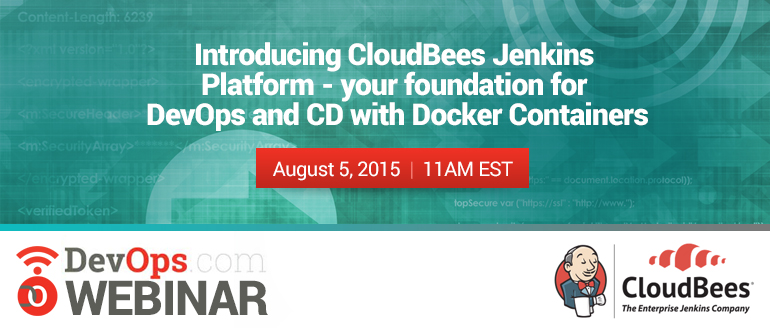
 Tracy Kennedy is an associate product manager for CloudBees and is based in Richmond, Virginia. Prior to her current role, Tracy has worked at CloudBees as a solutions architect and a developer success engineer. In her free time, she enjoys rock climbing, grand strategy games, and reading. Read more about Tracy in her
  Udaypal Aarkoti is the Director of Solution Architecture at CloudBees. He believes in complete end to end automation and that continuous delivery is the future of application delivery. Prior to CloudBees he lead the middleware solution architecture team at Red Hat.

 Georg von Sperling, DevOps and Technology Evangelist at CA Technologies
 Anbu G. Muppidathi, Vice President at Cognizant Technology Solutions

 Sander Ettema




 Matt Williams is the DevOps Evangelist at Datadog. He is passionate about the power of monitoring and metrics to make large-scale systems stable and manageable. He tours the country speaking and writing about monitoring with Datadog and when he’s not on the road, he’s coding. You can find Matt on Twitter at
  Dave Nielsen recently joined Redis Labs as a Developer Advocate where he organizes and leads workshops and hackathons to help developers create real-time and scalable apps running on Redis. Prior to joining Redis Labs, Dave was the co-founder and lead organizer of CloudCamp, a community of Cloud Computing enthusiasts and community organizers in 100+ cities around the world.