Category: DevOps Onramp

  • Balance Software Quality, Dev Speed and Cost With CI/CD

    Balance Software Quality, Dev Speed and Cost With CI/CD

    In many cases, success in the business world relies on software, be it a compelling mobile app, desktop application suite, interactive website or even an embedded system for the IoT. Because of this need, companies with mature software development processes enjoy a significant competitive advantage over those without. Part of fostering this maturity involves crafting quality software with high velocity but low costs.

    Modern software development methodologies, like Agile and its variants, play a key role in crafting applications in an effective fashion. As more companies adopted an Agile approach, the movement also fostered DevOps, a management structure combining software engineering and network administration teams while leveraging automation to build apps more quickly. In many cases, the ultimate goal for these adopters involved achieving the programming Holy Grail of continuous integration and continuous delivery (CI/CD).

    So, let’s take a closer look at continuous integration and delivery and how it helps companies successfully balance quality, speed, and cost in their software development projects. In a competitive global economy, adopting this approach remains a crucial differentiator, whether or not a business also fully adopts DevOps. In either case, understanding the benefits of CI/CD helps your software company achieve its business dreams.

    A Closer Look at DevOps

    As noted earlier, DevOps somewhat grew out of the Agile movement, but it isn’t a software development methodology in and of itself. Instead, it involves a company merging its software development team and its network administration staff largely responsible for helping the process of building applications. It increasingly leverages modern technologies like containers and virtualization for development, QA and production servers and automation for builds and testing processes.

    This organizational structure and mixture of tools combine to help companies build high-quality software with high velocity and at a lower cost. A mature community grew around DevOps, including tools, best practices, process experts and more. While DevOps originally served as the sole domain of large enterprises, now businesses of all sizes involved in software development benefit from adopting this approach.

    Defining Continuous Integration and Continuous Delivery (CI/CD)

    Continuous integration effectively automates the critical software development processes of builds and testing. It especially makes sense for shops using multiple programmers, as it works with the team’s source code version control system to ensure all programming changes are merged and remain in sync whenever a developer checks in their code.

    Any check-in typically kicks off a process where unit tests and a build are automatically run to ensure those changes don’t “break the build.” In pre-DevOps days, this tended to be a highly manual effort, leading to inefficiencies in any software development project. In short, the team only discovered any integration issues after a manual test. Automation now plays a crucial role in making this aspect of application building significantly more efficient. CI remains a critical best practice in any DevOps shop.

    Continuous delivery shares many similarities with continuous integration, especially its use of automation and the latest software development tools. However, instead of performing builds for internal developers and the QA team, CD focuses more on delivering a software product for release to a user community, customer or the public at large. Again, this is another part of the software development process that led to inefficiencies in the days before DevOps and automation.

    In terms of software development for mobile apps, CD ends up being the last part of the development process before the app gets delivered to the App Store or Google Play. It also comes into play with any fixes or feature improvements after the app is on the market. A key aspect of engendering goodwill among your customers directly relates to the speed of app improvements. Adopting a CI/CD approach plays an important role in making app changes with high velocity.

    CI/CD is the Heart of Successful Modern Software Development

    Simply stated, if your company wants to be a successful software developer, adopting both continuous integration and continuous delivery remains crucial. Following an older, manual approach causes too many bottlenecks and inefficiencies to thrive in a highly competitive industry. No matter how great your startup’s idea or app design is, failure to deliver it with high velocity ultimately results in failure. Once again, this same concept applies to fixes and feature enhancements after the app’s launch.

    At the same time, you don’t need to fully embrace the DevOps organizational structure by creating a separate team made up of software engineers and network administrators. At many startups with a small headcount, your developers might handle many of those network tasks, including managing virtual servers and containers. Hiring a network admin or two might be an unneeded luxury.

    In the end, if you want to build your startup’s app in the most efficient manner, adopting the CI/CD approach makes perfect sense. It provides speed that allows your team to effectively balance quality, speed and cost, resulting in a great app without overspending. It’s the right approach for any successful software project.

  • Watching the Watchers: Solving the Problem of Meta-Permissions

    Watching the Watchers: Solving the Problem of Meta-Permissions

    The move to the cloud and microservices has introduced new challenges in managing permissions. Software has been broken down into small, independently-deployable microservices, each with its own unique set of permissions. These permissions make it excruciatingly hard to ensure and track correct access. While this technological shift is challenging, it pales in comparison to the cultural and organizational shifts it has caused—one of which is the challenge of authorization for authorization. The challenge of authorization for authorization, or “controlling access control,” is a crucial but often misunderstood aspect of system design, and  its recursive nature is quite confusing.

    At its core, authorization for authorization deals with ‘meta-permissions’—the permission to grant and revoke permissions for the designed system.

    Controlling Access Control

    Deciding who can do things inside an application is one thing. Deciding who can decide (or, in other words, dealing with meta-permissions) is another story entirely. Once you start dealing with authorization for authorization, there are two main problems to contend with: Recursiveness, which is a technical challenge, and the question of trust, which can be hard to handle and can have dire consequences if handled incorrectly.

    Naively, developers often choose to be the superusers—the ones calling the shots; retaining all of the power with them. This can produce a very stable and secure application, but will quickly put a strain on precious R&D resources, turning developers into bottlenecks for the entire business operation.

    The opposite approach—delegating all of the power away from developers to other stakeholders—is equally dangerous, often creating a slow-moving, inefficient bureaucracy (looking at you, security and compliance) or an unstable, risk-filled environment (looking at you, sales and product).

    At the end of the day, it’s a question of balance—one that varies for every company and application.

    When building this balance, it’s important to empower the various stakeholders (and customers) working with the application, giving them a significant amount of control and decision-making abilities to enable the business to move quickly and securely while enabling developers to monitor the flow without becoming a bottleneck.

    To keep you on track as you tackle this challenge, here are some guidelines, do’s, and don’ts:

    Common Pitfalls to Avoid

    ● Don’t mix up authentication and authorization: This might seem trivial, but it happens all the time. Authentication is the process of identifying the user, while authorization is the process of granting access to specific resources based on the authenticated user’s roles or privileges. Solutions are required for both.

    ● Thinking you won’t need authorization for authorization: Simple systems may require meta-permissions functionality and advanced ones will undoubtedly need it. It’s important to consider when you’d need this ability and set the groundwork for it accordingly.

    ● Limiting access control to the vendor side: It’s not enough to delegate access control from developers to the rest of the organization. Doing so merely moves the bottleneck up the chain. To appropriately delegate the workload, you must be able to assign at least some access controls to the end customers themselves, providing them with true self-service.

    ● Thinking access control is limited to direct human use: Your first users are likely to be human users, but with increasing automation, more and more of your “users” will be automated agents—other applications and AI agents acting on behalf of humans. You will need to cater to them, too, and it might be sooner than you think.

    ● Delaying providing interfaces to non-technical people: A powerful interface that’s intuitive to non-technical users is crucial for access control systems.

    Best Practices

    ● Create a cascading waterfall of trust and permissions: By creating a cascading system of permissions and trust, you can ensure that the right permissions are granted to the right users at the right time. Often, developers and security would be the main source of this waterfall, but it mustn’t end with them. Design your flow to gradually delegate more and more between the different levels with each level empowering the ones below it.

    ● Assign an owner: To avoid conflicts, such as two admins being able to remove each other, always have a primary admin, or “owner,” who takes precedence to avoid conflict. Owners often cannot be removed without transferring the title first.

    ● Identify bottlenecks early on: Identify potential bottlenecks in permission delegation (permissions that are hard to delegate, or manage) and have a plan and interfaces to mitigate in advance before friction piles up.

    ● Use a classic policy model (e.g. RBAC, ABAC) for your meta-policy: Just like with your regular permissions, there’s no need to reinvent the wheel. Start with common policy models first.

    ● Use the same policy model for your meta-policy: This can help to ensure consistency and ease of understanding across the system, lowering the cognitive load on system managers and users.

    ● Have meta audit logs: The information on who changed the meta-permissions is just as critical, if not more so, than who changed the permissions. Log it and track it.

    ● Build on top of existing AuthZ for AuthZ: Use tools that have authorization for authorization already baked into them (such as Permit.io), saving the effort of starting this from scratch.

    In conclusion, solving the problem of meta-permissions requires a multifaceted approach that considers both the technical and cultural challenges associated with modern software systems. By following the best practices outlined above and by carefully thinking through the design of the interfaces and trust flows that govern the system, it is possible to create a system that is secure, usable and ready to accelerate to the velocity required by modern cloud-empowered business today.

  • Back to Basics

    Back to Basics

    We here at devopsy.kinsta.cloud do sometimes suffer from The Curse of Knowledge. We write about DevOps regularly for an audience that is doing or managing DevOps. We assume knowledge, but there are still a fair number of people and organizations who are unclear about some of the terminology/technology that we talk about.

    So if you are a regular reader of my blog, this might be a redundant post—but read on because it might have info you haven’t had a reason to consider yet.

    I’m going to start with the obvious—how most readers got here to begin with: DevOps. DevOps is automating the build process so that builds are automated and repeatable. Teamed with Agile development, DevOps means that development teams can rapidly iterate through development and generate regular updates to their applications. Everything else in this blog is based on the premise that it is running in a DevOps environment.

    Continuous integration: Typified by Jenkins, continuous integration (CI) is the part of DevOps that runs the automated builds. It includes reporting and defect resolution only in the sense that it feeds into other systems that track defects. With CI in place, a developer or DevOps engineer can say, “Okay, ready to test a build,” and with one command, can kick off a build that will result in a finished artifact. Or result in a built product, anyway. ‘Finished’ is optional, and the target of CI is not generally a running application.

    Continuous delivery: One of the most confusing things for new DevOps people is CD. The way that the space evolved, there are actually two things that CD could stand for; continuous delivery–automated build of the complete application —or continuous deployment—delivery of a running application onto infrastructure. Continuous delivery is straightforward and means all the bits of the application are code complete–or at least the current state of the application is complete enough to build an application. Continuous deployment is much more convoluted. It might mean deployed to a development environment for developer-level testing or a test environment for running automated (continuous testing) tests on or in production. It might be a staged rollout, where users are siphoned over, or it might be a hard rollout where the old version is replaced by the new in a manner similar to ripping a Band-Aid off.

    Continuous test: Automated testing is at the heart of continuous test (CT), and it is only now becoming a real possibility for most short-staffed enterprises. Advancements in machine learning (ML) mean that tests can be run, results filtered to eliminate false or duplicate results, and IT staff is only notified of the important bits. Unlike traditional testing, staff is required only to create the tests and to look at meaningful results.

    Infrastructure-as-Code: Infrastructure-as-Code (IaC) is the ability to define all relevant elements of infrastructure with text files. Often this is done in YAML and sometimes in a variety of other formats. The idea is that infrastructure provisioning can be on-demand and adaptable. It is certainly more agile to change a text file from port 80 to 8080 and then run a command to process the text file–now the port is documented and whenever needed the command can be re-run to move to a known state. IaC largely relies upon software implementations over physical. While the idea of software-defined networking (SDN) has fallen out of favor, the underlying principles are everywhere and part of IaC, for example.

    GitOps: All the rage these days, GitOps is probably best defined as applying DevOps to operations. That does sound weird, but I like to break it up as “traditional DevOps is DevOps, while IaC (to a lesser extent) and GitOps (to a huge extent) are DevOps.” The point being that GitOps uses the text files generated in IaC and worker nodes generally designed for continuous deployment and then performs operations tasks based on those text files. If IaC defines the entire environment that an application needs and DevOps defines all of the sources that an application is composed of, bundling the two together will enable full-on automation from conception to decommissioning. When a new version of a source file or configuration file is checked into Git, the system then makes certain that every instance of the application is updated with the new version. Of course, this process, like every one listed here, is far more complex than that in implementation; we are talking about ‘what, not how’ at this level.

    All of this really is the very tip of the iceberg, but that was the goal here – to offer readers a place to start if they’re finding themselves looking at DevOps for the first time. As you dig deeper, things like DevSecOps and test driven development (TDD), or defect tracking and Agile methodologies start to play into the landscape, and maybe I’ll write an intro bit for those also. But this time, we’re out of space.

    As always, keep rocking it. No matter which or how much of the above you are using, if the organization’s applications are up and running, that’s you. And you deserve more kudos than you are likely getting. But keep grinding through—the rest of us get it, and thank you.

    Image source: Photo by Towfiqu barbhuiya on Unsplash

  • DevOps Done Right: How to Succeed in DevOps From Day One

    DevOps Done Right: How to Succeed in DevOps From Day One

    Whether you are diving into DevOps for the first time or trying to do it right this time, DevOps Onramp provides all the information you need for a successful DevOps journey. Join us on May 4, 2023, to learn how to get started with DevOps—and how to do it right.

    You’ll learn:

    • DevOps best practices, processes and the tools you’ll need
    • Tips and tricks from experienced practitioners sharing their real-world experiences
    • The basics of DevOps
    • How to choose the right technologies
    • Common challenges and how to overcome them
    • The benefits of DevOps as a methodology and a career
    • And more!

    As organizations face increasing pressure to adapt faster and become more agile, getting DevOps right and adopting a DevOps mindset is crucial to deliver high-quality software faster and increase business value. And that opens up great opportunities for anyone looking to start a new career or pivot from an existing role in technology.

    DevOps has become the standard of software development methodologies and it’s critical for successful digital transformation. Adopting DevOps—and doing it the right way—can benefit not only your organization but also your customers and end users by fostering innovation, reducing time to market, increasing development productivity, improving product quality and reliability and reducing costs.

    That’s why many big companies, such as Amazon, Netflix, Facebook and many others have adopted a DevOps mindset—and DevOps practices. And as more businesses are looking to move to the cloud and transition into DevOps, there are plenty of job opportunities available for DevOps engineers at various levels.

    DevOps is a growing field with a lot of opportunities for professional growth. According to a research study by Global Market Insights Inc., the DevOps market is expected to surpass $30 billion by 2028. Due to the high demand for skilled DevOps engineers and the shortage of qualified DevOps professionals in the industry, there is no better time to upskill than now.

    Whether you are diving into DevOps for the first time or trying to do it right this time, DevOps Onramp provides all the information you need for a successful DevOps journey.

    At DevOps Onramp Virtual Summit, taking place on May 4, 2023, you’ll get all the knowledge you need to get started with DevOps —and how to do it right. Join us to learn about DevOps best practices, processes and tools and get tips and tricks from experienced practitioners sharing their real-world experiences. We’ll go through the basics of DevOps, how to choose the right technologies, common challenges and the benefits of DevOps.

    One thing is for sure: The future of DevOps is very promising. The rush has started—don’t be left behind!

    DevOps Onramp Virtual Summit - Submit your talk

    If you’re interested in becoming a sponsor, please contact us. For more information, please visit the DevOps Onramp website.

  • Voice.ai ‘Stole’ Code ¦ AWS Gets Filthier

    Voice.ai ‘Stole’ Code ¦ AWS Gets Filthier

    Welcome to The Long View—where we peruse the news of the week and strip it to the essentials. Let’s work out what really matters.

    This week: Alleged theft of GPL code, and Amazon will run its data centers on gas. (more…)

  • 5 Technologies Powering Cloud Optimization

    5 Technologies Powering Cloud Optimization

    Cloud optimization is the process of improving the performance, cost-effectiveness, and reliability of cloud computing resources and services. It involves identifying and addressing inefficiencies in cloud architecture, application design and resource utilization, as well as implementing best practices for security, scalability and disaster recovery. 

    The goal of cloud optimization is to maximize the benefits of cloud computing while minimizing the risks and costs associated with it. It is a multi-disciplinary process that may involve several key elements, such as:

    • Capacity planning: Evaluating the current and future resource requirements of your cloud environment and ensuring that the right amount of resources are available to meet your needs.
    • Resource utilization: Monitoring and managing the utilization of cloud resources to ensure that they are used efficiently and effectively.
    • Cost optimization: Minimizing the cost of cloud resources and services by identifying and addressing areas of inefficiency and waste, such as over-provisioning or underutilized resources.
    • Performance optimization: Improving the performance of cloud applications and services by optimizing network bandwidth, storage performance and database performance.
    • Security optimization: Enhancing the security of cloud resources and data by implementing best practices for access control, encryption and threat mitigation.
    • Scalability optimization: Making sure that your cloud environment can scale up or down as needed to meet changing resource demands.
    • Disaster recovery: Establishing a disaster recovery plan to ensure that your cloud environment can quickly recover from failures or outages.

    Why is Cloud Optimization Important?

    Optimization is important for several reasons, including:

    • Cost savings: By optimizing the use of cloud resources, organizations can reduce their cloud computing costs and ensure that they are only paying for what they actually need.
    • Improved performance: By optimizing cloud applications and services, organizations can improve the performance and responsiveness of their systems, leading to a better user experience and increased productivity.
    • Increased reliability: Optimization helps organizations to improve the reliability and availability of their cloud environment, reducing the risk of downtime and ensuring that their systems are always available when they are needed.
    • Better security: By implementing best practices for security, organizations can better protect their cloud resources and data, reducing the risk of data breaches and other security incidents.
    • Scalability: Cloud optimization enables organizations to scale their environment up or down as needed, ensuring that they always have the resources they need to support their growing business.
    • Improved agility: Organizations can be more agile and responsive to changing business needs, enabling them to quickly and effectively respond to new opportunities and challenges.

    5 Technologies Powering Cloud Optimization

    Cloud Cost Management

    Cloud cost management is a critical component of optimization that helps organizations to monitor and manage their cloud spend. The goal is to ensure that organizations are only paying for the cloud resources they actually need and that they are using those resources efficiently.

    Cloud cost management solutions (such as Azure Cost Management or AWS Trusted Advisor) provide detailed cost reports, usage analytics and cost optimization recommendations to help organizations understand their cloud spend and identify areas of inefficiency. For example, these solutions can:

    • Monitor and report on cloud resource usage: By monitoring the usage of resources, cloud cost management solutions can provide detailed cost reports that show how much an organization is spending on each resource, such as compute instances, storage and network traffic.
    • Automate cost optimization: Many cloud cost management solutions can automate cost optimization tasks, such as turning off unused resources or right-sizing instances to reduce waste.
    • Provide cost analysis and forecasting: These solutions can provide detailed cost analysis and forecasting to help organizations understand the impact of changes to their cloud environment and plan for future spending.

    Autoscaling

    Autoscaling is a technology that enables organizations to automatically scale their cloud resources up or down as needed to meet changing demands. The goal of autoscaling is to ensure that organizations always have the right amount of resources to support their workloads while minimizing costs and ensuring that their systems are always available when they are needed.

    Autoscaling works by monitoring the performance and usage of cloud resources, such as compute instances, storage and network traffic, and automatically adjusting the size of those resources to meet changing demand. For example, autoscaling can:

    • Add or remove instances as needed: If demand for a resource increases, autoscaling can automatically add more instances to meet that demand. If demand decreases, autoscaling can automatically remove instances to reduce waste.
    • Optimize resource utilization: Autoscaling can optimize the utilization of cloud resources by right-sizing instances to meet demand, ensuring that resources are not over-provisioned or underutilized.
    • Improve system availability: By automatically adding or removing resources as needed, autoscaling can ensure that systems are always available and responsive, reducing the risk of downtime and improving the user experience.

    API Gateway

    An API gateway is a server that acts as an intermediary between an application and one or more microservices. The API gateway is responsible for request routing, composition and protocol translation, which enables microservices to communicate with each other securely and efficiently.

    An API gateway can help with cloud optimization in several ways:

    • Load balancing: The API gateway can distribute incoming API requests to multiple microservices, improving the overall performance and reliability of the system. It can also provide features such as automatic failover and load balancing, which helps to ensure that the system remains available and responsive even in the face of high traffic volumes or other performance challenges.
    • Resource optimization: By acting as a single entry point for API requests, the API gateway can help to reduce the overall resource usage of the system. For example, it can cache frequently used data and serve it directly to clients without having to go back to the microservices, reducing the load on the underlying system.
    • Monitoring and management: API gateways provide a centralized management interface for the microservices, making it easier to monitor and manage the system as a whole. This includes features such as logging, monitoring and alerting, which can help to identify and resolve performance issues quickly and effectively.

    GitOps Platforms

    GitOps is a paradigm that helps automate application deployment and infrastructure provisioning. It typically involves using Git, an open source version control system, as a single source of truth for declarative infrastructure and applications. 

    GitOps aims to improve the developer experience by letting teams use their familiar software development tools to manage application and infrastructure changes.

    With GitOps, cloud optimization can be achieved by:

    • Automating the deployment process: GitOps automates the deployment process, reducing the risk of human error and speeding up the deployment process. This helps to ensure that resources are deployed consistently and correctly, improving the reliability and performance of the environment.
    • Managing cloud infrastructure as code: With GitOps, cloud infrastructure can be defined and managed as code, making version control and collaborating on configurations easier. This helps to optimize the use of resources and improve the overall efficiency of the cloud environment.
    • Improving collaboration and communication: GitOps enables teams to collaborate and communicate more effectively, reducing the risk of conflicts and delays. With Git, changes can be easily tracked, discussed and approved, improving the speed and quality of deployments.
    • Enforcing governance and compliance: GitOps provides a centralized and auditable record of all changes to the environment, making it easier to enforce governance and compliance requirements. This helps to improve the security and reliability of the cloud environment, reducing the risk of breaches and other security incidents.

    APM

    Cloud application performance management (cloud APM) is the practice of monitoring, analyzing and optimizing the performance of cloud-based applications. The goal is to ensure that these applications are available, responsive and performing optimally to meet the needs of users.

    These solutions provide a range of tools and capabilities for monitoring and optimizing cloud-based applications, including:

    • Performance monitoring: Cloud APM solutions monitor application performance in real-time, providing visibility into performance metrics such as response time, resource utilization and error rates.
    • Root cause analysis: These solutions can help identify the root cause of performance issues by providing detailed performance data and tracing information.
    • Capacity planning: Cloud APM solutions can provide detailed performance data and analytics to help organizations plan and optimize their application deployments.
    • Performance optimization: These solutions can provide recommendations for performance optimization, such as right-sizing cloud resources, reducing resource utilization and improving application design.
    • Continuous performance monitoring: These solutions can continuously monitor application performance, providing real-time visibility and alerting to help organizations quickly identify and resolve performance issues.

    Conclusion

    In conclusion, cloud optimization is critical for organizations looking to maximize the value and minimize the costs of their cloud deployments. By using technologies such as cloud cost management, autoscaling, API gateways, GitOps platforms and APM, organizations can improve availability, performance and efficiency while reducing costs and ensuring that they are always prepared to meet changing business needs. 

    These technologies provide the tools and capabilities necessary to monitor, analyze and optimize cloud-based applications, helping organizations to ensure that their deployments are always delivering the best possible value. By embracing optimization, organizations can stay ahead of the curve and ensure that their cloud deployments are always aligned with their business goals and objectives.

  • Five Great DevOps Job Opportunities

    Five Great DevOps Job Opportunities

    devopsy.kinsta.cloud is now providing a weekly DevOps jobs report through which opportunities for DevOps professionals will be highlighted as part of an effort to better serve our audience.

    Our goal in these challenging economic times is to make it easier for DevOps professionals to advance their careers. Of course, the pool of available DevOps talent is still relatively constrained, so when one DevOps professional takes on a new role it tends to create an opportunity for others.

    The five job postings shared this week are selected based on the company looking to hire, the vertical industry segment and, naturally, the pay scale being offered.

    We’re also committed to providing additional insights into the state of the DevOps job market. In the meantime, for your consideration:

    LinkedIn

    Apple
    San Diego, California
    Site Reliability Engineer (SRE) – Video
    $115,000 to $217,500

    SimplyHired

    ScientiaMobile
    Reston, Virginia
    Senior DevOps Engineer
    $110,000 to $150,000

    Monster.com

    Larsen & Toubro Infotech Ltd.
    Farmington, Connecticut
    DevOps Engineer
    $110,000 to $130,000

    Indeed.com

    TherapyNotes.com
    Remote
    Senior DevOps Engineer
    $105,000 to $155,000

    Dice.com

    MRoads
    Dallas, Texas
    Platform Engineer – SRE
    $100,000 to $120,000

  • The Ultimate Guide to Hiring a DevOps Engineer

    The Ultimate Guide to Hiring a DevOps Engineer

    The economic downturn, pandemic management challenges, supply constraints and the ongoing Russian-Ukraine war have led to layoffs in many industries. While these events also impact the technology industry, it does not necessarily have to mean disaster for DevOps professionals who find themselves looking for a new role.

    Tech recruiters are looking for candidates with the right skills and experience to establish or enhance their digital presence to reach customers and clients without compromising security.

    In this article, we will explore the role of a DevOps engineer in more detail, including the skills and knowledge necessary to succeed in this field. We will also discuss how to hire a good DevOps engineer and the skills you should focus on while hiring someone for this role.

    Understanding the DevOps Engineer Role

    Continuous Integration and Continuous Delivery (CI/CD)

    DevOps engineers are responsible for creating, designing and maintaining a CI/CD pipeline using tools such as Jenkins, Gitlab, CircleCI or AWS Code Pipeline. One of their main goals is to streamline the deployment process and reduce the time it takes to deploy software, potentially cutting deployment time from a lengthy process to a quick one.

    Automation of Repetitive Tasks

    DevOps engineers apply their Bash and Python scripting skills to automate various tasks like configuring infrastructure, servers, containers and cron jobs.

    Security

    As part of their responsibilities, DevOps engineers are charged with implementing security best practices and ensuring code, applications and systems are secure. This involves responding to attacks, performing security audits, hardening servers and implementing user security controls like managing AWS accounts, SSH keys, Linux/Unix privileges and permissions, SSL certificates and encrypting data like API keys using tools like Amazon KMS.

    Application Troubleshooting

    DevOps professionals are also responsible for troubleshooting issues that arise in the software development process, deployed applications and web applications and identifying opportunities for improvement.

    Administering and maintaining databases

    Some DevOps professionals are also responsible for an organization’s data; building and troubleshooting database clusters to meet business needs, managing streaming data and more. DevOps teams ensure that systems are configured correctly and are scalable to handle increasing workloads and support business growth.

    Here are some soft skills that can be beneficial for a DevOps engineer to have:

    • Excellent communication skills: DevOps engineers often work closely with developers, IT staff and management across an entire organization, so they should communicate technical concepts and ideas effectively.
    • Collaboration: DevOps is all about teamwork and working closely with other team members, so working well with others is crucial.
    • Problem-solving: DevOps engineers need to be able to troubleshoot problems and find creative solutions to challenges that may arise.
    • Adaptability: The field of technology is constantly evolving, so DevOps engineers must adapt to new tools, technologies and processes.
    • Time management: DevOps work can be fast-paced and involve multiple projects, so managing time effectively is important.
    • Continuous learning: To keep up with the rapid pace of change in the tech industry, DevOps engineers need to be committed to constant learning and staying up-to-date with new developments in their field.

    Hiring Process

    The hiring process for a DevOps role can vary depending on the specific needs and goals of the organization as well as the availability and skill level of candidates.

    However, some general steps are common to many DevOps hiring processes:

    1. Define the role and responsibilities: Identify the skills and experience required for the DevOps role and the specific tasks and projects for which the individual will be responsible.

    2. Source candidates: Use various methods to find potential candidates, including job boards, current employee referrals and professional networking sites.

    3. Review resumes and cover letters: Look for candidates with the relevant technical skills and experience and the ability to communicate effectively and work well in a team.

    4. Conduct initial phone screens: Use this opportunity to learn more about the candidate’s background, skills and interests and to assess their fit for the role.

    5. Administer technical assessments: Depending on the specific needs of the role, you may want to give candidates a technical assessment to evaluate their knowledge and skills. This could include a coding challenge, a written test or a hands-on technical project.

    6. Schedule in-person interviews: Use this opportunity to learn more about the candidate’s personality, communication skills and work style. You may also want them to meet with other team members to understand how well they would fit in with the company culture.

    7. Check references: Contact the candidate’s past employers and colleagues to get a sense of their work history and performance.

    8. Make an offer: If the candidate is a good fit for the role and the company, extend a job offer and negotiate terms.

    9. Onboard the new hire: Once the candidate has accepted the offer, provide them with the necessary training and resources to get up to speed in their new role.

    By following these steps, you can effectively hire a DevOps engineer who will contribute to the success of your organization.

    Onboarding and Training

    Onboarding and training are essential components of the employee experience and can significantly impact the success and retention of new hires.

    This is especially true for DevOps roles which often require a broad range of technical skills and knowledge and the ability to work effectively with other teams and departments.

    Here are a few reasons why comprehensive onboarding and training are crucial for DevOps roles:

    1. Because DevOps roles often involve working with complex technical systems and processes, a comprehensive onboarding and training process is crucial to help new hires quickly learn the tools, technologies and techniques they need to use in their role, enabling them to begin making contributions sooner.

    2. In DevOps roles, it is common to work closely with other teams and departments. An onboarding process that helps new hires understand the company’s culture and values as well as the roles and responsibilities of other team members can facilitate the building of strong working relationships and effective collaboration.

    3. In DevOps roles, the ability to adapt to rapidly changing environments is often necessary. An onboarding and training process that helps new hires understand the company’s goals and objectives and its direction can enable them to see how their role fits into the larger context and how they can contribute to the organization’s success.

    4. Onboarding and training can help new hires feel welcome and supported in their new role. In addition, a positive onboarding experience can help new hires feel more engaged and motivated, leading to better retention and performance.

    By investing in an effective onboarding and training process, organizations can set new hires up for success and ensure they can contribute to the company’s success from the start.

    The Bottom Line

    Hiring a DevOps engineer is a critical decision for any organization looking to optimize its development and operations processes. A skilled DevOps engineer can help your organization improve efficiency, speed up application deployments and reduce downtime. To hire the best DevOps engineer for your company, it is essential to define the role and responsibilities, source a diverse pool of candidates and assess their technical skills, communication abilities and fit with your company culture.

  • The Strategic Product Backlog: Lead, Follow, Watch and Explore

    The Strategic Product Backlog: Lead, Follow, Watch and Explore

    The economic outlook for 2023 suggests many organizations will be leading through a period of resource scarcity as IT budgets are scrutinized and organizational priorities are re-evaluated. For the product manager, smaller budgets and fewer resources place even greater emphasis on ensuring alignment between enterprise priorities and the product backlog.

    Many tools are available to help product managers prioritize individual work items at a tactical level for DevOps teams. These models generally seek to quantify some combination of internal stakeholder value and level-of-effort required for developers and DevOps teams to complete. Higher-value lower-effort items rise to the top.

    Other strategic factors are just as important in the prioritization process, particularly for products living within a larger enterprise product portfolio and competing for scarce resources. For these, a product manager must understand why a given work item or capability should be given priority and how it should be pursued. This involves asking questions such as: On what basis should an item come into the product consideration set? How much should DevOps and developers seek to innovate in delivering a specific capability or feature? What is the product and the portfolio-level opportunity cost of pursuing a given piece of work?

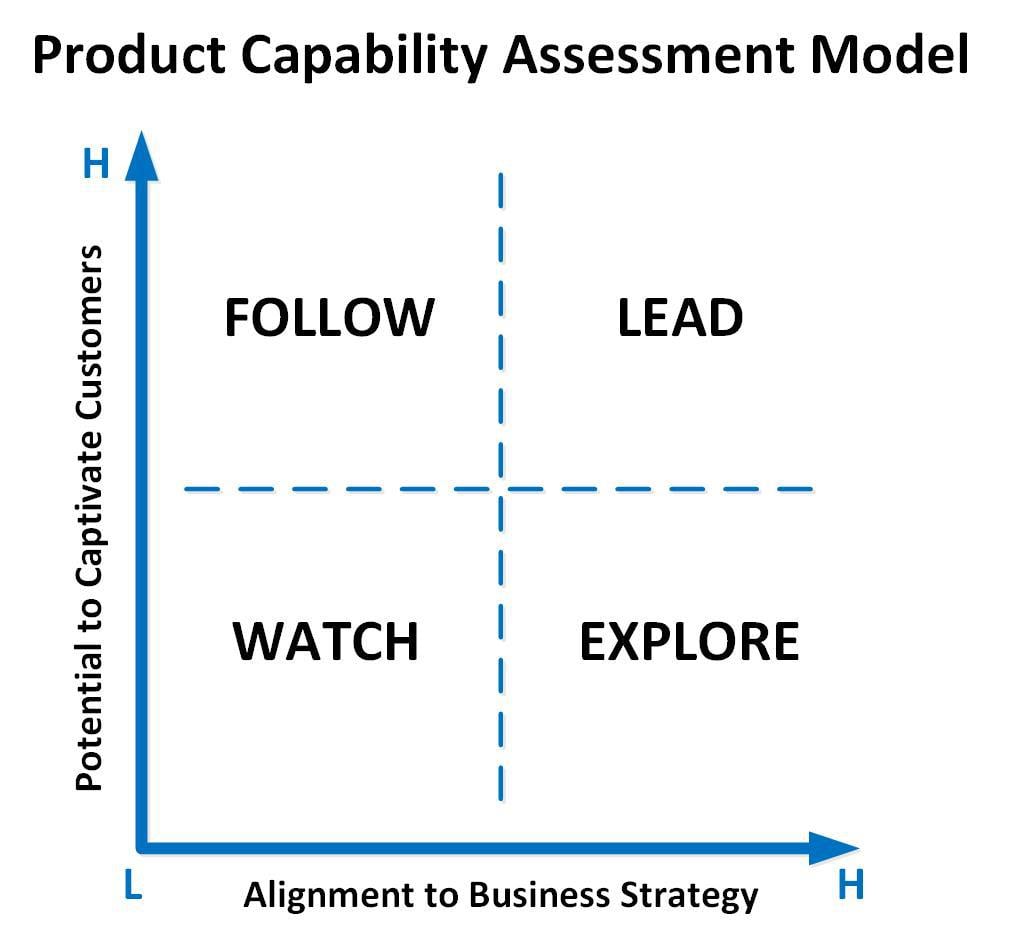
    A strategic model for backlog evaluation helps to set expectations with DevOps, developers and other internal stakeholders and ensure customer needs are front and center in prioritization decisions. It establishes a common language for collaboration. Two dimensions should emerge in evaluating capabilities at higher product and portfolio levels: Capability alignment to business-level strategy and the potential for a capability or feature to not just satisfy but captivate customers with a novel or compelling experience.

    The intersection of business strategy and customer experience factors can serve as a useful model for a product manager to think strategically about their backlog. The model helps to inform not only the question ‘Should we do this?’ but also ‘How should we proceed?’ and make things clearer for DevOps teams.

    Lead

    Items in this quadrant are the unicorns of the backlog and have the greatest potential to both strategically differentiate a product or enterprise and captivate customers. Product focus in this quadrant should be to invest in innovative, industry-leading approaches to satisfying customer needs in a manner that is consistent with business strategy and unique selling proposition. These items should receive the highest strategic priority on the product backlog.

    Follow

    Potential work items in this quadrant have a high potential to delight customers if handled well and irritate them if not. However, these elements are unlikely to be competitively differentiating given the current business strategy. Product focus in this quadrant should be to continually assess competitor treatment of these elements and adopt proven best-in-class experiences within the industry and adjacent industries. The product should focus moderate priority on competitive intelligence for elements in this quadrant and follow existing competitor approaches that enhance the customer experience.

    Watch

    Items in this quadrant are generally not problematic for customers. They are unlikely to differentiate the product or enterprise from competitors given the current business strategy and should be given low priority. The product should monitor proposed solutions in this quadrant to ensure no unnecessary customer effort is being introduced by other backlog items.

    Explore

    Product functionality in this quadrant is either not problematic for the customer experience or represents capabilities that are still emerging in the marketplace. These elements have a likelihood of developing into competitive levers, provided they can be developed in a manner that enhances the customer end-to-end journey. The product should place a high priority on product discovery for elements in this quadrant. It should explore capability innovation through design thinking or similar customer-centered ideation approaches.

    Mapping a product backlog to these four quadrants is as much art as science. It requires a deep understanding of business strategy, intended outcomes and customer needs. As with any strategic model, its value comes from the quality of discussions it produces and its role in surfacing implicit assumptions from the product’s stakeholder group, including DevOps teams and developers. Whatever model is used, having a mechanism to drive strategic product discussions is a critical tool in the product management toolbox and an important step to product management maturity.      

  • Deploying a Service Mesh: Challenges and Solutions

    Deploying a Service Mesh: Challenges and Solutions

    A service mesh is a dedicated infrastructure layer that enables communication between microservices in a distributed application. It helps to abstract the underlying communication infrastructure, such as network protocols and load balancing and provides a consistent interface for microservices to communicate with each other.

    In a service mesh, each microservice in the application is represented as a “service” within the mesh, and the mesh acts as a proxy between the services, routing requests and responses between them. It also includes a control plane, which manages and configures the proxy instances and provides observability and monitoring capabilities for the services.

    Some of the benefits include:

    • Improved observability: A service mesh provides visibility into the communication between microservices, which can be helpful for debugging and monitoring the performance of the application.
    • Resilience: It can help to make microservices more resilient by providing features such as retries, timeouts and circuit breakers, which can help to prevent cascading failures.
    • Security: A service mesh can help to secure communication between microservices by providing features such as mutual TLS (mTLS) and rate limiting.
    • Ease of use: It provides a consistent interface for microservices to communicate with each other, which can make it easier for developers to build and manage distributed applications.

    Why is a Service Mesh Important?

    A service mesh is important because it helps to abstract the underlying communication infrastructure for microservices-based applications, which can make it easier for DevOps teams to build and manage these types of applications.

    One of the main benefits is that it provides a consistent interface for microservices to communicate with each other, which can make it easier for developers to build and manage distributed applications. For example, a service mesh can provide features such as load balancing, retries and timeouts, which can be useful for ensuring the resilience and reliability of the application.

    It can also help to improve observability for microservices-based applications by providing visibility into the communication between the microservices. This can be helpful for debugging and monitoring the performance of the application, which can, in turn, make it easier for DevOps teams to identify and resolve issues more quickly.

    What are the Main Deployment Challenges?

    There are several key challenges that a DevOps organization may face:

    • Complexity: Service meshes can be complex to set up and manage, especially in large, distributed applications. This can make it challenging for organizations to implement and ensure that it is configured correctly.
    • Operational overhead: Service meshes can add a layer of complexity to the application stack, which can increase the operational overhead of managing the application. This can be especially challenging for organizations that are not used to operating one.
    • Cost: While service mesh software is typically open source, the need to run a sidecar container alongside every container can increase the compute capacity needed to run a Kubernetes cluster.
    • Integration with existing systems: They can be difficult to integrate with existing systems and processes, especially if the organization has not previously used a service mesh. This can make it challenging to get the full benefits.
    • Lack of expertise: Service meshes are relatively new technologies, and there may be a lack of expertise within the organization. This can make it challenging for organizations to get started and ensure it is used effectively.
    • Performance overhead: Service meshes can add a performance overhead to the application as they introduce an additional layer of proxying between microservices. This can make it challenging to ensure that the application is performant and scalable.

    Best Practices to Ease Service Mesh Pain

    Here are a few best practices that can turn service mesh deployments from a pain to a pleasure.

    Use Configuration-as-Code in a GitOps Approach

    Using configuration as code in a GitOps approach is a best practice to improve reliability and maintainability.

    GitOps is a way of managing infrastructure and applications using Git as the single source of truth. In a GitOps approach, all configuration and deployment information is stored in Git, and changes to the infrastructure and applications are made by committing code changes to Git.

    Using configuration-as-code in a GitOps approach can help to improve the reliability and maintainability of the service mesh in several ways:

    • Version control: Storing configuration-as-code in Git allows you to track changes to the service mesh configuration and roll back changes if necessary. This can help improve the service mesh’s reliability by making it easier to identify and fix issues.
    • Collaboration: Git allows multiple people to work on configuration at the same time, which can make it easier to collaborate on changes and ensure that the service mesh is properly maintained.
    • Automation: GitOps approaches often use automation tools, such as continuous integration and delivery (CI/CD) pipelines, to automatically deploy changes to the service mesh when code is committed to Git. This can make it easier to manage and maintain and can help to improve its reliability by reducing the risk of errors.

    Focus On Developer Experience

    Ensuring a positive developer experience is a best practice because it can help to improve the productivity and effectiveness of the development team. A positive developer experience means that developers can easily understand and use the service mesh, and that it does not introduce unnecessary complexity or frustration into their workflow.

    Here are some ways to improve the developer experience:

    • Provide clear documentation: It is important to provide clear and comprehensive documentation on how to use the service mesh, including examples and tutorials. This will make it easier for developers to understand and use.
    • Integrate with existing tools and processes: The service mesh should integrate seamlessly with the existing tools and processes that the development team is already using. This will help to minimize disruptions to the team’s workflow and make it easier for them to work with.
    • Provide support and training: It is important to provide support and training to help developers understand and use the service mesh effectively. This can include online resources, in-person training, and support from the vendor.

    Reduce Costs With Low-Cost Cloud CPUs

    A service mesh increases the cost of an entire containerized deployment because it requires deploying a sidecar container alongside all workloads. When running on Amazon Web Services (AWS), the AWS Graviton processor can ease deployment by reducing the cost of running service mesh infrastructure.

    The AWS Graviton processor is a custom ARM-based processor designed specifically for use in Amazon Web Services (AWS) environments. It is optimized for running workloads commonly found in the cloud, such as microservices and containerized applications.

    Using the AWS Graviton processor can help to reduce the compute costs of a service mesh because it is generally less expensive than other processors, such as Intel Xeon processors. The AWS Graviton processor is also designed to be highly efficient, which can help reduce the service mesh’s overall resource utilization. This can help to reduce the cost.

    Choose the Right Control Plane

    Choosing the right control plane is a best practice because it can impact the performance, reliability and maintainability of the service mesh. The control plane is the central component that manages the proxy servers and enables you to configure and monitor the communication between microservices.

    Here are some considerations for choosing a good control plane:

    • Compatibility: It is important to choose a control plane that is compatible with the rest of the service mesh infrastructure, as well as with the application and its dependencies. This will ensure that the control plane can operate effectively and support the needs of the application.
    • Performance: The control plane should be able to handle the traffic and data volumes of the application without experiencing performance degradation. It should also be able to scale up or down as needed to meet changing demand.
    • Reliability: The control plane should be reliable and able to withstand failures without interruption. It should also provide features such as circuit breaking, retries and timeouts to help improve the resiliency of the service mesh.
    • Ease of use: The control plane should be easy to use and understand, with clear documentation and a user-friendly interface. This will make it easier for the DevOps team to manage and maintain the service mesh.
    • Integration with other tools: It is important to consider how the control plane integrates with other tools and systems, such as monitoring and logging tools, and how it can be integrated into the overall workflow of the organization.

    Conclusion

    In conclusion, deploying a service mesh can be a complex and challenging process, but it can also provide significant benefits in terms of improving the reliability, scalability and security of a cloud-native application. 

    Some of the key challenges include complexity, operational overhead, integration with existing systems, lack of expertise and performance overhead. 

    To overcome these challenges, it is important to choose the right service mesh, use configuration-as-code in a GitOps approach, choose the right control plane and ensure a positive developer experience. By addressing these challenges and following best practices, organizations can successfully deploy a service mesh and reap the many benefits it has to offer.

    Image Source