Category: CloudBees

  • Under the Hood of Jenkins X – A CI/CD Solution for Cloud Applications on Kubernetes

    Under the Hood of Jenkins X – A CI/CD Solution for Cloud Applications on Kubernetes

    Motivation

    First, we articulated the business value that Jenkins X in automating Continuous Everything for Kubernetes. We encourage you to read it first.

    If you recall, Jenkins X as an automated CI/CD solution for cloud applications on Kubernetes. Jenkins X automates the installation, configuration, and upgrades of tools, so that users can learn at their own pace. This vastly simplifies the user experience, since users don’t have to stomach all the various pieces on Day One, and can learn at their own pace.

    With the built-in automation, teams can focus on releasing quality and secure software frequently and predictably to customers, without worrying about the shipping logistics. At CloudBees, we think it will be easier for our users if we tease things apart even before you start wondering what’s under the hood. This blog provides a quick overview on some of those “undercover agents,” including Jenkins itself, so that you can seamlessly continue on your journey in the continuous paradigm!

    Jx

    Jenkins X introduces the jx command line – a single command to rule them all.

    You can either:

    • Install the “jx” binary on your local machine, or
    • Use the Google Cloud shell. The shell comes with most of the tools that you will need like Git, gcloud, kubectl, etc.

    Some examples of using jx are:

    • “jx create cluster gke “ creates a new Kubernetes cluster on Google Cloud
    • “jx create quickstart” creates a new app and imports the generated code into Git and Jenkins for CI/CD
    • “jx open jenkins” opens Jenkins in a browser
    • “jx sync” synchronises your local files to a devpod
    • “jx cloudbees” opens the CloudBees CD for Kubernetes app in a browser
    • etc.

    You can type “jx help” to find the various operations you can perform in Jenkins X.

    Helm

    Find details here.

    Helm charts:

    • Manage Kubernetes applications in a predictable and repeatable fashion, which means, they:
      • Define the app
      • Install the app
      • Upgrade the app
    • Are versioned in source control, and hence can be audited
    • Are easy to create and publish, and hence reduce communication overhead
    • Make rollbacks to the last known good version stress-free (and drama-free)

    In our modest example, Jenkins X creates the following Helm chart asset(s) in Git:

    ChartMuseum

    Find details here.

    Let’s understand the basics of a chart repository first.

    A chart repository is:

    • An HTTP server that houses an index.yaml file and optionally some packaged charts
    • A location where packaged charts can be stored and shared

    ChartMuseum:

    Skaffold

    Find details here.

    Skaffold is a command line tool that:

    • Facilitates CD for Kubernetes applications
    • You can iterate on your application source code locally then deploy to local or remote Kubernetes clusters
    • Handles the workflow for building, pushing and deploying your application, and leverages that workflow in an automated pipeline to promote applications from test to staging to production.

    Jenkins X creates the following build and deploy workflow yaml using Skaffold:

    Jenkins

    Find details here.

    Jenkins is an open source automation tool that:

    • Is a self-contained Java-based program that can be used as a simple CI server or turned into a continuous delivery hub
    • Has a plugin ecosystem to support building, testing, and deploying any project
    • Requires Jenkinsfile that supports pipeline-as-code syntax/DSL in two formats:
      • Declarative syntax (recommended)
      • Scripted syntax

    Jenkins X creates the following pipeline to promote through various stages:

    Docker

    Find details here.

    Docker:

    • Standardizes and automates the way we build, manage, and secure applications using containers
    • Creates true independence between applications and infrastructure
    • Creates a model for better collaboration and innovation between developers, QA, release, operations and security professionals

    Jenkins X creates the following image for the containerized application:

    Kubernetes

    Find details here.

    Kubernetes runs production workloads at Google, which translates to running billions of containers per week

    Among many other things, Kubernetes:

    • Automates deployment, scaling, and management of containerized apps
    • Groups containers that make up an application into logical units for easy management and discovery
    • Gives you freedom to take advantage of on-premise, hybrid, or public cloud infrastructure, letting you effortlessly migrate workloads
    • Restarts containers that fail
    • Replaces and reschedules containers when nodes die
    • Kills containers that don’t respond to health checks
    • Scales your application up and down:
      • Automatically based on CPU usage or
      • Manually with a command or a UI

    Ksync

    Find details here.

    Ksync:

    • Syncs files between our local file system and a Kubernetes cluster.
    • Transparently updates containers running on the cluster from your local checkout.
    • Enables developers to use their favorite IDEs to work from inside a cluster instead of from outside it. There is no reason to wait minutes to test code changes when you can see the results in seconds.

    “jx sync” within Jenkins X allows us to sync files between our local lie system to the devpods on the Kubernetes cluster. This prevents typical problems like “works on my machine!” from slowing down business, even when everyone knows there are problems in production.

    Prow

    Find details here.

    Prow is the system that handles GitHub events and commands for Kubernetes. It hails from the Kubernetes ecosystem and was created at Google. It is an event based solution that provides a loosely coupled architecture ideal for the cloud native world. It leverages ChatOps to interact with a build system. Prow manages its job configuration in Git. So, in the event of a wipeout, pipelines can be restored.

    Prow includes a scalable and highly available webhook event handler that writes ProwJob CRDs to Kubernetes based on git events, so that other microservices can perform operations like running CI/CD pipelines. These git events can be triggered by new PRs and issues, comments, merges and pushes.

    Jenkins X includes Prow out of the box when creating clusters on GKE (Google Kubernetes Engine) with Terraform using “jx create terraform” or when using the feature flag on “jx create cluster gke —prow” or “jx install —prow” commands. Prow, along with Knative build, makes serverless Jenkins possible that addresses problems originating from static Jenkins masters.

    Knative Build

    Find details here.

    Knative Build is a cloud native solution that extends Kubernetes with CRDs and provides ways to build applications from source. Teams can chain steps that run sequentially in the same Kubernetes pod using different containers where they can share state between each step.

    Build templates are Kubernetes CRDs and are automatically upgraded with each Jenkins X release. The Prow configuration that is generated by Jenkins X when creating or importing applications refers to a build template. Knative build, along with Prow, makes serverless Jenkins possible that addresses problems originating from static Jenkins masters.

    Teams can leverage build templates to reference the type of Kubernetes pod that is created to run builds. These templates allow teams to specify which docker image to execute your build in, what environment variables exist at build time, what service accounts and secrets are in play and what volumes should be mounted.

    Cloud

    For those of us who have tinkered with Kubernetes, we know it is difficult to setup and manage. Jenkins X alleviates that pain and leverages the managed Kubernetes solutions offered by major cloud providers, like:

    • Google Cloud (GKE)
    • Amazon Web Services (EKS)
    • Microsoft Azure (AKS)
    • Oracle Cloud (OKE)
    • etc.

    Let’s take the example of Google cloud. The Google cloud sdk provides the command-line interface for Google Cloud Platform products and services, like:

    • Gcloud, which manages authentications, local configurations, developer workflow, and interactions
    • Kubectl, which orchestrates the deployment and management of Kubernetes container clusters on gcloud
    • etc.

    Summary

    Jenkins X automates CI/CD for cloud applications on Kubernetes. So that engineers can focus on writing and testing products that wow the world, Jenkins X abstracts away a lot of the shipping logistics that would otherwise consume your time and energy.

    Jenkins X gets you started at the speed of light, however, the onus lies on you to gradually and eventually catch up to these underlying details. While we are sure you are well on your way to design and implement resilient pipelines, we wanted to make sure you have these details at your fingertips.

    Pipeline is no longer a pipe dream – so, happy coding!

    Additional resources


  • Introducing Software Delivery Management

    Introducing Software Delivery Management

    If you were amongst the attendees of our first few CloudBees Days events of 2019, in Madrid April 4, Zurich April 10, or yesterday in Dallas April 16, you witnessed us introducing the world to a new category of software we are inventing here at CloudBees: Software Delivery Management, or SDM (yeah, I know the world needs another TLA – sorry.) Tomorrow at the San Francisco event, we have a big announcement that is key to us realizing this new vision.

    So what is Software Delivery Management, or SDM? Why does the world need it?

    Well, at the most basic level, with “software eating the world,” every company in the world is learning how to be a software company. That means that every company is trying to get better at delivering software. This is a big change for many from the time when software development in most companies was the province of IT as a cost center. This is what “digital transformation” is about. Software development organizations are now the engines of innovation at the companies that have transformed most quickly.

    Digital Natives like Facebook, Netflix, Amazon, Google and the like as well as scores of fast moving startups have pioneered a set of continuous integration, delivery and deployment practices (CI/CD) as well as industrialized agile and DevOps methodologies to deliver new releases to their customers, 1000s of times more frequently, with higher quality, fewer defects and faster time to recover.

    Even software companies like us are learning to be more effective software companies to keep up, and essentially going through our own digital transformations.

    These transformations usually start with adopting CI/CD, agile and DevOps tools, practices and cultures. At CloudBees, as the leading CI/CD vendor to enterprises in the world, with nearly 50% of the Fortune 100 amongst our 1000s of customers, and the corporate sponsor of Jenkins, the dominant CI/CD automation server in the world, we have a front row seat to this mad dash. In the last year, we’ve seen these initiatives move from important to top level urgency at the largest companies in the world.

    But once these transforming companies start seeing faster and better software through these practices, they start to see other problems.

    People outside of engineering have a hard time knowing what’s been deployed. Engineers working on a feature are disconnected from the user and market input that drove product management to prioritize the feature. A feature might be behind a feature flag but customer success doesn’t know what enabling the feature for a customer will do exactly. Roadmaps are increasingly irrelevant so marketing and sales feel like they don’t know what’s coming down the line to make the most of the innovation in the market. Engineering doesn’t know what changes in system performance or user behavior resulted specifically from their latest change. Senior management doesn’t have a trustworthy view of value moving through the system and the business impact of this faster pace of innovation.

    For a new greenfield product built to be buzzword compliant from the start – cloud native, microservices on Kubernetes or serverless, etc. – some of the newer generation cloud native CD tools (like our own Jenkins X) + some of the latest generation observability tools may solve these problems to an extent, and from a developer’s perspective – seeing how their feature flows through to, and performs in, production.

    But that’s not the reality of software development in an organization of any complexity in terms of sheer size, the diversity of software being developed and environments to which it is being delivered, and the range of stakeholders who legitimately care when software is at the center of the business. In our Madrid event this month, I was really struck by how many attendees in roles like head of DevOps transformation talked about the impedance mismatches with other functions of the business once software development becomes truly continuous and agile – this is what I’ve written about before as “Continuous Everything.”

    So Software Delivery Management (SDM) is the new category of software system that we are inventing to solve this problem of getting every function in and beyond the software delivery organization on the same page. On the same page about what’s being or been delivered, why, and its impact. Ensuring that the entire organization can have connected processes on top of a common real time view of the truth. That encompasses the entirety of diverse software product portfolios, from mainframe to microservices, on premise to public cloud, embedded to mobile, and beyond.

    SDM will be for the software development organization what Salesforce.com is for the sales organization, NetSuite is for finance and Workday is for HR.

    Like the best of these systems, it serves all roles and all levels in the organizations that use them. For SDM, our aim is that even developers find that using such a system doesn’t control them, but sets them free by giving them all the context they need to build software that has an impact – and the ability to see that impact in concrete ways. And other roles can interact with software development in a supportive rather than disruptive way. While pointy-haired bosses like me stay out of their way when we can see that things are humming along. Together, everyone in an organization using SDM cooperates fluidly with one another to “Build Stuff that Matters.”

    Watch this space in the coming weeks and months for more detail on what the building blocks of an SDM are, how it will benefit different people in different roles in software organizations, and how we’re using our own internal experiences at CloudBees to inform its design.

    Meanwhile, the foundation of software delivery management as a category and as a practice is CI/CD, and choosing CloudBees for CI/CD today is the best first step on that journey we will hopefully take together.

  • Why SaaS CI/CD Solutions Work for Open Source Projects

    Why SaaS CI/CD Solutions Work for Open Source Projects

    Today, open source communities use a wide range of tools for building and delivering their software. These tools tend to also be open source, but more and more open source communities are starting to see the value of managed, SaaS tools to help support their communities and their goals. Still, finding the right fit can be a challenge – you want tools that help developers but also support the values of the open source community. Factors like hosting, cost, scalability and integration support play a crucial role in making these choices. In this post, I’ll take a look at why SaaS solutions are often the right choice for open source, and why they may be the right choice for your own continuous integration/continuous delivery (CI/CD) open source project.

    While Jenkins is most open source projects’ default choice for CI/CD – and often rightly so – it’s not the only thing your team should consider. These days, teams working in open source projects have also started using various SaaS tools (Heroku, GitHub, JFrog, etc.) for their infrastructure and portions of their CI/CD pipeline. Still, somehow, they are reluctant to use hosted CI servers. This raises the point – if you can trust Heroku for your open source projects, then why shouldn’t you trust a SaaS CI/CD provider whose core business is based on the same service?

    Why SaaS?

    Sometimes, an open source community may decide to use a hosted, SaaS tool so that it’s one less piece of infrastructure they have to oversee and manage or to keep newer projects at the lowest level of community governance and decision-making needed for as long as possible. Cloud-based CI/CD solutions delivered on SaaS models can help let communities move fast and worry less for a variety of reasons:

    • Cost. For open source projects, most of the SaaS CI/CD tools are available free of cost.
    • Security. Organizations keen on security and compliance can adopt a hybrid approach, where they can host their code on servers running in private networks and run CI/CD builds in the cloud. This lets the CI/CD service own the security problems, which is one less thing for a community to worry about.
    • Efficiency. SaaS CI/CD, such as CloudBees CodeShip, are optimized for speed and flexibility with no overhead or management to achieve those goals.
    • Simplicity. It’s easy to get started with SaaS CI/CD; provisioning can be done within a few clicks (discussed below). It is ideal for small teams managing the entire CI/CD setup as it significantly reduces overheads in the development and deployment process.

    Out-of-the-box CI/CD solutions

    A lot of teams and individual developers prefer to work with out-of-the-box cloud-based CI/CD solutions like CloudBees CodeShip, which one can use for free for their open source projects. That’s because, in addition to the cost advantage and ease of setup, cloud-based hosting means there are no administration and maintenance – from version updated, to security patches to world-class technical support -everything is handled for you and made simple. With no hardware or software infrastructure to procure and maintain, teams can focus on working on their projects and writing high-quality code, not on infrastructure.

    That is why organizations starting with small open source projects often find out-of-the-box SaaS CI/CD solutions useful as they make it possible to start small and scale up when required. The SaaS model enables easy scalability allowing developers to perform a higher number of commits, provision larger build machines for tests and use parallel pipelines. Therefore, these solutions are very popular in the CI/CD market. The tradeoff is that such solutions are not suited for all organizations as they offer limited flexibility for customization.

    The bottom line

    Teams comfortable with open source often cite a lack of openness in SaaS solutions as a major concern. However, vendors have gradually started exploring the benefits of open source; the biggest and most commonly cited example is that of Microsoft which has embraced open source as well as SaaS in recent years. Similar trends in the industry suggest that SaaS and open source will complement each other more in the future and certainly aren’t at loggerheads. In fact, SaaS-based software delivery solutions like CloudBees CodeShip are gaining acceptance among open source communities – which suggests that the future of such solutions is bright.

    SaaS CI/CD solutions like CloudBees CodeShip fits a variety of open-source and private projects, offering better scalability, customization and ease of use. Moreover, as these solutions are generally free, teams using Jenkins-based solutions can easily try the CloudBees CodeShip CI/CD solution in their environment and make an informed decision for its adoption with their open source projects.

    Additional resources

  • What is DevOps?

    What is DevOps?

    From conferences to articles and books, the term DevOps has taken the IT world by storm. The buzz is understandable, as many IT groups are looking for a way out of the morass of delayed projects, questionable quality and missed deliveries in which they often find themselves.

    It’s clear DevOps has potential to address the challenges IT faces. Organizations that have embraced DevOps – including companies such as Etsy, Netflix, Target, Walmart, Ticketmaster, Amazon and Facebook – have shown that DevOps principles can lead to competitive differentiation by enabling teams to deliver higher quality software at the speed required with customer expectations of 24/7 uptime and instant access. As a result, it’s not a stretch to say DevOps is becoming the industry standard for software development.

    Why DevOps anyway?

    A little more than 100 years ago, the automotive industry was revolutionized by the first moving assembly line. Once industrialization and automation were applied to dramatically reduce the time required to produce an automobile, there simply was no going back. Certainly a few car manufacturers resisted the change, clinging to their existing approach, but the holdouts all eventually adapted or they perished.

    DevOps computer image

    Companies that have adopted DevOps principles are innovating faster and leaving competitors behind. So what is the DevOps culture and why do we need it? By changing to a DevOps culture, these companies have aligned all stakeholders – from dev and ops teams to management and more – around the common objective of delivering quality software rapidly and reliably.

    Today’s technically savvy customers expect immediate access to the benefits of technological innovation and they’ve grown increasingly intolerant of software that is buggy, unstable or not secure. Customer expectations are driving what is known as the continuous economy, in which customers experience a business through its software and how they deliver it using continuous integration/continuous delivery (CI/CD). In this economy, technology is a business enabler and the ability to reliably deliver quality software is critical.

    Organizations will need to transition to DevOps soon to remain competitive in the continuous economy – even to stay relevant. This may sound like hyperbole, but an increasing number of companies are finding out the hard way that almost every company is a software company and that DevOps is a common sense way to gain a sustainable, competitive business advantage. In addition, developers will seek employment at companies where they can innovate instead of fight fires all day.

    Even companies in industries far afield from software have found that they need to make software companies part of their core business. Take Ford Motor Company. You may not think of trucks as software, but the Ford F-150 truck features more than 150 million lines of code. A lead engineer on the Ford EcoBoost engine team noted that the “secret sauce” in the success of EcoBoost technology is software.

    There is no going back. It’s safe to assume that your more successful competitors will be embracing DevOps sometime within the next five years. The question you must answer is, “Where will your organization be in five years?”

    Why you should care about DevOps

    Simply put, companies that have embraced DevOps are better positioned to solidify their position in existing markets and expand into new ones. Indeed, adopting DevOps is rapidly becoming the de facto standard for software development. A quick look at industry examples – think Apple, Netflix, Tesla, Uber, AirBnB and many others – reveals early successes and tremendous potential.

    Once DevOps is implemented, companies have seen an increase in satisfaction for development process stakeholders. Because they are applying modern software development practices, these companies are attracting and retaining better talent, who will drive further quality improvements, productivity improvements and ultimately success at the company. When developers no longer perform tedious, rote manual coding tasks and are free to innovate and make a difference, they are happier.

    A large financial software company saw a 15 percent improvement in employee satisfaction just weeks after adopting CD in support of DevOps principles. Just as important, a happier and more engaged workforce means increased productivity, lower costs and better software.

    At the end of the day, any company that needs to deliver quality software faster needs to care about DevOps and the supporting practice of CD, which enable continuously building, testing and deploying software in frequent, incremental releases.

    Companies that fail to embrace DevOps will bleed talent and fall further behind their competition, serving as illustrations of the adapt-or-perish maxim that is as true in the software development world as it is in the natural world.  Which company do you want to work at?

    What is the DevOps model?

    There’s been a lot of talk about what DevOps is and is not, but recent consensus is that DevOps is primarily about culture. Organizations that have adopted this culture value collaboration, experimentation and learning. In a DevOps culture, all participants in all phases of the software delivery lifecycle align around a shared goal: the rapid delivery of stable, high-quality software from concept to customer.

    Automation of software development, testing and deployment through continuous delivery goes hand-in-hand with DevOps. Automation enables organizations to deliver software more quickly while ensuring operations can have confidence in what is being deployed, and customers get the quality, security and stability they require.

    The DevOps trinity

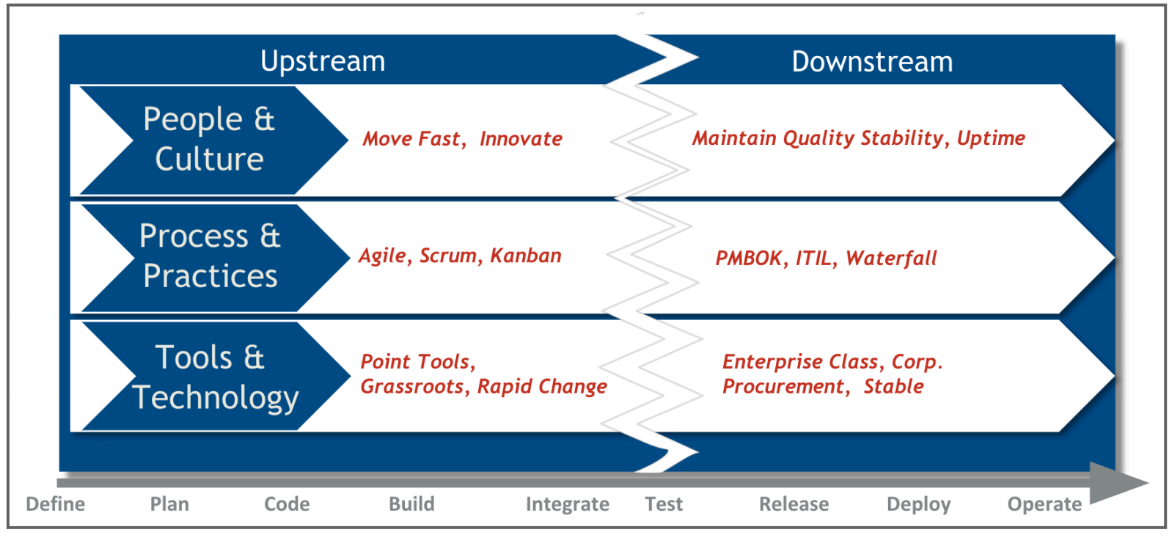
    At its core, DevOps is being about gaining alignment between all software development lifecycle participants on three planes – people, process and tools – often called the DevOps trinity. In this framework, the software development lifecycle is viewed as having upstream (development) and downstream (operations) halves. The two halves are part of the same software delivery process but in many traditional IT organizations these halves are highly disconnected (Figure 1).

    DevOps Upstream Downstream

    Figure 1: The disconnect between upstream and downstream people, process and tools.

    Upstream, the development culture usually prioritizes speed and innovation, whereas downstream the operations culture is tasked with a focus on maintaining quality, stability and uptime. Upstream, development uses point tools to define and build software using agile methods. Downstream, enterprise class tools are the norm for managing the test, release, deployment and operation of the software.

    Downstream meetings are much more likely to be filled with talk of Information Technology Infrastructure Library (ITIL) and Project Management Body of Knowledge (PMBOK) than Kanban and the latest scrum. DevOps is about connecting these worlds and eliminating the chasm that exists between the upstream and the downstream.A look at the “How” of DevOps

    Often, discussions on the how of DevOps are too narrowly focused on the technical core of what happens from the time developers commit code to the time software is deployed to a server. In reality, DevOps extends from the initial concept to the customer deployment.

    The full DevOps cycle starts with understanding the customer’s needs. Once they are clear, then you create a plan to define a solution, a plan to deliver it and a plan to support it once it moves into operation, where you gather customer feedback and the whole cycle begins again.

    Figure 2: Agile methods, continuous integration and continuous delivery provide the foundation for a DevOps transformation.

    DevOps –fad or here to stay?

    Anyone who’s been in the software industry for any length of time has seen fads come and go. The buzz for software-oriented architectures (SOA) was all the rage a few years ago, but that buzz faded to a whisper.  Waterfall methods are fading fast, replaced by agile development. How can you tell if DevOps is just the latest in a line of operational strategies that will fade out?According to a Harvard Business Review survey sponsored by Google, 86 percent of the 654 respondents say that it is important to their company to develop and put new software into production quickly. That leaves 14 percent who do not realize that they need solutions like DevOps. At times like this, it pays to step back, take a breath and take stock of where we are and where we are going. When we do, it becomes clear that DevOps is not a fad; rather it is the way successful organizations are industrializing the delivery of quality software today and will be the new baseline tomorrow and for years to come.

    DevOps today

    When research shows that most companies surveyed are planning to or are already transitioning to DevOps enabled by CD, that speaks to the current popularity of DevOps. In taking a closer look at the companies that have already adopted CD practices and a DevOps culture, many of these companies are the established leaders in their respective industries and hold a dominant market position. Having made substantial, long-term investments in CD and DevOps, they are already seeing impressive benefits. For example:

    • Amazon, the leader in public cloud infrastructure, now releases on average every second
    • Etsy, the leading peer-to-peer e-commerce marketplace, went from deployments that took hours to deploying changes 50 times per day
    • Ticketmaster, the world’s leading ticketing company and one of the world’s top 10 e-commerce sites, deploys to production at the end of every sprint or multiple times per sprint
    • Netflix, disrupter of the entire cable and TV industry and responsible for about 30 percent of North American internet traffic, deploys thousands of times daily
    • Nordstrom, a leading fashion specialty retailer with 323 stores in the U.S., increased the pace of releases to monthly from just twice per year
    • Allstate, the largest publicly held personal lines property and casualty insurer in the U.S. is now delivering new applications in half the time it took to deploy a single new feature
    • Coca Cola, the world’s third most valuable brand, has accelerated project delivery as much as 50 percent and cut defects in production by about half

    While some organizations have resisted making a DevOps transition – either due to confusion about what DevOps entails, concerns that it may just be a passing fad or a simple aversion to change – other organizations have jumped in with both feet.

    The organizations who’ve made the jump are eager to reap the benefits being realized by competitors and other companies that have already transitioned to a continuous delivery and a DevOps culture. These companies are differentiating themselves and delivering higher quality software faster by aligning development and operations across the DevOps trinity – people and culture, process and practice, and tools and technology. Better alignment across these three planes enables organizations to improve time to production, drive business value and reduce IT costs.

    CloudBees drives DevOps, CI and CD

    The CloudBees Suite enables companies to automate their software delivery with a layer of visibility and governance all built on DevOps and CI and CD best practices. CloudBees Core delivers Jenkins for the enterprise with a tested and verified Jenkins core, advanced enterprise features that extend the power of Jenkins, fully-tested updates and professional support for the Jenkins core and all 1,500 community plugins. The flagship offering provides high availability to support continuous delivery processes, as well as simplified manageability, security and scalability of Jenkins to ease administration across distributed Jenkins environments and IT architectures, on-premise or in the cloud.

    CloudBees DevOptics offers businesses the visibility into the software delivery pipelines to visualize their value streams and determine their DevOps performance based on industry metrics. CloudBees CodeShip enables teams to get up and running fast using CI/CD as a service while the CloudBees Starter Kit gets teams up and running for free with CloudBees Core and CloudBees DevOptics.

    DevOps customers including Capital One, IHG, Autodesk, Mabl and a host of others can attest to their DevOps transformations using CloudBees products. See what they’ve done by reading their case studies and decide on whether deploying a DevOps model is best for you.

    Where will your organization be in five years?

    Additional resources