— ROELBOB

Over the course of the last several years we have seen the DevOps movement continue to mature and evolve. It has moved beyond the early adopter, visionary stage into the mainstream of the market. Therefore, it should be no surprise that some of the leading solutions in the DevOps space should likewise mature and evolve as well. Yesterday Puppet (formerly Puppet Labs) made several announcements as part of a broader message that they are ready, willing and able to continue to be a leader in this space for years to come.
There are several parts of the Puppet announcement yesterday, lets have a look at each of them:
Growth indicators – Somewhat mandatory, Puppet announced that they continue to enjoy rapid growth. 
Not a lot to add here, the numbers speak for themselves.
Puppet Labs is now just Puppet. In my conversation with Nathan Rawlins, SVP of marketing, he said that this was a case of recognizing what the market is already doing. I don’t know how many people you have heard refer to the company as Puppet Labs. Most everyone I know says Puppet. So why push rope up hill? Henceforth the company will be known simply as Puppet.

But there is more than just the name here. Rawlins told me that along with the new name, they have also gone through a complete rebranding. New logo, new website look, new collateral look. The new brand seeks to give the impression of simplicity, stability and maturity.
 New leadership – The company has hired a software/tech industry veteran leader, Sanjay Mirchandani as President, COO. Mirchandani has held senior leadership roles at VMware, EMC and Microsoft. His responsibilities will include go-to-market operations, including sales, marketing, customer success, and global expansion. From what Rawlins told me, Sanjay will be leading much of the day to day operations of the company.
This is not a case though of a professional leader coming in to replace the founder/CEO. Puppet’s Luke Kanies remains in the CEO role. Mirchandani will free up Kanies to do what he is best at. Be a visionary and chart the course for Puppet and in turn help shape the DevOps and software delivery market as well. It takes a confident founder to bring in a real professional to help run the business to allow you to do what you do best. Many are too insecure to share management with a newcomer who “just wouldn’t love their baby the way they do.” Kudos to Luke for recognizing this move for the long term good of the company.
 Project Blueshift– Many people are focusing on Blueshift’s capabilities of using Puppet with container technologies like Docker, Kubernetes, Meseosphere, CoreOS, etc. While Blueshift does focus on this as of the release today, there is actually more to it than that. Blueshift is really a collaboration between the Puppet community and the company itself to ensure that Puppet will always be able to help companies adopt next-generation infrastructure technologies. While today those next-gen technologies are container related, the idea is to grow Blueshift into something capable of working with new technologies as they emerge. It is a longer range project beyond 2-3 years, instead looking at what could be on the horizon 5-10 years from now. It is an ambitious vision. It is always hard to know what is the next big thing. But the fact that Puppet is even attempting to keep its eye on this is commendable.
Upgrades to Puppet Enterprise and Puppet Orchestrator – Mixed in all of the news is that Puppet has released upgrades to its Enterprise product and the Orchestrator product that was released last year. Without going into a feature by feature recap (you can read the link to the PR if you like), Puppet continues to polish their enterprise products as part of their maturation.
Integrations with Splunk and HipChat – As DevOps matures, the market will want greater integration between their tools. Puppet has taken a nice step in that direction by releasing a Splunk App that will allow you to automate set up of Splunk servers and give greater visibility into enterprise DevOps environments.
The HipChat integration allows your Puppet Orchestration management to show up right in the HipChat GUI and allows users to manage it from within HipChat. A nice bonus is the access rights which make sure that those without permission do not have access to the Puppet Orchestration data.
All in all, this is a major step up by Puppet. To be fair, the folks at Chef have also been taking steps to further mature their product and organization. As DevOps continues to grow, I am sure we will see some of the other DevOps tools startups follow the leaders here in maturing and growing along with the DevOps market.

In part 1 of this series we talked about server provisioning tools. In that post, we mentioned some of the more prominent application provisioning tools on the market with regard to integrations. This post will focus on the application layer of full layer automated provisioning (FLAP).
Application provisioning technologies most likely are familiar: Puppet, Chef, Salt, etc. We’ll take a look at each, how they compare in the areas of control mechanisms, operating systems support and ease-of-use features (integration with server provisioning tools is mostly covered from a server provisioning tool perspective in part 1 and part 3 of this series, because integration must be managed in the server provisioning tool). A blog is too short to go much deeper than that, but this will help you determine which ones should be considered in your environment. Information here is valid as of the day this blog is written, but the market is moving fast, so don’t hesitate to check at the provided links for improvements. Because this topic is a popular one, don’t hesitate to look for up-to-date information provided by other sources, either.
It is worth mentioning that all of these tools are moving to support configuration of network equipment. For a guy who spent years worrying about programmability and interoperability at a networking gear vendor, that is very cool news. I haven’t had time to actually try any of that support yet, so I’ll leave evaluations to you.
A word of advice: This entire marketplace has cutesy-naming disease when it comes to really important concepts. While you are grimacing at “recipes” or “grains” or whatever, learn that terminology. It may be cutesy, but the heart and soul of these products hides behind those names and the details of what concepts they encapsulate. During your evaluation period preferably—but certainly once one is chosen—you should get those terms and their meanings down pat. It will make your life much easier. The same is true with the variety of scripting formats. They’re all communicating basically the same information, but so do English and Japanese—knowing one doesn’t automatically makes you an expert in the other. Take the time to truly understand the scripting language for your tool of choice.
Ansible is a full-app provisioning tool that allows users to install and customize applications through a combination of a command line and scripts. The tool is well-documented, easy to install and works very well at its designed task. Ansible offers support for Red Hat and Windows running on Docker, OpenStack and AWS. Notably missing is VMware support, but since the machines are available via IP and the OSes are standardized, VMware virtuals can be managed/orchestrated with Ansible.
The open source version of the tool comes with command line interfaces and management is handled via command line and editing scripts. The premium add-ons such as Tower include UI, analytics and programmable APIs.
Since the purchase by Red Hat, it is reasonable to expect an increased focus on RHEL for this tool and a commensurate reduction in non-Red Hat OSes. Not that this is assured, but history says it is a likely long-term result. If you’re a Red Hat shop, Ansible is a good place to start—though looking at Satellite—and trying to predict how Red Hat’s various open and add-on provisioning tools will evolve and emerge—is a good idea for any evaluation at this point in time.
Chef is one of the original application provisioning tools out there. It is managed through command line and scripts in the open source version, and through these plus a GUI in premium. Unlike Ansible, many Chef APIs are bundled with the open source product, only APIs for premium services like analytics and reporting are premium.
Chef supports most variants of Linux and Windows, with most cloud and virtualization vendors available as platforms. In terms of completeness of support, it really is up toward the top of the list.
If you have a largely heterogeneous environment, Chef is a good tool to look at for automating application provisioning—be it for deployment, refresh or continuous delivery.
Juju advertises itself as an orchestration layer above the other products in this space. While there is a small amount of truth to that claim, most of what you can do in terms of orchestration with Juju can be done with the others. In fact, Puppet has kind of found a home in entire complex multi-server systems. Juju comes with GUI in the open source version, but the product does not have a traditional API.
Juju supports Ubuntu and Windows, and is interoperable with most of the major cloud providers. Deep server provisioning integration is really only provided for MaaS (another Canonical project), but users have made it work with other server provisioning tools. Juju scripts (charms) are primarily written in Ruby, though other languages are definitely possible. For Ubuntu shops, Juju would be the item I’d place on the top of the application provisioning list. For Windows shops, it would definitely be worth considering. For Red Hat shops, other solutions are probably more appealing.
Puppet should need no introduction to readers of DevOps.com. The standard in application provisioning, it uses scripts and command lines to deploy applications with a pretty broad base of user support that equates to lots of user shared scripts. Other vendors in this list also have vibrant communities contributing scripts, but Puppet, by sheer weight of numbers (and marketing), has a larger selection available.
Supporting all major operating systems, Puppet’s documentation is solid. The only quibble is that you have to be careful when coming from a search engine about whether you’re on the open source documentation or the Professional Edition documentation. Puppet comes with APIs, though the GUI is only available in the commercial version. Puppet is the progenitor of Razor, the server provisioning tool, and while it has been used with all of the provisioning tools in the first iteration of this article, expect it to work best and provide the most value with Razor going forward.
For highly heterogeneous shops, or shops that include multiple server provisioning tools, Puppet is a solid bet. While it will work fine in other situations, the value-add of a more focused product is worth considering if your environment maps to another tool’s strengths.
Salt is an interesting member of the application provisioning crowd. They don’t share name recognition with some of the other players, and yet have a respectable user base. Their product is certainly comparable to the others in this market, and the user community is pretty active. Not being deeply associated with any of the server provisioning tools, SaltStack has been integrated with most of them.
The Salt Master runs on almost all flavors of Linux, and can manage all major Linux distributions plus Windows, OS X and Solaris.
Like all of these other tools, SaltStack can manage any machine that is accessible over the network and is running a supported operating system., Additionally, the dev branch has Salt Cloud built in to the Salt Master, which spins up cloud images, automatically puts them into salt and starts managing their configuration. Expect that this type of functionality will become the norm for the market (Juju does some of this also, and others have varying levels of cloud support)—it just makes sense, and it compliments server provisioning. There is a tiny bit of overlap in the VM space, but then you can choose whether to use server provisioning or Salt Cloud to handle those instances.
For highly heterogeneous shops that wish to use best-of-breed (actually “best fit” is a better name) server provisioning along with a solid application provisioning tool, SaltStack is a heavy hitter worth considering. If you have a more specialized environment focused on a single OS, SaltStack will work, but its advantage of broad support for both OS’s and server provisioning tools will not come into play.
Satellite is Red Hat’s provisioning solution. Unlike most of the others in this list, it is a cross between server and application provisioning. In actuality, it is that “layer above provisioning” that Juju positions itself as. Under the covers, Satellite (as of release 6.0) is using Foreman for server provisioning and Puppet for application provisioning. The reason it still makes this list then is because it does do application provisioning, and does orchestration too. You can use it to spin up MariaDB or OpenStack, and it is a marketed and supported product, so it fits the list.
As one might wholly expect, Satellite supports RHEL. It can manage instances of RHOSP and RHEV, along with VMware and Amazon, and does bare metal through Foreman also. Satellite is deeply tied to Foreman and Puppet, so if you have issues using this tool set, it’s not going to be your first choice. Because Satellite extends and improves Red Hat Network access, for Red Hat shops it should be No. 1 on the list of viable options, but if you use a lot of non-Red Hat machines, including (as of version 6) Fedora and CentOS, it is less appealing. It used to be that Spacewalk was the viable option for those CentOS and Fedora installs, but now they are separate code bases, meaning you have to maintain two different systems. At that point, it is worth looking at other options available on the market.
The newer version 6 architecture is designed to provide a platform moving forward that is more powerful and adaptable, so expect to see good things from it if you are a Red Hat customer, possibly even cancelling out the disadvantage of no support for CentOS and Fedora.
All of these products are very good in their best environment, and most of them will give you pain in their very worst environment. The question is, which environment do you have? While only employees can answer that for a given environment/tool combination, hopefully there are some pointers here—and elsewhere—that can help make the decision.
In the third and final installment, we’ll look at the combination of server and application provisioning to offer full stack automation.

If you ever wanted to learn about Rugged DevOps (some call it DevSecOps), sit down for a spell with Shannon Lietz, Ian Allison and Scott Kennedy from Intuit. We discussed a number of important topics including internal war games, culture hacking, gamification of Rugged DevOps and starting as a small team. There are 100 gold nuggets in this conversation for novices and experts alike.
Derek Weeks: I have some of the Intuit DevSecOps team here with me today. We’re going to talk to them a little bit about Rugged DevOps and how things work over at Intuit. Let’s start with some introductions.
Allison: I’m Ian Allison. I help run the Red Team at Intuit, which is, I guess you’d say, an interesting way of taking control of security at our company. We try to get ahead of the attackers by basically being the attackers. We’re essentially ethical hackers. We go after all of our own stuff to make sure we can find where the deficiencies lie in all of our software.
Lietz: I’m Shannon Lietz. I’ve been working at Intuit 3 1/2 years and helped to found the 24×7 DevSecOps capability at Intuit, leading the Red Team, our security operations capability, our cyber SOC, and what we also consider “blue teaming”: being able to hunt for defects.
The organization has really had to transform how we do software development because we’re a 30-year-old software company. We are now seeing the traditional way of putting together software really embracing DevOps. For us, it’s been exciting to really work in the industry with Rugged DevOps, trying to help build security into the DevOps movement.
Kennedy: I’m Scott Kennedy. I run the forensics and threat intelligence part of cyber work.
Weeks: Shannon (@devsecops), tell me a little bit about software supply chains and how that vision of software development has impacted the way you see things at Intuit.
Lietz: That’s really a great question. It was interesting when Josh Corman and I first talked; we had a lot in common. One of those things was the software supply chain. What I really love about the concept is being able to have processes driven a certain way so that you can reduce defects.
Having worked for Toyota in the past and understanding the supply chain mentality, you get a sense of how you could put something together better, incrementing on it, figuring out how to share that process, and then really figuring out what things are important. Having that notion of fewer, better suppliers was really a core concept.
I love the idea of transparency, building things a certain way, and really getting into continuous improvement. You need to look at things from an opportunities perspective—making sure you’re not just looking to make things perfect. You’re looking for those opportunities to improve over time.
https://www.youtube.com/watch?v=nRaURhaTH9o
Weeks: As we think about Rugged DevOps within your security team, how do you measure the success of what you’re doing? What kind of metrics are you looking at that matter to the business?
Lietz: We measure everything. For example, mean time to remediation (MTTR). Once somebody finds a defect, we analyze that defect from the time it got into the supply chain to when it actually gets resolved. We track everything from mean time to remediation to when the ticket was created, to being able to look at when the code actually got published, to when it actually got found, and then we work on those things over time. We really try to uplift.
____
Once somebody finds a defect, we analyze that defect from the time it got into the supply chain to when it actually gets resolved.
____
We leverage JIRA [Software] just like a software development team does. We register our defects and figure out how to get development teams to take responsibility for those ideas. It goes through their process of release and regression testing. As part of that, we look back to see where our opportunities are.
As an example, we started out where things may have taken weeks. We then reduced it down to days and ultimately got it down to hours. We’ve seen defect resolution where it’s now minutes. When it’s something we’ve discovered that was just a mistake by an engineer, we realize “mistakes do happen.” We found that our cycle times also help us to find fault stack vulnerabilities in real time because we get to do end-to-end testing more aggressively utilizing this method.
Weeks: How has consistency in your operations helped with Rugged DevOps and has it fragility within the organization?
Allison: One of the things we do is to utilize a golden image for all of the AMIs (Amazon Machine Image) we use, for all of our customers, and we require everybody to use these AMIs. We’ve also built some really interesting automation around scanning these AMIs. So one thing we realized quickly when we first started native U.S., when we try to do full vulnerability scans against another system, if it’s set up to autoscale, we all of a sudden have 50 systems. Right? We can’t … it’s really hard to do a full vulnerability scan right against the system, so we came up with a way to share back all of the AMIs with a special account. Then we bring those up and we scan them. Then we grade them.
Based upon the vulnerabilities that are found, you’ll get a letter grade, like A through F, based upon the system you have. While we always strive to have our base image be an A, people continue to run on older images. But they get graded, and those grades get pushed up, so everybody in their org structure gets to see what the grade is for their account. I think by being a little standardized, basically with these images, lets us know what’s in everything, and we have a grade for everyone. It helps everyone have a really good idea of where they stand when it comes to a security standpoint.
____
Based upon the vulnerabilities that are found, you’ll get a letter grade, like A through F … so everybody in their org structure gets to see what the grade is for their account.
____
Weeks: That’s not only a grading but a policy enforcement governance kind of role that grading plays. How rapid is the feedback loop in that grading system for the teams that you’re working with?
Lietz: It’s really quick, and we’ve discovered through some science that having component-based resources like AMIs provides us with an advantage when doing things like remediating vulnerabilities. Using AMI-based resources, we have seen that when there’s a defect in it, we can find and remediate all of the defective AMIs quickly. That improves everyone’s security across the company.
So if you’re just picking out really good components, keeping track of those components and adding security into them, then you’ll actually see a different effect across our pipeline. A single change can actually have a dramatic effect on reducing the problems within the pipeline.
Allison: It’s really interesting. This morning I got an email from somebody that said, “Why did our baseline AMI go from an A to a C today?”
We had just received notice of a new vulnerability. Our stuff caught it, we scanned it, and we pushed the grade out to our portal where all our customers go to look at the grades. Our customers were able to see that change quickly.
They could now say, “Wow, it changed from an A to a C in less than 12 hours.” I think the feedback is really important. The other important thing is that we have people going and looking. I wouldn’t be getting emails about why has this changed if people aren’t actually looking and wanting to make their grades better.
Weeks: You mentioned customers. Are these internal customers?
Allison: Internal.
Lietz: Yeah, for our development teams, we as a security team really have changed how we think about things. It used to be that the security team would go out and govern. Basically, you got the fear of the security team coming in, descending upon you.
We’ve really changed how that happens within our organization. We grade our resource components, and we grade the way in which our applications come together. That changes how developers want to operate because they really want to figure out how to get better grades in security. And it creates a learning dynamic that incentivizes somebody to improve continuously.
___
That changes how developers want to operate because they really want to figure out how to get better grades in security. And it creates a learning dynamic that incentivizes somebody to improve continuously.
___
Weeks: Does it create a competitiveness or gamification of who has better grades?
Lietz: Absolutely, which is why we did it in the first place. To your point there, gamification is something where when you start to grade components like that, you can actually start to leverage a leaderboard concept. We do have leaderboards as part of this. We have APIs where you can actually pull down your grades and include them in your automation. With these, you can make governance decisions.
If you sort of have that “game afoot,” right, your leaders can then ask for specific grades within their pipeline. That up-levels the system, and you just see a continuous improvement lifecycle come to bear. Ultimately, you see fewer defects, and ultimately, you get to the notion of Six Sigma in our way of thinking. DevOps is really about continuous improvement and embracing automation. Embracing that concept allows us to get to fewer defects faster.
___
DevOps is really about continuous improvement and embracing automation. Embracing that concept allows us to get to fewer defects faster.
___
Weeks: As you embraced continuous practices and DevOps practices, were there points when you realized certain old ways of doing things weren’t going to enable you to move forward?
Kennedy: In looking at the progression of what we’ve been doing, one of the decisions that was made in Intuit and one of the things that I saw was really unique was the way they decided we were going to migrate into AWS. Our idea was to have the chaos team be the first people out, and that’s the security team. So the security team was the one that was going out and finding out how to use each of the products that AWS has and creating the concept of whitelisting. Each product was rated as to whether or not it met security’s requirement.
Therefore, no team can go ahead and pull down this new cool tool that AWS released yesterday and use it in production because it’s not been “whitelisted.” That can go into their scoring. Their scoring is not only used by the development teams but also is useful when reporting to the board. When the board asks, “How are we doing as a company across the entire organization?” we can say that product A got a lower score than product B, and then they turn to the VP in charge of it and say, “Well, why?”
___
When the board asks, “How are we doing as a company across the entire organization?” we can say that product A got a lower score than product B, and then they turn to the VP in charge of it and say, “Well, why?”
___
We decided to not rush into the cloud but to take a careful, considered approach and migrate in a very intelligent and well-thought-out way. At the same time, we gave the chaos team the ability to make the mistakes and grow and learn, so they can immediately turn around and share the mistakes with everyone else. They could say, “Hey, these are the things that didn’t work for us. We came across a lot of problems, especially when you look at things like accounts and account roles.”
How do you control when you have thousands of accounts and you need to have some sort of administrative control?
You can either have a gigantic effort to force your namespace and your Active Directory to be the source of control. Or you can use the vendor-specific tools like IAM and have each account have their own separate islands, but with the concept of cross-account roles, you can then do remote administration from a centralized account. You have it locked down. You have the capability to have a restricted group and be able to remotely go in and do the necessary actions.
That also gives you an audit trail. That also gives you multifactor built in because the AWS products get those things added to them.
Lietz: I think when it comes down to it, I think culture-hacking your environment can have a profound effect, especially when you’re going through a DevOps transformation.
Weeks: What is culture hacking?
Lietz: That’s a great question. We use it when really trying to figure out how we as a security team can change and transform. A lot of the things that take place in a company are really based on traditional processes: What has worked before, and why would we change something that is working, right? If you’re really going to go into an innovative frame; if you’re really going to get into that next-generation innovation; if you are trying to figure out what’s going to work in that … it’s never going to be the thing that is working. It’s going to be the thing that you’re going to learn as you go to that next step.
Culture hacking is really about looking at the people who are operating right now and trying to figure out how you’re going to help them go from A to B, making that change. What is that the experience going to be like?
What we have done, to Scott’s point, is we’ve forced our security team to have empathy for the DevOps teams. We go through the process of developing something in the cloud, utilizing it as a method of taking their paranoia and trying to balance the notion of getting something done within a specific time frame. We try to really wrangle what it takes to do those things securely and safely but, ultimately, still be able to deliver for the business.
I think that culture hacking really comes into play when you’re trying to figure out how to move somebody from the rock they’re on to the rock you need them to be on and trying to figure out what those mechanisms are.
___
Culture hacking really comes into play when you’re figuring out how to move somebody from the rock they’re on to the rock you need them to be on.
___
Weeks: Part of your security practice is looking at open source and third-party components and your own binaries. Can you shed some light on how Intuit is using Sonatype solutions to better manage those vulnerabilities?
Lietz: Yeah, Sonatype Nexus is a fantastic platform. We love the Nexus repositories. We love how you guys put together a community. We learn a lot.
A lot of our DevOps practice is working together with it. We’ve put together our Nexus repositories to do code signing and figuring out how to really secure our pipelines a certain way. We are taking advantage of the fact that we can pick up components, track them and then scan them [for known vulnerabilities].
That’s allowed us to reduce the defect count that goes to production. Actually scanning and looking for vulnerabilities within our components and our open source libraries allows us to make better decisions about what we’re including in our software.
Weeks: When you govern what open source, third-party or proprietary components are being used by developers, is there any kind of feedback from the teams saying, “Hey, you’re restricting my behavior, not improving my innovation”?
Lietz: What we’ve found is that the notion of security approvals, exceptions and gates really doesn’t work. Quite often, you just create a culture where developers are going to go out and do it, and then you’re going to find out about it. When it comes to really partnering and being boundary-less about how you think about security in your business, it’s all about transparency. It’s all about benefits. It’s creating things like a security markdown file within your repository manager. It’s about taking responsibility and accountability for the things that you’re doing from a security perspective in your development process. It’s ultimately having an attacks.md file, keeping track of what’s out there, keeping track of your open source, understanding what components you’re leveraging, and why you made the decisions that you made to bring those things into your project.
___
It’s about taking responsibility and accountability for the things that you’re doing from a security perspective in your development process.
___
At a top level, all of those things work. But really having tools that can help the decisions that were made by some of the other open source programmers that you’re getting contributions from is really necessary. All of the things that they might be deciding are also part of your decision tree, and ultimately, you’re rolling all of that and bundling it together. The attack surface is not just the decisions that your team is making, but the ones that you share across the code base that you’ve got.
Weeks: Your practices are very mature. You’ve clearly developed them over a long time, and some people watching this might think, “Well, Intuit’s a huge organization,” and it may be daunting to them if they haven’t started down the path of Rugged DevOps. Can you be a small team and have success in these kind of practices?
Lietz: We’re not exactly a huge organization, but we are relatively large in size now. When we got started, I believe I was one of maybe three people that started this, only a couple years ago. We have hired into our group pretty extensively to help grow it, and some of the things that we’ve done have really allowed us to operate differently, to bring in people and have them immediately be successful. Our practices allow someone “day one” to be able to work with the environment, to be able to develop code, to be able to contribute code that week.
We do things like weekly demos, where we actually do video demos. A person has to come in, program something, secure something, operate it and create a demo, all within their first week. So having the right bar for those folks is really important, but more importantly, our Red Team leader here (points to Ian), he came in and just is amazing, has created a Red Team pretty much out of thin air. So is having somebody from forensics, who’s just done an incredible job to help us, to make it so that we have a life cycle where we can snapshot something and be able to learn from it when it’s actually offline.
___
A person has to come in, program something, secure something, operate it and create a demo, all within their first week.
___
Those are the types of practices where you start to extend yourself past the normal baseline practices of processes today and really think past that about how you’re going to support innovation. You get into it very quickly. You get a learning culture. You get people who know that making mistakes—and figuring out how to learn from them—is okay. That’s a really important part of that actual culture that you’re putting in place.
Allison: Yeah, I was going to say, it’s all about iteration, right? We started small, and we just continually iterate on what we’re doing to try to get better and be better at what we all do.
When I first started this journey, I was a security guy—a pen tester. It was always the developer’s fault. Developers always made the mistakes. I always had to clean up after them. But after six months of developing Ruby APIs and Ruby and working my butt off in code, the empathy was there.
I really understand what the developers are going through and why they make the choices they do. But I think by allowing us to help them, by creating tooling that allows them to self-serve, to understand it without making them … helps them make themselves more secure without them having to become a security professional. I think that’s kind of our ultimate goal.
Shannon: Being friendly hackers, right? Basically going out and attacking them so their applications don’t get attacked by external attackers is really part of that frame.
Kennedy: The Red Team shift at the company has been profound because you see how people react. When the Red Team started, it was not as well shared, and a lot of people suddenly were very upset that they were attacked by the Red Team. But when it was pointed out, “Well, what would you rather have happen? Would you rather have somebody in China do this to you, that didn’t work with you, didn’t sit next to you and help you fix the product, or would you like to have a friend who, by the way, their job is to attack?”
When we went through several drills and actually practiced the muscle of defending the company against an attack, people were upset. “Oh, I had to do all this work.”
My response to them: “Well, you did the right work.”
“You did the right thing. You saw something bad. You did it. You did good. You practiced the muscle. Now when it happens again and it’s not the Red Team, I know that you’ll know what to do. You know that the process works, and we can actually defend the company faster and more securely.”
___
You know that the process works, and we can actually defend the company faster and more securely.
___
Weeks: Yeah. That’s an incredible story. Thank you for sharing it.
My final question: If you could pick a superpower in dev, security or ops that you would have in the organization, what would it be?
Allison: To me, they’re all alike; they’re the same, right? That’s what we do, DevSecOps, right? We try not to actually separate them out because I think once you start to separate them out, you start to lose perspective.
Kennedy: Yep.
Allison: There’s a good thing about having them all be one thing, so I’d choose them all.
Kennedy: It’s been pretty consistent. DevSecOps is the answer. What was the question? (Laughter)
Lietz: I think the reason we went out and created DevSecOps was just simply to change how we thought about doing development and technology—and to really to get ahead of it, to realize that attackers weren’t setting up appointments or meetings to help you figure out how they were going to attack your software, and so then why were we? Why were we operating at a fragile level?
I think that the superpower that I would like to have is DevSecOps because I know that we are going through the process of creating a less-fragile capability in security that will allow us to get ahead of attackers, make it much harder for them to go after the software that gets built, and we’re seeing those improvements. That’s actually a great thing.
Weeks: It sounds really exciting, and it’s very cool, so thank you all very much. I really appreciate it.
All: Thank you.
If you loved this interview and are looking for more great stuff on Rugged DevOps, I invite you to download this awesome research paper from Amy DeMartine at Forrester, “The 7 Habits of Rugged DevOps.”

As Amy notes, “DevOps practices can only increase speed and quality up to a point without security and risk (S&R) pros’ expertise. Old application security practices hinder speedy releases, and security vulnerabilities represent defects that can leave a company open to cyberattacks. But DevOps practitioners can leap forward with both increased speed and quality by including S&R pros in DevOps feedback loops and including security practices in the automated life cycle. These new practices are called Rugged DevOps.”

Ernest Mueller, the Agile Admin has been part of the DevOps scene almost since the very beginning. He was one of the founders and still a leader of the Austin DevOps scene. Ernest after many years of speaking at DevOps Days Austin had announced that he was “semi-retired” from speaking at DevOps Days Austin and would no longer appear there. DevOps.com in an exclusive, is now reporting that Ernest Mueller, the Agile Admin is back!
Via unnamed confirmed sources we have verified that Mueller will be reprising his “State of DevOps” presentation at this year DevOps Days Austin on May 2nd and 3rd. If this is indeed true, what a great turn of events for the DevOps community.
Our unnamed confirmed sources also tell us that the his fellow organizer crew for DevOps Days Austin crew is ecstatic that Ernest has reconsidered. Just on the rumors alone ticket sales for the event have immediately picked up.
Will this be Mueller’s swan song? Will this years presentation rekindle his burning desire to present at DevOps Days Austin? Only time will tell. We hope to confirm details with Mueller shortly and will have a follow up story shortly. For now though the news is that Ernest M is back!

It seems IT practitioners haven’t realized yet the scale of digital disruption. Mired in the old IT thinking, they firmly believe that sophisticated tools are all businesses need to survive the ongoing digital disruption waves. Most of them warn, “Digital transformation is changing the way we do business, the way we deliver IT services must change, businesses need to adapt the way they work.” The problem is, there’s nothing new in what they offer to help businesses work the “right” way.
Indeed, the same old IT thinking’s practices are still applied with the illusion that deployment automation and configuration management tools on their own will make businesses agile, responsive to market opportunities, and therefore in line with the digital economy’s competitive challenges. That belief misses the point for two reasons: First, it’s an incorrect understanding of what business agility is, and second, it’s a misunderstanding of the global competitive environment’s transformation.
Turning your IT organization lean and agile is the competitive differentiator your business lines desperately have been calling for. Authentic DevOps implementation is the way to go. That’s the price to pay to keep up with the pace imposed by new leading-edge companies such as Google, Apple, Uber and the like.
A digital economy threatens the existence of all businesses. Yes, you read it right, their existence is at stake. And that fact is underestimated by IT vendors and consulting firms.
As illustrated, we’re shifting from business environments where established businesses (incumbents) control a large percentage of market segments to competitive contexts where, attracted by the amazing digital opportunities and the adoption of cloud which significantly reduces infrastructure expenses, a growing number of startups disrupt entire industries:

The proliferation of startups created by highly qualified unemployed seniors and creative entrepreneurs, coupled with the propagation of highly innovative digital services (e.g., Internet of Things [IoT] applications) substituting traditional services, have been disrupting the vast majority of industries.
Several examples substantiate that fact: the taxi industry shaken by the emergence of technology-driven companies such as Uber, the banking industry facing new breed of competitors including PayPal, Google and Apple; and the healthcare industry increasingly disrupted by companies such as GlowCap.
To grow and prosper in the digital era, your scale, brand equity or market capitalization aren’t enough anymore. To succeed, your business lines must be on top of the digital economy’s competitive standards: competitive innovation (the ability to continuously improve customer experience), market responsiveness (the ability to deliver added-value services to the right market segments at the right moment) and timely revenue (the ability to continuously increase customer value).
The obligation for business lines to focus on innovation, market responsiveness and timely revenue is unprecedented for techies; it forces them to think beyond tools and address issues as unusual as organizational and operational effectiveness.
Indeed, innovation, market responsiveness and timely revenue assume greater cross-functional collaboration, IT focus on business priorities, organizational flexibility and accelerated time to market. Make no mistake, you’ll never achieve them by only deploying tools, but by also making your IT operating model flexible through proactively eliminating the organizational and operational dysfunctions that prevent cross-functional collaboration, fast problem-solving and decision-making.
That’s what is meant by making the business agile.
The new IT thinking is summarized in that simple arithmetic: Digital Competitiveness = Lean and Agile Operating Model + Effective and Efficient Tools. Without the lean and agile operating model, innovation and timely revenue are wishful thinking. Without effective and efficient tools, innovation and market responsiveness are wishful thinking as well.
The organizational and technological dimensions are complementary. Adam Jacob, Chef’s CTO, confirms that fact in a very informative article, “The Secret of DevOps: It’s Always Been About People, Not Technology.” This is where DevOps can help businesses succeed.
Contrary to a now (unfortunately) established belief, DevOps isn’t a technology; Chef, Puppet, Jenkins, OpsWorks, alike aren’t DevOps, they’re only pieces of it. It’s important to be clear about it.
As I’ve been implementing it, DevOps is a system of principles, practices, roles and responsibilities, governance structure and tools purposely arranged to establish cross-functional collaboration, enable accelerated applications delivery and, in turn, make the business responsive to market opportunities:
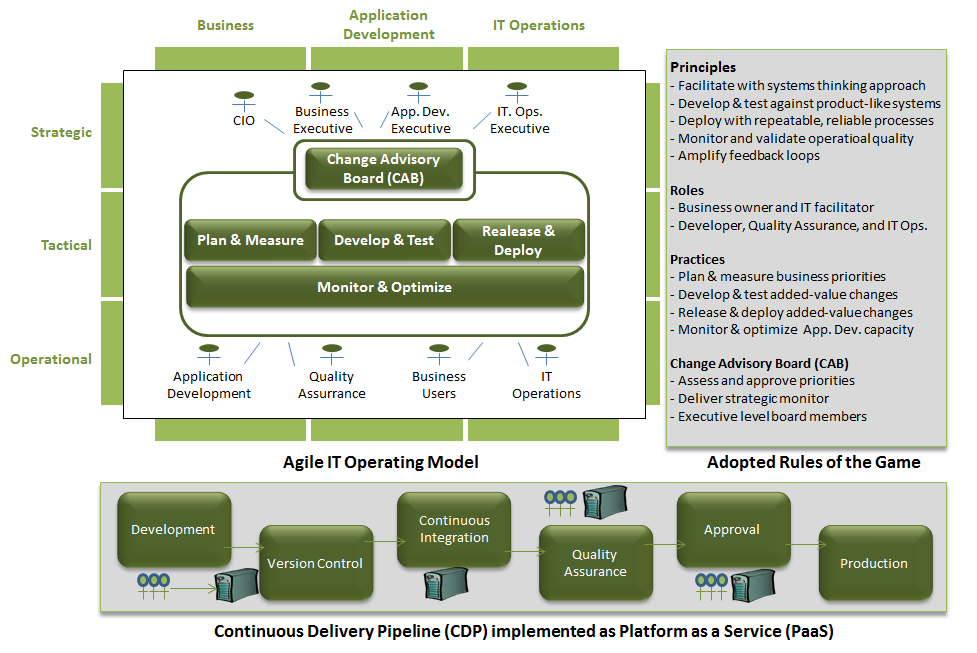
As illustrated, DevOps as a business capability is made up of three components: the Rules of the Game, the IT Operating Model and the Continuous Delivery Pipeline (CDP). Let’s explore them.
Rules of the Game are a fundamental dimension of DevOps: They enable the establishment of lean and agile environments. I refer to them as the DevOps non-technological piece.
In practical terms, they’re a set of principles, practices, roles and responsibilities and tools institutionalized to ensure accelerated applications delivery.
They serve as catalysts to specific organizational and operational effective practices. Let’s take the principle, “Facilitate with system thinking (involvement of all relevant stakeholders)”—it forces application development stakeholders to adopt a collaborative mindset, which in turn breaks down organizational silos to eliminate the impediments to operational flexibility and institutionalize cross-functional collaboration.
They’re the poor cousin of today’s DevOps practices, which ignore them in favor of more technical and technology issues. That’s a terrible mistake that reduces DevOps influence vs. the digital economy’s challenges.
The IT Operating Model reflects the interactions that take place across your application development value stream. In practical terms it represents the work environment derived from the application of DevOps’ rules of the game.
I always remind my clients that DevOps’ rules of the game aren’t theories, they’re the foundations of a tangible strategic capability: the lean and agile IT environment. They demand a thorough transformation of your application development work space to put together business, application development, and operations:

The picture illustrates what’s meant by lean and agile IT environment, it substantiates Adam Jacob’s point that “Fundamentally DevOps is about taking the behaviors and beliefs that draw us together as people, combining them with a deep understanding of our customers’ needs, and using that knowledge to ship better products to our customers.”
The IT operating model is the poor cousin of today’s DevOps practices which ignore it in favor of more technical and technology issues. Once again, it’s a terrible mistake that reduces DevOps influence vs. the digital economy’s challenges.
The importance of the rules of the game and the resulting IT operating model don’t suggest at all that technology doesn’t matter. Make no mistake about it, the CDP is essential; I refer to it as the DevOps technological piece. Through deployment automation and configuration management tools, it significantly accelerates application development, testing, resources provisioning and deployment.
However, one thing to be aware of is, digital economy raises technological challenges that transcend speedy delivery issues. They include:
As a matter of fact, IoT devices generate massive data and making use of it to generate revenue requires big data technologies to integrate, automate and analyze them.
On the other hand, this ocean of IoT data has generated an API business; the idea is, to monetize their data and generate revenue, businesses must provide their customers and partners with APIs that easily give access to their systems.
Implementing the CDP as part of PaaS cloud services can help to prosper in the digital economy; it allows businesses to benefit the cheap and on-demand computing, storage and network resources provided by the cloud.
In hindsight, with a business-oriented perspective, the ITaaS delivery model and DevOps follow the same goal: Provide business lines with the lean and agile IT environments they need to be flexible enough and responsive to meet the competitive challenges of digital economy:

Like DevOps, the ITaaS delivery model (…) takes advantage of an agile IT operating model to help businesses succeed in the digital era. It implements consumer-provider relationships across the IT value stream to ensure organizational flexibility and operational agility.
CIOs must realize that what matters to the business is to continuously generate revenue through improving customer experience and increasing customer value. Deploying applications at the speed of light for the sake of speed doesn’t make sense from a business perspective; as long as expected business benefits aren’t achieved, speed is a useless gadget.
Implement DevOps as what it is: a three-dimension IT capability including rules of the game, IT operating model and, of course, continuous delivery pipeline.

Remember that guy you knew in college who was working on his fifth or sixth degree with no plans to stop? At some point the idea of real work must have terrified him, and instead what appealed to him was a continual state of learning. If you have the funding to master five or six disciplines, and perhaps not the ambition to get going in any one of them, why not stay and explore the next one?
But if you work in IT, chances are you did not stay in college for more than a few areas of study, and since you entered the work force, your future options dwindled down to two: become a specialist (deep thinking in a singular discipline, but not too broad) or become a generalist (broad thinking across multiple disciplines, not too deep in any one of them).
Managers tend to start their careers as specialists who do so well they are promoted to manager, where their career shifts and they become generalists. From time to time they dabble in a particular area of study to speak the lingo, use the right buzz words and understand what is coming, but the role they play is inherently generalist, as they are forced to deal with a number of topics beyond the realm of any one particular area of study.
We tend to associate the title “architect” as being the specialist who is deep in an area we are forced to contend with. Examples might include, “We need to hire a network architect, or a database architect, or a software architect …” the list continues. When we do this, we have certain expectations. We are looking for the “guru” who can solve our network problems or database problems or security problems—wherever the skill set was that caused us to hire this specialist. If our new employee cannot solve our problems, we begin the search for another who can solve them.
But the candidate has expectations as well: The network guy may have a little knowledge about databases but does not expect to have to perform at the level of his peers in that discipline. If we hire a network guy and then ask him to do everything in every other discipline, we are the ones out of line and he will likely flee our employment in haste, calling us crazy on the way out.
To create a true master of the multiple disciplines that exist within IT would require creating a modern Frankenstein in networks, servers, operating systems, storage, database, middleware, software and mobility. And, of course, this list is not limited to one expression of each type, but indeed multiple expressions of each type. So for example, our database discipline likely includes deep expertise in Oracle, DB2, SQL Server, NoSQL, MySQL … you name it. If it is popular or relevant to our current stack, our Frankenstein must know that one.
As DevOps has gained in popularity, we have conflated certain aspects of it and driven ourselves off the highway of logic. Too often, proponents have taken the concept of co-location from the agile beginnings of DevOps and applied it to the operational endings of DevOps. Taking down silos is mistakenly applied to co-locating IT operational staff. This conflation occurs billed as the panacea it once was to co-locating business staff, with the developers producing products for them. In the strictly agile context, this works well. Applying it to IT personnel on the back half of delivery is the least effective means of creating Frankensteins. Co-location is a good way to share ideas, from user back and forth to innovator. In general, sharing ideas between a network guy (with limited interests outside his discipline) and middleware guy (who could care less how the network is configured in detail) has limited success.
These operational IT disciplines do interact, but only as they have need, which is significantly less than having to sit in the cube 4 feet away from a counterpart involved in a differing discipline. Co-location is not the cure for breaking down silos or increasing communication—common backbones are. Imagine the example of the medical profession: A hospital provides the common backbone for the neurosurgeon, the orthopedic surgeon and the heart surgeon. These disciplines are inherently separate, and if you have a particular illness, you are going to want the one who specializes in the thing you need done. While each doctor understands general health aspects, they specialize for a reason—a reason you want and need—when it is your time to seek help.
The hospital provides the common facility, the common support staff, the common electronic systems and tools we use. Our medical records are stored in one place, no matter what type of treatment we seek, so each specialist has to enter them there and can read them there. But distinctions by practice remain. There is a special surgical floor for heart surgeries, where they do not conduct orthopedic work or neurosurgical work. The tools may be slightly different; the medical journals are. The training is different. The experience is different. And none of these skills transfer by osmosis of co-location if you put all three doctors in one central cubical cluster. It takes years to get where they are. The same is true of our IT specialists.
If instead of co-location we looked more at common systems for moving, documenting and articulating change. If we gave limited access to our DevOps tooling to the specialists, confined to the niche they have expertise in, then instead of co-location we could have remote-work-concurrence. Experts from all over the country could work on the movement of change without ever physically seeing each other, but with full visibility into what is happening in real time through a common lens. Network operations center (NOC) personnel remain physically in the NOC, but can see the entire stack from that location and change only their portion as changes are required from there.
It is the common backbone of DevOps systems that breaks down the silos of change transparency and change participation. Prior to DevOps we were all using different tools to move change and track change. With DevOps we can begin to articulate change and document it, in the same tool or interface. Meaningful access is granted only to the portions of tools and only where it is needed. Database guys have full access to that platform and nobody else does (other than to see it). The same model works for every other specialty. And before you know it, you have a concert—or rather a symphony of moving parts—instead of disjointed sounds no one can comprehend.
Organizations that hold to the idea that staff will become Frankensteins, equipped with deep skills in all areas because they share cubicle clusters, would do better buying lotto tickets. Where the culture will require attention is in demonstrating to the impacted teams why participating in the common backbone approach has merit for each of them. For engineers who have never had to use “something different” before, this takes work, but is the real win.
When complete, what has truly happened is a conversion to a culture of unity. The work of the genius is still protected in this method; in fact, it is amplified as now it is visible to the entire organization. So even the prima donnas should be happy with the approach. And the ability to orchestrate change never will have been so high, with so much real-time interaction, as after the embrace of a common backbone of DevOps systems. This should offer executives new insights into product creation and evolution. In this sense, the cultural changes reach from top to bottom of the organization, and they are achievable.
To continue the conversation, feel free to contact me.

I read a recent comment to an article made by my friend Rob England (the IT Skeptic). Rob took exception with the authors point of view about that DevOps was so widely adopted. Rob asked the author of the article, “How many of the Fortune 500 are DevOps shops?”. My reaction to this was “Rob, not sure if you have noticed out in New Zealand, but there are a sizable number of Fortune 500 and other large enterprises that are DevOps shops now.” Maybe not a majority, but a sizable minority and growing every day. DevOps journeys of large enterprises are pretty well documented.
In fact my friend Gene Kim’s DevOps Enterprise Summit (where I last saw Rob) marches out one Fortune 500 (and other large organizations) after the next to hear their DevOps journey. It is one of the things tat makes that event so special.
Further proof of DevOps adoption by Fortune 500 and other large enterprises was also readily apparent at the recent IBM InterConnect event I attended in Las Vegas. As part of our video interviews and coverage of InterConnect I spoke to several IT leaders about their organizations DevOps transformation.
Continuing our release of videos from IBM InterConnect 2016 I wanted to highlight these DevOps journeys of large enterprises:
Our first journey is Hertz. You have probably heard of them. John LeFreniere of Hertz who is undertaking a huge transformation at Hertz updating their technology stack using DevOps, Cloud and Agile, had this to say about Hertz’s adoption of DevOps:
John says, “The DevOps methodology is in lock step with where we want to go.”
Another DevOps journey of a large enterprise was the Maersk story. Maersk if you don’t know is a large shipping company that has been around a long time. I spoke to Spencer Rodrigues and David Loughnane of Maersk.
As David says, “Devops is about us ultimately delivering a better customer experience.”
Let me give you one more large enterprise talking about their DevOps journey, Starwood Hotels and Resorts Thomas Seremet tells us about their journey.
Thomas said that Starwood started their DevOps journey in 2014. A piece of the journey that they have now really concentrated on is the cultural element of DevOps.
Finally, you don’t have to take my word for it. Let me give you one more interview, this one with Carmen DeArdo of Nationwide. Carmen is always one of my favorite interviews and besides leading Nationwide’s own journey, he has some great insight on DevOps in general. Here is what Carmen had to say:
For Carmen the difference at InterConnect this year “was seeing the journey and progression that different organizations are on”. Carmen said they have gone past just agile or CD and are now putting all of this together including changing of the culture.
So my opinion is that DevOps is well entrenched in Fortune 500 and other large enterprises. Maybe I live in the DevOps echo chamber though. What do you think? Would love to hear about more DevOps journeys.
