— ROELBOB

Our team has recently returned from the OpenStack Summit in Austin. While there were many hot topics, we discovered people fell within two camps when it comes to backup and recovery: those who understand why a native OpenStack solution is required, and those who question why legacy backup and recovery won’t fit the bill.
I sat down with Trilio Data’s co-founder, Murali Balcha, to detail why legacy backup and recovery solutions are not suited to protect OpenStack applications without considerable retooling. Even then, these solutions do not naturally fit into OpenStack operating model and will increase your total cost of ownership (TCO) considerably.
First, let’s look at the OpenStack operating model. It includes:
OpenStack does not come with the maximum capacity that it can grow into. The architecture is inherently scalable without any theoretical boundaries; it can be deployed in a single box or it can scale to thousands of nodes.
Contrast this with existing backup solutions that always have some predefined capacity, whether it is number of applications it can back up or the amount of backup storage capacity that it can manage. So essentially you have a forever scalable architecture, tied to a backup solution with a limit on capacity.
Multi-tenancy is an integral part of OpenStack cloud. The tenancy is different than supporting multiple active directory users in a backup application. Active directory users are typically OS users, whereas cloud tenancy usually represents individual organizational units with in a bigger organization. So there is a mismatch on how existing backup solutions are created versus how OpenStack multi-tenancy works.
One way to make existing solutions work with OpenStack is to deploy a backup application for each tenant and make that tenant responsible for managing its own instance of the backup application. This means each tenant has to manage the application and any storage that is provisioned to save backup images.
Some backup applications provide an aspect of a self-service portal for individual users to manage their own backup policies. Backup applications use host agents on either virtual machines, or on servers to back up files and provide a portal to restore a backup copy in place through its agent infrastructure. This kind of self-service portal is, again, in contrast to what an OpenStack self-service portal is—it provides the ability to provision virtual resources.
Existing backup solutions are only good at doing file-level backups. Yes, they have evolved to do virtual machine (VM) backups for VMware, but vCenter is not a cloud platform, and the mechanism to do a VM backup on VMware platforms is totally different from doing VM backups in OpenStack. Anyone trying to retrofit existing backup solutions for OpenStack will only have their file-level backup feature to rely on.
File-level backups only back up bits and pieces of your application. File-level backups are the legacy of backing up scale-up systems, where huge databases are confined to a beefed-up single host. But cloud applications are lot more distributed. Instead of provisioning one beefed-up server to host a large database, cloud applications are deployed as multiple VMs, with each VM performing discrete functionality. The data in these applications are also are distributed to multiple VMs. File-level backups will not ensure consistent backups. They are notoriously insufficient to restore an entire application environment and may seriously affect your recovery time.
File-level backups are not well-suited to address cloud application needs. Instead, a backup application that is aware of cloud infrastructure provides a perfect solution for your cloud applications. Since cloud applications are distributed, your backup should include not only the data but also the application context to successfully recover the application.
An application context includes the VMs, flavors of the VMs, network settings and all the volumes attached to those VMs. Let’s not forget that all of the aforementioned will be tweaked and will evolve over time to suit that moment in time. So only backup solutions that can provide a single snapshot that includes all the VMs, storage volumes mapped to each VM, network settings and the meta data associated with each VM and its resources at that point in time are suited for OpenStack backup needs. Since such backup solutions capture the entire application environment, recovery with this backup solution is very deterministic and reliable, irrespective of the size and complexity of application.
Solutions that are aware of the infrastructure also can back up applications into one availability zone/region and restore into a different zone/region. Beyond speed of recovery, this now empowers data protection (or backup) with resource management capabilities.
DevOps is an integral part of OpenStack cloud deployment and management. Your choice of backup solution should play with your cloud DevOps scripts. For example, if you standardize on Ansible playbooks to manage your cloud deployments, the backup application should play into your DevOps strategy so you can reduce the TCO of your backup application.
In traditional IT, the data management functions such as backup and recovery, disaster recovery and application migration require different applications. However, your backup solution for OpenStack should be more than just a backup and restore of the files. A backup solution that is well-designed for OpenStack is a re-orchestration from a point-in-time and should be able to provide additional uses cases such as:
OpenStack offers an operating model that warrants a completely new thinking around backup solutions. Retrofitting existing solutions not only is inadequate in protecting your applications, it also increases your TCO. So do yourself a favor and look for solutions that are purpose-built for OpenStack. That will provide the best data protection possible, decrease your TCO and simplify recovery.

We live in a continuous customer economy. Buyers in the 21st century are continuously discovering, adopting and discarding products and services online, telling us—very loudly and unequivocally—that value isn’t perceived in the actual product itself, but rather in our ability to change a product continuously. So, it’s now about the options to change the product, not the product options themselves.
This utter lack and loss of brand loyalty puts companies at an insane disadvantage. They’re living with a “see you later” digital mindset, where it’s easy for consumers to say goodbye to something they know online for an opportunity with the newest, next best thing.
Take this to the next logical business level and you see why continuous transformation of your organization is so critical. If you can’t continuously transform the way you deploy your people, processes, skills and resources, so everything is aligned with the consumer’s “see you later” mindset, there’s no way you can keep up with customers, who are continuously discovering, adopting and discarding products at what seems like warp speed.
Obviously, this means learning and acquiring new knowledge fast.
The same old knowledge, the knowledge of the past, just doesn’t work in the world of now. But, more profoundly, to continuously transform your organization and meet customers where they are today, you need to learn how to learn.
Yes, sure, you have to learn from customers and gain an understanding of what they want and need. But every organization does that today. It’s no longer enough to simply grasp that insight and intelligence and run with it. No, you have to continuously improve how you learn from customers in this fluid and fast-changing world.
Why? Because, at the end of the day, continuously improving how you learn is the only way to continuously transform your organization. And, thus, continuously improving how you learn is the only competitive advantage you have.
Assume, for a moment, that you’re shipping an update of 1,000 lines of software code each week.
That’s great.
You’re likely using continuous delivery.
But if you can’t continuously improve how you’re learning from customers and continuously improve the teams inside your organization, you can’t ship continuously improved products. So, you need to improve what you ship and how you ship to continuously transform your organization.
Here’s an example of how this works.
Let’s say your software development team senses the customer wants an improved red button that’s square instead of round. Okay, development of an improved red button proceeds and is completed in one week. But, at the same time, the team creates an automated test for the red button as well as clear metrics for determining if the red button is actually the problem. Remember, the idea that the button needed changing is a hypothesis until it has been tested with customers.
So, in addition to shipping the new square button to some customers, the team keeps some subset of customers using the round button. The customer test is then simply whether the click rate of the square and round button differs.
Let’s imagine that the processes are not currently in place to enable the development team to receive these metrics, as many teams are kept in splendid isolation from the results of their work. Then the establishment of this relationship, perhaps with the web operations team, is also going to be required.
This is as much a requirement of successful deployment of these features as the features themselves. The focus on the delivery of function, as well as developing internal capability, is a core principle of continuous transformation.
This is the Two-Product Principle.
Think of the product we ship to the customer as “Product 1.”
Meanwhile, the internal capabilities we wish to develop—our view of what we need to improve while we build—is “Product 2.”
To recap two critical points:
If you take these two critical points to heart, then your organization will do all it can to shorten the time to deployment and action to shorten the time to gain new learning in the market. This limits the length of the costly business guessing game, the cash-draining theory time.
The way you can do this is by continuously shipping, continuously delivering, continuously learning how to improve how you learn and deliver—continuously improving your internal capabilities and continuously transforming.
Unfortunately, many organizations that want to increase velocity go faster without improving their ability to learn at this new speed.
The implications of this short-sightedness are profound: When you’re leaning and looking backwards, you’re not improving how you learn from your customers in real time and, instead, you’re adding to your risk going forward because you’re so out of step, and out of touch, with what the market wants and needs.
Too many companies fail to obtain crucial feedback. They throw a ball up in the air and walk away before it actually lands. We see this in software development when an organization releases a new quarterly product or feature and returns four months later; sadly, this approach doesn’t allow for much effectiveness tracking, or much learning, or much improvement.
Which is why every single action in the continuous transformation process needs to be an act of design. The act of design is an act of feedback. And, in continuous transformation, you’re continuously getting feedback—whether you’re shipping product externally to a customer or you’re making changes inside your organization.
The bottom line is that you need to continuously test your assumptions about the world, as well as your effectiveness in responding to those assumptions, if you want to keep up with continuously changing customers in the continuous economy of the 21st century.
Overwhelming number of quality submissions led organizers to add an additional eight-session track
PORTLAND, Oregon, May 25, 2016 /PRNewswire/ — IT Revolution (http://itrevolution.com), the industry leader for advancing DevOps, today announced the final program and speakers for DevOps Enterprise Summit London (DOES16), the premier industry conference for the leaders of large, complex organizations implementing DevOps in the UK and Continental Europe (http://events.itrevolution.
Logo – http://photos.prnewswire.
“We had so many compelling submissions of real-world DevOps transformations in large, complex organizations that we added an additional track of eight more sessions than originally planned,” noted Gene Kim, founder of IT Revolution and co-author of “The Phoenix Project: A Novel About IT, DevOps, and Helping Your Business Win.” “We wanted to enable every attendee to hear relevant stories of how DevOps can help them succeed. The phenomenal speaker lineup and remarkable stories being shared in late June shows how much innovation is happening in DevOps.”
The final round of speakers added to the program include:
· Helen Beal, DevOps Director, Ranger4
· Kevin Bowman, Head of Operations, Sky Betting and Gambling
· Tom Clark, Head of Common Platform, ITV
· Charlotta Croiset Van Uchelen, Chief DNA Officer, Schuberg Philis
· Martin Croker, Managing Director, Accenture Technology Architecture and DevOps, Accenture
· Margo Cronin, Head of Technology Architecture, Zurich Insurance
· Darren Hague, Cloud Infrastructure Architect, SAP
· Simon Parkes, Enterprise Infrastructure Architect, Ordnance Survey
· Scott Potter, (former) Head of Digital, News UK
· Pat Reed, Principal Consultant, iHoriz Inc.
· Robert Scherrer, Head Application Engineering, SIX
· Jan Schilt, Owner Founder, GamingWorks BV
· Jonathan Smart, Head of Development Services, Barclays
· Gebrian Uit De Bulten, DevOps lead Gallia (Netherlands, France, Belgium,
· Vincent Van Kooten, Domain Manager Front Office, Ingenico ePayments
· Benjamin Wootton, Co-Founder, Sendachi
The full program is available online and can be found here: (http://bit.ly/doesldnagenda).
IT Revolution and Premier Sponsor HPE Software are excited to present the inaugural DOES16 London event. As a vendor-neutral conference, DevOps Enterprise Summit curates stories from the enterprise point-of-view. Most of the presentations follow a very specific “experience report” structure—each speaker describes their organization and their industry, the business problem they faced, where they started their transformation, what they did, and the business outcomes. It’s a simple yet powerful format that reveals solutions to shared problems and new practices that can be used in other business contexts.
Join the #DOES16 Conversation
Interested in joining DevOps Enterprise speakers for an online social media chat? DOES16 organizers will be hosting aCrowdChat on Thursday, June 9 at 11am EDT / 4pm BST. To join the conversation, please visit: (https://www.crowdchat.net/
For more information about DOES16 London, please visit: (http://events.itrevolution.
Share This: DevOps Enterprise Summit London Announces Program http://bit.ly/
About IT Revolution
IT Revolution assembles technology leaders and practitioners through publishing, events, and research. Our goal is to elevate the state of technology work, quantify the economic and human costs associated with suboptimal IT performance, and to improve the lives of one million IT professionals by 2017.
Contact:
Jeremy Douglas
Catapult PR-IR

The first post in this series on DevOps Discovery discussed the importance of asking fundamental questions of stakeholders to facilitate alignment on priorities and establish a mission statement when beginning a DevOps transformation. Part 2, below, reviews definitions of common DevOps-related terms and provides examples of how failure to agree on such terms can hinder your transformation.
The industry is full of terms such as continuous integration, agile, continuous delivery, DevOps, etc. The practices described by these terms often are defined differently by various industry “experts,” resulting in stakeholders in the software delivery process having different understandings of what constitutes these practices. Some will state they are already following the practices; others will state they do not. Some will believe the objectives unachievable, while others will be bullish on the prospects; differing interpretations blocking agreement on the organization’s current and target states. If stakeholders cannot agree on the current state (or the start point) and the target state (or the destination), it is impossible to “map a route” for the journey to DevOps.
For example, let’s look at how some define continuous delivery:
Continuous Delivery – Definition 1:
A software engineering approach in which teams produce software in short cycles, ensuring that the software can be reliably released at any time. It aims at building, testing and releasing software faster and more frequently.
The approach helps reduce the cost, time and risk of delivering changes by allowing for more incremental updates to applications in production. A straightforward and repeatable deployment process is important for continuous delivery.
Source: Wikipedia
Continuous Delivery – Definition 2:
Continuous Delivery is a software development discipline where you build software in such a way that the software can be released to production at any time.
[Continuous Delivery Blog Post by Martin Fowler]
You may read the above and initially think there is no difference in the definitions but, note that the first definition addresses deployment of software with the statement: “A straightforward and repeatable deployment process is important for continuous delivery,” whereas the second definition addresses deployment of software with the statement: “Build software in such a way that the software can be released to production at any time.”
This distinction may seem trivial, but it is the often the source of confusion between the practices of continuous delivery and the practice that is commonly called continuous deployment. In contrast to continuous delivery, which states that every software build “could be released,” continuous deployment is loosely defined as “the practice of releasing every good build to users.”
When establishing your target state for the DevOps transformation a seemly slight confusion such as this can result in pushback from stakeholders concerned that continuous deployment is unachievable or too disruptive. These sentiments include:
The confusion and potential pushback exemplify the need for establishing baseline definitions and alignment at the start of a DevOps transformation, and doing so in the specific context of your organization. The importance of points such as how far it deploys varies with the organization—some organizations can support continuous deployment to production multiple times a week or even multiple times a day, such as Netflix does. Other organizations, such as providers of critical financial systems, may never pursue this cadence of deployment. Be sure to apply these industry practices pragmatically as fit for your organization, not dogmatically based on generic industry definitions.
Let’s look at a couple of definitions of DevOps:
DevOps – Definition 1:
“DevOps (development and operations) is an enterprise software development phrase used to mean a type of agile relationship between Development and IT Operations. The goal of DevOps is to change and improve the relationship by advocating better communication and collaboration between the two business units.”
DevOps Definition 2:
“DevOps (a clipped compound of “development” and “operations”) is a culture, movement or practice that emphasizes the collaboration and communication of both software developers and other information-technology (IT) professionals while automating the process of software delivery and infrastructure changes. It aims at establishing a culture and environment where building, testing, and releasing software, can happen rapidly, frequently, and more reliably.”
Like the example with continuous delivery, these two definitions also are very close. Yet on detailed observation, it is clear the first definition describes DevOps as being focused on relationships (i.e., culture and collaboration). The second definition extends this to include the “automating the process of software delivery and infrastructure changes,” giving consideration to tools and technical practices such as continuous delivery.
Does this matter? Yes. Often if the executive sponsors and key stakeholders do not account for the need to establish tools and technical practices and only focus on relationships, there is a high chance for unrealistic expectations for timeline, budgets and results. Conversely, if the need for changes in culture and process are not considered and the DevOps transformation focuses only on tools and technical practices, the efforts are also unlikely to yield the expected results. A DevOps transformation must account for the trinity of “People, Process and Tools.”
When considering DevOps, it objectives and the objective of its component practices it is useful to establish a clear idea of the relationships between theses practices. It is often useful to visualize them as below:
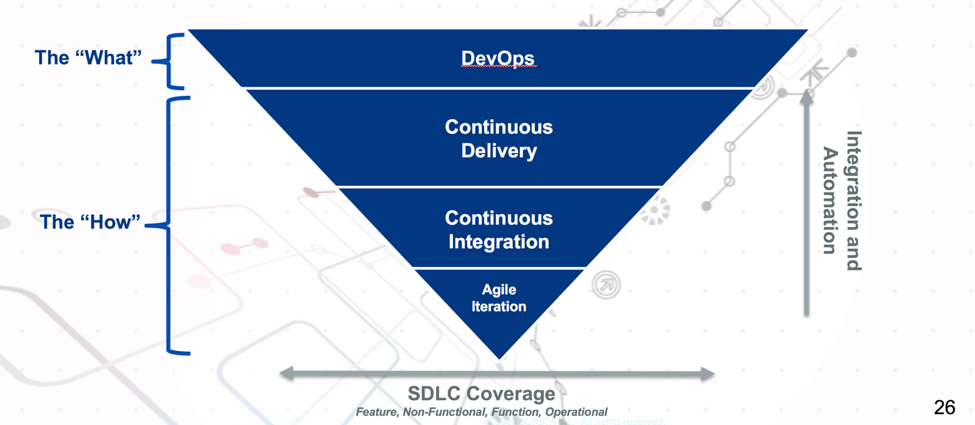
DevOps is the “What,” the target state as defined by a set of guiding principles. Agile development, continuous integration and continuous delivery are the “How,” a collection of process, practices and tools that together build the foundation for a sustainable DevOps implementation.
In the next section, we will review some of the initial discovery questions asked when beginning on a DevOps transformation, provide real-world examples of answers from various stakeholders in real organizations, and analyze those answer to better understand the journey to DevOps.

Consider how much money your enterprise spends on audits. Smaller firms not subject to external regulation should consider how much money is spent on quality assurance—or the lack of it. A business that suffers from a customer-facing quality incident will, at minimum tarnish the brand of its services or at the high end, lose market share altogether. Larger firms that fail audits can suffer from brand tarnishing as well as high fees, not to mention further scrutiny by regulatory agencies.
Failure to perform or failure to follow proscribed processes inevitably leads to a black eye in front of customers. The entire discipline of governance is premised on avoiding both. Whether your governance practices are efficient or not—and whether your “process” as it sits today leads to quality or not—is not the subject of this review; it is how DevOps and automation can shine a spotlight on both and radically reduce the costs you spend today to achieve them.
The spotlight of DevOps begins with consistency that leads to predictability. Automating any given kind of process or technology the same way every time begins to give insight on any “holes” from things that do not work (or work well). If all that changes in your deployment process, for example, are pointers inside a configuration file and the kind of testing executed against this version of the code, you have achieved a build-once, deploy-many state of deployment automation. Operations staff who support the deployment of change or maintain the environments in the software development life cycle (SDLC) begin to isolate any issues faster because they become familiar with “how” a given kind of technology is automated to deploy. This reduces the total number of deployment errors and, in tandem, reduces the length of time it takes to fix them. Any “process” problems or weaknesses in your governance model become apparent quickly and can be fixed quickly. Limiting variation is the medicine to keep them away in future.
The spotlight of DevOps next turns to transparency. Offering your entire enterprise visibility or “read only” access to your entire DevOps tooling suite has a profound impact on the transparency of change. As an example, consider that I am a humble accountant in your firm who has submitted an agile story to improve our billing system. I may or may not, given the nature of my job, be co-located near the programming team who will fulfill this request. If our firm specializes in accounting software then perhaps I will co-locate, but if I am only requesting a change to an ancillary or support system, likely not. Without direct access to the programmers through traditional agile co-location, my visibility into the progress of change is limited to the tracking system I submitted the request within (assuming you have one, and don’t use email to do this).
If I know a programmer in MIS, perhaps I ask him at lunch how my change is coming along. But if I have read-only access to the testing systems, or to the release orchestration (RO) tooling, I may get a much better up-to-the-minute view of exactly where my change is, how it is doing from a quality assurance (QA) perspective, and when it is scheduled for release into production. Based on this news, I may make decisions about how we bill our customers in what time frame to increase overall revenue to the company. I would notify my boss of same (who also has access, but pays less attention), and of any changes that impact the new timeline I create. The marketing team (who also has access) begins to work with public relations (PR) and the advertising guys on customer announcements, etc. etc.
The net impact of having universal transparency is that audiences who are not traditionally notified or interested in the inner workings of change movement now make decisions based on it. Consider that prior to this systemic access, and the reliability of DevOps to ensure delivery, the only news you got before was from “the IT guy,” who was often wrong. It does not take long before IT loses credibility from being wrong about delivery timelines, and these other audiences begin to pay less attention (if at all). At that point, an “I’ll believe it when I see it,” attitude emerges. And this same attitude infects internal auditors because of what they hear and see from disaffected internal customers who have been misled repeatedly by the failed manual methods of the past (pre-DevOps).
Processes that are disinfected over time by the consistency of DevOps begin to change the internal company thinking about the delivery of innovation—namely that it can be counted on as accurate. Transparency offered to all audiences of a company increases the visibility into all aspects of innovation delivery and better ideas emerge, both about what to do with completed efforts and how to improve the innovation process itself. And before you know it, your governance and QA processes become efficient, reliable and predictable. Variation is eliminated or greatly reduced, and the costs of operation and innovation begin to decline.
What is rarely a matter of focus in most companies is the secondary ability to automate the compliance history of a given application. Most firms are content (translate, only able to) work with their testing tools to produce logs about a given version of an application now residing in production. A test log does show an auditor the majority of the quality related information about a given version of an application. But the log is a highly limited view of what has taken place. What is needed is the full context of innovation. Enter compliance automation.
Consider for a moment, that requirements drive the train. Why are we doing the innovation we are doing? Is this a bug-fix, a new feature, a client request, a regulatory requirement? Being able to trace the code itself back to the requirements system that drove the need adds significantly more context than is possible from mere test logs. Next, think about the number of attempts that finally resulted in this version of the application. An automated build tool (part of our DevOps suite) has this information. At this point you could evaluate how many builds and deployments took place in development before a worthwhile candidate emerged to traverse the remainder of the SDLC. An automated deployment tool (part of our DevOps suite) can trace the number of environments this version of the app was deployed into for testing and how long the overall process took to get something moved from development to production.
And finally, testing is often done from a variety of tools, with results compiled in a variety of result repositories. This information may be available from a solid RO tool that tracks the gated progress of this version of the application, but if it’s not, it still should be sitting in each of the testing tools used throughout the process. Depending on the level of inherent DevOps tool integration (i.e., using a vendor suite) much of this information may “flow” from one tool to the next. But if not, the information does still exist in the logs produced by each of the DevOps tools.
It may be well worth the application of internal programming resources to put together a tool that gathers all this information (automates the collection and presentation of) for audit purposes. Imagine the reduction in cost of supporting an audit that can gather a simple push-button report (or dashboard) of the entire life cycle of a given version of change. At that point, you have the entire context for a piece of innovation. You know what drove it (requirements). You know what it took to create it (build and deploy). You know the entire history of testing it (testing tools). And, finally, you have the entire governance process used in its deployment to production (RO tooling). But instead of examining multiple tools to collect and present it, you have created a push-button system to do so.
The investment in adding automation to the compliance history of innovation pays off in more than one way. It is not just the ease with which history can be recited. It follows the same principles as DevOps itself. Automation introduces consistency in how audit information is gathered and presented (reducing variability from one audit to the next). Automation introduces transparency if the entire company is given “read only” access to this new system. Automation shows auditors we are not afraid to learn from our mistakes and proud of our accomplishments. And in effect, it reduces the need for audit altogether.
Typically, regulatory bodies investigate and audit firms where they are uncertain of how the results were obtained. An automated system like this one fully eliminates that need. Transparency as could be offered here, may convince auditors that attention is not warranted here. Keeping in mind the spotlight of DevOps has already improved quality and streamlined process, add to that full transparency of audit materials and the confidence of auditors regarding your company may increase significantly. Routine becomes the only reason to audit, rather than suspicion.
Invariably the “new” will sometimes result in an error that your current systems and processes (automated or not) will not catch. But this truism is recognized, and accounted for, in how DevOps enables innovation. And if you have this kind of automation in place, it can be demonstrated in how we fixed what we fixed (whether governance or QA). Your strategies in DevOps should help you achieve this level of confidence. (If you need help, feel free to contact me, I am currently looking.)
To continue the conversation, feel free to contact me.