Category: Blogs

  • Best of 2018: The Beauty of the COBOL Programming Language

    Best of 2018: The Beauty of the COBOL Programming Language

    As we close out 2018, we at DevOps.com wanted to highlight the five most popular articles of the year. Following is the first in our weeklong series of the Best of 2018.

    Well-written code is a work of art. Always has been, always will be. A programmer pulls a thought pretty much out of nowhere and transforms it into a working idea that can be used by others. It’s abstract expression made real. Computer programming requires a depth of creativity and discipline of logic that is hard to find elsewhere. Maybe architecture and the theoretical sciences come close, but computer programming stands apart. Computer programming is special and I love it!


    Thus, I am always interested to learn a new programming language. Every programming language offers a new way to expand my thinking. It’s always time well-spent.

    Recently I decided to learn COBOL, for no other reason than the fact that there are a lot of mainframe installations out there and it’s the mainstay language for many of them. Mainframes are critical to the operations of many banks, insurance companies, transportation systems and governmental agencies. Learning COBOL been on my Bucket List for while.  So I took the plunge.


    What does the term, COBOL stand for? Common Business-Oriented Language

    Working with COBOL in a Modern IDE

    The first thing I needed in my journey to learn COBOL was an IDE. I am a big supporter of coding in an integrated development environment (IDE). I like being able to write, test and run code all in one place. Also, I find the support features that an IDE provides, such as visual code structure analysis, code completion and inline syntax checking, allow me to program and debug efficiently.

    The IDE I found is an open source product, OpenCobolIDE, as shown below in Figure 1.
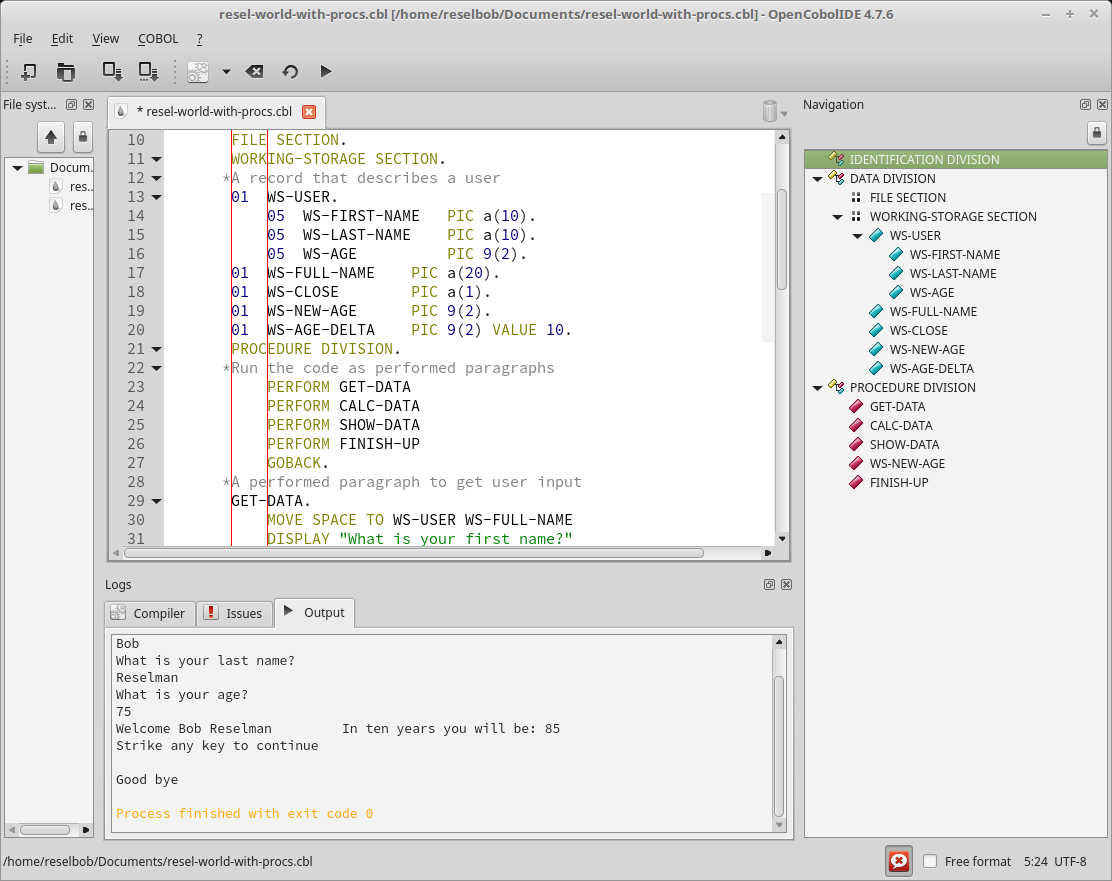
    Figure 1: OpenCobolIDE provides many tools to make COBOL programming easier

    OpenCobolIDE allows me to write, compile and run code all in one place, without having to go out to the command line, which is very good because I am the world’s worst typist!

    Programming COBOL in the Real World

    When it comes time to do real world, mainframe based COBOL programming, you will do well to look at the IDEs that IBM provides. The tools are designed to go about against its Z Systems environment seamlessly as a set of Eclipse plugins. These tools allow COBOL developers working in the mainframe environment to code, debug, unit test and do problem determination.

    Having set up my development environment, the next thing to do was design my first project.

    Designing My First COBOL Program

    Typically when learning a new language I like to start small and work my way up into more complex tasks. I did the typical Hello World program. You write the code to display string, Hello World, to standard output. Every developer does one. It’s a trivial program, as shown below in Listing 1

    beauty-of-cobol-listing-01
    Listing 1: A Hello World program written COBOL


    While the Hello World required that I learn about the concept of a DIVISION, which I will discuss in detail below, in the scheme of things, I needed more. I wanted to write a program that would force me to learn how the following:

    • How to create and use variables.
    • How to structure data into a hierarchy.
    • How to structure code into encapsulated procedures.
    • How to do some basic arithmetic.
    • How to accept user input and then do some manipulation around that input.

    Thus, I create the program, RESEL-WORLD, as shown in Listing 2, below.

    beauty-of-COBOL-Listing-02

    Listing 2: The COBOL program, RESEL-WORLD accepts and manipulates users’ input

    The user input and program output is shown below in Figure 2.


    Figure 2: The RESEL-WORLD COBOL program asks a user for first name, last name and age, then manipulates the input

    The RESEL-WORLD program taught me a lot about COBOL and how to program in the language. In the spirit of giving, I am going to share what I learned from writing the program. However, before I delve into the details, please be advised that the information I’m presenting is but a high-level overview. As with any programming language, it takes about a year of consistent coding to become an entry-level professional. My sincere hope is that the information I provide gives the reader a good sense of the language and enough motivation to want to learn more. As I mentioned early, learning COBOL is worth the effort.

    COBOL is Code in a Structured Document

    The most important thing to understand when learning COBOL is that is very strict in terms of code layout. The layout rules relate to the use of columns and characters. Also, the format uses a hierarchical outline structure. The following sections describe the details of layout specification.

    The COBOL Column Specification

    In COBOL a line of code can be no longer than 80 columns in length. You can also think of a column as a character. Columns are segmented into groups, with each group serving a particular purpose. The columns groups are as follows:

    Columns 1-6 is the group in which a programmer defines a sequence number. A sequence number is similar to a line number.

    Column 7 is reserved for special characters. Asterisk (*) starts a line of comment. Hyphen (-) indicates line continuation and slash (/) is form feed.

    Columns 8-11 is called Area A. Area A is the group of columns in which you start a DIVISION, PARAGRAPH and SECTION. We’ll talk more about these below in the next section, The COBOL Structural Hierarchy.

    Columns 12-72, also known as Area B, is where you write code statements.

    Columns 73-80 is reserved for developer use. You can write poetry in there, if you so desire. Just make sure you don’t go past column 80.


    Figure 3, below illustrates the columns grouping described above.

    Figure 3: Each column in a COBOL file is specified to serve a specific purpose


    COBOL is a compiled language. When it’s time to run your code, the compiler will check to make sure that the code layout adheres to the column grouping specification. If there is a violation, the compiler will error.

    Understanding Performance in Terms of Compilation and Compilers

    COBOL is a compiled language, as are others such as Java, C# and C++. Compilation is the process of taking textual source code and converting into a binary format that the computer can understand.

    There’s a lot of variety in the COBOL world when it comes to compilers, particularly when it comes to cost and performance efficiency. For example, how a compiler orchestrates the way numbers are loaded and then computed in memory matters a lot! A good compiler will make code run really fast.

    IBM has been in the COBOL business for a long time and has a keen understanding about making compilers that are fast and cost-effective. For example, the z14 System compilers improve efficiency by taking advantage of almost 24 new low-level instructions. As a result, computation speeds improve dramatically.

    As you work more with COBOL, you’ll come to appreciate the power that an industry-leading compiler such the IBM Z Systems brings to the coding experience.

    The COBOL Structural Hierarchy

    The concept behind the file format of a COBOL program is based on the structure of a document outline, with a single top-level heading followed by subordinate levels. The organizational units that make up the hierarchy are PROGRAM, DIVISION, SECTION, PARAGRAPH, SENTENCE, STATEMENT and CHARACTER. Figure 4 illustrates the hierarchy.
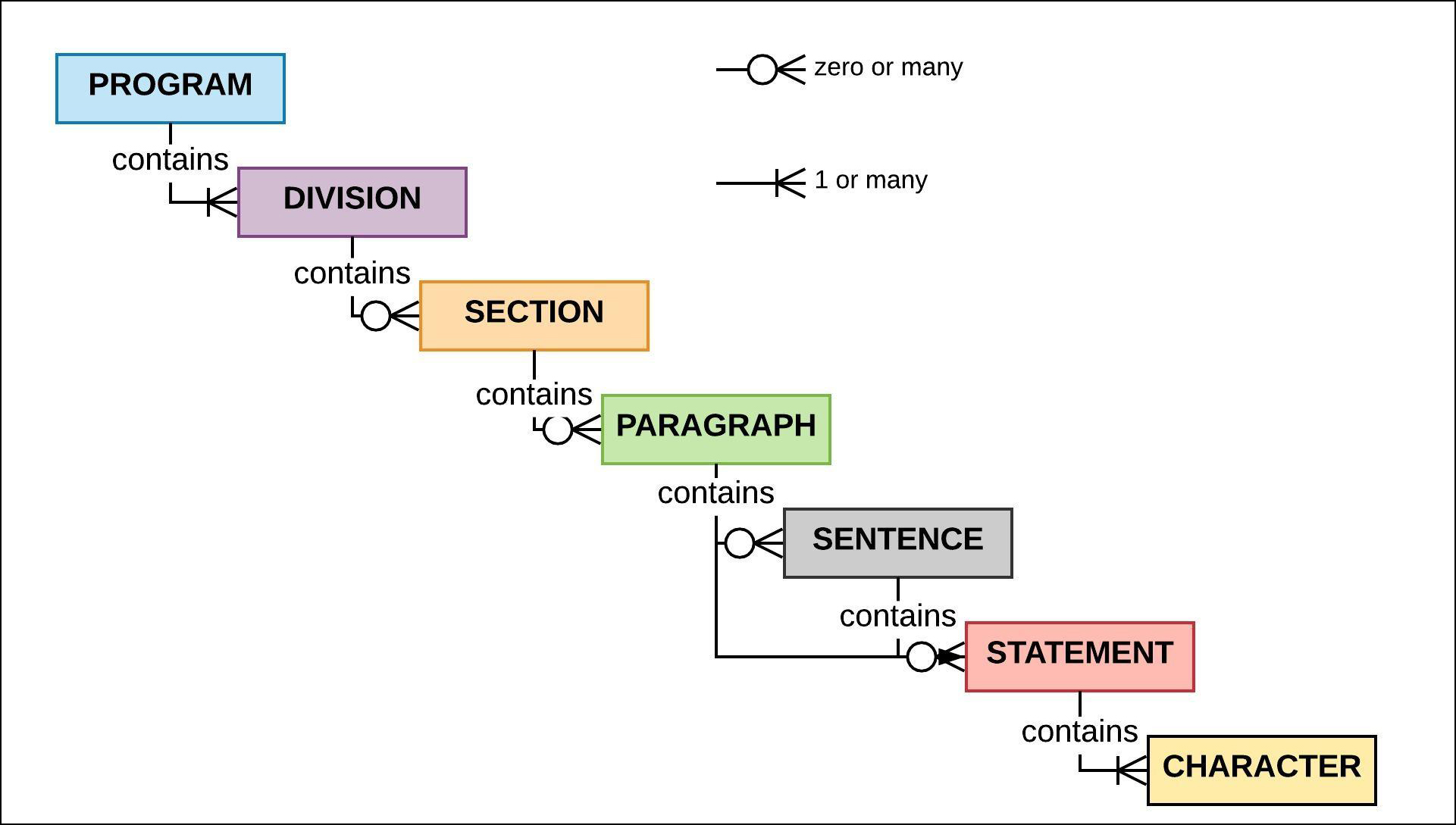
     

    Figure 4: The structural hierarchy of COBOL program entities

    PROGRAM is the root level of the COBOL code hierarchy. PROGRAM represents the unit of code that the mainframe job scheduler, the JCL, loads into memory to run. The program is identified by the PROGRAM ID statement in the IDENTIFICATION DIVISION. The IDENTIFICATION DIVISION is part of the next level of hierarchy that descends from PROGRAM. PROGRAM must contain the IDENTIFICATION DIVISION.

    There are other DIVISIONs that can be included. These other DIVISIONs are: ENVIRONMENT DIVISION, DATA DIVISION and PROCEDURE DIVISION,  which occur after IDENTIFICATION. Also, these subsequent DIVISIONs must appear in the order defined: ENVIRONMENT, DATA and then PROCEDURE. You can read a detailed description of each DIVISION here. DIVISION names are terminated with a period, for example,

    DATA DIVISION.

    The next organizational level down from DIVISION is SECTION. (Please see Figure 5.) Each DIVISION will contain SECTIONs that are special to it. For example, the DATA DIVISION can contain FILE SECTION, a, WORKING-STORAGE SECTION and/or the LINKAGE SECTION. You can read the details about DIVISIONs and SECTIONs here.


    Figure 5: A COBOL program is structured in a hierarchical manner

    A SECTION name is terminated with a period, for example:

    WORKING-STORAGE SECTION.

    A SECTION contains zero or many PARAGRAPHs. (Typically a SECTION will have at least one PARAGRAPH.) A PARAGRAPH name is terminated with a period, similar to a DIVISION and a SECTION.

    A PARAGRAPH contains SENTENCEs or STATEMENTs. A SENTENCE is a group of STATEMENTs. Usually a PARAGRAPH contains one or more STATEMENTs. A STATEMENT is a line of execution. A STATEMENT is made up of CHARACTERs. A CHARACTER can be an alphanumeric symbol or a special character. CHARACTER is at the bottom of the COBOL code format hierarchy.

    Variable and Data Types

    COBOL allows you to declare variables in a variety of data types. Special to COBOL is the concept of a variable level as represented by a level number. A level number defines a variable in terms of being or having a parent variable. (You’ll see more about this in the section, COBOL Supports Hierarchical Data, later on.)

    The following statement, which will be declared in the WORKING-STORAGE SECTION of the DATA DIVISION, is the declaration of a variable, WS-QUANTITY. WS-QUANTITY will hold a numeric value.

    01  WS-QUANTITY PIC 9(2) VALUE 12

    The expression above above declares a variable , WS-QUANTITY to be a two-digit value with an initial value of 12. Also, the variable is declared to be at level 01, which is the highest level possible. The variable has no parent. The way we know that WS-QUANTITY is a variable for a two-digit value is due to the PIC (Picture) clause. You can think of a PIC clause as a type declaration. Table 1 provides a high-level description of the various PIC clause symbols.

    Symbol Description Example Declaration Sample Value
    9 A numeric value where each occurance of 9 represents a digit 99 or 9(2) 35
    a Alphabetic aaa or a(3) “Bob”
    x Alphanumeric xxxx or x(4) “R2D2?”
    v Implicit decimal* v(3) .175
    s Sign s9(2) -76
    p Assumed decimal* p9 .6

    Table 1: Symbols for a PIC Clause

    *COBOL has a special way of storing numbers such that the numeric conversion take place when the characters are loaded into memory. For example, a variable with a PIC of p9(2) will be stored as 56 and loaded into memory as .56. For a more detailed discussion of usage and the PIC clause, go here.

    COBOL Supports Hierarchical Data

    Storing data in a named group of variables makes programing easier. For example, in the C programming language, we can use a struct to name a group of variables, as shown below in Listing 3.

    struct User { 
      char  first_name[10]; 
      char  last_name[10] 
      int   user_id; 
    };

    Listing 3: A simple structure in C


    One of the real nice things about COBOL is that it allows you to organize data according to a named group of values similar to that of a C struct. What’s interesting in a historical sense is that COBOL has had this capability well before Kernighan and Ritchie created the C programming language.

    The way COBOL accomplishes named data grouping is with construct called a record. Figure 6 below shows a graphical representation of a record named, WS-USER.

    Figure 6: The record, WS-USER contains subordinate variable, WS-FIRST-NAME, WS-LAST-NAME, WS-AGE

    The code snippet in Listing 4, which is from the RESEL-WORLD program at the start of this article, shows the COBOL code that declares the record, WS-USER.


    beauty-of-COBOL-Listing-04

    Listing 4: The record, WS-USER contains 3 subordinate elements, WS-FIRST-NAME, WS-LAST-NAME, WS-AGE

    Notice in Listing 4 above the there are two levels of data variables in play: 01 WS-USER and 05  WS-FIRST-NAME, 05 WS-LAST-NAME, 05 WS-AGE. The variable, WS-USER is a parent to the subordinate, level 05 variables, WS-FIRST-NAME, WS-LAST-NAME, and WS-AGE.

    Assigning variable to a numeric level is special to COBOL. The declaration logic is that a record variable (the root of the record) has a level number of 01.  Levels 02 to 49 are used to declare subordinates elements. (You can think of a element as a member of the record.)

    You use the reserved word OF to access an element of a record. Listing 5 below shows two statements. The first asks a user to input their first name. The second statement takes the value entered and assigns it to the element, WS-FIRST-NAME of the record, WS-USER.

    DISPLAY "What is your first name?".
    ACCEPT WS-FIRST-NAME OF WS-USER.

    Listing 5: Accessing an element of a record in COBOL


    It make sense that records were part of COBOL from the start. COBOL was intended to be a language used for business application. Businesses have been organizing values according to named groups since before the customer form was created. COBOL was designed to reflect business needs. It’s interesting that the fundamental needs of businesses in terms of logical data structures have been surprisingly consistent over time.

    COBOL Has a Natural Language Syntax

    Expressing a statement in COBOL is very similar to the way a person speaks naturally. Listing 6 below shows the statement that adds together the values of the two variables, WS-AGE-DELTA and WS-AGE (from the record WS-USER), and stores the result in the variable, WS-NEW-AGE.

    
    ADD  WS-AGE-DELTA WS-AGE OF WS-USER TO WS-NEW-AGE.

    Listing 6: Adding two integers, WS-AGE-and DELTA WS-AGE, then storing the sum in the variable, WS-NEW-AGE

    Notice that the statement in Listing 6 is very close to saying, “Add WS-AGE-DELTA and WS-AGE from WS-USER to WS-NEW-AGE.”


    What I find pretty astounding is that many modern programming paradigms try to capture the ease of natural language expression that COBOL has had for years. What comes to mind immediately is the use of natural language expressions in the NodeJS Chai package. Chai is used in NodeJS unit testing to express BDD assertions. Here’s a Chai expression that checks a variable, myVar to assert that it’s a string.

    expect(myVar).to.be.a('string');
    
    FAST FACT: Is COBOL a case-sensitive language?

    No. COBOL will consider a variable named WS-FIRST-NAME to be the same as one named ws-first-name.

    COBOL supports DRY

    For programming language to be really useful, it needs to support DRY. DRY is an acronym for Don’t Repeat Yourself. Most programmers don’t want to write the same code over and over again, nor should they. What you want to do is to encapsulate code in to a single area of execution that can be called repeatedly. Being able to program by DRY is common for most languages—BASIC, Java, C#, Javascript, Python, to name a few and … you guessed it: COBOL.

    COBOL supports code segmentation and reuse in a variety of ways. One way is through linkage, calling routines between programs. Another way is to segment code inline under a PARAGRAPH in the PROCEDURE DIVISION and then call that PARAGRAPH. (See Figure 7.)

    Figure 7: You can make code reusable in COBOL PARAGRAPHs

    The little RESEL-WORLD program I wrote uses the inline PARAGRAPH technique. Before I go in to the details of calling code encapsulated into a PARAGRAPH, it’s important that you know that in COBOL the entry point of execution into a program is the first line of code after the declaration of the PROCEDURE DIVISION, as shown below in Listing 7.

    beauty-of-COBOL-Listing-07
    Listing 7: COBOL supports reusable code by using PARAGRAPHS to segment execution

    Notice the PERFORM statements right after PROCEDURE DIVISION. These four statements are calling PARAGRAPHs. (For those of you familiar with JavaScript, you can think of each PARAGRAPH as a function definition.) Essentially what the code is saying is, “Execute the code at the paragraph named, GET-DATA, then perform the code at CALC-DATA, SHOW-DATA and then FINISH-UP.”

    Encapsulating code into STATEMENTs within a PARAGRAPH prevents code from become spaghetti that is hard to maintain. Also, the encapsulation enforces the sensibility of DRY. Any language worth its salt needs to support some sort of encapsulation. COBOL meets the need with room to spare.

    An Expressive Language for Now and the Future

    The more I learn about COBOL, the more I like it. The language continues to evolve to meet the needs of our fast-changing times, with revisions as recent as 2014. Since its inception there have been a dozen enhancements to COBOL including a continuing stream of formal standards.

    Today’s COBOL supports modern programming paradigms such as object orientation. The IDEs have grown to keep pace with the demands of modern users. And, given the immense installation base out there, there is a lot of money to be made doing COBOL programming. To quote Wikipedia:

    In 2006 and 2012, Computerworld surveys found that over 60% of organizations used COBOL (more than C++ and Visual Basic .NET) and that for half of those, COBOL was used for the majority of their internal software.


    What’s even more amazing to me is the cleverness of engineering the language has promoted. COBOL developers addressed problems in the past that still vex many today. We modern developers can fall prey to thinking that before we came along, there was no cool stuff. It’s like the young, aspiring guitarist who thinks thinks he has his chops down and can shred to the top of the heap. Then one day his music teacher gives him a 1936 recording of Django Reinhardt playing guitar, and playing with only two functional fingers on his left hand! At that point the young artist realizes that virtuosity transcends era and that creativity has no bounds. This is what it’s like for me as I learn COBOL. It’s a beautiful, expressive language that was cool then and is very cool now. Learning it is making me appreciate how much amazing thinking went on back then and continues to emerge. There’s a lot of rich opportunity at hand to make great code for mainframes using COBOL. It’s only a matter of mastery, creativity and discovery.

    Special Thanks

    If I have seen further it is by standing on the shoulders of giants.

    —Isaac Newton, Letter to Robert Hooke, February 5, 1675

    Learning any programming language is hard work. Years ago, when I wanted to learn a new language, I would get a few books on the topic and then hunker down to spend the hours necessary to absorb the required knowledge. If I had the time, I might take a course. Maybe I had an expert friend I could call up when I hit a wall or needed real-world guidance.

    We’ve come a long way since that time. The internet is a game-changer. Online tutorials, videos and interactive, digital books make things a whole lot easier than in earlier times. My experience learning COBOL testifies to the value of these modern benefits. But still, as I’ve been learning, I’ve hit more than one wall that required professional guidance and review. Allan Kielstra and Roland Koo at IBM (who also wrote this great article) provided the expertise that made my learning COBOL not only less difficult, but also fun. I am in their debt. Their enthusiasm for COBOL was infectious. Their commitment to technical excellence is inspiring.

    — Bob Reselman

  • The Time for Time Series Data

    The Time for Time Series Data

    More than four years ago, we launched InfluxDB, an open source time series platform. In the years since, time series technology has become increasingly popular; according to DB-Engines, over the last 24 months time series has been the fastest growing database category. This popularity is fueled by the “sensorification” of the physical world (i.e., IoT) and the rapidly increasing instrumentation requirements of the next generation of software. InfluxDB has millions of downloads, an expanding list of enterprise customers and a growing community that is always finding new ways to deploy and build on our platform and we believe we are just scratching the surface.

    Amazon Web Services (AWS) recently entered the market with Timestream, a hosted time series database. We have been evangelizing the importance of high compression, super fast engines and a purpose-built stack for time series data and Amazon seems to have followed this model pretty closely. We are excited to have more competition in the market, as it affirms the broader market opportunity and further validates the need for robust, purpose-built solutions such as InfluxData. Amazon makes smart and strategic moves and we know that when it enters a new space, it’s not done so haphazardly—there is a lot of thought and research that goes into identifying the commercial potential, so its play in the time series database space is further evidence of what we already knew: that building a time series platform on existing multipurpose SQL or NoSQL databases is a nonstarter for a modern enterprise. AWS is a bedrock of the modern cloud-based internet and we are excited to see how Timestream evolves.

    Public details about Timestream’s technical capabilities are limited, but based on the AWS model, there are likely several significant differences between our offerings—enough to appeal to distinct developers and use cases. Among them:

    • Open source — We are first and foremost an open source company. We are committed to sharing ideas and information openly, collaborating on solutions and providing full transparency to drive innovation. InfluxData’s products are continuously improved by an energized group of developers that help to make them more reliable, secure and awesome. The power of the open source community to drive innovation is unsurpassed by any proprietary software solutions.

    • Hybrid cloud and on-premises support — Distributing assets on any or across multiple cloud-hosting environments is often the best choice for companies. Key among the advantages is avoiding vendor lock-in, which can limit the ability to customize systems and negotiate better rates, ultimately making it very difficult—and expensive—to change cloud providers to meet ever-evolving business and technical needs. Every business has specific functionalities and a hybrid cloud system offers the flexibility to choose services that best fit their needs, whether it’s to support GDPR regulatory requirements or teams that are spread across multiple providers. And from an operations perspective, a multi-cloud system increases efficiencies and provides another layer of security to ensure there is no downtime.

    Inevitably, as recognition of the power of time series data becomes more prominent, we’ll see even more competitors enter the space. And this is great from our perspective: Not only does competition fuel innovation, it grows the market as a whole. More importantly, it keeps us vigilant and focused on delivering value for the developers and those in the DevOps space who solve real-world problems with our platform.

    Our priorities remain the same and we will proceed on the track we’re laying for the future. We will continue to push the edge with this technology—leveraging the advantages of a purpose-built system, developing new languages, supporting new platforms and new workloads and pursuing exciting opportunities as they come. We are committed to having a project with velocity, investing in the platform to make it successful and in the community of creative and talented developers who are discovering new ways to deploy our time series platform every day.

    InfluxDB is available now and we encourage developers, both existing users and those who are just learning about the power of time series databases, to download and get up and running in minutes.

    — Evan Kaplan

  • InfluxData Video Series: Dealing with Large Amounts of Data

    InfluxData Video Series: Dealing with Large Amounts of Data

    The data deluge is becoming a daily issue, as companies collect ever more data from ever more devices and endpoints. But collecting data is one thing; deriving value from it is another.

    In this video, InfluxData VP of Products Tim Hall discusses some of the considerations in dealing with large amounts of data and how a time series database can help.

    “The vast majority of data systems that exist today are not really set up to ingest and analyze that data at speed,” he said, which can pose a real issue for organizations looking for actionable insights from their data in real-time. Time series databases enable ingestion and analysis instantly, with an ingest pipeline that allows users to gather and shape data to be useful upstream.


    To learn more, watch the video and download the “Benefits of a Purpose-Built Platform” infographic here. Also, check out the first video in the series here, the second video here and the third video here.

    — Charlene O’Hanlon

  • DevOps: The Ultimate Way to Break Down Silos

    DevOps: The Ultimate Way to Break Down Silos

     Let’s imagine Jim works on the development team for a food company and his colleague, Julie, works on the operations team. On a daily basis, Jim focuses on analyzing users’ needs, testing and developing software, while Judy manages IT infrastructure and policies.

    Although they share the responsibility of software deployments and application support, Judy and Jim rarely interact with each other. In other words, they operate in siloed functions that do not encourage teamwork.

    Many organizations recognize these silos. So, to enhance cross-team collaboration and reduce repetitive work, they are implementing the DevOps mindset. This methodology facilitates constant feedback and creates an environment where the building and testing of software occur simultaneously. But to successfully implement DevOps, business leaders first need to understand what a silo is, how it’s created and its impacts on employee morale.

    What is a Silo?

    Take development and operations teams as an example. Development and operations work with two distinct mindsets. Operations values stability, which can slow down software updates. On the other hand, development values speed and is encouraged to create, innovate and generate as much as possible.

    Silos develop when these departments are structured to work as separate entities with their own visions, goals and responsibilities. If development employees aren’t passing information about software bugs to the operations team, then workflow quickly becomes bottlenecked and productivity suffers.

    How Silos Impact Employee Morale

    The lack of information-sharing across teams takes a toll on employee morale and transparency, preventing development and operations teams from forming trust and mutual respect. Within silos, the development team might not report a software bug to operations out of fear of being reprimanded. Without an honest and open information sharing system, workflow is not only delayed, but the potential for misinformation increases.

    Silos create a structure in which departments focus on their own goals instead of working toward organizational objectives. Eventually, this mentality can lead to hostile relationships between departments, which negatively impacts efficiency and harms the bottom line.

    How DevOps Can Eliminate Silos

    Implementing DevOps is the natural first step when shifting employee attitudes from departmental focus to organizational goals. This way, employees don’t have to face the daunting task of completely eliminating all silos at once.

    By breaking down silos with DevOps, companies can avoid overspending on departments that may be resistant to change. Employers can create momentum for upcoming changes in other teams with the end goal of cultivating a collaborative mindset within every department of their organization.

    To facilitate this transition, organizations should assign a DevOps administrator to act as a mediator between departments. This administrator works to communicate and apply the DevOps methodology across teams while navigating cultural differences to facilitate cross-team collaboration. To successfully implement a DevOps mindset, the administrator should keep the following strategies in mind:

    • Direct teams toward common organizational goals. Team leaders should set specific goals that align with overall business needs. It’s crucial for leaders to point out how departmental goals directly support common objectives.
    • Design shared metrics. A consistent measurement tool holds everyone accountable and encourages stronger teamwork by enabling leaders to track progress and assign workloads accordingly. For instance, organizations can set up delivery cycle metrics for both development and operations teams to measure how much workflow speed increases for both teams while maintaining continuous delivery.
    • Organize regular meetings. Inviting team representatives to participate in recurring meetings creates an opportunity for everyone to give updates on project statuses.

    How DevOps Impacts Organizations 

    Today, IT is no longer an isolated function but an essential department within organizations. It’s important that future leaders invest in technology that drives business success while keeping its employees in mind. For example, enterprise, or employee, service management is popular among businesses for its ability to deliver automated insights and support. Many organizations are turning to a modern IT service management platform to bring their employees fast and quality service—two central qualities of the DevOps mindset.

    DevOps’ culture of continuous delivery helps shorten resolution time and encourages collaboration among development and operations teams. At first, businesses can struggle with continuous delivery due to siloed IT functions because these established support structures often come with lengthy and outdated processes that slow down delivery speed. However, a DevOps-focused culture supported by an IT service desk empowers developers and operators to deliver configuration changes and resolve issues at a faster pace.

    In today’s competitive environment, a silo mentality is a detriment to the innovation required for companies to stay ahead of the curve. Through effective management strategies, the integration of the DevOps mindset will eventually break down silos, increasing collaboration and productivity.

    — Michael Mazyar

  • DevOps Chat: Container Security and Aqua 3.5 with Rani Osnat and Andy Feit

    DevOps Chat: Container Security and Aqua 3.5 with Rani Osnat and Andy Feit

    In just a little more than three years Aqua Security has set its mark in the container security space. With its major new release of Aqua 3.5, the company has again raised the bar with serverless and container encryption upgrades and feature sets.

    I sat down with the Aqua Enforcer himself, Rani Osnat, and “Boston” Andy Feit to discuss the details of this major release. Rani and Andy give us an inside peek.

    As usual, the streaming audio is immediately below, followed by the transcript of our conversation.

    Transcript

    Alan Shimel: Hey everyone, it’s Alan Shimel, DevOps.com, and you’re listening to another DevOps Chat. Today’s chat is a little bit about cybersecurity, container security, Kubernetes and a major new release coming out of our friends at Aqua, Aqua Security. I’m happy to be joined with the dynamic duo of marketing at Aqua, Andy Feit and Rani Osnat. Andy, Rani, welcome.

    Rani Osnat: Hi Alan, thank you.

    Andy Feit: Hi Alan, good to talk to you.

    Shimel: And just so people know, Andy, you’re joining us from Boston today. And Rani, you’re out in Israel. Is that correct?

    Feit: Yes. Yes. Today I am in _____ _____ [Crosstalk].

    Osnat: Right.

    Shimel: Modern technology. We have a worldwide panel. But guys, the big news is, Aqua just announced version 3.5 of their platform suite of tools. And you know, Aqua’s not a company that every single new time there’s a new release, and the DevOps mantra, you can’t get too excited about any one release. Right? Because there’s always a next one and a next one and a next one. But this is one to get excited about, huh?

    Feit: Absolutely.

    Osnat: We certainly think so.

    Shimel: So why should we be excited?

    Feit: Rani, you want to take that one?

    Osnat: Yeah, I’ll take this one. So, with every release we make, especially, and in the beginning of course everything’s new. But we’ve been in this space now for three years. Which is not a long time, but in this space it’s a very long time. And so now we’re at the point where we have a lot of large enterprise customers using our product. And we have a market that’s looking for innovation.

    And with every new release we try to balance these factors of, you know, offering something new that the market wants. But at the same time ensuring that our enterprise customers can make use of our platform, as they themselves grow their cloud native container implementations. So there is a maturity factor here as well as an innovation factor.

    And so on the innovation side, we’re introducing a few significant innovations. First and foremost, risk assessments for serverless functions. Which is a, you know, a kind of a sideways expansion for us into the serverless technology space, in addition to containers. Thinking that you know, what we see as, it’s basically the same teams and the same benefits that are gotten from containers people expect to get from serverless, it’s just another means to get the same end.

    And so we want to provide our customers with all the controls they need to address any challenges they have around securing those technologies. And it doesn’t matter if they use containers or serverless or both, or any sort of mixed environment. We also added something that’s innovative in the space, which is container encryption, and we can talk about that.

    And then on the side of enterprise scalability and ease of use, we’ve added quite a significant I would say rearchitecting of how we manage both administrative controls on our platforms and what users can do in terms of access. As well as the policy engine to make it a lot more scalable for multicloud, multiteam, multiapplication use.

    Shimel: Got it. Got it. Andy, did Rani leave anything out you want to add?

    Feit: No, I mean, those are the big pieces that are in the release. As he said. I mean, it’s very much being driven by our customer base and where they’re headed. And you know, in some aspects, it’s the technology elements. Like adding serverless. And in other aspects, it’s really about living with the solution. You know, as our customers, we now have customers that are we think the largest container deployments in the enterprise.

    We have some very large users and span of different industries. As they look to roll out, they’re finding they have multiple teams working on these projects. And they need to implement different levels of security. And in many cases, they’re implementing that on different technology stacks. And some are using containers, some are using serverless environments.

    And they may be using even different underlying providers of some of the infrastructure. Whether that’s tools for development or the cloud provider itself. And so we’re really, we’re becoming very heterogeneous in terms of what we need to support. And for our customers who, on the security side, are trying to look at that whole context and manage that whole context and have consistent policies, all our consistent reporting across all of them, and not be monitoring 17 different dashboards. It’s important that it be easy to do, to be able to see that whole network of activity. And that’s really what a lot of this release is about.

    Shimel: So guys, one of the things that you mentioned, both of you actually mentioned, was the serverless piece. And this is something that we are, we’re hearing a lot about from our readers and from people we speak to. You know, how quickly, and we live in crazy times, right? So the whole container revolution, if you backed up on hypervisors. And now, how quickly serverless is you know, gaining a foothold and people are building around that type of infrastructure.

    Osnat: Right.

    Shimel: Let’s, just baseline, what are some of the security challenges that you guys are seeing around this?

    Osnat: Right. So I’ll preamble that, you know, just add one more thing. There’s, you know serverless has been around almost as long as containers have, in terms of the, you know, its current incarnation of the use in the cloud. But, the use cases is quite different. And while it is gaining traction, the use cases are much more limited than containers. There’s a whole kind of religious war, you know, between the proponents of containers and the proponents of serverless. Personally I don’t believe it’s a zero sum game. I think that both are going to end up being used, and both are going to end up being used in hybrid architectures.

    Shimel: Yeah, I don’t think it’s either or.

    Osnat: Yeah, I know, but some people would like you to think it is. I don’t think it is. I think it’s both. And so we, but there are some fundamental differences between containers and serverless when it comes to security. First of all, most of the serverless workloads that happen today are cloud based and specific to a cloud provider, right? Mostly Amazon, because Amazon is the larger cloud provider in general, as well as in serverless specifically with Lambda.

    But basically you run those functions and it’s quite cloud specific. That’s one area of difference. The other is of course that you know, these are very small single-function entities that can run for a fraction of a second. So when we talk about run time security for serverless, for example, there is a lot less to do there than you have with containers.

    Containers are, there are applications that can run, they could run for a minute but they often run for a lot longer than that. With something that runs for a split of a second, there is really only so much you can do when it’s already running. So a lot of the stuff you need to do is before it ever runs. You want to make sure that what you’re running is actually something that is secure, that passed your policy, and that you know about, right?

    So when you look at the challenges, one of those is actually discovery. What functions do you have in your inventory, and what are you using them for? The second is ensuring that what’s in them is secure and not vulnerable, configured properly. And that also includes permissions. So, when you define for example a Lambda function to run on AWS, there is a set of permissions you can give it.

    And depending on how you configure it, this can be very liberal or not. And of course you want it to be less, the least liberal you can. So as not to allow it to do anything outside the scope of what it’s supposed to be doing. So right now we’re primarily concerned, and that’s also where our customers are, with preventive controls. Basically ensuring that you are, that when you run something you actually know what it is. You know that you’ve approved it. And you can run it safely. That’s the first step in what we think is the right approach to securing serverless functions.

    Shimel: Fair enough, fair enough. And back to what you said kind of right at the get go with the either or thing. It was the same arguments about, would container replace hypervisor type of thing. And I think what we see is the majority of people want containers on hypervisor.

    Osnat: That’s true. It’s –

    Feit: Yeah, and I would also add that the data centers with lots of VMware and hyper-v haven’t gone away yet either. And they won’t. They probably will never entirely go away. New development today is cloud native development. Most of your mobile customer facing development.

    It makes sense to do that in the cloud and as long as you’re doing new development, why not do it on the latest and greatest. But, and the flexibility that you get from doing something on containers or serverless or a hybrid approach of those, makes it a lot smoother, easier, scalable. You get all these wonderful benefits. But we don’t see people going in wholesale and saying, I must clean out this data center now. So I think that –

    Shimel: _____ [Crosstalk] throw out the baby with the bathwater. And people –

    Feit: Yeah.

    Osnat: Yeah. So I think that’s one thing that we did. The other, I think very interesting and innovative feature that we’re announcing is container encryption. And I want to explain the use case. So we work with, you know, we work with many organizations. For example, we work, some of our customers are ISVs, who create software for customers to use.

    And that software is proprietary IP that they’ve developed and invested in. And they often want to make sure for those reasons as well as for reasons of governance, to make sure only the latest stuff is being used, et cetera, that they have some control over where it’s running and who’s using it. And so one of the things we provide here is an ability to encrypt, you basically encrypt the container image when it’s built.

    And then in order to run it, you need to decrypt all its contents, so there’s basically a key that the customer will have, the end user will have. And that will decrypt the image as it’s running. And if you don’t have that key, the image will not run. So the container itself once it’s running is not encrypted. But up till that point, it’s encrypted and you have to decrypt it in order to run it. And then of course this prevents the sort of, someone reusing or forwarding your software and you can imagine various use cases except the ISV one where companies would want this sort of deep security control over their containers.

    Shimel: Sure. Sure. And I think it’s just the, you know it’s funny, Rani. I think you said right in the beginning that over the last three years, you know, the progress that Aqua has made, and the progress the whole industry has made in securing their containers. Like everything that’s come before it, right, with each new release, with each light bulb, _____ security we see like more polish being applied.

    So, to me this idea of container encryption is you know, maybe first we have to concentrate on just getting the containers to work in a somewhat secure manner. But now we can start thinking about next level, next, you know, how do we turn it up a notch? Things like container _____. What’s the word I’m thinking. Like the standard, the, you know, the container encryption becomes ubiquitous over time?

    Osnat: I don’t know if it will become ubiquitous. I mean, certainly today you have a lot of encryption happening with TLS and all the stuff, all the pipes that handle containers. But as for the code itself, you know, even in highly regulated environments, I don’t necessarily see everyone encrypting everything. But certainly there are some crown jewels that you will want to encrypt.

    And it’s especially those areas where you’re not talking about reusable components, right? A lot of the containers that our customers use are reusable based on open source components, that’s fine. You don’t need to encrypt your NGINX webserver container, right? That’s, it’s identical to the same, other NGINX containers people use. But if you have proprietary stuff, that’s where you want to, or something that’s especially sensitive, whether it’s for any kind of security, confidentiality reasons, or for IP reasons. That’s when you would want to use something like that.

    But what you said actually, you know, brought me to the other topic I wanted to talk about, which is how the use of these technologies has matured with some of the more leading or pioneering companies that we work with, which is why we’ve invested in these scalability, manageability features. So I want to kind of explain what it looks like in a customer environment.

    So when we started out, and we started out kind of together with the market, the companies we were talking to, even larger companies, would typically have one or two teams that actually use containers, right? And so, you were talking about isolated projects. And that’s one level of doing things. But as we move forward, you know, now we have customers that have hundreds of development teams working with containers. They make thousands of images on a daily basis, because it’s all in a CI pipeline.

    And it all gets, it all goes into this large blender where it’s being spit out at the end, through Kubernetes or mesosphere, basically through an orchestrator to a variety of delivery platforms, whether it’s OnPrem or cloud or a mix of both. And if you look at it from an enterprise perspective, what they want is a way for them to apply security policies but maintain segregation of duties. Maintain compartmentalization and multitendency models that they have. So what we’ve done is really change both our administrative access model as well as the policy engine to enable that.

    So basically, you’re talking about people who use the Aqua platform. They have one installation of the Aqua platform. But they can basically distinguish between what different teams can see and do, what different roles can see and do, and how those policies apply.

    I’ll give an example. Let’s say that you have an application that is PCI DSS related. Handling credit card transactions. And so it has to comply with certain criteria that are requirements of the PCI DSS standard. You want, and you’re, but at the basis you’re using some basic elements like, I don’t know, MongoDB or MySQL. That same MySQL image that you apply a policy to within the PCI contexts will have a different policy than in non-PCI contexts. So having contextual policy is important.

    So that’s one area. The other area is who’s got access to what. So of course the people who handle the PCI application, the developers, the DevOps team, will need to handle certain aspects of this. But they don’t necessarily need to control the policy. That’s expected to be done by the security and compliance team. And the same token, they don’t need to access, or other teams don’t need to access that PCI application.

    So we’re talking about a matrix that really separates who’s got access to what and what they can do with that access, according to the specific application or geographic location, or what cloud it’s on or what registry it uses. All of these parameters. So you know, we’ve done this and we have, now both of these models combine to basically give you this matrix that is, that has you know, dozens of parameters on each facet to basically determine who’s got access to what, and who can do, whether it’s view access or edit access or only access to the logs, for example, for auditors and so forth. And so, it’s really a step up in terms of enabling these large deployments to work in an enterprise environments.

    Shimel: Absolutely. Good stuff. Guys, I want to _____ two other topics or areas I want you to hit on. One specific to 3.5, one specific to the market. And we’re coming up on the end of our time. So you know, we hear about immutable infrastructure, and you know one of the advantages of a container environment.

    So how do you deploy, you know, now you’ve got a bunch of customers. They want to upgrade to Aqua 3.5. Talk a little bit about how do you actually upgrade or run out this upgrade deployment. Is it a question of throw out what you have and just stand up new? Because Aqua itself is containerized. Or is, what, give us a little insight, nuts and bolts if people want to upgrade. Do you know what I’m saying.

    Osnat: Yeah. So our upgrade process is you know, it is simpler because we use containers, right? So there’s nothing to install. You simply run the new container. We do have backward compatibility with our previous versions, so when there’s an upgrade path for anyone using older versions of Aqua to this version.

    We actually, we’re the last, we don’t, I mean, we release software more often than what some of our customers would like to follow, in terms of their upgrade schedule, right? And we don’t force them to do that. But in the last version, the last major release, 3.2, we actually had a lot of customers move to that. So we’re in good shape from that respect.

    And they can of course upgrade to 3.5 when it becomes available at the end of the month. So there’s really no, there’s nothing in particular they need to do except of course, we always, always recommend doing it in a test environment first. And then once you see everything works, you move that to production.

    Shimel: Excellent. Excellent. So let me add –

    Feit: There’s one more thing now I was going to jump in with, which is, we’re sort of talking about as our organizations of scale and especially if they have multiple teams that are working on different platforms and policies that need to be implemented. In some of these larger enterprises, it’s become very hard to really even see everything and know about it and track, you know, who’s running what and where, and who are these owners. And so one of the things that’s new in the product is a pretty slick interface.

    Probably that’s the prettiest part of our product right now. The dashboard’s always looked great. But you can now go in and do what we call workload explorer. And visually view all of your running workloads, whether they’re on Kubernetes or Docker or OpenShift, and you can see everything that’s running across a large distributed runtime environment. And drill down into them, and you can start doing things like highlighting those that are vulnerable or high-risk, and those that are PCI compliant can be coded to jump out, and you’ll see that much more easily.

    You can then do tabular mechanisms. Begin to filter. Show them only those running on this platform. Let’s say that there’s a vulnerability that’s exposed in a certain component. You can show me just those, and start drilling down and looking at them, seeing where are they running? Is this one on-prem? Is this one on the cloud? Which cloud provider is it running on?

    So you know, as companies have become multiteam, multicloud, multistack, it’s the matrix of what you’re looking at has become pretty complex. And as workload explorers, it’s a great way to just sort of move around in a large enterprise. See what you have and understand what you need to work on right now.

    Shimel: You know, and let’s not trivialize it. Let’s not belittle. I’m having a tough time with the word. Let’s not belittle it. You’re a hundred percent right, Andy. Today’s organizations are multi everything.

    Osnat: I agree.

    Shimel: _____ _____ distributed on so many different levels, that really, having a 360 degree view of, just of the lay of the land, where all this, how it all plays together. That in and of itself, someone could make a product out of. I mean, it’s crazy.

    Feit: It’s eye opening for customers. Just in the last, we’ve been working with this product for about a month or six weeks, with some of our early adopter customers. And some of our sales engineers have been implementing it in proof of concept environments. And when the customers see this map, and they, you start drilling down, they say wait a sec – where’s that running? Show me that one.

    They’re finding things that they didn’t realize they had because you can now visualize it and see it. You know, when it was coming in as yet another alert or a text field or you know, something coming in to your SIM system, that was one thing. You had to look at the logs and know the query to type. But when you see it visually and you jump in and start looking around, and says wait, what’s that?

    And people were, it was eye opening. Okay, I need to go talk to that person. Literally, people were discovering things they didn’t know they had in their environments. And that’s exactly how, in a big environment, this tool can be very helpful in organizing things and showing you what’s out there.

    Shimel: Absolutely, absolutely. Guys, that last question for you is not really 3.5 related but more mark related. You know, we seem to be undergoing a, well, it’s constant. But recently we’ve seen just more and more consolidation in the tech vector general within containers, around Kubernetes, you know, IBM’s Red Hat –

    Feit: Cloud, right?

    Shimel: IBM’s Red Hat acquisition, $34 billion. I mean, is the king of it. But we saw for instance, CA or Broadcom CA, whatever they call it now, spin on _____ for near a billion dollars. To Tom or Bravo. We saw, who, someone just bought, was it _____ just bought a –

    Osnat: Later insight, yep.

    Shimel: Container something.

    Osnat: Right.

    Shimel: I mean, at some point, consolidation to what Aqua’s been out here preaching for three plus years. How do you think that affects, I mean certainly now, 3.5, you’ve raised the bar again. Let everyone else try to catch up. But in this atmosphere, talk to us a little bit. What does that mean around Aqua? Or do you just keep doing your thing?

    Osnat: Yeah, that’s a good question, Alan. I mean really, I think you keep doing your thing. Because your thing is understanding where customers are headed and building solutions that address what they really need. We’ve tried to keep our eye on that ball. And we’ve been big pushers of the concept of supporting multiple platforms, from the early days.

    We were Docker first, but today we support all kinds of things including things, less broadly used technologies. But pivotal, and Microsoft containers. Supporting all the cloud. So you keep your eye on that ball with the goal of building a customer base that is satisfied and loves your product, is excited about working with you.

    And one of the things that’s important to us is our customers are going to continue to renew with us and retain. You know, we’ve only been around three years. But we look at, our largest customers are very happy and using us, and expanding their use of us. They’ve put us in a pilot two years ago, and now they’re in production and they’ve put us in production with five applications. And now they’re on 50 applications. So this is all good. We’re not very focused on hey, we must be acquired by some time or we must be public by some time.

    It’s, let’s build the right products, continue to see adoption. We’re growing very rapidly, both within our base and customers deploying more, and new names, new logos, that are using our solution. And that’s what’s important to us. And the market, you know, the market will be the market. If somebody says wait, I can’t let these guys get that much bigger. I’m going to try to snap them up. That may happen. But it’s not something that we’re really focused on. We’re focusing on building the business organically in the right way.

    I have to say, we’re all old enough to have been through the dot com boom. And you know, the craze that went on back then. And I think it’s important to keep level headed. We’ve been around for three years now. We’ve just crossed the 100-employee mark. Celebrated that. You know, we work with our customers, we’re happy about that. We keep our heads, you know, leveled and we keep doing the work. You know, someone comes along and offers $35 billion to buy us, like Red Hat, I’m sure the board will approve.

    Shimel: They might think about it as –

    Feit: They’ll think about it a couple of days, you know. But in the meantime, we’re trying to keep things sane.

    Shimel: I hear you. Guys, just one last reminder while I have you both on. I’ll see you both out at the TubeCon Native, cloud native, Linux foundation event, along with Red Hat, right? Sponsoring a Monday conference on container security. I think we spoke about it last time. And I just, I don’t want to mess up the date, but I thought it was December 9th, or 10th.

    Feit: Nope, December 10th. So it’s the Monday right before KubeCon starts, and it’s collocated with the event in Seattle. And you can register on the CNCF site when you register for KubeCon, or if you already did you can go back there and add on one of these collocated events. Ours is very focused on enterprise security, so it’s called KubeSec Enterprise Summit.

    So for larger organizations, facing you know compliance requirements and deploying containers in production, it’s a great way to learn what others are doing. We have a great lineup of speakers. We have, JPNC is speaking. We have Tinder speaking. We have Starbucks talking about their journey towards secure containers. We have Liz Rice and Michael Hassenboss, who wrote the recent book on Kubernetes security. Which is not even published in paper yet, it’s still an eBook, but it will be first delivered in paper form at KubeCon. We’ll have them in our booth, and they’ll be signing books there.

    So it’s kind of a great event that people can get exposed to all of these technologies, and hear from a lot of different people. We ran an open call for presentations, so we have everything from technology to compliance to best practices. It’s going to be a great event. We’ve got a couple hundred people already signed up. We only have room for 300. So, if any of your readers do want to attend, they should do that soon.

    Shimel: Absolutely. Well, I’ll be there as well. We’ll be reporting for it. Andy, Rani, we’re way over time as usual. I ____ _____, we’ll need to call a wrap here. Congratulations on Aqua 3.5. I’m sure it’s going to be a great benefit, and the customer base will really appreciate it, and we’ll look forward to seeing you in Seattle.

    Feit: Look forward to seeing you, Alan. It’s always great to talk to you. And share what’s going on with your listeners.

    Shimel: Thank you. Andy Feit, Rani Osnat, Aqua Security. This is Alan Shimel for DevOps.com, and you’ve just listened to another DevOps Chat.

    — Alan Shimel

  • How to Become a DevSecOps Engineer

    How to Become a DevSecOps Engineer

    The popularity and success of DevOps means it’s now an increasingly common feature in IT job descriptions.

    One of the most important roles within DevOps, however, is the Security Engineer or DevSecOps Engineer. This deeply rewarding career requires a specific technical skill set, current knowledge of cybersecurity trends and a decent amount of experience.

    Perhaps the best thing about this role is that demand is rising. You’ll find the need for such engineers is sky-high right now and will continue to rise as cyberattacks grow in frequency and sophistication.

    What Does Being a DevSecOps Engineer Involve?

    The work of a DevSecOps Engineer is like many other IT security professional roles. Both use a variety of best practice tools and methods such as cybersecurity software, threat modelling and risk assessments to detect and analyze threats.

    However, in keeping with DevOps practices, there are some key differences when compared to a typical IT security role.

    On DevOps projects, security isn’t an afterthought but is built into the software while it is being created, by using secure coding. During development, the software is attacked to find vulnerabilities, as opposed to running scans once it has been created.

    Collaboration is a core practice of DevOps, and therefore DevSecOps roles work alongside DevOps Engineers to ensure that security vulnerabilities are assessed and fixed during development. Automation tools to detect vulnerabilities play a key role, so DevSecOps need a good understanding of such toolsets.

    Knowledge of threats is shared with the whole team, instead of keeping it within the Ops silo team. Therefore, DevSecOps Engineers require great communication skills.

    What Skills Are Required?

    DevSecOps Engineers require a broad set of skills. They need the technical skill set of an IT security professional, as well as knowledge of the DevOps approach. They’ll also need a passion for cybersecurity, with sound awareness of the latest threats and trends. These are the main skills required:

    • Knowledge of the DevOps culture and principles.
    • An understanding of programming languages such as Ruby, Perl, Java, Python and PHP.
    • Strong teamwork and communication skills.
    • Knowledge of threat modelling and risk assessment techniques.
    • Up-to-date knowledge of cybersecurity threats, current best practices and latest software.
    • An understanding of programs such as Puppet, Chef, ThreatModeler, Checkmarx, Immunio and Aqua. They may also need to know Kubernetes, Docker or AWS.

    Such skills can be acquired on the job, either in formal employment or through an internship or work placement. You can also take courses to learn DevOps principles, programming languages or automation tools. Of course, you can also teach yourself such languages and tools, as many IT engineers tend to do.

    What About Experience and Qualifications?

    Many DevSecOps Engineers have experience in a non-DevOps IT security role. If you have no experience as an IT security professional, it is recommended you start there first before getting into DevSecOps.

    Starting a career in IT security generally requires a degree in computer science, cybersecurity, math, engineering or science. It is then recommended you gain experience on an internship or graduate placement. You can also enter the field without a degree by gaining practical industry standard certification, such as that offered by Microsoft, CompTIA, Cisco or Certified Ethical Hacker (CEH).

    Making the move into DevOps requires IT security experience, and you’ll need to gain knowledge of the languages and automation software commonly used on DevOps projects. It is also advised that you gain accredited DevOps qualifications from the DevOps Institute, specifically the DevOps Foundation and DevSecOps Engineering (DSOE) qualifications. These will equip you with a solid understanding of DevOps principles and DevSecOps methods.

    Summary

    You might think DevOps or DevSecOps are just trendy words for developers, operations and security teams who work closely together. But this is wrong. There is so much more to DevOps than that. Ask Netflix, Amazon or Sony—all hugely successful companies that use DevOps culture to get things done.

    DevSecOps is a crucial part of DevOps, especially given the current cyberattack climate. As the need for such individuals grows, so will the job openings. If you have security experience and want to boost your career or are thinking about which degree and career path to take, keep DevSecOps in mind.

    — Stephanie Rowe

  • DevOps and Collaboration: Fraternizing with the Enemy?

    DevOps and Collaboration: Fraternizing with the Enemy?

    DevOps is all about collaboration, we hear.
    “You must collaborate,” say managers initiating DevOps adoption programs.
    HR make new posters declaring the corporate values “We value Collaboration & Teamwork.”
    Can’t fail!
    Then when it appears not to be as effective as we had hoped we tell teams they are “Empowered” to collaborate.
    Blank stares!
    When things still don’t appear to be working we tell teams they are “self-steering,” “self-organizing, collaborative teams”….
    Still, we don’t get what we were hoping for.
    Luckily the tool vendors come to the rescue and tell us why it is failing. We need “collaboration tools and software” – Throw some “Slack” at it.
    Can’t fail!

    This is when we usually get frustrated managers knocking on our door asking about the Phoenix Project DevOps simulation. They are moaning about communication and collaboration! When we talk to the teams they are frustrated and moaning about “empowerment” and managers not “walking the talk.”

    In my mind these lack of collaboration skills is not really surprising. Why?

    Impression: Well, it doesn’t help when the word has also historically been connected to global conflict situations. “He faces charges of collaboration,” “fraternizing with the enemy.” Dev & Ops. Traditional adversaries?

    Interpretation: The interpretation of the word itself is also part of the problem. I googled an English Language Help Desk:

    Collaboration: “To work together with somebody in order to achieve a single shared goal.”
    Cooperation: “Work with other people by achieving one”s own goals as part of a common goal.”

    In an HBR article titled, “There’s a difference between cooperation and collaboration,” it was argued  “… Managers mistake cooperativeness for being collaborative,” adding, “… most managers are cooperative, friendly, willing to share information – but lack the ability and flexibility to align their goals and resources with others in real time.” If managers don’t get it then what chance do the teams have when told – “You must collaborate”!

    Induction: Part of our failure to be able to effectively collaborate could come from our schooling. We are chastised at school for asking others for help, for looking to see how somebody else is doing it—”That is cheating”—things are changing with more “collaborative assignments.” Yet, my children (now in their early 20s) were not taught what effective collaboration is, other than discovering for themselves. As my daughter explained about her school assignment, “You have to do it yourself if you want it done because others will slink off and not do it, then my individual grade may suffer.” They are told they need to collaborate but individual performance grades are scored. My daughter once came home stressed and almost in tears, declaring “Oh no! I have been given another collaborative assignment for my most important subject!” Children leave schools distrustful of collaborating.

    Indoctrination and Imperative: There is also the historical perspective. When we, the current workforce entered our chosen profession we had decades of functional silos that created a “them” and “us” attitude. This stimulates a sort of “territorial imperative” or “tribalism,” not helped by our own “technology” languages and tribal cultures. We have learned over time that other teams “dump things on us” or other teams “stop us from getting stuff done.” In other words, Other teams frustrate work.  (Territorial imperative—”the drive in animals and man to take, hold and defend a particular area, zone, turf,” —e.g. defending their best practice framework! And attacking others that come near!).

    Inconsistency: We then built walls between these teams and if they wanted something from each other they needed to escalate it to their manager. Managers would collaborate or not, especially when they were given conflicting, inconsistent goals and KPIs. Development teams are given goals to release as fast and as often as possible. Operations are given goals to make sure everything is as reliable as possible and available at all times.

    I had an example of this “them and us attitude,” once with a board of directors. I split them into two teams and gave each team a pack of ABC cards (Attitude, Behavior and Culture) and within 10 seconds heard, “Oh good, our team will win this!” automatically creating an atmosphere of competition and winning and losing, I hadn’t even explained the task yet! Teams compete.

    ‘It’ factor: A study by Google (2012) called Project Aristotle, named in tribute to Aristotle’s quote, “The whole is greater than the sum of its parts,” looked into why some teams work and others don’t. One of the key conclusions was that “psychological safety” was the “it” factor, “… a sense of confidence that the team will not embarrass, reject or punish someone for speaking up.” Because we have not learned to collaborate and because we have a “them and us” history often accompanied by blame, there is fear, uncertainty and doubt (FUD) about speaking up, sharing ideas or giving feedback.

    In the dark: However, there is another significant reason for poor collaboration, as I have discovered from running hundreds of Phoenix Project simulations with teams globally. It is the fact that nobody has defined the “behaviors” that demonstrate effective collaboration. We assume everybody knows what we mean when we say, “You must collaborate.” Fact: We don’t!

    Below are the results of a series of recent Phoenix Project simulations. One of the goals was to learn DevOps practices such as CALMS and the Three Ways, while another goal was to learn effective team-working and collaboration.

    I asked the teams at the start of the sessions, “What is effective collaboration? What behaviors will I see today that demonstrate this”?  The teams came up with a list of behaviors (each team came up with a top five or six behaviors; this is the consolidated list from seven teams).

    • Transparent communication – “open and honest” and “frequent.”
    • Calm and constructive dialogue (no blame, accusations and shouting).
    • Feedback “asking for and giving feedback.” Constructive feedback.
    • Shared team goals (and cross team). What are we aiming for? Impact on others and their goals. Maybe conflicts that need managing.
    • Listen – is it clear and understood? Show that you listen.
    • Being open for dialogue, being approachable –not closing the door or hiding behind.
    • Giving and taking responsibility.
    • Sticking to agreements.
    • Central moment to get together (e-2-e).
    • Knowing the roles and responsibilities, sticking to responsibilities.
    • Mistakes are OK.
    • Be proactive to get information needed.
    • Equal treatment: “Respect” ideas from ALL
    • Don’t HOPE, confirm.
    • “Willingness.” Confirm and agree.
    • Ownership of responsibilities.
    • Clear agenda and purpose of meetings.
    • Pleasure – celebrating success.

    “Are these behaviors you want to see more of in your daily work?” I asked.

    Yes! Was the answer.

    “Do we now all commit to sticking to these behaviors today, in this simulation?

    Yes! Was the answer. Easy! See there’s nothing to this collaboration stuff.

    However …

    During the simulation it soon became evident that roles and responsibilities were not clear or not being carried out; it was not agreed which information was needed by the business nor when; goals were unclear, meaning that priorities were arbitrary; people did not understand procedures and did not ask for help; assumptions were made (“I told you …,” “I thought you meant …”); people taking responsibility were not respected (“Let’s stop and try and sort this out …”)— everybody just carried on running around! “Headless chickens,” said one delegate; people were not listening to each other; there was a lot of “assumicide”; mistakes were made and people blamed—there was no exploration as to why and what can be done to stop these  mistakes. Mistakes were often corrected by somebody else but without giving any feedback to correct future mistakes; agreements were unclear across the team; there was no end-to-end flow—work and information was ping-ponging back and forward.

    “All in all, just like reality!” declared the teams.

    See how easy collaboration is. Within one hour of making a list of desirable behaviors, they were totally, utterly and universally ignored. Nobody appeared to own these behaviors or to confront each other on them.

    After the Experiences in Simulation

    At the end of the simulation round we looked at the team scores (number of releases, number of successful releases, business value realized). It wasn’t a pretty sight. The CEO wasn’t happy. The team felt stressed, unhappy, frustrated and powerless.

    We explored what this had to do with “effective collaboration.” Had anybody used the list of behaviors? No.
    Had anybody consciously practiced these behaviors?
    No.
    Did anybody give feedback on these behaviors when they were clearly not done?
    No.
    “Giving feedback feels strange, it feels like we are criticizing and blaming,” said one delegate. Another assumption!

    “It’s hard,” said one delegate. “The manager needs to manage this,” said another.
    “It was YOUR list and YOU all agreed this, why is this a manager’s job to get you to do what you said you wanted to do?”
    There was silence. “It’s not easy, we fall back into old ways of doing things, we need help!”

    Is it a Bird, Is it a Plane, Is it a Bus? No, it’s a coach!

    As the simulation progressed, the team refined their list of desirable behaviors based upon their experiences. They were coached for two rounds and consciously practiced and experimented with the behaviors. The coach role became a critical catalyst.

    In the final round the team owned, and were executing on these behaviors without coaching.
    Why were they suddenly executing?
    They felt less stressed; they were trusting each other; they felt the positive impact on their work; they saw, felt and shared the value gained by these behaviors. They felt immediate positive consequences from these behaviors.
    Why no more coaching?
    The team were taking it in turns to lead their own stand-ups; they were giving feedback and correcting their own behaviors. These were the additions the teams made to the behaviors as they practiced them.

    • Transparent communication – “open and honest” and “frequent” (Relevant, and timely as agreed with the various stakeholders).
    • Feedback “asking for and giving feedback.” Constructive feedback. (Related to agreed behaviors and responsibilities, calling stop, then swarming to solve an impediment, constraint, or remove waste; immediate fact based feedback).
    • Shared team goals (and cross team). What are we aiming for? Impact on others and their goals. Maybe conflicts that need managing. Understanding strategic portfolio and how we contribute to strategy, show you understand and agree common goals and prioritize accordingly. Goals for both value creation (features and benefits) and value leakage (risks, debt).
    • Leadership within team – team members took turns in facilitating the stand-up and retrospective. This role was respected.
    • Listen – is it clear and understood? Show that you listen, sender: Ask for clarification, ask to confirm understanding, listener: summarize what was understood and agreed. Avoid assumptions.
    • Being open for dialogue, being approachable—not closing the door or hiding behind. All were engaged and equal in the stand-up and retrospective. All were asked for feedback, ideas, suggestions.
    • Giving and taking responsibility. Respecting team behaviors; e.g if somebody calls “stop,” or “respect somebody taking responsibility for an improvement stand-up.”
    • Sticking to agreements. Confront people to understand why agreement not met and what can be done about it in the future (e.g conflicting priorities, lack of understanding).
    • Central moment to get together (e-2-e). Scheduled stand-ups, retrospectives, and improvement prioritization.
    • Knowing the roles and responsibilities, sticking to responsibilities, confirming your responsibilities, confronting people on responsibilities (feedback). Showing that you take ownership.
    • Mistakes are OK – no blame, so long as it is used as an opportunity to learn and improve.
    • Be proactive to get information needed (or ensure information is available, e.g. visible management board, avoid unnecessary “disruptions).
    • Equal treatment: “Respect” ideas from ALL. Ask people for input, engage ALL in ideas generation and decision-making.
    • Don’t HOPE, confirm.
    • “Willingness.” Confirm and agree – “Willingness” and “ability,” empower to be able. Share knowledge, cross train, coach, help.
    • Ownership of responsibilities. Confronting people on responsibilities.
    • Clear agenda and purpose of meetings. My role, what is expected from me? What is in it for me? avoid “wasting” time in meetings.
    • Team coaching to give feedback on behaviors.
    • Create trust by demonstrating team behaviors.
    • Check understanding and commitment to “agreements” and confront people (feedback) on agreements.
    • Improving own work as a team.
    • Asking for and offering help.
    • Having insight, overview, visibility.
    • Limit WIP (reserve WIP for learning, improving, technical debt).
    • Pleasure – celebrating success. Product owner shared results including customer feedback. Team complemented each other.

    The teams were then asked to make a list of behaviors and actions they wanted to take away and apply. Their line managers and assigned team coaches were there when the list was made and gave commitment to help guide, coach and empower teams to experiment and practice these new behaviors in their daily work.

    The team would prioritize one or two behaviors to start with and consistently practice in the coming weeks. When the new behavior becomes the accepted norm and a “habit” they would focus on more behaviors.  This fits in with the Third Way of DevOps: Continuous experimentation and learning. “Understanding that repetition and practice is the prerequisite to mastery.” And to tie this back to Aristotle the philosopher (not the Google project): “Excellence is an art won by training and habituation … We are what we repeatedly do. Excellence, then, is not an act but a habit.”

    Meetings, Including Training Sessions!

    And finally, one of our industry’s most popular, and wasteful, examples of collaboration are poorly run meetings, which are the biggest time-sink in organizations and a source of frustration. I include some training classes as forms of meetings.

    In more than 100 training sessions in the last year, less than 10 percent have started on time.
    Nine minutes late is the average. Delegates say this is normal in their organizations. When I ask people what their own personal learning goals are for sitting eight hours in this “training meeting,” more than 25 percent had not defined this and more than 70 percent had not agreed this with the “sponsor” of the training.

    We need to manage our overload of wasted meeting effort. How? One way is the ask for goal and agenda in advance, asking what value you need to bring in and what value you need to get from the meeting; also to limit your time to the agenda items relevant for you or your team.

    Efficient collaborators decide when they do, or don’t, have unique value to add—“maintaining focus on what matters.”

    The same applies to training, asking, “Why am I going on the training?” “What am I expected to learn?” “What problem is this training expected to help solve?”  “What will I be expected to do differently after the training?” “How will the learning be transferred back to the workplace?” “Will I be mentored and coached?” “Will I be given opportunities to experiment?” “Will I get constructive feedback?” “How can we demonstrate that the new knowledge delivers expected benefits?” This is better than the most common answer, “I don’t know I was told to come to this training!”

    A training is also a form of collaboration between you, the trainer and the person sponsoring the training.

    There is an “I” in Team, after all. “I” am responsible for my effective contribution to team performance.

    — Paul Wilkinson

  • Upskilling: The Enterprise DevOps Skills Survey and Report

    Upskilling: The Enterprise DevOps Skills Survey and Report

    There has been a lot of recent reference to “T-shaped” IT professionals—individuals whose core competence (the stem) is supplemented by a broad range of other knowledge including soft skills (top of the T). T-shaped talent is in such high demand with a limited supply that recruitment efforts have become very competitive for those with upskilled and cross-skilled transformational know-how.

    Unfortunately, the migration from a deeply skilled specialist to a T-shaped practitioner is leaving many confused about what skills they should be acquiring and hiring and when. That’s why DevOps Institute (DOI) recently launched the 2019 “Upskilling: Enterprise DevOps Skills Report” community survey to help individuals and enterprises better understand the current and future state of DevOps skilling across the global IT community. Using data science coupled with hiring manager interviews, DOI’s goal in fielding the report is to provide tangible insight into why and where IT practitioners, managers, leaders and business stakeholders should focus their efforts in growing personal and organizational skills portfolios.

    Eveline Oehrlich, a former vice president and research analyst at Forrester, is bringing her data science expertise as the lead analyst for the report. Founding Platinum sponsor Electric Cloud and founding Gold sponsor Cloudbees are also sponsoring this important project. The “Upskilling: Enterprise DevOps Skills Report” will be a year over year project, and the results will be published in Q1 2019.

    The global survey will remain open until Dec. 7 and can be accessed through the following link: https://www.research.net/r/K9WD2XC

    We encourage everyone in the DevOps community to complete the survey so that the data samples truly reflect the global state of DevOps skills.  Any organization that has at least 20 people complete the survey will get a personal snapshot of the data results. All respondents who complete the survey will be entered into a drawing for four $100 Amazon gift cards.

    — Jayne Groll

  • Are Developers Your First Line of Security Risk or Defense?

    Are Developers Your First Line of Security Risk or Defense?

    Every organization on the planet, whether public or commercial, is facing an ongoing challenge: to exist in an increasingly digital space. Past products must transform to meet the digital expectations of their customers, and new products must be built with “digital-first” frameworks in mind. After all, if they fail to meet these expectations, there’s almost certainly a competitor ready to swoop on the opportunity.

    So, what does that mean for all these businesses, old and new? It means they are employing teams of developers to create line after line of the code that forms their digital product or service.

    In this fast-moving, high-pressure environment, CIOs have become the new innovators, and are in positions of immense influence. However, they face a strong demand to meet rapid speed-to-market goals, enhance product quality with each update and increase flexibility. This has led to complex, often fragmented development teams whose primary focus is on rapid development of features and functions, without consideration of the vulnerabilities they could be creating in the code they are so quickly churning out.

    If our data is to remain safe, we must implement a new way of working. Just look at the catastrophic damage Equifax faced following its recent breach: a disaster that occurred as a direct result of insecure coding practices.

    CIOs and CISOs need to consider carefully whether their development teams are in fact the first line of data breach risk in the organization or the security champions, their company’s true “first line of defense” against cyberattacks. If they’re not the latter, they certainly could be.

    Secure Coding Checklist

    Where does your own dev team fit? I have created this Secure Coding Checklist to help CIOs and CISOs identify whether their development teams are truly equipped to be secure coding champions, helping to innovate with faster, better and safer code (or, indeed, whether you’re in need of a more robust security program):

    1. Is there acknowledgment at your executive C-level that traditional network security is no longer enough?

    These days, securing the network layer using traditional security measures is simply not good enough (and, let’s face it, is rarely successful anyway) even against semi-professional hackers. Among many consistent reports, Verizon’s “2017 Data Breach Investigations Report” cites that 35 percent of data breaches today are caused by web application vulnerabilities.

    Web application security is equally as important as network security; ignoring fundamental, protective AppSec measures could leave you well and truly open to a breach.

    2. Are you considering security from the start?

    The current approach to application security utilizes tools that focus on moving from right to left in the software development life cycle (SDLC). This, by design, supports a detection and reaction outcome. This means that security teams search for and detect vulnerabilities code that is already written, then react to fix them. According to the National Institute of Standards and Technology (NIST), it is 30 times more expensive to detect and fix vulnerabilities in committed code than it is to prevent them as they are written in the IDE. This doesn’t even take into consideration the production delays, double-handling and time spent in remedying any issues. Secure code champions start at the extreme left of the SDLC, with a focus on continually training their developers in secure coding, so they can be the first line of defense in their organization, preventing common vulnerabilities from occurring in the first place.

    3. Do you actually make the effort to build security skills, or are you just feeding knowledge?

    The vast majority of security training solutions (online and in-classroom) focus on building knowledge instead of building practical skills. For developers to thrive and engage in writing secure code, they need regular access to hands-on learning that actively encourages them to learn and build their skills in a real environment. They need to learn about recently identified vulnerabilities, in real code, and be able to work in their own languages/frameworks. This learning experience should help them understand how to locate, identify and fix known vulnerabilities in the code they are actively working on in the course of their jobs.

    4. Are you measuring your secure coding skills with real-time metrics?

    A vital step in ensuring a security-first mindset is being built within a development team is to collect and review evidence. Metrics seek to prove to the developer and their organization that their hard work is paying off, and secure coding skills are improving. You can’t improve what you cannot measure. There should be relevant assessments, and these should help identify the progress of your development teams in real-time as well as benchmarking their secure coding strengths and weaknesses for continuous improvement.

    5. How sure are you that any outsourced vendors are actively using secure coding techniques?

    Many organizations decide to contract out development work to other development houses. Whether they exist on- or offshore, their general secure coding abilities and practices are a relative mystery. In the best case, the only form of assurance an organization will receive relating to security is a statement in the contract requiring the deliverable to be “secure.” Few companies actually take the step to verify the skills of these development houses upfront, thus winding up with software that has been built without following sound secure coding practices. Worse yet, if the company is not aware of them, it risks going live with a vulnerable application.

    The most common scenario is that any vulnerabilities get picked up by dedicated security specialists (that come at a high cost) and you are faced with a delay of your go-live date, and possible contractual discussions on who needs to pay for fixing these security weaknesses. However, if you’re smart upfront and assess the application security skills of the developers who are going to build your next application, you save a lot of potential delay, frustration and cash.

    6. Are your developers aware of the most common security weaknesses?

    More than 85 percent of exploited web application vulnerabilities are attributed to just 10 known vulnerabilities—the OWASP Top 10. At a bare minimum, your application security training must cover these, in addition to many more vulnerability types. The training challenges your developers contend with must be actively revised and updated on a regular basis, with new challenges for either new coding frameworks or new vulnerability types.

    7. Do you have in-house security champions?

    Every developer-heavy organization should invest in a security champion—someone who is going to take responsibility for a security standard within the dev team. Their purpose is to be a support point of contact for anyone with questions around security, as well as become the chief advocate for following security best practice.

    8. Have you invested in tools for your developers to make secure coding easier?

    If your organization is one in which agile development is practiced, or indeed you are faced with frequent updates to company-built applications, automating parts of your security is one of the only ways to keep up with the frantic pace and volume of work.

    There are tools available at each stage of the SDLC that will serve as advisers, quality gatekeepers or detection tools. Ideally, you should have IDE plugins that focus on certain types of security bugs and act almost like a “spell-checker” while developers are writing their code. There are others that integrate with the build process, detecting certain types of weaknesses as the code is being submitted to a code repository.

    In addition, some tools run automated tests over the code, simulating attempted hacking once the software is in production. All have their own set of benefits and challenges, and none can provide a catchall, 100 percent guarantee that no security threats exist within the application. The No. 1 preventative measure you can employ is that the earlier you can capture the weakness, the faster and cheaper it is to remediate it with the least impact on your business.

    CISOs and CIOs are essentially forced to quickly and aggressively build their enterprise agile capabilities. As such, secure coding skills will be a weapon—not a hindrance to—innovation, and foregoing them could spell the absolute destruction of company reputation and data. Think twice before you skip this critical capability.

    So, how did your organization fare against this checklist?

    — Pieter Danhieux

  • How DevSecOps Can Help Avoid Catastrophic Breaches

    How DevSecOps Can Help Avoid Catastrophic Breaches

    Earlier this year, Tesla’s Cloud was hijacked and used to mine cryptocurrency, exploiting a vulnerability in the company’s Kubernetes cluster. A mountain of FedEx data was recently exposed, affecting 119,000 individuals. The Equifax breach garnered international attention after an estimated 145.5 million Americans were jeopardized. In other news, we’ve reported on how the Vine Docker registry fiasco was hacked, leaving an embarrassing PR trail in its wake.

    What is common across all these scenarios? They arguably could have been avoided with basic safeguards underpinned by a healthy dose of DecSecOps. In hindsight, let’s see what specific strategies developers can adopt to avoid such horrendous leaks.

    Basic DevSecOps Can Prevent Vulnerabilities

    DevSecOps is described as placing security at the forefront of every action. Within the world of cloud tooling, this means instilling protection at every point of the build life cycle. You would think this equates to advanced container and orchestration security, powerful access management and establishing hardened oversight for internal applications, right? Actually, many modern exploits simply involve a lack of basic password protection.

    Case Study No. 1: Tesla Cloud Cryptojacking

    In mid–2018, Tesla’s Amazon servers were hijacked by malware and used to mine cryptocurrency for rogue agents. Similar cryptojacking has transpired at Gemalto, Aviva and others. According to RedLock’s report, the hackers infiltrated the Kubernetes console, which was not password-protected. In one pod, they found access credentials to Tesla’s AWS environment. The breach exposed sensitive telemetry data, though was limited to “internally used engineering test cars only,” according to Tesla.

    How to Prevent

    Password protection for Kubernetes administrative consoles is a readily apparent lesson here. All cloud accounts, even if used internally, must be better-equipped and access credentials sequestered. Surely, instilling a “security by design” mentality can help limit the number of such consoles left accessible.

    Case Study No. 2: Vine Registry Breach

    In 2016 a white hacker by the alias avicoder was able to infiltrate Vine, the video-sharing social network. The hacker used tools to discover subdomains and behind one—https://docker.vineapp.com—found an open Docker private registry that housed the Vine source code. Such a vulnerability could have been used to collect user details or inject malware for malicious purposes. Thankfully, no users were compromised, and the Twitter Bug bounty program awarded avicoder a handsome sum for the discovery.

    How to Prevent

    In this particular incident, there was nothing at fault with Docker or Docker containers. The service (which was meant to be private) was simply left public and devoid of access controls. The lesson is that URLs on the world wide web are just that—publicly exposed to the world. It does not matter if no documentation links to them; such subdomains are easy to discover with crawlers and will be exploited if found.

    Case Study No. 3: Equifax Exploits

    In the Equifax breach, millions of customer records were stolen. The Equifax report notes that hackers exploited a “website application vulnerability.” Further reports detailed that the 2017 breach utilized flaws in Apache Struts, likely through a zero-day exploit, according to the Apache Struts Project Management Committee.

    How to Prevent

    Some note that the deserialization of untrusted data inherent in Apache Struts applications leaves some major vulnerabilities and potentially malicious code execution.

    Containers, due to their short lifespan, are not persistent, therefore making consistent hacking harder. They can also isolate functionalities so as to decrease attack vector. Regarding the Equifax breach, Aquasec speculates that container usage could have lessened the impact:

    “… it’s likely that such a breach would have been more difficult with containers, and that if successful, it would have been less persistent, not as widespread, and mitigated sooner.”

    Some view containers as a formidable force if armed with behavioral analysis and firewalls for network connections. Still, others note flaws in assuming containers are safer.

    Regardless of architecture, In DevSecOps, security for customer data isn’t drafted into the background; rather, it is imbued into the entire tooling process and holds equal footing within each build.

    Instilling a DevSecOps Culture

    Instead of a build-now, secure-later attitude, DevSecOps seeks to elevate security into every decision. With each build, security is melded with greater forethought regarding the repercussions for how data is treated.

    Admin consoles for Kubernetes clusters must be armed and password-protected, and the same goes for private GitHub repositories or Docker registries. Any traversal of data through cloud SaaS services must have authorization in place. A most obvious lesson is to password protect those “hidden” registries with discoverable URLs.

    Bounty programs for white hackers continue to lead to successful bug detection. At least for these institutions, there is less evidence of compromised user data and remediation is quickened.

    Much of this can be distilled by due diligence and through breeding a culture of security. While that’s a little fluffy for some, it apparently still requires repeating for institutions that continually de-privilege these basic safeguards.

    — Bill Doerrfeld