Category: Blogs

  • DevSecOps Implementation: EDR/XDR

    DevSecOps Implementation: EDR/XDR

    We mentioned host intrusion detection and network intrusion detection in an earlier blog, and mentioned firewalls a couple of times in passing. Let’s delve a bit into the history to understand how these tools’ functionality has evolved over time.

    On the host side, we had virus detection, in one form or another, from early in the evolution of the Internet. The idea being that, if an antivirus program could scan your files, it could help protect you from malicious applications. Applied to an organization, if antivirus applications could scan all users’ desktops, it could help protect the organization. And it did kind of work. Most organizations were protected, at one point or another, by their antivirus software. Then, they realized the need to see more than what simply scanning files could show. A file that looked innocent on disk could assemble malicious code while executing, so runtime environments also needed to be watched. Generally speaking, the same antivirus companies led the charge into runtime protection. But there is more to protecting systems than simply looking at running applications. Scripts, even database entries, could be made malicious, and activity over time could indicate a bigger problem than a virus – an intrusion. This problem was the reason host intrusion detection was born. The idea that all of your system(s) needed protection all of the time created a mostly agent-based environment that monitored several aspects of the running system to watch for suspicious activity.

    On the network side, firewalls were implemented early in the growth of the Internet to allow limited access to corporate resources over the network. If no one ever needed to telnet to the machines on subnet X, the telnet port for subnet X could simply be blocked at the firewall, and no sleep need be lost over attempts to connect. Almost immediately after their inception, firewalls started logging attempts to access ports, and this information was made available to network administrators to review. This had an interesting impact on the management of hosts, because now, the firewall could inform network administrators if one of the internal hosts was constantly attempting to do something it shouldn’t be – possibly indicating an intrusion or a bad employee (more often than not, it turned out that undertrained, curious employees were just poking around). But firewalls – whether using whitelist or blacklist methodology – were fragile and/or interruptive. They also simply plugged holes in the perimeter without being proactive. That is when some bright people realized that, if you monitored streams running through the firewall, you could detect attacks and intrusions and offer admins proactive information about potential threats. That was the genesis of network intrusion detection (at least, as with all of these, as much of it as I can cram into a blog).

    But as time has moved on, there was a need for more. Network intrusion prevention was tried, but most organizations don’t want automated systems cutting off connections for fear of impacting real users. While it is still around, it hasn’t gained all that much traction. The next step was to “connect the dots,” so to speak. If the HIDS on host A was detecting a suspicious pattern of behavior, it only made sense to have the HIDS on the other hosts in the network take a look for similar behavior. Command and control of cross-HIDS installs is at the heart of endpoint detection and response (EDR), which gathers information from multiple HIDS agents and correlates it to get a more holistic view and alert on activity that a single host might not have noticed (a super simplified example: if the same user account tries to get super-user privileges with a single attempt on a dozen machines. HIDS might not raise a high-priority alert for a single attempt, but EDR sees twelve attempts on twelve different machines, not just the one on a given box, and can raise a high-priority alert).

    Extended detection and response (XDR) extends this information amalgamation and analysis to the network side, including attempts to gain access to the network (in our simple example above, imagine if the same user account tried to ssh into machines it doesn’t have network access to).

    As of this writing, EDR and XDR are using machine learning (ML) to perform faster processing of all the data they are seeing, and to limit false positives while raising critical alerts up to human operators. At this point in the ongoing feud between attackers and security personnel, I’ll go so far as to call it state-of-the-art. For now. Other attack vectors and XDR-defeating attacks will no doubt come along, and will have to be answered, but for now, if you have a publicly exposed network, it is the best you can get. Vendors have moved both EDR and XDR analysis to the cloud, ostensibly to improve analysis. It does reduce the amount of maintenance customers must perform, but cloud usage comes with an operational pricetag that prospects should understand before signing on the dotted line. Most mid-sized or larger organizations don’t have a storage or processing power shortage, so operational efficiency is what you are really paying for, in most cases. Make sure it’s worth the cost, and you have a plan if you lose access to that ML engine in the cloud.

    Meanwhile, keep kicking rear. Mark each day with, “At least we’re not SolarWinds,” and, remember: you’re doing your best to protect the org in a dynamic and hostile environment. Celebrate each day without a breach as a success – because someone did try.

  • OpenTelemetry Project Gains Log Agent Software from observIQ

    OpenTelemetry Project Gains Log Agent Software from observIQ

    Stanza, an open source log agent developed by observIQ, a provider of an observability platform, has become part of the OpenTelemetry Project for collecting telemetry data.

    Mike Kelly, CTO and co-founder, observIQ, said Stanza will make it possible to collect log data alongside other telemetry data using a common application programming interface (API) and software development kit (SDK).

    OpenTelemetry is currently a sandbox-level project being developed under the auspices of the Cloud Native Computing Foundation (CNCF); it provides a set of open source libraries, agents and other components for collecting the telemetry data consumed by observability and IT monitoring tools.

    Contributors to the OpenTelemetry Project include Amazon Web Services (AWS), Elastic, Google, Honeycomb, Lightstep, New Relic and Splunk. After Kubernetes, Kelly said the OpenTelemetry Project is now the most popular open source initiative being advanced by the CNCF.

    The OpenTelemetry Project is still a long way from delivering agent software that will be widely employed on an IT production environment. However, the potential implications of the project are already being widely noticed. Rather than having to deploy, manage and update agent software for individual IT management tools, it will soon be possible to deploy a single set of agent software to generate data that can be consumed by multiple platforms.

    That shift will enable providers of these platforms to focus more of their effort on enhancing their analytics capabilities rather than developing proprietary agent software that typically doesn’t provide much differentiated value, Kelly said.

    Stanza is part of an IT observability platform developed by observIQ when it was previously known as Blue Medora. After selling its platform for integrating monitoring tools to VMware, Blue Medora changed its name to observIQ. Now, it is making an effort to advance adoption of an observability platform that it makes available as a software-as-a-service (SaaS) application.

    Will DevOps teams roll out elements of OpenTelemetry themselves, or wait for the observability and monitoring tool and platform providers to support open source agents that would automatically be deployed? That remains to be seen. Regardless, the total cost of observability should decline, as open source agent software replaces the proprietary agent software strewn across enterprise IT environments today. The expectation for vendors is that more applications will be consuming analytics data surfaced by the observability and monitoring platforms they provide.

    Of course, it will be a while before that dream is fully realized. In the meantime, IT organizations will need to carefully evaluate the total cost of observability against the business value of the application deployed. Cost is one of the reasons application performance management (APM) tools are not widely employed today. Of course, as IT environments become more complex, thanks to the rise of microservices and serverless computing frameworks, it’s also become increasingly apparent that observability will soon be a capability IT teams can’t afford to do without.

  • Pilot Testing DevOps in a Pandemic

    Pilot Testing DevOps in a Pandemic

    Savvy organizations are using the pandemic to drive innovation by pilot testing DevOps. As health experts brace for an exponential rise in COVID-19 cases across the nation and vaccine distribution ramps up, many states and cities are still implementing significant measures to reduce the virus’s spread. As shutdowns impact cities coast to coast, organizations are updating their business continuity processes and disaster recovery plans for COVID’s next wave.

    Software developers and testers are typically perceived as being able to adapt quickly to changes and the fast pace of IT. Since the beginning of the pandemic, SaaS adoption has become a go-to platform for businesses of all sizes looking to ensure business continuity and enable innovation during these uncertain times.

    To meet this demand, developers have worked at ever-increasing speed to configure, test and deploy advanced features and services to their clientele. This quickened pace, for some, has led to the abandonment of proper security guardrails.

    There are a few key ways to mitigate the pressure and risks involved in this accelerated environment, balancing continual innovation with ensuring developers and testers are applying robust security strategies.

    Fail Fast, Succeed Early

    At its core, DevOps is the process of using development technology to solve operational IT problems. Having a well-defined strategy helps; however, it’s nothing without proper implementation and calculated risks. Both of these factors help your organization achieve its goals in a shorter amount of time.

    Here’s an example. One of my colleagues worked on a software development project where, instead of testing one process at a time, they tested 30 different scenarios simultaneously to see which would be the better strategic fit for their organization. They could have planned and tested, one scenario at a time, for six months; however, in three weeks, they could determine their next step in a much shorter amount of time. Methods like this begin with a strong innovation culture where everyone aligns on the same goals.

    Additionally, access to funding also becomes essential, along with the ability to hyperscale. Cost does become a factor; however, this simultaneous testing and fail-fast methodology saves teams an extraordinary amount of time. The goal of failing fast in DevOps is not to increase the chances of failure, but to encourage experimentation, making it a surefire way to bring products to market quicker.

    Put the Cultural Shift into High Gear

    Whether or not a company finds itself in crisis due to the pandemic, leaders need to remember that tools are not the magic bullet of DevOps; culture is. DevOps is not only a philosophy, it’s a mindset that promotes collaboration, culture alignment and lends itself to innovation. Innovation is often a term that scares companies or teams, who may feel it is out of their reach. However, consider this: the very act of innovation involves trying. If you’re not putting yourself in the race, how can you win?

    From ideation to pilot testing, organizations need to understand that they can try something without being “all in.” Innovation is everywhere and within every process. What keeps the culture of innovation alive and well is building an ethos of collaboration; that leads to a team that not only thinks but believes that innovation can happen. Culture becomes everything when your organization starts to look for new and innovative ways to push your business and your clients further, successfully.

    There is an important caveat, though. Often, leaders introduce policies and procedures to their team without providing a long-term vision of the outcome(s). This often leads to long-term adverse effects, simply because the underlying organizational culture is not healthy. Even during a global pandemic, where budgets may be tighter, teams are leaner but innovation is still the goal, there must be vision, transparency and effective communication to allow for proper implementation and execution. All of these components start with culture.

    Scale DevOps Through Automation

    Working on a test automation strategy is the best way to set your organization up for success. Along with culture and collaboration, automation is a key pillar of DevOps. Research shows 60% of occupations have at least 30% of constituent work activities that will be automated by 2030, globally. Historically, teams have been skeptical about automating their work, and push forward with an “I can do it myself” way of thinking and working. COVID-19 created a massive uptick in demand for IT services, and teams’ pressure to perform has also increased.

    For DevOps teams to successfully “scale up” right now, the implementation of continuous automation into the testing process is critical. As with any type of new technology implementation, there are warning signs to consider.

    As wonderful as automation can be, the process often creates a skills gap; however, this does not mean leaders should shy away from the automation process. However, leaders must be aware of this and come up with a strategy to ensure training opportunities are available to close these gaps.

    The pandemic has reinforced how swiftly change happens, and that companies must be flexible and respond quickly just the same. While IT systems are built to extend and adapt, accelerating delivery cannot happen at the expense of business continuity. Pilot testing amid a global pandemic encourages a culture of transparency, collaboration and experimentation that will empower teams to track inefficiencies at an increased rate.

  • Citizen Development Program: Selecting the Right Use Cases

    Citizen Development Program: Selecting the Right Use Cases

    The COVID-19 pandemic forced us into new ways of working that demanded a truly digital enterprise. Digital enterprises require we deliver applications for our everyday tasks and processes with unprecedented speed. Our traditional development resources – our professional developers – and traditional, professional code development environments simply cannot meet the demands from our lines of business.

    Citizen development

    The rapid adoption of low-code application platforms and the ability to use more readily available “low-code developers” partially closes the demand-supply gap by improving app delivery velocity for IT organizations. But velocity is only half the battle. Because our app development teams (pro and/or low code) can be so focused on the application itself, they may not fully understand the larger context around that application, the business processes they are attempting to digitize or how to connect with the process owners to gain that understanding. We become faster at app delivery, but not necessarily more agile. True business agility comes when we push app development to the edge; out into our lines of business and into the hands of “citizen developers.”

    citizen development

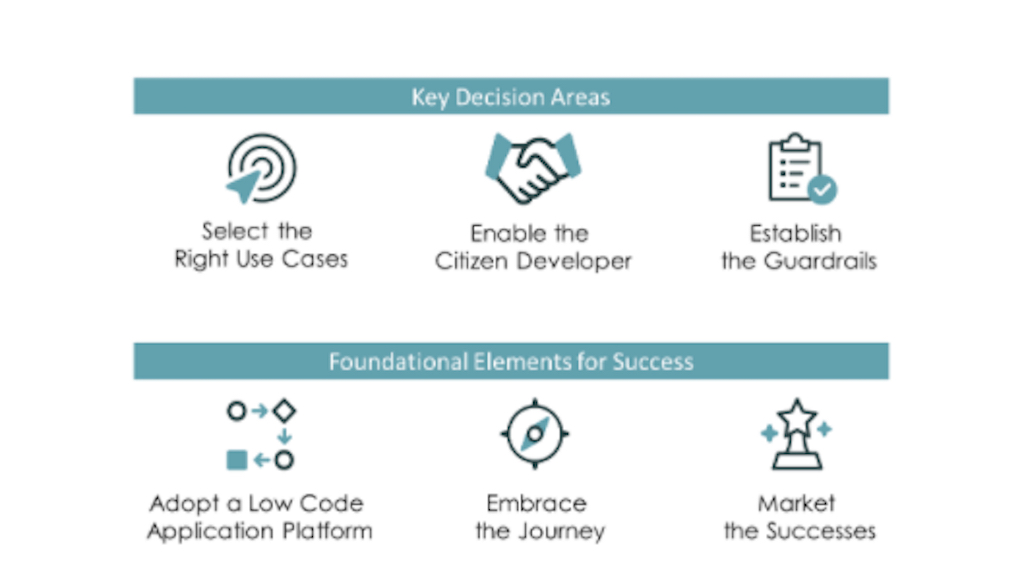
    Now let’s all take a deep breath, pause for a moment, and accept that citizen development is not the panacea for all our digitization needs – nor is it the beginning of application anarchy. A well-executed citizen development program can dramatically improve delivery velocity and business agility if organizations make good decisions in three key areas: 1) selecting the right use cases for citizen development; 2) enabling and empowering our citizen developers; and, 3) establishing citizen development guardrails that protect our organization.

    Before exploring the key decisions, it is important to note a few elements that are consistent across successful citizen development programs:

    • Adopting a Low-Code Application Platform (LCAP) – LCAPs benefit IT developers (both professional and low-code) but are critical to citizen developers. Teaching Java to your lines of business is what’s called a distributed development model – and that’s a whole different article.
    • Embracing the Journey – A citizen development program is a learning process for both the IT organization and the lines of business. Start focused, learn from the experience, adjust the approach and expand the reach.
    • Marketing Success – It is important to raise awareness of the program by telling the company about both the successes and the lessons learned – be candid and clear. People feel good about successful programs and rally around them.

    Selecting the Right Use Cases for Citizen Development

    We want to set up citizen developers, and the citizen developer program, for success, which means matching the business need to the citizen developer skillset.
    We need answer the following questions regarding line of business needs.

    • What business use cases are a good fit for our LCAP?
    • What technical requirements are a good fit for our LCAP? What technical requirements are not?
    • What types of applications in our enterprise are a good fit for citizen development?
    • Are there lines of business / departments that could benefit more than others from empowering citizen developers?
    • Are there specific risk, compliance, security and legal (RSCL) mandates that need to be addressed?
    • Are there other core enterprise systems that need to be considered for certain use cases?
    • Are there legacy technologies and/or is there technical debt that should be targeted?
    • What is the potential return on investment? How quickly can we start achieving that ROI?

    The answers to these questions are not binary. These questions, and others unique to each company, provide a filter to vet – and possibly score – use cases to determine suitability for a citizen development program.

    Just as important as selecting the right use cases is finding the right citizen developers. We need to answer the following questions about any potential citizen developers.

    • Will we have different categories of distributed / citizen developers? Are those categories based on skill level, organization and/or access?
    • Have we identified the aptitude and attitude characteristics of a good citizen developer?
    • How will we recruit and incentivize developers to join the program?
    • What is our value proposition to the citizen developer’s manager? Why would they support allocating some portion of their resource(s) building apps?

    In the early stages of a citizen development program, the most successful programs tend to prioritize the right developer over the right use case. A “high fit” developer delivering a “medium value” use case is a better bet than a “low fit” developer attempting a “high value” use case. Early wins matter.

    In part two of this series, we will explore enabling and empowering our citizen developers. We have now identified the right use cases and the right citizen developers, so let’s set them up for success.


    This post is the first of a three-part series offering real-world insights on delivering business value from citizen development initiatives.

  • ARMO Aims to Simplify Microservices Security

    ARMO Aims to Simplify Microservices Security

    ARMO this week emerged from stealth to launch a platform to secure cloud-native workloads and improve visibility. The ARMO Workload Fabric technology attaches code within the memory invoked by a microservice to enable cybersecurity policies to be applied via a cloud service.

    Company CEO Shauli Rozen said the ARMO Workload Fabric is designed to enable IT organizations to implement a zero-trust architecture more easily within the context of a DevSecOps workflow.

    Fresh from raising $4.5 million in seed funding, Rozen said ARMO’s approach eliminates the need to deploy and manage agent software, container sidecars or runtime application self-protection (RASP) software to enforce security policies across what inevitably will become thousands of microservices distributed across an enterprise IT environment.

    That leaner approach then allows for a centralized management platform that can be deployed on a cloud or on-premises IT environment to apply policies that restrict which microservices can communicate with one another, Rozen said. The approach would ensure that only microservices developed using a continuous integration/continuous delivery (CI/CD) platform are allowed to communicate with other microservices, Rozen said.

    Integration with multiple CI/CD platforms is already provided, added Rozen.

    That approach allows policies to be applied to microservices regardless of how they are constructed, Rozen said. That capability is critical, because developers are building microservices using everything from Python and Java to containers, he said. Many of those microservices are also frequently replaced, Rozen said, which can make updating any associated agent software a significant DevOps challenge. Given all the existing dependencies between microservices, overall application environment security is only as strong as the proverbial weakest link. The ARMO Workload Fabric enables developers to add a small amount of code to implement security policies each time a microservice is rolled out into a production environment.

    As part of an effort to make it simpler for IT organizations to apply those policies, ARMO provides a pre-built set of policies that organizations can immediately apply, in addition to creating their own polices over time, Rozen said. In many cases, IT teams simply don’t have the time or expertise required to build those policies, Rozen added.

    Microservices are being built and deployed at such a breakneck pace that it’s nearly impossible for cybersecurity teams to keep up. The ARMO Workload Fabric provides cybersecurity teams a means to centrally manage security policies that would otherwise be implemented as code by developers. It provides a level of observability for how those cybersecurity policies are being implemented across microservices that typically have a lot of dependencies on one another, Rozen said.

    Most organizations today recognize there is a clear need to shift responsibility for application security further left toward developers. The challenge is finding a practical way to achieve that goal, and in a way that doesn’t adversely impact the rate at which applications are being developed. The key to achieving that goal is finding a way to apply microservice security polices that causes the least amount of friction possible to existing DevOps workflows.

  • The State of Digital Innovation, One Year Into the Pandemic

    The State of Digital Innovation, One Year Into the Pandemic

    It’s obvious COVID–19 accelerated digital reliance for many companies. And it’s no surprise that, according to a recent study, 89% of tech leaders believe digital experiences are critical to addressing new COVID–19 challenges. In this race toward 100% digital business, agile innovation is the new elixir of life — without it, a company may face an early retirement.

    Kong just released their 2021 Digital Innovation Benchmark, which summarizes the tech priorities of 400 IT leaders. The findings stress the importance of rapid digital innovation, open source, microservices architectures, and high quality practices for scaling today’s application ecosystems. Here are the key points technology leaders need to know to remain competitive.

    Innovate or Dissipate

    The urgency to innovate is increasing. According to the survey, 84% of respondents predict a business will go under within six years if they lag behind in digital innovation. Fifty one percent of tech leaders believe their business can only survive three years.

    If digital transformation happens too slowly, it can pose an existential threat. But there are many factors that can hinder faster digital innovation; the complexity of using multiple tech stacks, reliance on legacy IT and lack of automation. Not only are there internal woes, but external danger — 62% of respondents worry about failing to keep up with competitors who innovate faster.

    It seems the urgency has increased over the last year. In last year’s report, just 37% reported they’d be out of business in three years if they didn’t keep pace with digital innovation. That figure rose to a whopping 51% in 2021.

    COVID Amplifies Digital Drive

    Virtually no one is anticipating a decreased IT budget in light of COVID–19. On the contrary, long-term digital transformation efforts are well on target at the majority of institutions, and 75% expect to see an increase in IT/developer budgets over the next 12 months.

    Interestingly, when it comes to securing the digital-only economy, European tech may have a head start. Only 40% of European tech companies have increased their security focus, compared to 51% in the U.S. This could be due to previous investment in security and stricter regulation in European countries.

    In terms of cloud adoption, 40% of tech leaders feel COVID–19 has accelerated their move to the cloud. Nearly 40% say the pandemic has encouraged the use of microservices and cloud native architecture.

    Quality Outweighs Speed

    When gauging what matters most to tech leaders, “improving operational efficiency” is still a top priority. However, this year’s report saw a spike in respondents saying application performance and reliability, as well as application security, were moving up the priority list. Though 3 in 5 (62%) respondents said they are “extremely concerned” about competition from speedier rivals, application stability outweighs the collective drive to innovate.

    These trends are likely indicative of a notable rise in cybercrime. As I’ve covered previously, to respond to emerging threats, DevSecOps practices and new security tooling are shifting left within the development cycle, automating things like vulnerability detection. Simultaneously, roles to increase application integrity, like site reliability engineers, are in high demand.

    New Technologies and Open-Source Thrills

    As mentioned earlier, IT budgets are increasing across the board. When adopting new technologies, companies place the highest emphasis on the tech that increases efficiency. A surge in automation follows a low-code movement gaining steam. Companies consider the following key factors when introducing new tech: reducing deployment risk, increasing collaboration, and increasing development. Ninety five percent of US respondents also listed the “need to integrate with existing tools” as necessary — no surprise in today’s API-driven development landscape.

    Ninety one percent of organizations use open-source software in 2021 — this is up from 82.5% in 2020. Across the board, open-source is intrinsically embedded into most software projects. We see open-source especially used in open databases, infrastructure automation, API design and testing, CI/CD tools, Docker containers, Kubernetes and service mesh. Arguably, modern DevOps would not be possible without such open source initiatives.

    Bring it on, Microservices

    If you haven’t heard of microservices yet, we would be worried. An impressive 87% of survey participants believe that microservices-based applications are the future.

    While that sounds substantial, a path toward 100% distributed microservices architecture has not been mapped within most organizations. In 2021, only 33% of companies have transitioned entirely to a distributed architecture, whereas most (53.5%) adopt a hybrid mix of microservice and monolithic styles.

    “This is strong evidence that microservices have quickly become the de-facto approach for modern application architectures that enable digital innovation,” the report said. Though more development is required, a microservices-centric future seems obvious.

    Within organizations that have already adopted a microservices approach, the average number of microservices in production is 102. And those are primarily to increase security. Ironically, the report also found maintaining security to be the top challenge of deploying a microservices system. Other drivers for microservices adoption include integrating new tech, increasing development speed and boosting flexibility.

    Kubernetes Becomes Ubiquitous

    Kubernetes has clearly emerged as the industry standard orchestration platform. Eighty six percentof all respondents report they now use Kubernetes in production, or plan to within 12 months. This is a massive jump from VMWare’s 2020 report, which put Kubernetes use at 48%.

    However, there are challenges to implementing Kubernetes in practice. Companies cite security, complexity, performance and monitoring as top setbacks when introducing Kubernetes. To say Kubernetes has a steep learning curve may be an understatement, as abstraction layers are introduced to rectify a widening knowledge gap.

    Service Mesh Prickly for Early Installs

    Interestingly, API gateway adoption and container usage, according to the survey, are both 38%. Yet, service mesh adoption is only at 20%. This could underscore the fact that service mesh is still an emerging concept — service mesh experts say the tech isn’t ready for widespread adoption. Or, it could reflect that production use cases are rare (primarily for supporting vast microservices deployments).

    Early service mesh adopters see increased service connectivity and discovery as a top benefit of the technology. This seems logical, as service mesh aims to be a common networking framework. Other common benefits include cost reduction, meeting compliances, zero-trust security in networking and traffic observability.

    Naturally, service mesh isn’t without its thorns. Complexity in deployment and ensuring performance at scale top the list of challenges faced when deploying service mesh, slowing its adoption.

    Hybrid Multicloud

    The current status of multicloud deployment sees a mix of on-premises and multiple cloud providers, with 41% of organizations using multicloud deployment strategies. While cloud adoption rates are increasing, 31% of organizations are still running on-premises servers. The saturation of cloud tooling, and the market validity of Azure and Google Cloud Platform to take on AWS, have influenced a multicloud environment. Cloud expertise is now a hot commodity to navigate multicloud modalities — so much so that some companies have introduced a new role, The Other CFO, or Cloud Economist, to balance the cloud checkbook.

    Riding out the Virtual Wave

    The pandemic has accelerated the move toward digital experiences, and in turn, quickened the pace of enterprise technological evolution across the board. As COVID–19 effects continue, there’s no indication the virtual wave will recede anytime soon.

    To summarize the current state of digital innovation:

    • Rising digital tide: The pace to innovate is rising, and those left below the new-digital-normal water line will drown.
    • IT spend is up: Most companies have increased IT budgets moderately to support new digital norms.
    • Needs for adoption: Desires for automation, speed, security and integration rank high for adopting new tech.
    • Microservices on fire: The report describes “accelerated mainstreaming of microservices.” Microservices, and the tech that supports them, are clearly the future.
    • Kubernetes everywhere: As Kubernetes rises to ubiquity, last-mile efforts center on security and developer usability.
    • Bullish on service mesh: Service mesh sees early production uses, which will likely signal more growth in this area.

    There’s nothing unexpected in these findings; instead, they affirm what most of us already know — digital innovation is going full throttle. Check out the entire 2021 Digital Innovation Benchmark here.

  • Advanced Systems Concepts Inc. Launches First Self-Healing Platform of Its Kind, Simplifying Workload Automation

    New Super REST API Adapter takes ActiveBatch API to the next level Company acquires JSCAPE to enable organizations to automate even more business processes

    Morristown, NJ– January 28, 2021– Advanced Systems Concepts Inc. (ASCI), creators of industry-leading workflow automation software ActiveBatch, today announced that the company will become the first of its kind to deliver an intelligent, self-healing workflow automation platform. The ActiveBatch platform will enable preemptive error detection and proactive troubleshooting so that organizations can ultimately reduce their support tickets to zero. The new, advanced capabilities will build on top of ActiveBatch’s full range of features and functions designed to simplify workload automation and extend the life of systems for companies at all stages of digital transformation. The company also announced the release of its Super REST API Adapter and acquisition of managed file transfer (MFT) leader, JSCAPE.

    The new Self-Healing Platform will recognize issues and report on the user’s environment, telling them what’s working, what’s changing and what’s broken – or what soon will be broken. Ultimately, ActiveBatch will be able to self-update and send proactive, AI-powered fixes so that it all runs seamlessly and support tickets move to zero.

    “There has been so little innovation in the workflow automation space, despite tremendous advances in software and applications. We saw an opportunity to rectify this with incredibly advanced technology that is easy to use and offers immediate value,” said Reed Overfelt, CEO of ASCI. “Trying to integrate, automate and manage systems, applications and services across an organization is unwieldy, and something is always breaking. With our new Self-Healing Platform, users will gain the ability to predict and fix issues before they become problems. We believe this is an absolute gamechanger for our workload automation customers.”

    The new Self-Healing Platform will analyze anonymized customer data, using it to identify and track trends and then proactively deploy fixes to affected customers. It is the only such offering for the workflow automation market, and ASCI will phase its rollout of capabilities over the coming months to bring customers along as they are ready.

    Next Level Super REST API Adaptor Makes Connections Simple

    ASCI has also developed a new Super REST API Adapter, which provides the capability to establish connections to any software or service with an API, efficiently enabling automation for any endpoint. This future-proofs automation by ensuring that companies can reliably connect to any endpoint or technology as their organization grows.

    Designed to accelerate the use of APIs, the intuitive, feature-rich UI includes a variety of helpers to guide users through setup. This includes icons that explain functionality, flags that identify errors and drop-down lists that allow you to quickly select variables and properties.

    The Super REST API Adapter simplifies the authentication process with a list of built-in helpers for commonly used predefined values. DevOps teams can now easily create resilient, reusable API jobs. The Super REST API Adapter comes with everything necessary for rapid deployment, reducing time spent on building connections and resulting in significant cost savings.

    JSCAPE Acquisition Furthers Vision and Extends Reach

    Additionally, ASCI recently acquired JSCAPE, an industry-leading Managed File Transfer (MFT) company, that will enable ASCI to deliver transformational technology to an MFT market that has experienced limited innovation in recent years. JSCAPE’s technology already assists a wide swath of customers, particularly across highly regulated industries such as financial services and trading firms, healthcare and insurance.

    By bringing JSCAPE’s technology under ASCI’s platform, the company can now offer its customers an integrated FTP server, industry-leading MFT functionality and monitoring. This new offering will help customers automate even more of their business processes.

    “We are excited to offer our customers the many workload automation and job scheduling tools that ActiveBatch has,” said JSCAPE CEO Van Glass. “Our MFT solution will be another great tool in ActiveBatch’s industry-leading workload automation software offering.”

    ASCI’s ActiveBatch currently integrates with enterprise IT and business applications across an organization, giving users the ability to bring their entire tech stack under a single pane of glass. It serves as a central automation hub for scheduling and monitoring to make business-critical systems, such as CRM, ERP, supply chain management, work order management, project management and consulting systems, work together seamlessly with minimal human intervention. ActiveBatch currently powers workload automation for global leaders such as Blue Cross Blue Shield, Bosch, Deloitte, Subway and Verizon, removing the integration obstacles that hinder digital transformation.

    To learn more about these latest developments and what ActiveBatch can do, please visit https://www.advsyscon.com/

    About Advanced Systems Concepts, Inc. 

    Advanced Systems Concepts, Inc. (ASCI) is the creator of ActiveBatch software, which helps organizations automate and manage their business and IT processes in a single platform. ASCI enables companies to reduce costs, both by eliminating human error and by allowing them to redeploy resources into more high-value tasks. Learn more at https://www.advsyscon.com/.

  • Open Mainframe Virtual Summit: Adding Value to the Mainframe

    Open Mainframe Virtual Summit: Adding Value to the Mainframe

    While many predicted mainframes would eventually become obsolete, they continue to be prevalent in the corporate world. Mainframes are still in high demand, and the mainframe market is likely to grow over the next few years as business and IT leaders validate its enduring role in their hybrid strategies. Mainframes are rapidly evolving to meet the demands of today’s changing technology and business environments. How can we leverage the mainframe for reliability, availability and security? How does open source fit in with the mission-critical workloads that only a mainframe can drive?

    At the Open Mainframe Virtual Summit, taking place on Feb. 11, top industry leaders will come together to discuss all open source projects and technologies impacting the mainframe.

    Open Mainframe is a free virtual event featuring a conference lobby, presentation theater, expo hall and more. Attendees will be able to interact with sponsors and like-minded individuals who are passionate about the mainframe industry, watch videos and download information.

    Open Mainframe Virtual Summit features an exceptional lineup of industry leaders, including:

    • Abubakar Siddiq Ango, Developer Evangelism Program Manager at GitLab
    • Anna Murray, Senior Product Manager at ASG Technologies
    • Bob Miller, Solution Architect and Legacy Transformation Lead, IBM Alliance at Deloitte Consulting LLP
    • Gatien Dupre, IBM Z DevOps Offering Manager at IBM
    • Girish Wani, Agile Product Owner at Swedbank
    • Kristaps Duburs, Software Engineer at Swedbank
    • Maneesh Goyal, Offering Management Leader at IBM
    • Mark Howell, DevOps Centre of Excellence Lead at Lloyd’s Banking Group
    • Mathieu Dalbin, DevOps Transformation Specialist at IBM
    • Matthew Cousens, IBM Z and LinuxONE Developer Advocate at IBM
    • Michael Bauer, Zowe CLI Squad Leader at Broadcom
    • Mürsel Taşgın, Mainframe Systems Manager at Credit Bureau of Turkey
    • Nathan Cassata, IBM Z DevOps Testing Lead at IBM
    • Patrick Wawrzoszek, Programmer Analyst Advisory at Scotiabank
    • Peter Haumer, Senior Software Engineer, IBM Z DevOps Intelligence at IBM
    • Rajesh Murugan, Software Engineer at Swedbank
    • Rosalind Radcliffe, Distinguished Engineer at IBM
    • Rose Sakach, Zowe Onboarding Leader at Broadcom
    • Seamus Hayes, Software Engineer at Broadcom
    • Terri Cobb, Vice President, Alliances Relationships at Deloitte Consulting LLP
    • Umut Arslan, Unit Manager at Garanti BBVA Technology
    • Vaughn Marshall, Senior Principal Product Manager at Broadcom
    • William Alexander, Senior Software Engineer at IBM

    The breakout sessions will cover a wide range of topics relevant to the open source and mainframe communities—the latest in IBM Z, DevOps, LinuxONE, cloud, analytics, open source and more. Speakers will discuss:

    • The growing usage of mainframe computing
    • How to build and debug mainframe application code
    • The biggest business challenges of mainframe modernization
    • The benefits of using open source tools such as Zowe, Git, Eclipse and VSCode with IBM Wazi Developer and IBM Z Open Editor to deliver continuous integration on IBM Z
    • How IBM Z DevOps testing solutions can improve your testing capabilities and enable your CI/CD pipeline
    • And more

    To check out the full agenda and to register, please visit the Open Mainframe website.